Big landslides on Mars might not require ice

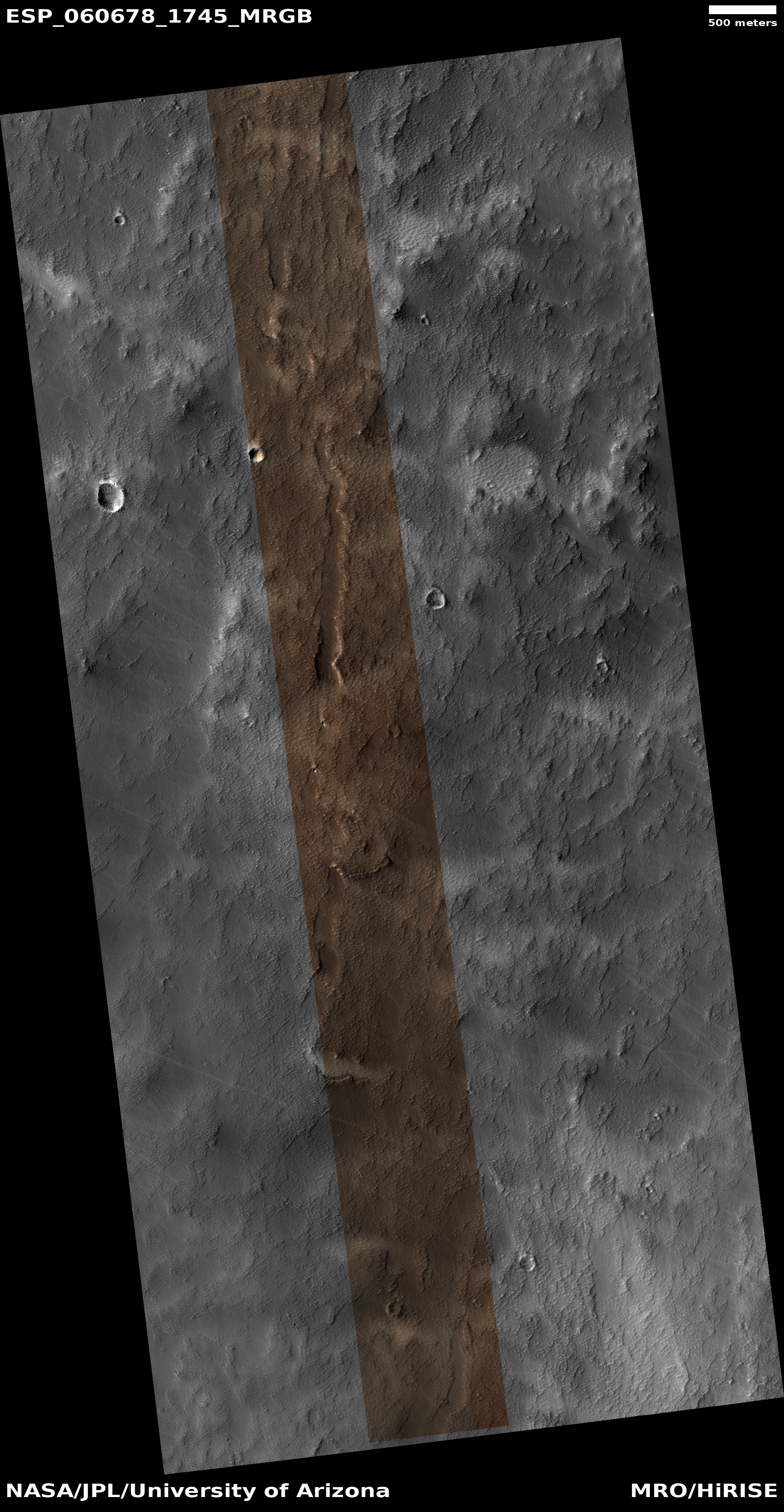
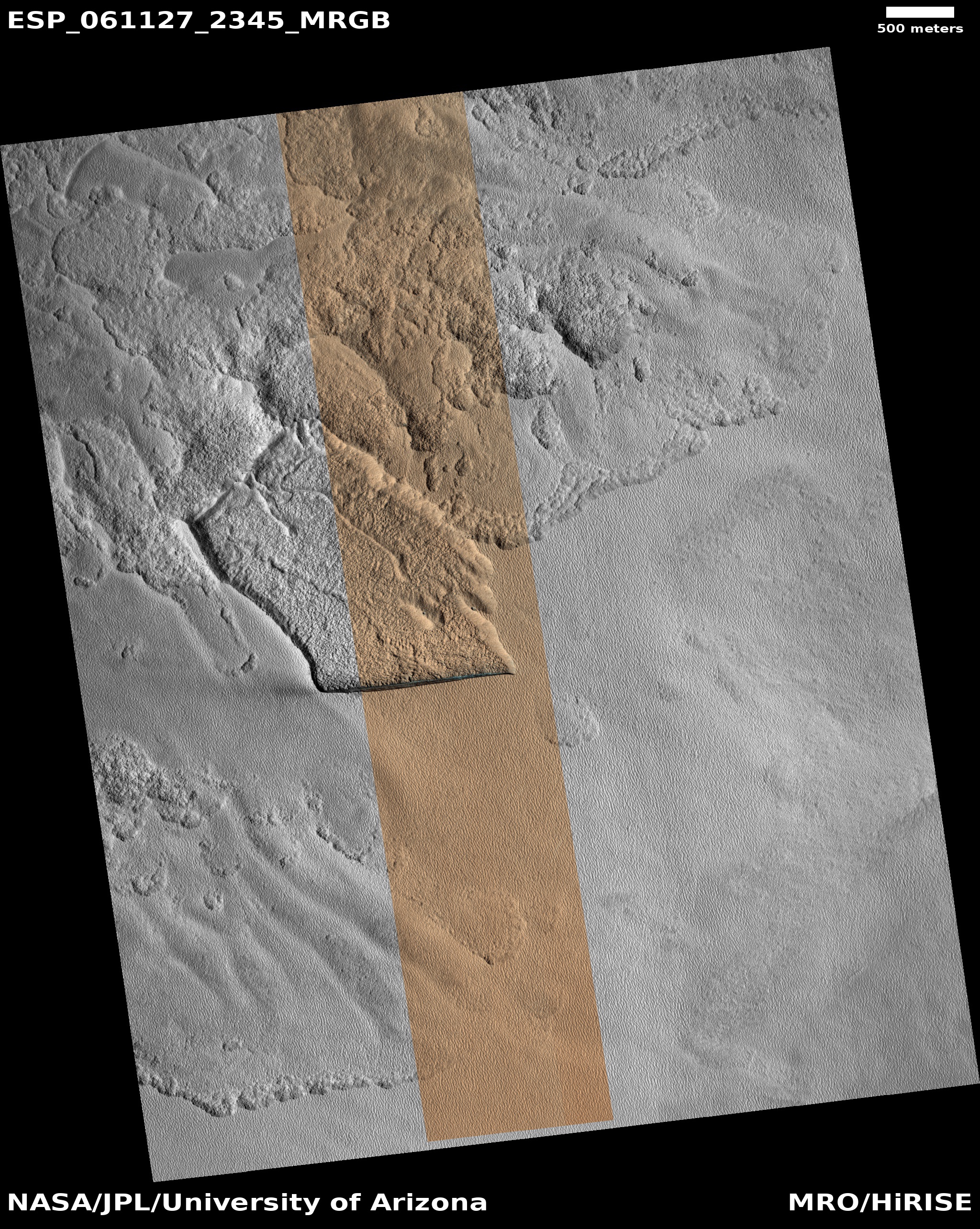
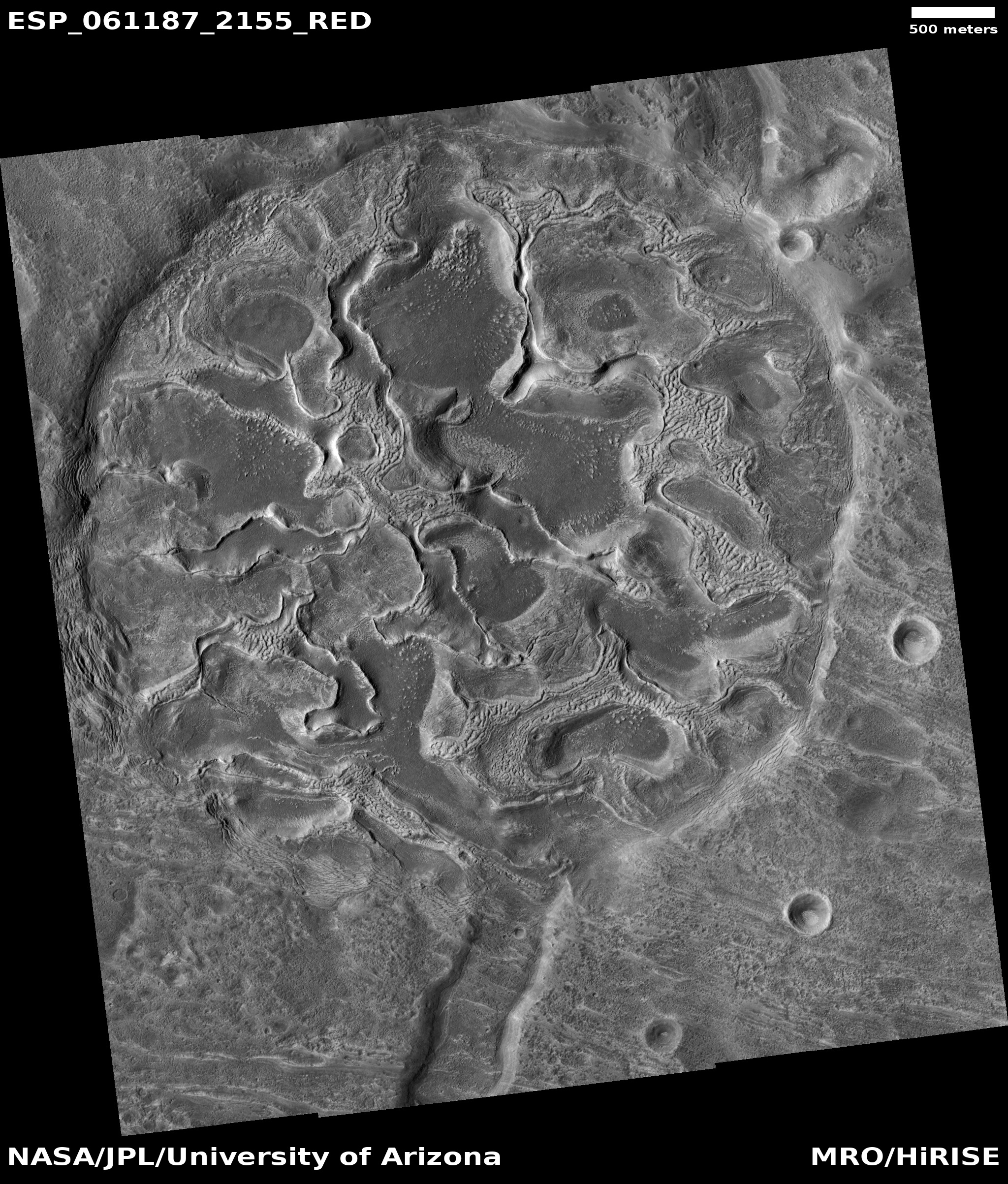
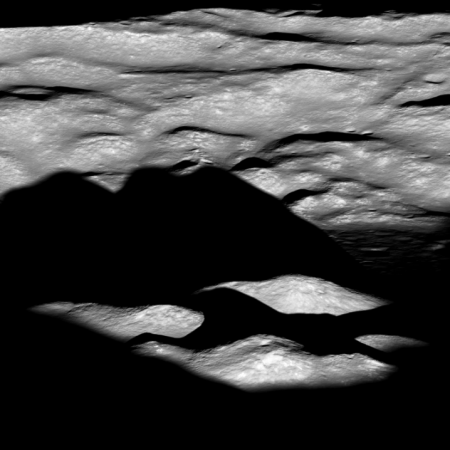
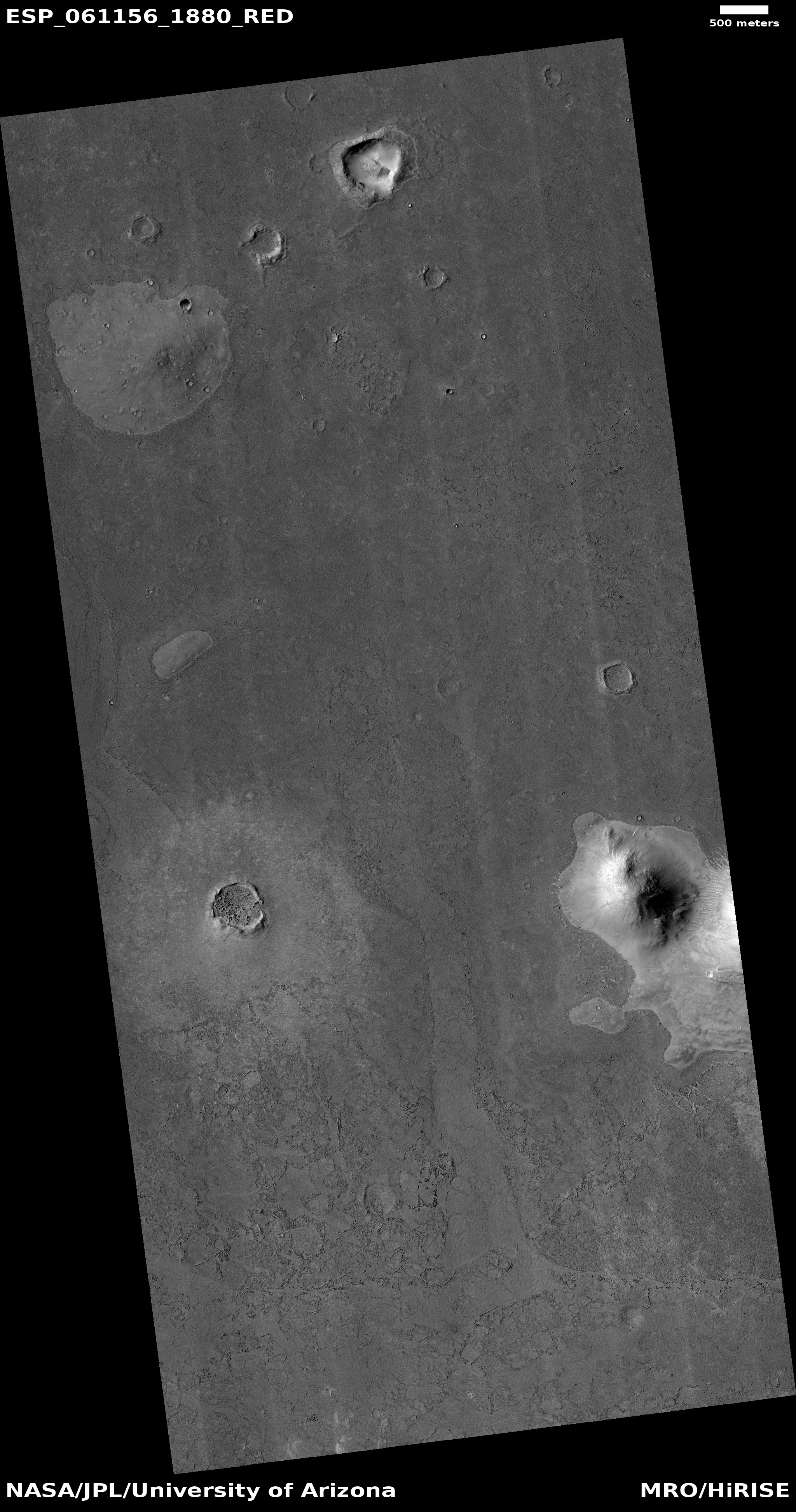
According to a new paper, scientists now think the biggest and longest landslides found on Mars might not require a base of ice on which it could slide such extensive distances.

The findings, published today in Nature Communications, show for the first time that the unique structures on Martian landslides from mountains several kilometres high could have formed at high speeds of up to 360 kilometres per hour due to underlying layers of unstable, fragmented rocks.

This challenges the idea that underlying layers of slippery ice can only explain such long vast ridges, which are found on landslides throughout the Solar System.

First author, PhD student Giulia Magnarini (UCL Earth Sciences), said: “Landslides on Earth, particularly those on top of glaciers, have been studied by scientists as a proxy for those on Mars because they show similarly shaped ridges and furrows, inferring that Martian landslides also depended on an icy substrate. “However, we’ve shown that ice is not a prerequisite for such geological structures on Mars, which can form on rough, rocky surfaces. This helps us better understand the shaping of Martian landscapes and has implications for how landslides form on other planetary bodies including Earth and the Moon.”

The lighter gravity of Mars, about one third of Earth’s, is part of the explanation, though many other factors are involved. Either way, this is one more data point in the evidence that the though geology on Mars might look like what we see on Earth, it is likely very different than we expect, due to the alien nature of Mars itself.
0 comments

Bhabha Crater at dawn

Central peaks of Bhabha Crater at dawn

Cool image time! The Lunar Reconnaissance Orbiter (LRO) science team have released a beautiful oblique image of Bhabha Crater, located on the Moon’s far side, taken just as dawn was breaking over the crater’s central peaks.

The image to the right is a section of that picture, showing the central peaks near the bottom with the western rim of the 50-mile-wide crater at the top. The giant shadows of those central peaks can be seen extending across the floor of the crater and against that western rim. The photograph was taken on August 28, 2019 from an altitude of about 45 miles. The area of the central peaks in daylight is estimated to be about nine miles across.

The LRO science team releases a new press release image about once every two weeks. I suspect that they hoped this release would have shown the location of India’s Vikram lander. As they are as yet unable to find it, they instead provided us this cool image instead.

If you go to the link you can use their viewer to view and explore this very very large image. For example, if you zoom into those central peaks you can actually see small boulders scattered across their rounded tops.

0 comments

Chang’e-4 and Yutu-2 awake for 11th lunar day

Engineers have reactivated both Chang’e-4 and Yutu-2 to begin normal operations on their eleventh lunar day on the far side of the Moon.

As is usual for these reports from the state-run official media in China, the article provides little information. However, this article today from space.com provides an update on the “gel-like” material that Yutu-2 spotted in August.

While gaining the attention of the Yutu 2 team, the material does not appear altogether mysterious, as claimed by Chinese media.

Clive Neal, a lunar scientist at the University of Notre Dame in Indiana, told Space.com that the new image reinforces the previous suggestion that the material is broadly similar in nature to a sample of impact glass found during the Apollo 17 mission in 1972.

…Dan Moriarty, NASA Postdoctoral Program fellow at the Goddard Space Flight Center in Greenbelt, Maryland, has analyzed and processed the image, seeking clues as to its precise nature. While this compressed image lacks a lot of the useful information a raw image would contain, Moriarty said he could gain insights by adjusting parameters. “The shape of the fragments appears fairly similar to other materials in the area. What this tells us is that this material has a similar history as the surrounding material,” Moriarty said. “It was broken up and fractured by impacts on the lunar surface, just like the surrounding soil.

Overall, Yutu-2 has traveled about 950 feet or 290 meters westward from Chang’e-4 since it began roving at the start of the year.

0 comments

InSight’s digging problems reveal the alienness of Mars’ soil

Even as InSight’s mole shaft driller shows signs of working, its difficulties in digging into the Martian soil has revealed how truly alien that soil is from what we normally expect.

[U]nlike typical holes dug here on Earth, the one excavated by InSight’s mole has no lip of dirt around its rim, Hoffman said. “Where did the soil go?” he said. “Basically, it got pounded back into the ground, so it seems like it’s very cohesive, even though it’s very dusty.”

And this is a weird combination of characteristics, strongly suggesting that Mars dirt is alien in more ways than one. “The soil properties are very different than anything we’ve ever seen on Earth, which is already a very interesting result,” Hoffman said.

That the soil of Mars is alien should not be a surprise. The planet’s dusty nature, combined with its light gravity and lack of life, practically guaranteed that the soil would have different and unexpected properties. What is disturbing is that it appears this likelihood was not considered in the slightest by the German engineers who designed the mole for digging.

0 comments

Lava-draped terrain on Mars

Lava surrounding hill and partly covering crater
Click for full image.

Hill surrounded by lava flows
Click for full image.

Cool image time! Continuing this week’s series of lava-related images from Mars (previous posts here, here, and here), today’s post is ironically the first to actually show lava flows.

The two images to the right, reduced and cropped to post here, are sections taken from an uncaptioned picture, titled “Lava-Draped Surface in Cerberus Palus” and found in the most recent download from the high resolution camera on Mars Reconnaissance Orbiter (MRO).

It is obvious why the MRO scientists gave this image this title. The hills in both pictures clearly seem to stand up like islands in a surrounding sea of frozen lava. Older craters, created prior to the lava flow, are partly obscured by the lava flows, their interior floors filled and their rims broken as the lava flooded this region.

Nor are these the only high points captured in the image that this flood of lava inundated. If you look at the full image there is even a low mound where it appears the surrounding lava flood worked its way up the hill’s gently sloping flanks only to freeze just before it completely covered the top of the mound.

The location of this image, shown by the red box in the overview map below and to the right, gives us a hint where the lava came from, though the distances involved to the nearest giant volcano, Elysium Mons, are so large it is likely that this flow is not directly linked to that volcano.
» Read more

0 comments

Sinkholes on Mars

Collapse pit on Mars
Click for full image.

Cool image time! In this week’s exploration of Martian geology that is reminiscent of Earth-based lava geology, today’s image is of a collapse pit in Ceraunius Fossae, the vast region of north-south fissures found to the south of the volcano Alba Mons. The photo to the right, cropped to post here, zooms in on that pit.

The picture was part of the most recent image release from the high resolution camera on Mars Reconnaissance Orbiter (MRO). What makes it especially interesting is the sharpness of its rim, in comparison to the collapse channel to the east. This suggests the pit is younger and fresher than the channel, and happened more recently. This also implies that the voids below the ground in which the surface is sinking are either still there, or due to on-going processes might be still be forming (like caves are on Earth).

For example, if there is underground ice, temperature changes or even thermal heat from the nearby giant volcanoes could melt that underground ice periodically, allowing it to flow and erode the surrounding material, forming voids. That this pit is located at 30 degrees north latitude, just inside the northern hemisphere band where glaciers are found, adds weight to this possibility.

The image below, reduced and rotated so that north is to the left, shows the entire sequence of collapse channels, with the more distinct pit from above in the bottom center of the picture.
» Read more

0 comments

A discontinuous Martian channel

Discontinuous channel near Olympica Fossae
Click for full image.

Close-up of channel

Time for more strange Martian geology! As I said in my post yesterday of a cool image of skylights into what might be a Martian lava tube, this is lava week on Behind the Black. The image at the right, rotated, reduced, and cropped to post here, is similar to yesterday’s photograph, showing a line of sinks and depressions that strongly suggest the existence of an underground lava tube.

The problem with this theory is that at present we really have no idea what flowed here. It could have been lava, but it also could have been mud, water, ice, or some as yet unimagined Martian geological process.

The image was part of the most recent image release from the high resolution camera on Mars Reconnaissance Orbiter (MRO), and was uncaptioned. The top image shows the whole channel as captured by the photograph, with the white box indicating the area covered by the second image, posted here at full resolution.

Though the overall slope of the terrain here is downhill to the west, the grade is relatively shallow, so there is no guarantee that the local slope of this particular channel follows that trend. Downhill could be either to the west or the east.

The reason I favor lava (as an amateur geologist) is the location of this channel, as shown in the overview map below and to the right.
» Read more

0 comments

Skylights into Martian lava tube?

Possibly connected skylights into lava tube
Click for full image.

Close-up of skylights
Click for full image.

Cool image time! In the archive of images from the high resolution camera on Mars Reconnaissance Orbiter (MRO) I came across the uncaptioned image on the right, dubbed “Possibly Connected Lava Tube Skylight Pair in Tharsis Region.”

The top image, cropped and reduced to post here, is a wide view, showing a narrow depression oriented in a north-south direction. Downhill is to the north, with the caldera of the giant volcano Arsia Mons to the south. The white box indicates the area covered by the bottom image, cropped and expanded to post here. Within this close-up are two dark spots, each about 150 feet across.

The two dark spots surely look like small pit openings. Their alignment with the north-south depression strongly suggests that an underground lava tube is below. That this depression is also aligned with the downhill slope further reinforces this supposition.

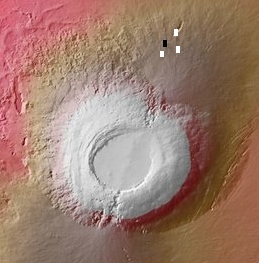
The depression itself also aligns with the gigantic fault that runs from the northeast to the southwest through all three of the giant Tharsis Bulge volcanoes. Arsia Mons is the southernmost of the three. It is also where that fault is most clearly expressed by two dramatic breaks in the volcano’s rim in the northeast and southwest, as seen in the overview image below. Scientists have taken of lot of images of these breaks in an effort to better understand the geology and how it fits in with the formation of the volcanoes.

Overview of Arsia Mons

However, a review of the entire image archive of MRO’s high resolution camera shows that scientists have taken very few close-up images in this region. The black box in the overview map on the right is the location of this image. As of now, only three other high resolution images, as indicated by the white boxes, have been taken by MRO of this part of the volcano’s north slope.

That the skylights and depression align with this giant fault is not evidence that this supposed lava tube is linked to that fault. Lava will flow down the mountain’s slopes, fault or no fault. At the same time, the fault’s existence is also going to encourage north-south cracks and fissures, which in turn could have served as a convenient flow route for the lava. Without a closer look, on site, it is hard to know one way or the other..

I’ve located a few more lava related cool images in the MRO archive, so I’m going to make this week lava week on Behind the Black. Stay tuned!

1 comment

Ice! Ice! Everywhere on Mars ice!

Ice scarp in Milankovic Crater
Click for full image.

In January 2018 scientists announced the discovery of exposed ice in a number scarp cliff faces found in the high-mid-latitudes of Mars.

These scarps, which have so far been found in one southern 50-55 degree latitude strip and in one crater, Milankovic, at the same latitude in the north, are important because they are one of the first places on Mars in its lower latitudes where we have found ice actually exposed and visible, not buried like the many buried glaciers very near the surface found in the 30 to 60 degree northern and southern latitude bands.

Since that press announcement, scientists have been monitoring these sites for changes, as well as expanding their survey to see if they can locate more of these scarps.

Overview map

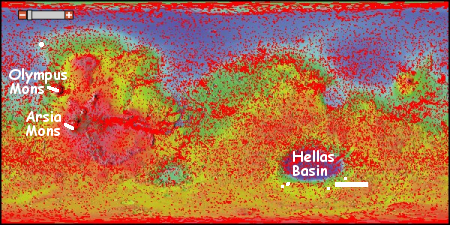
My previous posts on this subject were mostly focused on that southern strip near Hellas Basin, as shown on the map on the right. In reviewing the most recent image download from the high resolution camera on Mars Reconnaissance Orbiter (MRO), I noticed that the only new images of ice scarps were taken in the northern location, in Milankovic Crater, as indicated by the white dot north of Olympus Mons. The first image above shows the north-facing scarp of one of these images, cropped to focus in on the color section where, if you look close, you will see a strip of blue across the base of the scarp. That’s the ice layer, exposed as the scarp sublimates away over time from the north to the south.

over view of all MRO images taken so far in Milankovic Crater

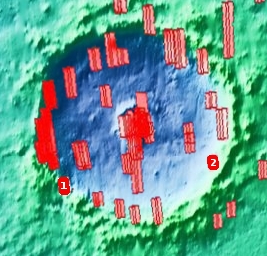
This scarp, labeled #2 on the overview map of Milankovic Crater on the right, is located inside the crater’s eastern rim. The second image, posted below and labeled #1 on the overview map, shows a wider area of several ice scarps located on the inside of the crater’s southwestern rim.

The red boxes in the overview map indicate all the images taken by MRO inside this crater. If you go to the camera’s archive and focus in on Milankovic Crater at 54.5 degrees north latitude and 213.3 degrees longitude, you can then click on each red box to see the high resolution image. In practically every image along the crater’s inside rim can be found numerous scarps.
» Read more

0 comments

Swirls and layers in Martian depression

Close-up on swirls and layers

Context of depressions in Columbus Crater
Click for full resolution image.

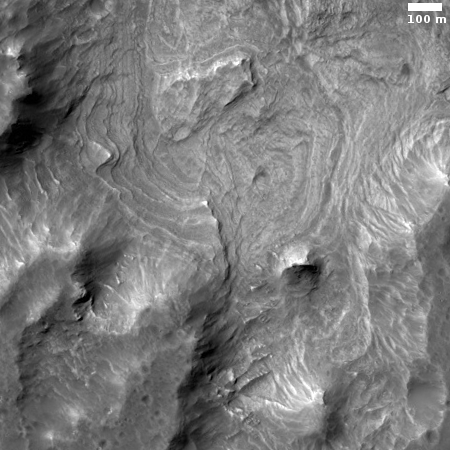
Cool image time! The southern highlands of Mars is littered with numerous craters, making it look from a distance not unlike the Moon. A closer inspection of each crater and feature, however has consistently revealed a much more complex history than seen on the Moon, with the origins of many features often difficult to explain.

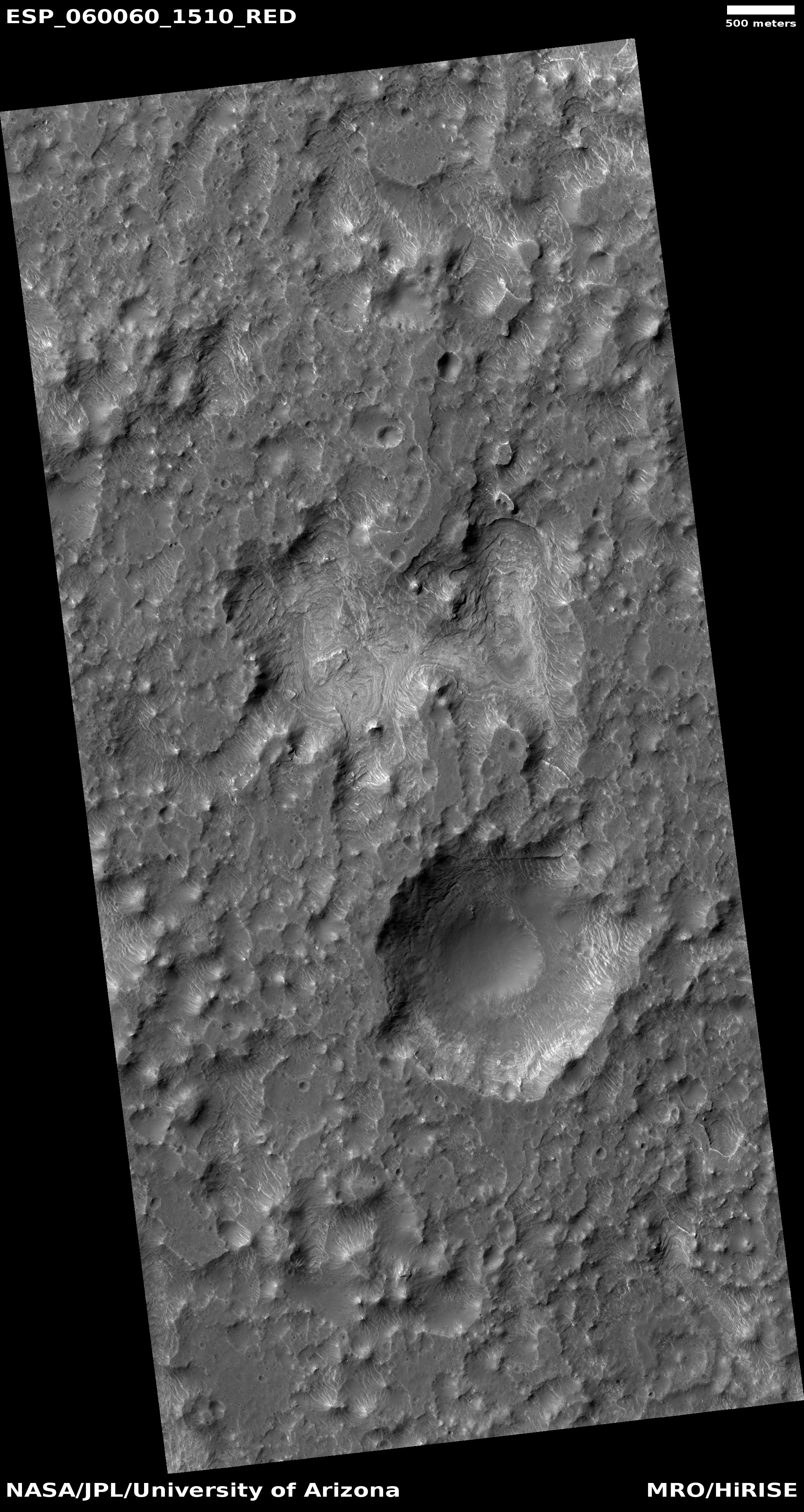
The two images on the right, rotated, cropped, and reduced to post here, shows one such feature in the floor of one southern highlands crater, dubbed Columbus Crater. The top image is a close-up of the area shown by the box in the bottom image.

The uncaptioned full photograph was taken on May 20, 2019 by the high resolution camera on Mars Reconnaissance Orbiter (MRO) and was simply titled “Depression in Columbus Crater.” Since the photo included two large depressions, as shown in the wider view in the bottom image, I’m not sure which depression this title refers. In both cases the features do not appear to be impact craters. The top depression is far too irregular, while both do not have the upraised rims that are found on most impact craters.

I have zoomed into the top depression because of its many swirls and layers. On Earth such terrain is usually caused by either water or wind erosion, slowly carving a smooth path across multiple geological layers. Here, there is no obvious evidence of any flows in any direction. Something ate out the material in this depression, exposing the many layers, but what is not clear.

The lower depression reminds me of sinkholes on Earth, where the ground is subsiding into a void below ground The same process could have also formed the top depression.

The surrounding terrain is equally baffling, resembling the eroded surface of an ice block that has been sprayed with warm water. In fact, the entire floor of Columbus Crater appears to have intrigued planetary scientists, as they have requested a lot of images of it from MRO. So far they do not have enough of these images to produce a full map. Since the terrain appears to change drastically over short distances, it is therefore hard to fit the geology of each image together. The overall context is missing.

When I first saw this image I tried to reach the scientist who requested it in the hope he might provide me a more nuanced explanation of what we see here, but despite repeated requests he never responded. Therefore let me propose one theory, based on my limited knowledge of Martian geology.
» Read more

1 comment

The drying out of Mars

Edge of wash
The Murray formation as seen in 2017

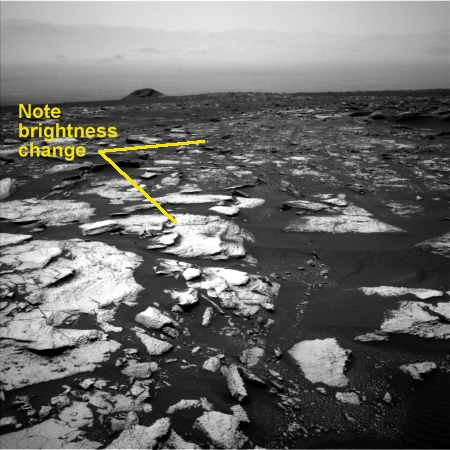
A new paper based on data gathered by the rover Curiosity in 2017 when it was lower on the slopes of Mount Sharp, as well as data obtained more recently at higher elevations, has confirmed that the past Martian environment of Gale Crater was wetter, and that deeper lakes formed lower down, as one would expect.

In 2017 Curiosity was traveling through a geological layer dubbed the Murray formation. It has since climbed upward through the hematite formation forming a ridge the scientists dubbed Vera Rubin Ridge to reach the clay formation, where the rover presently sits. Above it lies the sulfate-bearing unit, where the terrain begins to be get steeper with many very dramatic geological formations.

Looking across the entirety of Curiosity’s journey, which began in 2012, the science team sees a cycle of wet to dry across long timescales on Mars. “As we climb Mount Sharp, we see an overall trend from a wet landscape to a drier one,” said Curiosity Project Scientist Ashwin Vasavada of NASA’s Jet Propulsion Laboratory in Pasadena, California. JPL leads the Mars Science Laboratory mission that Curiosity is a part of. “But that trend didn’t necessarily occur in a linear fashion. More likely, it was messy, including drier periods, like what we’re seeing at Sutton Island, followed by wetter periods, like what we’re seeing in the ‘clay-bearing unit’ that Curiosity is exploring today.”

Up until now, the rover has encountered lots of flat sediment layers that had been gently deposited at the bottom of a lake [the Murray Formation]. Team member Chris Fedo, who specializes in the study of sedimentary layers at the University of Tennessee, noted that Curiosity is currently running across large rock structures [Vera Rubin Ridge and the clay formation] that could have formed only in a higher-energy environment such as a windswept area or flowing streams.

Wind or flowing water piles sediment into layers that gradually incline. When they harden into rock, they become large structures similar to “Teal Ridge,” which Curiosity investigated this past summer [in the clay formation]. “Finding inclined layers represents a major change, where the landscape isn’t completely underwater anymore,” said Fedo. “We may have left the era of deep lakes behind.”

Curiosity has already spied more inclined layers in the distant sulfate-bearing unit. The science team plans to drive there in the next couple years and investigate its many rock structures. If they formed in drier conditions that persisted for a long period, that might mean that the clay-bearing unit represents an in-between stage – a gateway to a different era in Gale Crater’s watery history.

None of these results are really surprising. You would expect lakes in the flatter lower elevations and high-energy streams and flows in the steeper higher elevations. Confirming this geology however is a big deal, especially because they are beginning to map out in detail the nature of these geological processes on Mars, an alien world with a different make-up and gravity from Earth.

Below the fold is the Curiosity science teams overall map, released in May 2019, showing the rover’s future route up to that sulfate unit, with additional annotations by me and reduced to post here.
» Read more

0 comments

Weird glacial features in Martian crater

weird glacial feature in crater on Mars
Click for full image.

Cool image time! In reviewing today’s October release of new images from the high resolution camera of Mars Reconnaissance Orbiter (MRO), I came across the strange geology shown in the image to the right, rotated, cropped, and reduced to post here.

The uncaptioned image calls these “glacial features within crater.” The crater is located at 35 degrees north latitude in Arabia Terra, one of the more extensive regions of the transition zone between the northern lowlands and the southern highlands. It is also located within the northern band from 30 to 60 degrees latitude where most of the buried Martian glaciers are found.

The most abundant type of buried glaciers are called concentric crater fill (CCF) because they are found inside craters, and often show decay in a concentric manner. This weird feature likely falls into that category, though I would hardly call these glacier features concentric.

I’m not even sure if this is an impact crater. If it is, its rim has been heavily obscured, making it look instead like an irregular depression with one outlet to the south. In fact, I suspect it is possibly one of the lakes that scientists believe pepper this part of Arabia Terra and might have contained liquid water two to three billion years ago. That water would have later frozen, and possibly become covered by dust and debris to protect it.

According to present theories, Mars is presently in a period where its mid-latitude glaciers are shrinking, the water sublimating away and being transported back to its poles. The weird formations here suggest this process. Imagine what happens when you spray warm water on a big block of ice. It dissolves, but randomly to form weird shapes.

In this case the glacier is shrinking randomly where the ice has gotten exposed. In the thin Martian atmosphere, it transitions directly from a solid to a gas, sublimating into the atmosphere to leave these inexplicable shapes.

2 comments
1 120 121 122 123 124 157