Fourth flight of Ingenuity set for today; shifting to operational phase

Ingenuity close-up taken by Perseverance April 28th

Even as the Ingenuity engineering team will attempt a fourth flight of Ingenuity, JPL announced today that they and NASA have decided to now shift to operational flights, attempting to duplicate the kind of scouting missions that such helicopters will do on future rovers.

The second link takes you to the live stream of the press conference. The press release is here.

Essentially, they will send Ingenuity on a series of scouting missions after this fourth flight, extending its 30 day test program another 30 days. Its engineers will be working with the Perseverance science team to go where those scientists want to send it. After the fourth and fifth test flights they will fly Ingenuity only periodically, separated by weeks, and send it to scout places Perseverance can’t reach, and have it land at new sites that Perseverance scouted out as it travels.

They have decided to do this because they want to spend more time in this area on the floor of Jezero Crater, for several reasons. First, they are still testing the rover to get it to full working operations. Second, they want to obtain some samples for future pickup at this location. Third, they want to spend an extensive amount of time exploring the floor up to a mile south of their present location.

Finally, the relatively flat terrain is perfect for testing and actually using the helicopter as a scout.

Though the extension is for 30 days, and though the helicopter was not built for long term survival, there is no reason it cannot continue indefinitely until something finally breaks.

Right now they are awaiting the data from the fourth flight, which will arrive at 1:39 pm (Eastern) and will be used to determine what the fifth flight will do, probably a week from now.

1 comment

The crack that splits the giant volcanoes on Mars

Source of Arsia Mons rille
Click for full image.

Cool image time! In the April download of new images from the high resolution camera on Mars Reconnaissance Orbiter (MRO) was the photo to the right, taken on February 23, 2021 and cropped and reduced to post here, of what was labeled as “Source Region of Possible Rille on South Flank of Arsia Mons.”

Arsia Mons is the southernmost of the string of three giant volcanoes that sit between Mars’ biggest volcano to the west, Olympus Mons, and Mars’ biggest canyon to the east, Valles Marineris. This depression is on the mountain’s lower southern flank, and likely shows an ancient resurgence point where lava once flowed out from beneath the ground to form a rill meandering to the southwest. Today there is no visible resurgence. The floor of the depression appears to be filled with sand and dust, with the surrounding slopes spotted with scattered boulders.

What makes this particular image more interesting is how, when we take a very wide view, it reveals one of the most dramatic geological features on Mars, the 3,500 mile-long crack that caused these three volcanoes, and is actually not obvious unless you know what to look for.

So we need to zoom out. Let us first begin with a mosaic of three wider MRO context camera images, showing the entire rille and the immediately surrounding terrain.
» Read more

4 comments

Twisted taffy in the basement of Mars

Taffy on Mars
Click for full image.

Cool image time! The photo to the right, taken on March 7, 2021 by the high resolution camera on Mars Reconnaissance Orbiter (MRO) and cropped and reduced to post here, shows us an example of one of Mars’ strangest and most puzzling geological features, dubbed banded or “taffy-pull” terrain by scientists.

Taffy-pull terrain has so far only been found within Hellas Basin, Mars’ deepest impact basin and what I like to call the basement of Mars. Because of the lower crater count in this terrain scientists consider it relatively young, no more than 3 billion years old, according to this 2014 paper, which also notes

The apparent sensitivity to local topography and preference for concentrating in localized depressions is compatible with deformation as a viscous fluid.

At the moment what that viscous fluid was remains a matter of debate. Many theories propose that ice and water acting in conjunction with salt caused their formation, similar to salt domes seen on Earth. Other propose that the terrain formed from some kind of volcanic or impact melt process.

Almost all of the taffy terrain on Mars has been found in the deepest parts of Hellas Basin in a curved trough along its western interior, as shown by the light blue areas in the overview map below.
» Read more

0 comments

Martian pit on top of Martian dome

Dome with pit
Click for full image.

Cool image time! The photo to the right, cropped and reduced to post here, was taken on March 7, 2021 by the high resolution camera on Mars Reconnaissance Orbiter (MRO) and was simply labeled “Pit on Top of Dome in Promethei Terra.”

The cropped section to the right shows one of two such pits visible on the entire image. Promethei Terra is a large 2,000 mile long cratered region due east from Hellas Basin, the deepest large region on Mars.

What caused these pits? The known facts provide clues, but do not really solve the mystery.

First, this image is located in the southern cratered highlands at 45 degrees south latitude. Thus, it is not surprising that it resembles similar terrain in the northern lowlands that suggests an ice layer very close to the surface.
» Read more

0 comments

Study: increase in seasonal Martian streaks after 2018 global dust storm suggests dust not water is their cause

Map of Mars showing location of new linneae after 2018 global dust storm
Click for full image.

The uncertainty of science: A just-published survey of Mars following the 2018 global dust storm found that there was a significant increase in the seasonal dark streaks that scientists call recurring slope lineae, providing more evidence that these streaks are not caused by some form of water seepage but instead are related to some dry process.

The map to the right is figure 2 from that paper. The white dots show the candidate lineae that appeared following the 2018 global dust storm. About half were new streaks, not seen previously.

From the paper’s conclusion:
» Read more

2 comments

Polygons and an inexplicable depression in ancient Martian crater floor

Polygons and an inexplicable depression in ancient Martian crater
Click for full image.

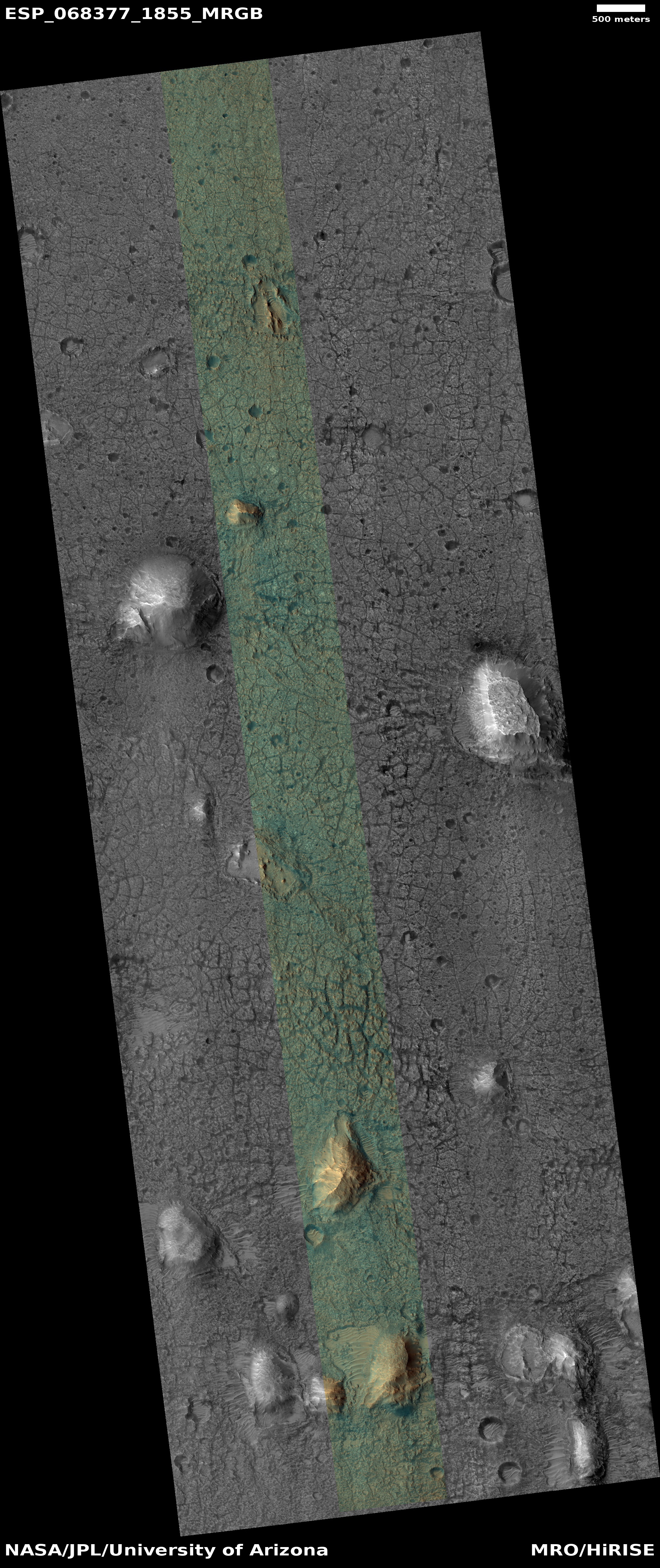
Cool image time! The photo to the right, cropped to post here, was taken on February 26, 2021 by the high resolution camera on Mars Reconnaissance Orbiter (MRO) of a small section of the floor of 85-mile-wide Galilaei Crater.

The main focus of the image is the polygonal cracks that cover the flat low areas of the crater floor, interspersed randomly by small mesas and shallow irregular depressions. The depression in this particular image is especially intriguing. It to me falls into my “What the heck?!” category, for I can’t imagine why among this terrain of polygons and pointed mesas there should suddenly be an irregularly shaped flat depression with a completely smooth floor that has no cracks at all.

The polygons are less puzzling. Galilaei Crater is very old, its impact thought to have occurred about 4 billion years ago. Though it sits at 5 degrees north latitude, practically on the Martian equator and thus in what is now Mars’ most arid region, scientists believe that once there was a lot of liquid surface water here. The overview map below illustrates this.
» Read more

8 comments

Gale Crater’s small mesas were formed by wind, not liquid water

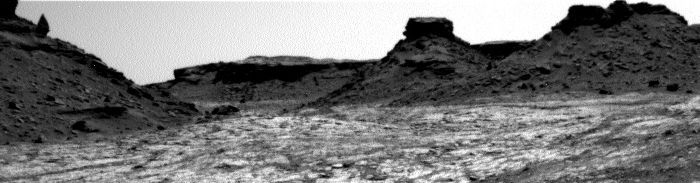
Route through Murray Buttes
The Murray Buttes. Click to see August 11, 2016 post.

The uncertainty of science: Though Curiosity has found apparent evidence of past liquid water during its early travels on the floor of Gale Crater, scientists have now concluded that the first small mesas and buttes it traveled past back in 2016, dubbed the Murray Buttes, were not formed by the flow of liquid water but by wind reshaping ancient sand dunes. From the press release:
» Read more

2 comments

Bumps and holes in the Martian mid-latitudes

Bumps and holes in the Martian mid-latitudes
Click for full image.

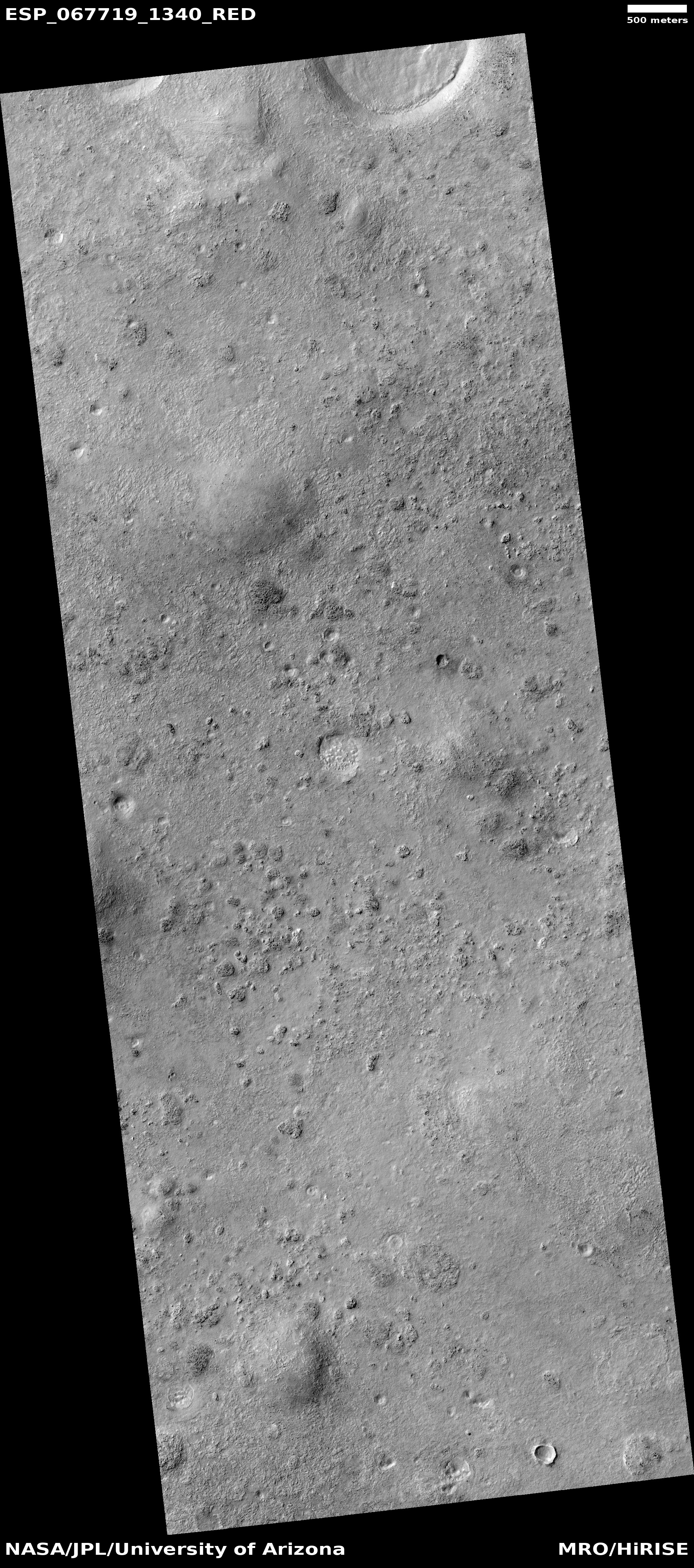
Today’s cool image to the right, taken on January 6, 2021 by the high resolution camera on Mars Reconnaissance Orbiter (MRO) and cropped and reduced to post here, focuses on what appears to be a volcanic bulge on the southeastern edge of the great Tharsis Bulge, home to Mars’ biggest volcanoes.

The terrain gives the appearance of hard and rough lava field, ancient and significantly scoured with time. The bumps and mounds suggest nodules that remained as the surrounding softer material eroded away. The holes suggest impact craters, but their relatively few number suggest that this ground was laid down in more recent volcanic events after the late heavy bombardment that occurred in the early solar system about 4 billion years ago. Since it is thought that the big Martian volcanoes stopped being active about a billion years ago, this scenario seems to fit.

However, the terrain also has hints of possible glacial features, as seen in the large crater-like depression in the image’s center. Below is a zoom in to that crater to highlight the flowlike features in its southern interior.
» Read more

1 comment

Glacial layers in a northern crater on Mars

Crater filled with many layered glacial features
Click for full image.

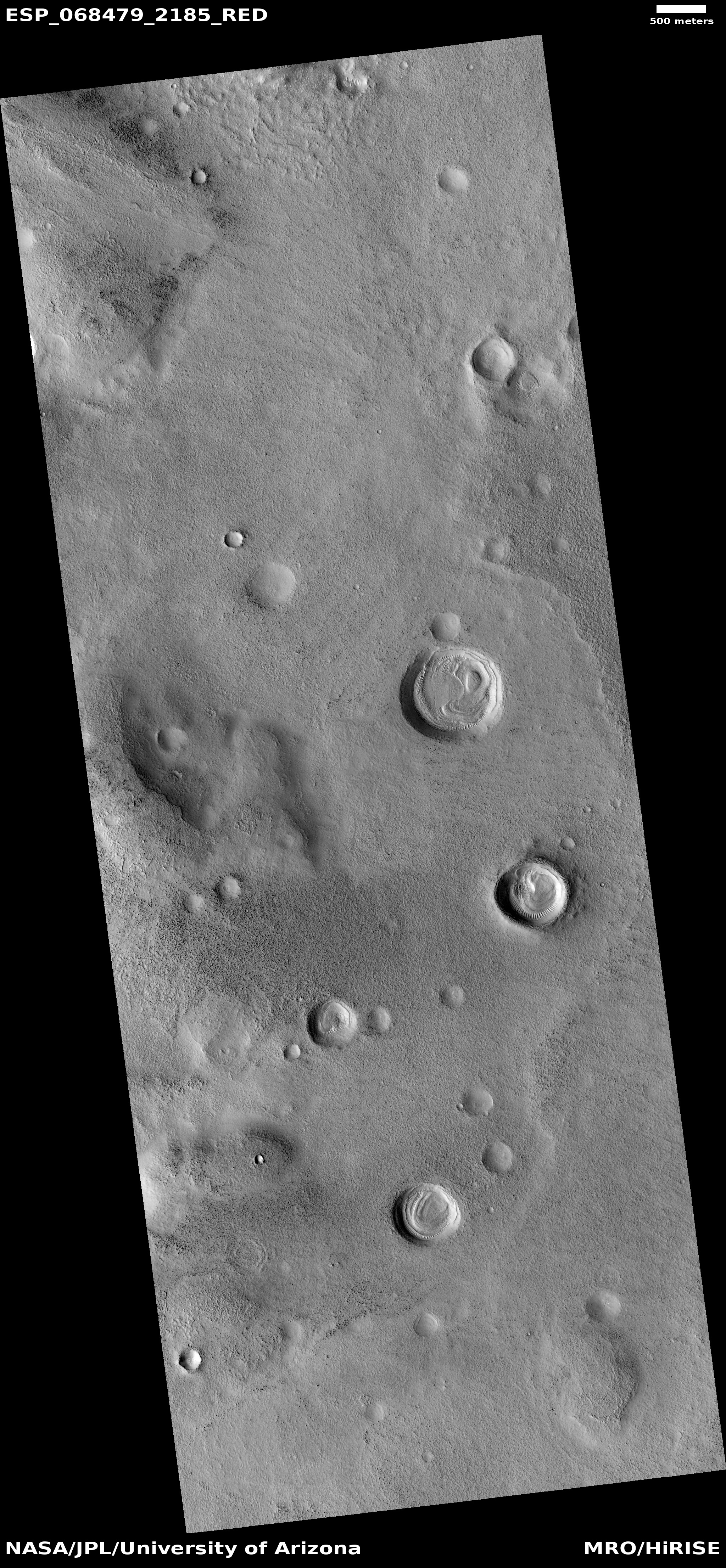
Cool image time! The photo to the right, cropped to post here, was taken by the high resolution camera on Mars Reconnaissance Orbiter on March 6, 2021, and shows a mid-latitude crater in the northern lowland plains of Mars with what appear to be layered glacial features filling its interior.

The theory that scientists presently favor for explaining many of the features we see on Mars is based on many climate cycles caused by the wide swings the planet routinely experiences in its obliquity, or rotational tilt. When that tilt is high, more than 45 degrees, the mid-latitudes are colder than the poles, and water ice sublimates southward to those mid-latitudes to fall as snow and cause active glaciers to form. When that obliquity is low, less than 20 degrees, the mid-latitudes are warmer than the poles and that ice then migrates back north.

Such cycles, which are believed to have occurred many thousands of times in the last few million years, will place many layers on the ground in both the mid-latitudes and at the poles. The layers in this crater hint at this.

The overview map below gives some further context.
» Read more

0 comments

Spring arrives on the northern polar cap of Mars

Buzzell dunes and pedestal crater near the Martian north polar ice cap
Click for full image.

Cool image time! It is now spring in the northern hemisphere of Mars, and the first bits of sunlight are finally reaching its north polar ice cap. During the winter, as happens each Martian year, that polar cap of water ice gets covered by a thin mantle of dry ice no more than six feet thick. Moreover, this mantle doesn’t just cover the ice cap, it extends south as far as about 60 degrees latitude, covering the giant sea of dunes that surrounds the ice cap.

When spring comes that mantle begins sublimate away, with its base first turning to gas. When the pressure builds up enough, the gas breaks out through the frozen mantle’s weakest points, usually the crest or base of dunes or ridges, leaving behind a dark splotch caused by the material thrown up from below that contrasts with the bright translucent dry ice mantle.

Each year for the past decade scientists have been using the high resolution camera on Mars Reconnaissance Orbiter (MRO) to monitor this sublimation process. The photo above, taken on February 24, 2021 and cropped, enlarged, and brightened to post here, marks the start of this year’s monitoring program. Dubbed informally “Buzzell” by Candice Hansen of the Planetary Science Institute in Arizona, it shows dunes with a round pedestal crater just right of center. Though almost everything when this picture was taken is still covered by that dry ice mantle, in the lower left is a single splotch, the first breakout of CO2 gas that marks the beginning of the annual disappearance of this dry ice.

Last Martian year I repeatedly posted images of Buzzell to illustrate this annual process. The second image below was taken on April 4, 2019, at about the same comparable time in spring.
» Read more

0 comments

Evidence of glaciers in the Martian equatorial regions?

Equatorial crater with glacial features?

Cool image time! The photo to the right, cropped and reduced to post here, was taken on February 2, 2021 by the high resolution camera on Mars Reconnaissance Orbiter (MRO) and was labeled as “Exhumed Craters Exhibiting Concentric Fill”.

The term “Concentric Fill” is used by planetary scientists to mark glacial-type features frequently found inside craters at latitudes greater than 30 degrees latitude. This crater however is at 22 degrees north latitude, too close normally to the equator to expect a buried glacier inside it. Any ice at such a latitude is expected to be underground and well protected. A debris covered glacier would likely sublimate away, which I think is why the scientists labeled this “exhumed.” Though there are the concentric features near its inside rim as well as covered by the sand dunes on the crater’s floor, they are assuming this is only evidence of past ice, no longer there. This assumption is strengthened by the splattered but eroded nature of the surrounding terrain. Such splats are typical of high latitude impacts in regions with ample buried ice. The eroded nature of this splat however suggests it is very old and has likely lost its ice.

Then again, this is an assumption.
» Read more

1 comment

A lonely dry lava spring on Mars

A lonely dry lava spring on Mars
Click for full image.

Today’s cool image from Mars takes us to the southern flank of the giant volcano Pavonis Mons. The photo to the right, rotated, cropped, and reduced to post here, shows what appears to be a volcanic vent from more than a billion years ago when it is believed Pavonis was actively erupting. The picture was taken on March 2, 2021 by the high resolution camera on Mars Reconnaissance Orbiter (MRO). The grade is mostly downhill to the east and south east.

It is very possible that this is the resurgence of a lava tube, the point where the underground flow either emerged to the surface or got so close to the surface that the ceiling was thin enough to later collapse, creating this depression. No pits or skylights are visible in this high resolution picture, however, so whether there is an underground lava tube here is not known, an unknown that is amplified by the wider MRO context camera image below.
» Read more

0 comments
1 95 96 97 98 99 157