The start of avalanche season at Mars’ north pole
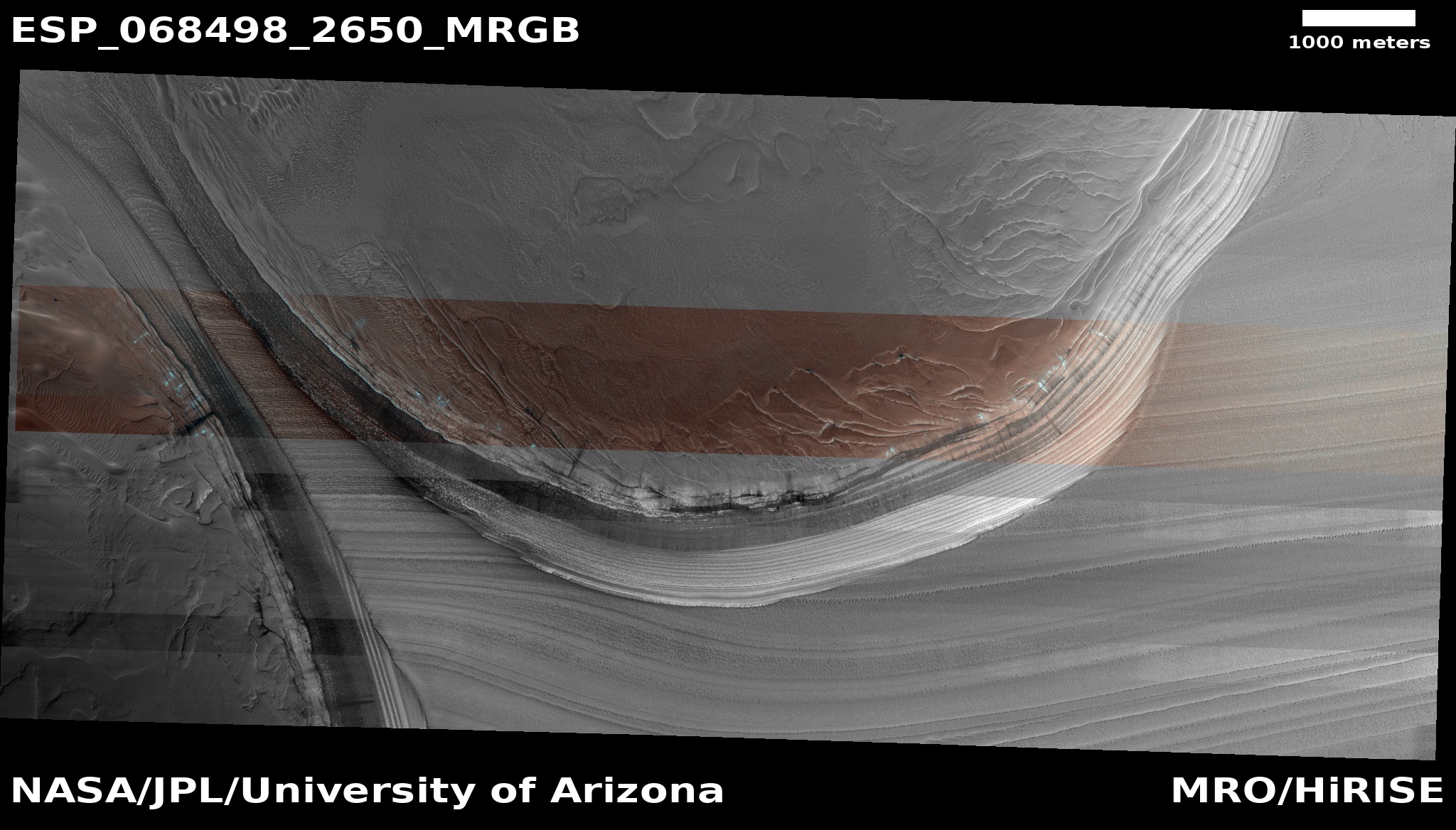
A narrow ridge with avalanches
Click for full image.

Every spring for the last seven Martian years scientists have eagerly aimed the high resolution camera on Mars Reconnaissance Orbiter (MRO) at the steep 1,500 to 3,000 foot high scarp at the edge of northern polar ice cap in order to capture images of what is Mars’s most spectacular annual event, the occurrence of tens of thousands springtime avalanches along that scarp.

Well, spring has returned to the northern hemisphere on Mars, and the scientists have begun another monitoring campaign. The photo to the right, cropped to post here, was taken on March 7, 2021 by MRO. It shows a particularly dramatic part of that scarp, a place where the scarp separates two curved alcoves and is thus narrowed down to a ridge about 1,000 feet high.

The nose of the ridge is sloping downward to the northwest, so the horizontal bands on its crest are actually evidence of older and older layers exposed as the elevation drops. The blue and black markings on the left slope are likely evidence of this season’s first avalanches, or might even be avalanches occurring as the picture was snapped! As explained to me by Shane Byrne of the Lunar and Planetary Lab University of Arizona during the last Martian avalanche season,

On Mars half of the images we take in the right season contain an avalanche. There’s one image that has four avalanches going off simultaneously at different parts of the scarp. There must be hundreds to thousands of these events each day.”

The overview map below shows the location of this picture, as well as all the other places the scientists have routinely monitored in the fourteen-plus Earth years since MRO reached Mars orbit.
» Read more
0 comments

Lava flooded mountains on Mars

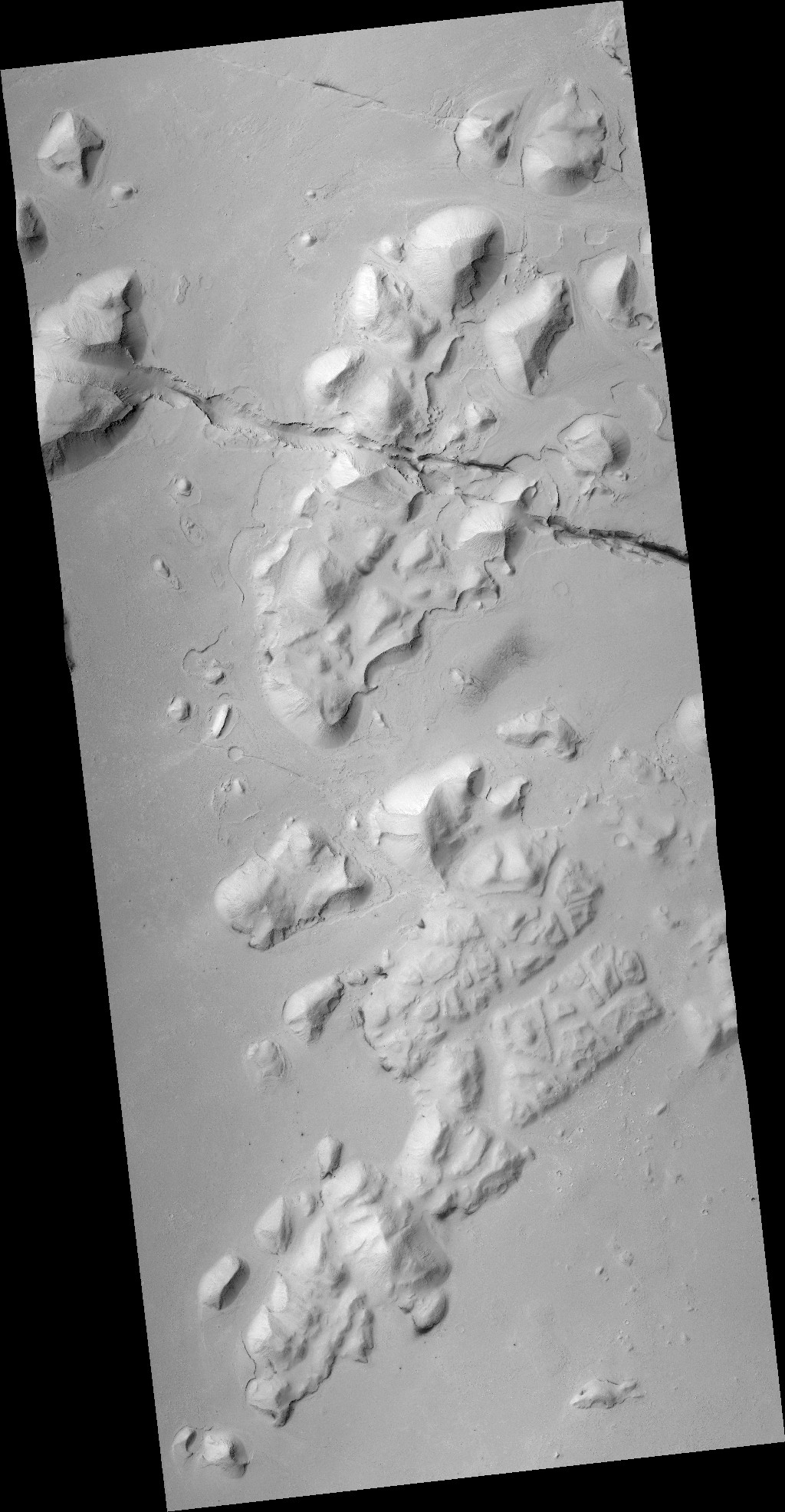
Lava-flooded mountains on Mars
Click for full image.

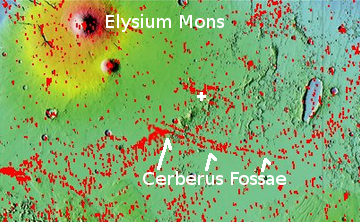
Overview map

Today’s cool image to the right, rotated, cropped, and reduced to post here, was taken in January 2012 by the context camera of Mars Reconnaissance Orbiter (MRO). The location is a small section of the Tartarus mountain range that is cut by the Cerberus Fossae fissures, all located in Elysium Planitia, the large volcanic lava plain that lies between Mars’ big volcanoes. The white cross on the overview map below marks the location of the photo.

I picked this photo because it quickly shows us in one picture many of the typical features one finds in that lava plain.

For example, the distinct fissure that cuts across the mountains near the top of the picture is the northernmost large fissure of Cerberus Fossae. In my initial post on Cerberus I mistaken thought its large and many hundreds of miles-long fissures might be evidence of underground lava tubes. Since then I have learned while the depressions may signal underground voids, they are not a lava tubes but graben, cracks formed by the movement of the terrain on each side. The cracks opened when past volcanic activity caused the ground to swell upward, stretching and splitting it.

The dark splotch in the flat area just south of the fissure remains me of the maculae found in these lava plains to the west of Olympus Mons, splotches that for still undetermined reasons dust devils like to congregate, blowing off the red dust so that the dark basalt lava becomes visible. No high resolution image of this spot has yet been taken, so this is a pure guess on my part.

The mountains near the bottom of the photo illustrate the ancient lava flood that inundated these mountain peaks. The white box shows the area covered by the recent MRO high resolution image that I include below.
» Read more

0 comments

Mars’ icy high latitudes

Mars' icy high latitudes
Click for full image.

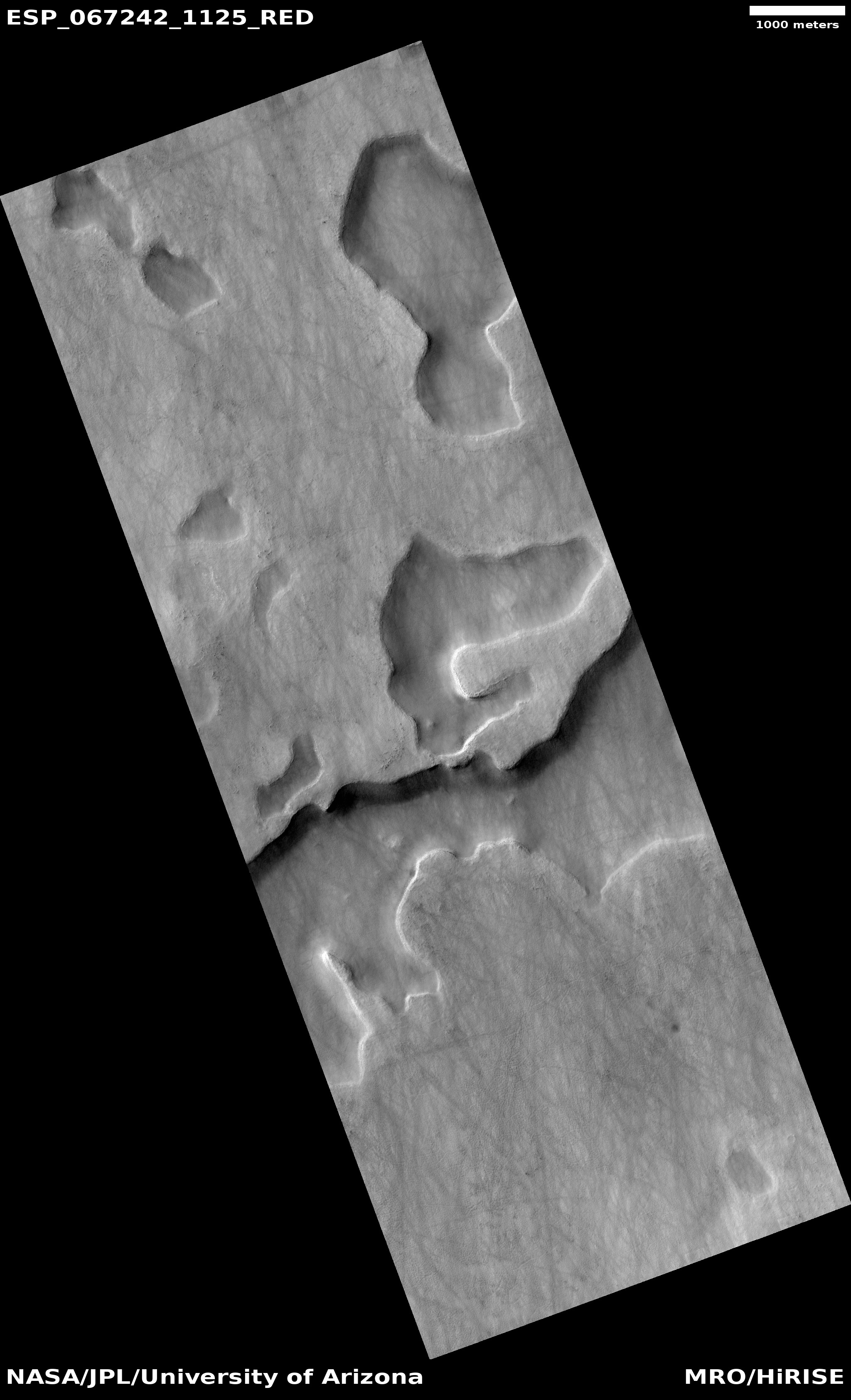
Cool image time! The photo to the right, rotated, cropped, and reduced to post here, was taken on November 29, 2020 by the high resolution camera on Mars Reconnaissance Orbiter (MRO). Labeled simply as “periglacial survey,” it is one of almost two hundred such images taken by MRO over the years, almost all of which are in the high latitudes above 60 degrees, with most being in the southern hemisphere. Most appear to be close to or above Mars’s Arctic Circle, which means these are locations that will see little or no sunlight for a portion of the year.

I have been unable to contact the scientists doing this survey, so I will have to make an educated guess as to its purpose and goals. “Periglacial” refers to the outer fringes or margin of a glacier or large ice sheet. Thus, in the context of this survey, the scientists appear to be studying places where they think the Martian high latitude ice sheets are beginning to sublimate away. Today’s photo is a good example. It is located at 67 degrees south latitude, in the southern cratered highlands but in an area that appears to be relatively free of craters. Instead, the terrain appears somewhat flat with only periodic depressions and scarps. The MRO context camera photo below of the same area, rotated, cropped, and expanded to post here, illustrates this.
» Read more

3 comments

OSIRIS-REx completes last close-fly of Bennu

OSIRIS-REx today successfully completed its last close-fly of Bennu before it will fire its engines on May 10th and begin its journey back to Earth to return its samples.

During the flyby, OSIRIS-REx imaged Bennu for 5.9 hours, covering more than a full rotation of the asteroid. It flew within 2.1 miles’ (3.5 kilometers) distance to the surface of Bennu – the closest it’s been since the TAG sample collection event.

It will take until at least April 13 for OSIRIS-REx to downlink all of the data and new pictures of Bennu’s surface recorded during the flyby. It shares the Deep Space Network antennas with other missions like Mars Perseverance, and typically gets 4–6 hours of downlink time per day. “We collected about 4,000 megabytes of data during the flyby,” said Mike Moreau, deputy project manager of OSIRIS-REx at NASA’s Goddard Space Flight Center in Greenbelt, Maryland. “Bennu is approximately 185 million miles from Earth right now, which means we can only achieve a downlink data-rate of 412 kilobits per second, so it will take several days to download all of the flyby data.”

While they will get images of the asteroid’s entire surface, the region scientists are most interested in is the Nightingale sample return site where the spacecraft grabbed its samples. To best understand the asteroid they need to have before and after shots, and this last fly-by gave them the latter.

4 comments

Study: a Martian crater lake fed by glacial run-off

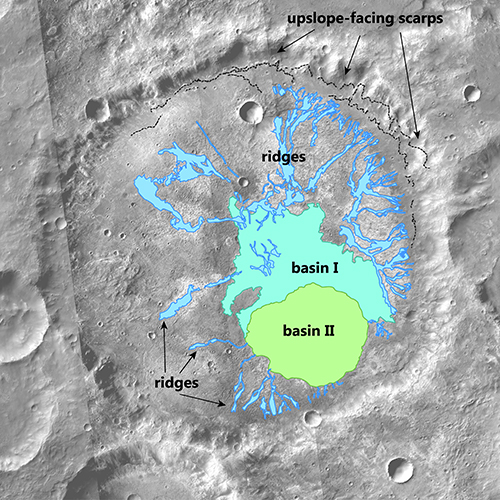
Map of crater lake and run-offs
From figure 1 on the research paper.

A new study of a 33-mile-wide Martian crater in its southern cratered highlands has found evidence that a lake had once existed on the crater floor, and was fed entirely by glacial run-off in a cold climate, coming from its interior walls, not from outside the crater.

In a study published in Planetary Science Journal, a research team led by Brown Ph.D. student Ben Boatwright describes an as-yet unnamed crater with some puzzling characteristics. The crater’s floor has unmistakable geologic evidence of ancient stream beds and ponds, yet there’s no evidence of inlet channels where water could have entered the crater from outside, and no evidence of groundwater activity where it could have bubbled up from below.

So where did the water come from?

The researchers conclude that the system was likely fed by runoff from a long-lost Martian glacier. Water flowed into the crater atop the glacier, which meant it didn’t leave behind a valley as it would have had it flowed directly on the ground. The water eventually emptied into the low-lying crater floor, where it left its geological mark on the bare Martian soil.

You can read the full paper here. The crater is considered very old, which means this evidence dates from a very early Mars when the climate was very different. As the scientists note in their conclusion:
» Read more

2 comments

Colorful mesa in the Martian northern lowland plains

Colorful mound in Martian northern lowland plains
Click for full image.

Cool image time! The photo to the right, rotated and cropped to post here and taken on January 15, 2021 by the high resolution camera on Mars Reconnaissance Orbiter (MRO), shows the colorful top of a small mesa in the northern lowland plains of Mars and about 300 miles north of the planned landing zone for Europe’s Franklin rover, scheduled to launch in 2022.

What makes this mesa stand out is the bright and colorful areas on its slopes. The colors are false, but they indicate [pdf] certain things. The yellow is likely dust covered rock. The pinkish rock is also likely dust-covered, but made up of coarser material. The bluish strip running along the mesa’s northern slope is possibly frost or ice, not unlikely as this mound is at 25 degrees north latitude and was taken during winter. The slope faces north, which would put it in shadow much of the time during winter.

The colors however only hint at what is there.
» Read more

0 comments

Two pits at opposite ends of Mars’ big volcanoes

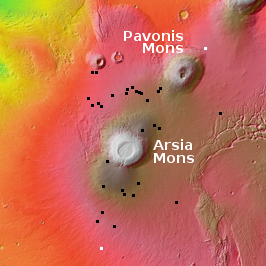
Overview map

Regular readers of Behind the Black know that since 2018 I have regularly documented all the images of pits taken by the high resolution camera on Mars Reconnaissance Orbiter (MRO). (See my last pit post in January for a full list of these previous articles.) The black dots on the map to the right shows the location of all the pits near the volcanoes Arsia and Pavonis Mons that have so far been highlighted here.

The two white dots are the two most recent MRO pits, and are the subject of today’s cool image. They also happen to be the farthest north and south pits so far documented. The southernmost pit, which I am saving till last, is the most interesting.
» Read more

2 comments

InSight detects additional 3+ magnitude quakes on Mars

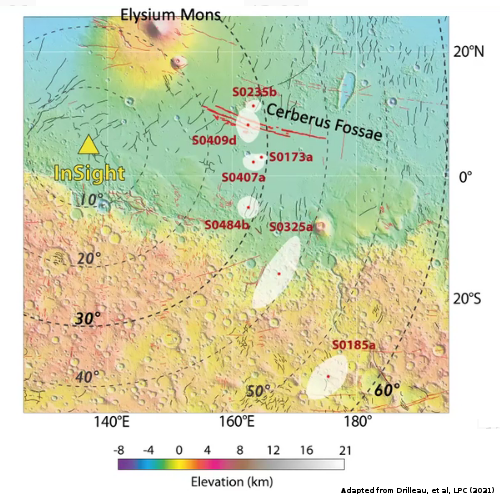
Martian quake map as seen by InSight

According to a JPL press release today, the seismometer on the Mars lander InSight detected two new 3+ magnitude quakes in March, both coming from the Cerberus Fossae region, the same region where the bulk of seismic activity has so far been pinpointed on Mars.

The map to the right was presented several weeks ago at the 52nd Lunar and Planetary conference, and could possibly include one of these two new quakes. The timing however of these March quakes is significant:

The new quakes have something else in common with InSight’s previous top seismic events, which occurred almost a full Martian year (two Earth years) ago: They occurred in the Martian northern summer. Scientists had predicted this would again be an ideal time to listen for quakes because winds would become calmer. The seismometer, called the Seismic Experiment for Interior Structure (SEIS), is sensitive enough that, even while it is covered by a dome-shaped shield to block it from wind and keep it from getting too cold, wind still causes enough vibration to obscure some marsquakes. During the past northern winter season, InSight couldn’t detect any quakes at all.

They are beginning to use the lander’s scoop to cover the seismometer and its communications tether with sand to protect both from the wind and temperature fluctuations. Once done they hope to be able to detect quakes during the entire Martian year, though this ability will be further limited by a reduction in power.

Despite the winds that have been shaking the seismometer, InSight’s solar panels remain covered with dust, and power is running lower as Mars moves away from the Sun. Energy levels are expected to improve after July, when the planet begins to approach the Sun again. Until then, the mission will successively turn off the lander’s instruments so that InSight can hibernate, waking periodically to check its health and communicate with Earth. The team hopes to keep the seismometer on for another month or two before it has to be temporarily turned off.

1 comment

Very peculiar flow features on Mars

Peculiar flows on Mars
Click for full image.

Today’s cool image focuses on one of the weirdest flow features I have yet seen on Mars. The first photo to the right, rotated and cropped to post here, comes from a January 27, 2021 picture by the high resolution camera on Mars Reconnaissance Orbiter (MRO). This cropped section focuses on the middle of three such weird features, two close flows heading downhill on the interior rim of very eroded 28-mile-wide crater. For some reason the flows also have depressions on their crowns. The depressions almost look like someone carved them out with a spackling spatula. In fact, the MRO science team agrees, labeling this image as “Spatulate Depressions with and without Upslope Gullies.”

The second image to the right shows a wider crop of the same picture, and explains the reason for the last half of that label.
» Read more

3 comments

Ice under Mars’ biggest volcanic ash field, at the equator?

Wind eddies on Mars
Click for full image.

According to new data obtained from the radar instruments on Mars Reconnaissance Orbiter (MRO) and Mars Express, scientists now think that the Medusae Fossae Formation, Mars’ biggest volcanic ash field and thought by some to be the source of most of the planet’s dust, might have an underground layer of ash that is also ice-rich. From their abstract:

The Medusae Fossae Formation (MFF) on Mars covers a vast area along the boundary between the rugged southern highlands and the smooth northern plains. While the MFF appears to be thick sediments or volcanic ash slowly eroding in the martian winds, how this material was emplaced remains mysterious. Most intriguing is evidence suggesting that some areas of the MFF may contain water ice. In this work we use sounding radar data from the SHARAD instrument on the Mars Reconnaissance Orbiter to probe up to 600 m below the surface and measure the electrical properties of the MFF material. The results suggest that the shallow parts of the MFF deposits are very porous and compress readily under their own weight. To match deeper probing by the Mars Advanced Radar for Subsurface and Ionosphere Sounding instrument on Mars Express requires a second layer of either vast porous deposits or ice‐rich material protected from sublimation by the dry sediments.

The MRO image above, originally posted here in November 2020, shows one example of the typical wind erosion found in the Medusae ash field. Apparently the ground-penetrating radar from orbit now suggests the possibility that there is an ash layer rich in ice, at depths beginning somewhere between 1,000 to 2,000 feet below the surface.
» Read more

4 comments

Martian glaciers flowing off interior walls of Renaudot Crater

Overview map

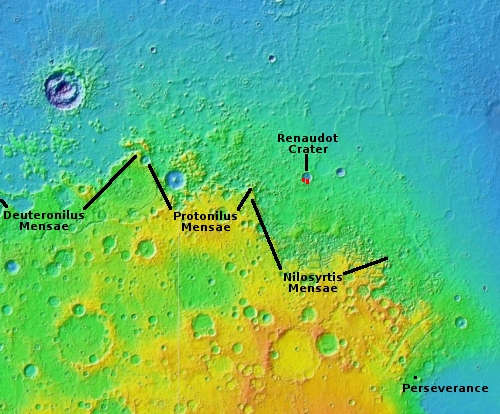
Cool image time! In the March 1st image release from the high resolution camera on Mars Reconnaissance Orbiter (MRO) were two pictures covering sections of the interior rim of 40-mile-wide Renaudot Crater, located in the northern lowland plains of Mars north of the region I dub Mars’ glacier country.

The map to the right provides the context. The two red boxes in Renaudot Crater show the location of the two images below, with the first being the one to the left. Located at about 42 degrees north latitude, we should expect to see evidence of ice and glacial features here, and that is exactly what both photos show.
» Read more

0 comments

Baffling ridges on Mars

Baffling ridges on Mars
Click for full image.

Today’s cool image is one of my “what the heck?” photos. The picture to the right, cropped and reduced to post here and taken on September 3, 2020 by the high resolution camera on Mars Reconnaissance Orbiter (MRO), shows a strange dune field of many parallel long dunes, cross-cut by larger ridges.

Are the larger ridges dunes? Or are they some form of volcanic or tectonic ridge, which is also very typical of this region, called Tempe Terra and located in the transition zone between the southern cratered highlands and the northern lowland plains?

Or are they eskers, ridges frequently found in places that were once covered by glaciers? At 35 degrees north latitude, it would not be surprising to see glacial features here, but as far as I can tell, the full image has no obvious such features.
» Read more

4 comments
1 96 97 98 99 100 157