A Martian avalanche: before and after

A Martian avalanche: before and after
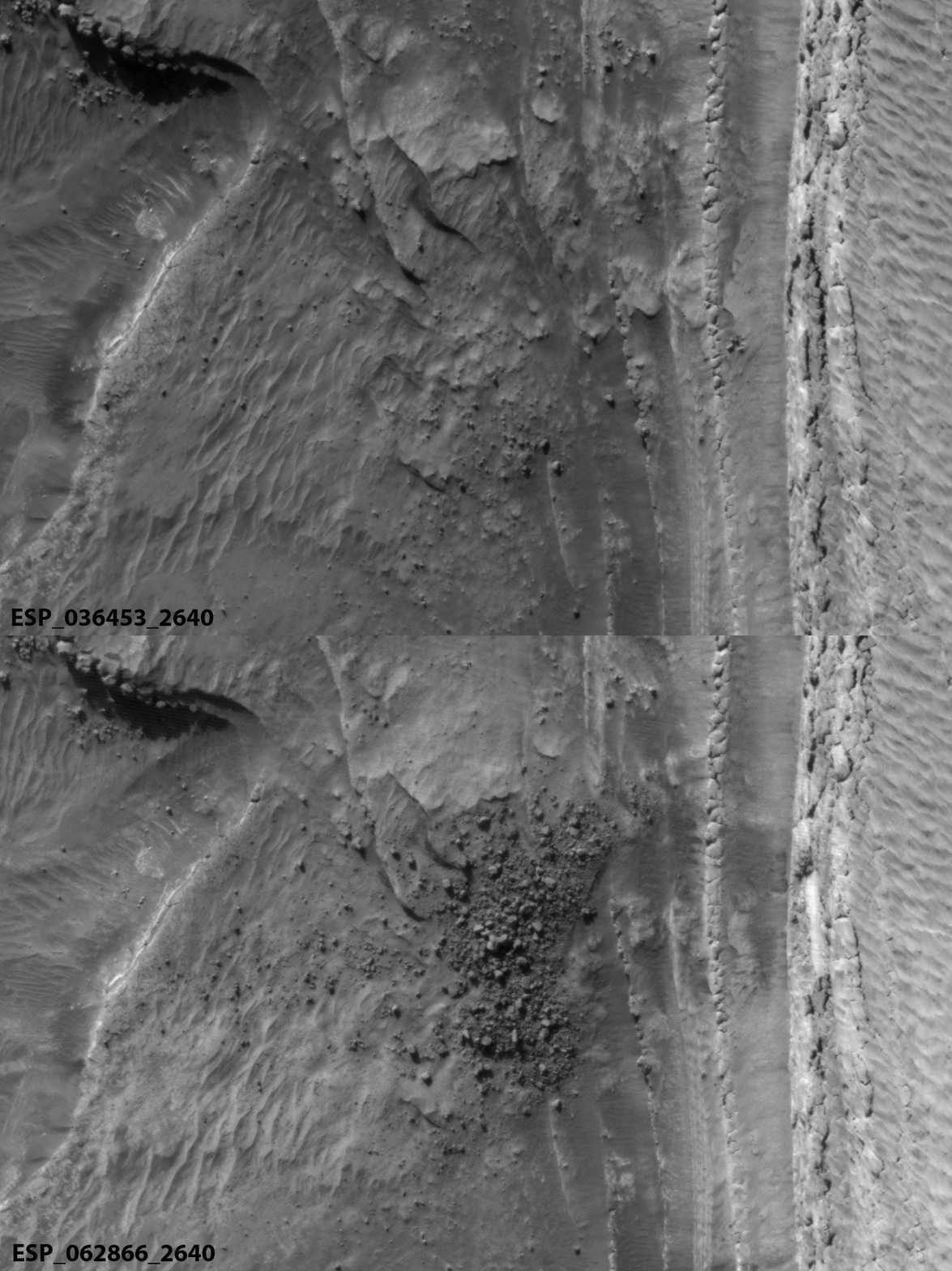
Click for full resolution animation.

Cool image time! The science team for the high resolution camera of Mars Reconnaissance Orbiter (MRO) today released a beautiful blink animation showing the before and after terrain at an avalanche site along the scarp of Mars’s north pole ice cap.

The animation is very cool, but it is also helpful to align the two images next to each other to carefully study what actually changed. The image to the right, cropped and reduced here, shows both photos. (Thank you to planetary scientist Shane Byrne for splitting the animation for me.). I have added the white bars to indicate the cliff section that broke off during the avalanche. That section was made of water ice, with probably some dust and rocks mixed in, and broke into the blocks that are now scattered on the ground below.

This avalanche itself is actually not unusual and as I noted in an earlier post, is part of an annual season of numerous avalanches that occur on this northern scarp of the polar ice cap each spring. As written by Dr. Candice Hansen of the Planetary Science Institute in Tucson, Arizona,

Every spring the sun shines on the side of the stack of layers at the North Pole of Mars known as the north polar layered deposits. The warmth destabilizes the ice and blocks break loose. When they reach the bottom of the more than 500 meter tall cliff face [about 1,600 feet], the blocks kick up a cloud of dust.

And as Byrne noted to me in an interview when I asked him how it was possible for MRO to image so many avalanches, as they occur,

“It is incredible. I think this is the most incredible thing about the whole process.” said Byrne. “If you fly over a mountain range on the Earth and take a picture, the chances catching an avalanche in progress are almost zero. But on Mars half of the images we take in the right season contain an avalanche. There’s one image that has four avalanches going off simultaneously at different parts of the scarp. There must be hundreds to thousands of these events each day.”

In an email exchange with him today, he also added that this is not the first before and after comparison images obtained. “We’ve been seeing these blockfalls for several years now. That’s partly why these scarps are being so intensively monitored by HiRISE.”

Do these avalanches mean that the Martian northern polar ice cap is shrinking? Maybe, maybe not. Right now scientists think the cap is in a steady state, neither growing or shrinking. These events are thus more likely comparable to the routine calving of ice sections from the foots of glaciers here on Earth, a common tourist destination in the waters of western Alaskan coast.
9 comments

Strange parallel grooves in Martian crater floor

Parallell ridges and ruts in Martian crater floor
Click for full image.

Full crater view
Click for full image.

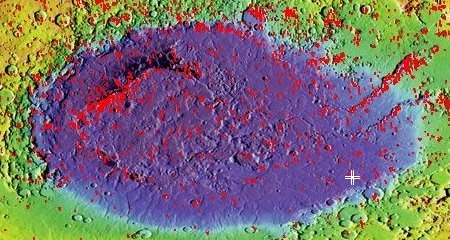
Cool image time! The image above, cropped to post here, was taken on December 2, 2019 by the high resolution camera of Mars Reconnaissance Orbiter (MRO) of a crater in the northern lowlands of Mars. It focuses in on the strange lineated ruts and ridges found on the crater’s central floor, as indicated by the black box on the wide shot to the right.

The north-south alignment of these groves suggests to me that they are wind caused, as if dust and sand had ponded in the crater’s lowest point and was then shaped by the prevalent winds. They also appear solid and old, as if this shaping occurred a long time ago and they are now decaying with time.

This location is at the same latitude as the plains around Erebus Montes, the prime candidate landing site for SpaceX’s Starship, and a region where a lot of shallow subsurface ice has been detected. It lies due west of that region, separated by the north-south Phlegra Montes mountain chain. At this latitude, 36 degrees north, scientists have found ample evidence of water ice, though some regions have more than others. This crater sits on the edge of this particular rich area, which might explain why the crater looks more solid and dry than others at similar latitudes. There simply might be less ice here, or the ice lies deeper below the surface.

I am off with Diane on a hike this morning, so this cool image fills in for my normal morning news posting. I should catch up this afternoon.

0 comments

More Martian pimples

More pimples on Mars
Click for full image.

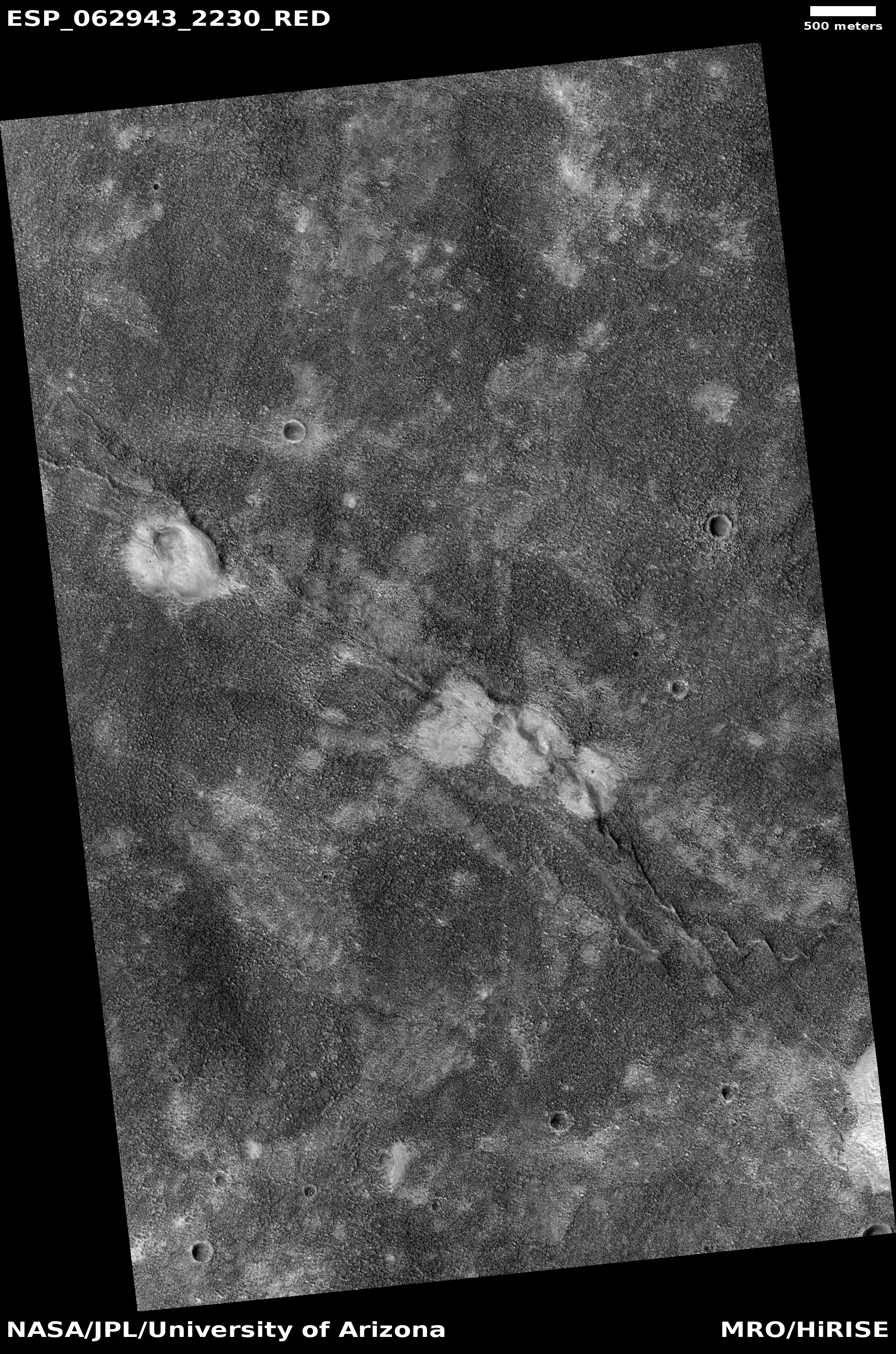
In a captioned image release last week from the science team of the high resolution camera on Mars Reconnaissance Orbiter (MRO), planetary scientist Alfred McEwen describes a string of mounds aligned and deformed by a fissue.

The image, cropped and reduced to post here, is to the right. As McEwen notes,

A possible geologic interpretation is that as the rift began to open, subsurface material (perhaps mud) erupted to create the mounds, which were then deformed as the rift continued to spread.

Located in Chryse Planitia, the region of the northern lowland plains just north of the outlet from Valles Marineris, these mounds and their probable geological origin seem very similar to the pimple mounds I highlighted in a cool image only last week. The only difference is that the earlier posted pimples were not aligned with any obvious fissure or rift.

0 comments

Inexplicable ridges on Mars

Inexplicable ridges on Mars
Click for full image.

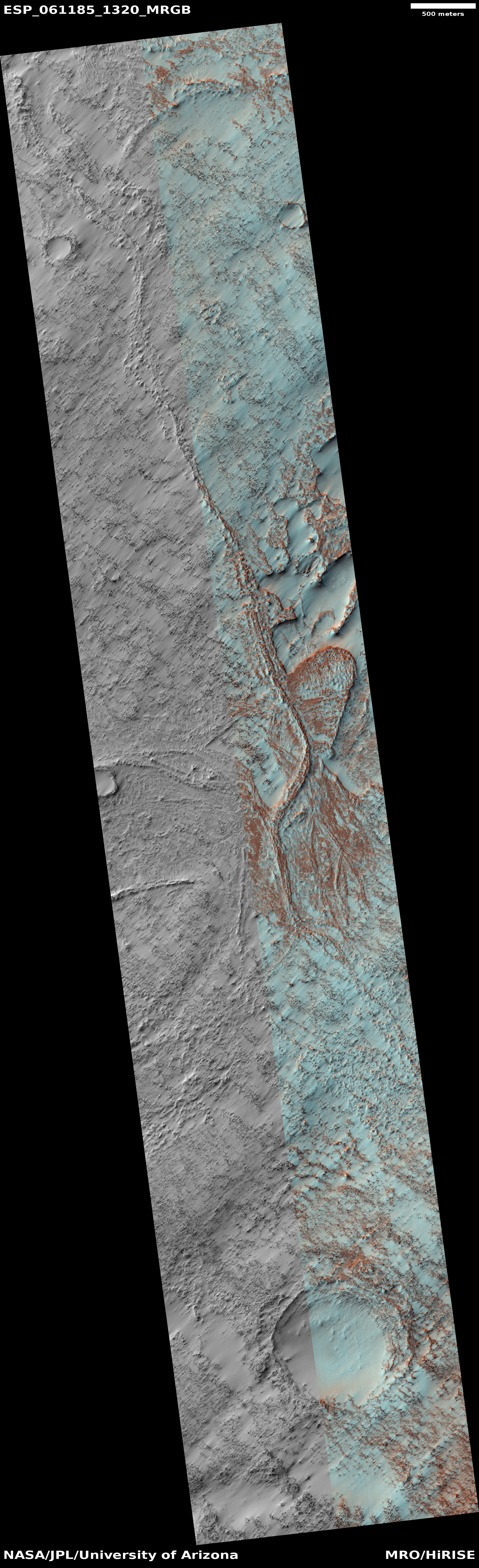
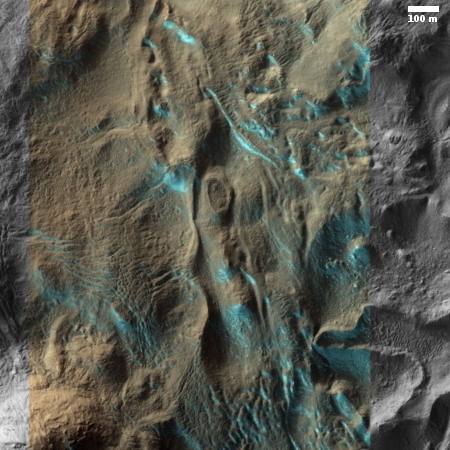
Don’t ask me to explain the geology on today’s cool image, rotated, cropped and reduced above. Taken by the high resolution camera on Mars Reconnaissance Orbiter (MRO) on August 16, 2019, the image’s uncaptioned website merely calls these “Convergent and Overlapping Narrow Curved Ridges.”

I don’t know why the sand in the hollows appears light blue, or even if it is sand. I don’t know what created the ridges, or why they seem to overlap each other randomly, or why they seem to peter out to the south.

I am sure there are planetary scientists out there who have theories that might explain these features. I also know that they would forgive me if I remained skeptical of those theories. This geology is a puzzle.

Hellas Basin, the basement of Mars

The location of these ridges is in the southeast corner of Hellas Basin, which I like to call the basement of Mars as it is the equivalent of the United States’ Death Valley, having the lowest relative elevation on the planet. As I have noted previously, the geology in this basin can be very strange. To my eye it often invokes a feeling that we are looking at Mars’s “uttermost foundation of stone” (to quote Tolkien), frozen lava that flowed in many ways and then froze in strange patterns.

Or not. Your guess is as good as mine.

3 comments

More evidence of ample shallow ice in Martian mid-latitudes

In a new paper released this week, scientists using instruments on both Mars Odyssey and Mars Reconnaissance Orbiter have found more evidence that there is a large amount of widespread ice close to the surface in the Martian mid-latitudes. As the scientists note in their abstract:

We show that water ice is present sometimes just a few centimeters below the surface, at locations where future landing is realistic, under mobile material that could easily be moved around. This ice could be exploited on‐site for drinking water, breathable oxygen, etc., at a much lower cost than if brought from Earth.

They deduced this by looking at how that ice would change the seasonal temperatures in the atmosphere directly above. Cooler regions suggested more ice close to the surface, while warmer regions suggested either no ice or ice deep below the surface. While this approach is indirect and did not directly detect ice, their conclusions match perfectly with all previous research. Below is a global map of Mars taken from the paper’s the supplementary material [docx file], reduced and annotated by me, showing the regions that seem to have ample shallow ice. Regular readers of Behind the Black will instantly recognize these locations.
» Read more

0 comments

The beginning of chaos on Mars

The beginning of a chaos canyon
Click for full image.

Cool image time! The photo on the right, rotated, cropped, and reduced to post here, was taken by the high resolution camera of Mars Reconnaissance Orbiter (MRO) on October 7, 2019. In one image it encapsulates the process that forms one of the more intriguing and major Martian geological features, dubbed chaos terrain.

Chaos terrain is typically a collection of mesas separated by straight-lined canyons. It is found in many places on Mars, most often in the transition zone between the southern highlands and the northern lowlands where an intermittent ocean might once have existed. It is believed to form by erosion, possibly caused by either flowing water or ice, moving along fault lines. As the erosion widened the faults, they turned into canyons separating closely packed mesas. With time, the canyons widened and the mesas turned into a collection of hills.

This image shows the beginning of this process. It is centered on a fault line running from south to north. In the south all we can see is the fault expressing itself as a very shallow small depression in the plains. As we move north the depression widens and deepens. The material inside the depression near the top of the photo could very well be a buried inactive ice glacier. Several million years ago, when the inclination of Mars was much higher and the mid-latitudes were much colder than the poles, the water ice at the poles was sublimating from the poles to those mid-latitudes where it fell as snow. At that time this glacier was likely active, helping to grind out this canyon.

The image was taken at the south border of a chaos region dubbed Nilosytis Mensae, as shown by the overview maps below.
» Read more

1 comment

Martian pimples

Pimples on Mars!
Click for full image.

Cool image time! The image to the right, cropped and reduced to post here, is one of those terrain sample images the science team of the high resolution camera of Mars Reconnaissance Orbiter (MRO) takes periodically when they have a gap in their observation schedule with no specific requests for images of the terrain below. Still, they need to use the camera regularly to keep its temperature maintained, so they then take a somewhat random picture over that terrain, based partly on information from lower resolution images but without a strong sense of what they will find.

In this case, they found what I dub pimples, raised mounds with small holes at their peaks. The image, taken on November 30, 2019, is located is in the northern lowlands, at a latitude (45 degrees) where subsurface ice is possible. Thus, we could be looking at water ice volcanoes.

Very few high resolution images have been taken of this area, with no others close by. Thus, the overall context of these mounds is hard to gauge. They could be widespread, or very localized.

The unknowns here and general lack of research suggests this location and these mounds are ripe research for some postdoc student interested in planetary geology.

3 comments

Nine finalists in Mars 2020 rover naming contest

The nine finalists in the Mars 2020 rover naming contest have been chosen, out of 28,000 entries from schools across the United States.

The nine candidate names were made possible by the “Name the Rover” essay contest, which invited students in kindergarten through 12th grade from across the United States to come up with a fitting name for NASA’s Mars 2020 rover and write a short essay about it.

More than 28,000 essays were submitted after the contest began on Aug. 28 last year. A diverse panel of nearly 4,700 judge volunteers, composed of educators, professionals and space enthusiasts from all around the country, narrowed the pool down to 155 deserving semifinalists from every state and territory in the country.

The public now gets to vote for their favorite, the choices of which are: Endurance, Tenacity, Promise, Perseverance, Vision, Clarity, Ingenuity, Fortitude, Courage. For the next week you can vote here. NASA will then take the poll results into consideration before making its final choice.

My personal favorite is Endurance. Vote for your own.

8 comments

Undulations on Mars

Undulations in Dokka Crater
Click for full image.

Time for a cool image that makes no sense. The photo on the right, cropped to post here, was taken by the high resolution camera on Mars Reconnaissance Orbiter (MRO) on November 15, 2019 of the floor of a crater, dubbed Dokka Crater, located in the high latitudes of the Martian northern lowlands. Uncaptioned but labeled “Undulations on Dokka Crater Ice Dome,” it shows a region of weird complex wave features, reminiscent of another weird Martian geological feature called brain terrain.

The problem is that brain terrain is generally found in the mid-latitudes, not the high latitudes. Both this feature and brain terrain however appear to associated with ice. In this case, these undulations are occurring on the ice dome that apparently sits inside Dokka crater, which is also likely to be related to the islands of ice found in many high latitude craters on Mars in the southern hemisphere..

In the case of the southern hemisphere ice-filled craters, scientists have found evidence suggesting that global wind patterns might affect their shape and placement within the craters. One wonders if this same factor is a part cause for these undulations in this northern hemisphere crater.

0 comments

Six Martian summers at a polar impact crater

Crater on Martian north polar ice cap
Click for full image.

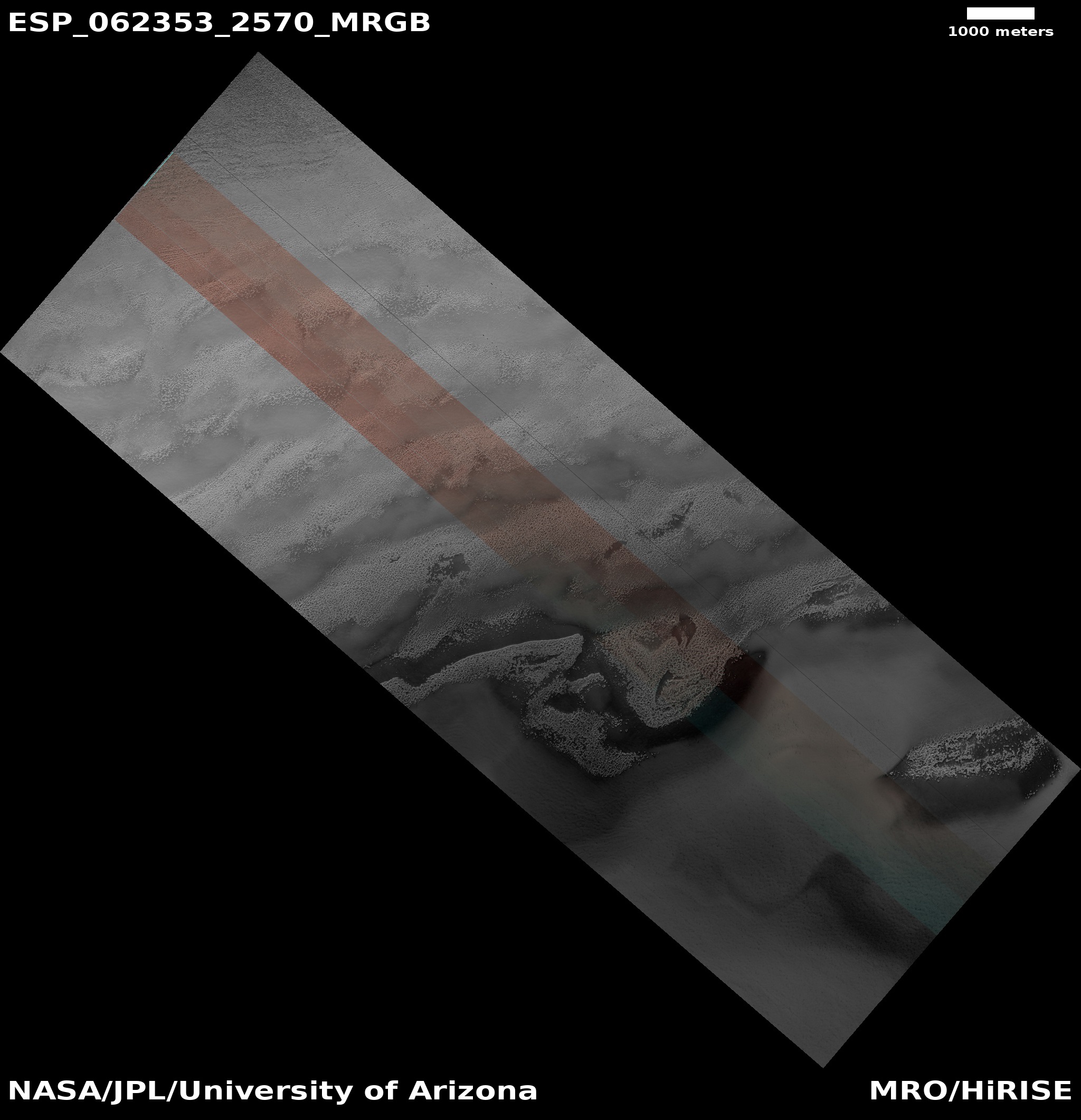
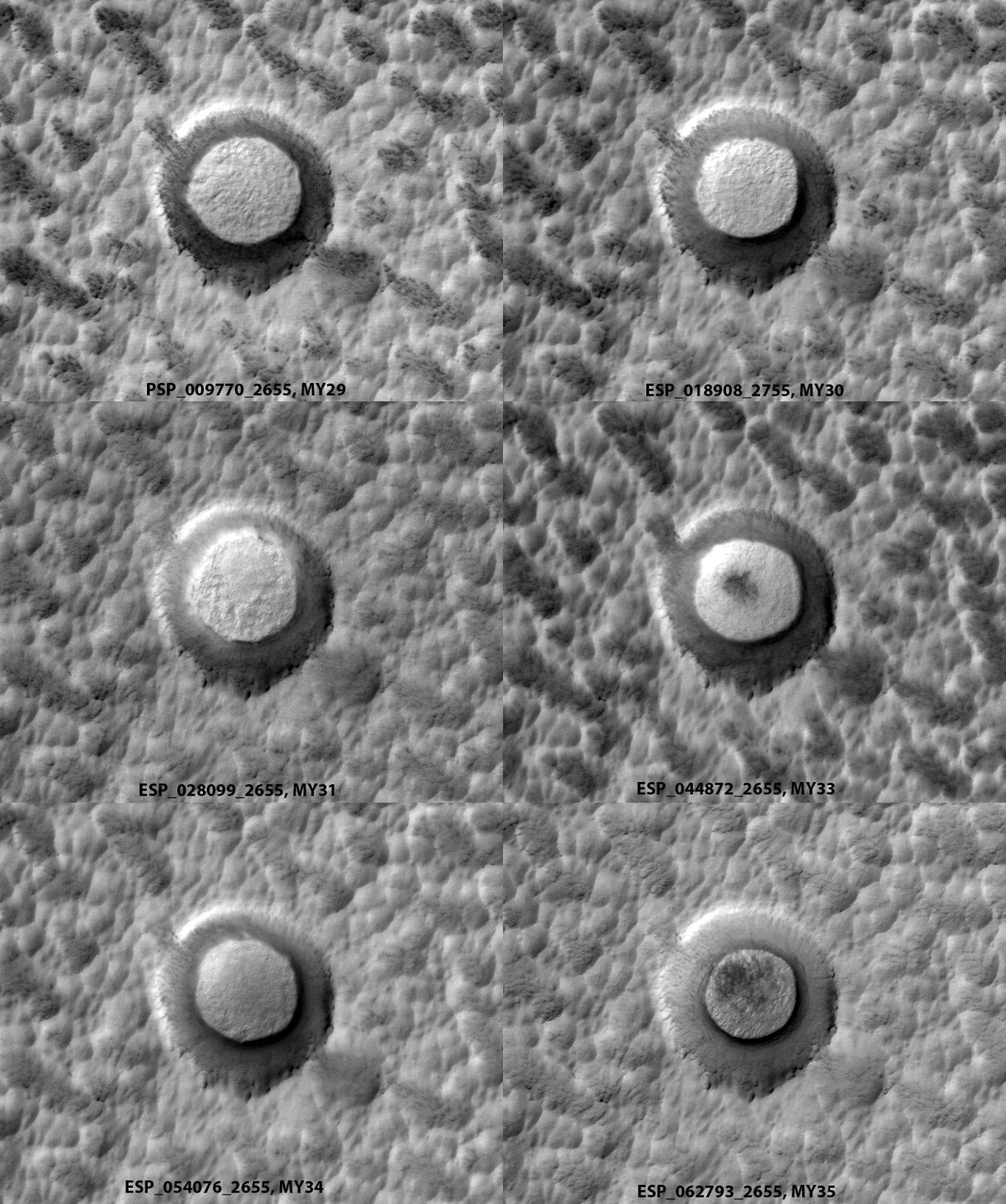
Cool image time! The science team for the high resolution camera on Mars Reconnaissance Orbiter (MRO) last week released a very neat short movie compiled from images taken of an impact crater located on top of the northern polar ice cap of Mars. As noted by planetary scientist Alfred McEwen of the Lunar & Planetary Laboratory in Arizona in the image caption,

Shown here is an impact crater on the north polar ice cap, which contains an icy deposit on the crater floor. These inter-crater ice deposits shrink and expand or change shape or surface texture from year to year,

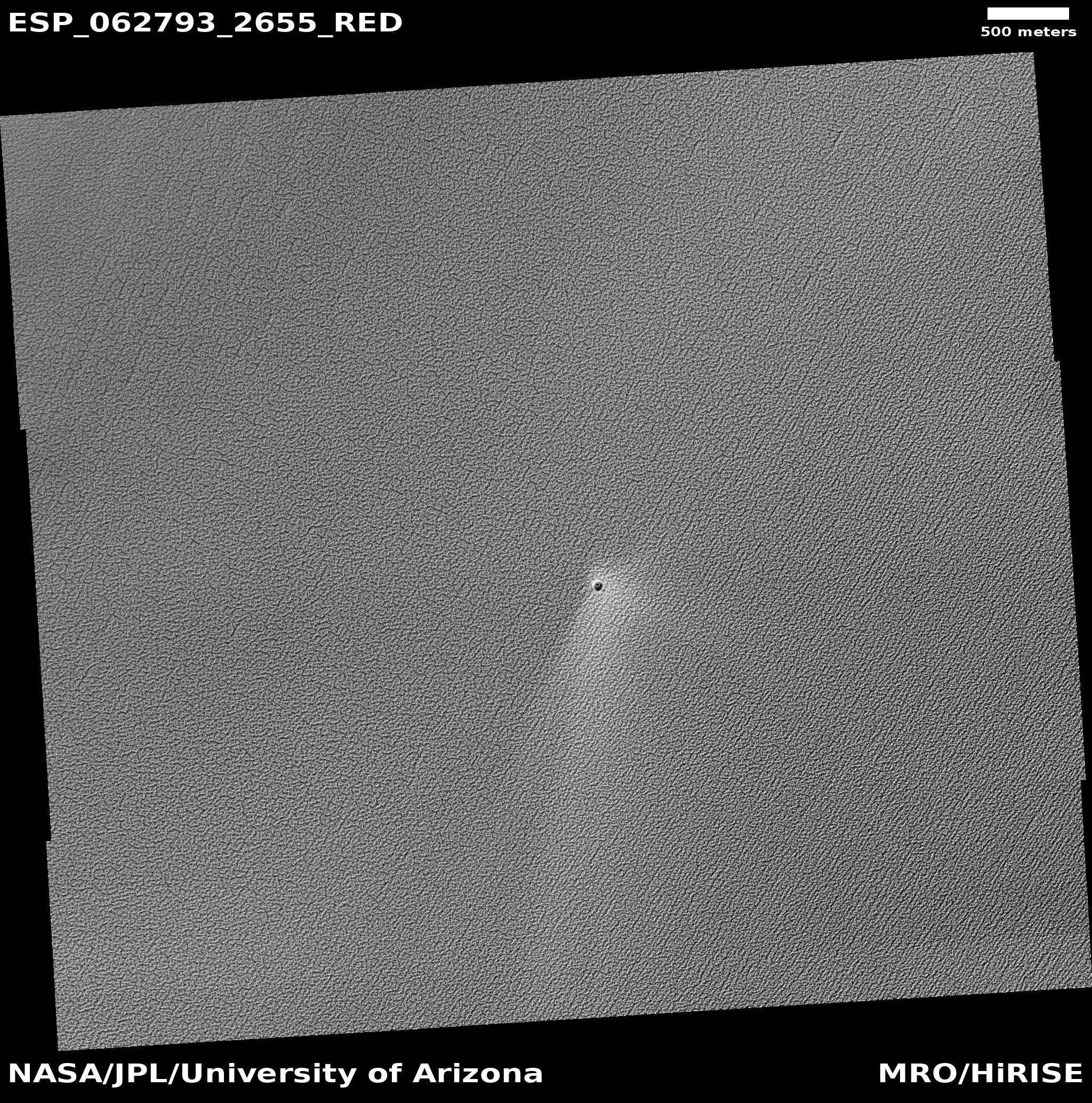
The image on the right, cropped and reduced to post here, is the most recent of these six images. The crater, which is about 200 feet in diameter, is the black speck in the center. The white streaks to the south of the crater, similar on all six photos, indicate that the prevailing winds come from the pole.

The animation zooms in on the crater so that you can see the details on its crater floor. And though the animation is fun, below the fold is a collage of all six photos, which I think makes it easier to see how the inter-crater ice deposits changed from summer to summer.
» Read more

0 comments

Tadpole on Mars

Tadpole on Mars
Click for full image.

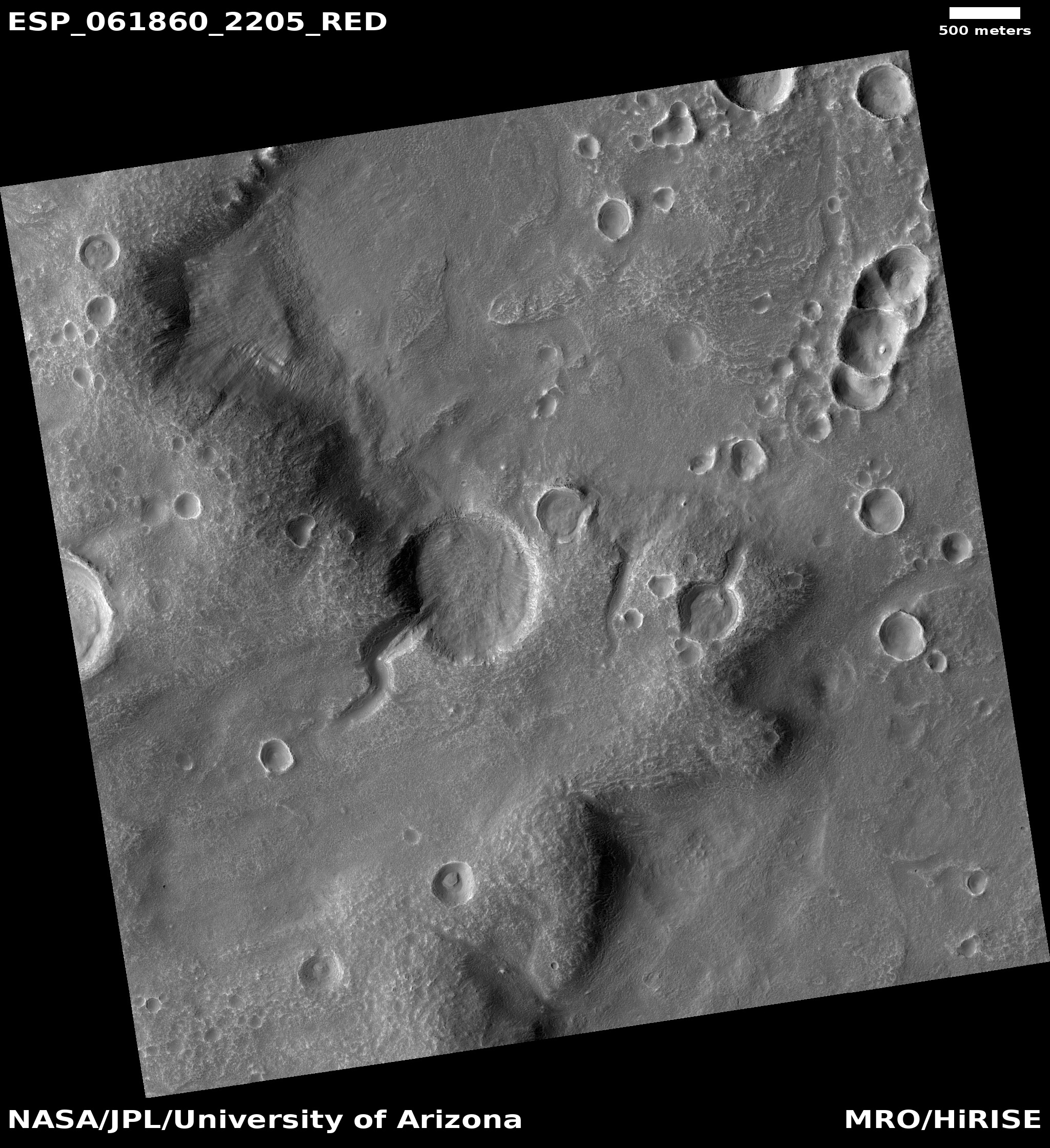
Cool image time! The image on the right, cropped and reduced to post here, was taken by the high resolution camera on Mars Reconnaissance Orbiter (MRO) on October 7, 2019, and shows a crater on the northern fringe of Arabia Terra, one of the largest transitional regions between the Martian northern lowlands and the southern highlands. It shows a crater with an inlet canyon that makes the entire crater resemble a wiggling tadpole.

This is certainly not first tadpole-resembling crater found on Mars. See for example this press release from February 2018, showing a tadpole crater with the tail being an outlet channel. In today’s image however the channel feeds the crater.

In fact, take a look at the full image. This crater apparently occurred right at the edge of a large mesa cliff, with this impact cutting into the cliff near its bottom. The canyon might have actually existed before the impact, with the crater merely obliterating the canyon’s outlet.

If you look along that escarpment to the east you can see similar southwest-to-northeast flows. One is a canyon flowing downhill through the escarpment, probably resembling what the first canyon might have once looked like before the impact. To the east of this is another tadpole crater. This second tadpole impact however took place on top of the mesa, so the channel flows out from the crater and then down off the mesa, the reverse of the tadpole crater above.

These flow features are consistent with the nature of this transitional zone, a region with many features suggesting it was once the shoreline of an intermittent ocean. That ocean, if it had existed, is long gone, though scattered across the Martian surface are geological ghost features like these that speak of its past existence.

5 comments

Martian dry ice frost on glacial remains?

Frost on ridgelines and inside crater
Click for full image.

Close-up of frost

Cool image time! The photo on the right, rotated, cropped, and reduced to post here, was taken by the high resolution camera on Mars Reconnaissance Orbiter on November 30, 2019. Located just east of Hellas Basin in southern mid-latitudes, the color strip shows dry ice frost both in the crater as well as on the ridgelines to the north. As noted in the caption, written by Candy Hansen of the Planetary Science Institute in Tucson, Arizona,

When we acquired this image, it was [winter in the southern hemisphere] on Mars, but signs of spring are already starting to appear at latitudes not far from the equator. This image of Penticton Crater, taken at latitude 38 degrees south, shows streamers of seasonal carbon dioxide ice (dry ice) only remaining in places in the terrain that are still partially in the shade.

The turquoise-colored frost (enhanced color) is protected from the sun in shadowed dips in the ground while the sunlit surface nearby is already frost-free.

Note for example how the frost disappears in the southern half of the crater floor, the part exposed to sunlight.

What immediately struck me however were the underlying features. The entire northeast quadrant of the crater’s rim appears to have been breached by some sort of catastrophic flow, as if there had been a glacial lake inside the crater that at some point smashed through suddenly, wiping that part of the rim out as it ripped its way through.

To the right is a full resolution inset, indicated by the white box above, of the dry ice frost on the outside of the crater. I find myself however drawn more to the underlying features, which once again have a chaotic aspect suggesting a sudden violent event, coming from the south and moving north.

I have no idea if my visceral conclusions here have any validity. At this latitude, 38 degrees, scientists have found a lot of buried inactive glaciers of ice, so I could be right. Or not. Your guess is as good as mine.

0 comments
1 128 129 130 131 132 212