Assembly complete on Europe’s Franklin Mars rover

Engineers have completed the assembly of Europe’s Rosalind Franklin rover that is scheduled for launch to Mars in July 2020

Rosalind Franklin, which is the result of cutting edge work from UK, European and Canadian scientists and engineers will now be shipped from the Airbus factory in Stevenage, Hertfordshire to Toulouse in France for testing to ensure it survives its launch from Earth next summer and the freezing conditions of Mars when it lands on the planet in March 2021.

Whether they can meet this schedule remains unknown because of the problems that occurred during testing of the spacecraft’s landing parachutes.

0 comments

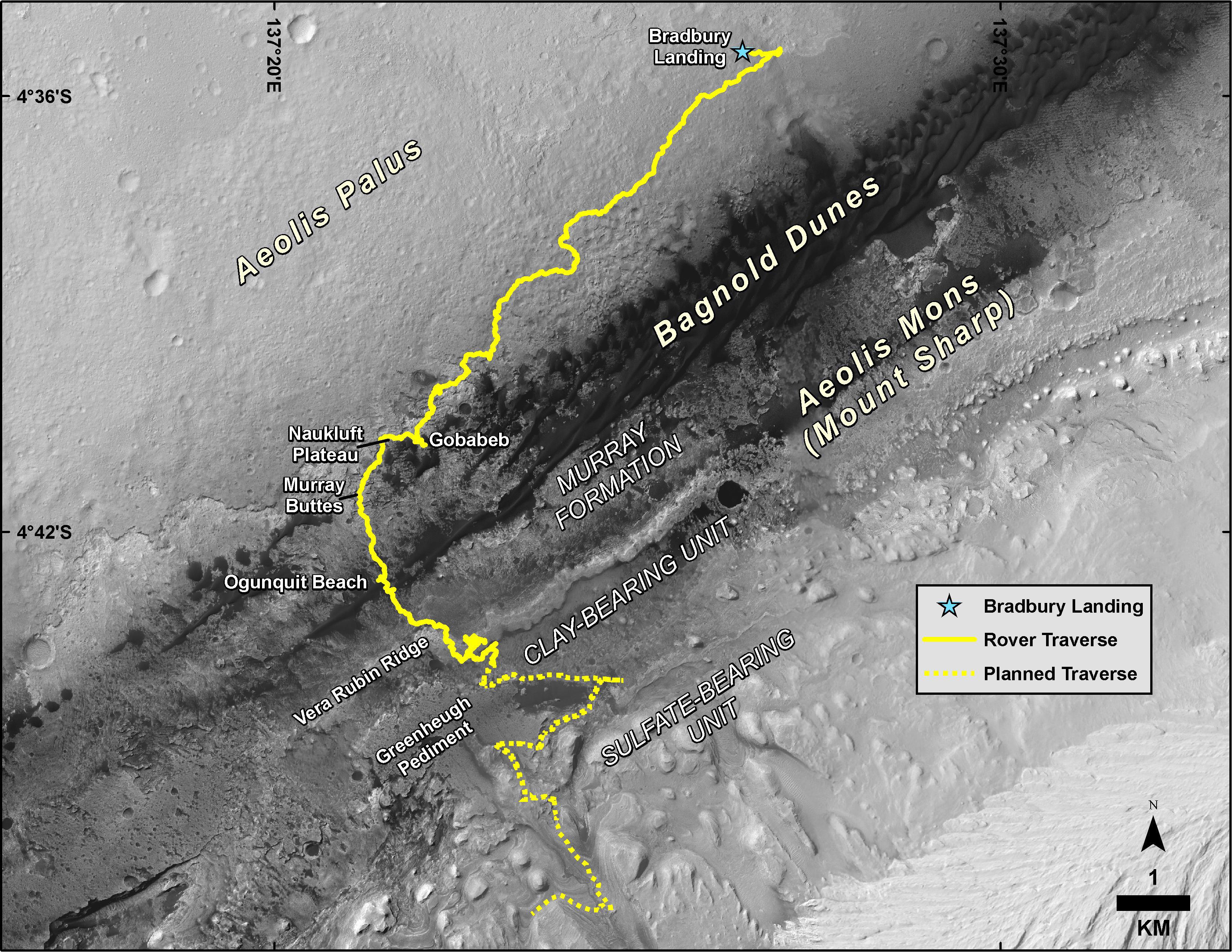
Curiosity’s future travels

Curiosity's planned route up Mt Sharp
Click for full image.
The Curiosity science team has released a new map showing an update of their planned route for Curiosity in the coming year or so, showing how they plan on leaving Gediz Vallis Channel after spending some time exploring the numerous geological layers exposed on its eroded surface.

The new information in this map is the route near the bottom of the image, showing more precisely the route up the canyon and then their retreat through the gap in the canyon’s western wall.

To get a better idea of what this means, I have updated my annotations on this Mars Reconnaissance Orbiter image of Gediz Vallis Channel, posted previously in my May 30, 2019 rover update.
» Read more

0 comments

Melting rocks on Mars

Melt pools near Mohave Crater
Click for full image.

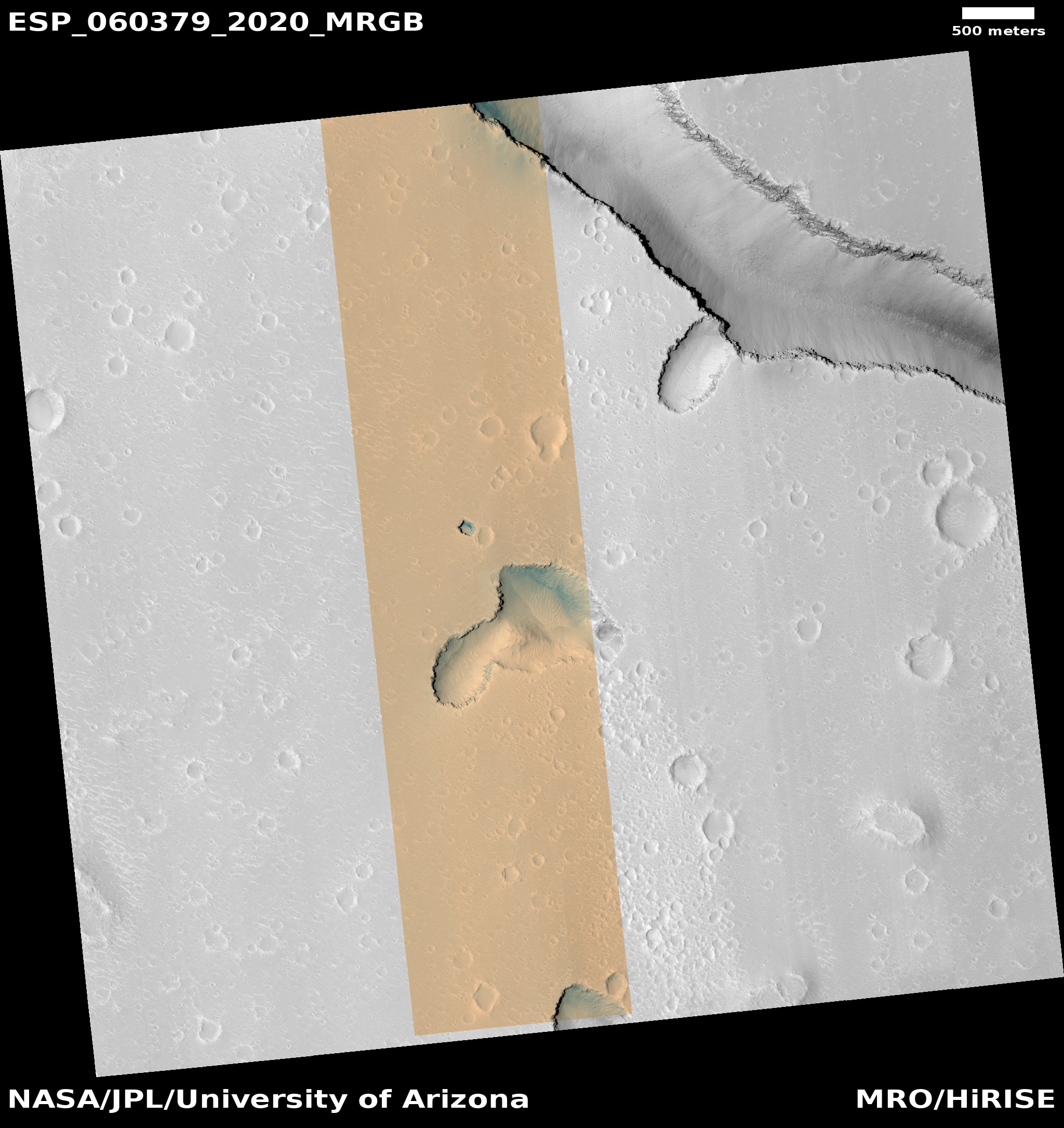
Cool image time! The image to the right, reduced, cropped, and annotated by me to post here, was part of the July image download from the high resolution camera on Mars Reconnaissance Orbiter (MRO) and was titled “Melt Pools around Mojave Crater”.

You can see that the flow began to the south, flowed northward (in the middle of the image), and then pooled in the two places as indicated. In the full photograph you can also see that the flow continued to the north, forming more pools.

The title to me suggests that this flow and the melt pools were lava, not ice. The low latitude, 7 degrees north, also suggests this is not ice. Though I was unable to reach the person who requested these images, it appears his research is aimed understanding the melt events that occur in the vicinity of craters upon impact. From his website:
» Read more

0 comments

Scientists resolve one Mars methane mystery

Scientists have now figured out why the methane data from Curiosity on the Martian surface did not match the methane data from Trace Gas Orbiter in orbit around Mars.

Last year, scientists learned that methane concentrations changed over the course of the seasons with a repeatable annual cycle. “This most recent work suggests that the methane concentration changes over the course of each day,” Dr Moores said. “We were able – for the first time – to calculate a single number for the rate of seepage of methane at Gale crater on Mars that is equivalent to an average of 2.8 kg per Martian day.”

Dr Moores said the team was able to reconcile the data from the ExoMars Trace Gas Orbiter and the Curiosity Rover, which appeared to contradict each other with wildly different detections of methane. “We were able to resolve these differences by showing how concentrations of methane were much lower in the atmosphere during the day and significantly higher near the planet’s surface at night, as heat transfer lessens,” he said.

Solving that data conflict helps them get a better grip on the real question: Why is the methane fluctuating in this manner?

3 comments

An eroding Martian glacier?

An eroded glacier on Mars?

Close-up of an eroded glacier on Mars?
Click for full image.

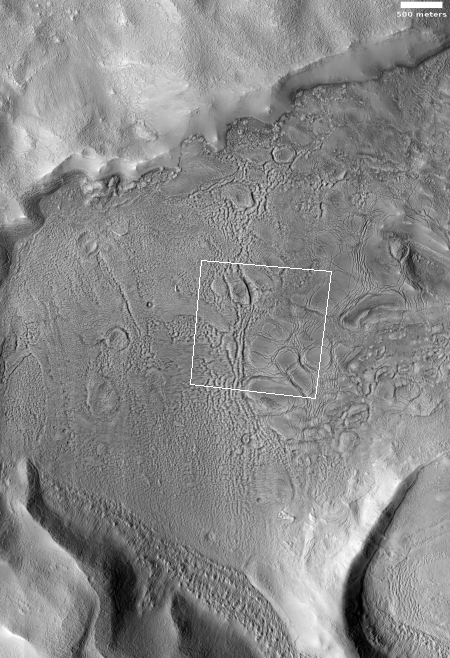
Cool image time! In my never-ending review of new images downloaded each month from the high resolution camera of Mars Reconnaissance Orbiter (MRO), I came upon an image dubbed merely “Terrain Sample” in the August release. To the right, cropped and rotated to post here, is the weird terrain from that image, with the section in the white box shown below at full resolution.

To keep MRO functioning properly, they need to take images on a regular basis, even if they have no planned features coming into view. As noted by Singleton Thibodeaux-Yost, the HiRISE Targeting Specialist at the University of Arizona who requested this image,

It was not taken in response to a suggestion from the public or our team database. This image was a ride-along with another instrument on MRO. [The scientists for that other instrument] targeted this region for a particular reason and we just turned on our camera as well to gather more data while they collected their data. I title these types of images โ€œterrain sampleโ€ as we donโ€™t always know what the results will be.

In other words, the scientists running the high resolution camera have no inkling what they will see until see it.

This image shows the inside rim of a crater, with the crater rim to the south just beyond the image’s bottom edge. This somewhat large crater is located in the middle of Arabia Terra, one of the largest regions of the transition zone between the southern highlands and the northern lowlands (where some scientists believe an intermittent ocean might have once existed). This transition zone has many features that suggest a tidal basin on the edge of that ocean.

A few months ago I would have been entirely baffled by what we see here. I might have speculated that these strange features were another variation of that shoreline region. Maybe these features are the erosion one sees on a dried lakebed after the water has drained away.

I might have also speculated that these shapes looked like the kind of frozen ice blocks one sees in the icecap of the Arctic here on Earth.

Both speculations then would have been complete guesses.

I now know, based on things I have recently learned in writing about several other images from MRO, that the second guess is likely right (though of course my opinion as a very amateur planetary geologist should not be taken very seriously). My reasons?
» Read more

0 comments

ESA confirms ExoMars parachute test failure

You heard it hear first! The European Space Agency (ESA) today confirmed earlier stories from last week that the parachutes for its ExoMars 2020 spacecraft had failed during a high altitude drop test on August 5.

I reported this on Saturday, August 10, noting that ESA had not confirmed it. It apparently took them a week to write the press release.

This was the second consecutive test failure for these parachutes, as noted in the release.

On 28 May this year, the deployment sequence of all four parachutes was tested for the first time from a height of 29 km โ€“ released from a stratospheric helium balloon. While the deployment mechanisms activated correctly, and the overall sequence was completed, both main parachute canopies suffered damage.

Following hardware inspection, adaptations were implemented to the design of the parachutes and bags ready for the next high-altitude test, which was conducted on 5 August, this time just focusing on the larger, 35 m diameter, parachute.

Preliminary assessment shows that the initial steps were completed correctly, however damages to the canopy were observed prior to inflation, similar to the previous test. As a result, the test module descended under the drag of the pilot chute alone.

The tests occur at high altitude where the Earth’s atmosphere mimics the thin atmosphere of Mars. In both cases it appears the parachutes became damaged very early in their deployment process, possibly during deployment. This means there might be a design problem with the deployment process. It also means that both tests were unable to test the chutes themselves, as they were damaged before inflation, meaning that the engineers still do not know if they would work as intended once filled with air.

All this puts incredible time pressure on the mission, which needs to launch in the summer of 2020 to meet its launch window. There is very little time to redesign and retest these chutes. I would rate their chances of meeting that launch date as less than 50-50.

0 comments

Monitoring Martian pits not near Arsia Mons

Second look at Hephaestus Fossae pit
Click for full image.

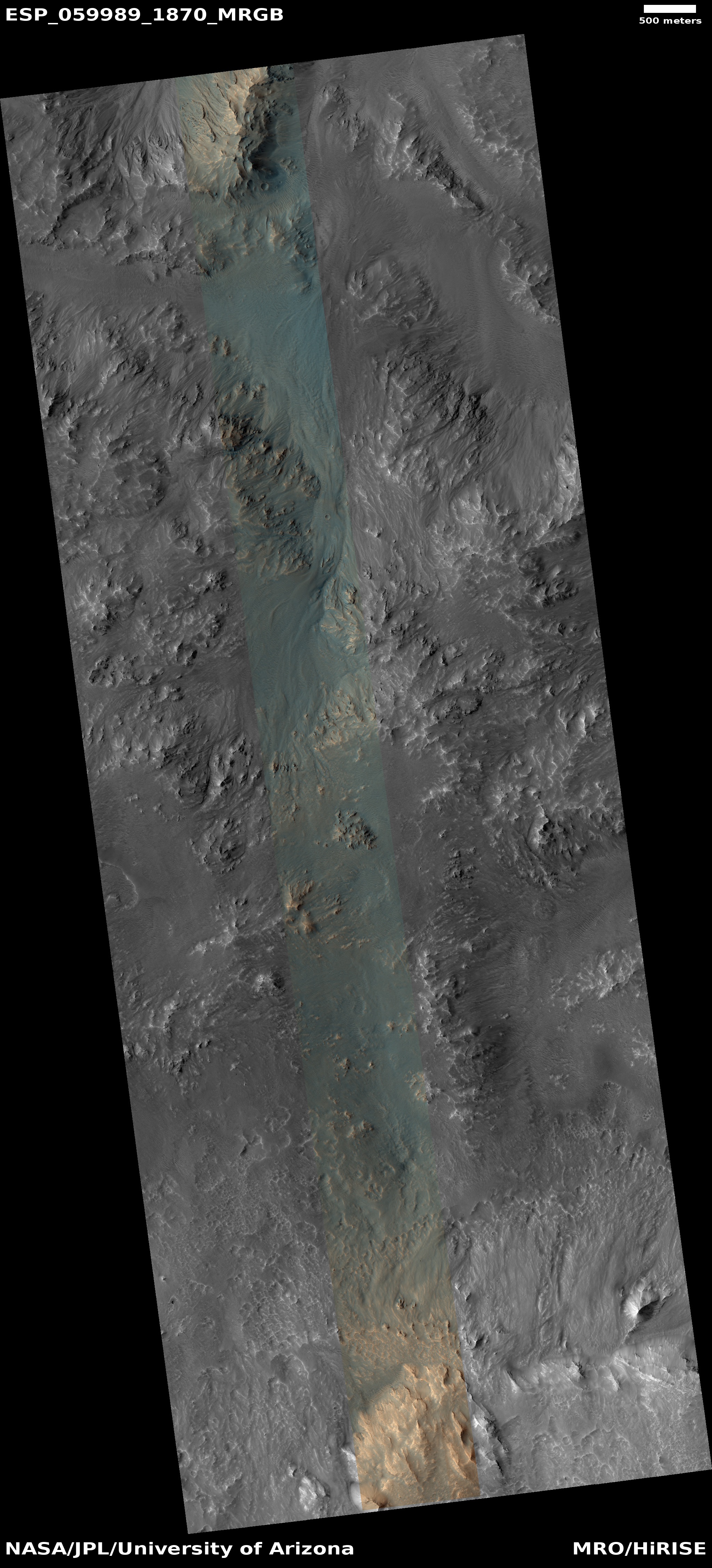
In reviewing the August image release from the high resolution camera on Mars Reconnaissance Orbiter (MRO), I came upon two different new pit images, the more interesting of which is highlighted on the right, cropped to post here..

Finding new pit images from MRO isn’t surprising, since the spacecraft has been photographing pits almost monthly since November (see: November 12, 2018, January 30, 2019, February 22, 2019, April 2, 2019, May 7, 2019, and July 1, 2019).

What makes these two new pit images more intriguing are their location, and the fact that both pits were previously photographed by MRO and posted on Behind the Black on June 5, 2018 and July 24, 2018. Both are located in Hephaestus Fossae, a region of fissures on the edge of the great Martian northern lowlands to the west of the great volcano Elysium Mons.

Almost all the pits from past MRO images have been found on the slopes of Arsia Mons, the southernmost of the three giant volcanoes southeast of Olympus Mons. In fact, last month I even asked the question, “Why so many pits there, and so few pits elsewhere?” The explanation from Chris Okubo of the U.S. Geological Survey, who is requesting these images, was that maybe it was due to geology, or maybe it was because we simply do not yet have enough information and might not have identified the many caves/pits elsewhere.

It appears that this same question had already been on the minds of Okubo and his partner, Glen Cushing, also of the USGS. As Okubo wrote me when I asked him about these new images:
» Read more

2 comments

Watching the yearly vanishing of Mars’ north pole dry icecap

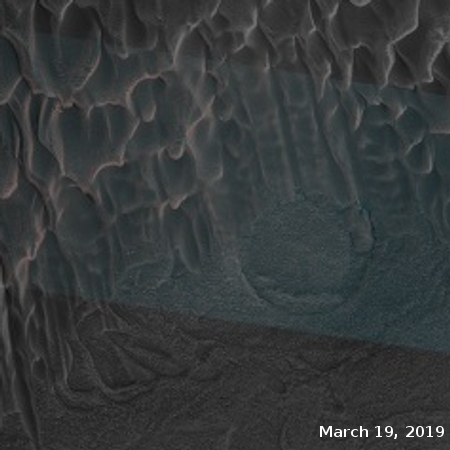
Buzzell dunes, March 19, 2019
Click for full image.

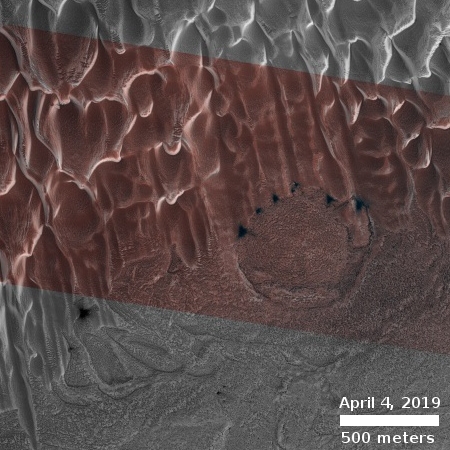
Buzzel dunes, April 4, 2019
Click for full image.

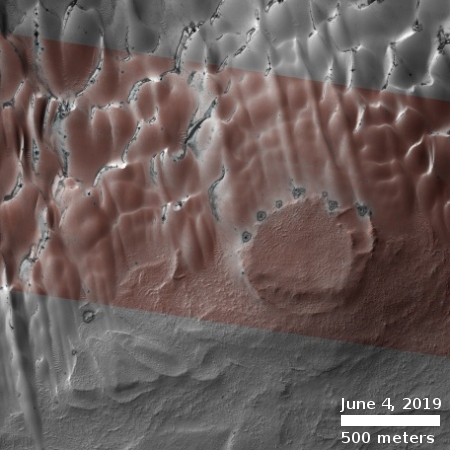
Buzzell dunes, June 4, 2019
Click for full image.

For the northern hemisphere of Mars it is presently spring. The season began sometime in April 2019 and will last until about October, twice as long as on Earth because of the Martian year is twice as long.

During the fall and winter the permanent water-icecap, which forms the bulk of the Martian icecap, gets covered by a mantle of dry ice, settling there as a layer of carbon dioxide snow about six feet thick. With the arrival of spring that dry icecap slowly begins sublimate away entirely.

Using the high resolution camera on Mars Reconnaissance Orbiter (MRO) planetary scientists are monitoring this process, taking pictures periodically.

On June 6, 2019 I had written a detailed story describing the Martian North Pole and outlining the process by which this sublimation of the dry icecap mantle takes place.

When winter ends and the sun reappears at this Arctic location, a small percentage of that sunlight, about 10%, goes through the dry ice and warms the sand that the dry ice mantles. This in turn warms the bottom of the dry ice layer, causing this to sublimate into a gas that is now trapped.

When the pressure builds sufficiently, that gas breaks free at the weakest spots in the dry ice layer, which are either at the dune crest or at its base, or sometimes on its face where cracks form. When it does so the CO2 gas carries with it material from below, which appears dark relative to the bright dry ice on the surface. As the summer season progresses and more dry ice sublimates away, the dark smudges disappear as they slowly blend in with the now-exposed original sand surface.

The first two pictures to the right were posted in that June 6, 2019 story, showing the initial evidence of sublimation on a set of dunes that the scientists have dubbed Buzzell. Below these, I have now added the newest image of the Buzzell dunes, taken on June 4, 2019 and just released in the August MRO image dump.

When this third image was taken, spring was only about two months old. Yet, this sublimation process is clearly accelerating. You can see many more dark patches at the crests and bases of many dunes, especially in the upper left of the image. According to Dr. Candice Hansen of the Planetary Science Institute in Tucson, Arizona, who is requesting these monitoring images, by sometime in October “you’ll see how the entire spring progresses from dunes completely covered with dry ice to the summer when they are just bare sand. Then you could comment on the whole spring series.”

I fully intend to do this. No harm however in providing an interim report or two. Stay tuned to Behind the Black for future on-going and up-to-date reports on the shrinking north pole dry icecap of Mars!

0 comments

Crater on the Basement of Mars

Crater in the bottom of Hellas Basin
Click for full image.

Cool image time! In the July release of images from the high resolution camera of Mars Reconnaissance Orbiter (MRO) was the image to the right, cropped to post here, showing what I suspect is a relatively young crater located in the lowest part of Hellas Basin, what I call the bottom of Mars.

Though this crater is not located at the lowest point in Hellas, it is not far off from there. What makes it important to geologists are two facts. First, there are not a lot of craters in Hellas, which helps indicate it is a relatively young feature. Second, and more important, the impact has made accessible material from below the surface, indicated by the different colors in this image. From this information they can better constrain their theories about the Basin’s formation and where it fits in Mars’s overall geological history.

Make sure you take a look at the full photograph by clicking of the image, and compare it with the earlier Hellas Basin images I posted here. The surface of Hellas appears to have a lot of flow features, as if it was laid down by volcanic activity, or by the motion of water that covered it. In either case that would explain the overall lack of craters.

0 comments

A bullseye on Mars

Layered crater at equator
Click for full image.

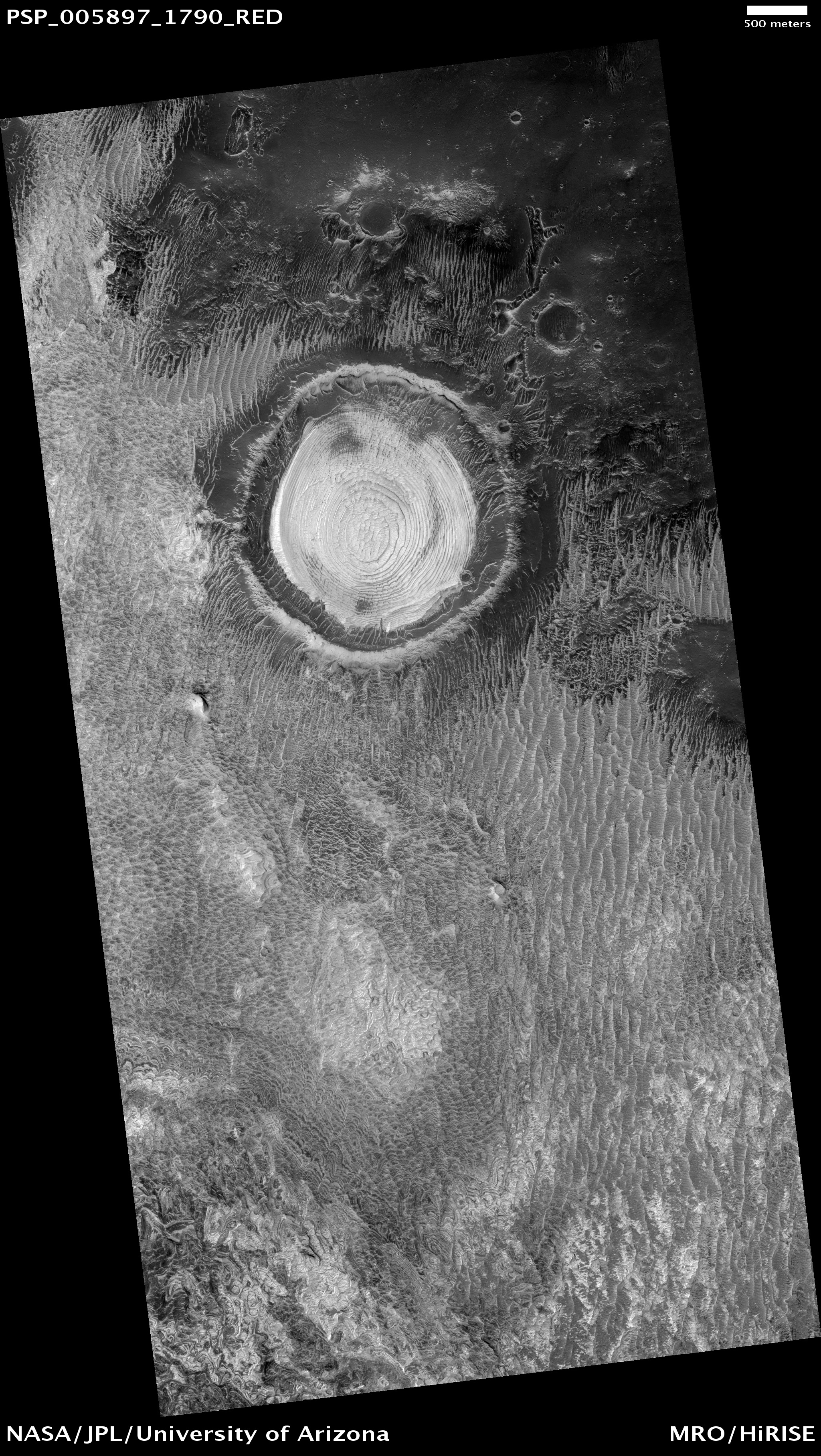
Cool image time! In researching my piece last week on the glaciers of Mars I had wanted to include a picture of a typical concentric glacier-filled crater, the most widespread glacial feature on the Martian surface, found in a band at latitudes between 30 and 60 degrees. (You can see the example I found at the link above, near the end of the article.)

To find that picture I searched the Mars Reconnaissance Orbiter (MRO) archive. Among the images I found was a captioned image taken very early in MRO’s mission showing a crater with concentric rings very similar to the concentric glacial-filled craters. The image at the right is that crater, the image reduced and cropped to post here. As described in that caption,
» Read more

1 comment

The glaciers of Mars

The glaciers on Mars

For the future colonists of Mars, the question of finding water will not be that much of a problem. Not only have planetary geologists mapped out the existence of extensive water-ice in the Martian poles, they have found that the planet apparently has widespread glacier deposits in two mid-latitude belts from 30 to 60 degrees latitude.

The question will be whether those Martian settlers will be able to easily access this water. The data so far suggests that much of the Martian underground water at high latitudes is likely mixed with dust and debris. Extracting it might not be straightforward. There are hints that the ice table at latitudes about 55 degrees might be more pure, but could be somewhat deep below ground, requiring the settlers to become miners to obtain their water. Moreover, all these high latitude locations are in environments that are more hostile, and therefore more difficult to establish a colony.

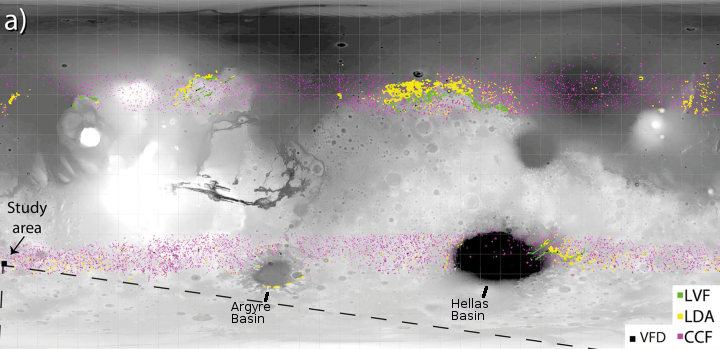
What about the glaciers? The global map of Mars above, reduced and annotated to post here, shows what are believed to be extensive glacial deposits at lower latitudes, and comes from a recently published paper on the subject. The different colors indicate the different types of glacial deposits the scientists have identified.

Green and yellow indicate what scientists call lineated valley fill (LVF) and lobate debris aprons (LDA) respectively, glacial deposits found in the transition zone between the southern highlands and either the northern lowland plains or the basins of the southern hemisphere, Hellas and Argyre. These glaciers are in many ways most similar to glaciers found on Earth, flows heading downhill along natural geographic features.

Magenta represents concentric crater fill (CCF), glacier features which seem very evenly distributed across both the northern and southern lower mid-latitude belts. Here scientists appear to have detected buried ice within the floors of craters.

The paper which included this map focused on describing a new glacial feature, something they dubbed valley fill deposits (VFD), that they had found so far in only one place, as indicated by the black square on the map.

The photograph below and on the right, reduced and cropped to post here, is from figure two of the linked paper.
» Read more

3 comments

Tsunamis on Mars?

New research has found further evidence of past tsunamis on Mars along the transition zone between the northern lowlands (where an intermittent ocean might have once existed) and the southern highlands, caused when a bolide crashed into that ocean.

The new research simulated the height of the tsunami waves and their propagation direction, run-up elevation and distance for three potential sea levels and compared these models with the Martian deposits.

The studyโ€™s results suggest several potential impact craters, 30 to 50 kilometers (19 to 31 miles) in diameter, as the source of the tsunami events. The largest tsunami waves may have been 300 meters (984 feet) high โ€“ nearly as tall as the Eiffel Tower โ€“ following the impact, and waves up to 75 meters (246 feet) high โ€“ nearly as tall as the Statue of Liberty. The waves ultimately reached the Martian coast, potentially traveling up to 150 kilometers (93 miles) past the shoreline.

Below the fold is a video showing the simulation of one such impact and tsunami.
» Read more

1 comment
1 135 136 137 138 139 212