The Martian cycles of climate change, as shown in just one crater

The Martian cycles of climate change, as shown in one crater

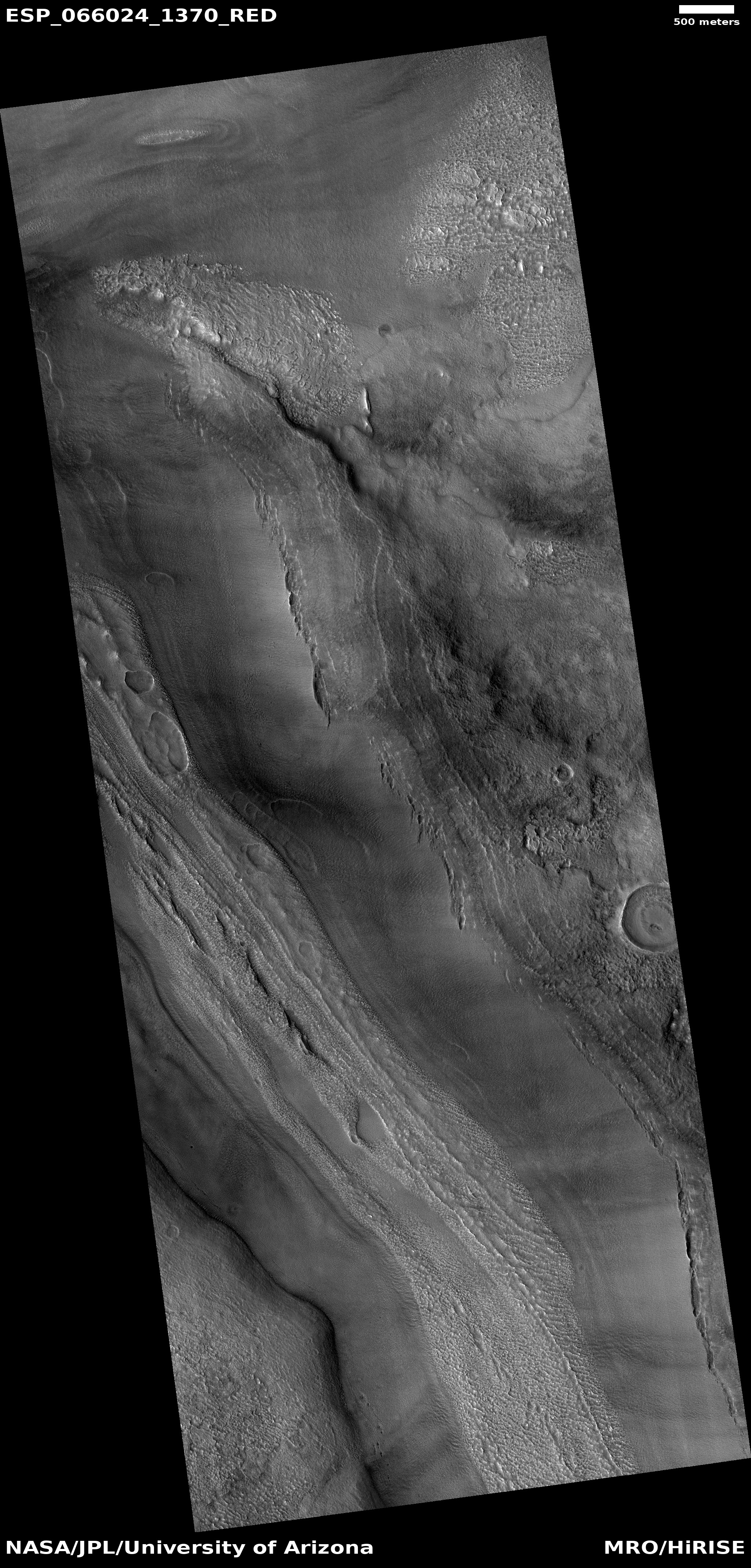
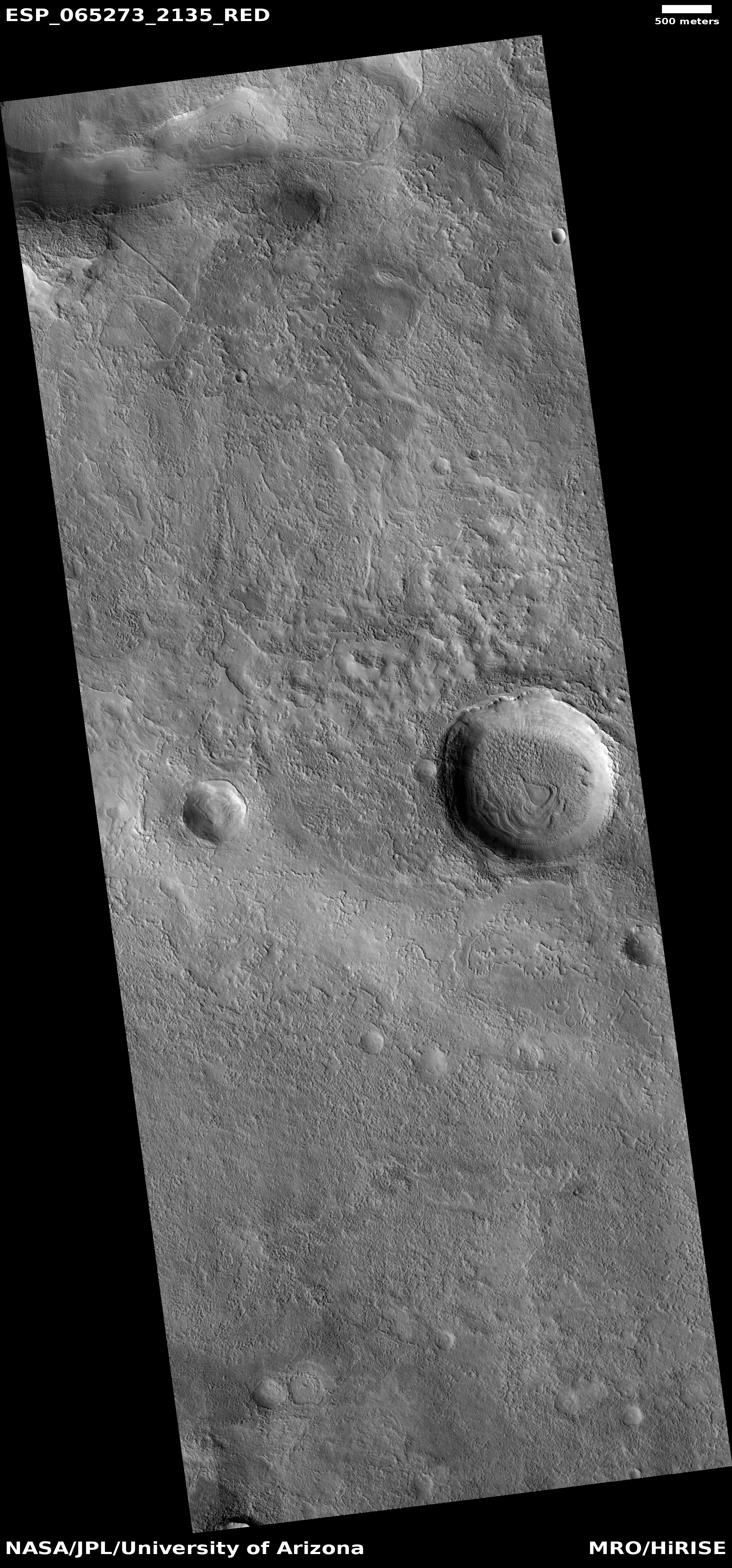
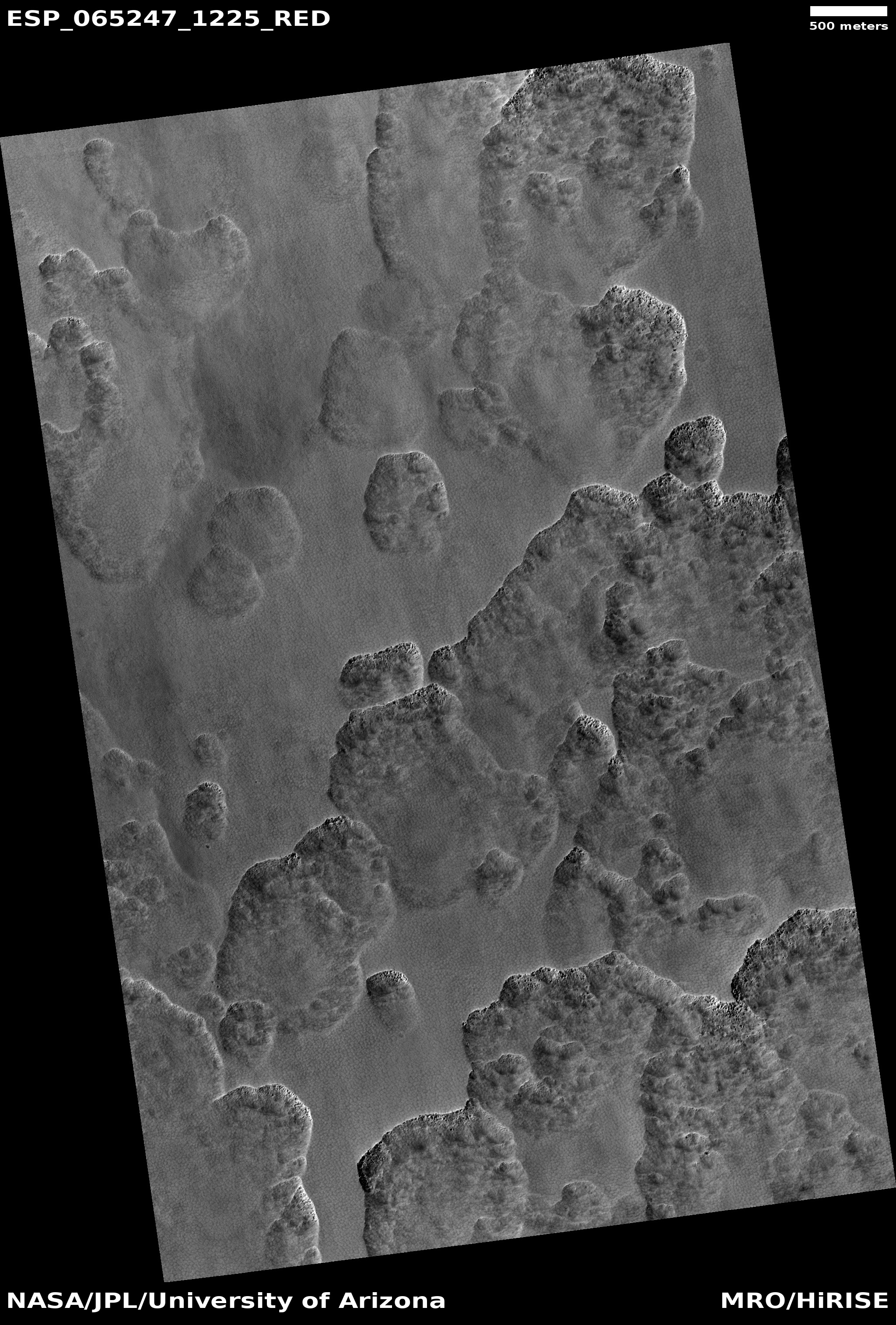
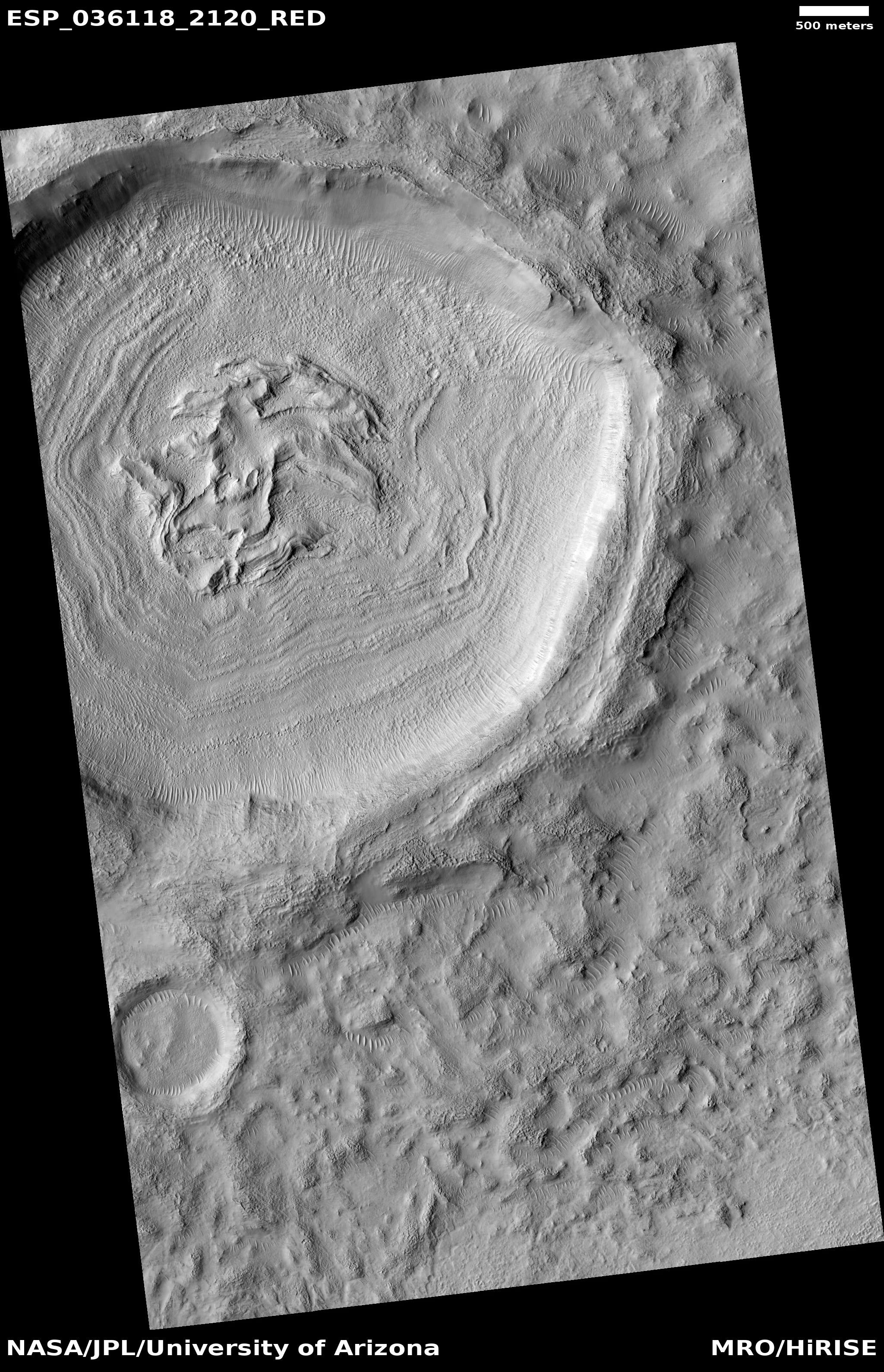
Cool image time! The photo to the right, rotated, cropped, reduced, and enhanced to post here, was taken on September 2, 2022 by the high resolution camera on Mars Reconnaissance Orbiter (MRO). The science team titled this picture “Gullies with Terminal Ridges on Glacial Crater Fill,” a title that in one phrase encapsulates everything we see here of this unnamed 8-mile-wide crater’s western rim and interior.

The crater is located at 46 degrees south latitude inside the much larger 145-mile-wide Kepler Crater, and about 1,500 miles east of Hellas Basin in a region where a lot of glacial ice is found. A context camera image taken in July 2020 shows the entire crater floor apparently covered with glacial fill that on the edges appears to be eroding away.

Today’s high resolution photo focused on the western part of the crater, where that eroding edge was instead replaced by a meandering ridge reminiscent of a moraine. The gullies on the interior slope to the west, as well as the parallel north-south cracks, suggest that debris falling and sliding down from that rim had pushed up against this glacial ice and created that ridge.

There is a lot more to this geology however.
» Read more

0 comments

A cliff face of volcanic erosion on Mars

A cliff face of volcanic erosion on Mars
Click for full image.

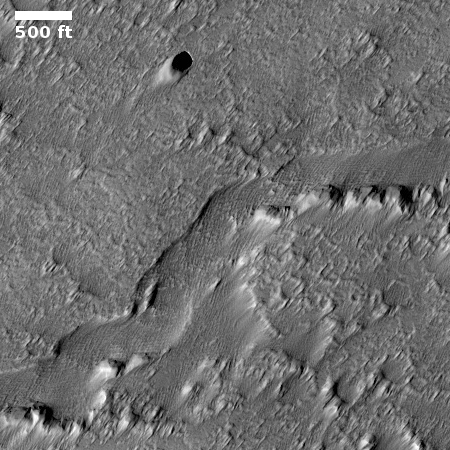
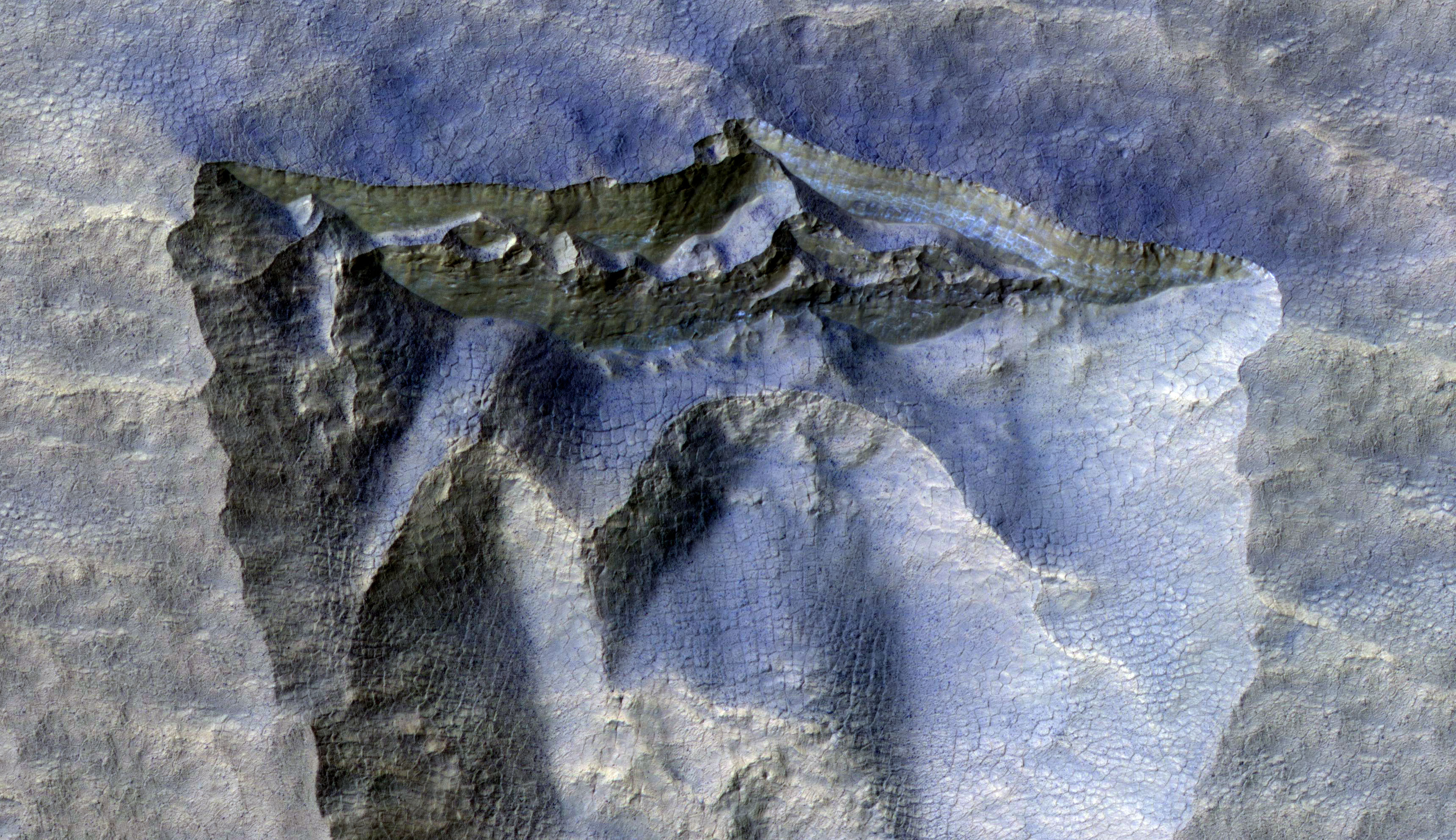
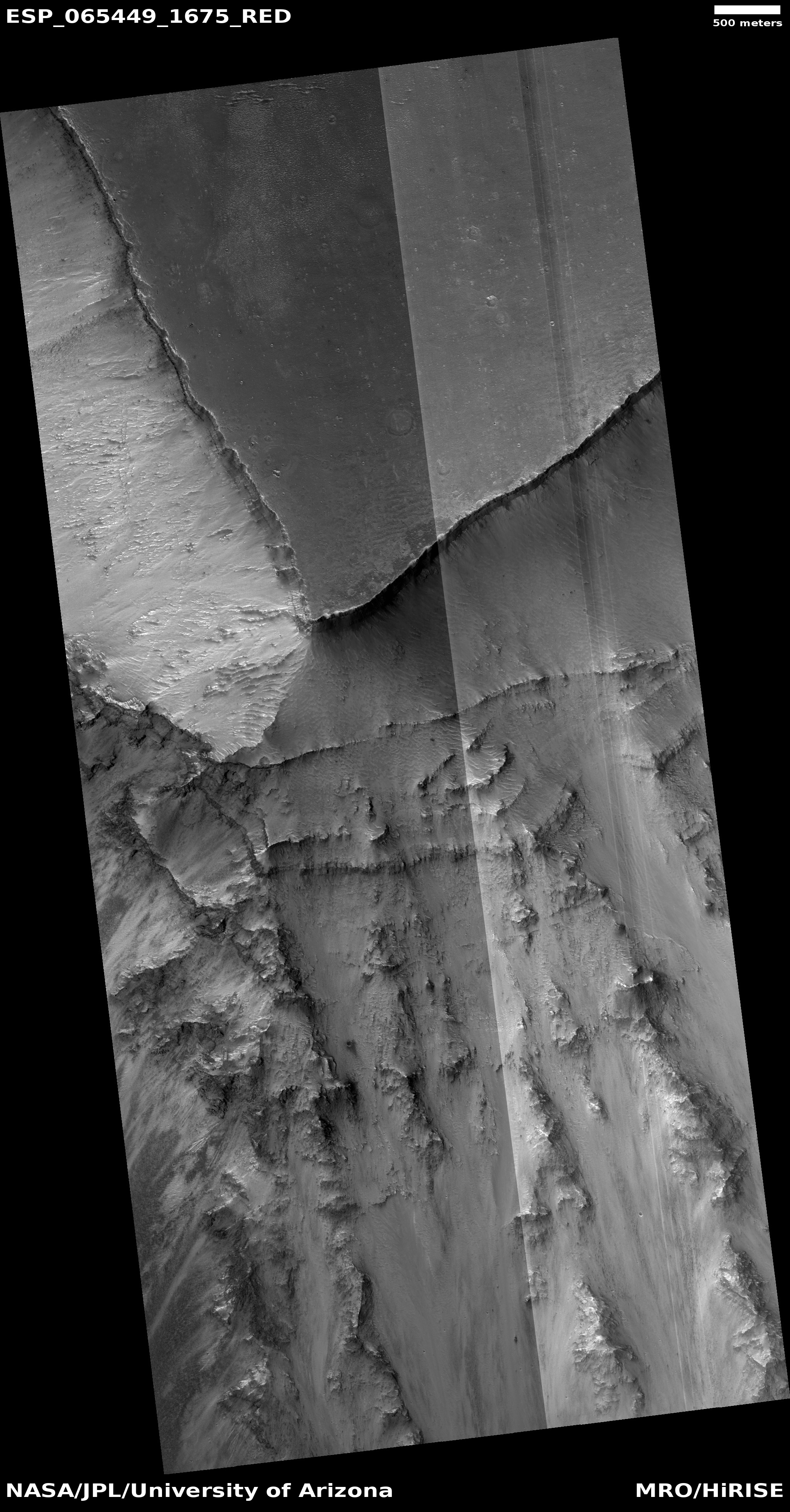
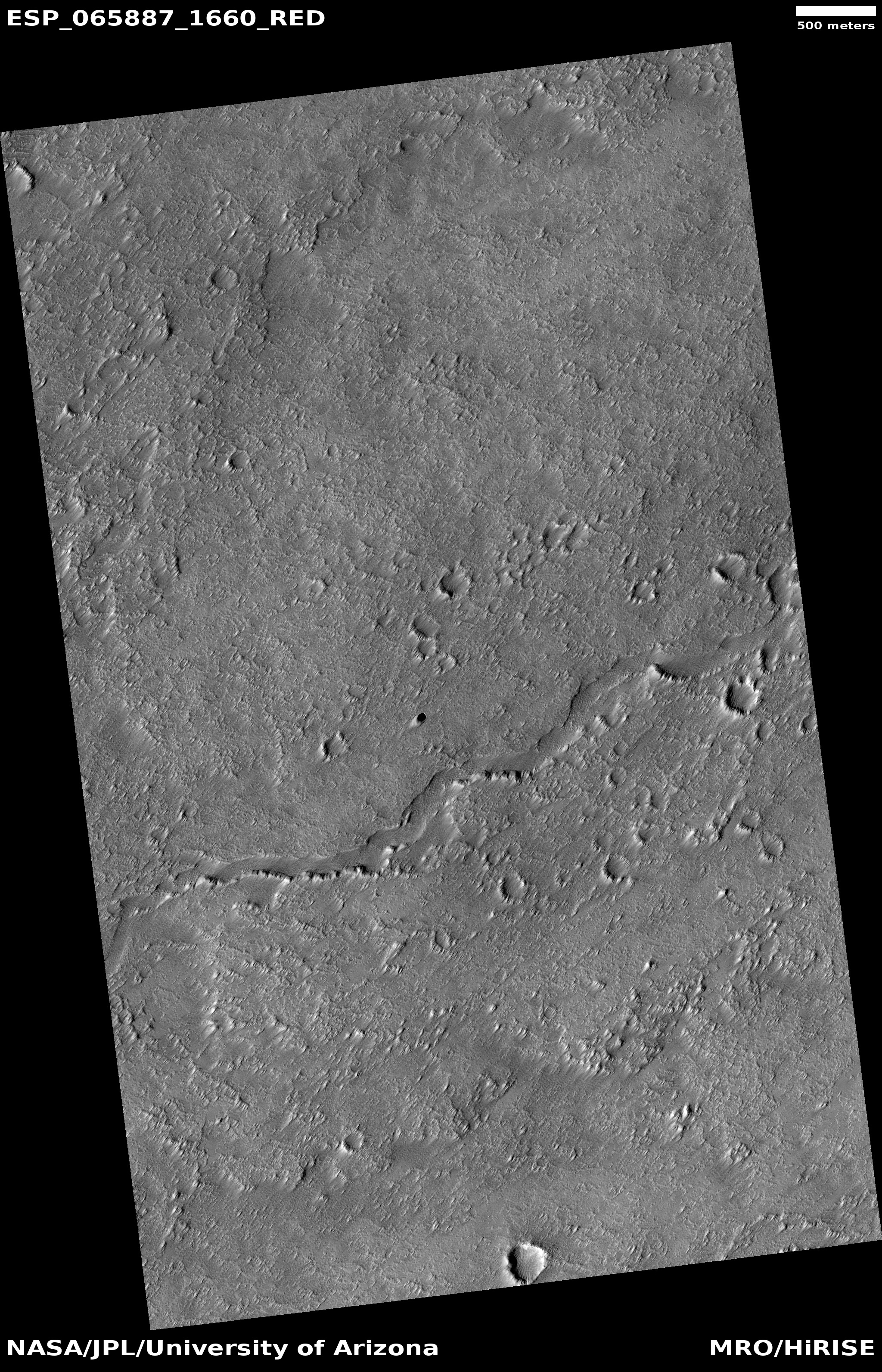
Today’s cool image is a variation of yesterday’s, showing another area on the edge of Mars’ largest volcanic ash field, dubbed the Medusae Fossae Formation and about the size of India. This time however the edge is an abrupt cliff, not the slow petering out of wind-shaped mesas.

The picture to the right, cropped, reduced, and sharpened to post here, was taken on August 27, 2022 by the high resolution camera on Mars Reconnaissance Orbiter (MRO). It shows what I very roughly estimate to be a 1,500 to 2,500 foot high cliff that appears to delineate the edge. To the north we have a plateau of intersperse layers of flood lava and ash. To the south those layers have eroded away, leaving a rough lava plain with a handful of scattered wind-sculpted mesas.

The overview map below, by providing a wider view of his region, makes its nature clearer.
» Read more

0 comments

Erosion at the edge of Mars’ biggest volcanic ash field

Erosion at the edge of Mars' biggest ash field
Click for full image.

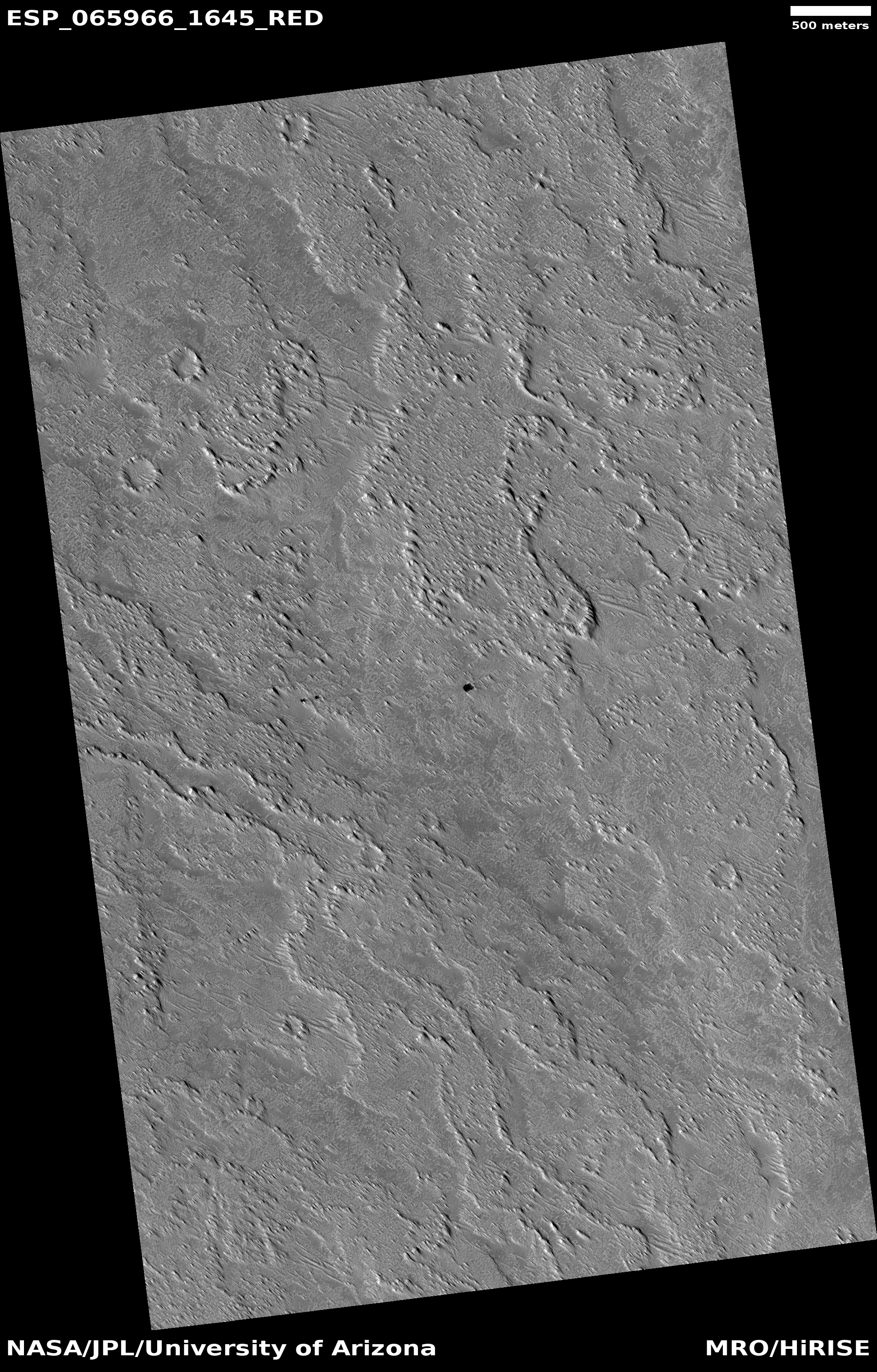
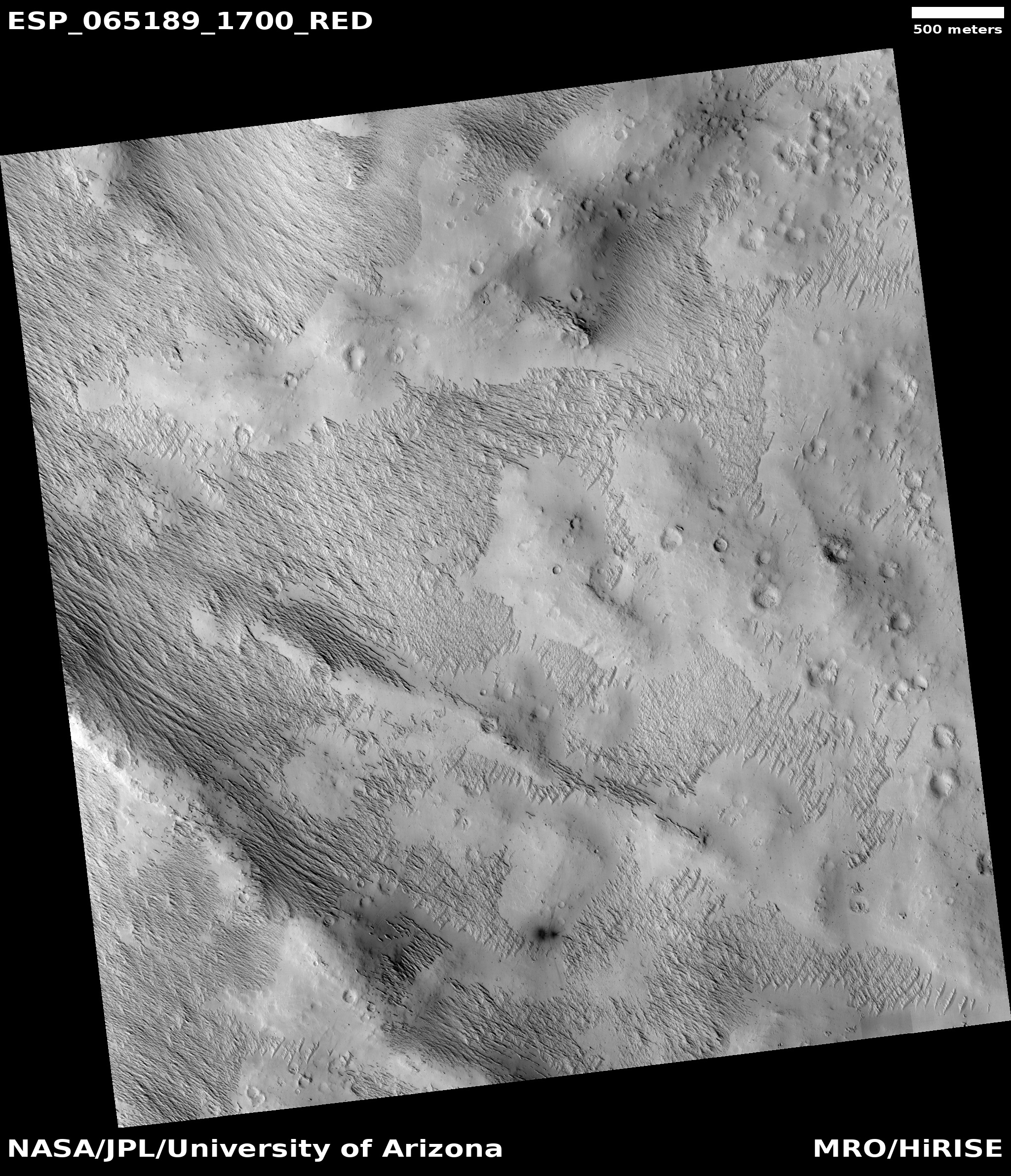
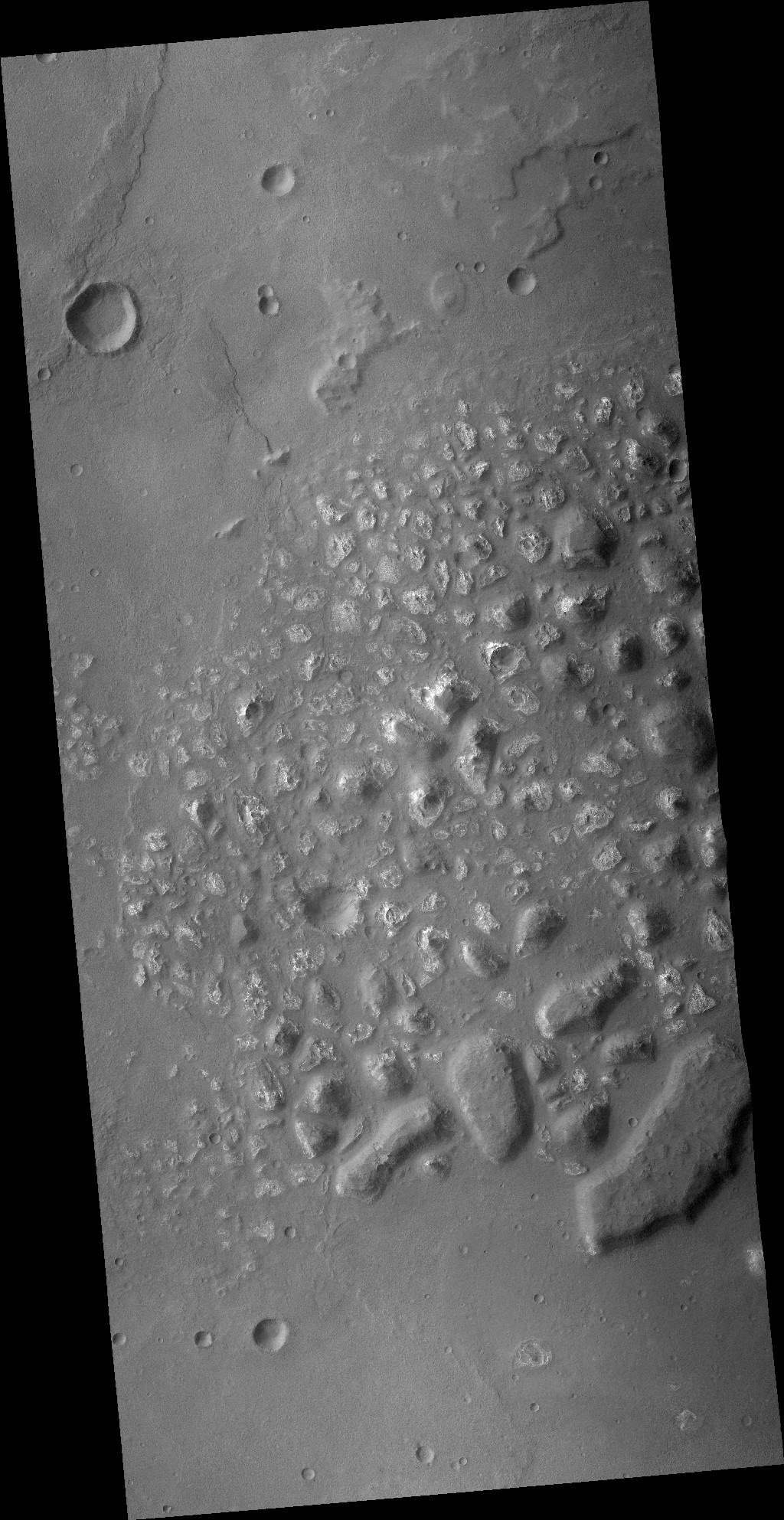
Cool image time! The photo to the right, rotated, cropped, reduced, and sharpened to post here, was taken on August 13, 2022 by the high resolution camera on Mars Reconnaissance Orbiter (MRO). It is another fine example of the wind-blown sculpted terrain that one finds routinely in Mars’ largest volcanic ash field, dubbed the Medusae Fossae Formation. About the size of India, this gigantic field is thought to be the source of most of the dust on Mars.

This particular location sits on the northernmost edge of that huge field. The elongated mesas mark the field’s edge, disappearing to the north but becoming thick and extensive to the south. The prevailing southeast-to-northwest winds have acted to clean most of the ash away.

We can get an idea about how deep and pervasive that field once was at this location by the pedestal crater in the middle right. Once, the floor of that crater was below the top of the ash field. At that time, the top of the dunes marked the general ground level across this entire image. Over time, the winds blew most of this material away, but the denser packed floor of the crater resisted that erosion, and thus now stands above the surrounding terrain.

The more normal-looking craters nearby could have occurred before the ash was deposited, or after it was blown away. The impact that created the pedestal crater however occurred when the ash covered everything here.
» Read more

0 comments

The weirdly eroded rocks of Mount Sharp

A weirdly eroded rock on Mars

Cool image time! The picture to the right, cropped, reduced, and enhanced to post here, was taken on November 2, 2022 by one of the high resolution cameras on the Mars rover Curiosity.

There isn’t much to say. This strangely eroded rock appears somewhat typical for many surface rocks in this area in the foothills of Mount Sharp. The erosion is likely from wind, combined with the rock’s low density because of Mars’ one-third Earth gravity. Even so, that wind would have needed many many eons to achieve this erosion, as the atmosphere on Mars is only about 1% as thick as Earth’s.

The lack of data also leaves open the possibility that other as-yet-unknown chemical processes contributed to that erosion.

Note: The grid pattern in the image is an artifact from the camera, and is not an actual feature on the Martian surface.

3 comments

Perseverance leaps forward

Perseverance's view on November 3, 2022 (Sol 606)
Click for full resolution. The original images can be found here and here.

Overview map
Click for interactive map.

Cool image time! After spending several weeks at one location at the base of the delta that flowed into Jezero Crater eons ago, the science team today put the rover Perseverance into high gear, programming it to move 684 feet in one leap forward. The move worked, so that Perseverance has now climbed up onto a terrace of that delta so that it sits at the base of one of the hills that forms the delta’s head. The panorama above shows that hill. I estimate that hill is about thirty feet high, give or take 50%.

The blue dot on the map to the right shows the rover’s position. The yellow lines show the area viewed in the panorama above. The green dot shows the location of the helicopter Ingenuity.

It is almost certain that the science team will get another core sample from this location, as it is at least one layer higher on the delta, thus providing new geology for that core to document. I am guessing unfortunately. Unlike the Curiosity science team (which posts updates at least one to three times a week), the Perseverance science team posts updates at best only once a week, if that, and those posts have rarely provided information about the team’s future plans.

The panorama above is cool, but what prompted this post is the image below that the rover took after arriving at this location.
» Read more

0 comments

Curiosity begins a detour

Panorama taken November 2, 2022 by Curiosity
Click for full image.

Overview map
Click for interactive map.

The science team running the Curiosity rover on Mount Sharp on Mars have decided to take the rover on a detour. As shown in the overview map to the right, rather than continue climbing directly up the mountain in the canyon dubbed Gediz Vallis, they have turned the rover to the west in order to put it back on its original planned route, though traveling in the opposite direction. The goal is to get to Gediz Vallis Ridge, which the rover attempted to reach by crossing the Greenheugh Pediment back in the spring, but was forced to retreat because the ground was simply too rough for the rover’s wheels.

From their October 31st update:

We are now officially on our detour, a short round trip to image and capture geochemistry of the “Gediz Vallis ridge” up on the pediment, before coming back down to the “Marker Band valley” and rejoining the MSAR (Mount Sharp Ascent Route). This detour will allow us to access some of the area we’d planned to visit before getting turned around by the ‘gator-back’ terrain on the Greenheugh pediment. For this part of the campaign, we are prioritizing driving, getting to our destination as fast as we can, but imaging as we go and marking areas of interest for contact science as we come back down.

The panorama above, cropped and reduced to post here, shows the rover’s view uphill to get to the ridge. The blue dot marks its present position. The yellow lines mark the approximate area viewed by the panorama above.

I think the rover’s path will take it up through the saddle between the two small peaks on the left. The science team is likely hoping that once they get up over that saddle, the terrain to get to the ridge will be smoother and less treacherous than the very broken and rocky surface of the Greenheugh Pediment.

This route also appears to also get them up on the marker band more safely. That band, marked by the white arrows, is a distinct smooth layer found in many places on the flanks of Mount Sharp.

0 comments

InSight status update: still alive!

InSight's daily power levels through October 31, 2022

UPDATE: JPL has released a press release, outlining the steps the InSight team will take to shut the mission down. Key quote:

NASA will declare the mission over when InSight misses two consecutive communication sessions with the spacecraft orbiting Mars, part of the Mars Relay Network – but only if the cause of the missed communication is the lander itself, said network manager Roy Gladden of JPL. After that, NASA’s Deep Space Network will listen for a time, just in case.

There will be no heroic measures to re-establish contact with InSight. While a mission-saving event – a strong gust of wind, say, that cleans the panels off – isn’t out of the question, it is considered unlikely.

Original post:
—————–

Another update on the power levels on the Mars lander InSight was released today, and is shown on the graph to the right.

As of October 31, 2022, InSight is generating an average between 280 and 290 watt-hours of energy per Martian day, or sol. The tau, or level of dust cover in the atmosphere, was estimated at 1.33 (typical tau levels outside of dust season range from 0.6-0.7).

Though the dust level in the atmosphere has dropped, it still is high. Moreover, there is no sign of any clearing of dust from InSight’s solar panels. During the press conference late last week announcing the discovery of impact craters using InSight’s seismometer, the science team gave the lander no more than six weeks of life. One of those weeks has now ticked off.

1 comment

Streaks on the Moon

Streaks on the Moon
Click for full image.

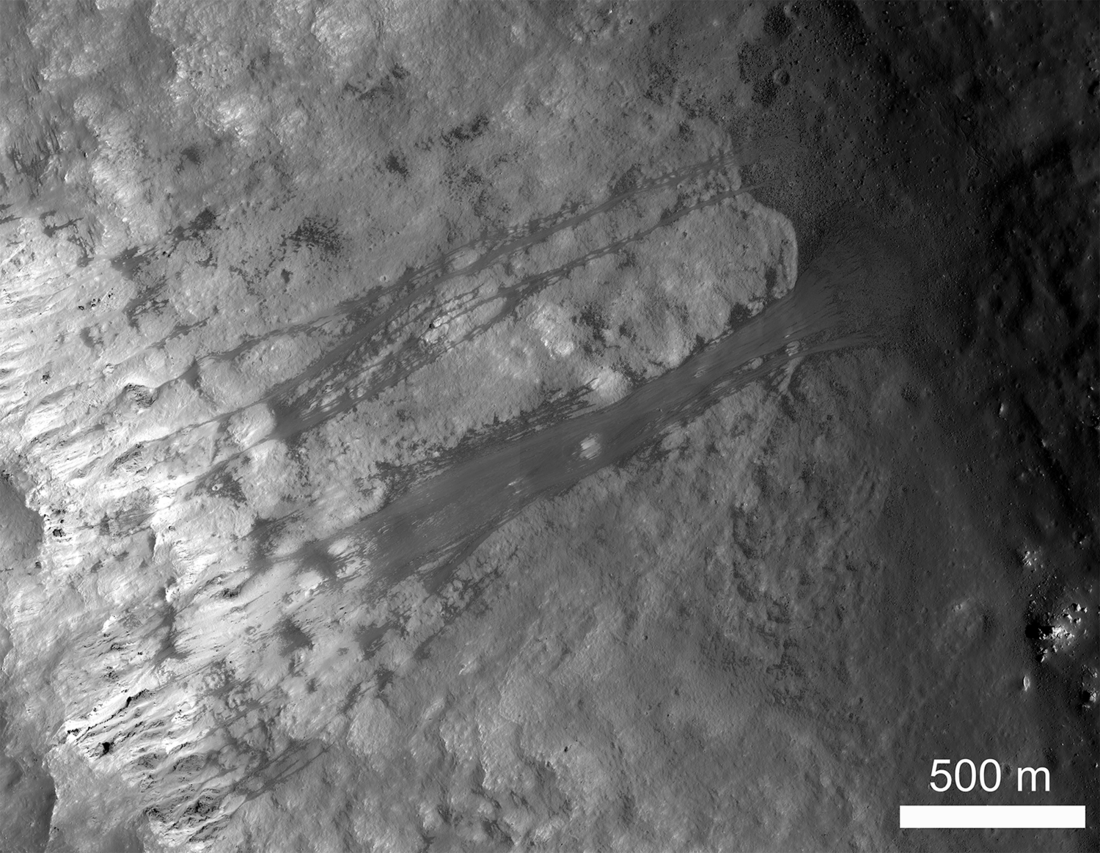
Cool image time! The photo to the right, reduced and enhanced to post here, is an oblique view taken by Lunar Reconnaissance Orbiter (LRO) of the rays that were created when four million years ago an object smashed into the Moon’s far side and produced the 13.75 mile-wide Giordano Bruno crater.

Rays are formed as material ejected from an impact event slams into the surface and churns up local material. Rays are bright because they expose fresh material from depth (both the incoming material and locally churned soil). What is fresh material? Over time the lunar surface is impacted by micrometeoroids and bombarded by radiation; both processes work to darken the surface. The dark “mature” layer at the surface is often only about 50 cm (20 inches) thick, so energetic impacts can easily bring up fresh material from the subsurface. Eventually, the bright rays darken and fade into the background as the surface matures.

In this image, you can see where the ejecta blocks from Giordano Bruno hit the surface, creating a secondary crater, which dug up local material and spread that bright material downstream (so to speak).

The image itself is 4.78 miles wide, at its center, and was snapped from an altitude of 66 miles.

0 comments

The knobby floor of a Martian crater

The knobby floor of a Martian crater

Cool image time! The picture to the right, rotated, cropped, reduced, and enhanced to post here, was taken on July 20, 2022 by the high resolution camera on Mars Reconnaissance Orbiter (MRO). It shows a small portion of the knobby floor of a 70-mile-wide ancient and eroded unnamed crater in the southern cratered highlands of Mars.

Why knobby? Usually such terrain on Mars signifies an very ancient and well eroded region of chaos terrain, its knobs the leftover worn remains of ancient mesas cut by eons of glacier flow.

If this is so, the location as shown in the overview map below suggests if there were ever any glaciers — or any near surface ice — at this location, it had to be a very long time ago.
» Read more

0 comments

Al-Amal orbiter tracks unusual northern summer dust storm on Mars

Fig. 3 from Al-Amal paper
Click for full figure.

Scientists, using UAE’s Al-Amal Mars orbiter, have documented the occurrence of a rare high northern latitude summer dust storm whose origin appears linked to both a major canyon in the northern ice cap as well as the giant sand dune seas that surround that ice cap.

The EMM [instrument on Al-Amal] observed a distinct dust cloud on 10 September 2021. That was outside of the classical Martian dust storm season. The observed dust cloud is an arc-shaped dust storm, typically observed at the northern polar cap edge. This type of non-season dust storm is a well-known phenomenon, but this particular case is interesting because the dust cloud has frontal structure. A large atmospheric front is unusual in this location and season.

EMM’s unique observational coverage adds value to this observation, by providing a sequence of four camera images of the frontal dust cloud, separated by 2–3 hr. The frontal dust cloud shows very little movement over 7–8 hr, that is, it is quasi-stationary. We estimated the wind speed and direction by tracking internal motion of the dust cloud. In one case, the estimated wind is consistent with near-surface easterly winds at the polar cap edge.

The two images to the right are adapted from the paper’s figure 3. The yellow line in the top image indicates the location of the dust storm’s front (about 1,200 miles long), aligned with the canyon Chasma Boreale, marked by the black line, that cuts a 300-mile-long and 4,600-foot-deep gash into the North Pole ice cap.

The storm’s wind speeds were estimated very roughly to be about 16 feet per second, about 10 mph. In Mars’ thin atmosphere these winds would be so gentle that they would be almost imperceptible.

The storm front’s alignment with Chasma Boreale is intriguing, but the overview map below suggests another intriguing alignment.
» Read more

1 comment

NASA & ESA pick site for Perseverance to deposit its samples for pickup

Overview map
Click for interactive map.

Engineers at NASA and the European Space Agency (ESA) have now chosen the site in Jezero Crater where Perseverance will deposit its first set of core samples for later pickup by a mission to bring them back to Earth.

The location, at the base of the delta that flows into the crater and indicated by the white cross on the map to the right, will contain all the core samples collected from the floor of the crater. This area, in the middle of the flat region the science team has dubbed Three Forks, provides a good landing place for the sample return helicopter that will fly from point to point to pick these samples up. The blue dot on the map indicates Perseverance’s present position. The green dot where the helicopter Ingenuity presently sits.

Once the rover has finished collecting samples and doing its research at the base of the delta, it will deposit those samples at this point and then move up onto the delta, where it will collect more samples that will be placed at a different spot for pickup.

0 comments

NASA sets new launch date for Psyche asteroid mission

NASA yesterday announced that the delayed Psyche mission, to the asteroid Psyche, now has a new launch date of October 10, 2023, with a planned arrival in 2029.

The spacecraft missed its original launch date in 2022 because of the late delivery of its flight software combined with problems with the equipment needed to test that software.

The new launch date, though only one year later than planned, will cause the spacecraft to arrive two years late because of orbital mechanics.

1 comment
1 63 64 65 66 67 157