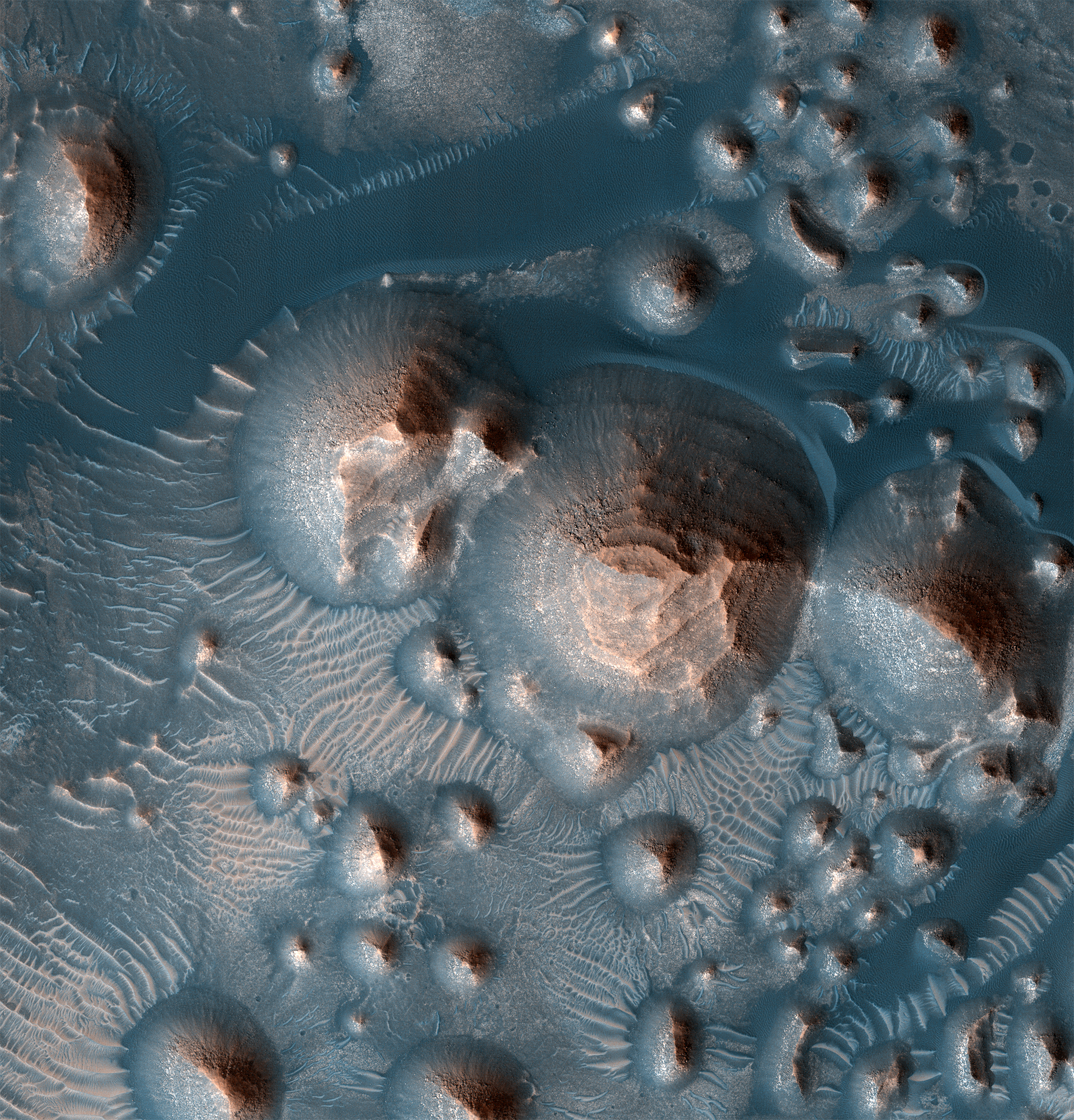
Ancient lava flows down the flanks of the solar system’s largest volcano

Lava flows on Olympus Mons
Click for full image.

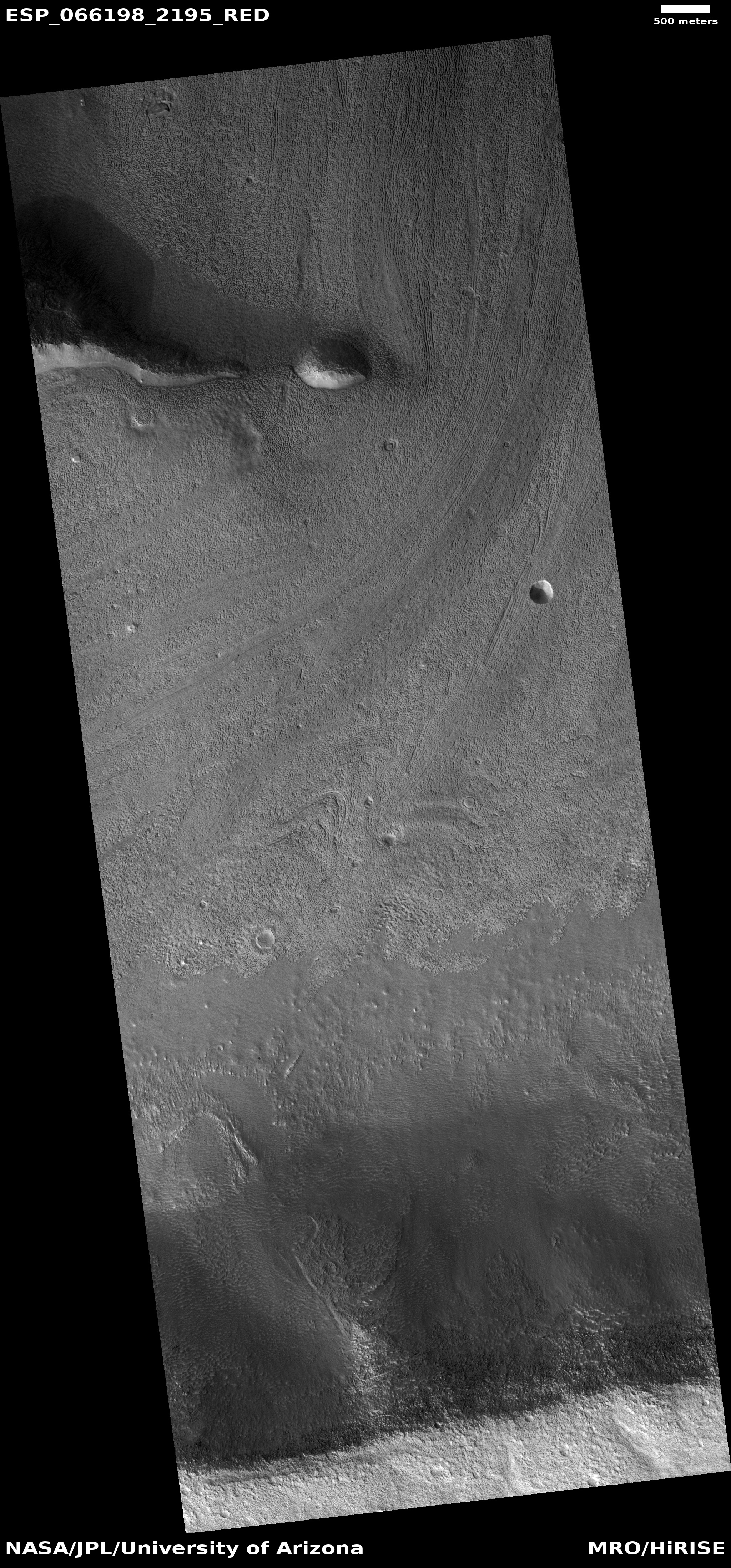
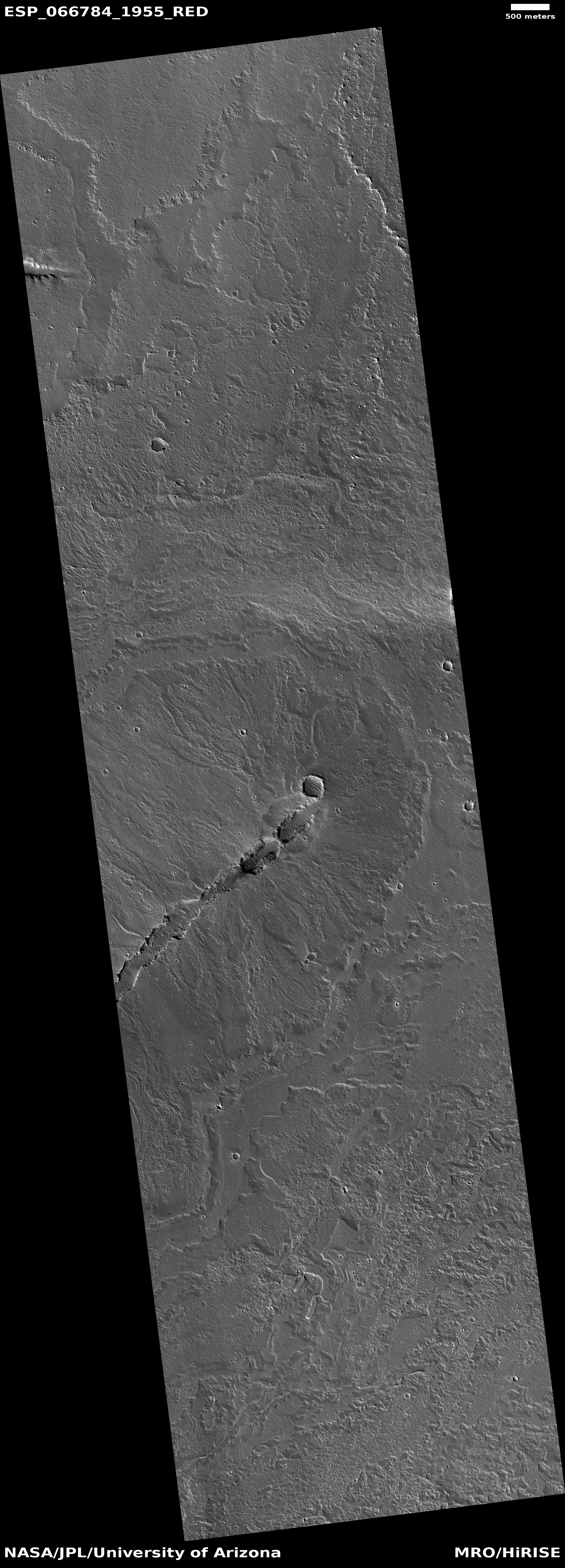
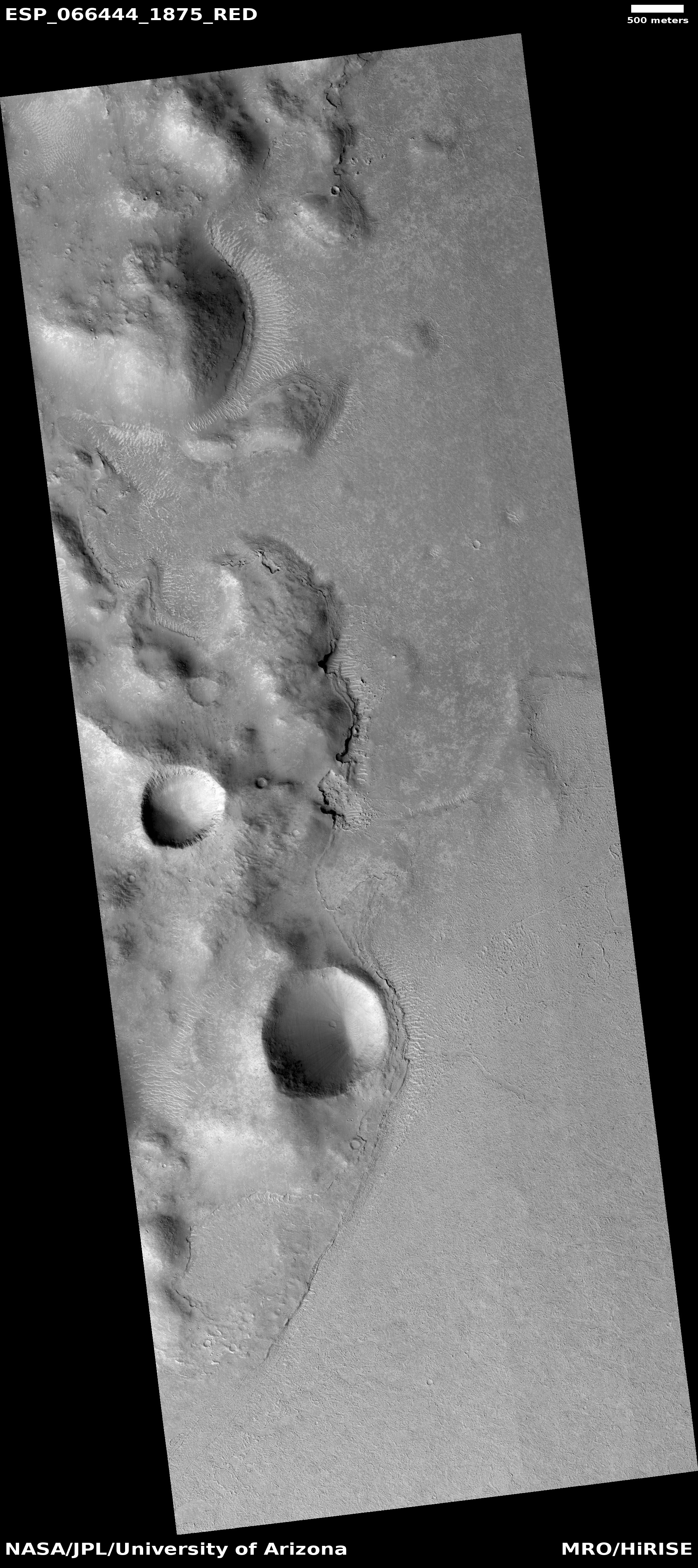
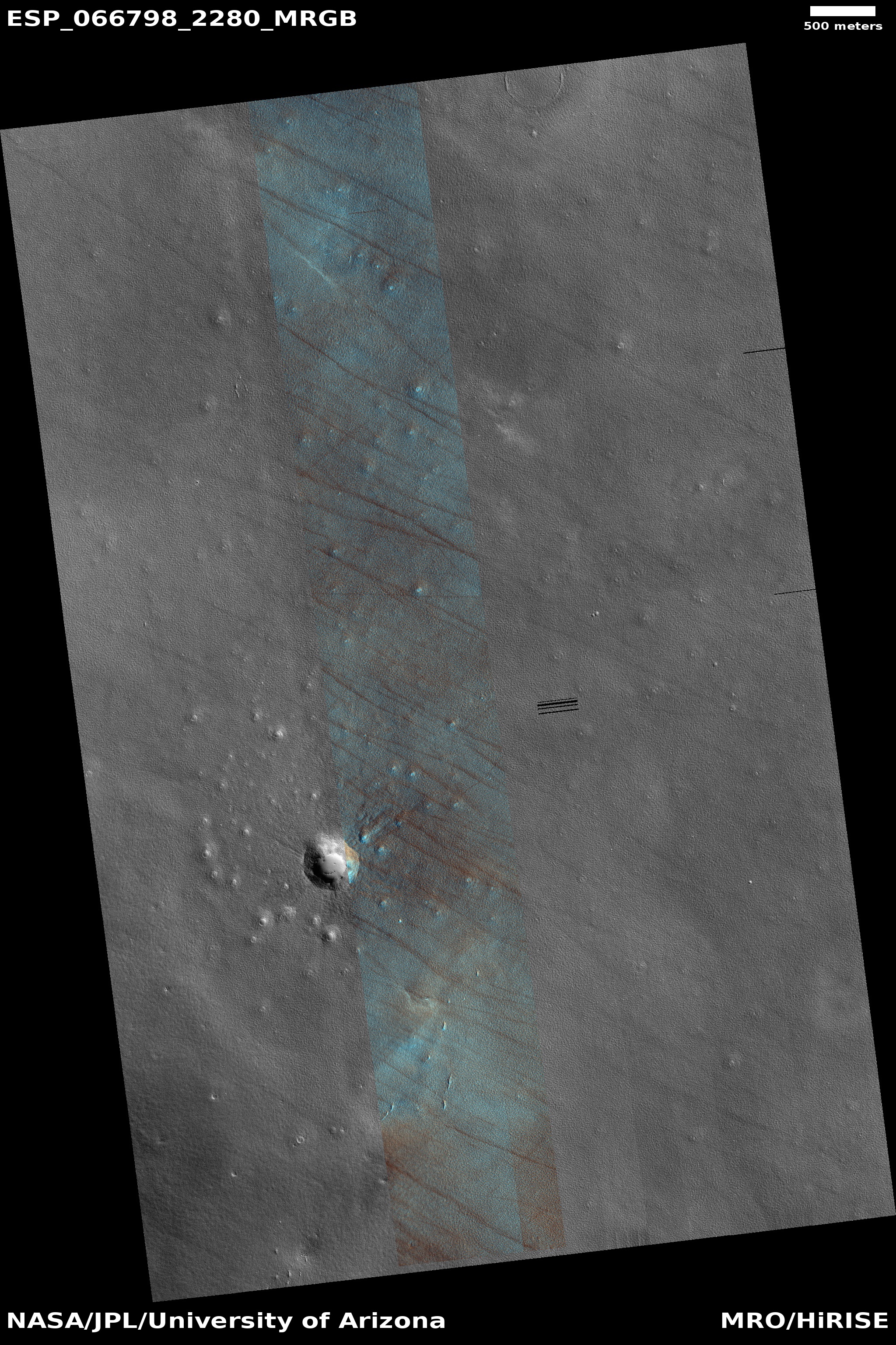
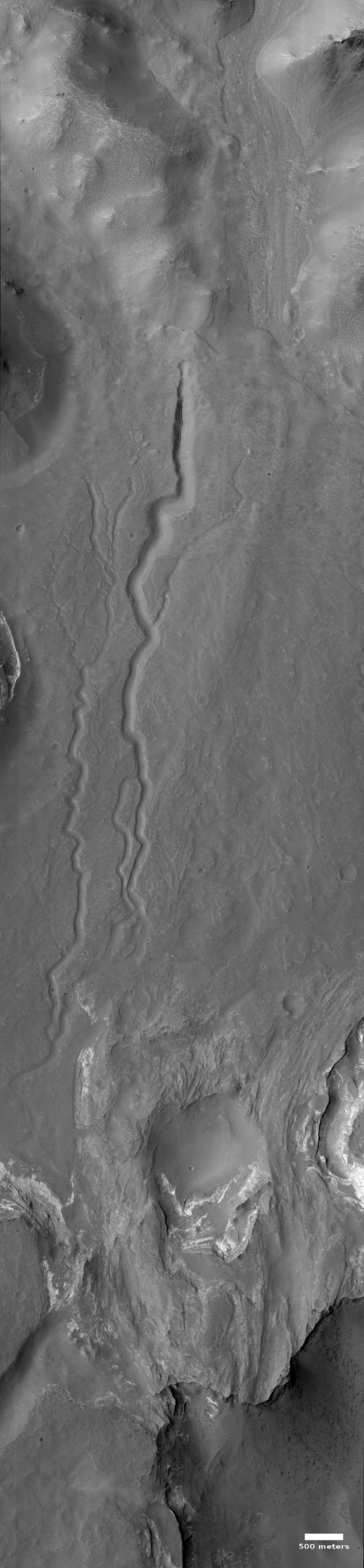
Cool image time! The photo to the right, cropped, reduced, and sharpened to post here, was taken on October 2, 2022 by the high resolution camera on Mars Reconnaissance Orbiter (MRO). It shows what appears to be very old and eroded lava on the northeast flanks of Olympus Mons, the largest volcano on Mars as well as the entire solar system. About 600 miles across, from the edge to its peak, Olympus rises about 54,000 feet, with an actual height relative to Mars’ “sea level” of just under 70,000 feet, more than twice as high as Mount Everest on Earth.

The white arrow show the downward grade. Several different flows can be seen throughout the picture, some confined to a central channel with smooth aprons of overflows on either side. Others are more broken and less coherent, and suggest that either the flows were inherently different, or are much older and have deteriorated with time.
» Read more

0 comments

What a Martian impact looks like on a sheet of slushy ice

Overview map

What a Martian impact looks like on a sheet of ice
Click for full image.

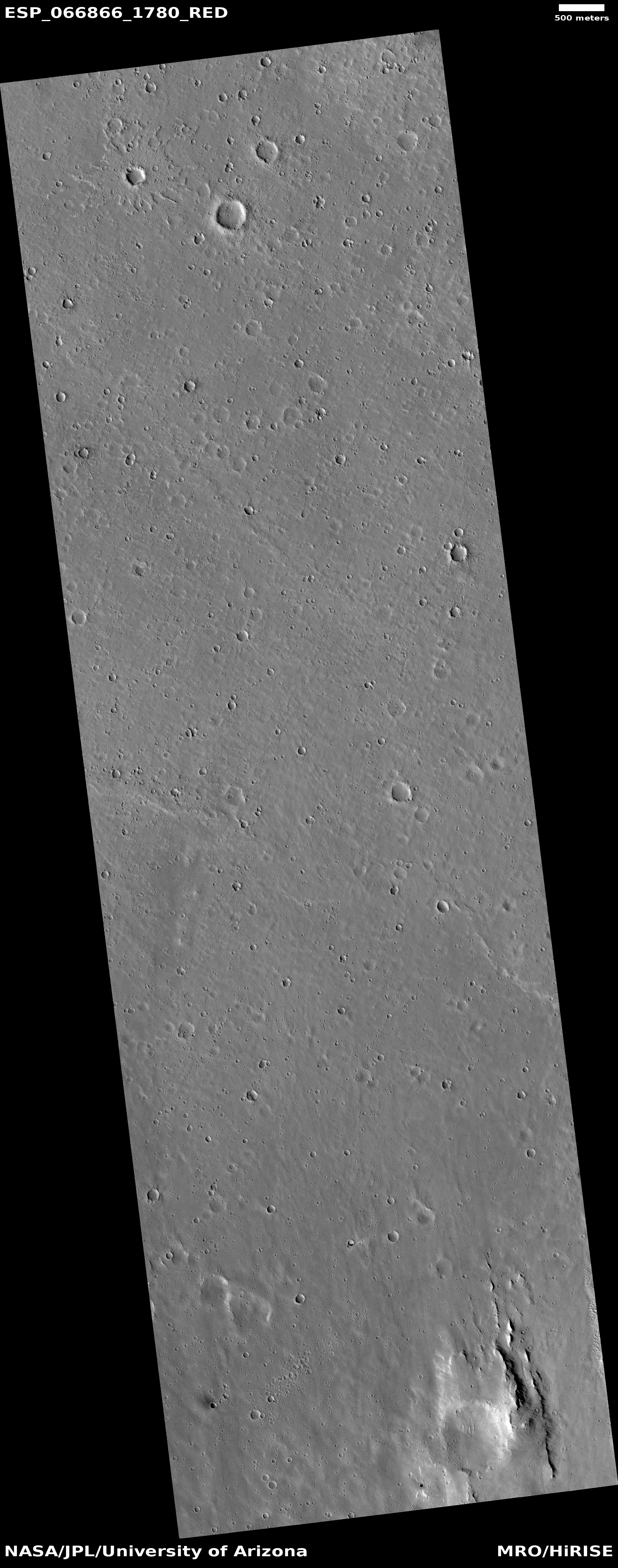
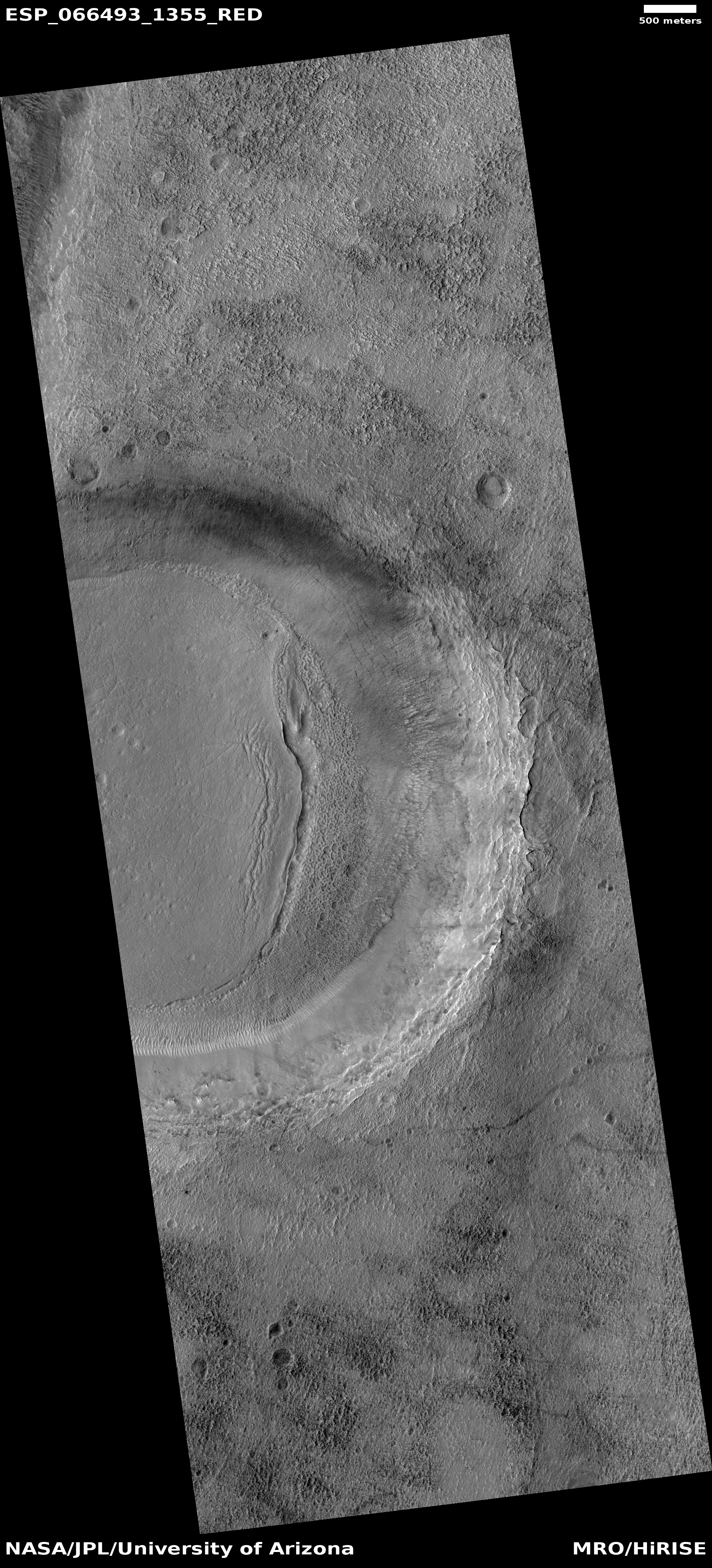
My headline is a bit of a guess, but it is an educated guess for today’s cool image. The photo to the right, cropped, reduced, and sharpened to post here, was taken on October 30, 2022 by the high resolution camera on Mars Reconnaissance Orbiter (MRO).

The location, as indicated by the white dot in the overview map above, puts this impact in a relatively flat area of Deuteronilus Mensae, the westernmost chaos region of the 2,000 mile long mid-latitude strip I call glacier country.

In other words, there is likely a lot of near surface ice here, as this impact makes very plain. If you imagine dropping a pebble into a thick layer of soft ice cream, you might get a crater reminiscent of this. I use for comparison ice cream on Earth because the lighter Martian gravity probably makes Martian ice softer and more slushy.

As I have said many times before, Mars is strange, Mars is mysterious, and above all Mars is alien.

1 comment

A Martian ship’s prow

A Martian ship's prow
Click for full image.

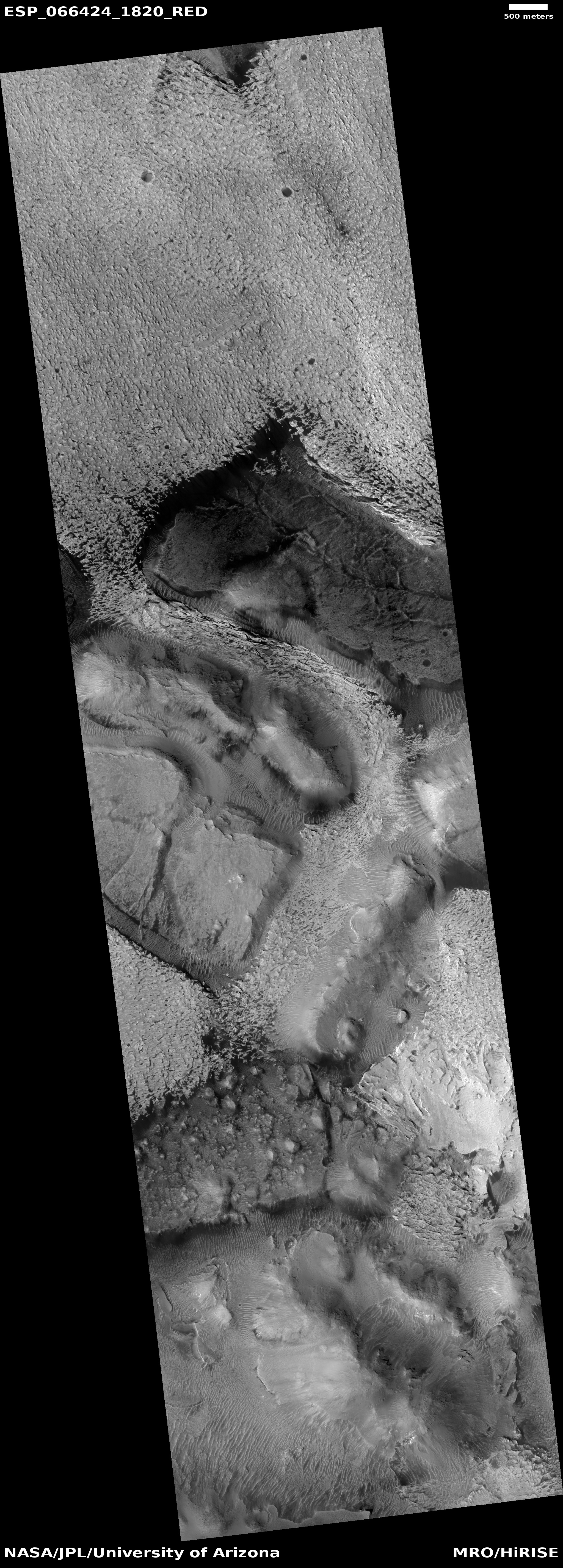
Cool image time! The photo to the right, cropped, reduced, and sharpened to post here, was taken on August 31, 2022 by the high resolution camera on Mars Reconnaissance Orbiter (MRO). It shows what the scientists call “layering” surrounding this pointed mesa, which I roughly estimate to be somewhere between 200 to 400 feet high.

As you approach the mesa you first walk on the dust-covered flat plains. Then you start up a slope of what looks like alluvial fill, material that over time has fallen from the mesa to pile up as an apron at its base. You then reach a series of terraces, each likely marking a different layering major event from sometime in the distance past. Over time, for unknown reasons, the material surrounding this material has eroded away, while the mesa and its layers somehow survived.

The overview map below helps tell us what those past layering events were, as well as the source of the large amount of dust and sand at this location.
» Read more

0 comments

Ingenuity sets altitude record on 35th flight

Overview map
Click for interactive map.

On December 3, 2022 Ingenuity completed its 35th flight, traveling about 49 feet sideways but reaching a new altitude record for the Mars helicopter of 46 feet.

The map to the right shows the helicopter’s new position by the green dot, with Perseverance’s present position shown with the blue dot. The helicopter only moved slightly to the northwest of its previous position.

The plan had been to test the helicopter’s upgraded software at this new altitude while flying fly 50 feet sideways for 52 seconds at a speed of 6.7 feet per second. The flight met these goals almost exactly, going a distance only slightly shorter, well within its margin of error. The new altitude record however is significant, as going even slight distances higher in Mars’ very thin atmosphere (1/1000th of Earth’s) is challenging, to say the least. This higher flight means Ingenuity can fly up above higher terrain, such as the delta that is Perseverance’s next goal.

0 comments

InSight’s low power levels holding steady

InSight's power levels as of November 29, 2022

The science team for the Mars’ lander InSight today (December 6th) released a new update (dated November 29th) of the power levels being produced by its dust-covered solar panels.

As of Nov. 29, 2022, InSight is generating an average between 290 watt-hours of energy per Martian day, or sol. The tau, or level of dust cover in the atmosphere, was estimated at .95 (typical tau levels outside of dust season range from 0.6-0.7).

I have added this new data unto the graph to the right, though I am puzzled by the date given to the update. Why post this today, when this update covers data only two days after the previous update (November 27th), and is more than a week out of date? This is especially puzzling because the numbers did not change at all.

Nonetheless, the lander is still alive, but barely. One wonders however what happened in the past week, since today’s update does not bring us up to date.

0 comments

Martian dunes, as far as the eye can see

Martian dunes
Click for full image.

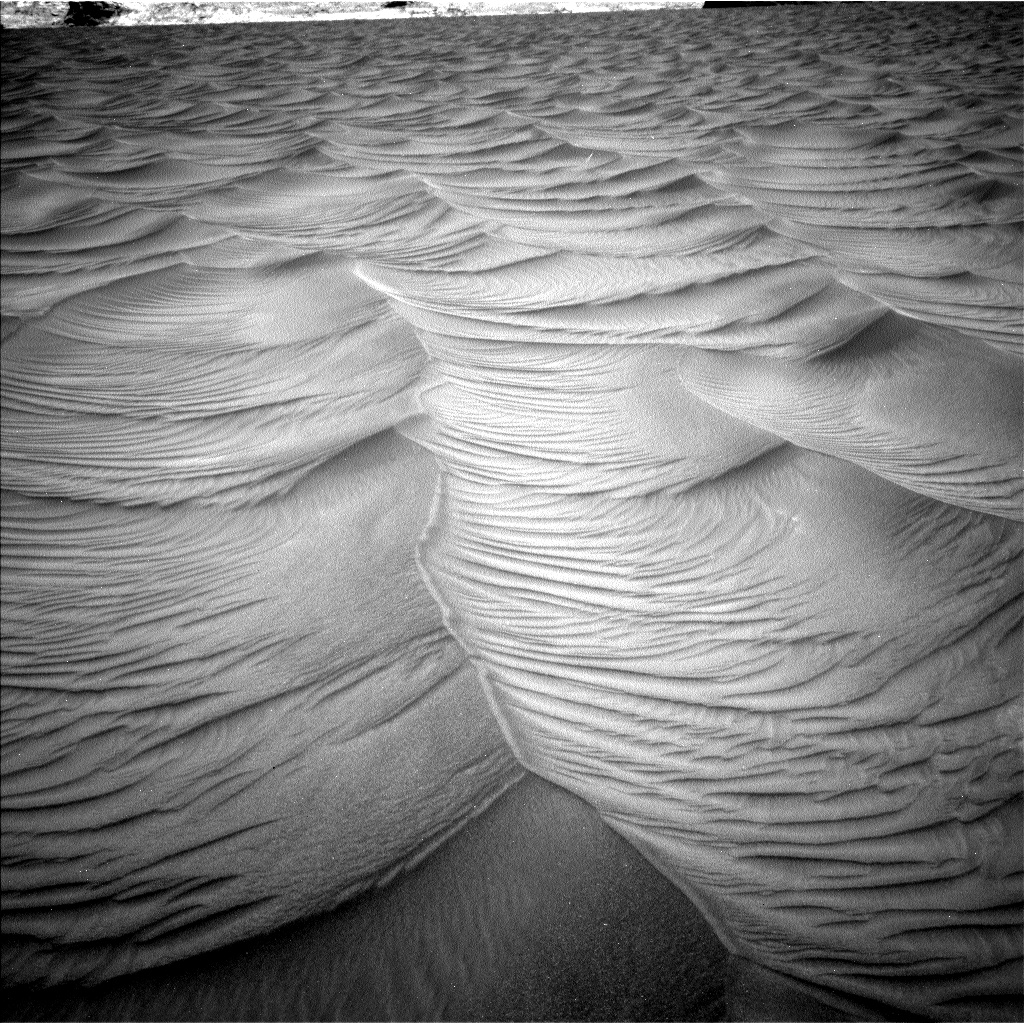
Cool image time! The photo to the right, cropped, reduced, and sharpened to post here, was taken on July 14, 2022 by the high resolution camera on Mars Reconnaissance Orbiter (MRO). It shows the dune filled floor of an unnamed 25-mile-wide ancient and very eroded Martian crater.

These endless dunes — which extend far beyond this photo to cover the entire floor of this crater as well as an overlapping crater to the north that is only slightly smaller — reveal something fundamental about this location: The winds prevail from one direction consistently, from either the north or the south. Closer inspection would likely resolve which way, but I don’t have the knowledge or access to the data to do so.

The overview map below, provides context, and also further information about why these dunes are here.
» Read more

0 comments

The steep interior rim of Aristarchus Crater

Aristarchus Crater
Click for larger image.

Cool image time! The photo to the right, cropped, reduced, and sharpened to post here, is a just released image taken by Lunar Reconnaissance Orbiter, looking across the top of Aristarchus Crater on the Moon from a height of only 60 miles, with the dark surrounding plateau in the foreground contrasting sharply with the bright crater interior. For scale, the distance from the floor of the crater to the top of the rim is about 9,000 feet. The bright central peak is about 1,300 feet tall. The contrast in brightness inside and outside the crater is explained thus:

Adjacent to Aristarchus crater is the Aristarchus plateau, one of the largest volcanic centers on the Moon. Here we find one of the largest rilles [on the Moon, dubbed Vallis Schröteri], a massive pyroclastic deposit, and the source of extensive flood basalts.

These volcanic materials are considered relatively young (for the Moon) – 1.5 to 2.5 billion years. The pyroclastic deposit formed when magma was explosively ejected from the vent and broke into small droplets quenched as glass in the cold vacuum of space as they fell back to the surface. Due to their high glass content, the pyroclastic deposits are distinctly low in albedo (relatively dark), providing a dark background for the bright Aristarchus crater. Within the crater, some of these pyroclastic deposits may be visible as the darkest areas on the far wall, and glassy impact melt is moderately lower in reflectance than the bright, rocky materials exposed on areas of the crater floor and walls.

The overview map below shows both the crater and the vent from which Vallis Schröteri belched.
» Read more

0 comments

Curiosity’s recent and future travels amid the Martian mountains

Curiosity's recent and future travels on Mars
Click for full panorama.

Overview map
Click for interactive map.

The panorama above, created from 31 images taken by Curiosity’s right navigation camera on December 5, 2022, provides us a wonderful overview of the rover’s recent and future travels amid the lower foothills of Mount Sharp in Gale Crater.

The overview map to the right provides context. The blue dot indicates Curiosity’s present position. The yellow lines indicate the approximate area viewed by the panorama. The red dotted line indicates Curiosity’s planned route, with the white dots the route it has actually traveled. On the panorama, the pink dotted line indicates where it has been, and the red dotted line where it is going.

For scale, Kukenan is estimated to be about 1,500 feet high. Though Chenapua in front seems comparable, it is actually much smaller, only about 200 to 300 feet high, at the most. Orinoco, though lower on the mountain, is probably about 300 to 400 feet high.

To really see the magnificence of this terrain, you must click on the panorama and explore the full image. Curiosity is truly traveling amid mountains, and is the first human robot to do so on another world.

0 comments

Martian glaciers below 30 degrees latitude

A Martian glacier below 30 degrees north latitude
Click for full image.

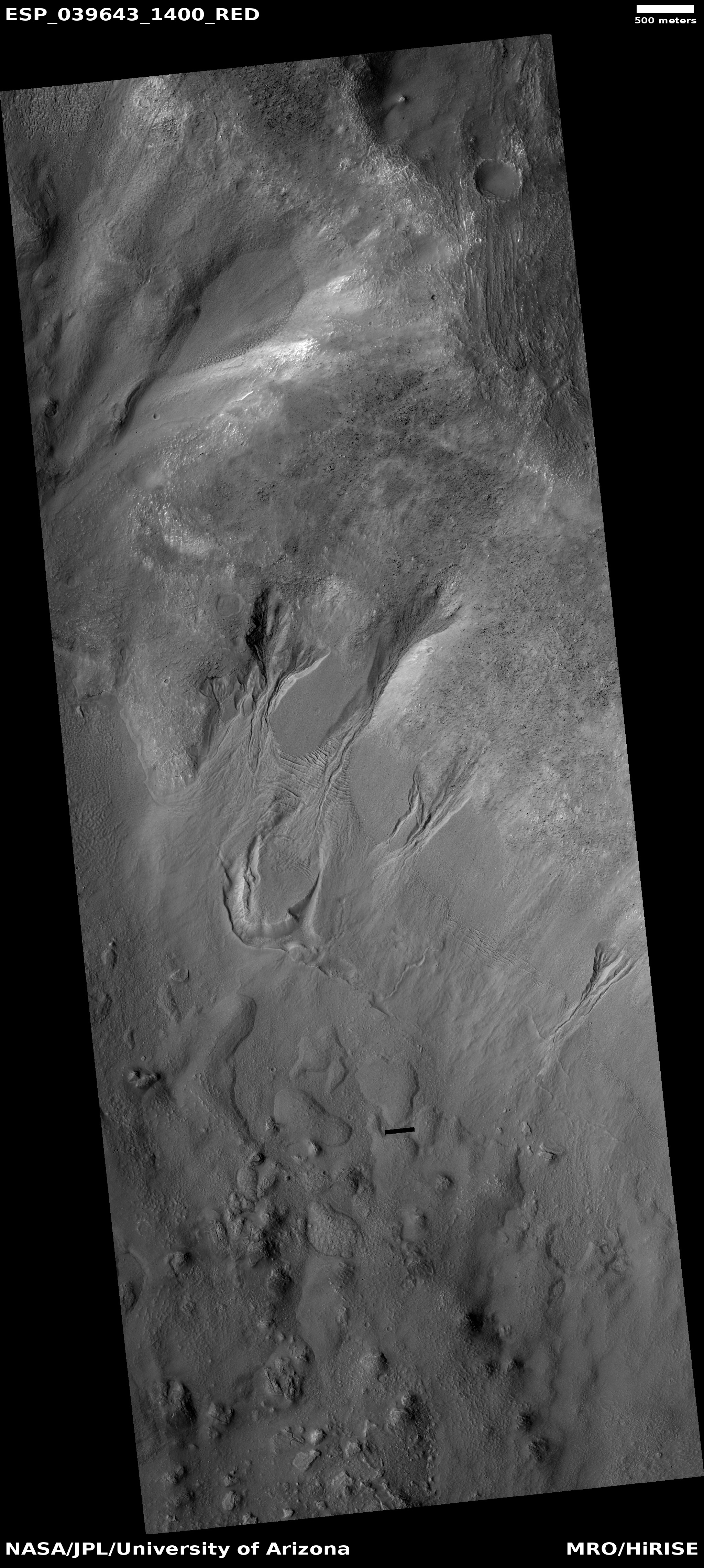
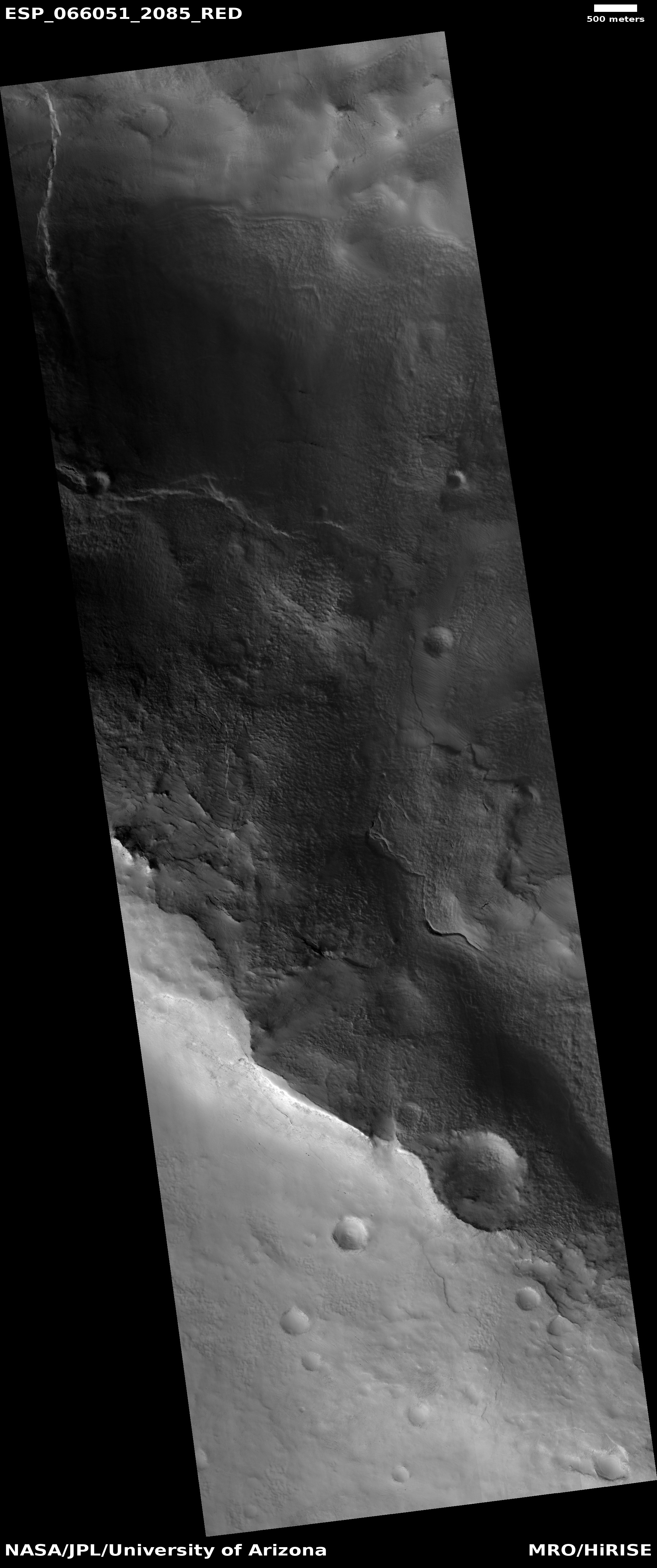
Cool image time! The picture to the right, cropped, reduced, and sharpened to post here, was taken on September 28, 2022 by the high resolution camera on Mars Reconnaissance Orbiter (MRO). While it shows what looks like a somewhat typical Martian glacial flow pushing through a gap between hills, this glacial flow is not typical. It sits at just under 30 degrees north latitude, closer to the equator than almost any glacial feature on Mars. Moreover, the younger impact crater on top suggests this glacier has been here for some time. Though the impact is younger than the crater, it is not that young, as the dark streaks normally seen in the first years after impact are gone.

Thus, this glacier suggests that not only can near surface Martian ice exist closer than 30 degrees latitude from the equator, it can survive there for a considerable amount of time.

Nor is this glacial flow, so close to the equator, unusual for this region of Mars.
» Read more

0 comments

Expanded craters in Martian ice

Expanded craters in Martian ice
Click for full image.

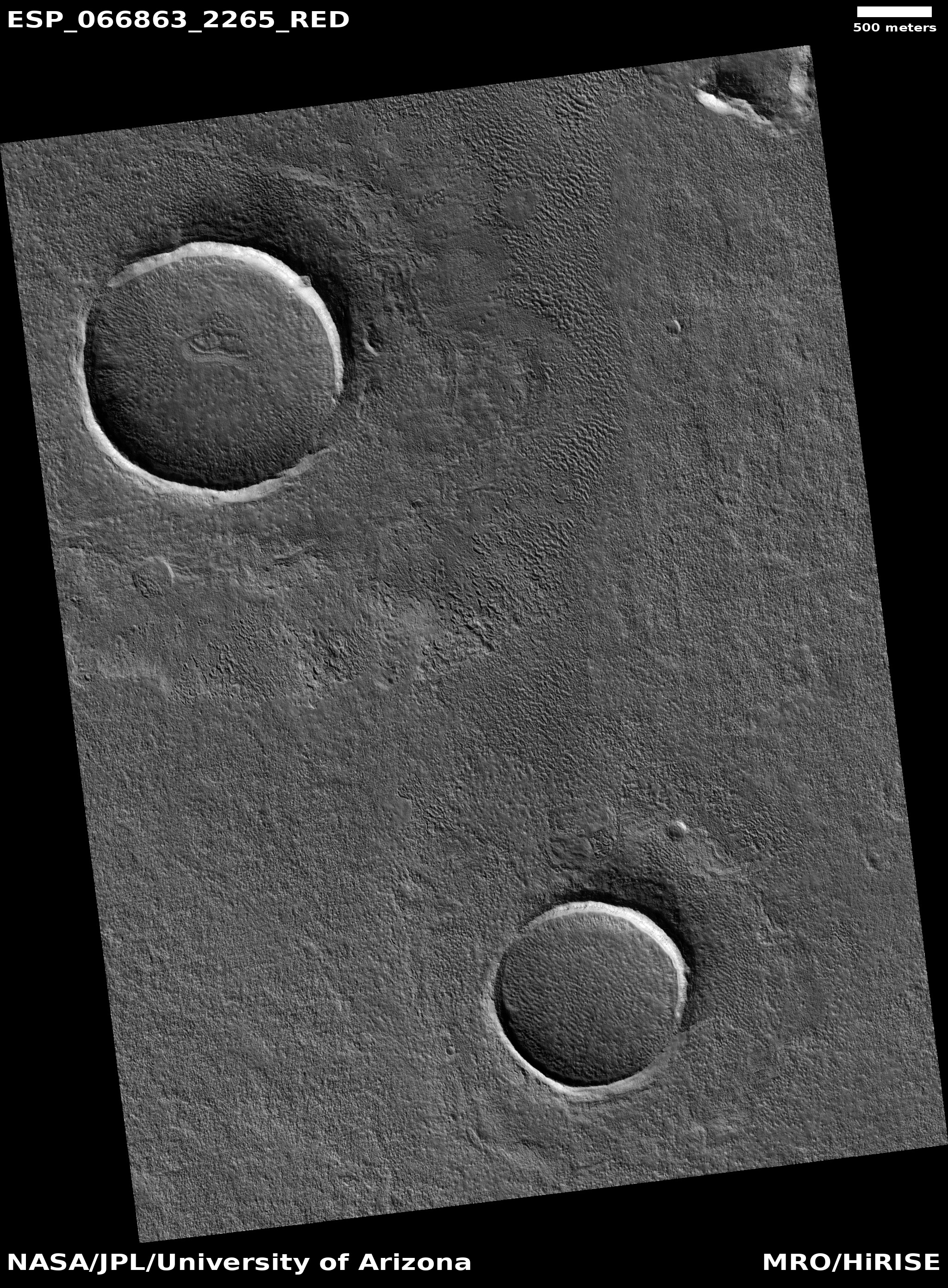
Cool image time! The photo to the right, rotated, cropped, reduced, and sharpened to post here, was taken on August 18, 2022 by the high resolution camera on Mars Reconnaissance Orbiter (MRO). It includes a wide variety of geology related to sublimating ice, including expansion cracks as well as several different examples of what scientists call “expanded craters,” impacts that occurred in near surface ice and have been reshaped by the ice’s melting and sublimation at impact and then later. It also shows some obvious glacial fill in the two distorted craters at the center right.

A 2017 dissertation [pdf] by Donna Viola of the University of Arizona outlines nicely what we know of Martian expanded craters. As she notes in her conclusion:
» Read more

0 comments

Scientists: Viking-1 might have landed on a field of Martian tsunami debris

The geological history of the Viking-1 Mars landing site

As outlined in their new paper [pdf], a team of scientists now hypothesize that the features that surrounded Viking-1 when it landed on Mars in 1976 were caused by two past Martian tsunamis. Each tsunamis occurred due to an impact in the theorized ocean that is believed to have existed in this part of Mars’ northern lowland plains several billion years ago.

The graphic to the right, figure 8 from the paper, shows the hypothesized sequence of events. From the caption:

(a) Pohl crater forms within a shallow marine environment, (b) triggering tsunami water and debris flow fronts. (c) The wave fronts extensively inundate the highland lowland boundary plains, including a section ~ 900 km southwest of the impact site. (d) The ocean regresses to ~ − 4100 m, accompanied by regional glacier dissection, which erode the rims of Pohl and other craters. (e) The younger tsunami overflows Pohl and parts of the older tsunami. Glaciation continues, and mud volcanoes later source and emerge from the younger tsunami deposit. (f) ~ 3.4 billion years later, the Viking 1 Lander touches down on the edge of the older tsunami deposit.

The overview map below provides the larger context.
» Read more

4 comments

InSight continues to just hold on

InSight's power levels as of November 27, 2022

The InSight science team today posted another update on the daily power levels the Mars lander’s dust-covered solar panels are producing. The graph to the right includes these new numbers.

As of Nov. 27, 2022, InSight is generating an average between 285 and 295 watt-hours of energy per Martian day, or sol. The tau, or level of dust cover in the atmosphere, was estimated at .95 (typical tau levels outside of dust season range from 0.6-0.7).

The atmosphere is definitely clearing from the dust storm that occurred in October. It also appears that not much of this dust is settling on InSight’s solar panels, since the daily power level has not dropped significantly.

Nonetheless, at these very low power levels, InSight’s future remains day-to-day. Unless it finally gets lucky and a dust devil blows the solar panels clear so more power can be generated, the mission will end should two scheduled communications sessions in a row fail to make contact.

0 comments
1 61 62 63 64 65 157