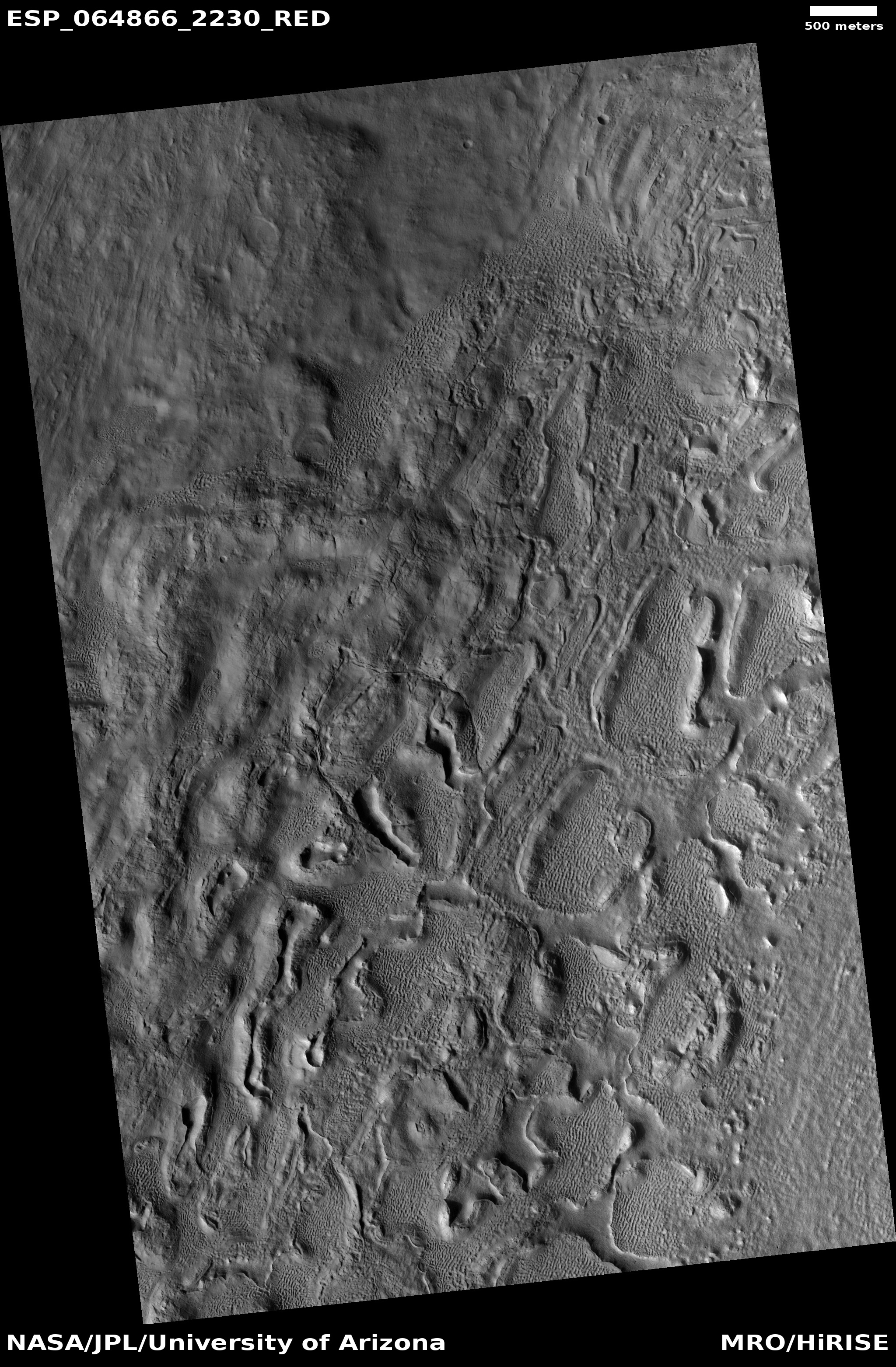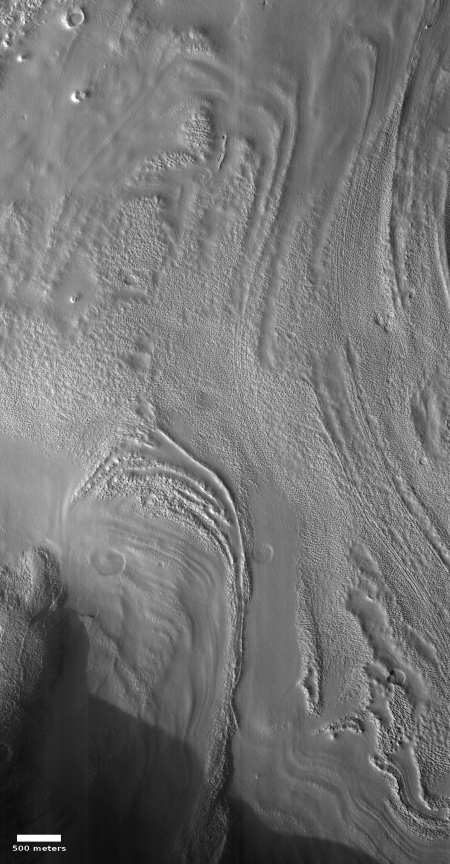
Mars: A small volcano at the base of a big volcano

Volcanic vent near Pavonis Mons
Click for full image.

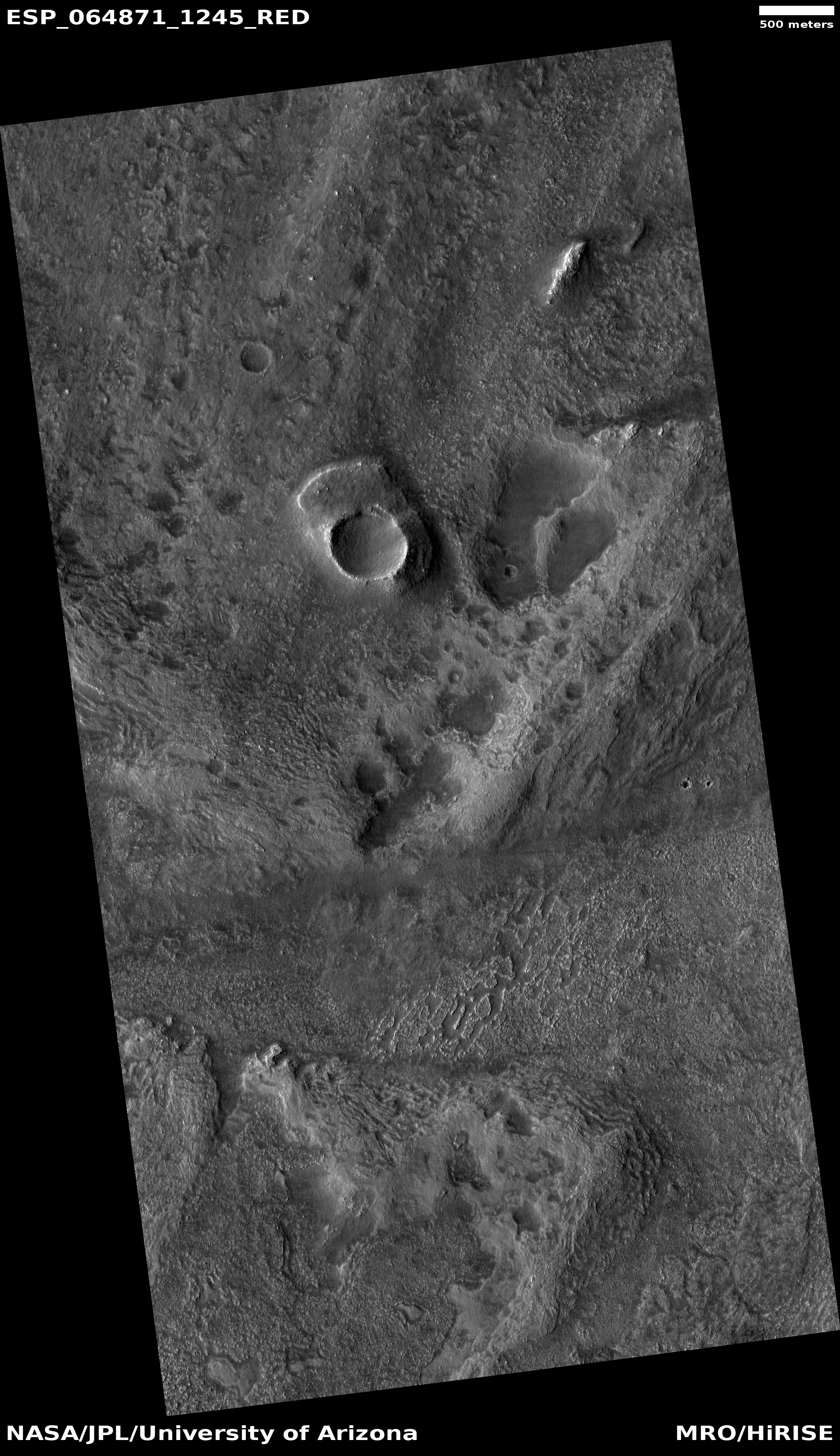
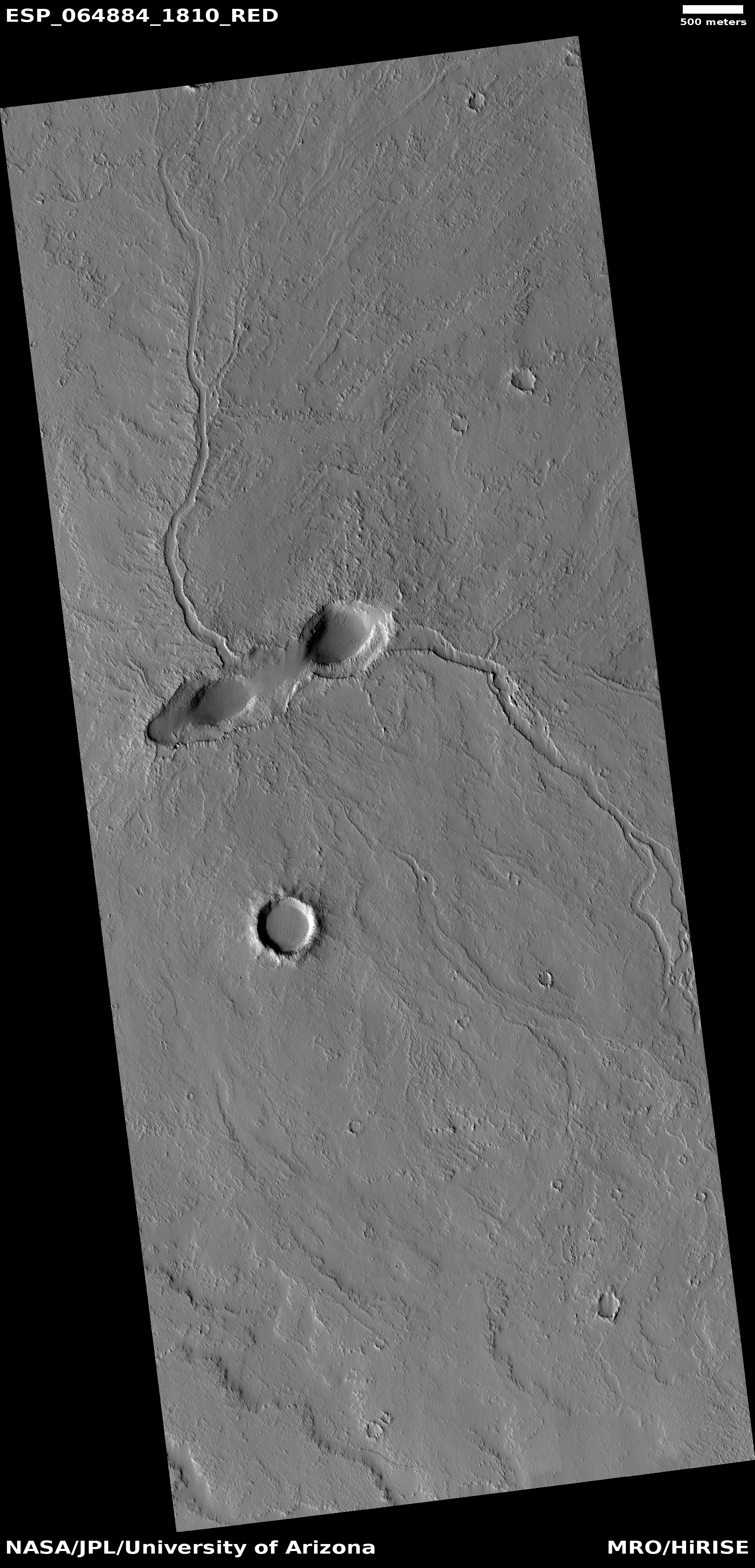
Today’s cool image is of a recent high resolution image taken on May 30, 2020 by Mars Reconnaissance Orbiter (MRO) of what they label as a volcanic vent near Pavonis Mons, the middle giant volcano in the string of three that sit between Olympus Mons, the biggest Martian volcano in the solar system, and Valles Marineris, the biggest canyon in the solar system.

MRO took a previous picture of this vent back in 2010, when they labeled it instead a “small volcano.” Both labels are essentially correct. The two depressions here clearly were a vent for lava at some point in the past. The depressions also fit the definition of a small volcano, as they sit at a high point with two rills flowing down from them. In some ways they could be considered small calderas at the top of a volcano.
» Read more

4 comments

Bottom edge of Martian glacier?

The foot of an inactive glacier on Mars
Click for full image.

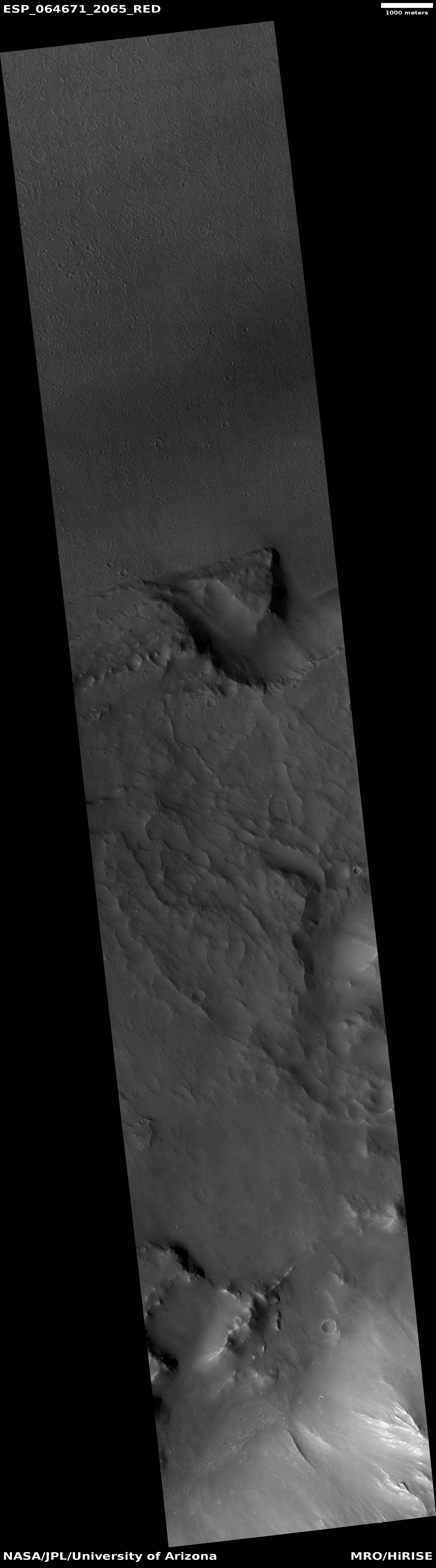
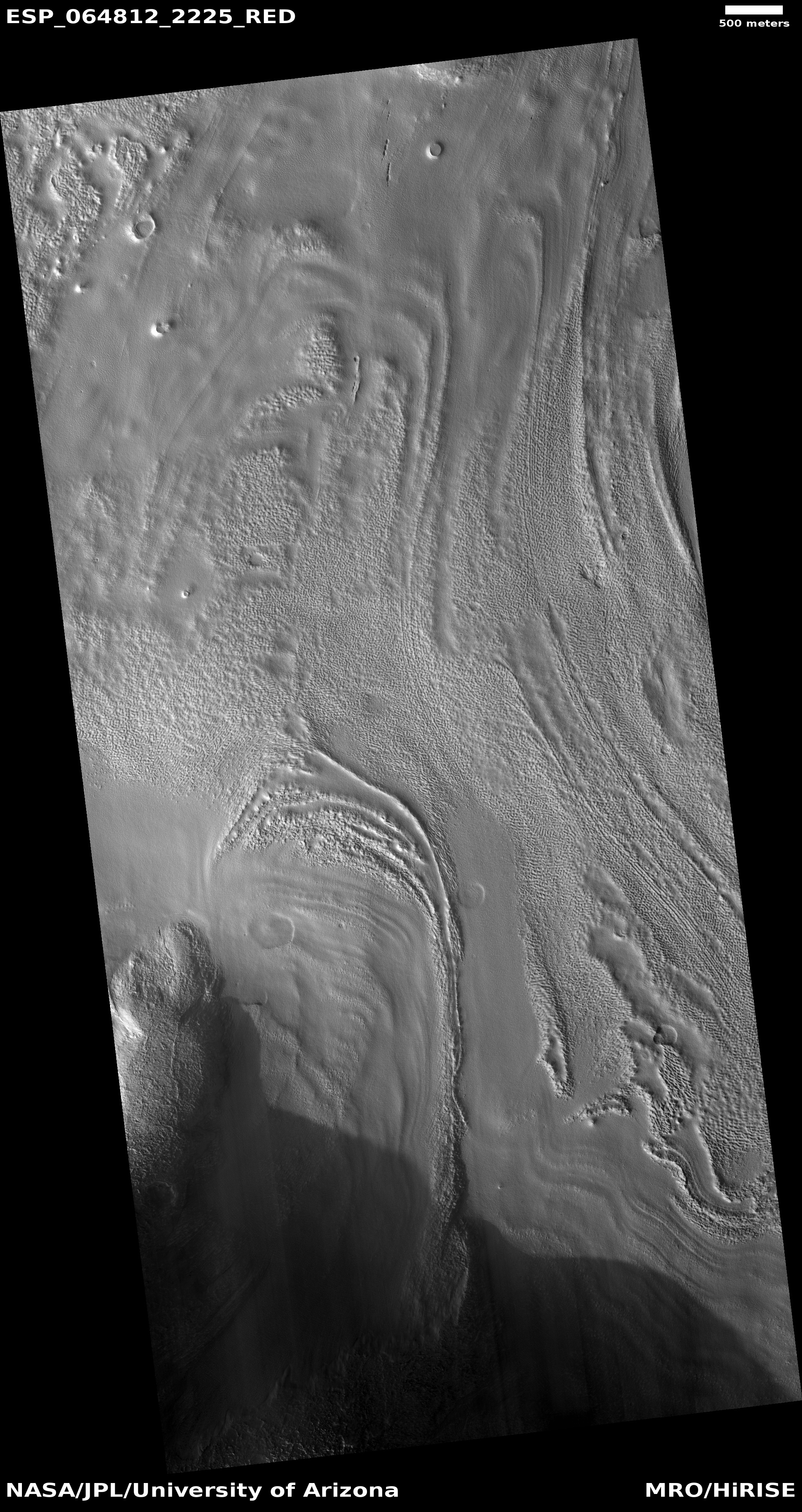
Today’s cool image, taken on May 25, 2020 by the high resolution camera on Mars Reconnaissance Orbiter (MRO), provides a nice example of the typical foot of an inactive buried glacial flow on Mars. The image to the right, rotated, cropped, and reduced to post here, focuses on the center of the full image. Uphill is to the right. The glacier’s edge runs down the middle left of the photo.

Scientists call this a lobate flow because its shape resembles a lobe, smooth and rounded as it comes down the slope. Located at 38 degrees south latitude to the east of Hellas Basin and just to the north of one of that basin’s major infeeding canyons, Harmakhis Valles, this flow comes down the west side of a large mountain. The overview map below provides the context, with the white rectangle indicating the photo’s location.
» Read more

0 comments

Corroded Martian southern highlands

Corroded Martian terrain in the southern highlands
Click for full image.

Today’s cool image is another example of strange terrain on Mars that is difficult to explain, though one can make some guesses. The photo to the right, rotated, cropped, and reduced to post here, was taken on May 29, 2020 by the high resolution camera on Mars Reconnaissance Orbiter (MRO), and shows an area in a region dubbed Aonia and located in the southern cratered highlands directly south of Valles Marineris.

This spot is in the high mid-latitudes, 55 degrees south. In the northern lowland plains one would expect to see a lot of evidence of ice, either as debris covered glaciers in craters or flowing off of mesas, or in an underground ice table that is revealed from impacts and other events that caused it to melt temporarily in the past for a brief instant.

No such features are apparent in this image however. In fact, the photo seems to show a very dry place, with the surface almost all hard bedrock that has been eroded to leave behind rough and sharp features. That a significant amount of erosion has occurred here is indicated by the pedestal crater near the image’s top. When its impact took place the topography was higher. Since then the ground around this crater has been worn away, with the mashed material under the impact at a higher density and more resistant to erosion.

If this spot has an ice table or any buried glacial material, it is not obvious, and certainly not revealed by this erosion.

The two square boxes indicate two insets that I have only cropped to show them at full resolution, and are posted below.
» Read more

0 comments

Catastrophes on Mars and Earth

Big rock break in Kasei Valles
Click for full image.

Cool image time! The photo to the right, rotated, cropped, and reduced to post here, was taken by the high resolution camera on Mars Reconnaissance Orbiter (MRO) on May 13, 2020, and shows what appears to be a giant block that at some point was attached to the cliff, and then broke off and fell away to the north. Subsequent erosion over the later eons widened the break until it now looks like a canyon.

Sounds great, but the event that separated this big piece of mountain, almost a mile across, from its cliffside was possibly even more catastrophic. And it might not have involved a sudden break and fall, but something more spectacular, and also still impossible based on everything we know about Mars.

Uncovering what really happened at this spot on Mars will not only help us understand the geological history of the Red Planet, it could also amazingly enough help illustrate the cultural shifts going on right now on Earth, and how to shift them in a more rational and sane direction.

This image is located near the outlet of Kasei Valles, one of the larger valleys draining downward from the Tharsis Bulge where Mars’ giant volcanoes are located. The overview map below shows us what Kasei Valles looks like in this area.
» Read more

15 comments

Martian sand traps and elongated dunes

Elongated dunes on Mars
Click for full image.

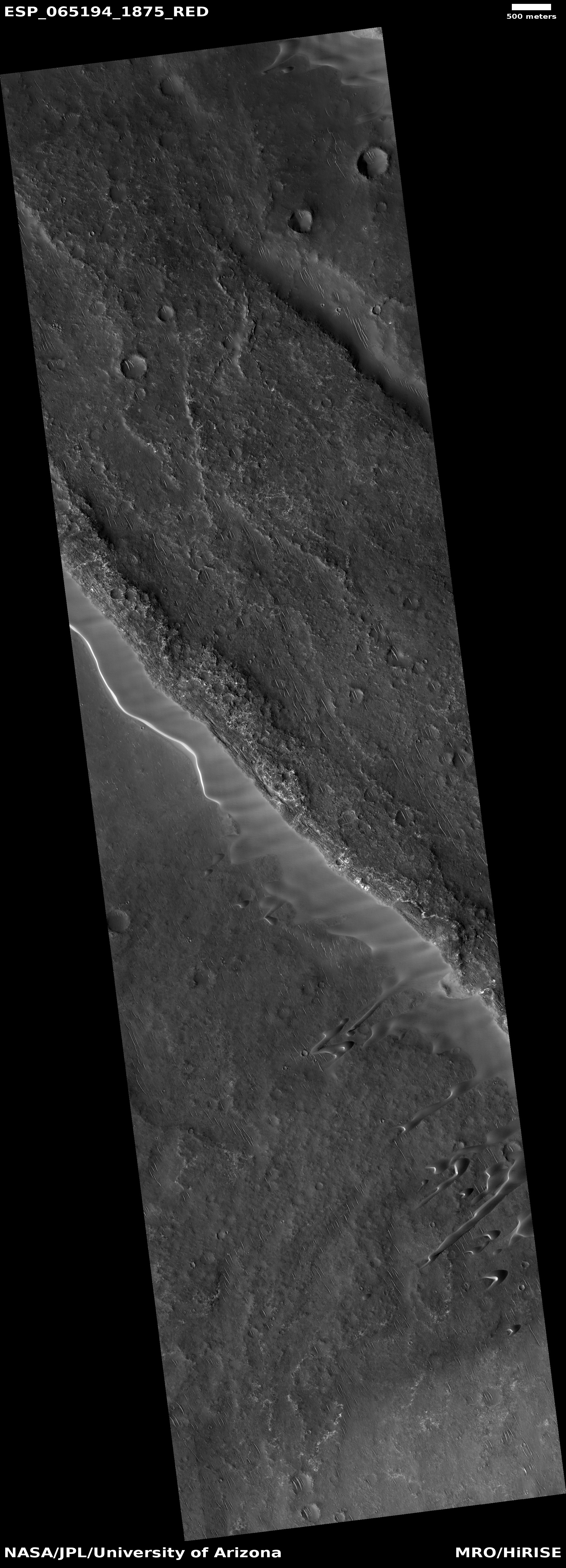
Cool image time! The photo to the left, rotated, cropped, and reduced to post here, was taken on June 23, 2020 by the high resolution camera on Mars Reconnaissance Orbiter (MRO). I was attracted by the uncaptioned image’s title, “Elongating Linear Dunes at Meroe Patera.” What are elongating linear dunes?

The photo shows two such dunes, stretching out to the southwest away from the pile of sand that abuts the cliff to the northwest. Unlike most dunes, which usually form and travel in groups, these for some reason form single straight lines extending for some distance.

I contacted the scientist who requested this image, Joel Davis of the Natural History Museum in London, hoping he could answer some questions about these strangely shaped dunes, and discovered that he was studying this exact subject for a paper since published. As noted in the paper’s introduction,
» Read more

3 comments

The edge of Mars’ south polar layered cap

The edge of the Martian south pole layered deposits
Click for full image.

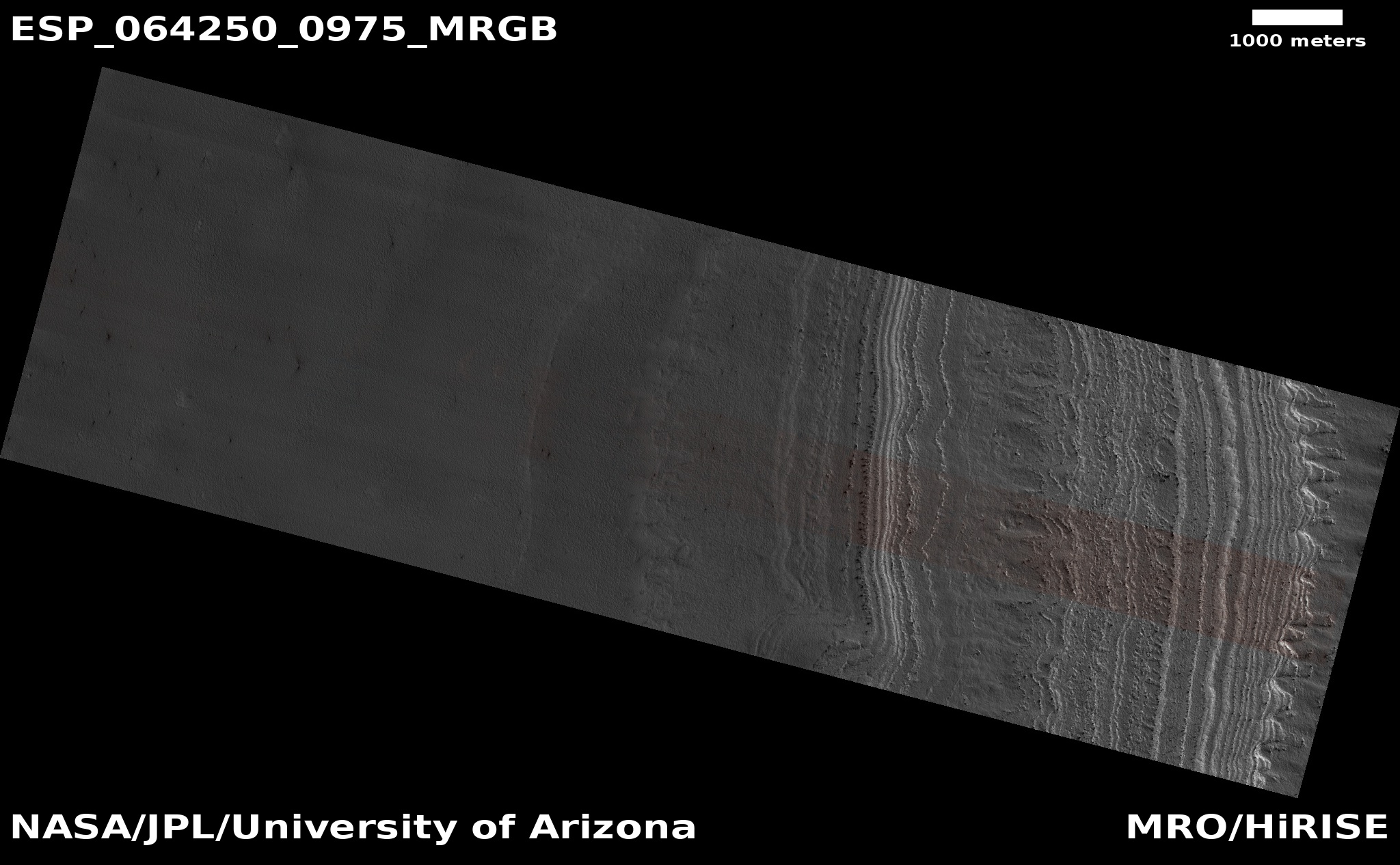
Cool image time! The photo to the right, rotated and cropped to post here, was taken by the high resolution camera on Mars Reconnaissance Orbiter (MRO) on April 10, 2020, and shows the edge of what scientists have dubbed Mars’s south polar layered deposits. The high point, towards the south, is at the bottom, and the terraced layers descend downward to the plains as you move up the image, to the north.

In essence, this spot is the edge of the southern ice cap, though unlike the north polar ice cap, this edge is not the edge of the visible ice cap, but the edge of a much larger field of layered deposits of mixed dust and ice. In the north the ice cap almost entirely covers these layered deposits. In the south the residual ice cap does not. Instead, the layered deposits extend out far beyond the smaller residual ice cap.

The map below provides the geography of the south pole, with the location of this image indicated by the blue cross.
» Read more

1 comment

Ascraeus Mons, Mars’ second highest mountain

Ascraeus Mons

Today’s cool Mars’ image started out when I came across an interesting image of a depression on the northern flank of the giant Martian volcano Ascraeus Mons, the northernmost of the line of three giant volcanoes just to the east of the biggest of all, Olympus Mons.

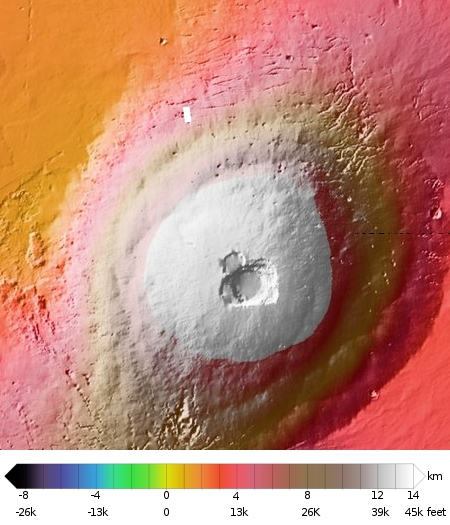
To provide context I created an overview showing the entire volcano (with the white rectangle showing the location of the depression image), and suddenly realized that this overview might actually be more interesting to my readers. To the right is that overview of Ascreaus, with a scale across the bottom to indicate the elevation of the mountain above what scientists have determined to be Mars’ pseudo sea level.

Notice that this volcano, the second highest on Mars, rises more than 43,000 feet above the surrounding plains. Its peak is estimated to be about 59,000 feet high, making it taller than Mt. Everest by about 30,000 feet (more than twice its height). Its diameter is approximately 300 miles across, giving it a much steeper profile than the higher but more spread out Olympus Mons. The map below shows this mountain in relation to Olympus as well as its nearby partner volcanoes.
» Read more

2 comments

Slushy floor of southern Martian crater?

Knobby floor of southern crater
Click for full image.

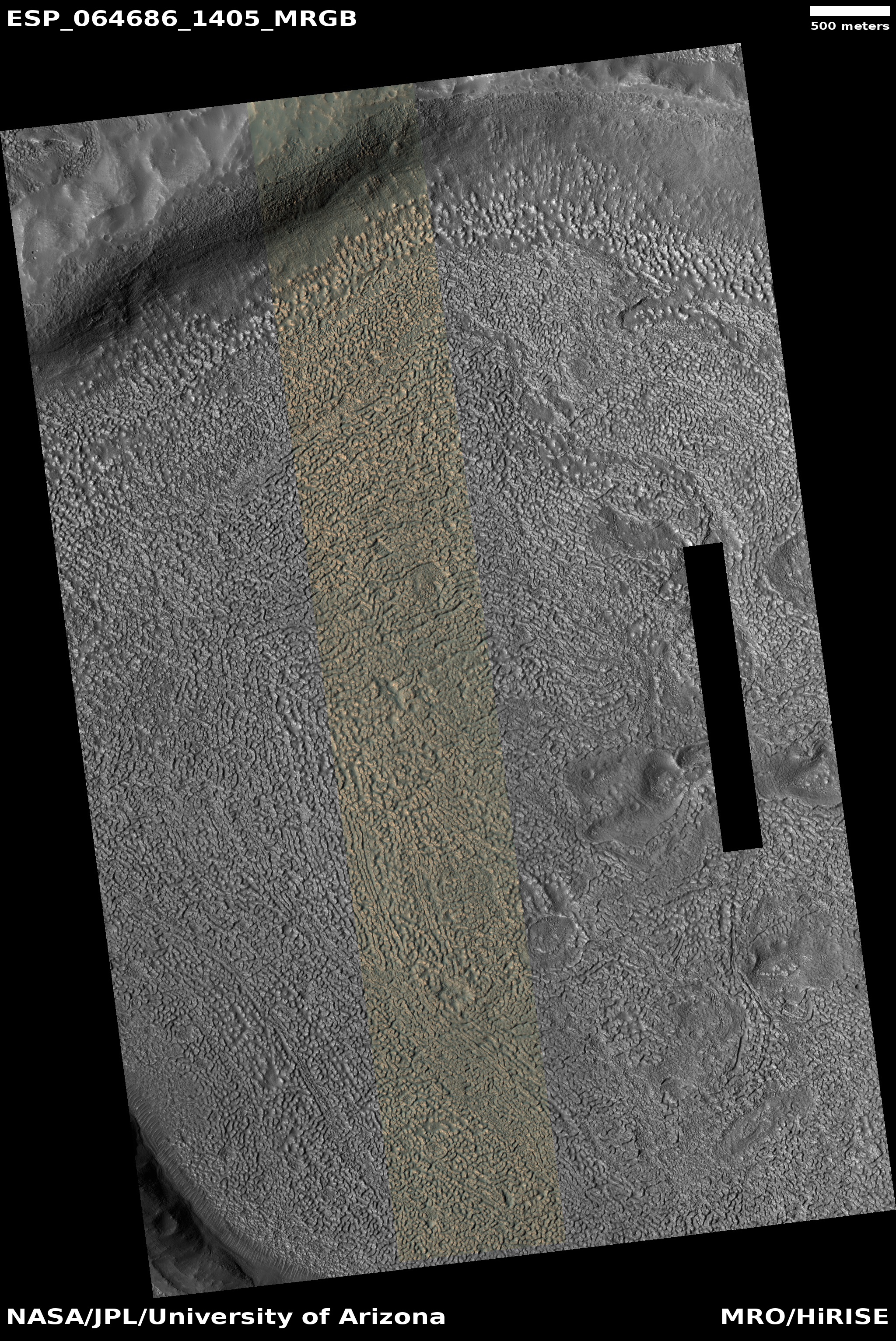
The cool image to the right, rotated, cropped, and reduced to post here, shows the northwest section of the floor of a crater in the southern cratered highlands of Mars, in a mountainous region dubbed Claritus Fossae, located south of Valles Marineris. The photo was taken by the high resolution camera on Mars Reconnaissance Orbiter (MRO) on May 14, 2020.

The entire crater floor appears to be covered by these strings of closely-packed knobs, reminiscent of the brain terrain found in the mid-latitude glacial regions of Mars and thought to be the result of underground ice sublimating upward.

Below is the area in the white box, in full resolution.
» Read more

0 comments

Filled and distorted craters on Mars

A very distorted and filled crater on Mars
Click for full image.

Cool image time! The photo to the right, rotated and cropped to post here, was taken by the high resolution camera on Mars Reconnaissance Orbiter (MRO) on May 25, 2020. The entire image was dubbed “Cluster of Filled Craters”, but I decided to highlight the crater of the cluster that was most strangely distorted of them all. The material that fills all the craters in the full image is almost certainly buried ice and is dubbed concentric crater fill by scientists.

This crater is located in the northern lowland plains the mid-latitudes between 30 and 60 degrees, where planetary scientists have found ample evidence of many such filled craters and glaciers.

Not only does the crater’s interior seemed filled with glacial material, its distorted rim suggests that it has been reshaped by glacial activity that might have covered it entirely over the eons as the mid-latitude glaciers of Mars waxed and waned with the extreme shifts that happen regularly to Mars’ rotational tilt. Moreover, there is strong evidence that in these lowland northern plains an underground ice table exists close to the surface, allowing for more distortion over time.

The overview map below provides some location context.
» Read more

5 comments

The dry barren plains of Tyrrhena Terra

Tyrrhena Terra badlands
Click for full image.

In a sense today’s cool image is a replay of one I posted in March, showing the dry barren terrain in the vast rough cratered highlands of Tyrrhena Terra, located along the equator of Mars between the giant basins of Isidis and Hellas.

Today’s image on the right, cropped to post here, was taken by the high resolution camera on Mars Reconnaissance Orbiter on March 26, 2020, and shows well the barrenness of this region. The surface appears quite solid, like bedrock, rather than the squishy soft surface of the northern lowland plains. Moreover, there is a lot of dust trapped in the low areas between the ridges, forming ripples that new data suggest move slowly across the surface. If you click on the full image, you will see that this terrain is far from local, and goes on in this manner for quite a distance in all directions.

This is a dry and forbidding place, about the size of the American southwest, from Texas to California.

The overview map below provides some context of Tyrrhena Terra’s location on Mars.
» Read more

0 comments

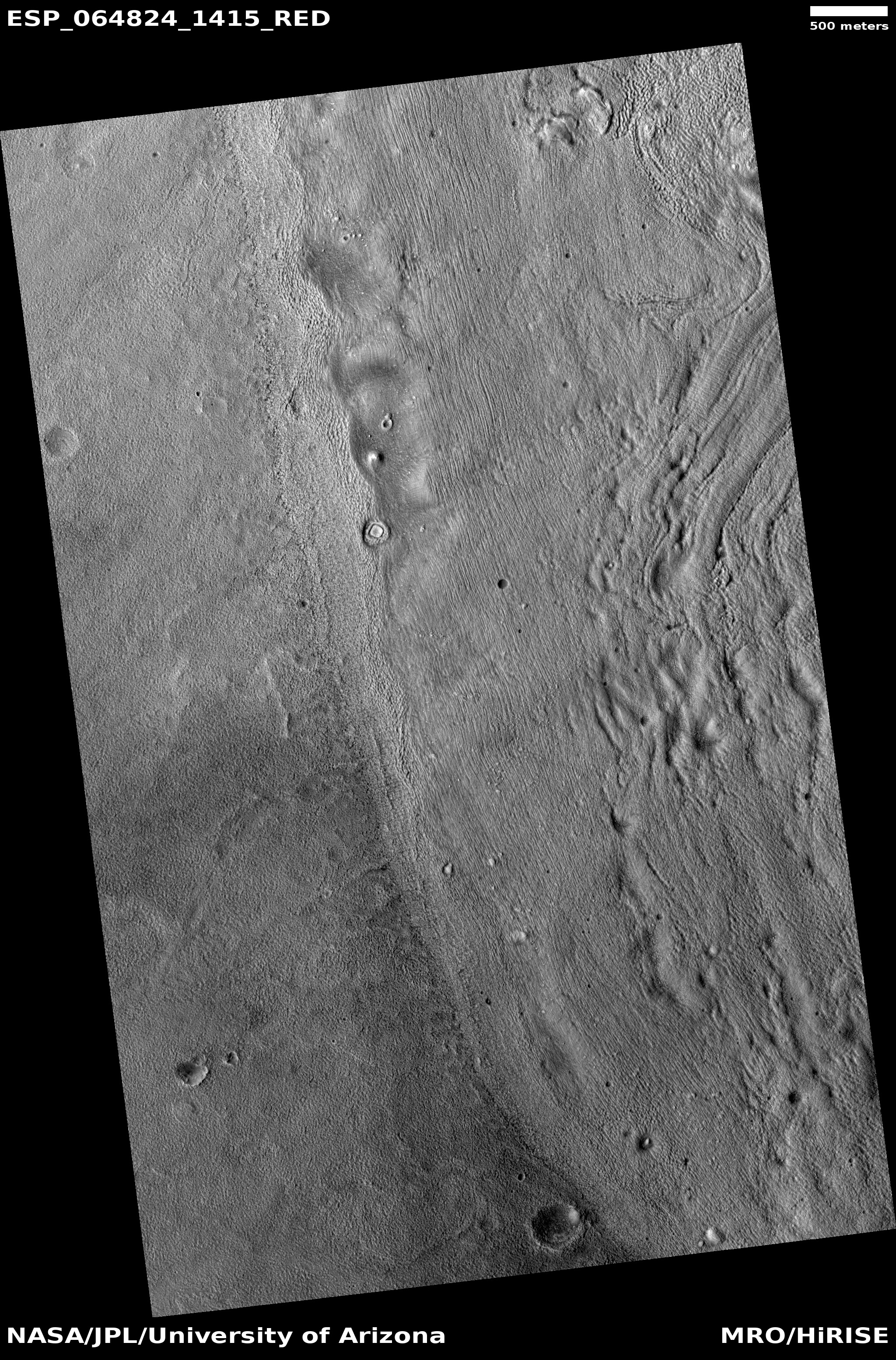
Glacier country on Mars

Glacial flow in Protonilus Mensae
Click for full image.

Cool image time! The photo to the right, rotated, cropped, and reduced to post here, was taken on May 24, 2020 by the high resolution camera on Mars Reconnaissance Orbiter (MRO), and provides a wonderful example of the kind of evidence of buried glaciers found extensively in the mid-latitudes of Mars.

This particular region, called Protonilus Mensae, is a region of chaos terrain at the transition zone between the southern cratered highlands and the northern lowland plains. I have featured a number of cool images in Protonilus, all of which show some form of buried glacial flow, now inactive.

The last cool image above was one that the MRO science team had picked to illustrate how to spot a glacier on Mars.

In this particular image are several obvious glacier features. First, we can see a series of moraines at the foot of each glacier in the photo, each moraine indicating the farthest extent of the glacier when it was active and growing. It also appears that there are two major layers of buried ice, the younger-smaller layer near the image’s bottom and sitting on top of a larger more extensive glacier flow sheet. This suggests that there was more ice in the past here, and with each succeeding ice age the glaciers grew less extensive.

Second, at the edges of the flows can be seen parallel ridges, suggestive also of repeated flows, each pushing to the side a new layer of debris.

Third, the interior of the glacier has parallel fractures in many places, similar to what is seen on Earth glaciers.

Protonilus Mensae, as well as the neighboring chaos regions Deuteronilus to the west and Nilosyrtis to the east, could very well be called Mars’ glacier country. Do a search on Behind the Black for all three regions and you will come up with numerous images showing glacial features.

Below is an overview of Protonilus, the red box showing the location of this image. Also highlighted by number are the locations of the three features previously posted and listed above.
» Read more

0 comments

Martian eroding ridges amid brain terrain

Brain terrain and bisected ridges on Mars
Click for full image.

Today’s very cool image is cool because of how inexplicable it is. To the right, cropped to post here, is a photo taken by the high resolution camera on Mars Reconnaissance Orbiter (MRO) of an area of what they call “Ribbed Terrain and Brain Terrain”.

I call it baffling.

Nor am I alone. At the moment the processes that create brain terrain (the undulations between the ridges) remain a complete mystery. There are theories, all relating to ice sublimating into gas, but none really explains the overall look of this terrain.

Making this geology even more baffling are the larger ridges surrounding the brain terrain, all of which appear to have depressions along their crests. Here too some form of sublimation process appears involved, but the details remain somewhat mysterious.
» Read more

1 comment
1 67 68 69 70 71 90