Enclosed Martian canyon, filled with ice
Ice-filled canyon on Mars
Click for full image.

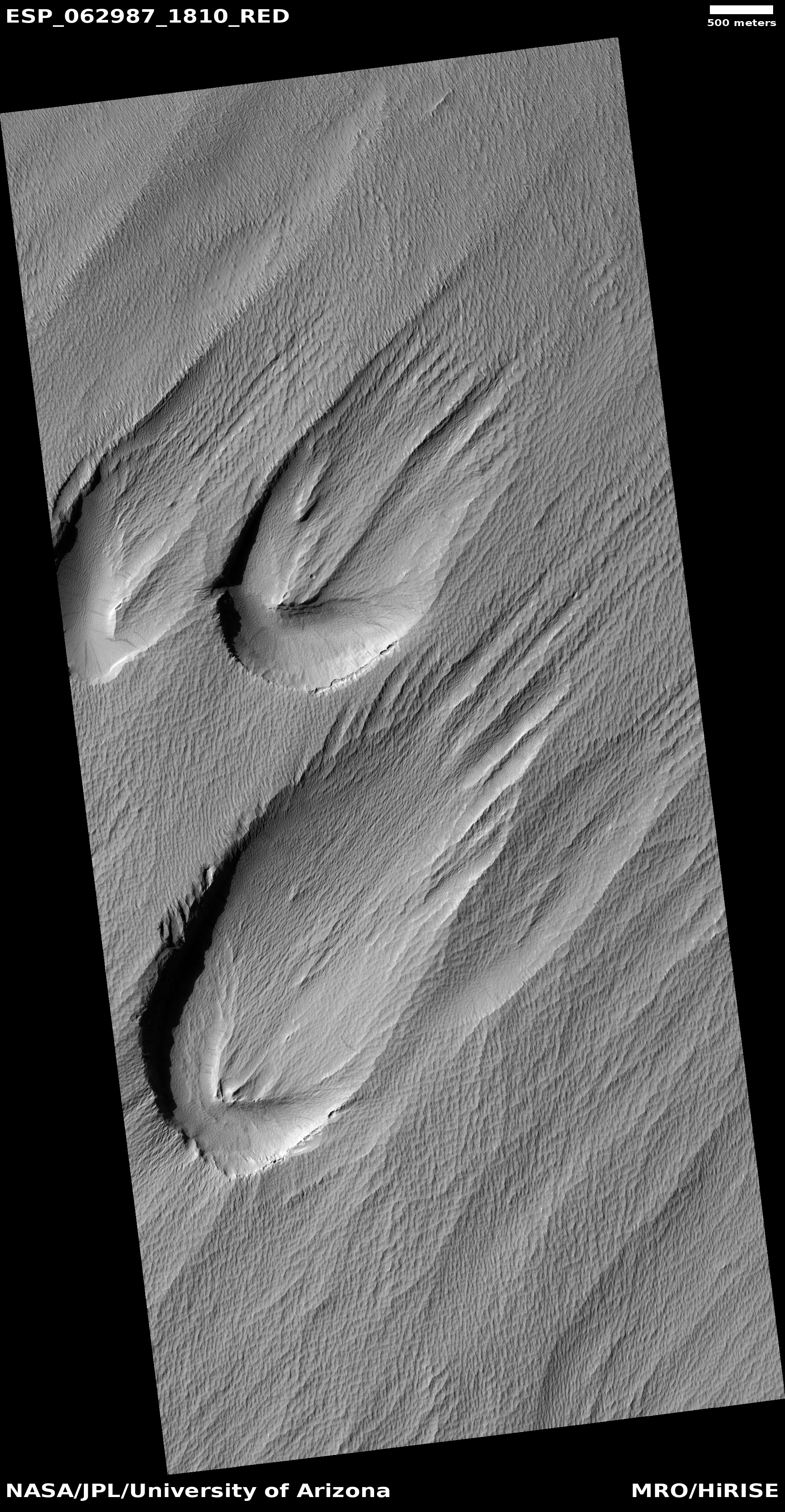
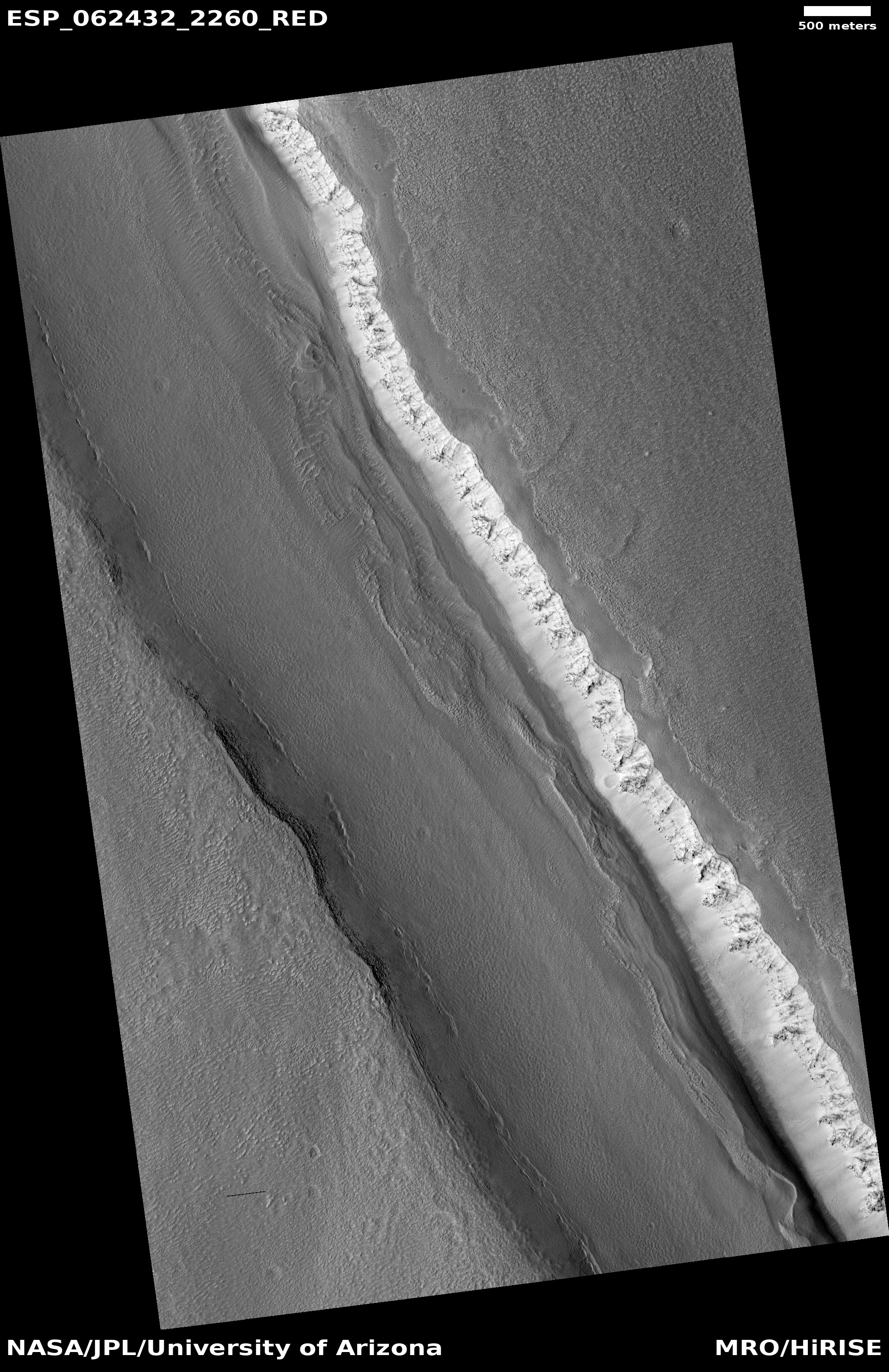
Cool image time! The photo on the right, rotated, cropped, and reduced to post here, was taken by the high resolution camera on Mars Reconnaissance Orbiter on November 21, 2019. The uncaptioned image was simply entitled “Ice-filled Graben.”

The location is on the lower flanks of the giant volcano Alba Mons, which in itself sits north of Olympus Mons and the volcanic Tharsis Bulge. The canyon is called a graben because it was formed when a section of the crust slips downward along parallel faults. It does not have the features of a rill, or lava flow, as it starts and stops suddenly. It probably formed due to the rise of the volcano, pulling apart its flanks along faults, causing some sections then to slip downward.

How do the scientists know this is ice-filled? I suspect they have other data that indicates the presence of water, but there are also clear features inside this canyon that resemble the glacial features found elsewhere on Mars. For example, note the parallel lines near the canyon walls. These indicate past surface levels as well as layers within the ice from cyclic climate processes. The line of pits along the southwest wall, where the surface gets more sunlight, also suggests that this sunlight is causing more ice to sublimate away.

Finally, the graben is located at 46 degrees north latitude, definitely far enough north for such ice to exist, based on ample other research.
8 comments

Quakes by InSight indicate Mars’ interior is active

Cerberus Fossae

The first seismic results from InSight’s seismometer now show that the interior of Mars is active, with regular moderately-sized quakes.

The Seismic Experiment for Interior Structure (SEIS) instrument โ€“ a seismometer developed by an international consortium under the leadership of the French space agency CNES โ€“ recorded a total of 174 seismic events between February and September 2019. Twenty of these marsquakes had a magnitude of between three and four. Quakes of this intensity correspond to weak seismic activity of the kind that occurs repeatedly on Earth in the middle of continental plates, for example in Germany on the southern edge of the Swabian Jura hills.

Although only one measurement station is available, models of wave propagation in the Martian soil have been used to determine the probable source of two of these quakes. It is located in the Cerberus Fossae region, a young volcanic area approximately 1700 kilometres east of the landing site.

Cerberus Fossae is a land of cracks and linear depressions located between the giant volcanoes, Elysium Mons to the north and Olympus Mons to the east. It is believed those fissures were caused by the rise of those volcanoes, stretching the crust and cracking it.

This new data from InSight strengthens this theory.

2 comments

Ice-filled canyon on Mars?

The ice-filled head of Mamers Valles
Click for full image.

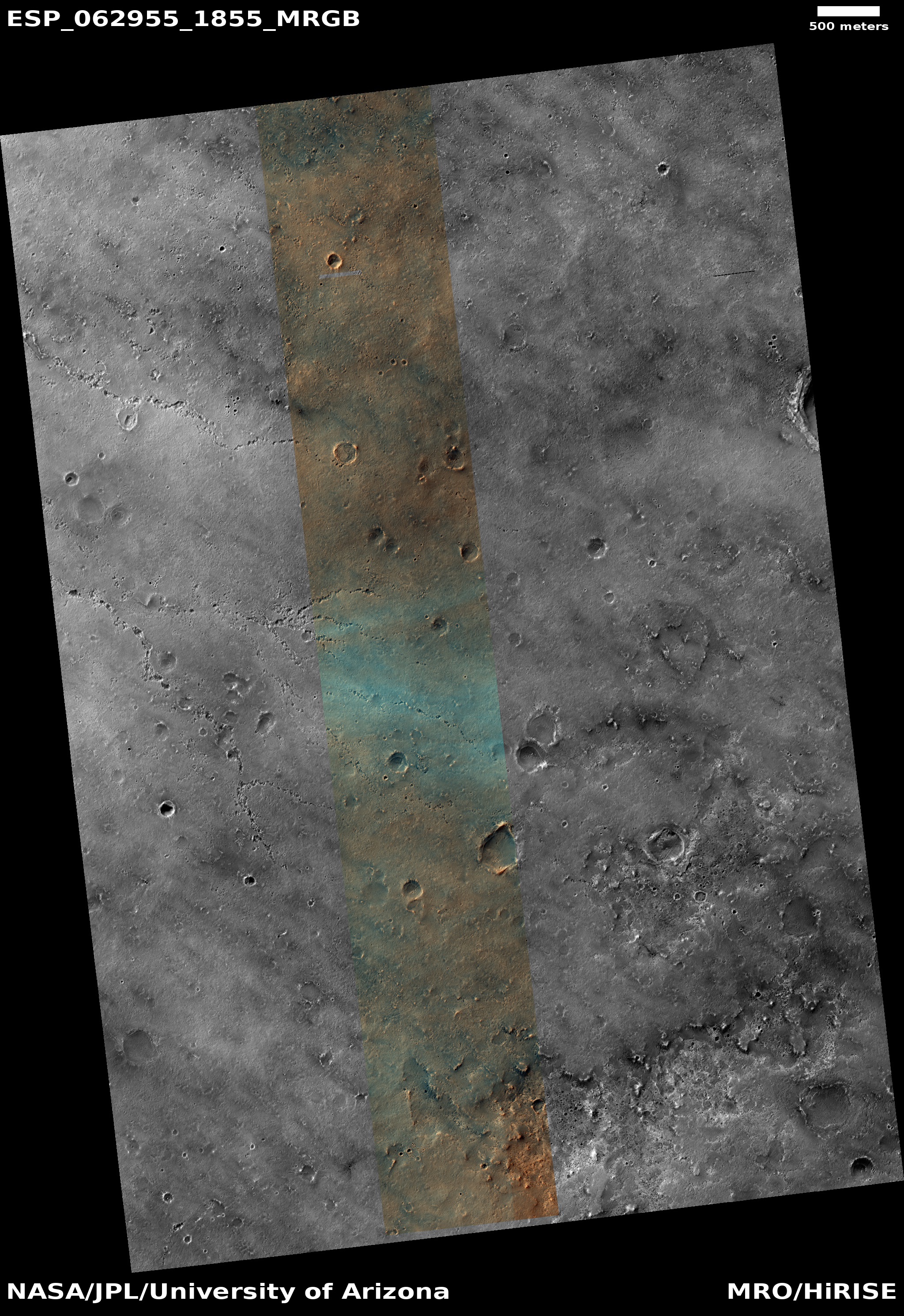
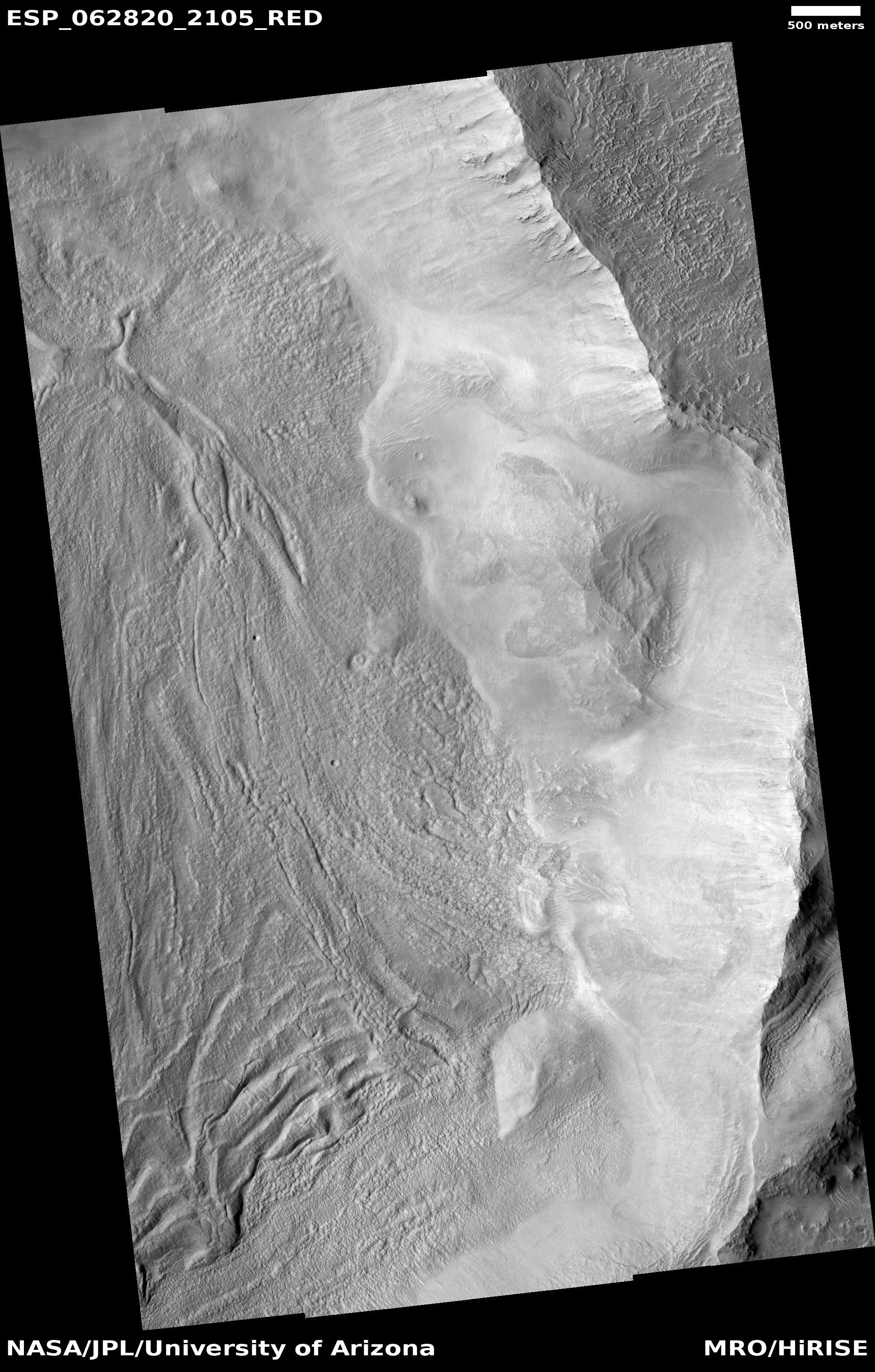
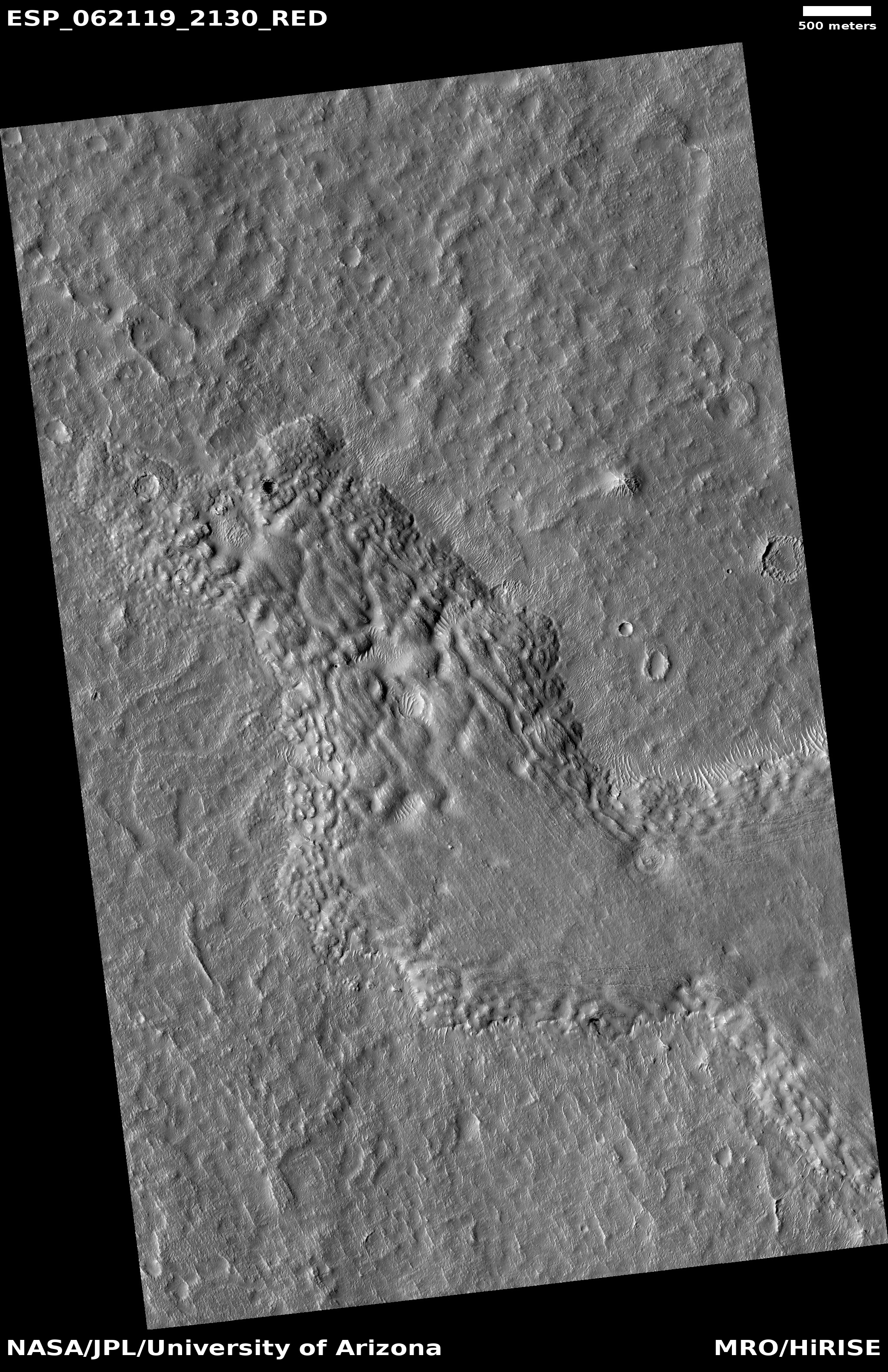
The image to the right, rotated, cropped and reduced to post here, was taken on December 19, 2019 by the high resolution camera on Mars Reconnaissance Orbiter (MRO). Labeled “Head of Mamers Valles”, it shows the very end of one side canyon to this very extensive canyon system made up of the fractured fissures and mesas of chaos terrain.

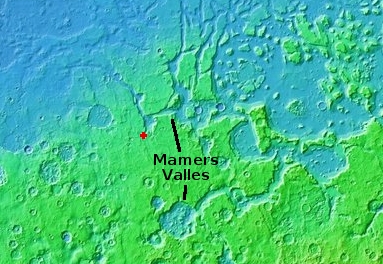
Mamers Valles itself sits in the transition zone between the northern lowland plains and the southern cratered highlands. This specific canyon is close to those lowlands, at a latitude of 40 degrees north, where scientists believe there are many buried inactive glaciers of ice.

The image reinforces this belief. The entire canyon appears practically filled with what looks like ice. In fact, it almost looks like we are looking down at a frozen lake with a layer of snow on top of it. In this case, the layer is not snow, but dust and dirt and debris that covers the ice to protect it and prevent it from sublimating away.

The overview map below shows the location of this canyon, by the red cross, within Mamers Valles.

Mamers Valles

Mamers Valles is actually a very large collection of miscellaneous canyons, flowing into the lowlands. In some areas it looks like very old chaos terrain, with the canyons so eroded that all we see are scattered mesas. In other places the canyons more resemble meandering river canyons sometimes interspersed with crater impacts.

Scientists have analyzed the canyons in Mamers Valles, and from this concluded that they were likely formed from “subsurface hydrologic activity”. which in plain English means that flowing water below ground washed out large underground passages, which eventually grew large enough for their ceilings to collapse and form the canyons we see today.

Yesterday I posted an image of a string of pits that could very well be evidence of this same process in its early stages of canyon formation. In Mamers Valles the process is far more advanced, and the canyons have existed for a long time, long enough for the planet’s inclination to go through several cycles of change, from a low of 25 degrees tilt (what it is now) to has high as 60 degrees. At that high inclination the mid-latitudes were colder than the poles, so that ice would sublimate from the poles to fall as snow in the mid-latitudes, forming active glaciers within canyons such as this.

Now that the planet’s inclination is similar to Earth’s, 25 degrees, the poles are slightly colder than the mid-latitudes, and the glaciers in this canyon are either inactive (if buried) or slowly sublimating away so that the water can return to the poles.

Here however the surface debris appears to be protecting the glaciers, leaving the canyon filled mostly with ice. For future settlers this ice would likely be relatively accessible, and at a latitude where the environment is also relatively mild, for Mars.

5 comments

Yutu-2 finds rocks that appear young

Yutu-2 has found a cluster of small rocks that appear relatively young, with little erosion.

The rocks also also appear as if they came from another place on the Moon.

Closer inspection of the rocks by the rover team revealed little erosion, which on the moon is caused by micrometeorites and the huge changes in temperature across long lunar days and nights. That anomaly suggests that the fragments are relatively young. Over time, rocks tend to erode into soils.

The relative brightness of the rocks also indicated they may have originated in an area very different to the one Yutu-2 is exploring.

Youth in this case is very relative. The rocks might be young when compared to the surface on which they sit, but they still could be more than a billion years olf.

0 comments

Pits indicating a Martian underground river?

A string of pits suggesting a past underground river system on Mars
Click for full image.

Cool image time! As my regular readers well know, I am a caver, and am thus always interested when the high resolution camera on Mars Reconnaissance Orbiter (MRO) takes a close-up of a pit that might also be an entrance to a cave.

The photo to the right, cropped and reduced to post here, was part of the most recent image release from MRO, but was boringly labeled “Arabia Terra” after the region where it is located, one of the largest transition zones on Mars between the northern lowland plains and the southern cratered highlands. When I took a close look, what I found was an intriguing string of pits whose arrangement is strikingly reminiscent of a river tributary system.

The white box indicates one section that I have zoomed into, as shown below.
» Read more

10 comments

Martian wind-swept buried depressions

Wind-swept Martian depressions
Click for full image.

Cool image time! The photo to the right, rotated, cropped and reduced to post here, was taken on January 3, 2020 by the high resolution camera on Mars Reconnaissance Orbiter (MRO). It shows three strange teardrop-shaped depressions, clearly wind-swept and partly buried by dust and sand.

The location on Mars of these depressions is in the transition zone between the southern cratered highlands and the northern lowlands. This is also a region dubbed the Medusae Fossae Formation, a region where it appears a great deal of volcanic material was laid down during one or more eruptive events 3 to 3.8 billion years ago.

Whether these depressions were formed during those events is impossible to tell from the available data, especially because the underlying bedrock is buried in dust.

Their shape appears to have been caused as the wind slowly exposed three buried peaks of hard rock. The wind, blowing from the southwest to the northeast, would hit the peaks, producing an downward eddy that would churn out dust from the windward side. The wind and dust would then blow around the peaks, creating the teardrop tail on the leeward side to the northeast.

0 comments

Large glacier-filled crater/depression on Mars?

Glacier-filled depression?
Click for full image.

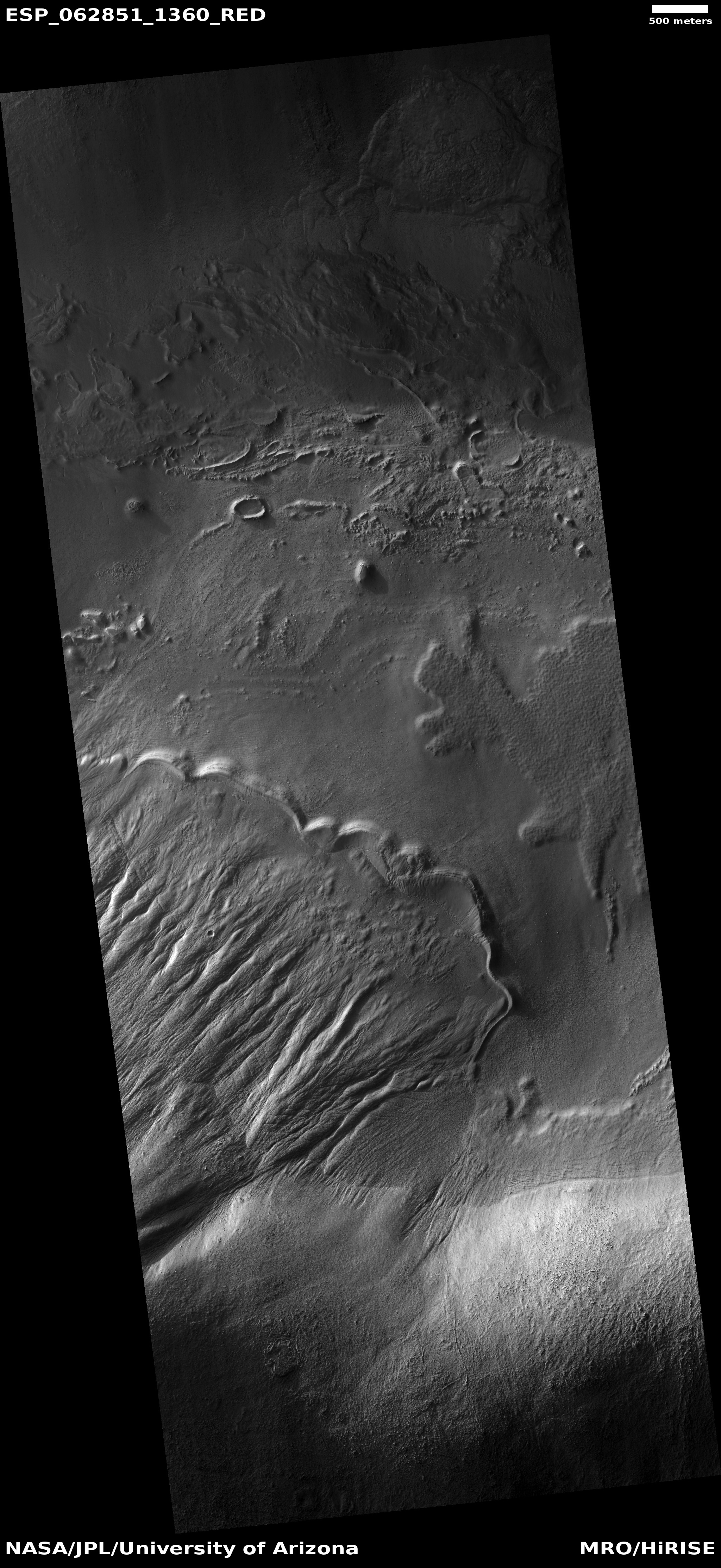
Cool image time! The photograph on the right, rotated, cropped, and reduced to post here, was taken by the high resolution camera on Mars Reconnaissance Orbiter (MRO) on December 21, 2019. It shows the eastern half of the floor and interior rim of a large squarish-shaped crater or depression in what seems to be an unnamed region of chaos terrain located in the transition zone between the Martian southern highlands and the northern lowland plains.

The floor of this depression has many of the features that indicate the presence of a buried ice glacier, including flow features on the depression floor, linear parallel grooves, and repeating moraine features at the slope base. In fact, all these features give the strong impression that this crater is ice-filled, to an unknown depth.

Chaos terrain, a jumble of mesas cut by straight canyons, are generally found in this transition zone, and could be an erosion feature produced by the intermittent ocean that some believe once existed in the northern lowlands. Whether or not an ocean lapped against these mesas and created them, this chaos terrain is believed to have been caused by some form of erosion, either wind, water, or ice.

Wide context view

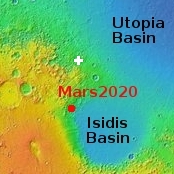
The location is of this chaos terrain in that transition zone is illustrated by the context map to the right. It sits on the edge of the vast Utopia Basin, one of the largest and deepest northern lowland plains. It also sits several hundred miles due north of the planned landing site of the Mars2020 rover in Jezero Crater. There is a lot of chaos terrain in this region, with lots of evidence of buried glaciers flowing off the sides of mesas.

Today’s image, with its numerous features suggesting the presence of a buried glacier filling the depression, reinforces this evidence.

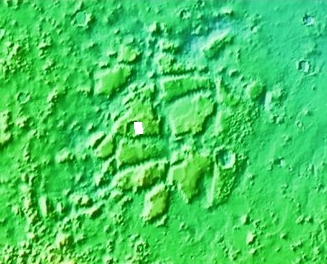
Closer context view, showing the chaos terrain region

What impresses me most about this particular depression — should it be ice-filled — is its size. I estimate from the scale of the image that the depression is about six miles across, somewhat comparable though slightly smaller than the width of the Grand Canyon. And yet, unlike the Canyon it appears to have a wide flat floor across its entire width. The second context map to the right zooms in on this chaos region to show how relatively large the depression is. It would not be hard to spot it from orbit. We don’t know the depth, but even if relatively shallow this depression still holds a heck of a lot of water ice.

While the depression appears like a crater in lower resolution wider photographs, higher resolution images suggest it is not round but squarish. Why is not clear, and unfortunately MRO’s high resolution camera has taken no other images of it. This image was also one of their terrain sample photographs, taken not because of any specific research request, but because they need to use the camera regularly to maintain its temperature. This location, having few previous images, fit this schedule and made sense photographing.

Thus, no one appears to be specifically studying this location, making it a ripe subject for some postdoc student who wants to put their name on some Martian geology.

0 comments

The range for exposed ice scarps on Mars keeps growing

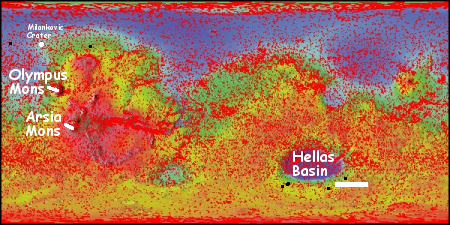
Overview of ice scarp locations on Mars

In January 2018 scientists announced the discovery of eight cliffs with visible exposed ice layers in the high mid-latitudes of Mars. At the time, those eight ice scarps were limited to a single crater in the northern hemisphere (Milankovic Crater) and a strip of land in the southern highlands at around latitude 55 degrees south.

In the past two years scientists have been using the high resolution camera on Mars Reconnaissance Orbiter (MRO) to monitor these scarps for changes. So far they have seen none, likely because the changes are below the resolution of the camera.

They have also been able to find more scarps in the southern hemisphere strip beyond that strip at 55 degrees south.

Now they have found more scarps in the northern hemisphere as well, and these are outside Milankovic Crater. As in the south, the new scarps are still all along a latitude strip at about 55 degrees.

The map above shows with the black dots the newer scarps located in the past two years. The scarp to the east of Milankovic Crater is typical of all the other scarps, a steep, pole-facing cliff that seems to be retreating away from the pole..

The scarp to the west of Milankovic Crater is striking in that it is actually a cluster of scarps, all inside a crater in the northern lowland plains. Moreover, these scarps are more indistinct, making them more difficult to identify. According to Colin Dundas of the U.S. Geological Surveyโ€™s Astrogeology Science Center in Arizona,
» Read more

1 comment

Remnant moraine on Mars

Remnant moraine on Mars
Click for full image.

Cool image time! Using both Martian orbiters and rovers scientists are increasingly convinced that Mars has lots of buried glaciers in its mid-latitudes. These glaciers are presently either inactive or shrinking, their water ice sublimating away as gas, either escaping into space or transporting to the colder poles.

The image to the right, cropped and reduced to post here, shows some apparent proof of this process. Taken by the high resolution camera of Mars Reconnaissance Orbiter (MRO) on December 23, 2019, it shows a weird meandering ridge crossing the floor of a crater. The north and south parts of the crater rim are just beyond the cropped image, so that the gullied slope in the image’s lower left is actually a slope coming down from that rim.

My first reaction upon seeing this image was how much that ridge reminded me of the strange rimstone dams you often find on cave floors, formed when calcite in the water condenses out at the edge of the pond and begins to build up a dam over time.

This Martian ridge was certainly not formed by this process. To get a more accurate explanation, I contacted Dan Berman, senior scientist at the Planetary Science Institute in Arizona, who had requested this image. He explained:
» Read more

1 comment

A bullseye on Mars

Bullseye crater on Mars
Click for full image.

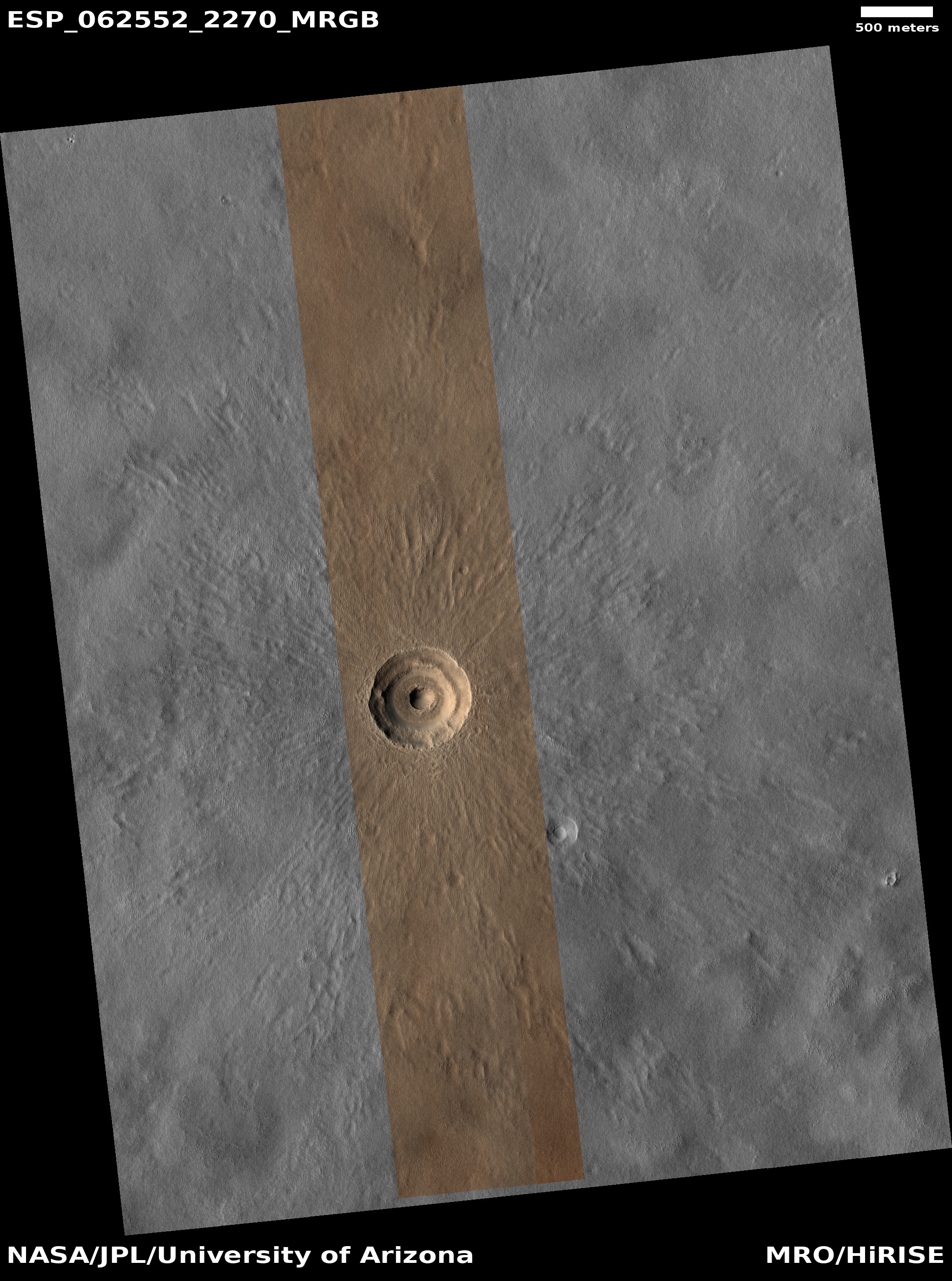
Cool image time! The photo on the right, cropped and reduced to post here, was taken by the high resolution camera of Mars Reconnaissance Orbiter (MRO) on November 30, 2019. It shows a lone crater on the flat northern lowlands of Mars in a region dubbed Arcadia Planitia.

The crater is intriguing because of its concentric ridges and central pit. As this region is known to have a great deal of subsurface water ice, close to the surface, these features were probably caused at impact. My guess is that the ice quickly melted, formed the kind circular ripples you see when you toss a pebble in a pond, but then quickly refroze again, in place.

This location is also of interest in that is it just north of the region that SpaceX considers the prime candidate landing site for its Starship manned spaceship.

1 comment

The cliff at the end of Chasma Boreale on Mars

The cliff at the end of Chasma Boreale
Click for full image.

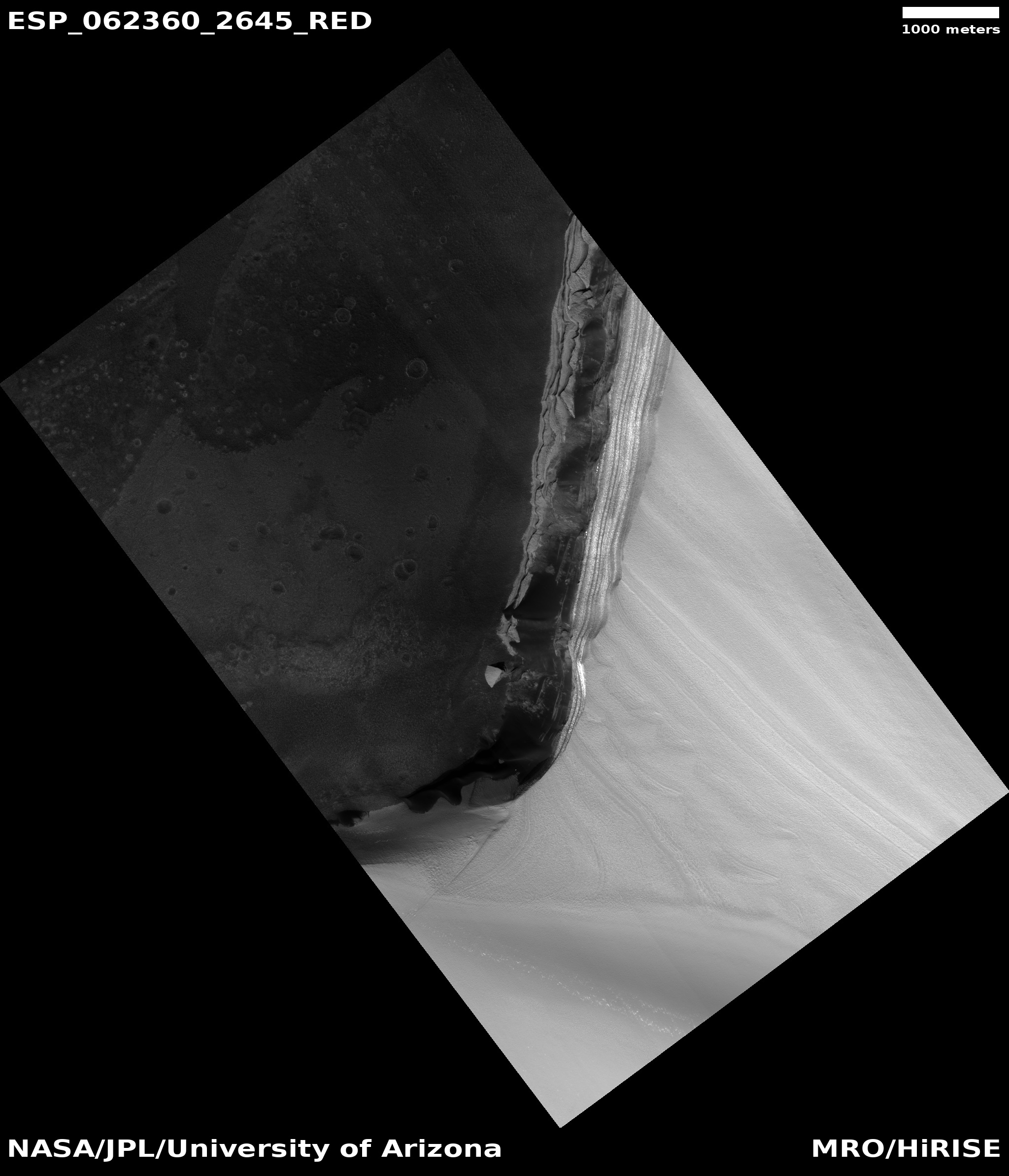
Cool image time! The image to the right, cropped to post here, was taken by the high resolution camera on Mars Reconnaissance Orbiter (MRO) on November 15, 2019 during the height of the Martian summer in the northern hemisphere. It shows the scarp of the polar ice cap, looking directly down that scarp at what the MRO image post dubs an “exposure of basal unit”, or the bottom of the cap itself. This suggests that the base of that cliff is no longer ice, but the bedrock below it. If this cliff is similar to other scarps off the polar ice cap it should be at least 1,600 feet tall. It might be more, however, as the elevation difference between the cap and the floor of this basin is estimated by scientists to be more than a mile total.

This scarp however is different than the outer icecap scarps where avalanches occur with great frequency during the spring and summer. Instead, it is located in the heart of the ice cap, at the very end of the gigantic canyon Chasma Boreale that slashes a deep cut into that ice cap, practically cutting it in half.

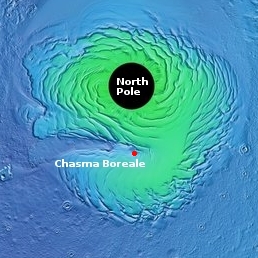
Overview

The overview map on the right, with the red dot showing where this image is located, illustrates the cutting nature of Chasma Boreale. The canyon itself is 350 miles long with a width of about 75 miles at its beginning and with walls that at some points rising a mile in height.

Scientists theorize this canyon was formed by melting ice from cap that built up at the cap’s base, causing erosion and collapse, with the flow following the grade down hill from this end point out to the lowland plains beyond. It is also possible winds played a part in this process, encouraging the canyon formation.

0 comments

Frozen lava that flowed from Elysium Mons

Lava flows off of Elysium Mons
Click for full image.

Cool image time! The photo on the right, rotated, cropped, and reduced to post here, was taken by the high resolution camera on Mars Reconnaissance Orbiter (MRO) on October 27, 2019. It shows a dramatic lava flow coming off the flanks of the giant volcano Elysium Mons, a flow that has probably been frozen in place for somewhere between 600 million to 3.4 billion years.

If you look close you can see several craters on top of the lava flow. To my eye these impacts look like they occurred when the lava was still soft, which suggests they were debris thrown up by the volcano. This however would be surprising, as the eruption of Elysium Mons is not thought to have been explosive, but slow and steady. Either way, these crater impacts are one of the ways scientists have been able to estimate the age of this volcano and its long frozen flows.

MRO has taken a scattering of high resolution images in this area, all of which are aimed at similar frozen flows coming off the volcano. All are about 250 miles from the caldera, which gives you a sense of the size and extent of Elysium Mons. While it is the fourth largest volcano on Mars at 7.5 miles high, its grade is so gentle that if you were standing on the surface the peak would be hard to see from any point.

0 comments
1 116 117 118 119 120 157