Martian plateaus and buttes

Martian plateaus and buttes
Click for full image.

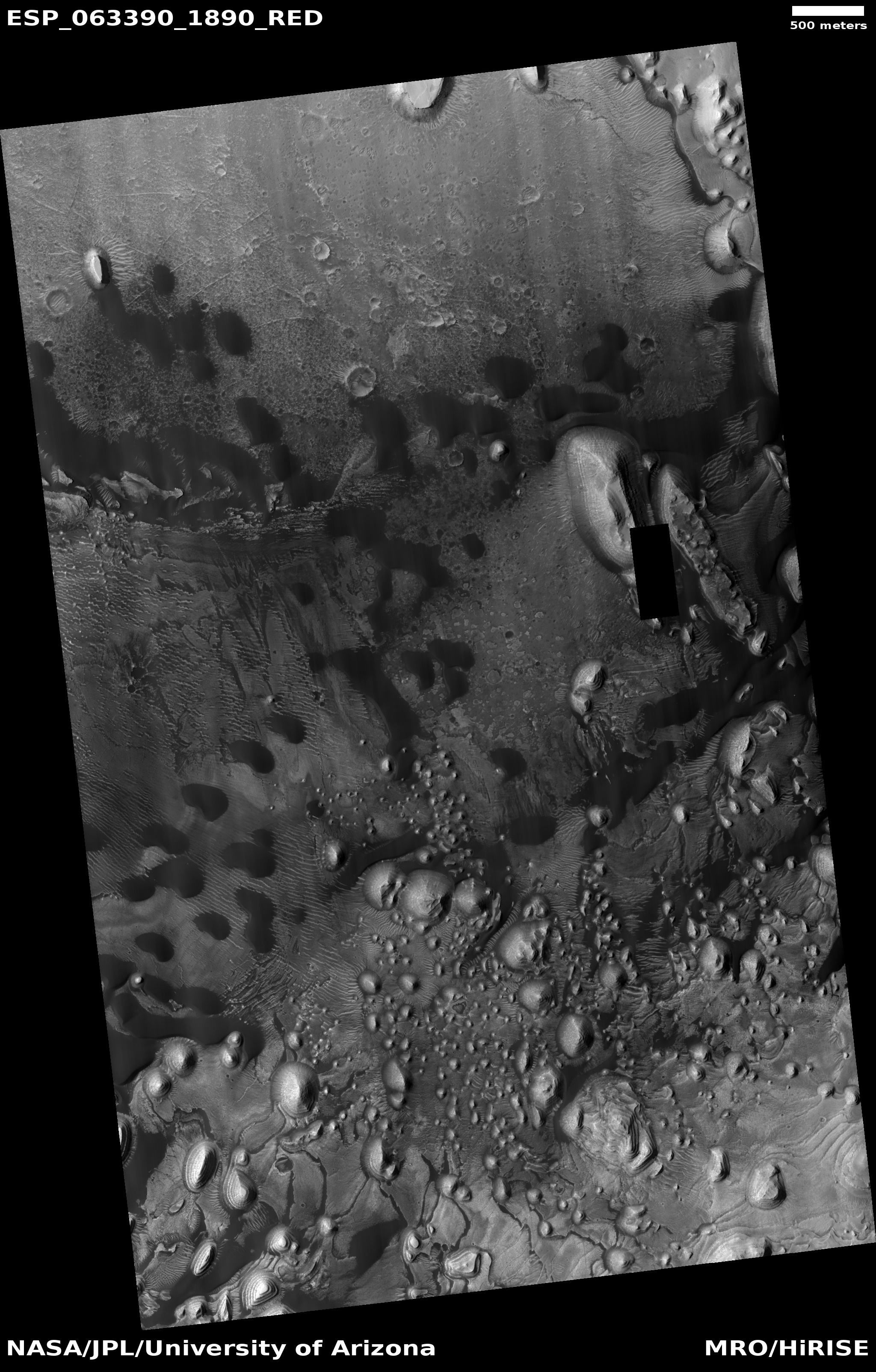
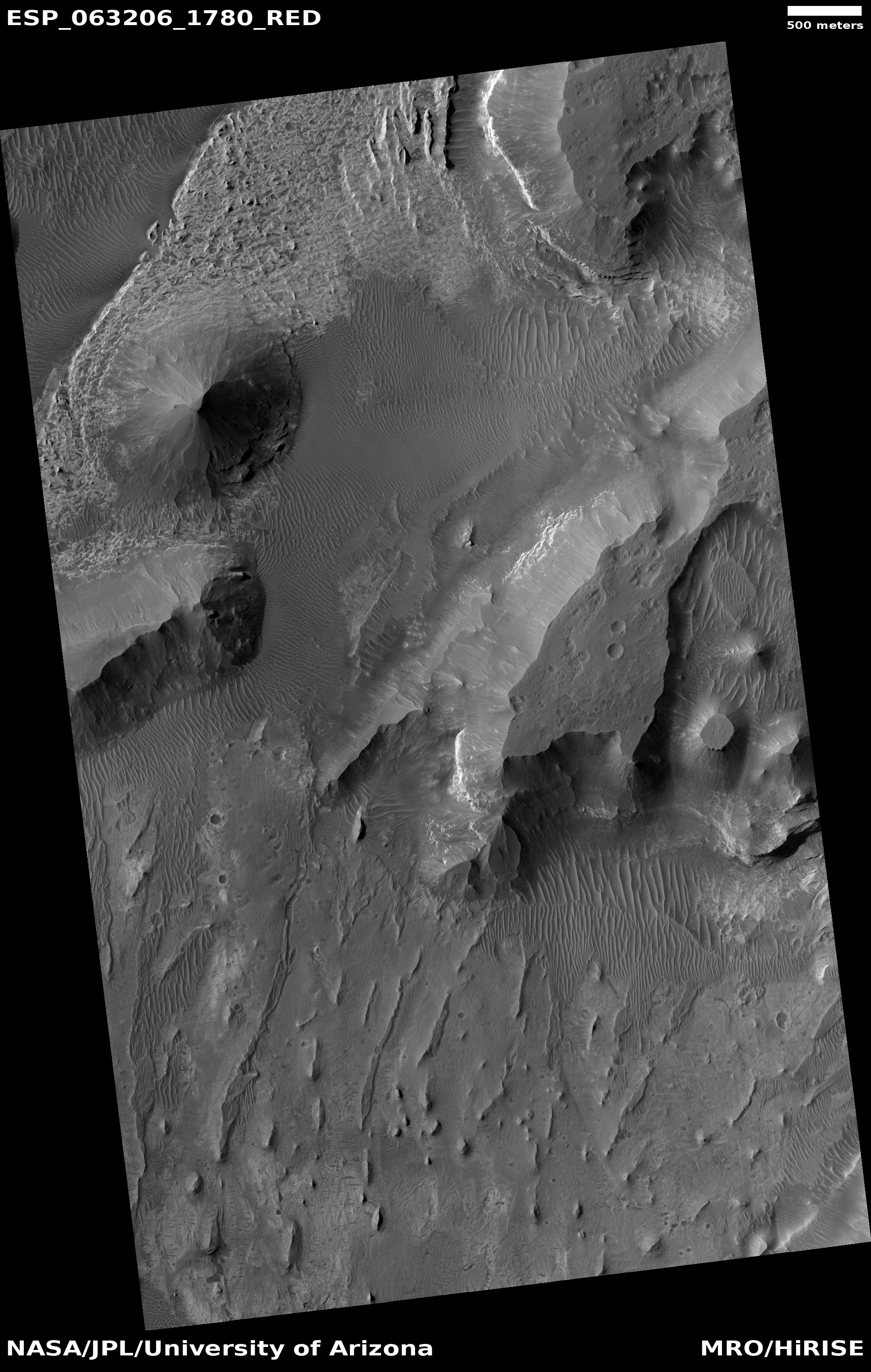
Cool image time! Rather than sit in cowering fear, as it appears too many worldwide are doing, I am going to stay calm and carry on. The photo to the right, rotated, cropped, and reduced in resolution to post here, was taken by the high resolution camera on Mars Reconnaissance Orbiter (MRO) on January 20, 2020. It shows a small section of a region dubbed Iani Chaos, a terrain dubbed such by scientists because of its cracked and chaotic nature, flat-topped mesas cut by canyons and fissures.

Chaos terrain is generally found in the transition zones on Mars between its southern highlands and northern lowlands. It was formed over time by erosion processes, either liquid water or ice, that slowly washed out the material along fault-lines, leaving mesas behind. This particular spot in Iani Chaos appears to be late in this process, with the gaps between the buttes wide and many of the mesas worn down into pointy knobs.

The location of Iani Chaos, as shown in the map below, tells us much about its history.
» Read more
1 comment

Inactive hot springs on Mars?

Inactive hot springs on Mars?
Click for full image.

Overview of Vernal Crater

Cool image time! In prepping my report of the interesting abstracts from Friday of the cancelled 51st annual Lunar & Planetary Science conference (to be posted later today), I found myself reading an abstract [pdf] from the astrobiology session about the possibility of now inactive hot springs on Mars! This was such a cool image and possibility I decided to post it separately, first.

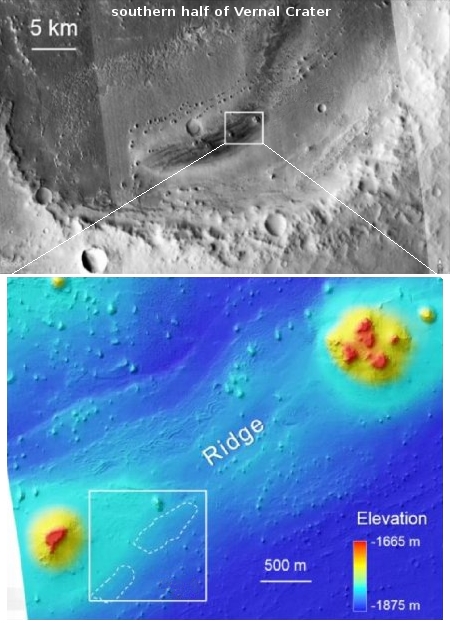
The top image to the right, cropped and expanded to post here, was taken by the high resolution camera on Mars Reconnaissance Orbiter in 2009. It shows some dark elliptical splotches inside the floor of a crater dubbed Vernal. The second image to the right, taken from the abstract, shows the context, with the top image a wide shot showing the southern half of Vernal Crater where these features are located, and the bottom image zooming into the area of interest. The white box focuses on the elliptical features seen in the first image above. From the abstract:

The elliptical features consist of concentric halos of high but varying albedo, where the highest albedo in each occurs in a small central zone that mimics the shape of the larger anomaly. Each feature is also traversed by circumferential fractures. Several similar tonal features extend for 5-6 km, on stratigraphic trend with the elliptical features. Hypotheses considered for the origin of the elliptical features included springs, mud/lava volcanoes, pingos, and effects of aeolian erosion, ice sublimation, or dust, but the springs alternative was most compatible with all the data.

The abstract theorizes that the small ligher central zone is where hot water might have erupted as “focused fluid injection” (like a geyser), spraying the surround area to form the dark ellipses.

I must emphasize that this hypothesis seems to me very tenuous. We do not really have enough data to really conclude these features come from a formerly active hot spring or geyser, though that certainly could be an explanation. In any case, the geology is quite intriguing, and mysterious enough to justify further research and even a future low cost mission, such as small helicopter drone, when many such missions can be launched frequently and cheaply.

0 comments

Black dunes and weird hills on Mars

Black dunes and weird hills on Mars
Click for full image.

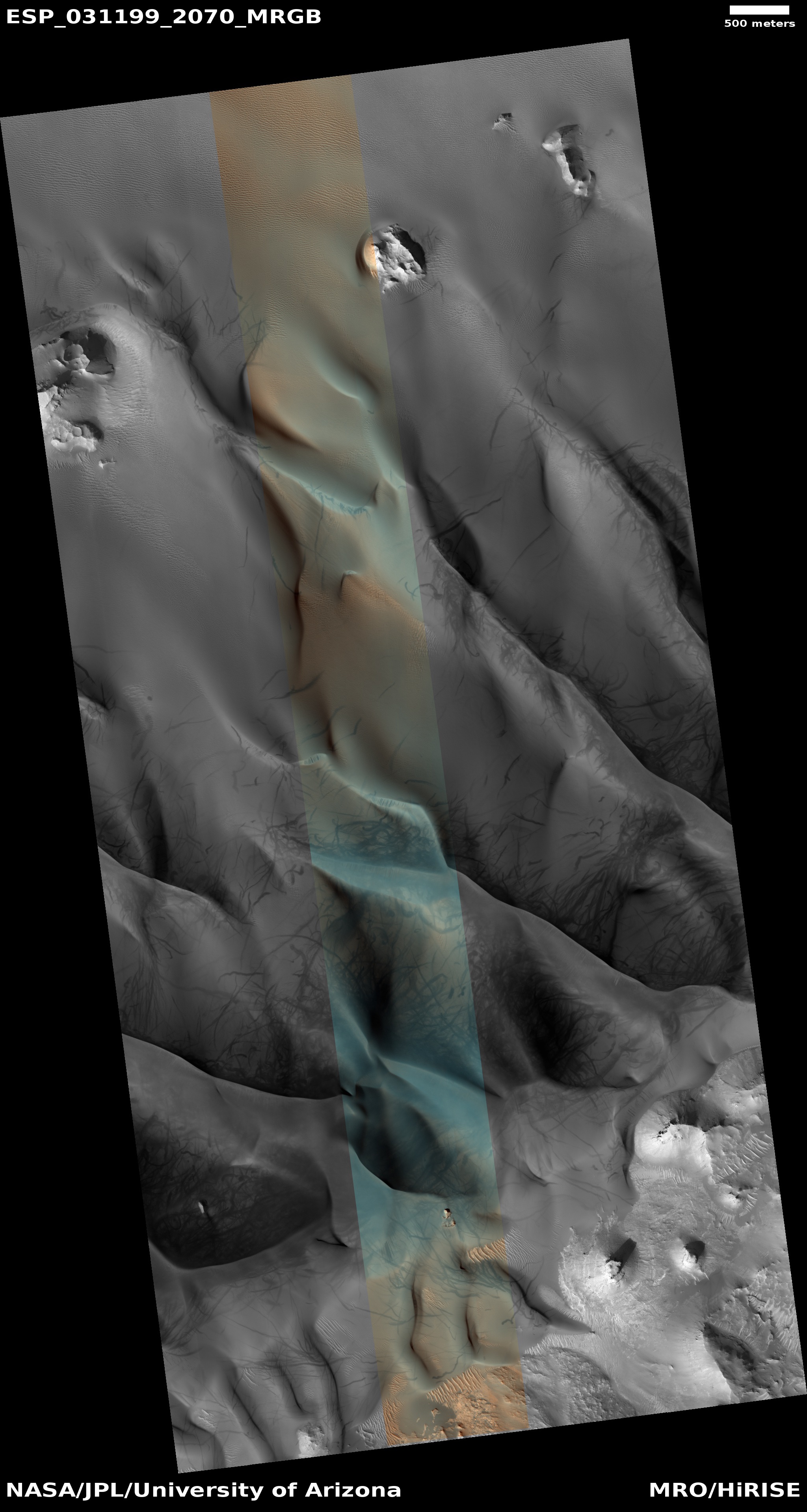
Cool image time! Or I should say a bunch of cool images! The photo on the right, rotated, cropped, reduced, and annotated by me, was taken by the high resolution camera on Mars Reconnaissance Orbiter (MRO) on February 3, 2020. An uncaptioned image, it was entitled “Arabia Terra with Stair-Stepped Hills and Dark Dunes.” Arabia Terra is one of the largest regions of the transition zone on Mars between the northern lowland plains and the southern cratered highlands. It is also where Opportunity landed, and where Europe’s Rosalind Franklin rover will land, in 2022.

This image has so many weird and strange features, I decided to show them all, Below are the three areas indicated by the white boxes, at full resolution. One shows the black dunes, almost certainly made up of sand ground from volcanic ash spewed from a long ago volcanic eruption on Mars.
» Read more

1 comment

Martian dust devil tracks come and go

The changing surface of dunes on Mars
Click for full image.

Earlier image of the same dunes
Click for full image.

Cool image time! To understand what created the vastly strange and alien Martian surface, it will be necessary for scientists to monitor that surface closely for decades, if not centuries. To the right is one small example. Taken by the high resolution camera of Mars Reconnaissance Orbiter (MRO) and rotated, cropped, and reduced to post here, it shows a dune field inside a crater in the southern cratered highlands of Mars. Craters have been found to be great traps for dust and sand on Mars. Once the material is blown inside, the winds are not strong enough to lift the material out above the surrounding rims. Thus you often get giant dunes inside craters, as we see here.

What makes this location of interest to planetary scientists is the changing surface of these dunes. They have been monitoring the location since 2009. In 2013, the MRO science team released a captioned photograph, the second image to the right, also rotated, cropped, and reduced by me to match the same area in the top image. In that caption planetary scientist Corwin Atwood-Stone of the Lunar and Planetary Laboratory in Arizona wrote,

This area was previously imaged in August 2009, about two Mars years ago, and in that image dust devil tracks were also visible. However the tracks visible now are completely different from the earlier ones. This tells us that there has been at least one dust storm since then to erase the old tracks, and lots of dust devil activity to create the new ones.

Since then the MRO science team has taken repeated images of this location to monitor how the dust devil tracks change, as well as monitor possible changes to the dunes themselves, including avalanches. The newest image above shows the result of the global dust storm last year. It wiped out the dust devil tracks entirely.

The newer image was entitled, “Monitor Dune Avalanche Slopes,” but I couldn’t find any examples. Based on published research, I am sure there is something there, even if I couldn’t find them. Maybe my readers have a better eye than I.

0 comments

Martian badlands

The Tyrrhena Terra badlands
Click for full image.

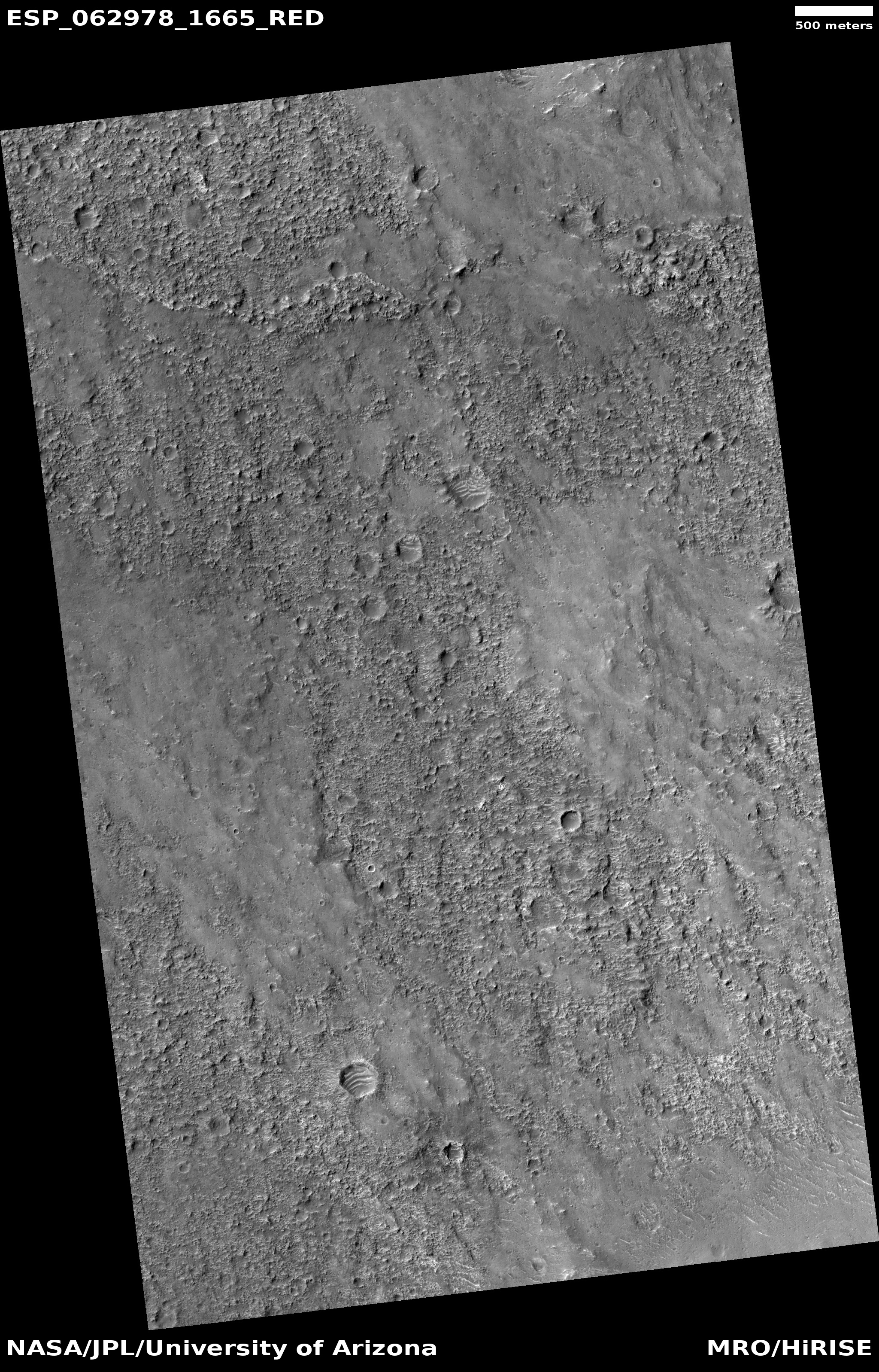
The photo to the right is a small section cropped from an image taken by the high resolution camera on Mars Reconnaissance Orbiter (MRO) on January 2, 2020. It shows the rough, cratered southern highlands dubbed Tyrrhena Terra that lie between the low Isidis Basin to the north and Mars’ deepest basin, Hellas, to the south.

The image was taken not because any specific scientific request, but because MRO was doing spectroscopy over this area and it made sense to also take a photograph. Comparing the photograph with the spectroscopic data allows scientists to better understand that spectroscopy.

The white cross in the map below shows the location of this image. The map itself covers latitudes from 40 degrees north to 55 degrees south.
» Read more

5 comments

Curiosity reaches highest point yet on Mars

Curiosity looking north across Gale Crater
Click for full resolution version.

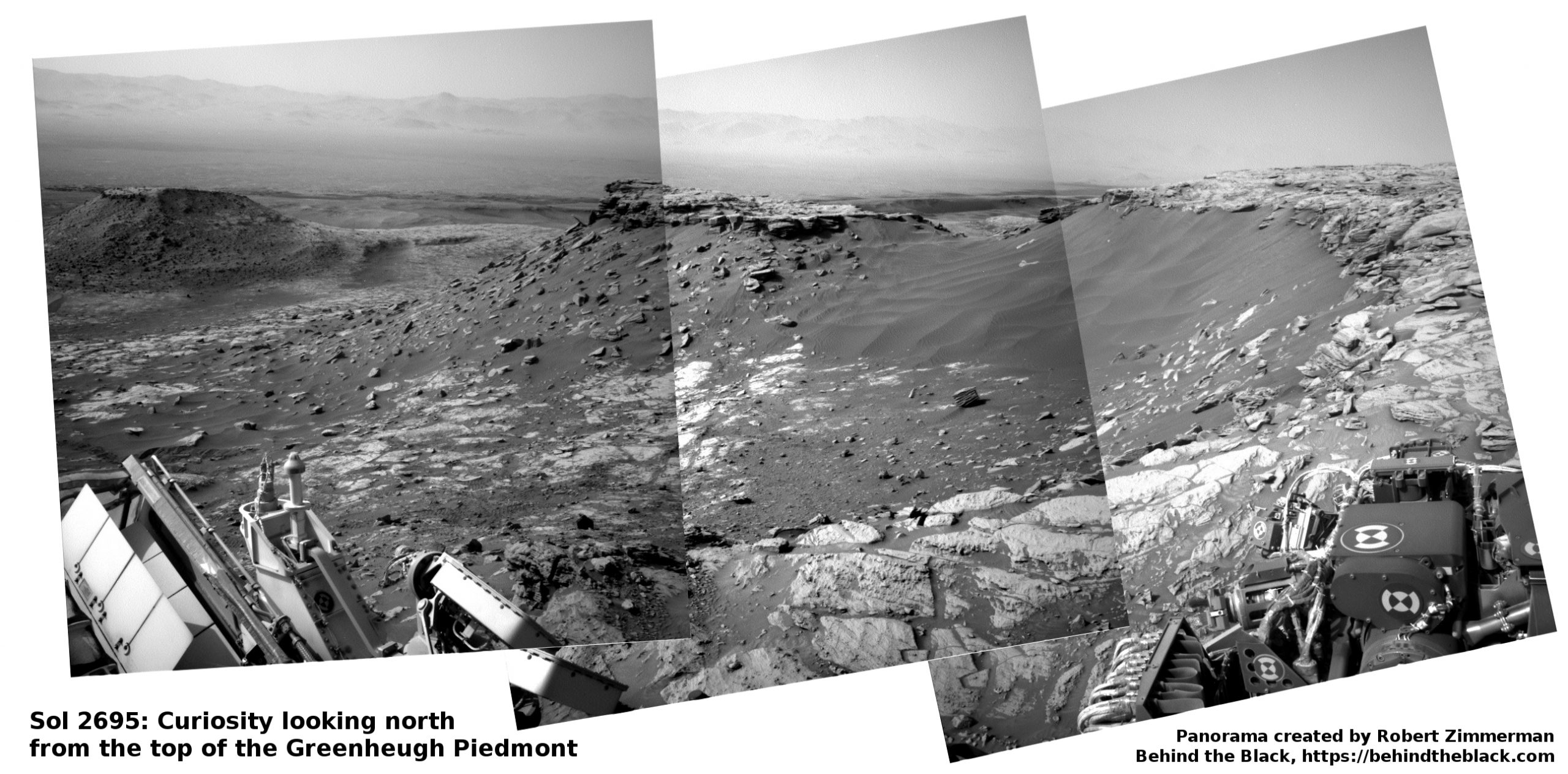
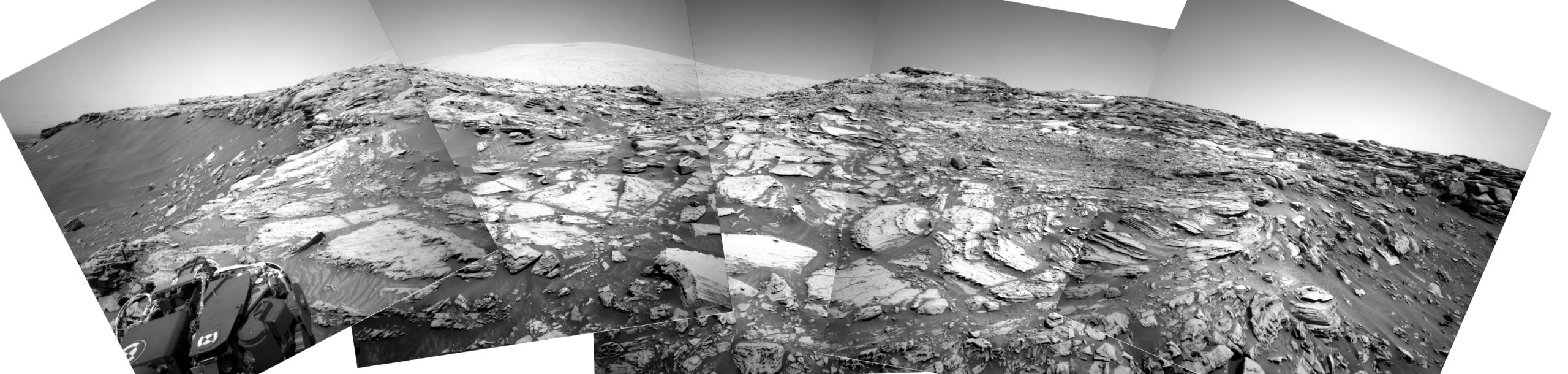
Time for some more cool images! The panorama above, cropped and reduced to post here, was assembled from images taken by Curiosity on March 6, 2020 by its left navigation camera, just after it topped the slope and settled on the very rocky plateau of what the scientists have dubbed the Greenheugh Piedmont, the highest point on Mars that Curiosity has so far traveled. It looks north, across Gale Crater to its far rim, about thirty miles away. That rim rises about a mile higher than where Curiosity sits today.

To quote Michelle Minitti, the planetary geologist who wrote the update describing this achievement:

Kudos to our rover drivers for making it up the steep, sandy slope below the “Greenheugh pediment” (visible in the [right] side of the above image) and delivering us to a stretch of geology we had our eyes on even before we landed in Gale crater!

The panorama below is also assembled from photos taken by the left navigation camera, but this time it looks south, across the piedmont toward Mt. Sharp. Its view of the the piedmont’s very very rough terrain I think proves that once the scientists have gathered their data from this point, the rover will descend back down and resume its original route, circling the piedmont to skirt its southern edge where orbital data suggests the going will be smoother.
» Read more

1 comment

Rolling boulders on Mars

Boulder tracks on Mars
Click for full image.

Cool image time! The photo to the left, cropped to post here, was taken by the high resolution camera on Mars Reconnaissance Orbiter (MRO) on January 21, 2020, and shows several boulders at the bottom of a slope, along with the tracks those boulders made as they rolled downhill sometime in the far past.

Uphill is to the south. We know the dark spots at the end of these tracks are large boulders partly because of the wind streaks emanating away from them to the north. As the wind goes around each rock it produces eddies that produce the tracks. Based on the scale and the image resolution (about 10 inches per pixel), these boulders range in size from about one to five feet in diameter.

This image has two points of interest. First, the tracks left by the boulders seem to have a repeating pattern. My guess is that the pattern most likely formed because the boulders are not spherical in shape, and as they rolled each roll repeated a certain pattern reflecting that shape. This theory is reinforced by a close look at each boulder. Though the resolution is insufficient to resolve the boulders themselves, the pixel distribution for each strongly suggests an asymmetric shape.

Second, this image, when compared with an earlier MRO image of the same spot, taken fourteen years ago in December 2006, shows no obvious change. These tracks, and their boulders, have therefore probably sat here, as we see them, for a long time. Since there appear to be two sets of tracks, with one overlying the other, this suggests that two separate events (an earthquake or nearby impact) each time caused a bunch of boulders to break free and roll downward together, with the second set of boulder tracks crossing over the earlier set.

Establishing when those two events occurred, however, will require some on-site data, something that will likely not occur until humans roam the surface of Mars in large numbers.

0 comments

Mars rover Update: March 4, 2020

Panorama looking south and uphill
Click for full resolution.

Curiosity

[For the overall context of Curiosity’s travels, see my March 2016 post, Pinpointing Curiosity’s location in Gale Crater.

For the updates in 2018 go here. For a full list of updates before February 8, 2018, go here.]

Map of Curiosity's travels

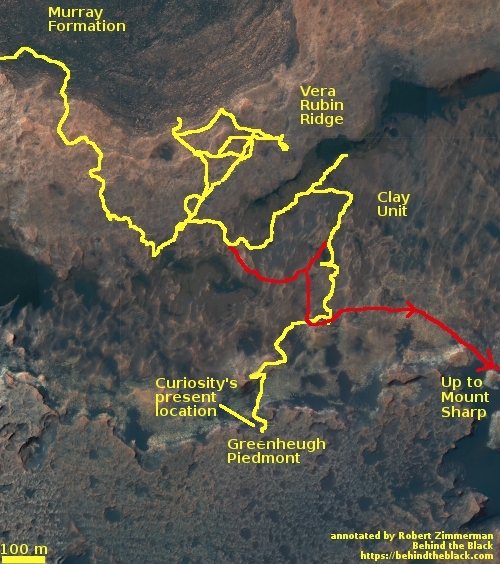
Since my last rover update on January 13, 2020, Curiosity has finally moved on from the base of Western butte, where it spent more than a month drilling a hole and gathering a great deal of geological data. Rather than head downhill and around the plateau and back to its planned route (as indicated by the red line in the map to the right), the Curiosity science team decided to push upward and onto the Greenheugh Piedmont (as indicated by the yellow line).

They had always planned to reach the top of this plateau, but not for several years. First they were going to head east to study a recurring slope lineae (see my October 2019 update), an example of a dark streak that darkens and fades seasonally and could provide evidence of water seepage from below ground.

Instead, they decided the close proximity of the top of the piedmont and its geology was too tempting. The piedmont is apparently made up of a layer that is very structurally weak, and breaks up easily, as you can see by the panorama above. It also appears to sit on softer, more easily eroded material, which thus accentuates this break up. If you look at the left part of the panorama you can see what I mean. The piedmont layer there is the thin unbroken layer sitting on what looks like sand. As that sand erodes away the layer quickly breaks into small pieces, as shown in the rest of panorama.

Traveling on the piedmont will likely be difficult and threaten Curiosity’s wheels. I suspect this reality prompted them to choose to get to the top and obtain data now, rather than wait several more years of rough travel that might have made access to the piedmont difficult if not impossible.

They presently sit just below the top, and are studying their options before making that last push.
» Read more

3 comments

Summer at the Martian North Pole

Buzzell pedestal crater in context with polar icecap scarp
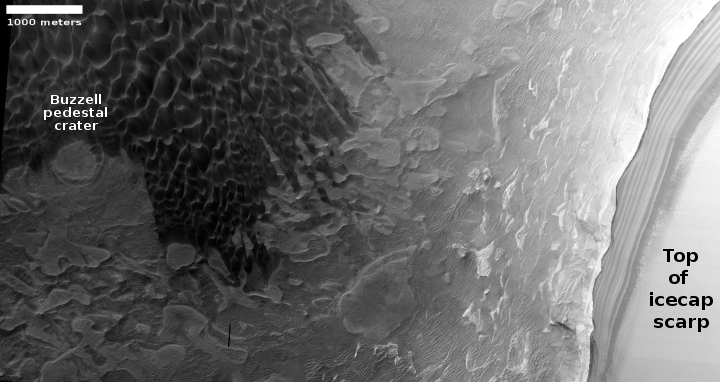
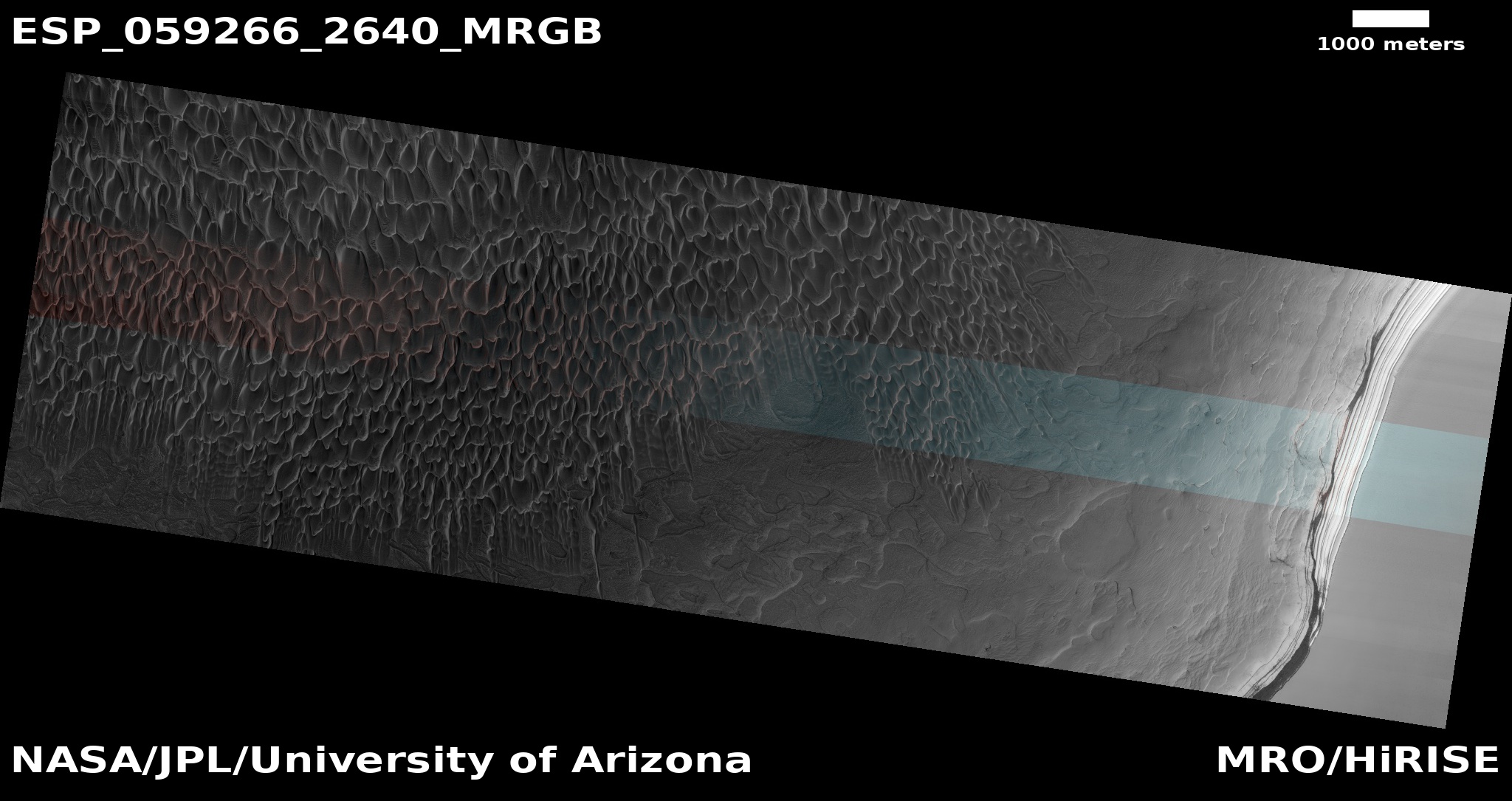
Cool image time! The image above, cropped, reduced, and brighten-enhanced to post here, was taken by the high resolution camera of Mars Reconnaissance Orbiter (MRO) on December 26, 2019 of the dunes just below the 1,500 to 3,000 foot high scarp that marks the edge of the Martian north polar icecap. I have brought up the brightness of the dune area to bring out the details.

This one image shows a range a very active features at the Martian north pole. At this scarp scientists have routinely photographed avalanches every Martian spring, as they have been occurring, caused by the warmth of sunlight hitting this cliff wall and causing large sections to break off. As Shane Byrne of the Lunar and Planetary Lab University of Arizona explained in my September 2019 article,

On Mars half of the images we take in the right season contain an avalanche. There’s one image that has four avalanches going off simultaneously at different parts of the scarp. There must be hundreds to thousands of these events each day.

Buzzell dunes, March 19, 2019
Click for full image.

On the left side of the image is an area of dunes that Candice Hansen of the Planetary Science Institute in Arizona has dubbed “Buzzell.” As spring arrives here, she has MRO regularly take images of this site (as well as about a dozen others) to monitor the changes that occur with the arrival of sunlight on the vast dune seas that surround that polar icecap.

The image to the right zooms in on one particular distinct feature, a pedestal crater, surrounded by dunes, that I have labeled on the image above. This image was taken just as spring began, with the Sun only five degrees above the horizon. At that time the dunes and pedestal crater were mantled by a frozen layer of translucent carbon dioxide that had fallen as dry ice snow during the sunless winter and then sublimates away each Martian summer.

Since March I have periodically posted updates to monitor the disappearance of that CO2 layer. (See for example the posts on August 2019 and November 2019.) Below are two more images, showing the ongoing changes to this area from early to late summer.
» Read more

2 comments

Glacial breakup on Mars

glacial breakup on Mars
Click for full image.

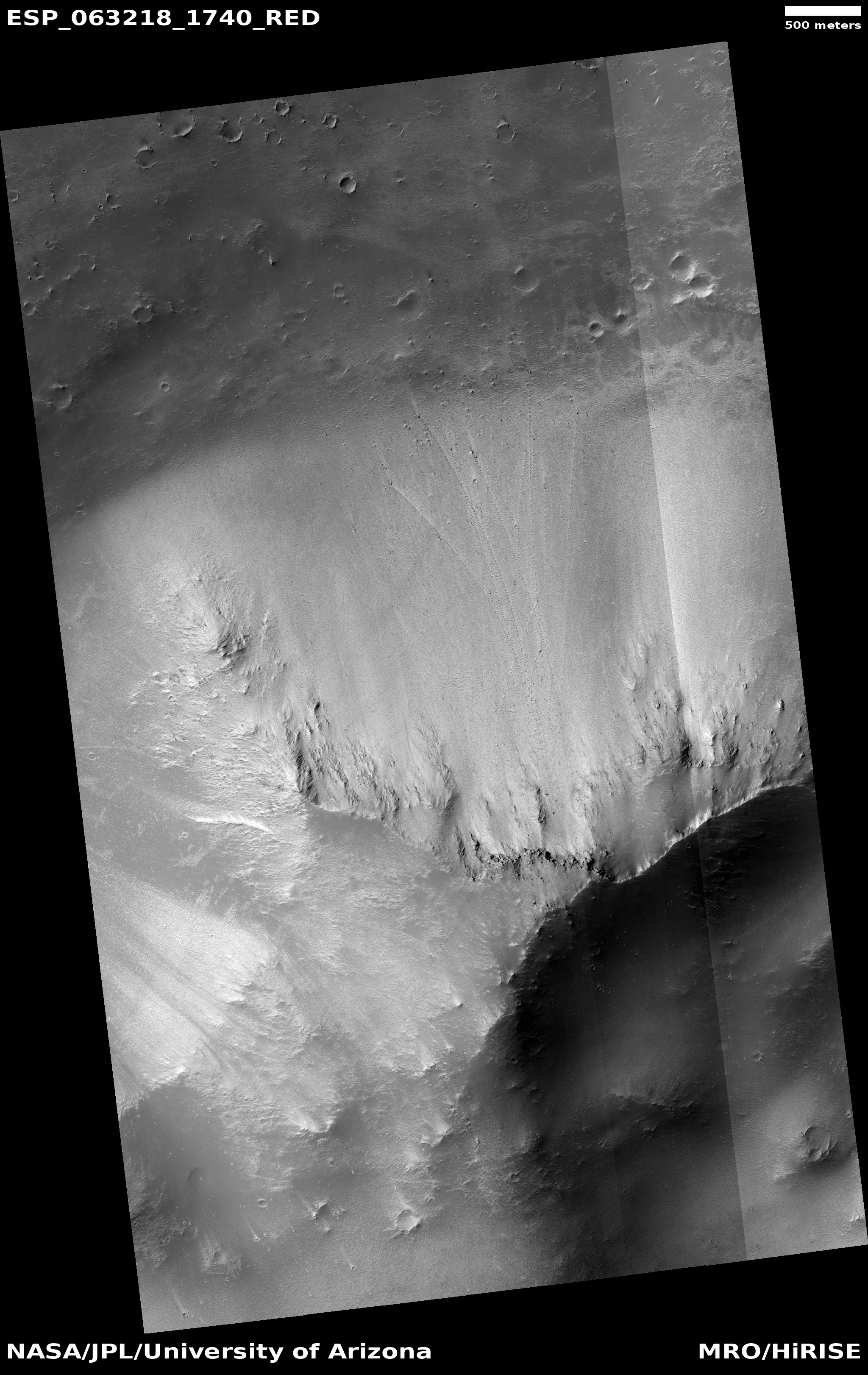
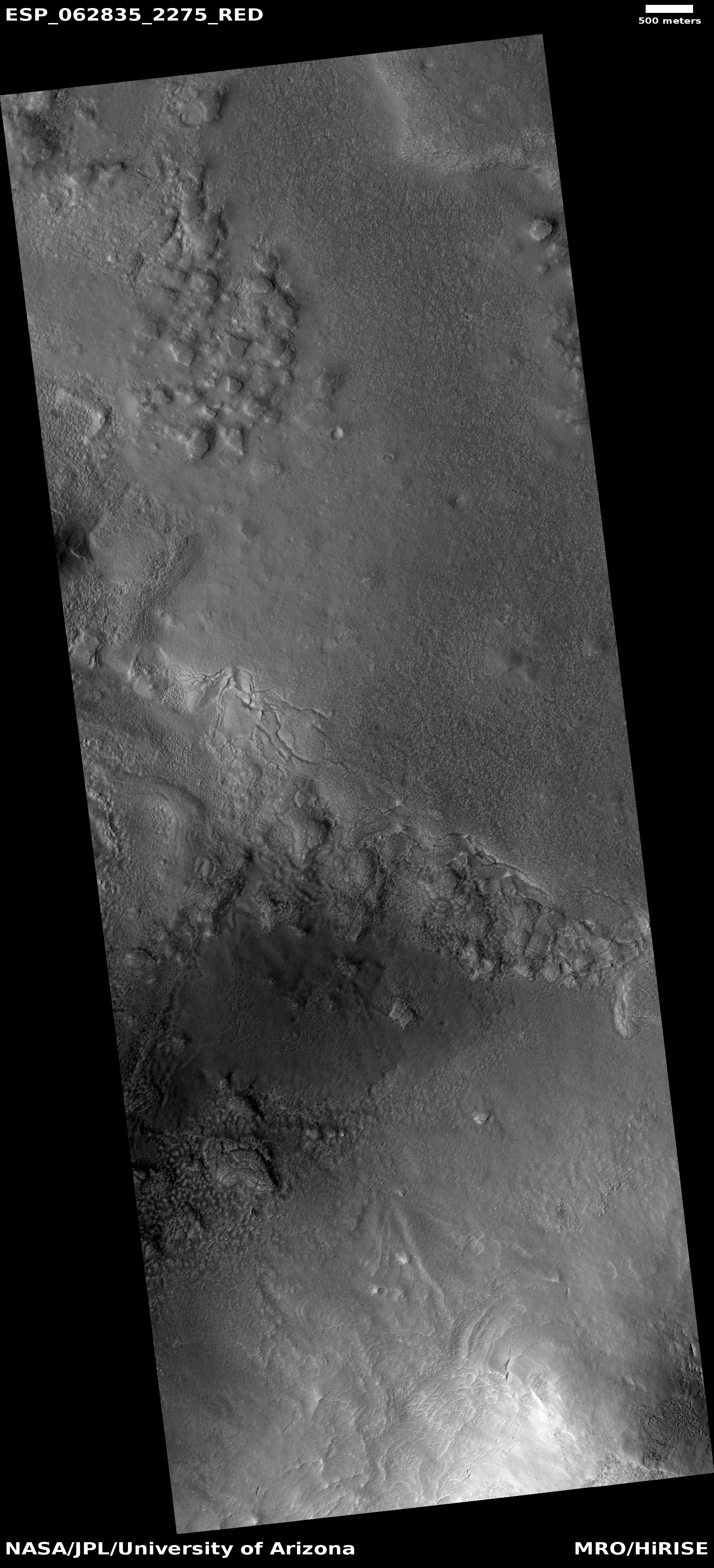
Cool image time! The photograph to the right, cropped and reduced to post here, was taken by the high resolution camera on Mars Reconnaissance Orbiter on December 22, 2019 and was titled “Contact Between Debris Apron and Upper Plains in Deuteronilus Mensae”.

The section of the full image that I have focused on shows what appears to be the downhill break-up of the surface debris covering an underlying water ice glacier. The grade is downhill to the south.

I am confident that this is buried glacial material based on recent research:

Both of these reports found lots of evidence of shallow ice in Deuteronilus Mensae, a region of chaos terrain in the transition zone between the Martian northern lowlands and the southern highlands.

With this image we see what appears to be the slippage of that ice downslope, causing breakage and cracks on the surface, with much of that surface made up of the dust and debris that covers the ice and protects it. Towards the bottom of the image it even appears that the disappearing ice is unveiling the existence of a bunch of buried bedrock mesas, typical of chaos terrain, previously hidden by the ice because it filled the surrounding canyons.

Below is a close-up of the photograph’s most interesting area of break-up.
» Read more

1 comment

Peering into a Martian pit

Peering into a pit
Click for full image.

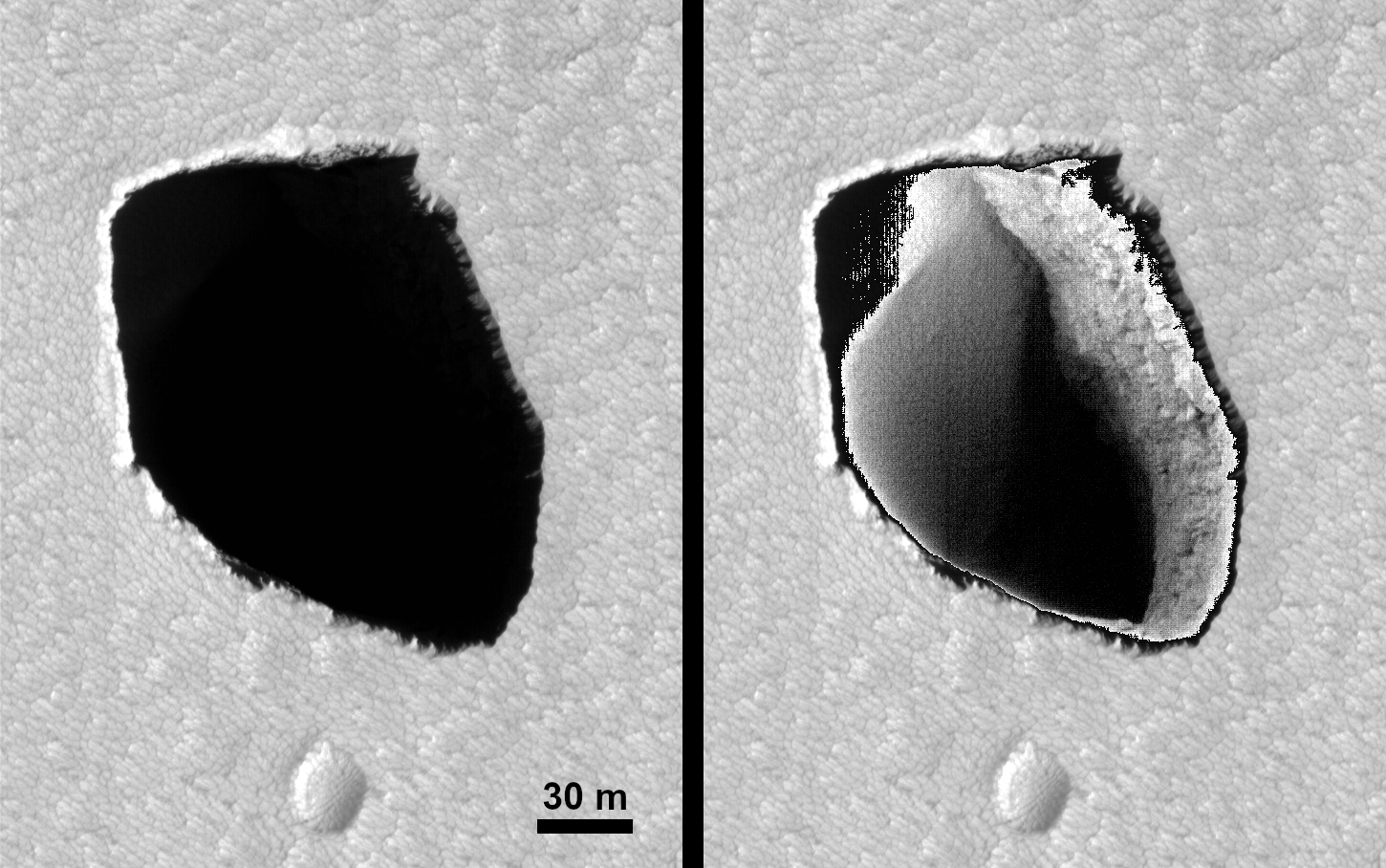
Cool image time! The science team for the high resolution camera on Mars Reconnaissance Orbiter last week released the above image of a pit to the west of the giant volcanoes Arsia and Pavonis Mons. The left image is without any adjustments in exposure. The right image has brightened the pit’s interior to bring out details in order to see what’s there. As planetary scientist Ross Beyer of Ames Research Center noted in his caption:

The floor of the pit appears to be smooth sand and slopes down to the southeast. The hope was to determine if this was an isolated pit, or if it was a skylight into a tunnel, much like skylights in the lava tubes of Hawai’i. We can’t obviously see any tunnels in the visible walls, but they could be in the other walls that aren’t visible.

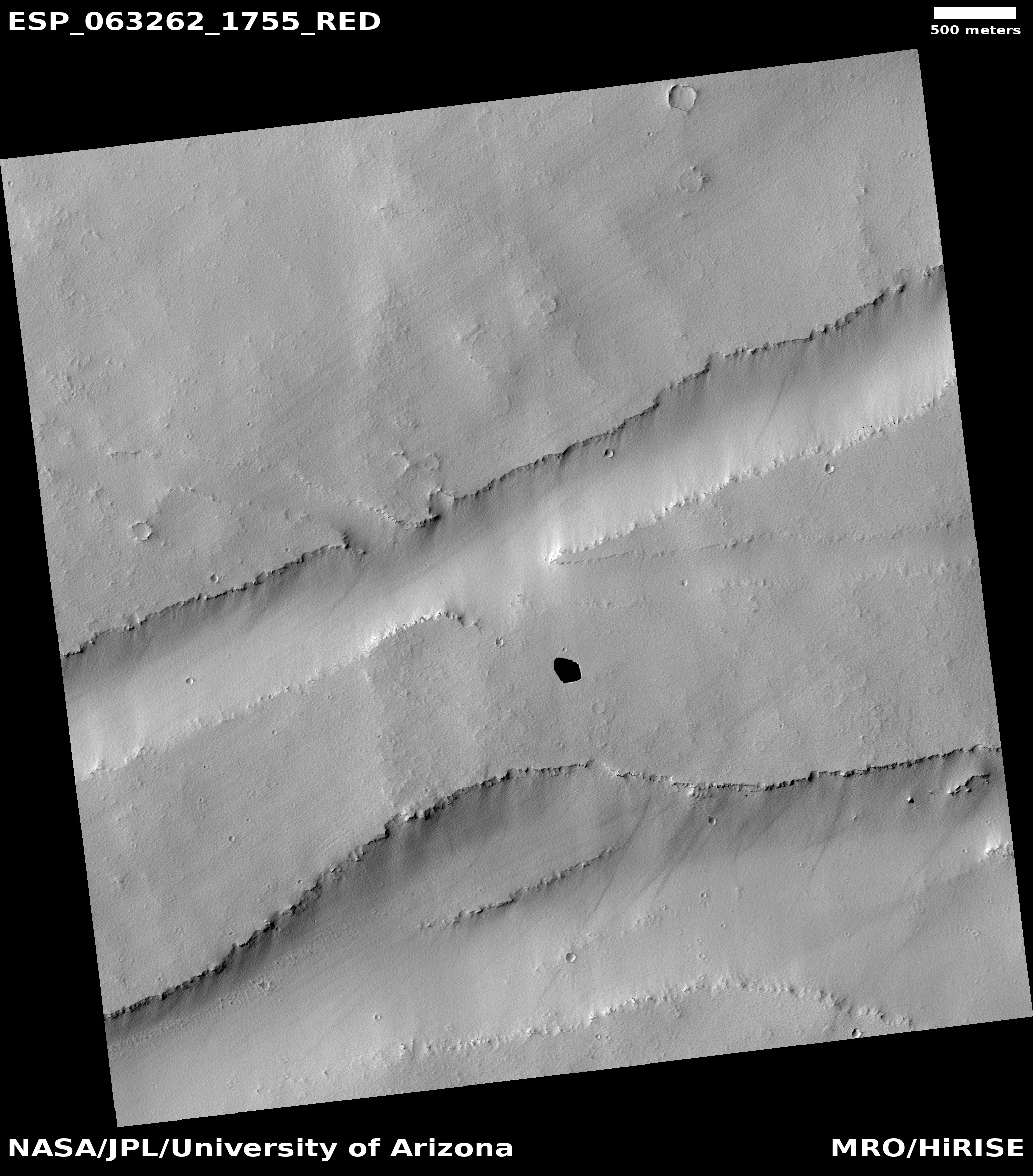
Wider view of pit
Click for full image.

Because the image has been rotated 180 degrees, north is down. The northern wall of the pit appears to be either very vertical, or overhung. A tunnel might head north from here, but because of the angle of the photograph, this cannot be confirmed.

To the right is a wider look from the full photograph, showing the surrounding terrain, with north now to the top. In line with this pit is a depression that crosses the east-west canyon to the north. This alignment strongly suggests that a fault or fissure exists here, and that an underground void along this fissure line could exist. It also suggests that a deeper and larger void could exist below that larger canyon.

This pit, and the accompanying fissures, were likely caused by crack-widening along these faults, produced as this volcanic region bulged upward.

Map of knowns pits surrounding Arsia Mons

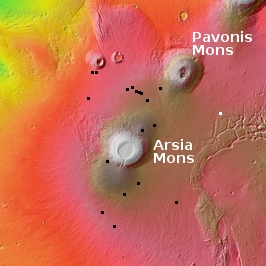
This pit is also one of the many many pits found near these volcanoes. The map to the right shows by the black boxes all the pits documented by the high resolution camera on MRO in the past few years, with this new pit indicated by the white box.

Beginning in November 2018 until November 2019 I was almost doing a monthly post reporting the new pits photographed by MRO. Since November however the number of new pit images dropped. This is not because every pit has been imaged, but because it appears they have completed their initial survey.

Below is a list of all those previous pit posts:
» Read more

2 comments

Chinese scientists publish radar results from Chang’e-4 lander

Layers as seen below ground by Chang'e-4 radar

The new colonial movement: Chinese scientists today published their first ground-penetrating radar results from their Chang’e-4 lander on the far side of the Moon.

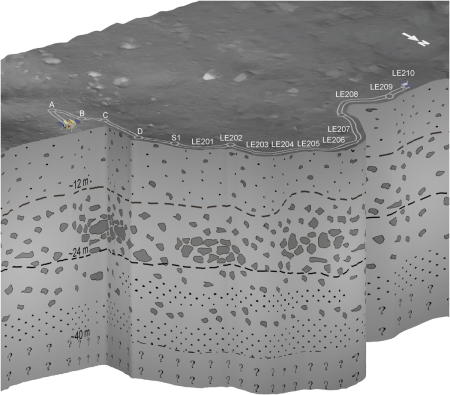
Using a ground-penetrating radar instrument on Chang’e-4, researchers have found that the rover is likely sitting on different layers of ejecta—debris from multiple impacts over time that rained down at high velocities to blanket the lunar surface and now fill the crater. “[We] see a very clear sequence of [layers],” says Elena Pettinelli of Roma Tre University in Italy, one of the paper’s co-authors.

The rover’s radar instrument was able to penetrate up to 40 meters below the surface of the moon, more than twice the distance achieved by its predecessor, the Chang’e-3 mission, which landed on the lunar near side in December 2013. Data from the latest mission show three distinct layers beneath the rover: one made of lunar regolith, or soil, down to 12 meters; another made of a mix of smaller and larger rocks down to 24 meters; and a third with both coarse and fine materials extending the rest of the 40-meter depth.

The figure to the right comes from the paper [pdf] Though the layers have not been dated, their differences suggest different past events in the formation of this surface.

These results are excellent, but they also have many uncertainties. Radar can tell you a lot, but the only way you can really ever know anything about what’s below ground is to go there and actually do some digging.

1 comment
1 115 116 117 118 119 157