New serious damage to Curiosity’s wheels?

New damage to Curiosity's wheels?
Click for original image.

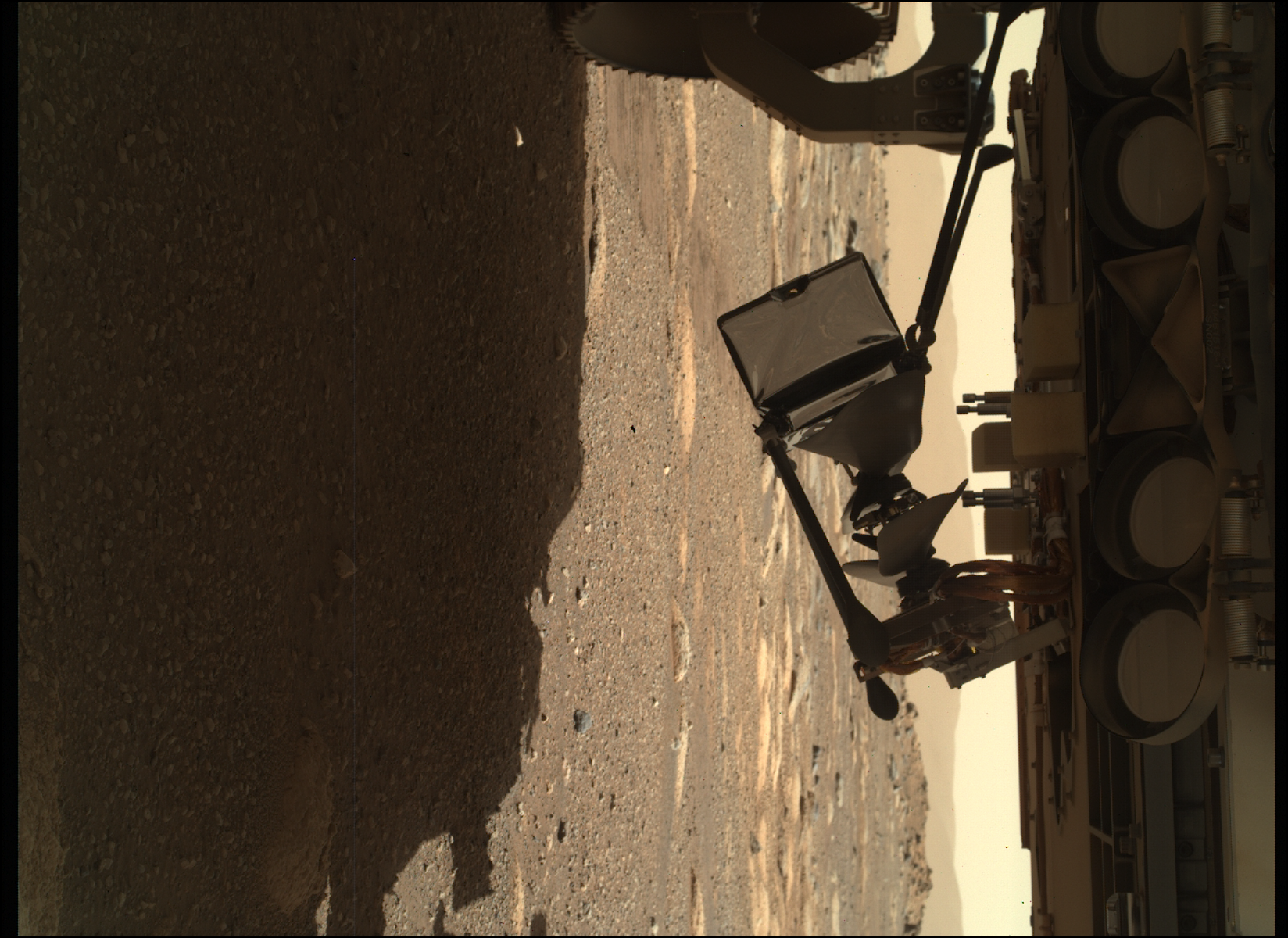
I must start this post with a strong caveat. The serious damage, as posted to the right, of the zig-zag growser treads on one of Curiosity’s wheels that was photographed by one of the rover’s cameras yesterday and downloaded today, could very well not be new damage. As noted in a report in June:

The team discovered that the left middle wheel had damaged one of its grousers, the zig-zagging treads along Curiosity’s wheels. This particular wheel already had four broken grousers, so now five of its 19 grousers are broken.

The damaged wheel to the right appears to be that left middle wheel. This photo thus might simply be documenting the damage noted in June, and not new damage. Since Curiosity has six wheels (three on each side), the middle wheels like this one are likely slightly less critical and can be worked around should it no longer function well.

Nonetheless, the damage to these growsers is of concern. Previously, the wheel damage has consistently involved breakage in the metal plates between the growsers. Though the science team noted in that June report that it has “proven through ground testing that we can safely drive on the wheel rims if necessary”, the team also said that it did not think that was going to happen soon.

Based on this image, however, it is happening, at least on one wheel. Fortunately, a review of all the images downloaded yesterday does not show any other broken growsers on any other wheel, though the image survey is not thorough and does not cover the entire surface of every wheel. For example, I could not identify any images of the damaged sections of the wheel that I have been tracking since 2017. It could be that the photo’s orientation this time was significantly different, making it difficult to find a match. It could also be that the damage had increased so much that no match with an earlier photo was easily possible. Or it could simply be that the same section on the wheel was not photographed this time.

Either way, the damage on this middle wheel foreshadows the rover’s eventual future, a future that is likely getting closer because of the roughness of the mountain and rocky terrain that Curiosity is presently traveling, and appears to have no end as it now climbs Mount Sharp.

8 comments

Colliding glaciers

Overview map

Colliding glaciers

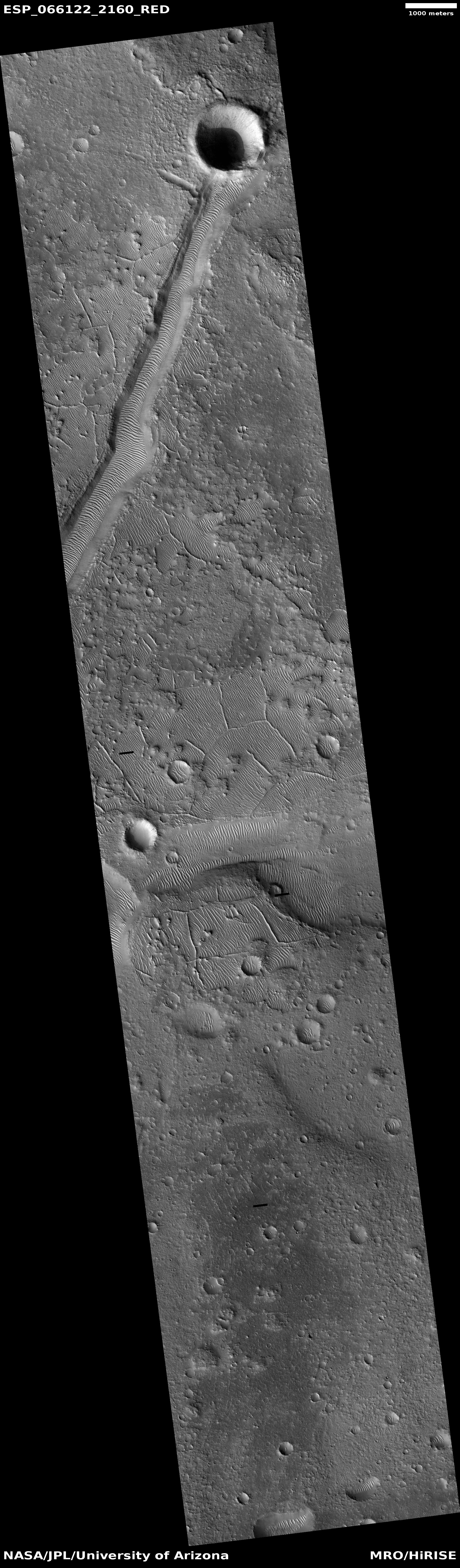
For today’s cool image we return once again to glacier country in the northern mid-latitudes of Mars. The picture to the right, rotated, cropped, reduced, and enhanced to post here, was taken on August 28, 2022 by the high resolution camera on Mars Reconnaissance Orbiter (MRO). It shows a spot where I think glacial flows coming from the north and south have collided at a low point. The white dot in the box on the overview map above marks its location, with the inset showing the mesas to the north and south that suggest this flow pattern.

What makes these colliding flows especially cool is the source of the northern flow. It appears that came out of the impact heat from that crater, which caused the ice on the downhill side to flow. You can also see the same phenomenon a short distance to the east, with a much smaller crater, likely a secondary impact from the first.

Note also the glacial fill inside the larger crater. This impact happened on top of older glaciers, but later climate cycles caused more ice to be deposited within the crater afterward. That this glacial fill appears terraced and thus layered also suggests that there were several if not many such later climate cycles.

1 comment

Glaciers everywhere in Mars’ glacier country

Glaciers everywhere in Mars' glacier country
Click for full image.

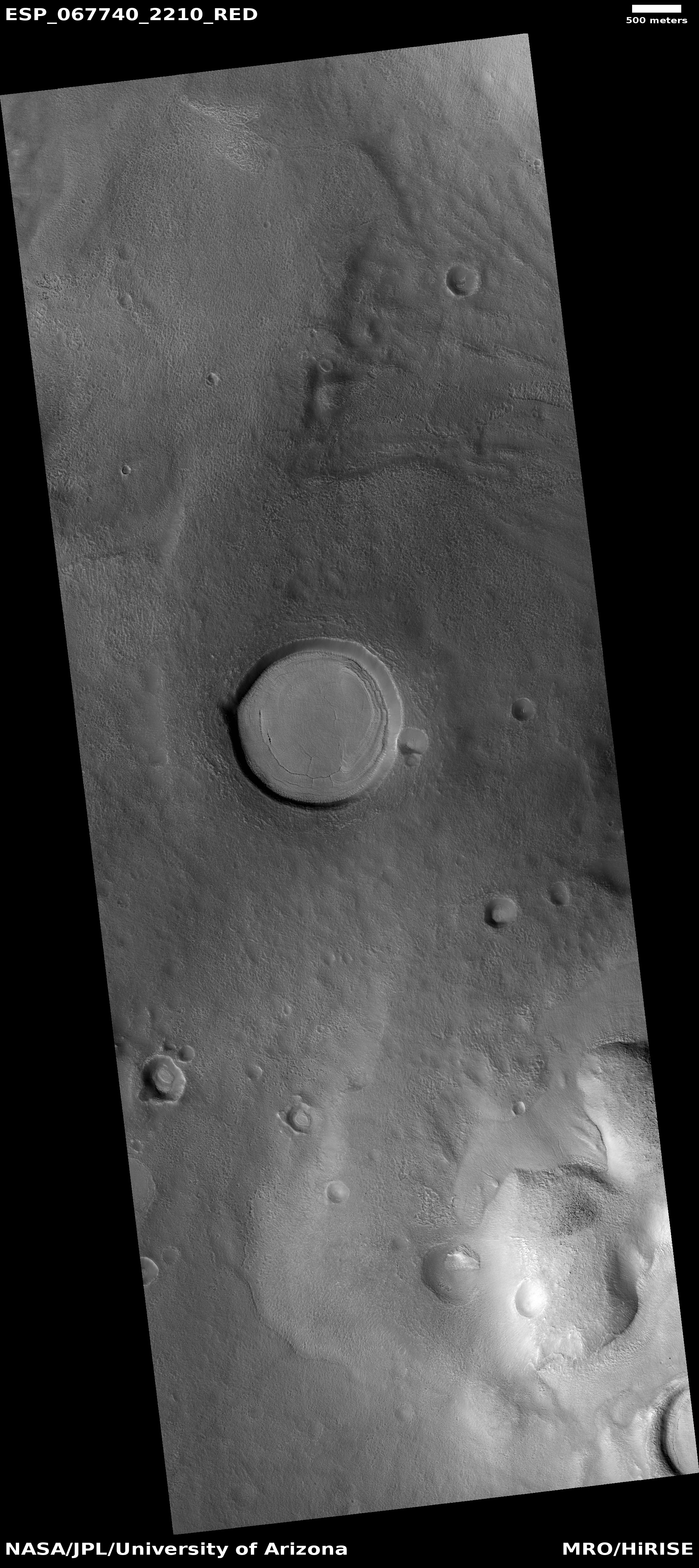
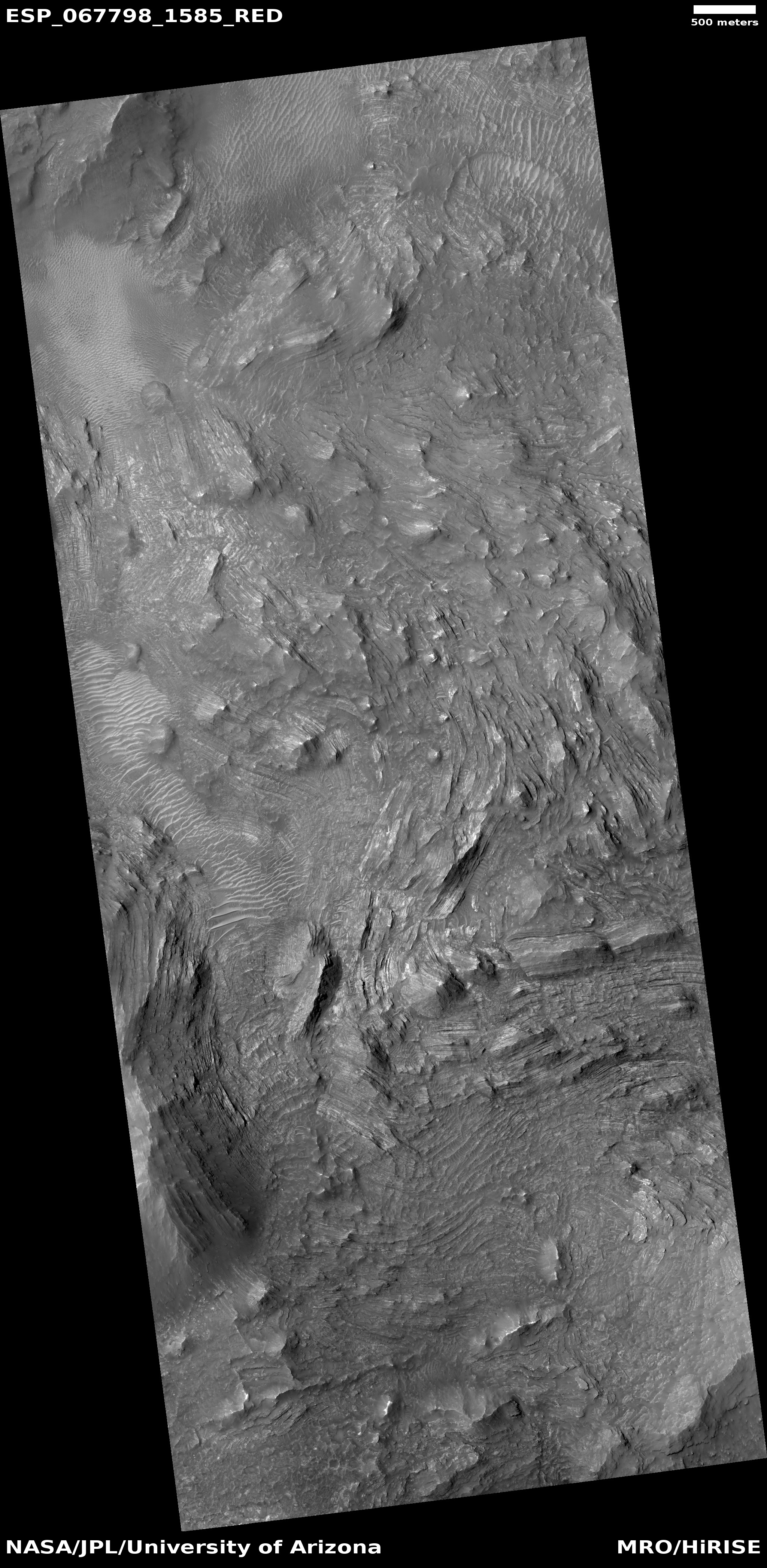
Cool image time! The picture to the right, rotated, cropped, reduced, and annotated to post here, was taken on August 24, 2022 by the high resolution camera on Mars Reconnaissance Orbiter (MRO). It shows glaciers apparently flowing down from two different mesas to the north and south.

The arrows indicate a major glacial stream coming from two directions. The many layered flow on the image’s upper right illustrates the many past climate cycles of Mars, with each subsequent period of snowfall and glacial growth producing progressively less ice. The chaotic region in the lower right marks what I think is the lowest point between the two mesas. Here the flows form eddies as the glaciers collide.

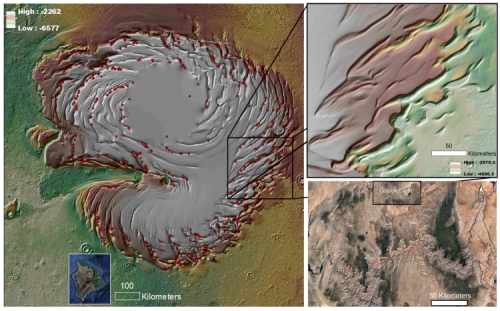
The overview map below shows us why there are so many glaciers at this spot on Mars.
» Read more

0 comments

Martian helicopters of the future

Today Bob Balaram, the chief engineer for the Mars helicopter Ingenuity, wrote up a short essay summarizing the helicopter’s successes on Mars.

This aircraft, very much also a spacecraft, has been on its own on the surface of Mars, detached from its traveling companion Perseverance, for over 500 Martian days or sols. It has operated way beyond its original planned mission of 30 sols, including surviving a brutal winter that it was not designed for. With 33 flights, almost an hour of flight time, over 7 km of travel in Jezero crater, takeoffs and landings from 25 airfields, almost 4000 navigation camera images, and 200 high-resolution color images, it has proven its worth as a scout for both scientists and rover planners. Currently, it is getting ready to use its fourth software update – this one with advanced navigation capabilities that will allow it to safely fly up the steep terrain of the Jezero river delta, scouting ahead of the rover Perseverance as it searches for signs of past life on Mars. [emphasis mine]

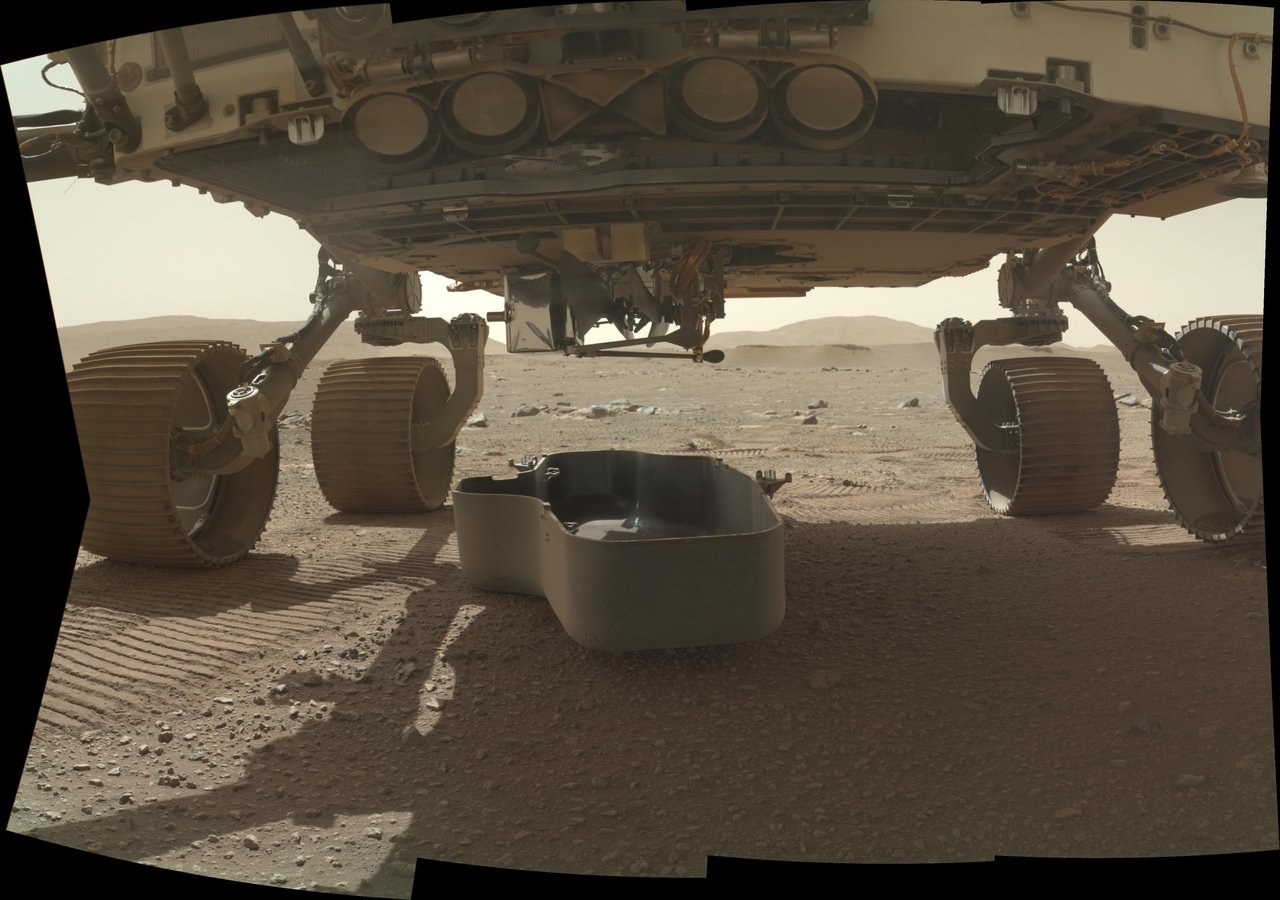
I have highlighted the number of flights above because Ingenuity was supposed to do a very short 34th flight on November 10th that would only have the helicopter go straight up 16 feet, hover, and then come straight back down. Yet, I have seen no postflight reports, and Ingenuity’s flight log still does not include it as of today. One image from Ingenuity that was taken on November 9th has been released, and shows the ground directly below it. No other recent images of this 34th flight however have been released.

The flight could still have happened, or was scrubbed for a later time. What is important however is all those other 33 flights, and what Ingenuity’s overall success has meant for future Martian exploration. As Balaram writes,
» Read more

5 comments

The Martian cycles of climate change, as shown in just one crater

The Martian cycles of climate change, as shown in one crater

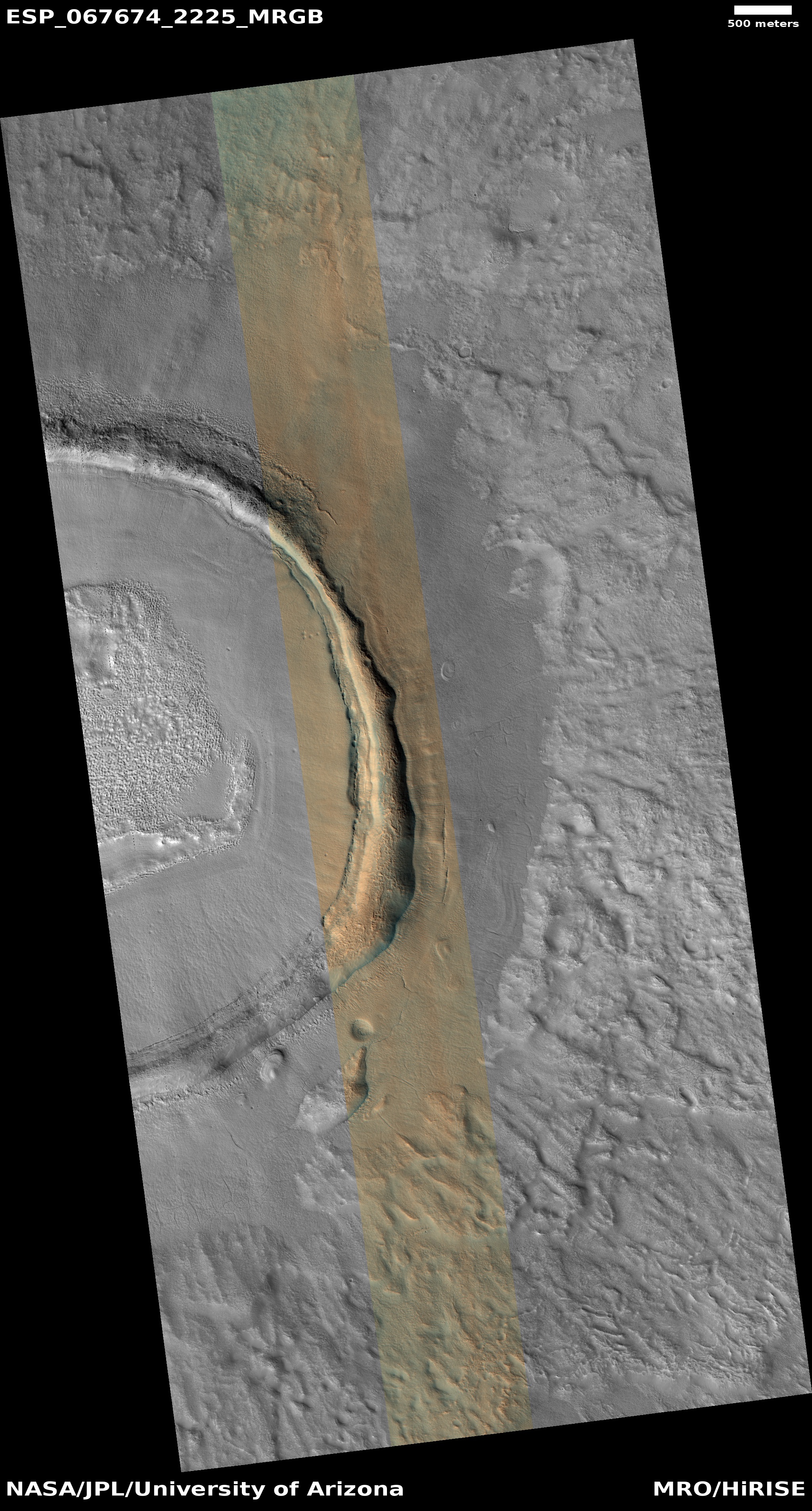
Cool image time! The photo to the right, rotated, cropped, reduced, and enhanced to post here, was taken on September 2, 2022 by the high resolution camera on Mars Reconnaissance Orbiter (MRO). The science team titled this picture “Gullies with Terminal Ridges on Glacial Crater Fill,” a title that in one phrase encapsulates everything we see here of this unnamed 8-mile-wide crater’s western rim and interior.

The crater is located at 46 degrees south latitude inside the much larger 145-mile-wide Kepler Crater, and about 1,500 miles east of Hellas Basin in a region where a lot of glacial ice is found. A context camera image taken in July 2020 shows the entire crater floor apparently covered with glacial fill that on the edges appears to be eroding away.

Today’s high resolution photo focused on the western part of the crater, where that eroding edge was instead replaced by a meandering ridge reminiscent of a moraine. The gullies on the interior slope to the west, as well as the parallel north-south cracks, suggest that debris falling and sliding down from that rim had pushed up against this glacial ice and created that ridge.

There is a lot more to this geology however.
» Read more

0 comments

A cliff face of volcanic erosion on Mars

A cliff face of volcanic erosion on Mars
Click for full image.

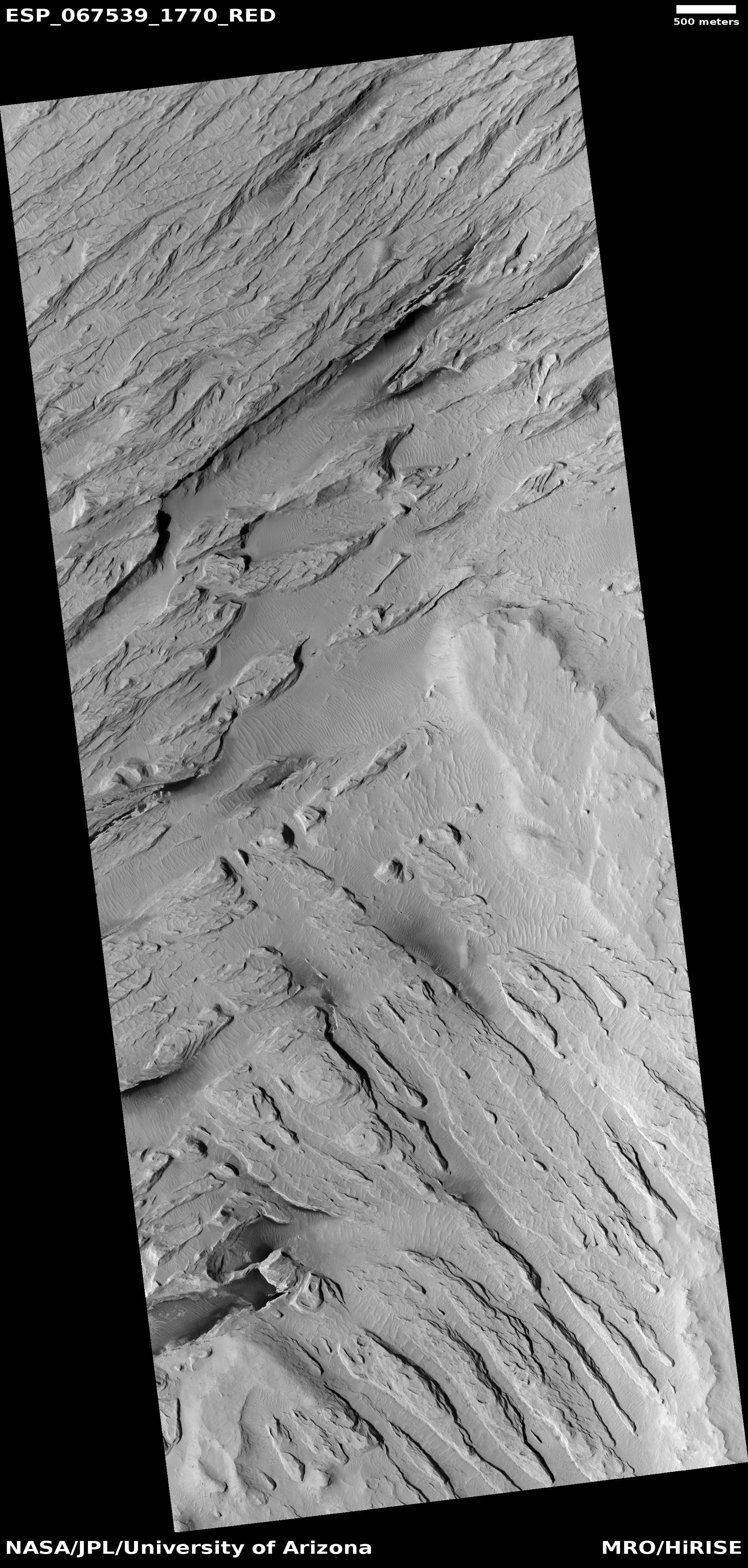
Today’s cool image is a variation of yesterday’s, showing another area on the edge of Mars’ largest volcanic ash field, dubbed the Medusae Fossae Formation and about the size of India. This time however the edge is an abrupt cliff, not the slow petering out of wind-shaped mesas.

The picture to the right, cropped, reduced, and sharpened to post here, was taken on August 27, 2022 by the high resolution camera on Mars Reconnaissance Orbiter (MRO). It shows what I very roughly estimate to be a 1,500 to 2,500 foot high cliff that appears to delineate the edge. To the north we have a plateau of intersperse layers of flood lava and ash. To the south those layers have eroded away, leaving a rough lava plain with a handful of scattered wind-sculpted mesas.

The overview map below, by providing a wider view of his region, makes its nature clearer.
» Read more

0 comments

Erosion at the edge of Mars’ biggest volcanic ash field

Erosion at the edge of Mars' biggest ash field
Click for full image.

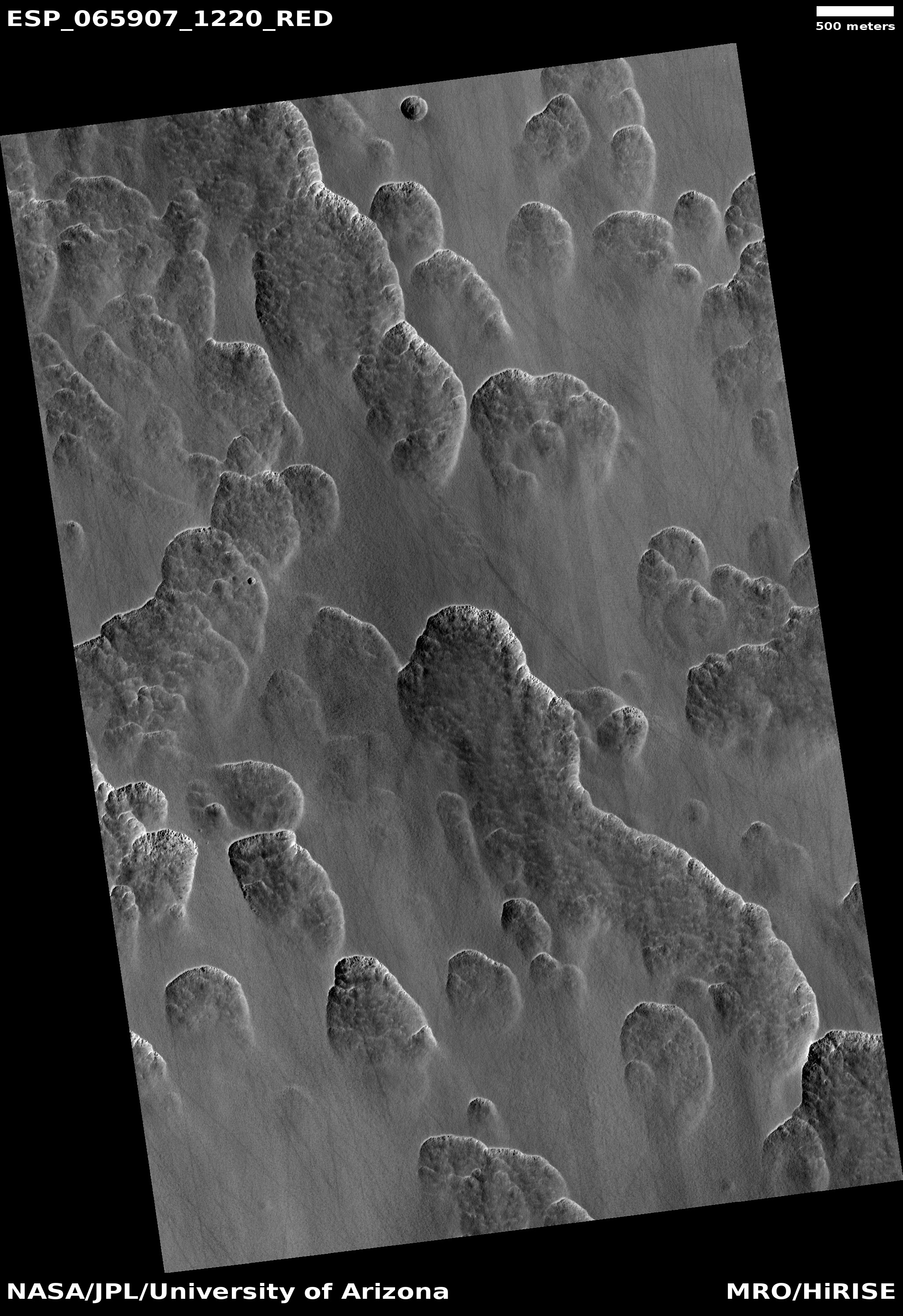
Cool image time! The photo to the right, rotated, cropped, reduced, and sharpened to post here, was taken on August 13, 2022 by the high resolution camera on Mars Reconnaissance Orbiter (MRO). It is another fine example of the wind-blown sculpted terrain that one finds routinely in Mars’ largest volcanic ash field, dubbed the Medusae Fossae Formation. About the size of India, this gigantic field is thought to be the source of most of the dust on Mars.

This particular location sits on the northernmost edge of that huge field. The elongated mesas mark the field’s edge, disappearing to the north but becoming thick and extensive to the south. The prevailing southeast-to-northwest winds have acted to clean most of the ash away.

We can get an idea about how deep and pervasive that field once was at this location by the pedestal crater in the middle right. Once, the floor of that crater was below the top of the ash field. At that time, the top of the dunes marked the general ground level across this entire image. Over time, the winds blew most of this material away, but the denser packed floor of the crater resisted that erosion, and thus now stands above the surrounding terrain.

The more normal-looking craters nearby could have occurred before the ash was deposited, or after it was blown away. The impact that created the pedestal crater however occurred when the ash covered everything here.
» Read more

0 comments

The weirdly eroded rocks of Mount Sharp

A weirdly eroded rock on Mars

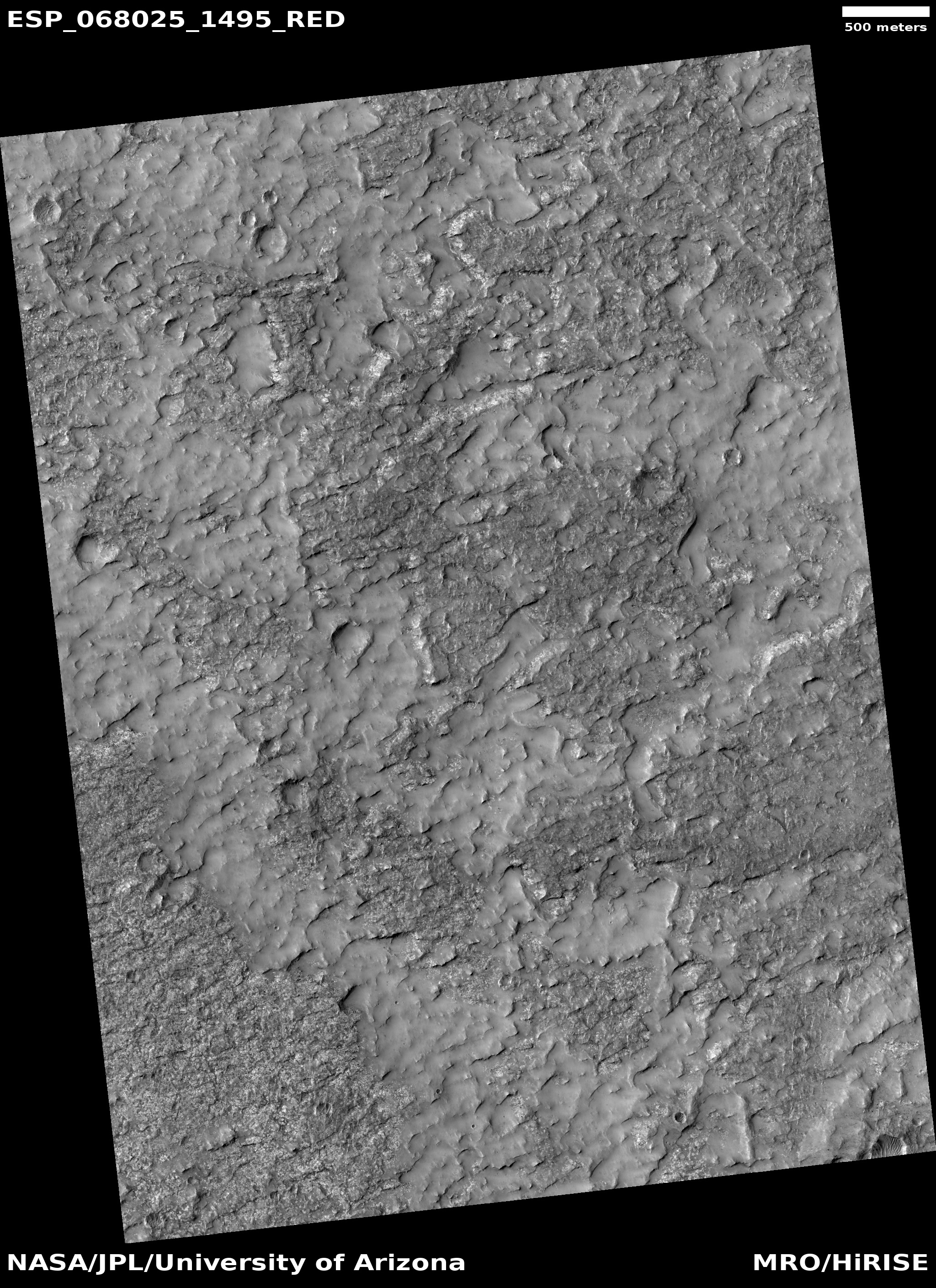
Cool image time! The picture to the right, cropped, reduced, and enhanced to post here, was taken on November 2, 2022 by one of the high resolution cameras on the Mars rover Curiosity.

There isn’t much to say. This strangely eroded rock appears somewhat typical for many surface rocks in this area in the foothills of Mount Sharp. The erosion is likely from wind, combined with the rock’s low density because of Mars’ one-third Earth gravity. Even so, that wind would have needed many many eons to achieve this erosion, as the atmosphere on Mars is only about 1% as thick as Earth’s.

The lack of data also leaves open the possibility that other as-yet-unknown chemical processes contributed to that erosion.

Note: The grid pattern in the image is an artifact from the camera, and is not an actual feature on the Martian surface.

3 comments

Perseverance leaps forward

Perseverance's view on November 3, 2022 (Sol 606)
Click for full resolution. The original images can be found here and here.

Overview map
Click for interactive map.

Cool image time! After spending several weeks at one location at the base of the delta that flowed into Jezero Crater eons ago, the science team today put the rover Perseverance into high gear, programming it to move 684 feet in one leap forward. The move worked, so that Perseverance has now climbed up onto a terrace of that delta so that it sits at the base of one of the hills that forms the delta’s head. The panorama above shows that hill. I estimate that hill is about thirty feet high, give or take 50%.

The blue dot on the map to the right shows the rover’s position. The yellow lines show the area viewed in the panorama above. The green dot shows the location of the helicopter Ingenuity.

It is almost certain that the science team will get another core sample from this location, as it is at least one layer higher on the delta, thus providing new geology for that core to document. I am guessing unfortunately. Unlike the Curiosity science team (which posts updates at least one to three times a week), the Perseverance science team posts updates at best only once a week, if that, and those posts have rarely provided information about the team’s future plans.

The panorama above is cool, but what prompted this post is the image below that the rover took after arriving at this location.
» Read more

0 comments

Curiosity begins a detour

Panorama taken November 2, 2022 by Curiosity
Click for full image.

Overview map
Click for interactive map.

The science team running the Curiosity rover on Mount Sharp on Mars have decided to take the rover on a detour. As shown in the overview map to the right, rather than continue climbing directly up the mountain in the canyon dubbed Gediz Vallis, they have turned the rover to the west in order to put it back on its original planned route, though traveling in the opposite direction. The goal is to get to Gediz Vallis Ridge, which the rover attempted to reach by crossing the Greenheugh Pediment back in the spring, but was forced to retreat because the ground was simply too rough for the rover’s wheels.

From their October 31st update:

We are now officially on our detour, a short round trip to image and capture geochemistry of the “Gediz Vallis ridge” up on the pediment, before coming back down to the “Marker Band valley” and rejoining the MSAR (Mount Sharp Ascent Route). This detour will allow us to access some of the area we’d planned to visit before getting turned around by the ‘gator-back’ terrain on the Greenheugh pediment. For this part of the campaign, we are prioritizing driving, getting to our destination as fast as we can, but imaging as we go and marking areas of interest for contact science as we come back down.

The panorama above, cropped and reduced to post here, shows the rover’s view uphill to get to the ridge. The blue dot marks its present position. The yellow lines mark the approximate area viewed by the panorama above.

I think the rover’s path will take it up through the saddle between the two small peaks on the left. The science team is likely hoping that once they get up over that saddle, the terrain to get to the ridge will be smoother and less treacherous than the very broken and rocky surface of the Greenheugh Pediment.

This route also appears to also get them up on the marker band more safely. That band, marked by the white arrows, is a distinct smooth layer found in many places on the flanks of Mount Sharp.

0 comments

InSight status update: still alive!

InSight's daily power levels through October 31, 2022

UPDATE: JPL has released a press release, outlining the steps the InSight team will take to shut the mission down. Key quote:

NASA will declare the mission over when InSight misses two consecutive communication sessions with the spacecraft orbiting Mars, part of the Mars Relay Network – but only if the cause of the missed communication is the lander itself, said network manager Roy Gladden of JPL. After that, NASA’s Deep Space Network will listen for a time, just in case.

There will be no heroic measures to re-establish contact with InSight. While a mission-saving event – a strong gust of wind, say, that cleans the panels off – isn’t out of the question, it is considered unlikely.

Original post:
—————–

Another update on the power levels on the Mars lander InSight was released today, and is shown on the graph to the right.

As of October 31, 2022, InSight is generating an average between 280 and 290 watt-hours of energy per Martian day, or sol. The tau, or level of dust cover in the atmosphere, was estimated at 1.33 (typical tau levels outside of dust season range from 0.6-0.7).

Though the dust level in the atmosphere has dropped, it still is high. Moreover, there is no sign of any clearing of dust from InSight’s solar panels. During the press conference late last week announcing the discovery of impact craters using InSight’s seismometer, the science team gave the lander no more than six weeks of life. One of those weeks has now ticked off.

1 comment

The knobby floor of a Martian crater

The knobby floor of a Martian crater

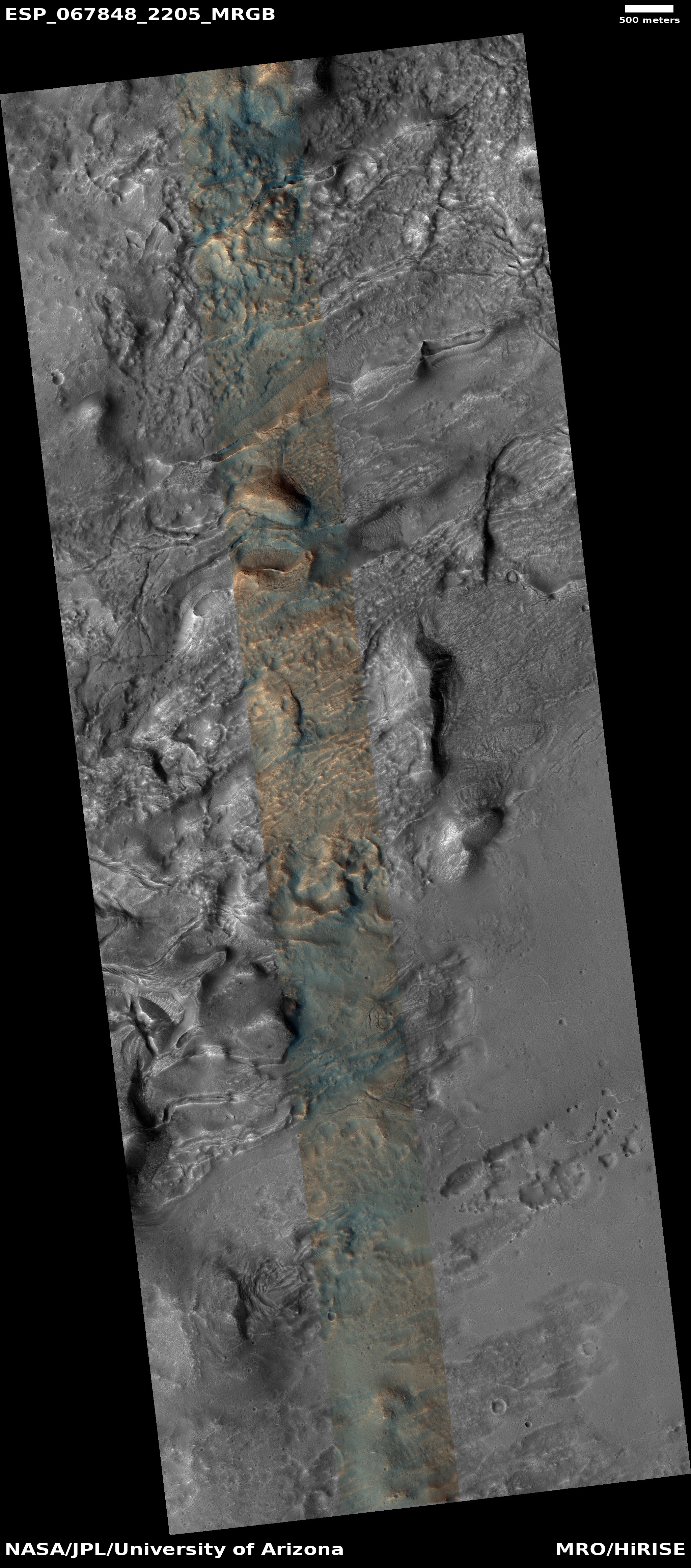
Cool image time! The picture to the right, rotated, cropped, reduced, and enhanced to post here, was taken on July 20, 2022 by the high resolution camera on Mars Reconnaissance Orbiter (MRO). It shows a small portion of the knobby floor of a 70-mile-wide ancient and eroded unnamed crater in the southern cratered highlands of Mars.

Why knobby? Usually such terrain on Mars signifies an very ancient and well eroded region of chaos terrain, its knobs the leftover worn remains of ancient mesas cut by eons of glacier flow.

If this is so, the location as shown in the overview map below suggests if there were ever any glaciers — or any near surface ice — at this location, it had to be a very long time ago.
» Read more

0 comments
1 62 63 64 65 66 212