Dusty chaos in Martian canyons

Outcrops in dusty chaos on Mars
Click for full image.

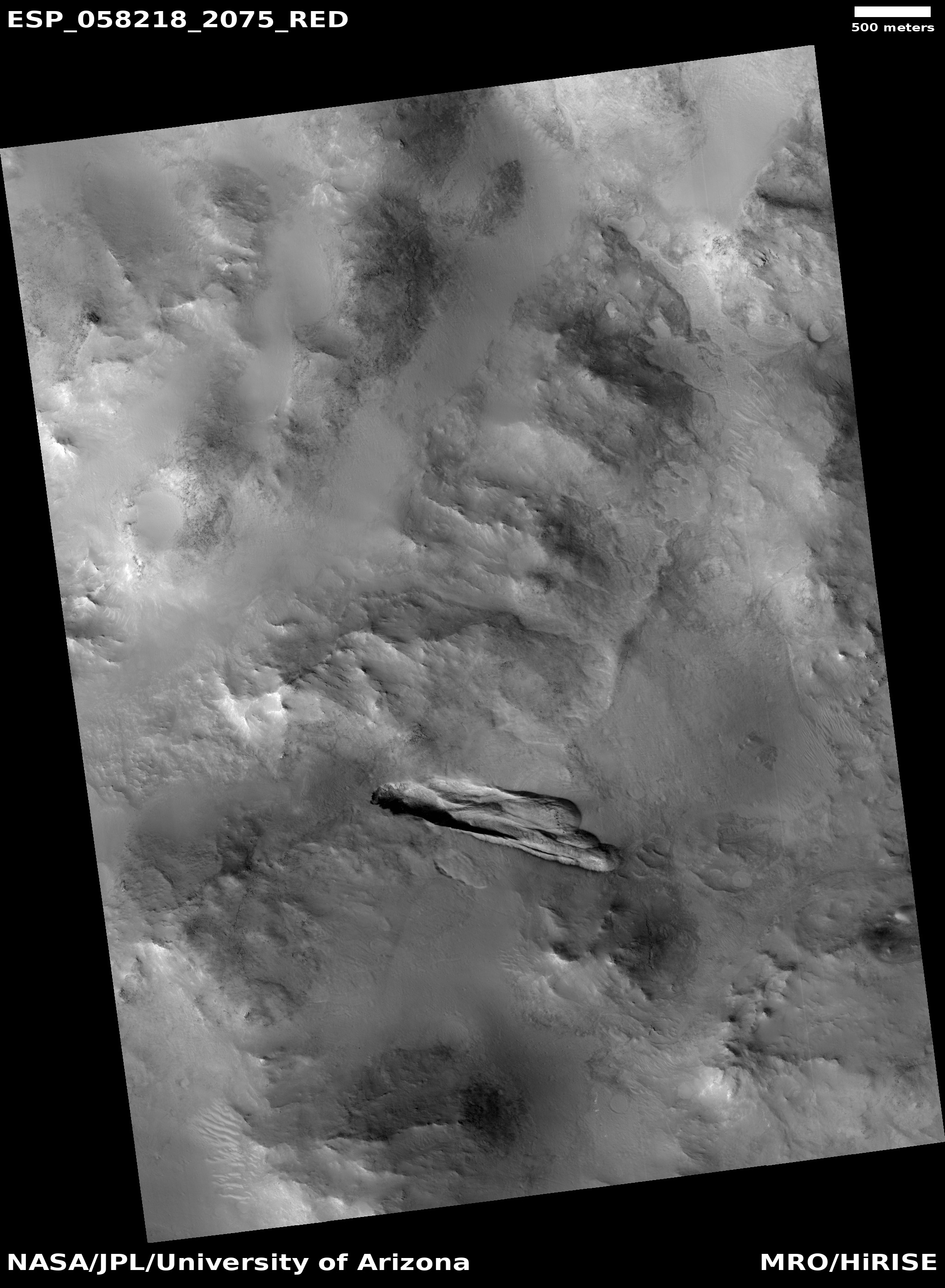
Cool image time! The photo to the right, cropped and reduced to post here, was taken on May 30, 2021 by the high resolution camera on Mars Reconnaissance Orbiter (MRO). It shows the dusty dry floor of the chaos region of rough terrain in a side canyon of Valles Marineris, near its outlet. The color strip and the bright outcrops suggest that this terrain contains interesting minerals and resources. To determine exactly what those materials are however requires more information not available in this photo.

This ancient chaos terrain is the leftover eroded sea floor of a intermittent inland sea, leftover water from the catastrophic floods that are theorized to have flowed out of Valles Marineris and carved its gigantic canyons.

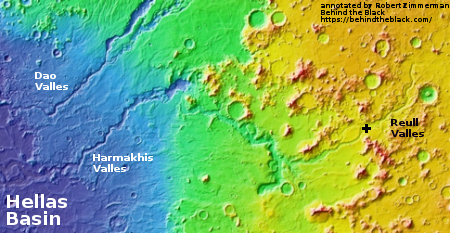
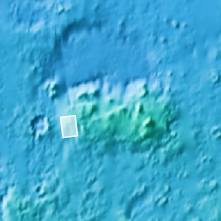
The overview map below shows this hypothesized sea.
» Read more

1 comment

Ancient fossil river in the very dry equatorial regions of Mars

Inverted Channel on Mars
Click for full image.

Cool image time! The photo to the right, rotated, cropped, and reduced to post here, was taken on August 29, 2021 by the high resolution camera on Mars Reconnaissance Orbiter (MRO). It shows what the scientists label an “inverted channel in Arabia Terra,” a small example of the more than 10,000 miles of fossilized rivers in this region on Mars that scientists have identified using MRO.

They are made of sand and gravel deposited by a river and when the river becomes dry, the channels are left upstanding as the surrounding material erodes. On Earth, inverted channels often occur in dry, desert environments like Oman, Egypt, or Utah, where erosion rates are low – in most other environments, the channels are worn away before they can become inverted. “The networks of inverted channels in Arabia Terra are about 30m high and up to 1–2km wide, so we think they are probably the remains of giant rivers that flowed billions of years ago. [emphasis mine]

Since this fossilized river is located at 11 degrees north latitude, smack in the middle of the dry equatorial regions of Mars, it has certainly been a dry desert for a very long time. You can see how barren the terrain appears by looking at the wider view afforded by MRO’s context camera below.
» Read more

4 comments

Data from Perseverance confirms Jezero Crater once held a lake

figure 5 from paper showing ancient lake in Jezero Crater

According to a newly published paper, the data obtained by the rover Perseverance has confirmed and refined what orbital data has suggested, that Jezero Crater once held a lake. From the abstract:

We analyze images taken by the rover in the three months after landing. The fan has outcrop faces that were invisible from orbit, which record the hydrological evolution of Jezero crater. We interpret the presence of inclined strata in these outcrops as evidence of deltas that advanced into a lake. In contrast, the uppermost fan strata are composed of boulder conglomerates, which imply deposition by episodic high-energy floods. This sedimentary succession indicates a transition, from a sustained hydrologic activity in a persistent lake environment, to highly energetic short-duration fluvial flows.

In other words, the crater first held a lake, which as it slowly dried out was periodically renewed by flash floods. The distinct delta of material that made Jezero Crater the prime landing site was apparently formed during the period when the lake existed. The conditions that caused the subsequent flash floods is as yet not been determined, though it likely is related to the red planet’s long term evolution.

The image above, figure 5 from the paper, shows the inferred lake in that early history. The red cross marks Perseverance’s landing site.

This data reinforces the fundamental scientific mystery of Mars. It shows evidence that liquid water once flowed on the surface of Mars, even though other long term data of the planet’s history says the Martian atmosphere has been too thin and too cold to allow that to happen. There is evidence that the atmosphere might have once been thicker, but no computer model or theory has been able to produce a time when it was warm enough.

3 comments

Report: Reduce contamination restrictions for some future Mars missions

A new policy paper from the National Academies has proposed reducing the planetary protection rules for some future Mars missions, concluding that Earth life cannot survive on Mars for long, and as long as a lander or rover does not land close to cave entrances or on extensive ice, the need to decontaminate is significantly reduced. From the press release:

In this report, the Committee focused on regions on Mars that might not be negatively impacted if visited by spacecraft that are not stringently sterilized. For missions that do not access the subsurface, such regions could include a significant portion of the surface of Mars, because the UV environment is so biocidal that terrestrial organisms are, in most cases, not likely to survive more than one to two sols, or Martian days. For missions that access the subsurface (down to 1 meter), regions on Mars expected to have patchy or no water ice below the surface might also be visited by spacecraft more relaxed bioburden requirements, because such patchy ice is likely not conducive to the proliferation of terrestrial microorganisms.

The report finds that it is imperative that any mission sent to Mars with reduced bioburden requirements remain some conservative distance from any subsurface access points, such as cave openings. Furthermore, though less stringent than current requirements, these missions with relaxed bioburden requirements would still need some level of cleanliness, which could be achieved for instance using standard aerospace cleanliness practices.

The report essentially concluded that missions to Mars’ dry equatorial regions as well as its glacial mid-latitudes pose no risk to contaminating the red planet with Earth life.

While the press release pushes the idea that this is a reduction in the planetary protection rules, it could be seen in a much worse light. Based on the proposed rules, missions to the Martian poles or higher latitudes, where ice is extensive and not “patchy,” might be entirely forbidden. This will significantly limit Martian exploration by the United States. Meanwhile, China and Russia and others will be faced with no such restrictions.

Note too that this report likely forbids SpaceX from landing its Starship in the company’s candidate landing sites, all of which are in the northern lowland plains ranging from 35 to 40 degrees north latitude. This region is thought to have extensive ice sheets very close to the surface. To land there, the rules proposed will either require extremely strict and very costly decontamination procedures, many of which do not even exist as yet, or will forbid landing there at all.

8 comments

The wavy and beautiful edge of the northern ice cap of Mars

The scarp of the north pole icecap on Mars
Click for full image.

Cool image time! The photo to the right, cropped and reduced to post here, was taken on August 7, 2021 by the high resolution camera on Mars Reconnaissance Orbiter (MRO). It shows the many layered scarp that forms the edge of the northern polar ice cap on Mars, probably more than 2,000 feet high.

Those layers are significant, as they indicate the many climate cycles that scientists think Mars has undergone over the eons as the red planet’s rotational tilt, or obliquity, rocked back and forth from 11 degrees inclination to as much as 60 degrees. At the extremes, the ice cap was either growing or shrinking, while today (at 25 degrees inclination) it appears to be in a steady state.

Why the layers alternate light and dark is not known. The shift from lighter colors at the top half and the dark bottom half marks the separation between the top water ice cap and what scientists label the basal unit. It also marks some major change in Mars’ climate and geology that occurred about 4.5 million years ago.
» Read more

4 comments

Land of Martian slope streaks

Land of Martian slope streaks
Click for full image.

Cool image time! The photo to the right, cropped and reduced to post here, was taken on May 21, 2021 by the high resolution camera on Mars Reconnaissance Orbiter (MRO). It shows a typical example of the many slope streaks found in the rough and very broken region north of the Martian volcano Olympus Mons, the largest in the solar system.

See this May 2019 post for a detailed explanation of slope streaks. While they appear to be avalanches, they do not change the topography of the ground, sometimes flow over rises, and appear to be a phenomenon entirely unique to Mars. While no theory as yet explains them fully, the two most favored postulate that they are either dust avalanches or the percolation of a brine of chloride and/or perchlorate in a thin layer several inches thick close to the surface. In both cases the streak is mostly only a stain on the surface that fades with time.

The location of this cool image however tells us something more about them.
» Read more

1 comment

Inactive volcano vent on Mars

Inactive volcanic vent on Mars
Click for full image.

Overview map

Cool image time! The photo to the right, cropped, reduced and annotated to post here, was taken on July 30, 2021 by the high resolution camera on Mars Reconnaissance Orbiter (MRO). The left image shows a pit that the scientists label a “vent” near the giant volcano Pavonis Mons. The right image is identical, except that I have brightened it considerably to bring out the details in the shadowed area.

As you can see, this pit is filled, and does not appear to have any existing openings into more extensive underground passages.

The white dot on the overview map on the right shows this vent’s location, to the south of Pavonis Mons, and in line with the giant crack that splits three of Mars’ four largest volcanoes. The vent is even aligned the same as that crack, from the northeast to the southwest. The black dots mark the locations of the many cave pits found in this region.

Was this a volcanic vent? If you look at the full image you will see that this pit aligns with a shallower pit to the southwest, with a depression linking the two. Visually this suggests this is a faultline which in turn makes for a good outlet point for lava flow.

Though the data suggests this is a volcanic vent, that supposition is as yet unproven. The full image does not show much evidence of a flow from the pit, which suggests instead that we are merely looking at a spot where the ground cracked along fault lines.

0 comments

Ingenuity’s 14th flight scrubbed by helicopter

Though Ingenuity successfully completed a preflight high speed test of its rotors on September 15th, when it came time to do its fourteenth flight two days later, intended as a short airborne test of that high speed, the helicopter’s computer sensed an issue prior to take-off and scrubbed the flight.

The goal of the high speed test and short flight were to see if Ingenuity could fly during the winter months when the atmosphere of Mars is thinner, thus requiring a higher rotor speed. Initially it was not expected the helicopter would still be operational at this point, so this is another example of it pushing its expected capabilities. The scrub however might be signalling the end date for Ingenuity, related to servo motors that help control the helicpoter:

Ingenuity performs an automated check on the servos before every flight. This self-test drives the six servos through a sequence of steps over their range of motion and verifies that they reach their commanded positions after each step. We affectionately refer to the Ingenuity servo self-test as the “servo wiggle.”

The data from the anomalous pre-flight servo wiggle shows that two of the upper rotor swashplate servos – servos 1 and 2 – began to oscillate with an amplitude of approximately 1 degree about their commanded positions just after the second step of the sequence. Ingenuity’s software detected this oscillation and promptly canceled the self-test and flight.

Our team is still looking into the anomaly. To gather more data, we had Ingenuity execute additional servo wiggle tests during the past week, with one wiggle test on Sept. 21, 2021 (Sol 209) and one on Sept. 23, 2021 (Sol 211). Both of the wiggle tests ran successfully, so the issue isn’t entirely repeatable.

One theory for what’s happening is that moving parts in the servo gearboxes and swashplate linkages are beginning to show some wear now that Ingenuity has flown well over twice as many flights as originally planned (13 completed versus five planned). Wear in these moving parts would cause increased clearances and increased looseness, and could explain servo oscillation. Another theory is that the high-speed spin test left the upper rotor at a position that loads servos 1 and 2 in a unique, oscillation-inducing way that we haven’t encountered before.

Because communications with Mars are now paused for two weeks because the Sun is in the way, the engineering team is holding off further tests until communications resume.

1 comment

A Mars mesa carved by floods and lava?

Overview map of Kasei Valles

With today’s cool image we once again start our journey from afar, and zoom in. The overview map to the right focuses in on the thousand-mile-long Kasei Valley on Mars.

The blue area is where scientists postulate a lake once existed, held there by an ice dam (indicated by the white line). At some point that ice dam burst, releasing the water in a catastrophic flood that created the braided flow features that continue down Kasei Valles to the northern lowland plain of Chryse Planitia.

The black area marks a giant lava flow that scientists believe came later, following the already carved stream channels for a distance of 1,000 miles, traveling at speeds of 10 to 45 miles per hour.

The red dot near the Kasei Valles resurgence is today’s cool image.
» Read more

1 comment

Flooding from crater lakes on Mars

Loire Valley on Mars

According to a new paper published today, scientists estimate that flooding from crater lakes on Mars — caused by sudden breaches in the crater rims — could have created as much as 25% of the volume of the valley networks that have been identified there.

Mars’ surface hosted large lakes about 3.5 billion years ago. Some of these lakes overtopped their rims, resulting in massive floods that rapidly formed deep canyons. Similar lake breach floods occurred in the northwest United States and central Asia at the end of the last glacial period over 15,000 years ago.

“We found that at least a quarter of the total eroded volume of Martian valley networks were carved by lake breach floods. This high number is particularly striking considering that valleys formed by lake breach floods make up just 3% of Mars’ total valley length,” Morgan said. “This discrepancy is accounted for by the fact that outlet canyons are significantly deeper than other valleys. These floods would have shaped the overall Martian topography, affecting the flow paths of other valleys. Our results don’t negate the importance of precipitation-fed runoff on early Mars. On the contrary, liquid water had to be stable for long enough for lakes to fill from inlet rivers.” [emphasis mine]

The map above shows in white the Loire Valles on Mars, located at about 20 degrees south latitude in transition zone between the northern lowland plains and southern cratered highlands. The paper cites this valley as a typical example of a flood valley caused by a crater rim breach.

This research only makes the geological and climate history of Mars more puzzling. Though the geological evidence strongly suggests lakes and liquid water once existed on Mars, and this research strengthens that conclusion (as indicated by the highlighted sentence above), no model of the planet’s climate has ever satisfactorily created a situation where that was possible. Either there are factors about Mars’ ancient history we have not yet identified (likely) and don’t yet understand (very likely), or the planet’s geology was formed by processes alien to Earth and thus not yet recognized by us.

2 comments

Perseverance as seen from orbit

Perseverance as seen from orbit
Click for full image.

Overview map
Click for interactive map.

The science team for the high resolution camera on Mars Reconnaissance Orbiter (MRO) have snapped a picture of Perseverance at its present location in Jezero Crater.

The first image to the right, cropped to post here, shows the rover as a white dot to the right of the two long sand dunes. If you look close image, you can see the rover’s tracks near the bottom of the image.

Ingenuity is likely also in the full image, but is likely too small for MRO’s high resolution camera to pick out.

The second image is a overview map. The green dot marks the rover’s position, with the red dot Ingenuity’s present position. The dotted white line shows the route the rover has taken so far. The light brown line indicates the flight paths for all of Ingenuity’s flights. The yellow dotted line indicates the future planned route of Perseverance.

With Mars about to slip behind the Sun, communications with both rovers, Perseverance and Curiosity, as well as all the orbiters, will shortly go silent for about two weeks.

When that pause ends, the question will be where Perseverance goes next. The original plan was to retreat back along its previous path, going to the southeast before heading north past the landing site. I strongly suspect that they will instead head directly to the landing site, going to the northeast across the rough terrain, both to see something new as well as further test the rover’s ability to travel tougher ground.

They avoided that area initially because they were still in the rover’s check out period. Now that they know it works, there is no reason to avoid that ground, especially because it will be ground they have not viewed before. They could even use Ingenuity to scout it out more thoroughly.

0 comments

Rivulets in Martian lava

Overview map

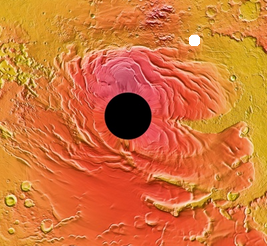
Today’s cool image is another example of scientists finding cool things hidden within distant pictures. The small white rectangle on the overview map to the right shows us where we are heading, to the severely eroded lava plains to the southwest of Mars’ largest volcano, Olympus Mons.

The white spot is about 500 miles from the caldera of Olympus Mons. In elevation it sits about 58,000 feet below that caldera, more than twice the height of Mt. Everest. Yet, despite these great distances, the material at that white rectangle was almost certainly laid down during an eruption from Olympus Mons, thus illustrating the gigantic scale of volcanic events on Mars. Because of the red planet’s light gravity, about 38% of Earth’s, not only can lava flow farther, it does so much faster.

The second image below is a wide angle photo taken by the context camera on Mars Reconnaissance Orbiter (MRO) in January, 2012, rotated, cropped, expanded, and enhanced to post here.
» Read more

1 comment
1 86 87 88 89 90 212