One last look at a Martian mountaintop

Siccar Point
For the original images go here and here.

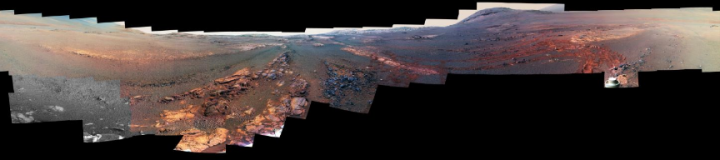
The image above is a mosaic made from two Curiosity navigation photos taken on October 23, 2021 and combined, cropped, and reduced to post here. It shows the top 30 feet or so of Siccar Point, the spectacular outcrop that I have featured several times previously.

Curiosity has now traveled past this outcrop, so that this view above is no longer visible to the rover. I post it now as a farewell image of what I think is the most breath-taking feature yet seen by any planetary lander — manned or unmanned — since the first set down on the Moon in the mid-1960s. It also illustrates with great clarity the alien nature of Mars. Those delicate overhanging rocks would not be possible on Earth, with a gravity about two and a half times heavier than Mars.

Note too that I have not enhanced the contrast or brightness. I think the twilight light here actually gives us a sense of the real brightness of a clear Martian day. Because the Sun is much farther away, even at high noon it provides much less illumination than on Earth. A bright day on Mars to our Earth-adapted eyes will always feel like dusk.

Meanwhile the science team is quickly pushing the rover south, to get…

…closer to the area we are targeting for our next drill campaign. This drive should leave us with bedrock in the workspace for additional contact science on the weekend. This terrain continues to be very challenging, with large boulders, sharp rocks that are wheel hazards, and sand ripples, like the terrain shown in the image. These drives take a while to plan to make sure we are avoiding all the hazards while getting to where science wants to go. Our paths end up looking a little โ€œdrunkโ€ as we weave our way around obstacles.

7 comments

Curiosity marches on into the mountains

Curiosity marches onward to Maria Gordon Notch
Click for full image.

Overview map
Click for interactive map

With the end of the solar conjunction in the first half of October, blocking communications with Mars because the Sun was in the way, Curiosity has resumed its travels. It has moved past the spectacular outcrop I have highlighted previously, an outcrop the science team has labeled Siccar Point.

They are now moving south at the base of the cliff to the west, the top of which is a plateau they call the Greenheugh Pediment, heading for a gap where the rover will be able to turn right and head up onto that pediment. The red dotted line on the overview map to the right shows this route, which corresponds to the red dotted line on the photo above.

I estimate the cliffs on both sides of Maria Gordon Notch are about 100 feet high. The notch itself I estimate is about 750 feet away. At the pace Curiosity has been traveling across this rough ground, it could probably reach it in about two to three weeks. However, I expect the science team will stop at least once along the way to do more detailed science work, so that journey might take a month or slightly more.

0 comments

Ingenuity completes 14th flight on Mars

Ingenuity's shadow below it during 14th flight
Ingenuity’s shadow below it during 14th flight.
Click for full image.

On October 24th, Ingenuity successfully completed its 14th flight on Mars, a short test hop up and down to see if the helicopter could function properly as the air pressure in the Martian atmosphere drops due to seasonal variations.

As planned, the helicopter executed its first 2,700 rpm flight, proving that Ingenuity is capable of flying in the weeks and months ahead on Mars, during which seasonal changes on the surface will result in decreases in air density. The short 23-second flight included a peak altitude of 16 feet (5 meters) above ground level, with a small sideways translation of 7 feet (2 meters) to avoid a nearby sand ripple.

I predict the next flight will head north, leap-frogging past Perseverance to get a better view of the South Seitah area so that the rover team can decide whether they can continue north through that terrain or retreat backwards.

0 comments

China resumes communications with Zhurong Mars rover

Elevation map of Zhurong location
Click for full image.

The new colonial movement: China yesterday announced that it has regained communications with its Zhurong rover, located in the Martian northern lowland plains of Utopia Planitia.

The image to the right, cropped and annotated by me to post here, is a digital terrain map created from two high resolution photos taken by Mars Reconnaissance Orbiter (MRO). The black line shows the route Zhurong has traveled since landing in May.

According to [Chen Baichao, the chief designer of Zhurong], the rover has traveled more than 1,000 meters since it landed on Mars at the southern part of Utopia Planitia in May 2021. After the solar conjunction, it will head south to find mud volcanoes, which scientists are interested in, located about 10 km away.

American scientists had hoped Zhurong would head north to a much larger mud cone that was much closer. Their decision to head south to the smaller cones farther away tells us that they have given themselves a much more challenging mission. It also suggests they decided it will be easier to get Zhurong closer to a smaller cone.

Based on that 10 kilometer distance, it seems the Chinese are aiming for the cones near the bottom of the map. It took Zhurong three months to travel the distance shown. At that pace, to get to those small southern mud cones will likely take, at a minimum, about fifteen months. Though the ground is quite flat, the rover will either have to negotiate one small rise of about 15 feet, or detour to the east somewhat to find a less steep route.

It is also possible that they will instead head to the mud cone south of the large impact crater. It is also a small cone, is much nearer, and will not require them to get past that rise.

4 comments

Layered glaciers in Mars’ glacier country

Layered glacier in Mars' glacier country
Click for full image.

Cool image time. The photo to the right, cropped and reduced to post here, was taken on August 30, 2021 by the high resolution camera on Mars Reconnaissance Orbiter (MRO). It shows two different impact craters in a glacial region dubbed Nilosyrtis Mensae, located in the northern mid-latitudes in the 2,000 mile long strip chaos terrain that I have labeled glacier country because practically every image finds them there.

The splash apron surrounding the larger crater is typical of craters in Martian regions where ice is thought to be near the surface.

What makes this picture interesting is that the glaciers appear layered. You can see evidence of this in the mounds inside both craters. Those mounds appear to represent earlier periods when there was more ice here. Since then the mounds have partly sublimated away.

You can also see evidence of layers in the material surrounding the nearby larger mounds.

The map below shows us where this image is, relative to all of glacier country as well as the rover Perseverance in Jezero Crater.
» Read more

0 comments

China resumes communications with Tianwen-1 Mars orbiter

With the Sun no longer between the Earth and Mars, China has re-established communications with its Tianwen-1 Mars orbiter.

According to the CNSA [China National Space Administration], the orbiter will enter the remote-sensing orbit of Mars in early November to carry out global detection and obtain scientific data such as morphology and geological structure, surface material composition and soil type distribution, atmospheric ionosphere, and space environment of Mars.

The orbiter will also relay the communication between the rover and Earth for the rover’s extended mission, the CNSA added.

Based on this information, full communications with the rover Zhurong will not resume until November because the orbiter needs to re-adjust its orbit.

0 comments

Curiosity’s new mountain views

Curiosity's future route
Click for full image.

With the resumption of communications with Mars, following the two week hiatus because the Sun was in the way, Curiosity is about to begin its travels again. The view above, taken by the right navigation camera and reduced and annotated to post here, looks forward, with the red dotted line indicating the planned route.

The distinct white outcrop on the right top is the same spectacular outcrop I have highlighted previously.

At the moment however the rover is not going anywhere. Just before the hiatus the scientists had Curiosity move a short distance to crush some nearby nodules so that they could see their interior. At their update they post an image of one crushed nodule, and write the following:

[L]ook closely for very straight imprinted lines in the middle of flattened areas that appear slightly more grey. You can also see cracks, especially clearly on the right of the nodule in the image, but if you look around, youโ€™ll find there are more of them. Some of the scratched areas are looking white, too. All those features will allow us an insight into the nodules and an interpretation beyond what we can otherwise see on the surface.

The image below, also taken by the right navigation camera and reduced to post here, looks back at Curiosity’s earlier travels, across the floor of Gale Crater about 1,500 feet below. The rim, about 25 miles away, can be seen through the atmospheric haze as the distant mountain chain.

See the orbital map at this post in September to get the context of what the two images are viewing. The top image looks south along the cliff line, the bottom looks almost due north.
Looking across Gale Crater
Click for full image.

1 comment

A collapsing north wall in Valles Marineris

Mass wasting in Valles Marineris
Click for full image.

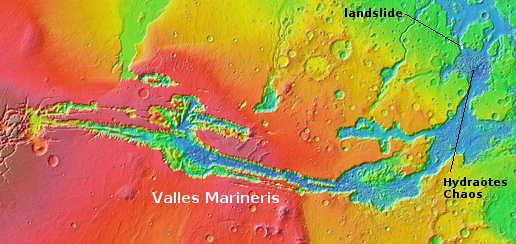
Cool image time! The photo to the right, rotated, cropped, and reduced to post here, was taken on July 17, 2021 by the high resolution camera on Mars Reconnaissance Orbiter (MRO). It shows what the scientists label as an alluvial fan.

I have also seen them label this kind of avalanche as mass wasting, where the material moves down slope suddenly in a single mass.

The image shows the aftermath of such an event, after a large blob of material broke free from the mountainside and slid almost as a unit downhill to settle more than two miles away on the floor of the canyon. The distance traveled and the blobby nature of the flow both reveal how the lower Martian gravity changes the nature of such events, compared to what you might see on Earth. The flows can travel farther, and can hold together as a unit easier.

The overview map below not only provides the context, but it tells us that such events are remarkably common in this place.
» Read more

2 comments

Scientists resume communications with U.S. Martian rovers

Example of first rover images downloaded following communications break
Click for full image.

Both U.S. Mars rovers Curiosity and Perseverance have resumed communications with Earth, each downloading a bunch of images that they had been programmed to take during the two week communications hiatus from October 3 to October 17, caused by the Sun being between the Earth and Mars.

Most of the images are a variation of the one to the right, reduced to post here, taken by Curiosity’s left hazard avoidance camera. As neither rover moved during the communications break, the scientists limited most photography to only a handful of cameras, with the photographs mostly confirming day to day that the rover and its instruments were functioning.

You can see all of Curiosity’s new images here. Perseverance’s new images can be viewed here. (To see the new Perseverance images click on “latest images.”)

A Curiosity team update today notes the work they plan to do in the coming days as they gear up for future travels. The Perseverance update today focused more on the paper published during the break that confirmed, using data from the rover, that Jezero Crater once contained a lake.

0 comments

The icy Phlegra Mountains on Mars

Overview map

Cool image time! The Phlegra Mountains on Mars are probably the iciest mountains on the red planet, something I noted previously in an April 2020 essay, highlighting a half dozen images from the high resolution camera on Mars Reconnaissance Orbiter (MRO) that showed that iciness. As I stated:

Here practically every photograph taken by any orbiter appears to show immense glacial flows of some kind, with some glaciers coming down canyons and hollows [#1], some filling craters [#2], some forming wide aprons [#3] at the base of mountains and even at the mountains’ highest peaks [#4], and some filling the flats [#5] beyond the mountain foothills.

And then there are the images that show almost all these types of glaciers, plus others [#6].

The overview map above not only shows the locations of these six images in black, it also shows in red two of SpaceX’s four prime candidate landing sites for its Starship spacecraft. Note that #3 above is one of those sites.

The white rectangle in the Phlegra Mountains marks the location of today’s cool image below, taken on June 11, 2021 by MRO’S high resolution camera.
» Read more

0 comments

Dry Martian chaos

Dry chaos on Mars
Click for full image.

On Mars, one of the most common kinds of landscape is called chaos terrain. Made up of mesas, buttes, and cross-cutting random canyons, this geology is not seen on Earth, and when first identified by scientists in early orbital pictures in the 1970s, it baffled them. While it is clear that some form of erosion process caused it, the scientists did not have enough data then to figure out what that process was.

Today scientists have a rough theory, based on what they now know about Mars’ overall geology and its climate and orbital history. The canyons of chaos terrain were originally fault lines where either water or ice could seep through and widen. See this January 2020 post for a more detailed explanation.

Most of the cool images I have posted of chaos terrain have been in places in the mid-latitudes that are covered with glaciers. See for example this December 2019 post of one particular mesa in glacier country, with numerous glaciers flowing down its slopes on all sides. That mesa is quite typical of all such mesas in the mid-latitudes.

Today’s cool image above, cropped to post here, takes us instead to the Martian very dry equatorial regions. The photo was taken on May 17, 2021 by the high resolution camera on Mars Reconnaissance Orbiter (MRO), and like mid-latitude chaos, it shows a collection of random mesas with canyons cut almost randomly between.

Unlike the mid-latitudes, however, there is no evidence of glaciers here. Instead, the canyons and mesa slopes are covered with dust, shaped into wind-blown dunes.

As always, the overview map below gives us some context.
» Read more

0 comments

A gecko on Mars

Gecko on Mars
Click for full image.

Today’s cool image is also today’s picture of the day from the science team of the high resolution camera on Mars Reconnaissance Orbiter (MRO. That picture, rotated, cropped, and reduced to post here, can be seen to the right. As the caption authors Sharon Wilson and Sarah Sutton write:

The smooth volcanic surfaces in the Gordii Fossae region are sometimes interrupted by long, narrow troughs, or fissures. These fissures form when underground faults, possibly involving magma movement, reach the near-surface, allowing material to collapse into pits or an elongated trough. This fissure appears to have erupted material that flowed onto the surface.

If you use your imagination, this trough resembles a gecko with its long tail and web-shaped feet!

This impression is even more evident in the wider image taken by MRO’s context camera below.
» Read more

3 comments
1 85 86 87 88 89 212