Craters in the soft Martian northern lowland plains

Craters in the soft Martian northern lowland plains
Click for full image.

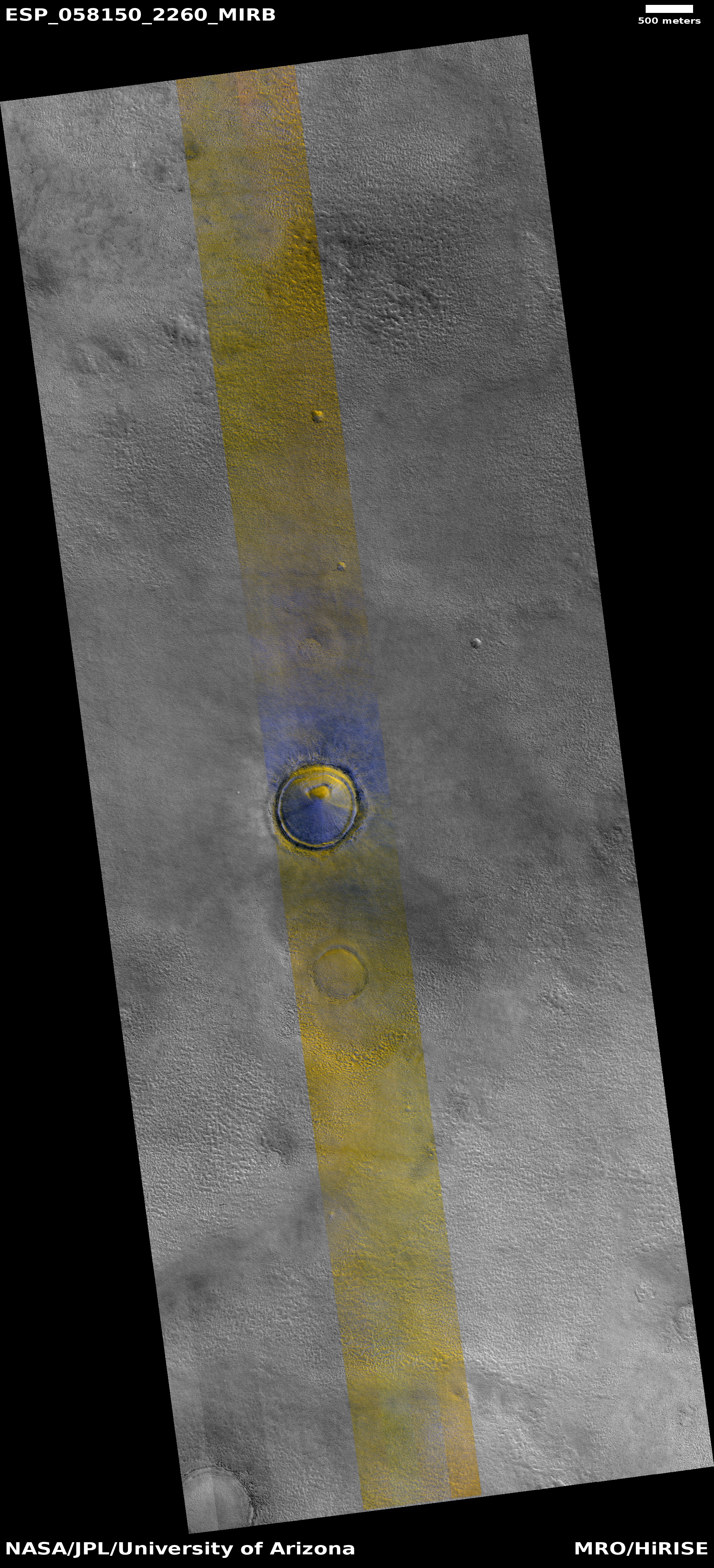
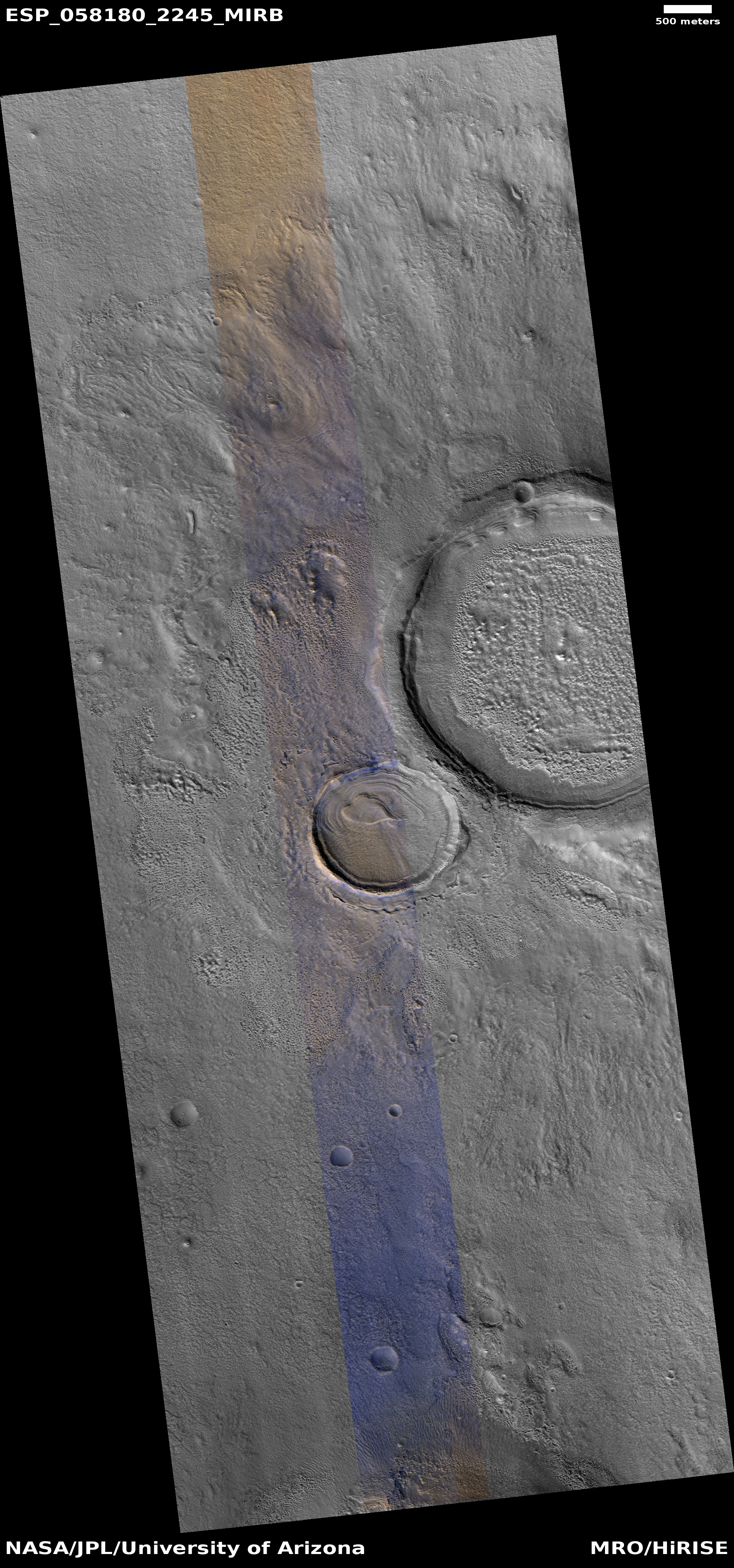
Cool image time! The photo to the right, cropped and reduced to post here, was a featured image today from the high resolution camera on Mars Reconnaissance Orbiter (MRO).

The caption, written by Carol Weitz of the Planetary Science Institute in Arizona, focused on the wind patterns created within these craters.

These impact craters in the northern middle latitudes have interesting interiors: all of them have wind-blown (aeolian) ripples.

Outside of the craters and along the crater floors, the ripples are all oriented in the same direction. However, along the walls of some of the larger craters, the ripples are situated radially away from the center, indicating the winds moving inside the larger craters can be influenced by the topography of the crater wall.

Additionally, many of the larger craters have layered mesas along their floors that are likely sedimentary deposits laid down after the craters formed but prior to the development of the aeolian ripples.

I am further intrigued by the rimless nature of these craters, as well as the lack of significant rocky debris at their edges. They all look like the bolides that created them impacted into a relatively soft surface that, rather than break up into rocks and boulders, melted, flowed, and then quickly refroze into these depressions.

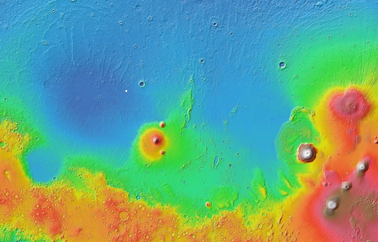
The location, as always, provides us a possible explanation.
» Read more

2 comments

Zhurong’s continuing travels on Mars

Zhurong overview map
Click for original map.

This past week the Chinese press released a new but limited update on the status of both its Mars orbiter Tianwen-1 and its Mars rover Zhurong.

The map to the right uses as its background a high resolution picture from Mars Reconnaissance Orbiter. I have superimposed Zhurong’s route in green. You can get an idea of how far the rover has traveled since resuming communications with Earth in late October by comparing this map with the one I posted then. After stopping at a small sand dune (the crescent-shaped white features), it curved around to head to the southeast towards a rough area and a trough that is thought to be filled with sediment.

Meanwhile, the orbiter has shifted its orbit, changing from one dedicated mainly as providing a communications relay between Zhurong and Earth to one that now allows it to begin a two-year photographic survey of Mars.

To supplement the resulting gaps in communications for Zhurong, China and the European Space Agency (ESA) have made their first test using ESA’s Mars Express satellite as a relay satellite. Both hope to know soon whether it worked.

In either case, Zhurong’s travels will likely be slowed somewhat due to the reduction in communications access.

0 comments

Snow on Martian dunes

Snowy dunes near the Martian north pole
Click for full image.

Close-up of snowy dunes
Click for full image.

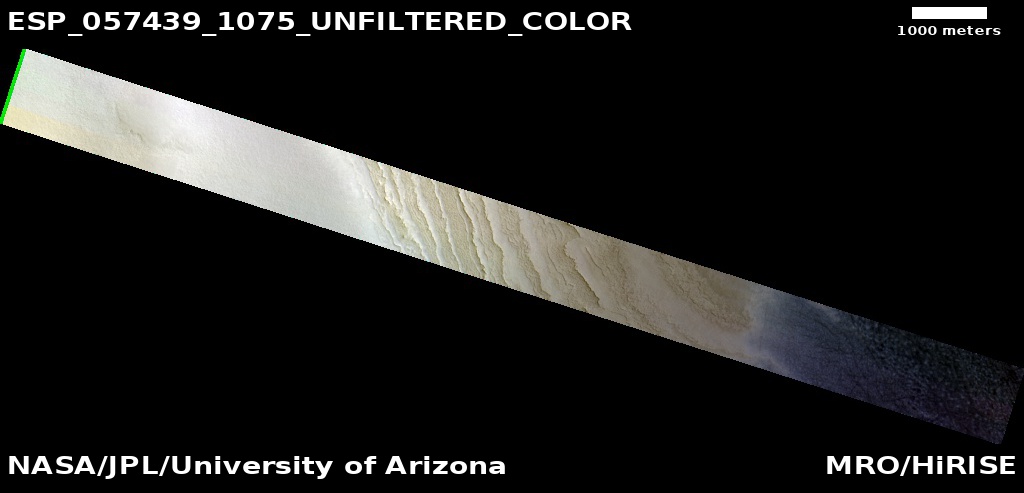
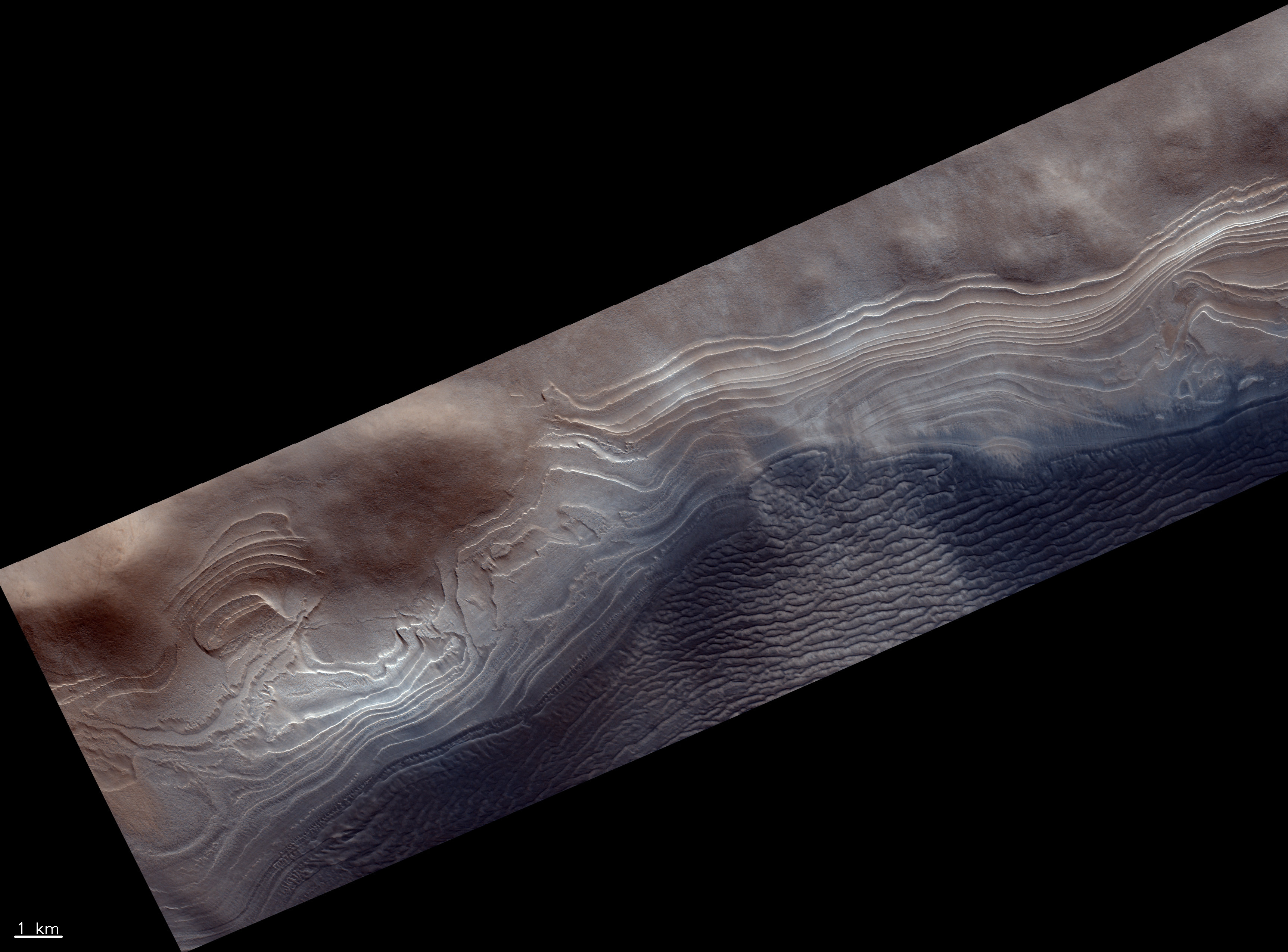
Cool image time! The first photo to the right, rotated, cropped, and reduced to post here, was taken on September 19, 2021 by the high resolution camera on Mars Reconnaissance Orbiter (MRO), and shows what appears to be snow nestled in the hollows of many dunes.

The second photo, cropped to post here, shows in high resolution the area in the white box.

Is that snow water, or dry ice? The location is very far north, 76 degrees latitude, so it could be either. Since the photo was requested by Candice Hansen of the Planetary Science Institute in Arizona, I emailed her to ask. Her answer:

Early in the spring all the bright stuff is dry ice. As it gets later in the spring it is probably still mostly dry ice but with HiRISE images alone we cannot really distinguish the composition of the ice. In-between the dunes it is almost certainly bare ground late in the spring, but since the dunes are dark the surface just looks bright in contrast

This picture was taken in summer, which suggests the snow is probably water, not dry ice. Yet, all the snow is found in the north-facing hollows, places that will remain mostly in shadow at this high latitude, 76 degrees north. Thus, it is possible that the snow is the last remaining traces of the thin dry ice mantle that covers the Martian poles down to about 60 degrees latitude during the winter, and sublimates away in summer.

Hansen had requested a whole bunch of similar images of such snowy dunes. As she explained,
» Read more

2 comments

A volcanic extrusion on the floor of Valles Marineris?

A volcanic extrusion on the floor of Valles Marineris?
Click for full image.

Cool image time! The photo to the right, rotated, cropped, and reduced to post here, was taken on August 31, 2021 by the high resolution camera on Mars Reconnaissance Orbiter (MRO). It shows what the science team labels a “possible contact between two units.”

I think that contact is the point where that eroded mountain touches the surrounding smooth canyon floor. The mountain itself looks to me to be a very eroded extrusion of lava that was placed there from below a very very long time ago, covered later by material, and now exposed for a long enough period that its surface appears to have been carved by wind and even possibly flowing water or ice.

Because it is lava it is more resistant to erosion, which is why it sits higher than the smooth terrain around it. Even though both experienced the same processes of wear over time, the mountain’s surface was only carved away partly, while the material that had been in the floor was washed away entirely.

This is all a guess. However, a look below at the overview map, showing this mountain’s location on Mars, as well as MRO’s wider view from its context camera, I think strengthens my hypothesis.
» Read more

0 comments

Frozen lake bed in the Martian high latitudes?

Frozen lakebed in the Martian high latitudes?
Click for full image.

Today’s cool image comes from today’s Mars Reconnaissance Orbiter’s (MRO) high resolution picture of the day, rotated and cropped to post here. The original was taken back on March 28, 2017.

What formed those strange circular ridges and the many small cracks and hollows? The caption provided is somewhat vague and I think confusing:

This formation looks like a crater from a meteor impact rather than an ancient caldera of a volcano. Connected to the crater is a carved-out area that resembles a lake bed. At high resolution, we might be able to determine the likelihood of a water lake bed or lava bed. This observation will give insight into some of the interesting geology of this area.

The crater this caption is referring to is not visible in the image provided. It can be seen to the west of this location, in the MRO context camera picture below.
» Read more

0 comments

Curiosity: Approaching the saddle

The saddle ahead
Click for full image.

Cool image time! The photo to the right, reduced to post here, was taken on November 5, 2021 by Curiosity’s high resolution camera, and looks forward at its planned route up onto the saddle ahead, where the rover will turn right and climb up into Maria Gordon Notch. (See this October post for a map outlining the rover’s future travels.) I think that cliff face is between 40 to 60 feet high, though this is a very wild guess.

As noted by Abigail Fraeman of JPL on the Curiosity blog on November 3, 2021,

The terrain is beginning to steepen as Curiosity gets close to the end of this region, so even though weโ€™re only a few drives away from our last drill site … weโ€™ve already climbed 25 m higher!

The route ahead looks equally steep, though the ground actually appears less rough, with fewer large jagged boulders that Curiosity must avoid to protect its wheels.

It will likely be at least one to three weeks however before Curiosity gets to that saddle. The science team has begun a drilling campaign at the present location, and this will take time, depending on how many holes they decide to drill.

1 comment

Ingenuity completes 15th flight

Ingenuity landing on November 6th
Click for full image.

No details have been released, but based on the latest raw images downloaded from the Mars rover Perseverance today, the helicopter Ingenuity successfully completed its 15th flight in Jezero Crater yesterday.

The image to the right is the last of five released this morning, showing the helicopter’s shadow on the ground, just before Ingenuity touched down. Note how the shadow of Ingenuity’s four legs appear oriented level relative to the ground. While the first of the five images shows the shadow tilted, as if the helicopter is making a last turn, the last four photos all show the legs oriented properly.

We will have to wait now for official confirmation.

7 comments

Ingenuity next flight will begin route retracing its path

Overview map

The Ingenuity engineering team has revealed that the helicopter’s 15th flight on Mars will have it begin retracing its steps, following approximately the same flight route as it heads back towards Perseverance’s landing site in Jezero Crater.

Flight #15 is the start of our journey back to Wright Brothers Field [the helicopter’s initial flight test area just north of the landing site]. Taking place no earlier than Saturday, Nov. 6 at 9:22 a.m. PT, or 12:03 LMST (local Mars time), the 254th sol (Martian day) of the Perseverance mission, Flight #15 will return Ingenuity back to the Raised Ridges region, imaged in Flight #10. In this flight the helicopter will traverse 1,332 feet (406 meters) during 130 seconds of flight, travelling at 11.1 mph (5 mps) groundspeed. Weโ€™ll capture color return-to-earth (RTE) high resolution (13MP) images, one post-takeoff pointed to the SW, and nine pointed toward the NW along the flight-path. Nominal altitude for the flight is expected to be 39.3 feet (12 meters) above ground level.

This will be the second flight of Ingenuity during Marsโ€™ summer low air-density, requiring that the rotor blades are spun at 2,700 RPM to compensate. This flight will generate critical high-RPM motor performance, which the team will use to design and tailor upcoming low-density flights in the months ahead.

Perseverance is presently sitting in an area they have dubbed Seitah, a region the rover skirted around to get to this point. I had hoped both the helicopter and rover would return to the north cutting across Seitah and thus scout out new terrain. Instead, it appears that both the rover and helicopter will return as initially planned, traveling over the same ground both took to get where they are today.

In other words, the teams have decided to take the safest route, though it will provide them much less new science data. While this might seem prudent, it really appears overly cautious, based on the capabilities of Perseverance and the roughness of the terrain in Seitah. Curiosity is presently traveling across far more difficult terrain in the mountains at the foot of Mt Sharp, and it is doing so with wheels that are damaged and not as well designed as Perseverance’s. Not roving in uncharted terrain seems a waste of Perseverance’s capabilities.

1 comment

The strange surface of Mars’ north pole icecap

Mars' north pole icecap
Click for full image.

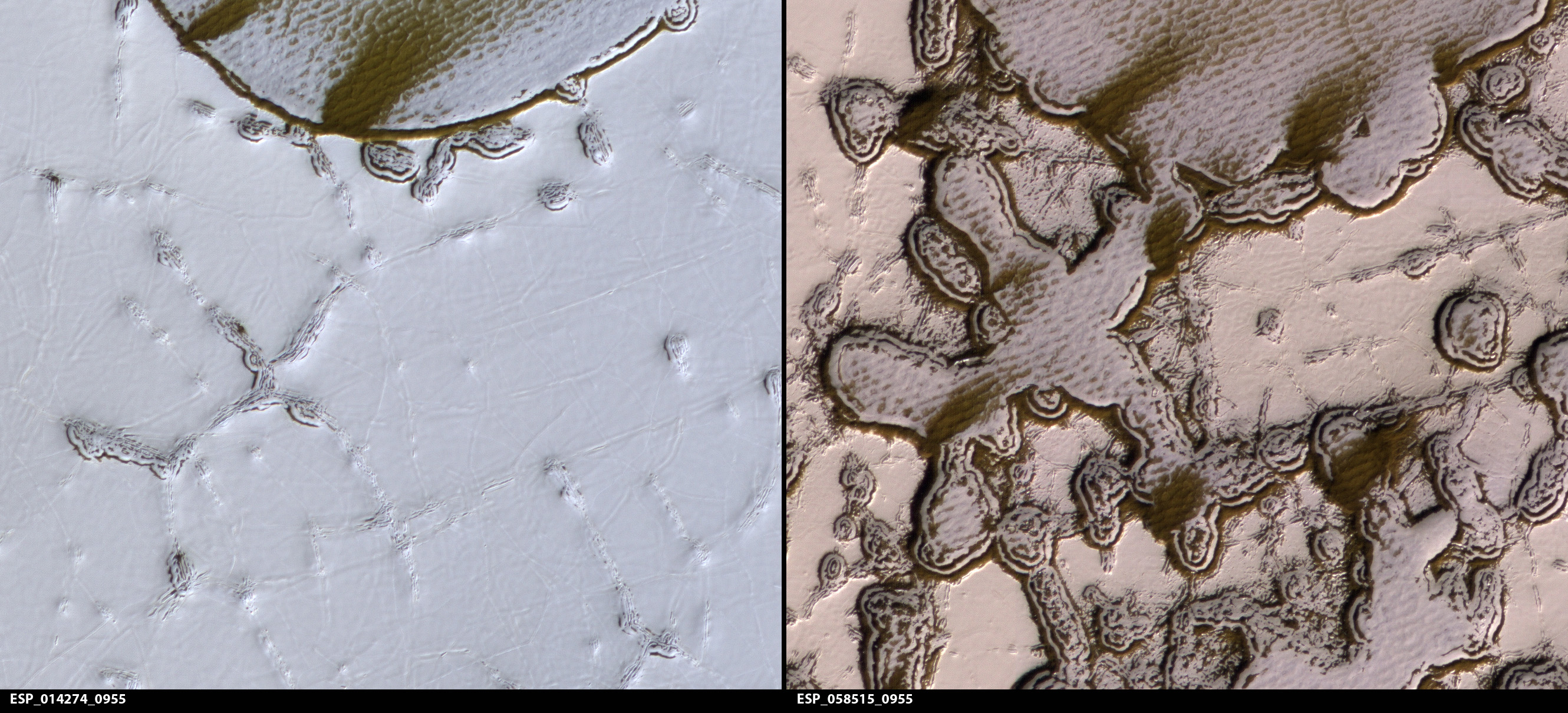
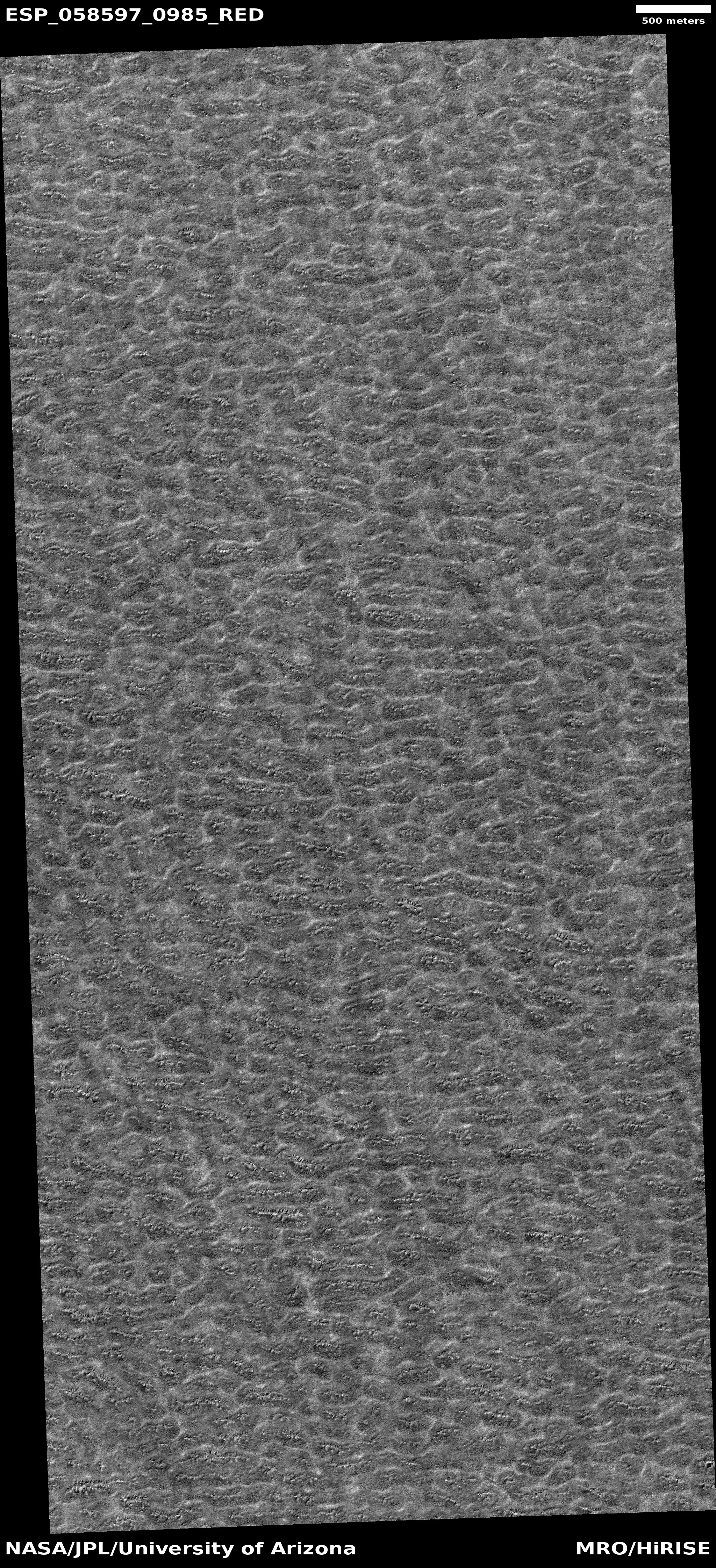
Cool image time! The photo to the right, rotated, cropped, and annotated to post here, was taken on September 17, 2021 by the high resolution camera on Mars Reconnaissance Orbiter (MRO). It shows us a very small section of Mars’ north pole icecap.

What are we looking at? The picture was taken in summer, so by this point the thin mantle of dry ice that falls as snow in the winter and covers the north pole down to about 60 degrees latitude has sublimated away. This surface thus is water ice interspersed with Martian dust.

Yet, unlike the Antarctic icecap on Earth, the ice surface is not smooth and flat. Instead, this Martian ice has a surface that is a complex arrangement of hollows and ridges, all about the same size. Why?

And what are the two larger white spots? What caused them and why are they the only differently-sized objects in the picture?

The full resolution close-up, found at the image website, provides some answers to these questions.
» Read more

0 comments

Two skylights into connected Martian lava tube?

Two skylights into a connected Martian lava tube?
Click for full image.

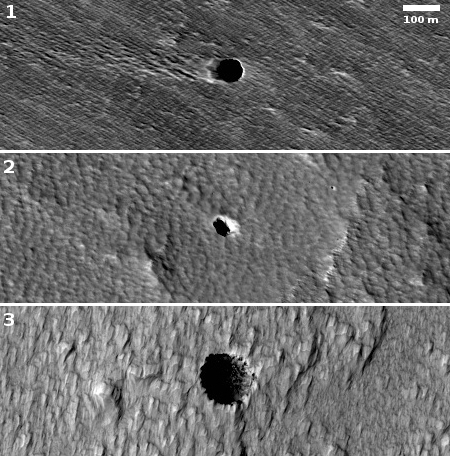
Cool image time! The photo to the right, cropped and annotated to post here, was taken on September 1, 2021 by the high resolution camera on Mars Reconnaissance Orbiter (MRO). I have annotated it to note the two apparent skylights that appear aligned along a north-south depression.

The grade is downhill to the north. If you look at the full image you will see that this north-south depression extends for a considerable distance beyond the edges of the cropped image above, with that depression appearing to dissipate to the north into a series of parallel very shallow depressions, almost like the lava had flowed out of the tube and formed branching surface rivulets heading south.

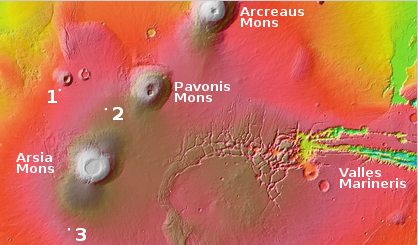
The overview map shows that this tube is on the northern flanks of the volcano Arsia Mons.
» Read more

2 comments

Curiosity looks back across the alien landscape of Mars

Gale Crater, October 31, 2021
Click for image.

Cool image time! The photo above, the first of 21 identical images taken by Curiosity’s right navigation camera, taken at intervals of about thirteen seconds on October 31st, was probably snapped as part of an effort to spot a moving dust devil. At the resolution available to my software, I see nothing when I compare all 21 photos.

What I do see is a remarkably alien landscape. In the distance can be seen the mountains that mark the rim of Gale Crater, 30-plus miles away. On the image’s right edge you can see the rising slope heading up to the peak of Mount Sharp about 13,000 feet higher.

In the center are those blobby mesas that make this terrain look so strange. For the past decade Curiosity has been traveling from the floor of the crater on the picture’s far left to circle around that dark sand dune sea to climb up the mountain slopes in the foreground in front of those mesas.

It is now heading to the right, into the mountains that make up Mount Sharp. Such a view of the floor of Gale Crater will thus be for the next few years more difficult to catch, as the mountains themselves will block the view. Assuming the rover survives long enough, it will have to climb much higher before it can get such an expansive view again.

5 comments

Holes in snowy ice on Mars?

Holes in snowy ice on Mars?
Click for full image.

Cool image time! Today we return to the regions surrounding Milankovic Crater in the high northern latitudes of Mars. The photo to the right, cropped and reduced to post here, was taken on June 1, 2021 by the high resolution camera on Mars Reconnaissance Orbiter (MRO). It shows a spray of impact craters where the bolides apparently landed in relatively soft material. The location itself is about 10 miles to the southeast of the 74-mile-wide crater, and sits within its rim ejecta blanket.

The label for the image says this is showing “crater modification,” which suggests that the rimless nature of these craters became so after their creation. This location, at 54 north latitude, is in a region of Mars where scientists have found a lot of evidence of near surface ice. For example, within Mikankovic Crater itself they have identified numerous scarps with clearly seen pure ice layers.

If ice is close to the surface here, then the ground could be like soft snow on Earth, especially because Mars’ lighter gravity would not compress that ice as much. Think about what happens when you toss pebbles into soft snow. They fall through, and leave behind holes not unlike the ones we see in this picture. Later, sunlight would begin to modify the holes so that their edges grow outward, once again exactly as we see here.

The overview map below as always gives some context, which in this case has less to do with Mars but with Elon Musk and Starship.
» Read more

0 comments
1 84 85 86 87 88 212