A hint at Mars’ past climate cycles

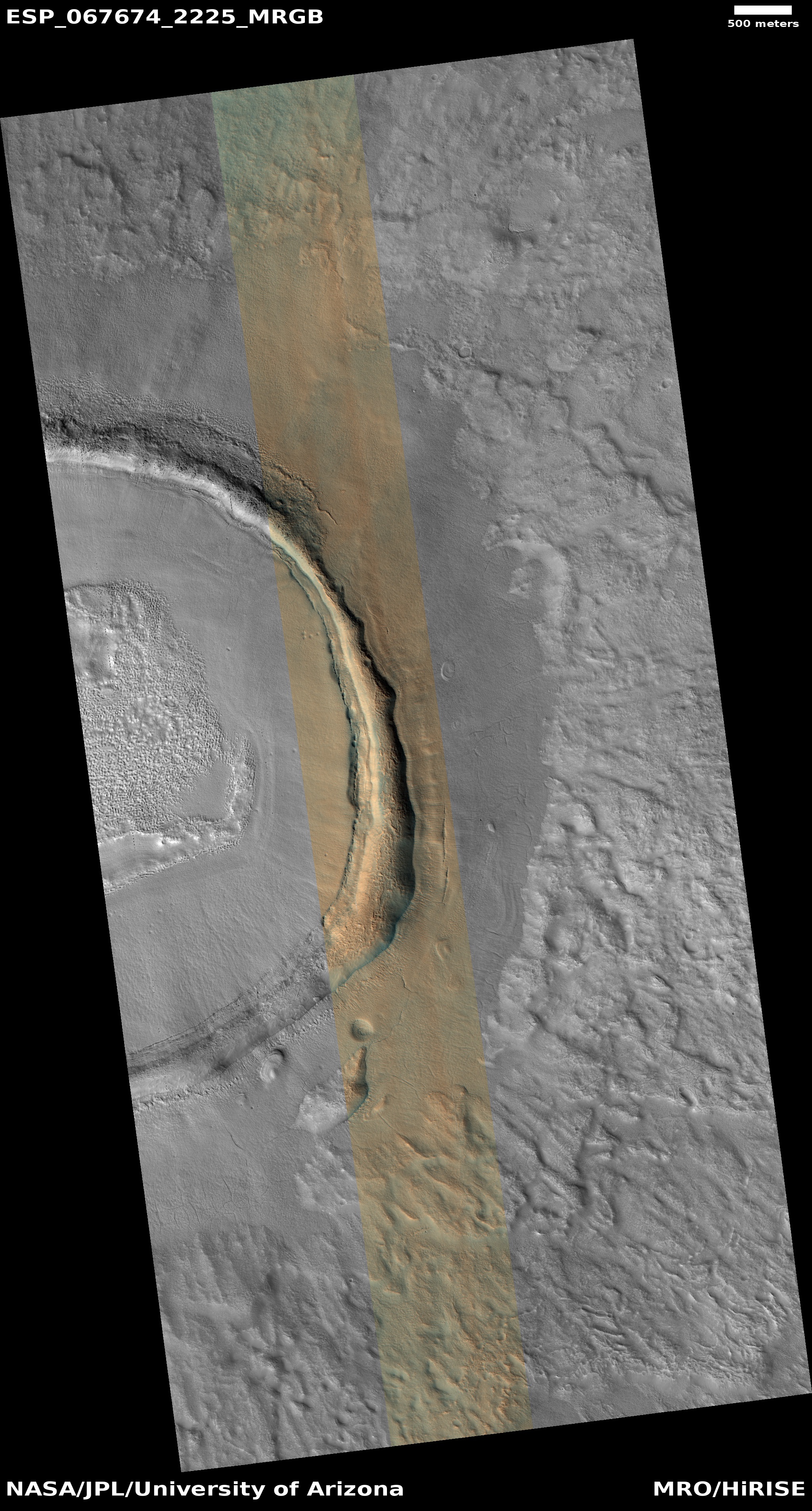
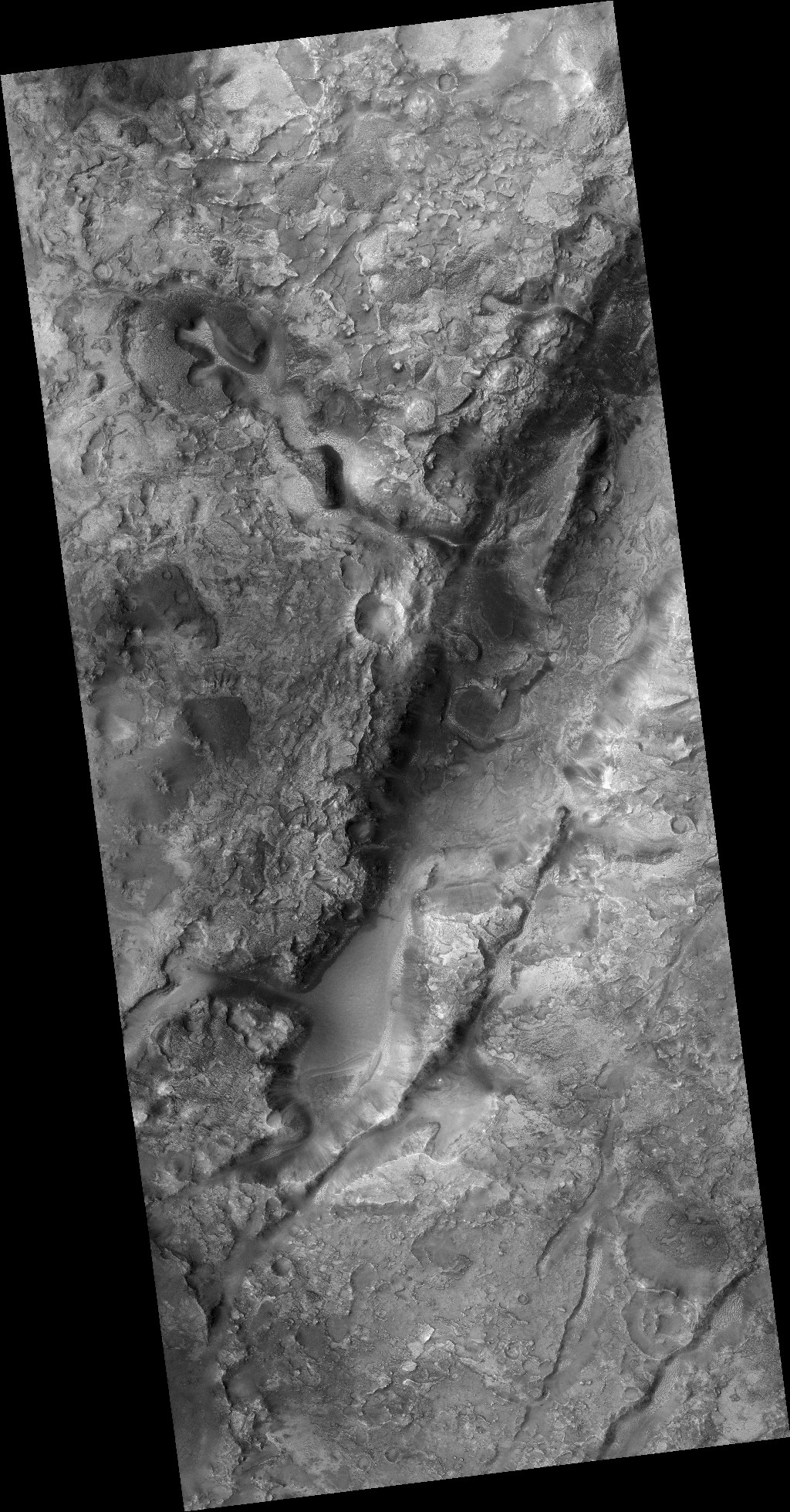
Terraced glaciers in Martian crater
Click for full image.

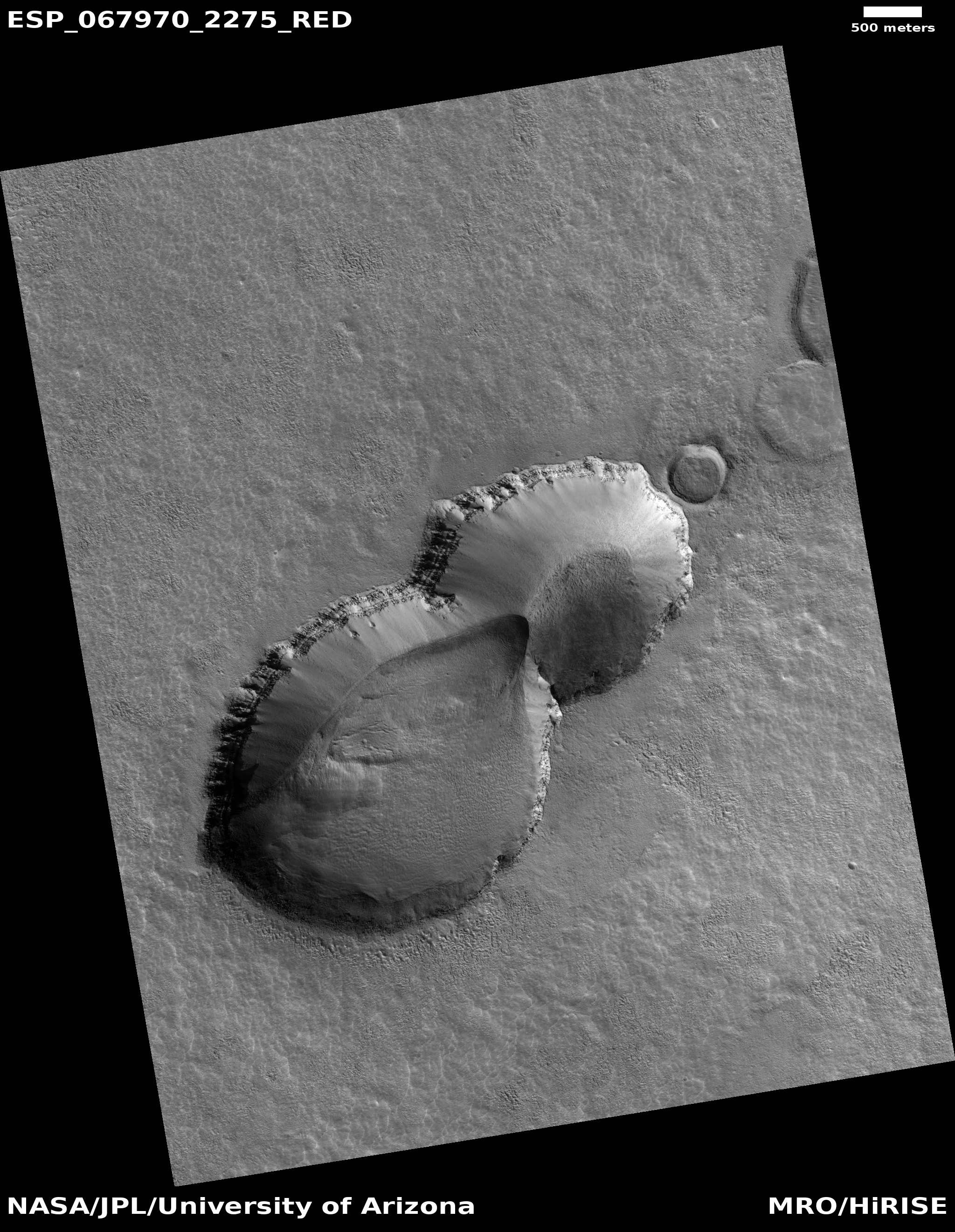
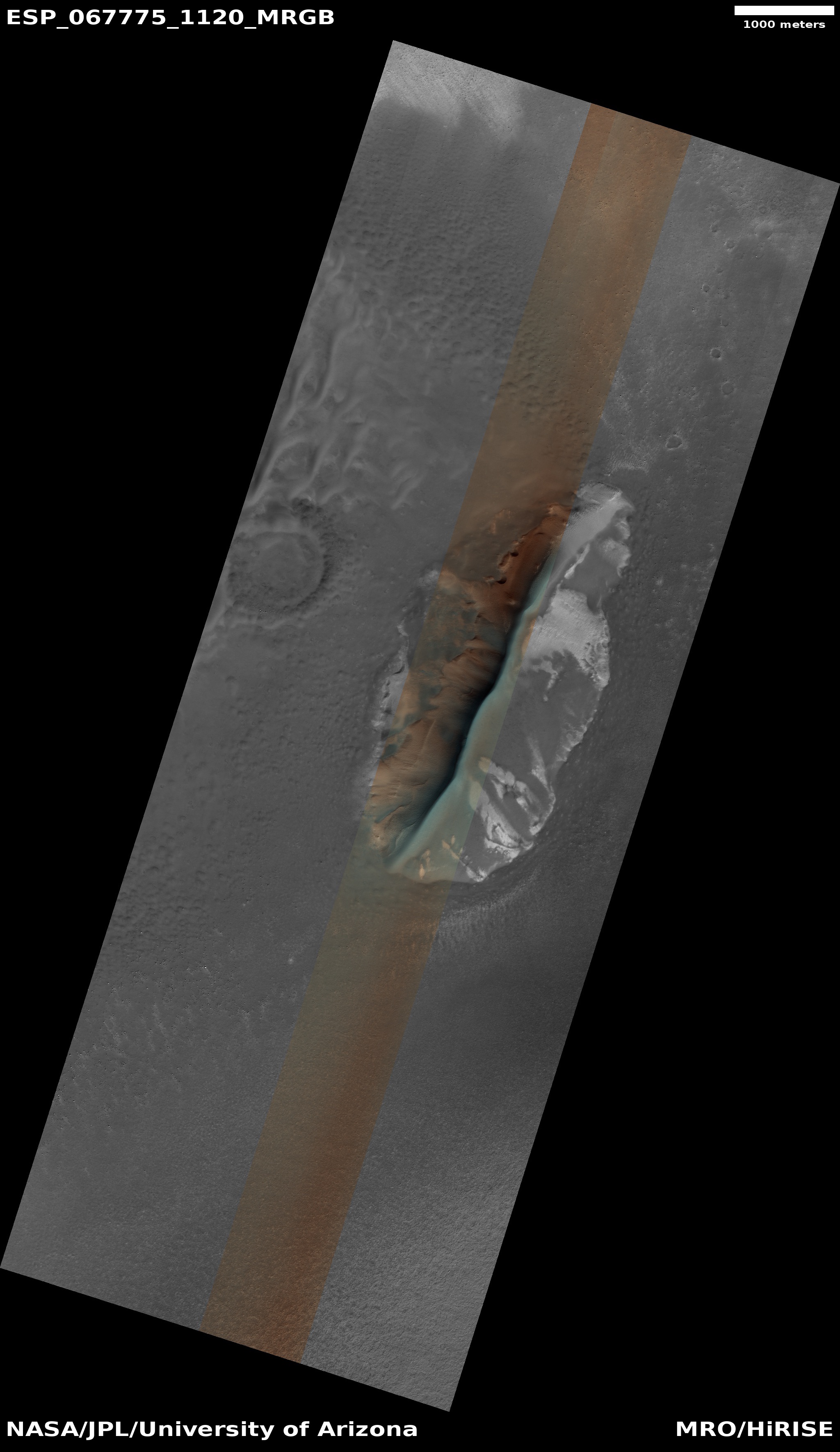
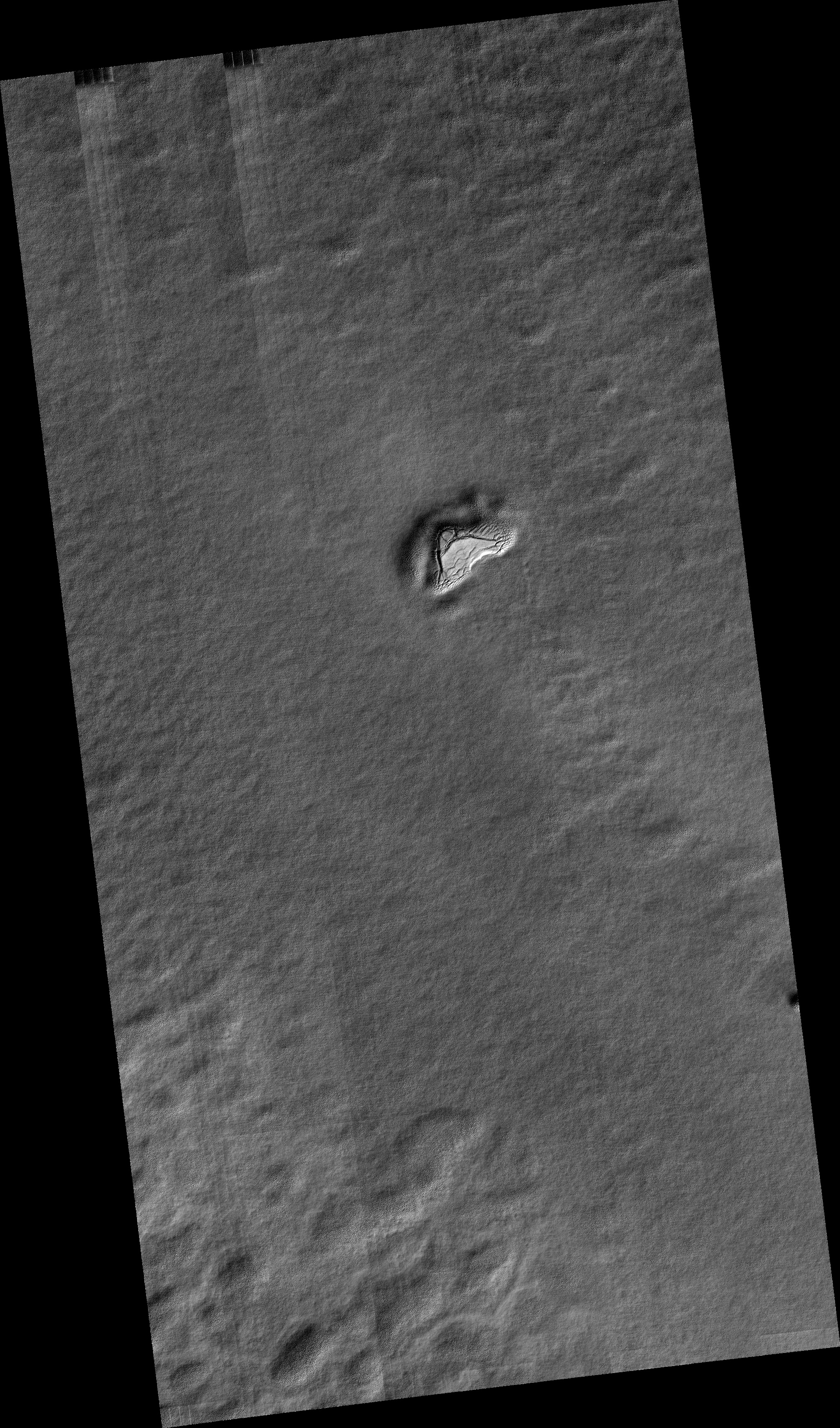
Cool image time! The photo to the right, cropped to post here, was taken on October 28, 2022 by the high resolution camera on Mars Reconnaissance Orbiter (MRO). It shows what the scientists label as a “layered feature” inside a small 4,500-foot-wide crater.

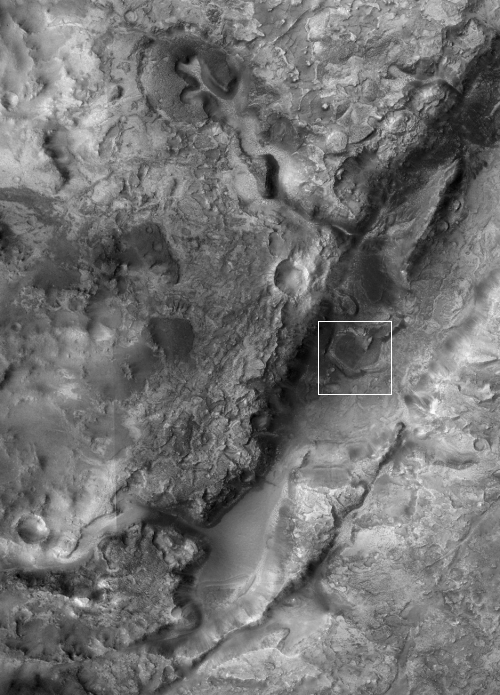
Located at 36 degrees north latitude, we are likely looking at glacial ice layers inside this crater, with each layer probably marking a different Martian climate cycle. The terraces suggest that during each growth cycle the glaciers grew less, meaning that less snow fell with each subsequent cycle. This in turn suggests a total loss of global water over time on Mars.

The overview map below gives us the wider context.
» Read more

0 comments

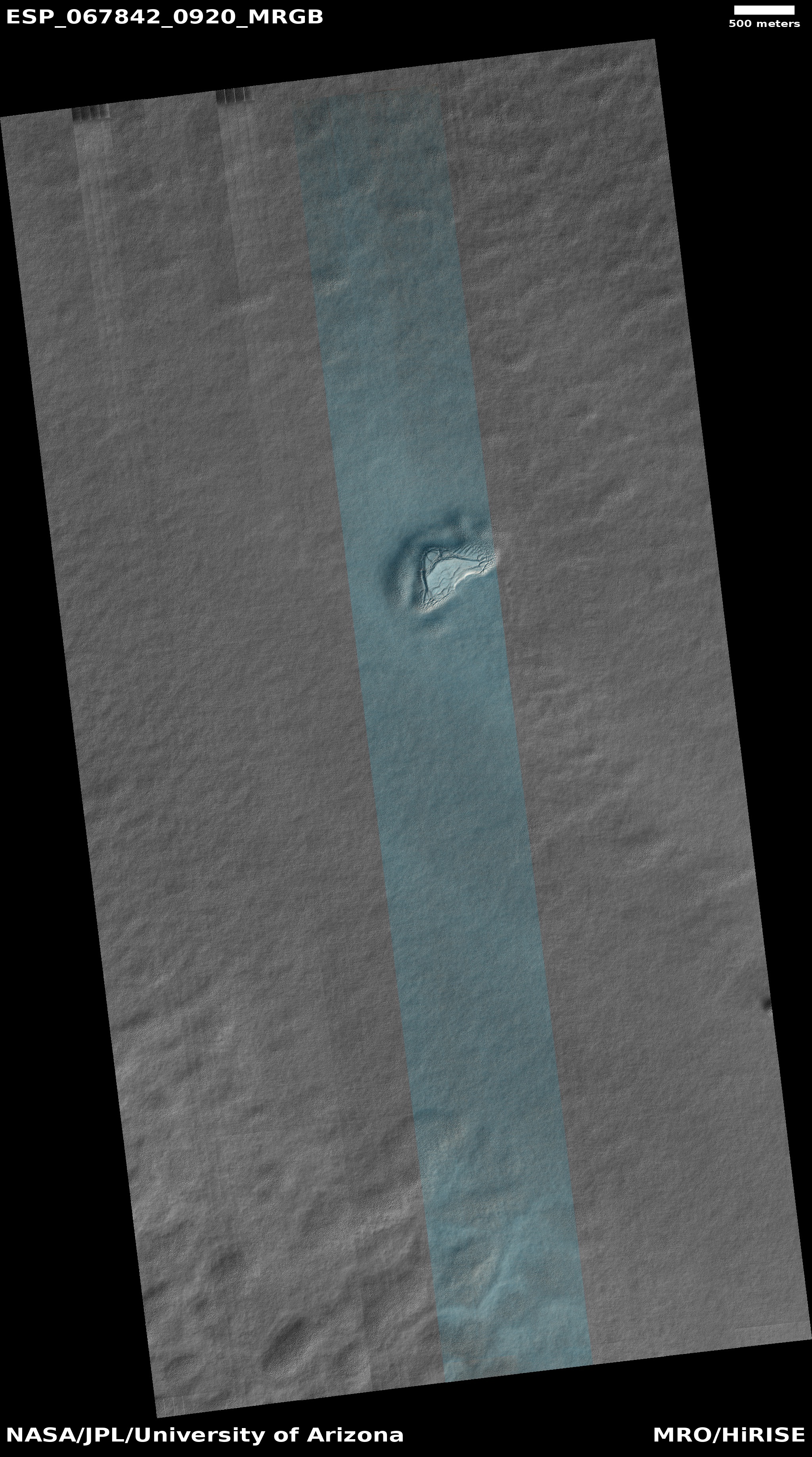
A “What the heck?” glacier image on Mars

Glacial material on Mars
Click for full image.

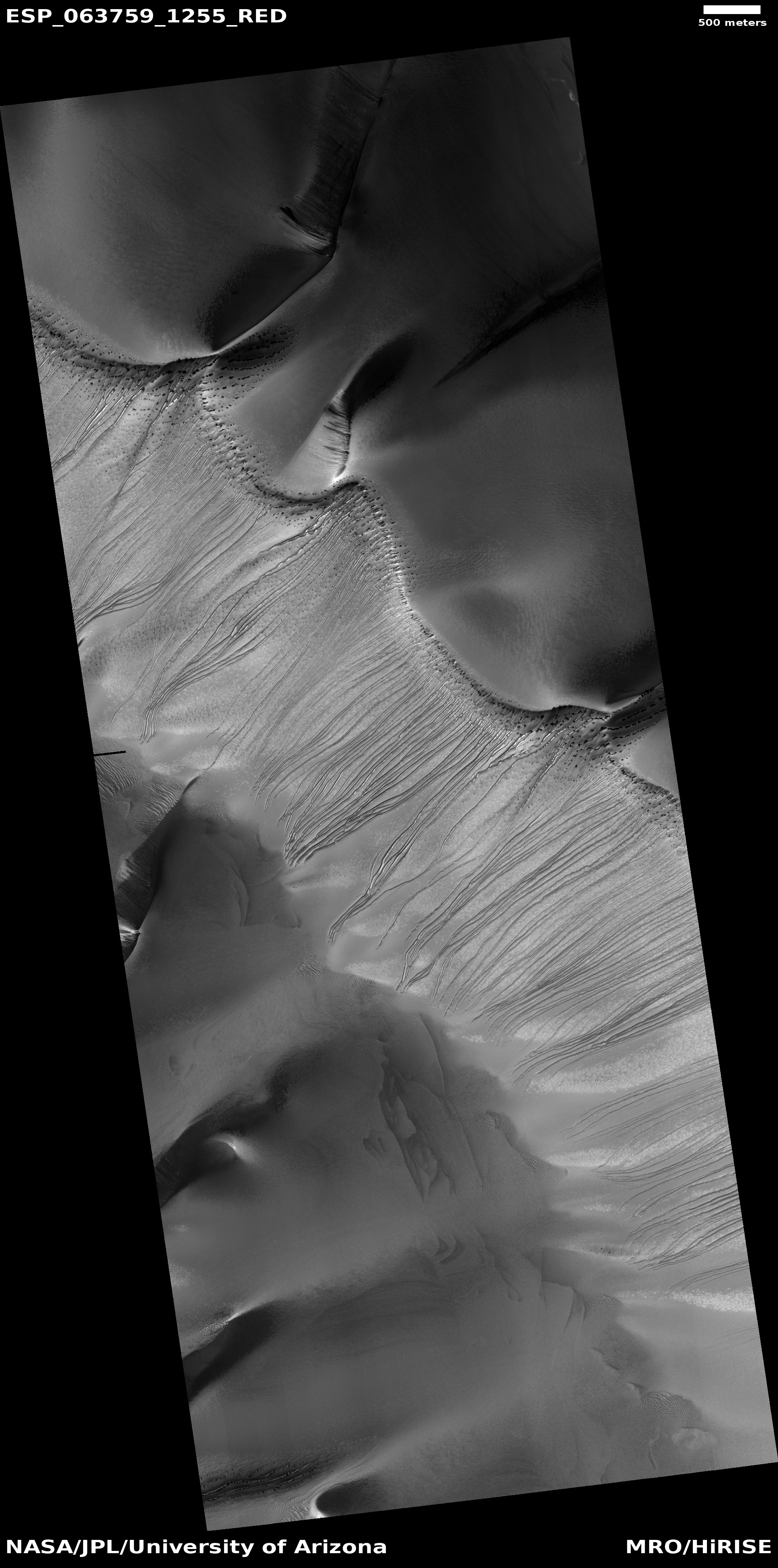
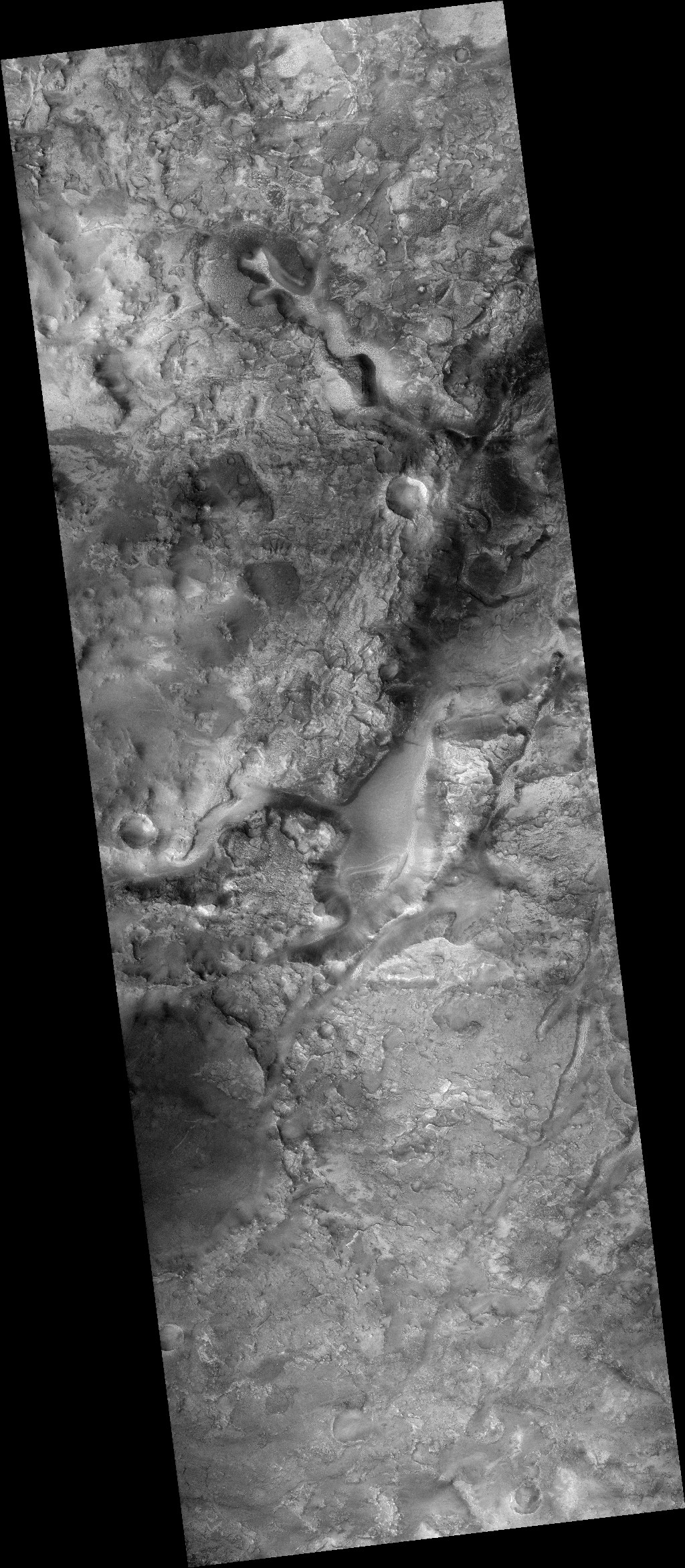
Sometimes a cool image goes from bafflement to obvious as you zoom into it. The cool image to the right, cropped to post here, does the opposite. It was taken on October 11, 2022 by the high resolution camera on Mars Reconnaissance Orbiter (MRO). I have purposely cropped it at full resolution, so that its eroded glacier nature is most obvious.

The cracks and hollows are likely caused by the sublimation of the near surface underground ice, breaking upward so that the protective surface layer of debris and dust collapses at some points, and cracks at others.

The overview map below further confirms the likelihood that we are looking at glacial features, but when we also zoom out from this close-up we discover things are not so easily explained.
» Read more

6 comments

Using reflected light from Jupiter to photograph Ganymede’s night side

Ganymede as seen in the reflected light of Jupiter
Click for full image.

During Juno’s June 7, 2021 close fly-by of Ganymede, scientists used its instruments to obtain the first good image of a part of this Jupiter moon. What made the achievement especially amazing was that the area photographed was only lit by the reflected light from Jupiter, the equivalent of its “earthshine.” From the paper’s abstract:

On 7 June 2021, the Juno spacecraft flew within about 1,000 km of the surface of Jupiter’s largest moon, Ganymede. The Mission used their sensitive navigation camera to photograph the moon’s dark side where it was lit only by scattered sunlight from Jupiter. This new imaging approach revealed multiple surface features, including a patchwork of different surface textures (such as grooved terrain), several craters, and ejecta deposits. These features had not been visible in images collected by previous spacecraft.

The picture to the right is from figure 2 of the paper, cropped and reduced to post here. It shows a region on Ganymede that in the earlier images had shown few details because the lighting was poor and thus features were not easily discerned (as can be seen by the inset in the lower right). In the new picture, the only light was reflected from Jupiter, and its low angle brings out the surface topography.

0 comments

Finding Martian glaciers from orbit

Glacier flow on Mars
Click for full image.

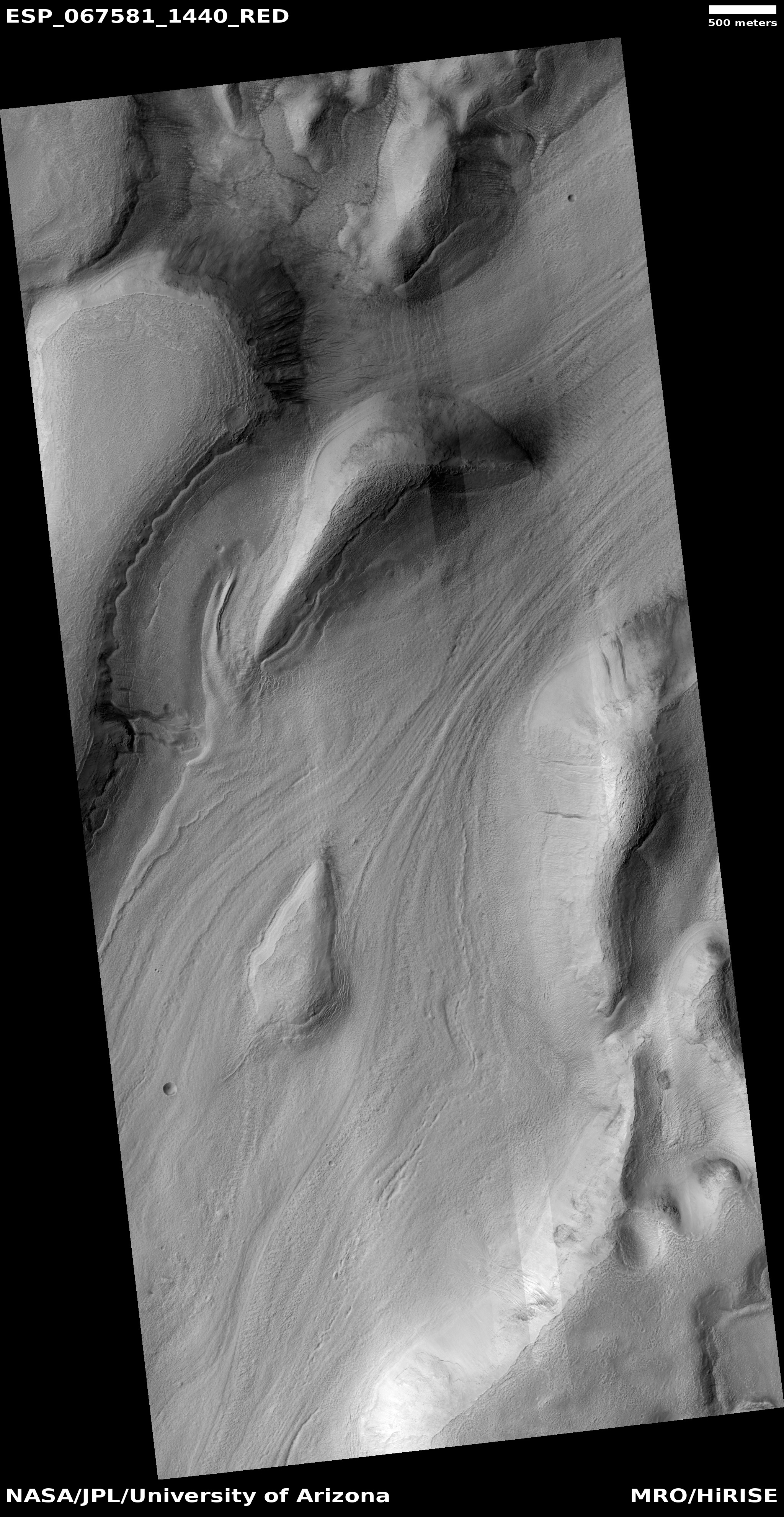
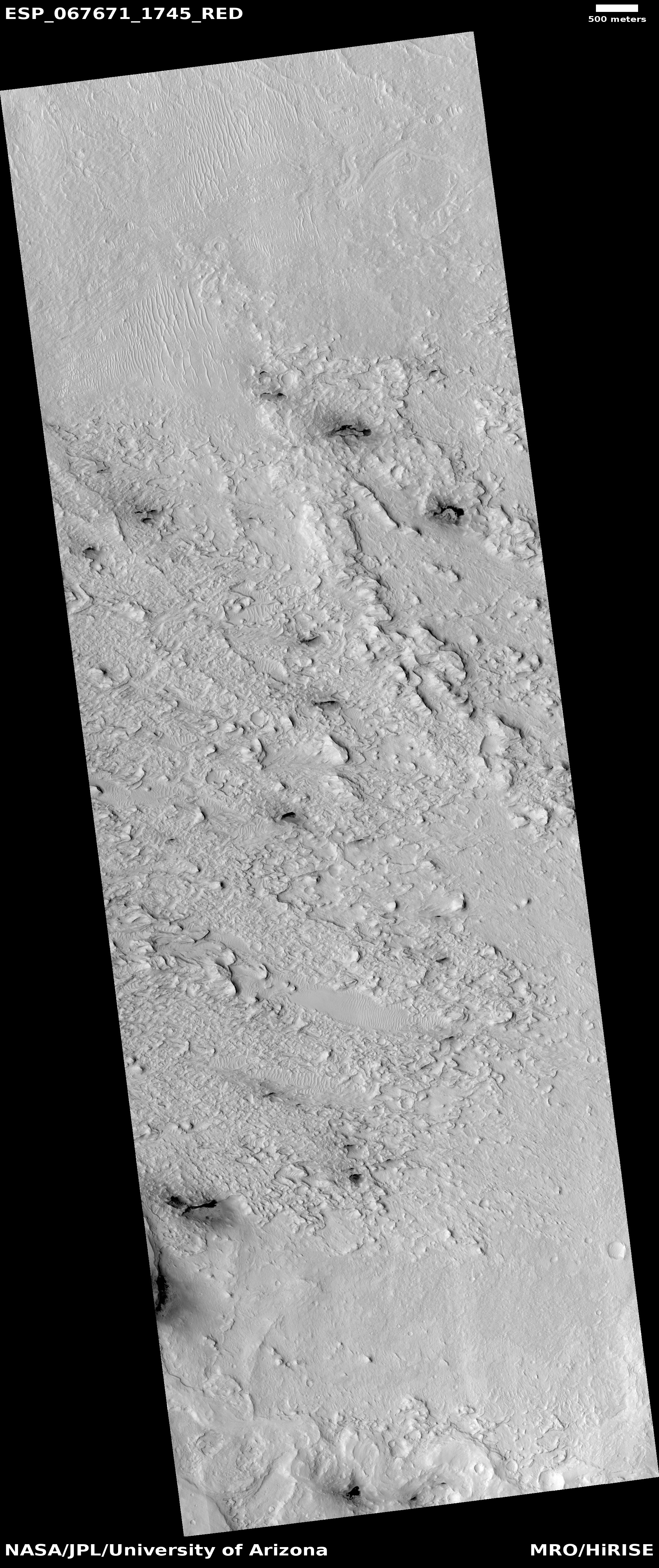
Today’s cool image is a great example of the surprises one can find by exploring the archive of the high resolution pictures that Mars Reconnaissance Orbiter (MRO) has produced since it arrived in Mars orbit back in 2006. The picture to the right, rotated, cropped, and reduced to post here, was taken by MRO’s high resolution camera back on May 4, 2017. I only found it because I had picked out a October 24, 2022 high resolution image that covered a different area of this same flow feature just to the north east. In trying to understand that 2022 picture I dug to see other images had been taken around it, and found the earlier 2017 photo that was even more interesting.

Neither however really covered the entire feature, making it difficult to understand its full nature. I therefore searched the archive of MRO’s context camera, which has imaged the entire planet with less resolution but covering a much wider area per picture. The context camera picture below captures the full nature of this feature.
» Read more

1 comment

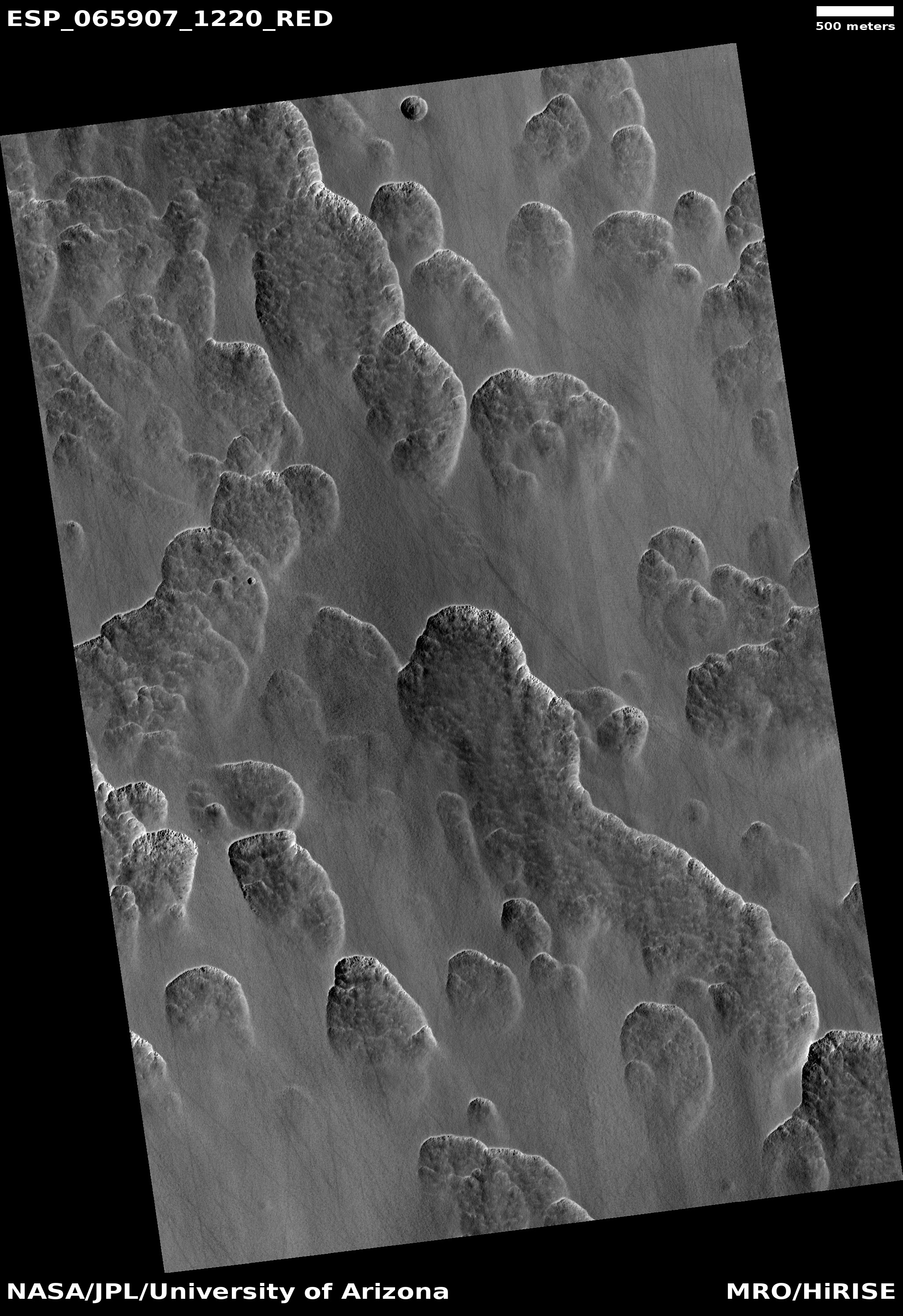
Cones, mounds, and layers of Martian ice?

Cones, mounds, and layers of Martian ice?
Click for full image.

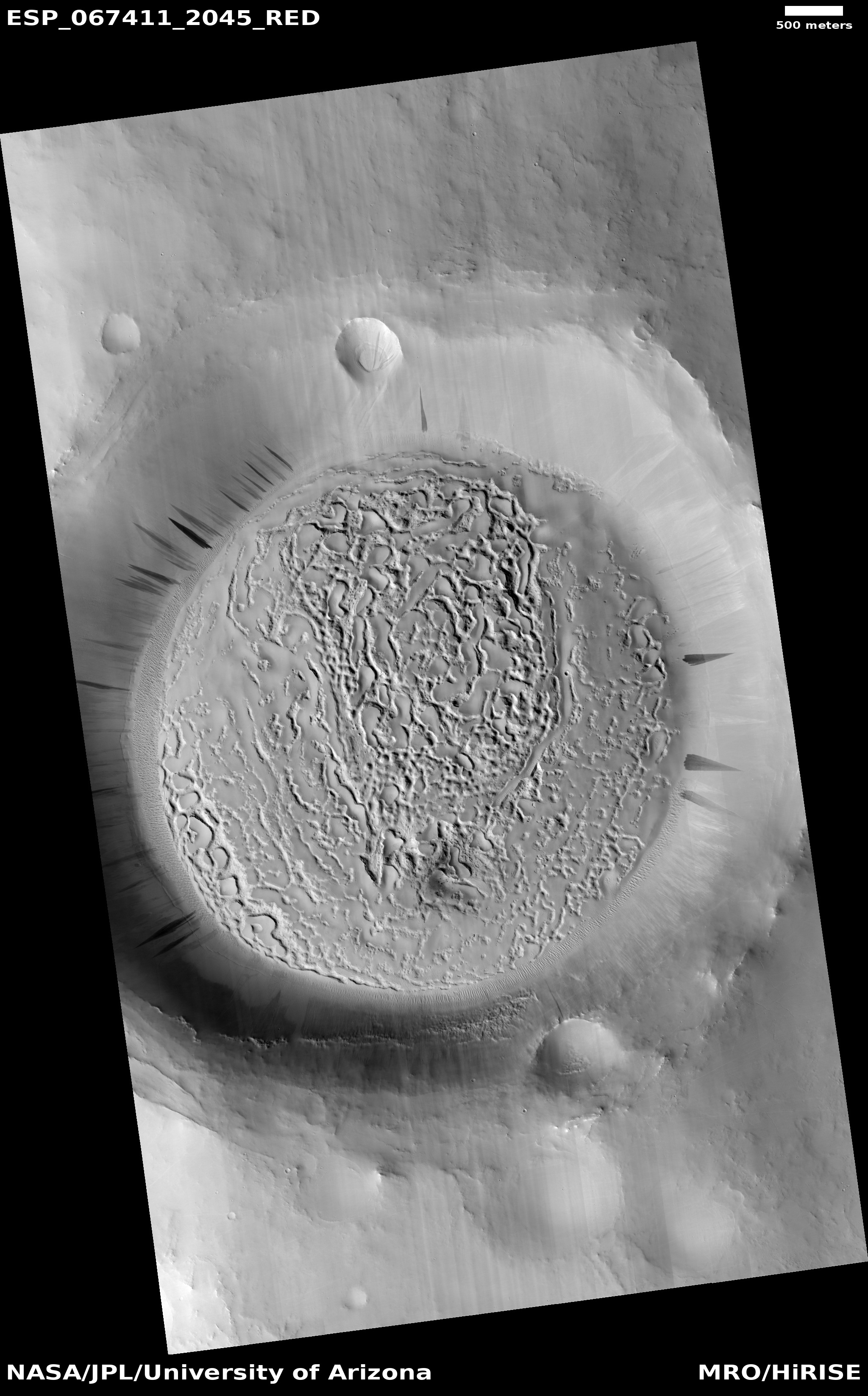
Cool image time! The photo to the right, rotated, cropped, and reduced to post here, was taken on September 10, 2022 by the high resolution camera on Mars Reconnaissance Orbiter (MRO).

The location is at 38 degrees north latitude, in the Martian northern lowland plains. At this latitude in these plains the geological features seen in high resolution pictures almost always invoke near surface ice, including processes that disturb that underground ice layer.

This picture is no different. Not only does it appear that a glacier is flowing down from the top of east-west ridge, the middle mound includes a crater with its southeast rim gone and appears filled with material that suggests ice.

The greater geographic context of this location can be seen in the overview map below.
» Read more

18 comments

Crater at the edge of the Martian south pole ice cap

Oblique view of south pole crater
Click for full image.

Overview map

Cool image time! The oblique panorama above, reduced and sharpened to post here, was created from an image taken on May 19, 2022 by the European orbiter Mars Express. Its location on edge of the layered deposits of ice and dust that form most of the Martian southern ice cap is indicated by the white rectangle on the overview map to the right. From the press release:

While it may look like a winter wonderland, it was southern hemisphere spring at the time and ice was starting to retreat. Dark dunes are peeking through the frost and elevated terrain appears ice-free.

Two large impact craters draw the eye, their interiors striped with alternating layers of water-ice and fine sediments. These ‘polar layered deposits’ are also exposed in exquisite detail in the rusty red ridge that connects the two craters.

The scattered white patches are either water frost, or the winter mantle of dry ice, both now sublimating away with the coming of spring.

The black line on the overview map indicates the extent of the layered deposits, and suggest that the ridgeline is not considered part of that ice cap layer, in contradiction to the press release language above.

Which is it? I would guess the answer is simply the uncertainty of science. Some scientists took a look here and decided the ridge was actually a base layer sticking up through the layered deposits. The European scientists who took this picture have instead concluded, based on the image, that the ridge is part of the layer deposits.

4 comments

Bursting lava bubbles on Mars

Burst lava bubbles on Mars
Click for full image.

Cool image time! The photo to the right, rotated, cropped, reduced, and sharpened to post here, was taken on September 4, 2022 by the high resolution camera on Mars Reconnaissance Orbiter (MRO).

I really have no idea what caused these distorted cones. My intuition (a dangerous thing to rely on when it comes to science) suggests these are volcanic in nature. Imagine hot lava with gas bubbling up from below. Periodically a gas bubble will burst on the surface releasing the gas. Depending on temperature, that bursting bubble could harden in place.

The overview map below provides some support for my intuition, but it also suggests this first hypothesis could be completely wrong, something that does not surprise me in the least.
» Read more

4 comments

Perseverance deposits first core sample for pickup later

Perseverance's location December 21, 2022
Click for interactive map.

The Mars Perseverance rover has now deposited its first core sample on the floor of Jezero Crater for pickup later by a future Mars helicopter for eventual return to Earth.

A titanium tube containing a rock sample is resting on the Red Planet’s surface after being placed there on Dec. 21 by NASA’s Perseverance Mars rover. Over the next two months, the rover will deposit a total of 10 tubes at the location, called “Three Forks,” building humanity’s first sample depot on another planet. The depot marks a historic early step in the Mars Sample Return campaign.

The blue dot on the map to the right shows this location. The green dot shows Ingenuity’s present position. The red dotted line the rover’s future travel route.

0 comments

InSight mission ended

Location of InSight's largest quakes
The white patches mark the locations on Mars of the largest quakes
detected by InSight

NASA today announced that it has officially ended the mission of the InSight lander on Mars.

Mission controllers at the agency’s Jet Propulsion Laboratory (JPL) in Southern California were unable to contact the lander after two consecutive attempts, leading them to conclude the spacecraft’s solar-powered batteries have run out of energy – a state engineers refer to as “dead bus.”

NASA had previously decided to declare the mission over if the lander missed two communication attempts. The agency will continue to listen for a signal from the lander, just in case, but hearing from it at this point is considered unlikely. The last time InSight communicated with Earth was Dec. 15.

Other than the success of InSight’s seismometer, this project was mostly a failure. Its launch was delayed two years, from 2016 to 2018, because of problems with the original French seismometer, forcing JPL to take over. Then its German-made mole digger failed to drill into the Martian surface, causing the failure of the lander’s second instrument, a heat sensor designed to measure the interior temperature of Mars.

Fortunately the seismometer worked, or otherwise it would have been a total loss. That data has told us much about Mars and its interior.

12 comments

The same region on Ganymede, as seen by Voyager-1 in 1979 and Juno in 2021

Ganymede compared between Voyager-1 and Juno
Click for full image.

When the Jupiter orbiter Juno did a close pass of the moon Ganymede on June 7, 2021, it took four pictures, covering regions mostly photographed for the first time by Voyager-1 in its close fly-by in 1979.

Scientists have now published the data from this new fly-by. Though Juno’s higher resolution pictures revealed many new details when compared with the Voyager-1 images from four decades earlier, the scientists found no changes. The comparison image, figure 2 of their paper, is to the right, reduced and sharpened to post here.

A flicker comparison between the registered JunoCam and Voyager reprojected mosaics revealed no apparent new impact features. Given the high albedo of fresh craters on Ganymede, with high albedo ejecta deposits two or three times the diameter of the craters themselves, we argue that new craters as small as 250 m diameter would be detectable in images at these 1 km per pixel scales. Extrapolating Ganymede cratering rates from Zahnle et al. (2003) below 1 km, the probability of JunoCam observing a new crater over 12.2 million km2 in 42 years is 1 in 1500, consistent with none being observed.

In other words, at these resolutions finding no new impacts is not a surprise.

Of the new features detected, the Juno images could see more details in the bright rays emanating from the crater Tros (in the lower center of both images), and thus found “…terrain boundaries previously mapped as ‘undivided’ or as ‘approximate’, several large craters, and 12 paterae newly identified in this region.”

Paterae resemble craters but are thought to be a some form of volcanic caldera. Their geological origin however is not yet completely understood.

The paper’s conclusion is actually the most exciting:

The insight gained from this handful of images makes it likely in our opinion that new observations from the upcoming JUICE and Europa Clipper missions will revolutionize our understanding of Ganymede.

3 comments

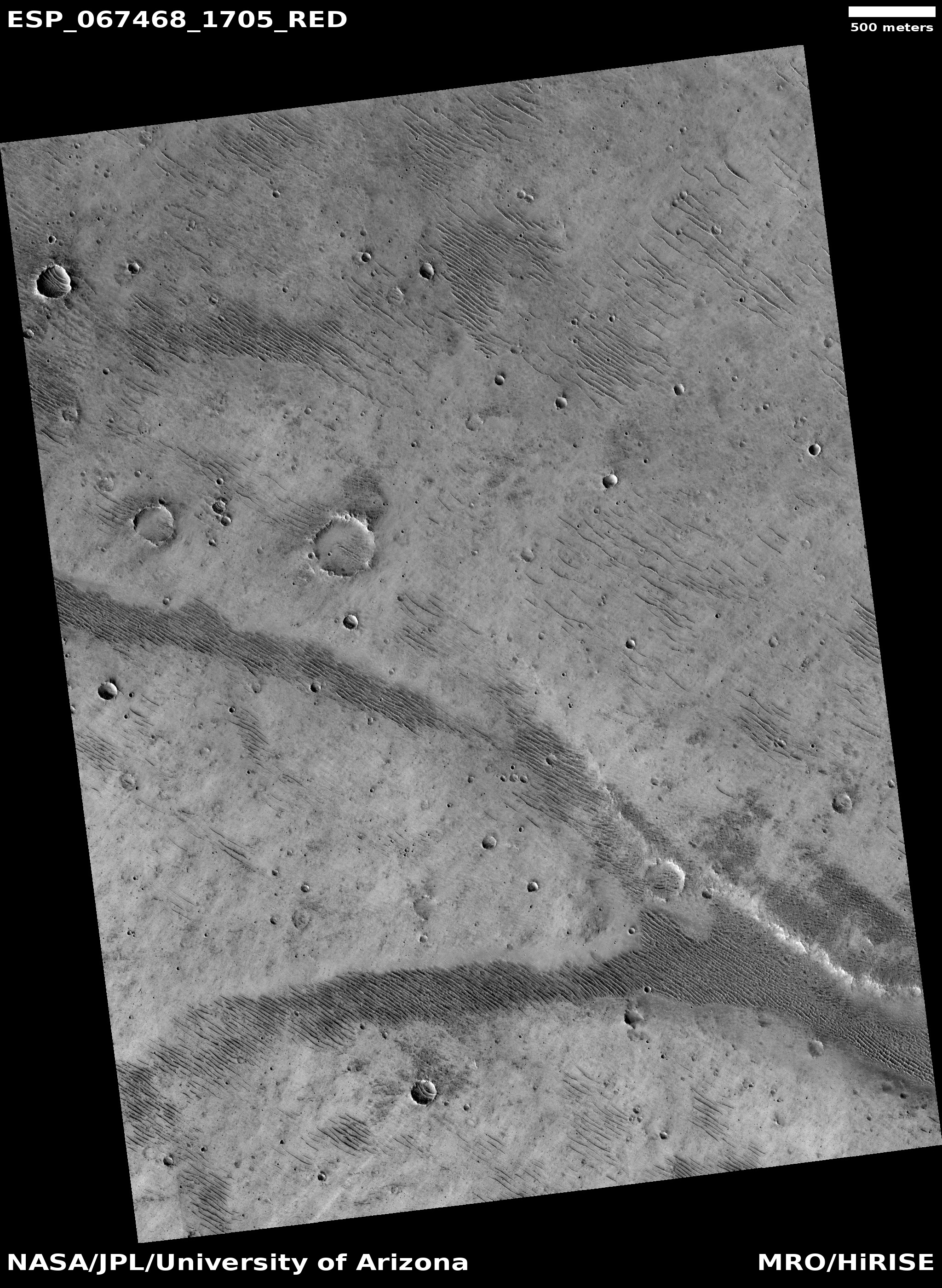
A congregation of Martian dust devils

A congregation of Martian dust devils
Click for full image.

Cool image time! The photo to the right, rotated, cropped, reduced, and sharpened to post here, was taken on September 9, 2022 by the high resolution camera on Mars Reconnaissance Orbiter (MRO). It shows a spot on Mars where, as indicated by the many many tracks, dust devils routinely develop and travel across the surface.

Though this whole region appears to favor dust devils, within it are places that are even more favored. For example, the number of tracks on the northern and eastern slopes of that small hill at center left practically cover the surface, while the hill’s western and southern slopes are almost untouched.

Both the overview map and the global Mars map below provide the full context.
» Read more

2 comments

Perseverance’s planned route up onto the Jezero Crater delta

Perseverance's future route onto the delta
Click for original image.

Even as the Perseverance science team prepares to cache the ten first core samples on the surface of Mars for later pickup by a future Mars helicopter for return to Earth, they have also released the planned route they intend to follow as they drive the rover up onto the delta that flowed into Jezero Crater in the distant past.

The black line on the map to the right shows that route, with the black dots indicating points in which further core samples will likely be taken. The red dot indicates Perseverance’s present position, with the white line indicating its past travels. The green dot marks Ingenuity’s present position.

5 comments
1 59 60 61 62 63 157