“What the heck?!” swirls on Mars


Click for original image.

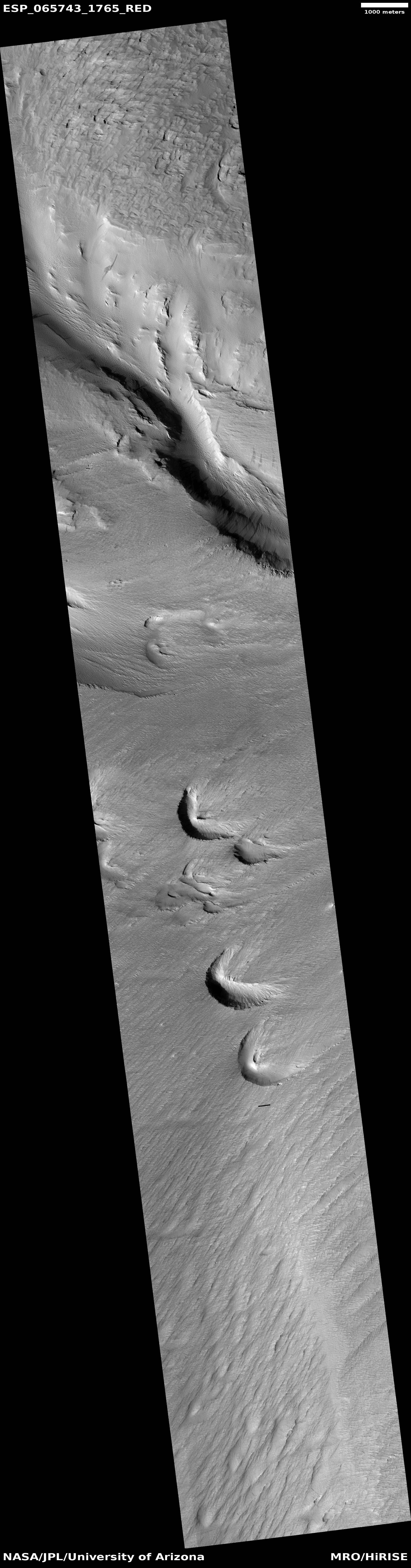
Time for another “What the heck?!” image on Mars. The picture to the right, cropped to post here, was taken on January 6, 2023 by the high resolution camera on Mars Reconnaissance Orbiter (MRO). It is what the science team calls a “terrain sample,” which means it wasn’t taken as part of any specific scientific investigation and requested by a scientist. Instead, it was taken to fill a gap in MRO’s schedule. In order to maintain the camera’s proper temperature it is necessary for it to take regular pictures, and sometimes if there is a gap between requested images the science team picks something almost at random to fill the gap.

Sometimes the picture results in something relatively uninteresting. More often they try to pick something intriguing but not yet of interest to any particular researcher. With today’s cool image they certainly found something intriguing, so much so that I haven’t the faintest idea what is going on here.

Clearly, the tan swirls lie on the higher topology, and could be dust covered. The darker hollows in between could be darker because they are so, or because they are in shadow.
» Read more

0 comments

A glacial river on Mars

A glacial river on Mars
Click for full image.

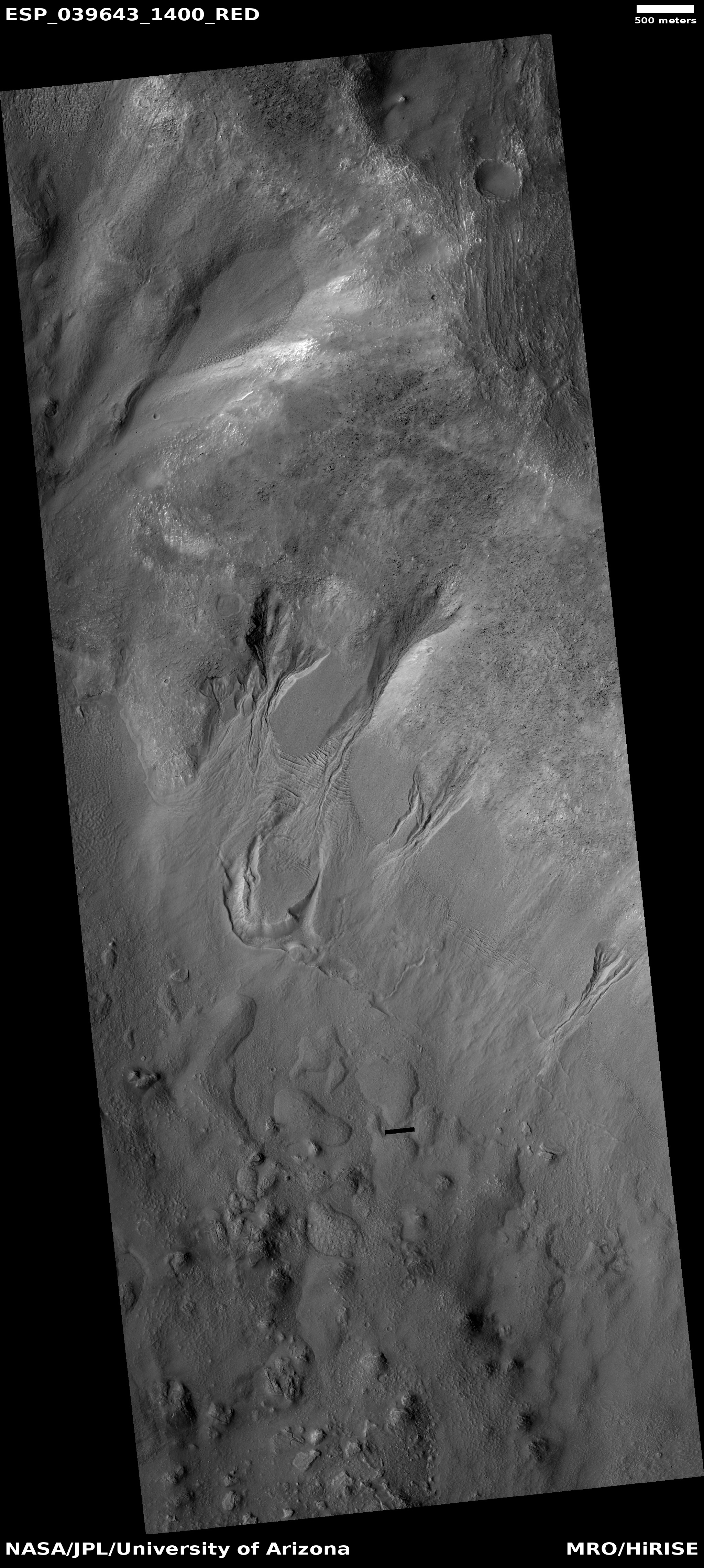
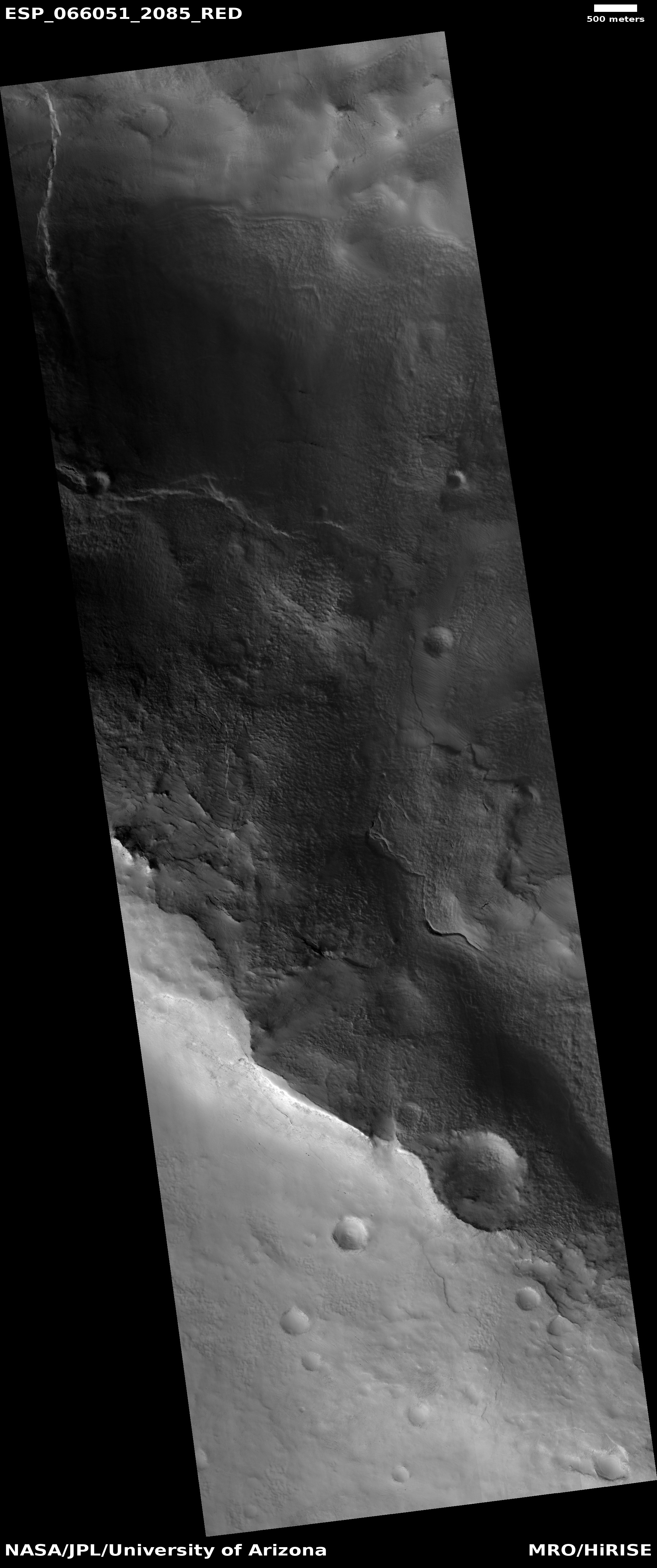
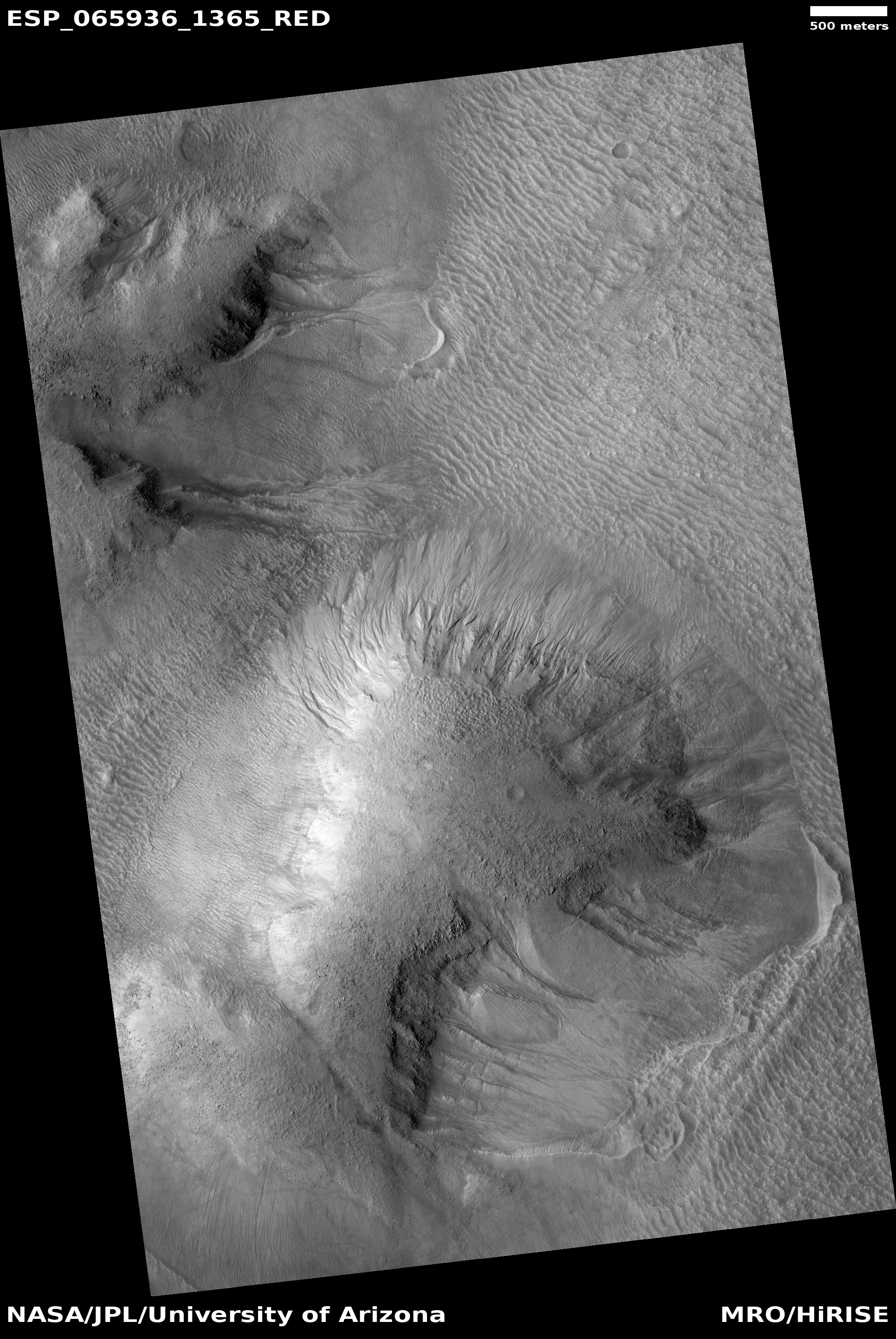
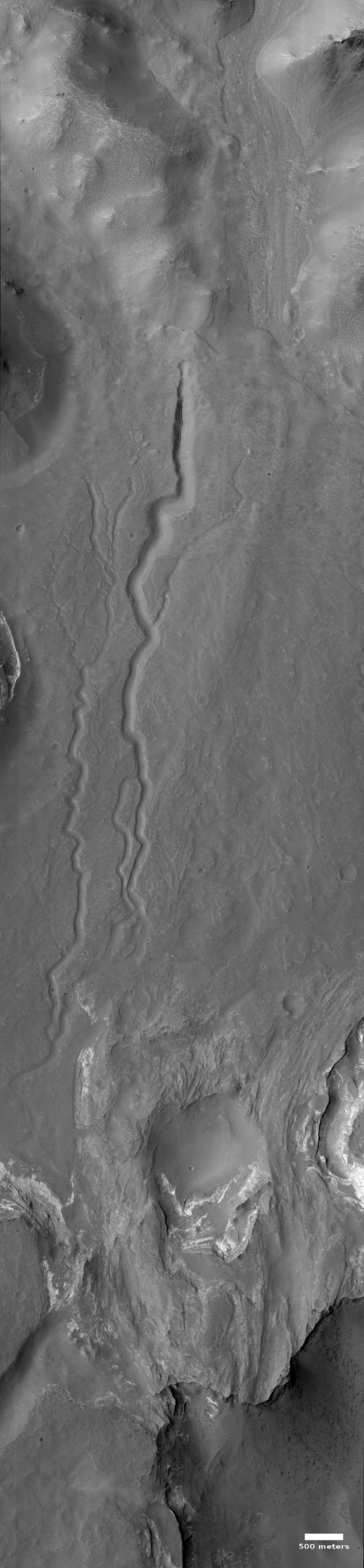
Cool image time! The picture to the right, cropped, reduced, and sharpened to post here, was taken on November 1, 2022 by the high resolution camera on Mars Reconnaissance Orbiter (MRO). It shows a wonderful example of a glacier-filled canyon on Mars, the ice apparently flowing both along and around mesas as it carves its way downhill.

I think the downhill grade here is to the north, but this could be wrong for the two side canyons on the main canyon’s north side.

Not only is the material in the canyon likely ice, covered with a protective layer of trapped dust and ash that makes the glacier surface look so smooth, the mesa tops are likely impregnated with ice as well. The mesas however have little dust, so the plateaus have a mottled stippled look likely caused by sublimation of that underground ice.

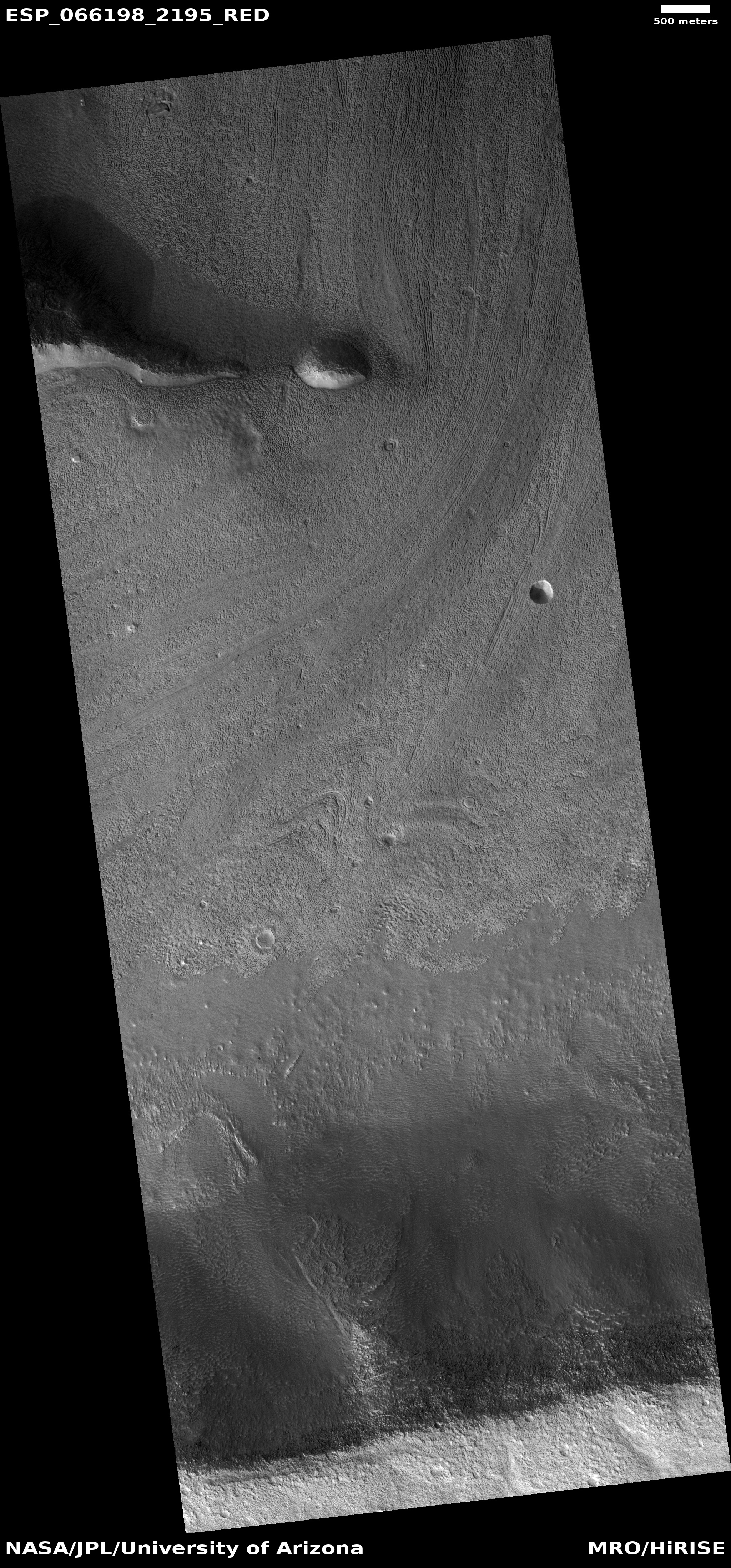
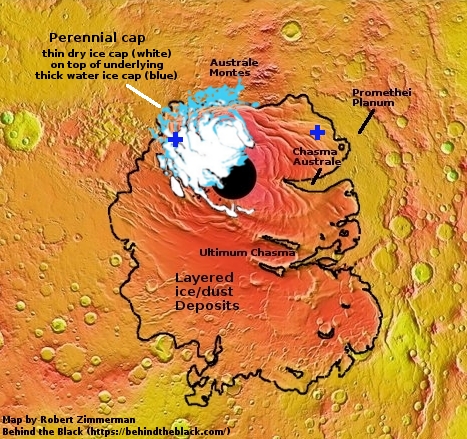
The location of these canyons explains the presence of ice.
» Read more

0 comments

Cracked ash-filled Martian terrain

Cracked ash-filled fissures on Mars
Click for original image.

Cool image time! The photo to the right, cropped, reduced, and sharpened to post here, was taken on September 26, 2022 by the high resolution camera on Mars Reconnaissance Orbiter (MRO). The science team labeled this “Possible Pit,” but other than a small dark stain on the rim of a crater north of the section cropped to the right, I could find nothing that even closely resembled a pit. More likely the scientists were referring to the large circular depression in the top center of this picture. It does not at first glance look like a crater, as it has no obvious rim. In fact, almost none of the circular depressions in this image look like craters, as almost none have uplifted rims.

However, it is not clear what caused these dust-filled fractures as well as the image’s many circular depressions. The location, as indicated by the overview map below, does not really help.
» Read more

1 comment

Terraced serrated layered mesas on Mars

Terraced mesas on Mars
Click for original image.

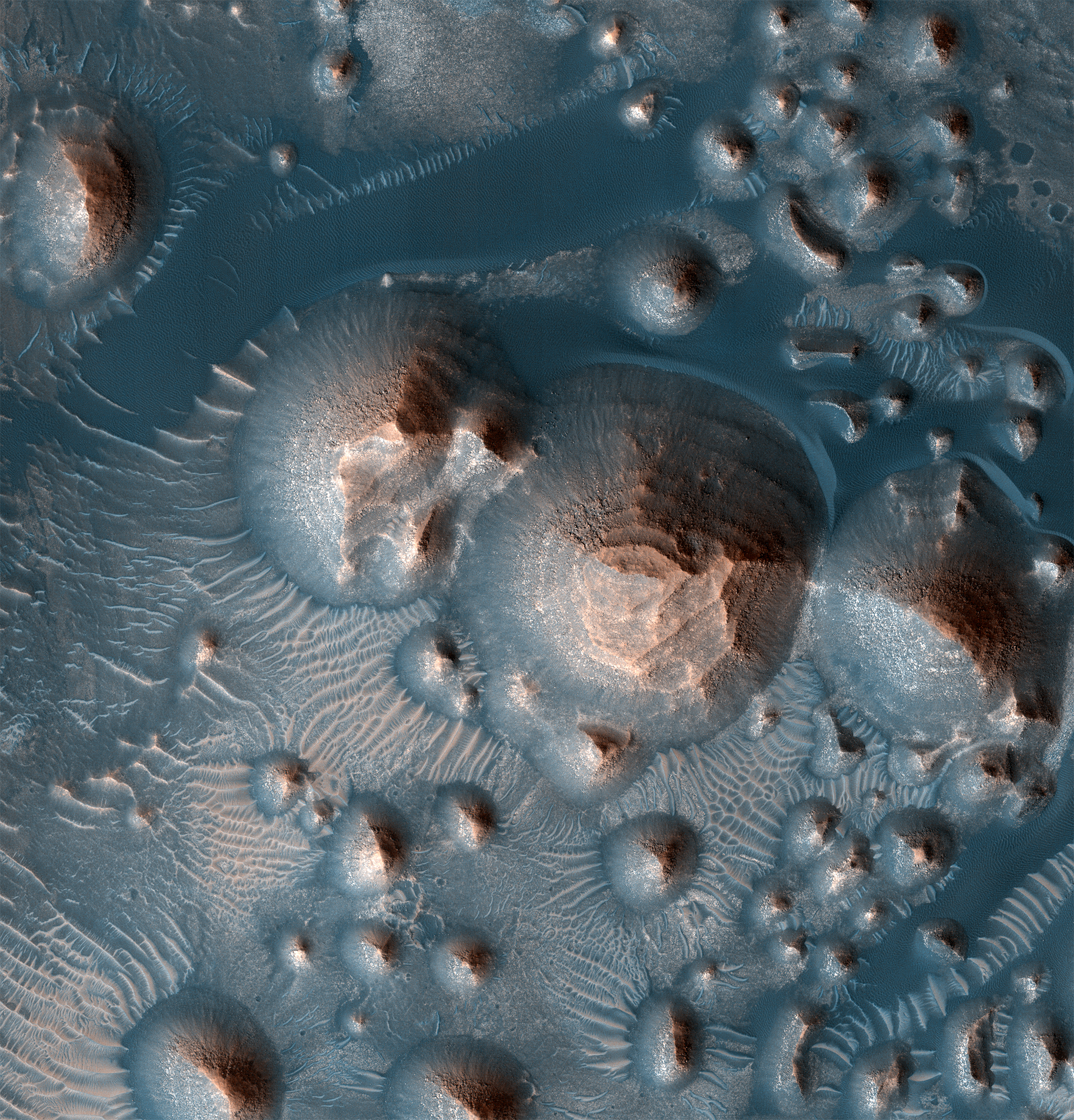
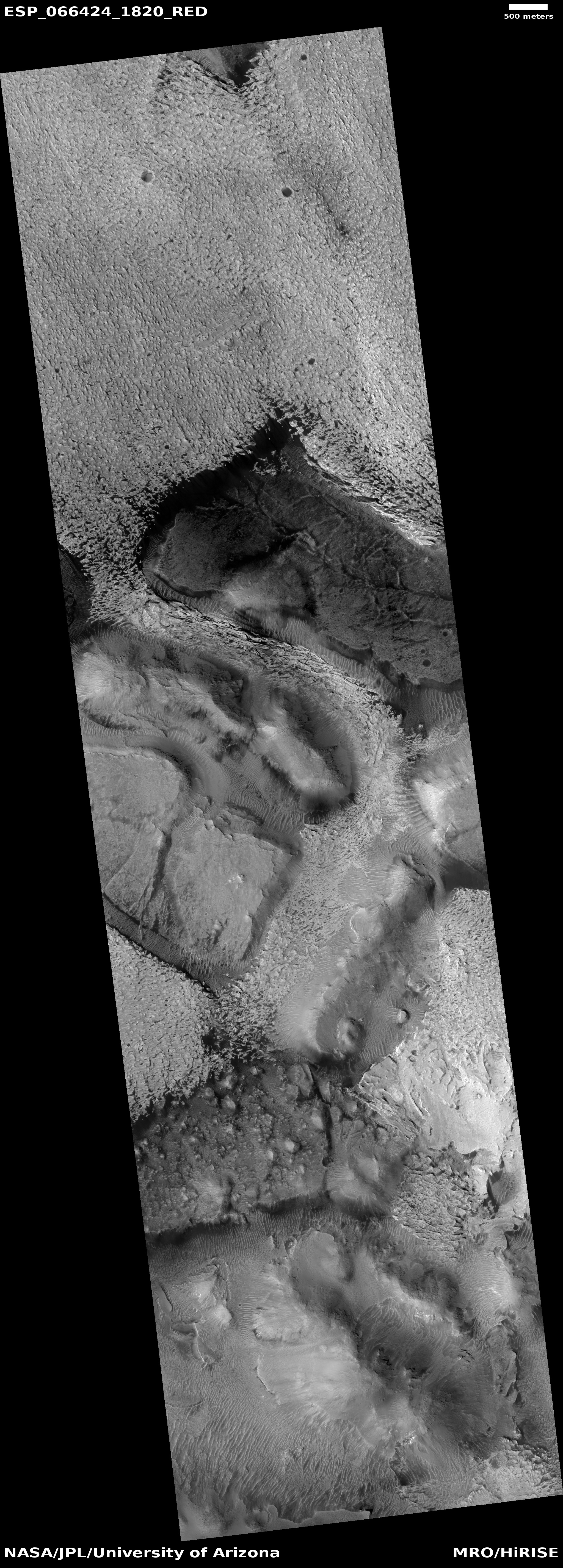
Cool image time! The picture to the right, rotated, cropped, reduced, and sharpened to post here, was taken on November 19, 2022 by the high resolution camera on Mars Reconnaissance Orbiter (MRO). It shows a collection of terraced mesas covered with dust of a variety of colors.

The bluish colors suggest exposed bedrock, while the different shades of tan suggest areas covered by dust and volcanic ash. That the tan areas are likely dust is strengthened in that it is found between and on these rough mesas, where dunes are also seen. The dust gets blown in but gets trapped there.

The tan colors however could also indicate different types of bedrock, especially because different terraces seem to be of different shades. We will need more data to determine which, or whether this is a combination of all these geological processes.
» Read more

0 comments

Dormant volcanic vent on Mars

Dormant volcanic vent on Mars
Click for original image.

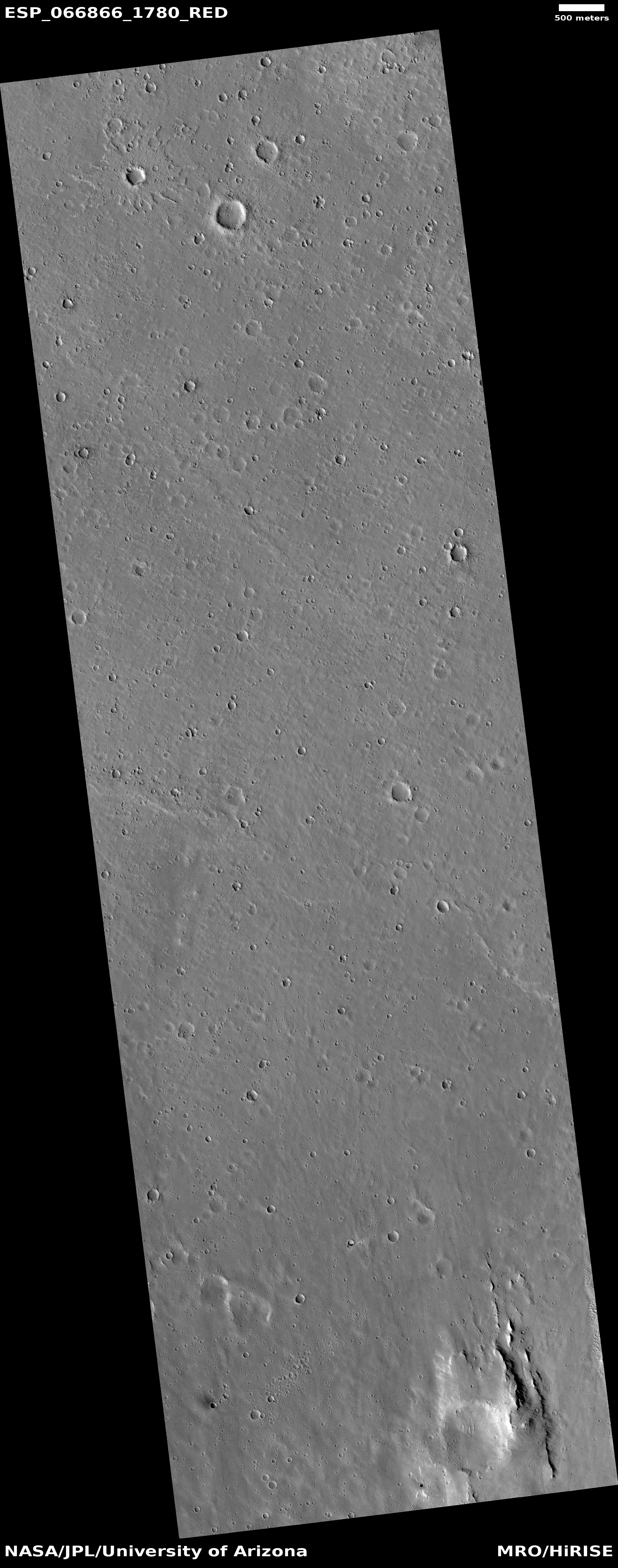
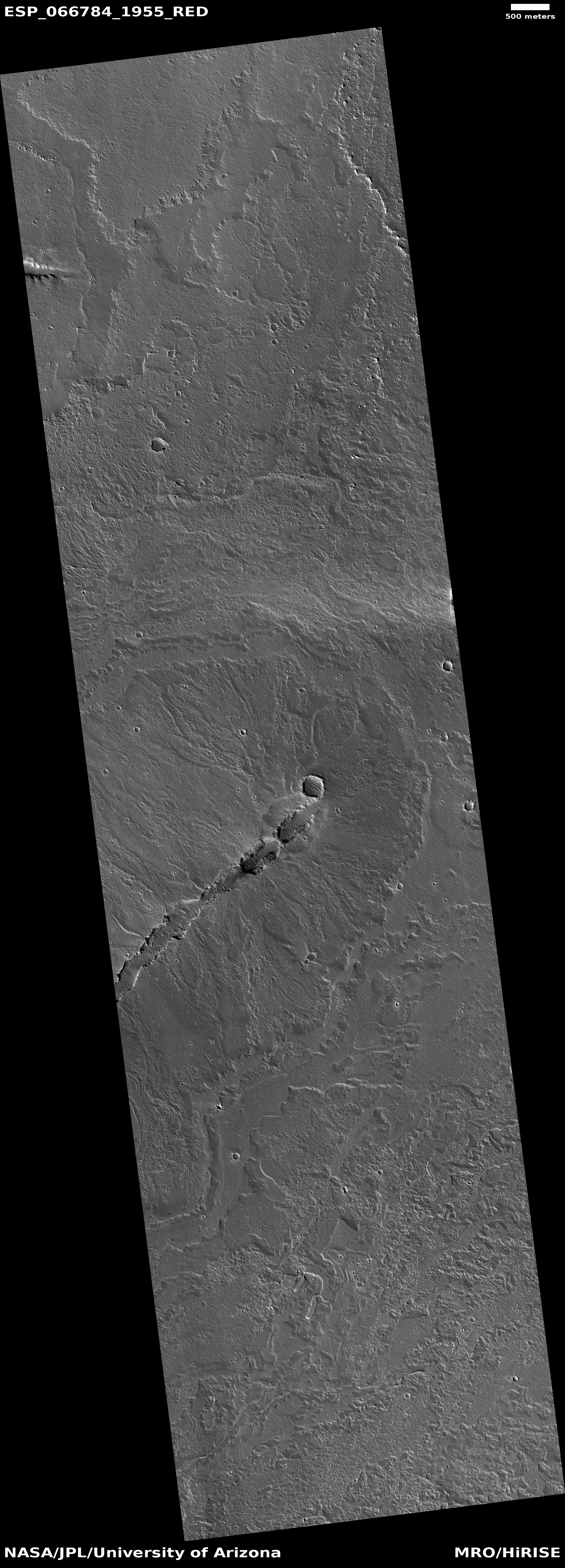
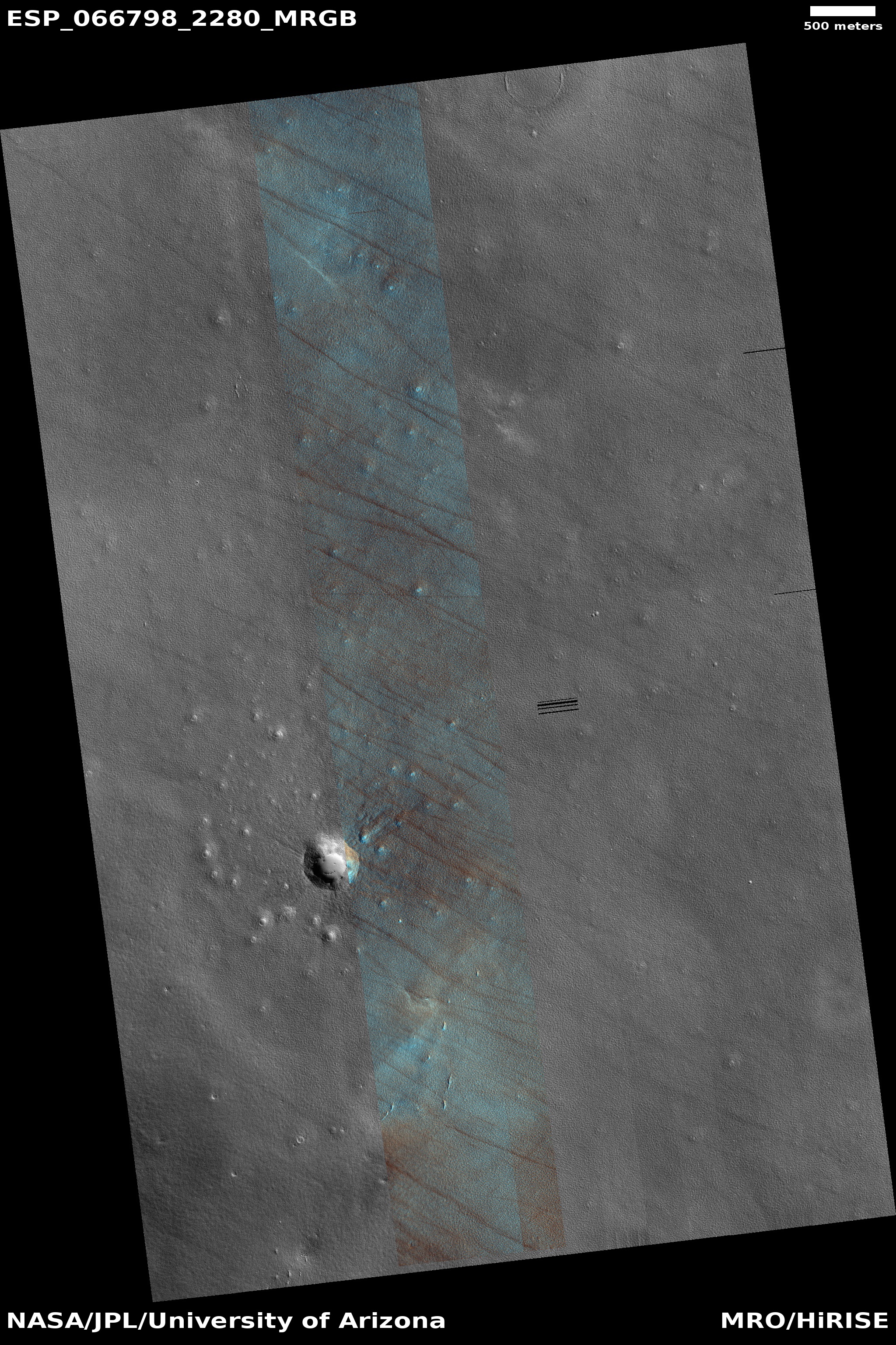
Cool image time! The photo to the right, rotated, cropped, and reduced to post here, was taken on November 19, 2022 by the high resolution camera on Mars Reconnaissance Orbiter (MRO). It shows what the science team labels “Intersecting Fissures.”

These fissures stand out distinctly on this terrain. If you look at an MRO context camera image, showing a wider view, you can see that the surrounding plain is relatively featureless, with few craters. Except for some strange and inexplicable dark streaks close by to the east, some mottled but flat terrain to the north, and a long but very faint similar east-west fissure to the south, this runelike fissure is the only major topological feature for miles around.

That context camera image also shows that this fissure sits on top of a very faint bulge, with hints that material had flowed downhill from the fissure’s western and southern outlets. Located very close to the equator, it is unlikely that any of those flow features are glacial, and in fact they do not have that appearance in the context camera picture. Instead, they have the look of Martian lava, fast-moving and far less viscous than Earth-lava, and thus able to cover large areas much more quickly.

Thus, all the evidence says that this feature is a dormant volcanic vent, sitting on a flood lava plain. And the overview map below cements this conclusion.
» Read more

1 comment

A Martian slope streak caused by a dust devil?

A Martian slope streak caused by a dust devil?
Click for original image.

Cool image time! The photo to the right, cropped, sharpened, and enhanced to post here, was taken on January 5, 2023 by the high resolution camera on Mars Reconnaissance Orbiter (MRO). It shows the interior slope of an unnamed 9-mile-wide crater, located just south of the Martian equator.

On that slope are several slope streaks, their dark color suggesting they are relatively recent. Also on that slope is the track of a dust devil that traversed that across slope. The track and the top of one of those streaks match, suggesting the dust devil might have caused the streak.

Did it? Maybe. This image was certainly taken to try to find out. Right now scientists do not know what causes slope streaks, a phenomenon unique to Mars. Though they look like avalanches, they do not change the topography at all, and sometimes flow over rises. If anything, they appear to be a stain on the surface, caused by some unknown process.
» Read more

1 comment

Razor butte on Mars

Razor butte on Mars
Click for original image.

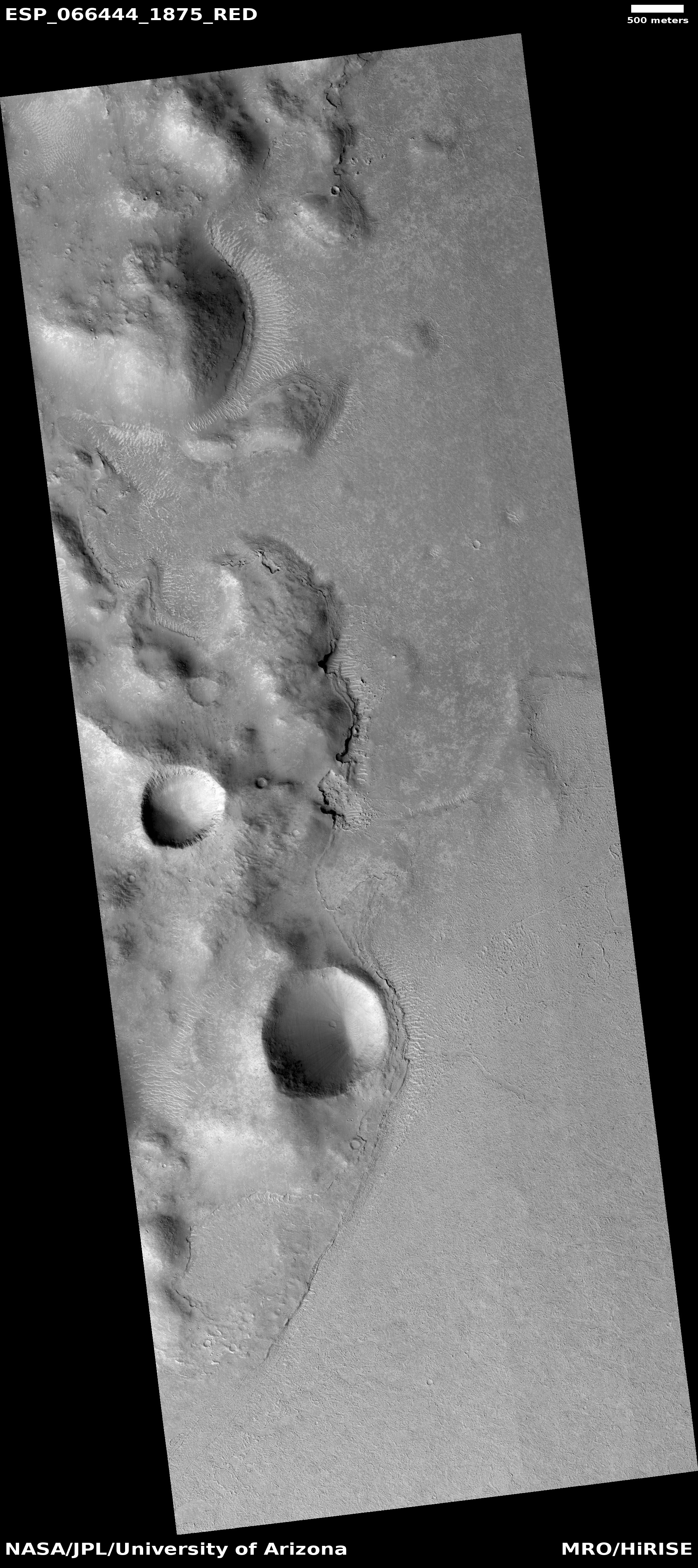
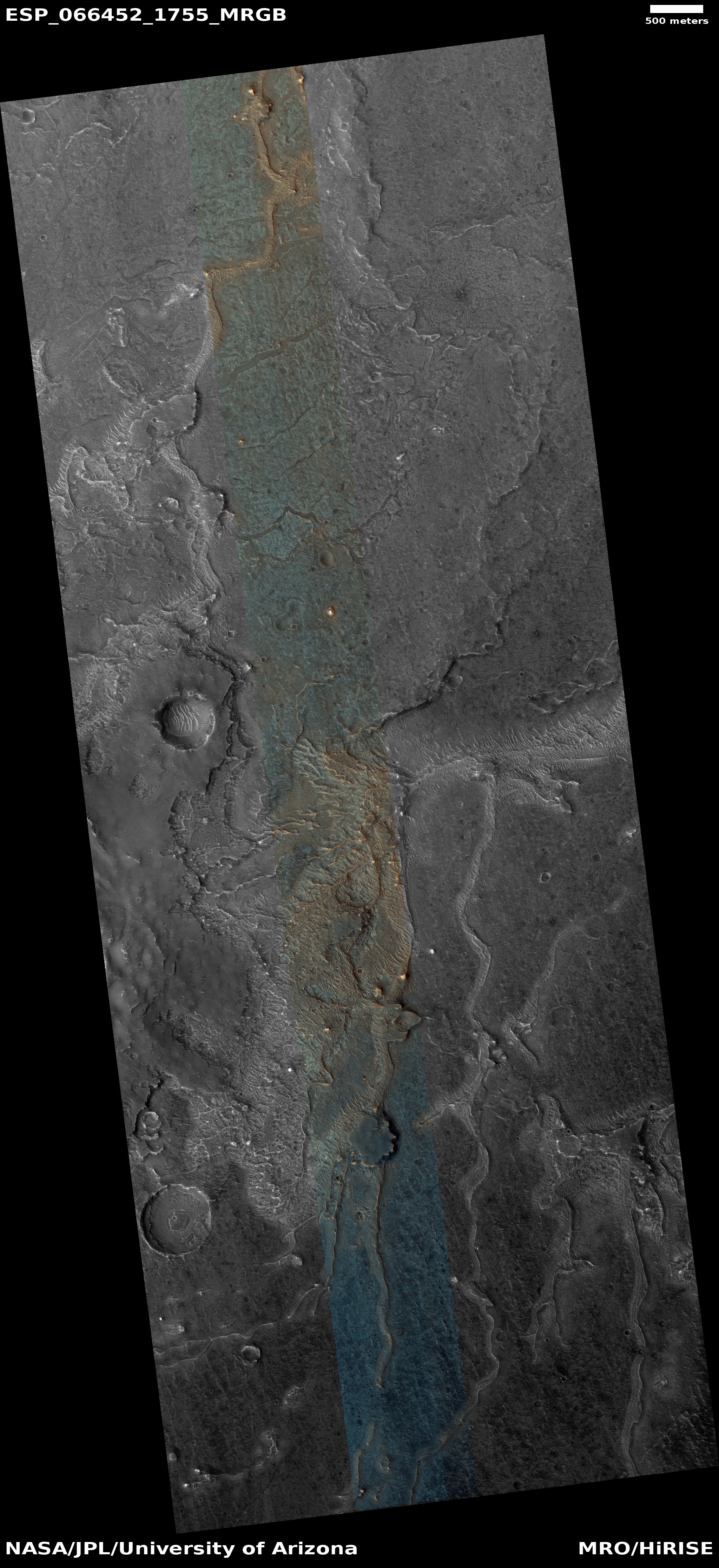
Cool image time! The picture to the right, cropped, reduced, and sharpened to post here, was taken on November 18, 2022 by the high resolution camera on Mars Reconnaissance Orbiter (MRO). The science team labeled this image “Inverted Channel and Possible Lake Deposits.” The sharp razor-like butte, which I estimate is about 200 to 400 feet high, is an example of the several inverted channels in the full image. The serrated-edged flat plateau at the top of this picture, one of several in the full image, is an example of those possible lake deposits.

Why do the scientists think a lake might have once been here? Located at 8 degrees north latitude in the dry equatorial regions of Mars, there is almost certainly no near surface ice here now.

As always, the overview map provides the context, and a possible explanation.
» Read more

3 comments

Dramatic layers in Valles Marineris

Dramatic layers in Valles Marineris
Click for original image.

Cool image time! The picture to the right, rotated, cropped, and sharpened to post here, was taken on December 28, 2023 by the high resolution camera on Mars Reconnaissance Orbiter (MRO), and shows one tiny section of the interior slope of the giant Martian canyon Valles Marineris.

The while layers are not made of frost or ice, because they are light tan, as per the color image. Thus, the alternating layers of dark and light indicate different layering events. The dark layers are probably major lava flood events with a lot of dark ash intermixed, while the tan layers were flood lava events with little dark ash.

The dark lines that cut across these layers are ripple dunes formed from dust that has accumulated inside Valles Marineris.
» Read more

0 comments

Buried silo on Mars?

A buried silo on Mars?
Click for original image.

Cool image time! The picture to the right, rotated and cropped to post here, was taken on December 31, 2022 by the high resolution camera on Mars Reconnaissance Orbiter.

The headline is pure silliness, and should not be taken seriously. However, the geological feature is intriguing nonetheless. Its almost perfect circular shape suggests a partly buried or eroded crater, except that its consistent thickness, almost like a wall, does not match what the rims of any crater should look like. Crater rims are made up of ejected material pushed out during impact, and thus always include some chaotic features.

My guess is that this circular feature is volcanic in nature. Maybe this was once a caldera, and the circle indicates a final vent from which lava extruded and then solidified.

At least, that’s my story.

The feature is located in the southwest quadrant of Hellas Basin, the basement of Mars, at 49 degrees south latitude. While this also suggests that ice might help explain this, we must also remember that much of the geology in that basin remains unexplained. Thus, there is no reason not to add one more feature to the list.

2 comments

That ain’t snow on Mars

That ain't snow on Mars
Click for original image.

Today’s cool image proves once again that you must never too quickly jump to any conclusions when you first look at a picture from space. The photo to the right, cropped, reduced, and sharpened to post here, was taken on November 24, 2022 by the high resolution camera on Mars Reconnaissance Orbiter (MRO).

At first glance it appears that those ridges are topped with patches of snow or frost. Not. What appears white in this black and white photo is immediately revealed to be light-colored dust in the color image.

According the label assigned to this image by the science team, these ridges represent layers, likely tilted steeply so that when exposed they form the layered cliff edges where that light dust has now gathered.

The overview map below provides further evidence that the white patches are dust, not snow.
» Read more

0 comments

Glaciers or taffy on Mars?

Glaciers of taffy on Mars?
Click for full image.

Cool image time! The photo to the right, rotated, cropped, reduced, and sharpened to post here, was taken on November 28, 2022 by the high resolution camera on Mars Reconnaissance Orbiter (MRO). It was released on January 4, 2023 as a captioned image, with this caption by Alfred McEwen of the Lunar & Planetary Laboratory in Arizona:

The floor of the Hellas impact basin, the lowest elevation on Mars, remains poorly explored because haze often blocks it from view. However, we recently got a clear image, revealing the strange banded terrain. These bands may be layers or flow bands or both.

At first glance, these bands reminded me of the many glaciers found on Mars. McEwen however is being properly vague about the nature of these features, for a number of reasons illustrated by the overview map below.
» Read more

1 comment

A Martian bear!

A Martian bear!
Click for original image. Full image here.

Silly image time! Today the science team for the high resolution camera on Mars Reconnaissance Orbiter posted the photo to the right, which I have cropped, reduced, and annotated to post here. It was taken on December 12, 2022, and was rotated so that north is to the right in order to make its resemblance to a bear’s face obvious. As noted in the caption by Alfred McEwen of the Lunar & Planetary Laboratory in Arizona:

Thereโ€™s a hill with a V-shaped collapse structure (the nose), two craters (the eyes), and a circular fracture pattern (the head). The circular fracture pattern might be due to the settling of a deposit over a buried impact crater. Maybe the nose is a volcanic or mud vent and the deposit could be lava or mud flows?

Maybe just grin and bear it.

If you have red-green glasses you can see a 3D anaglyph of this image here. The feature itself is located in the southern cratered highlands of Mars at 41 degrees south latitude, so the presence of near surface ice that would cause a mud volcano is definitely possible.

7 comments
1 37 38 39 40 41 90