Mars Express looks at Martian river relic

Mars Express perspective view of Nirgal Vallis
Click for full image.

The Mars Express science team today released a mosaic produced by the orbiter’s high resolution camera of the 300 mile long relic river valley Nirgal Vallis. The image to the right, reduced to post here, is the oblique view that was produced by computer using the camera’s stereo images.

This ancient valley system is named Nirgal Vallis, and was once filled with running water that spread across Mars. By exploring the characteristics of the surrounding craters, scientists estimate the system’s age to be between 3.5 and 4 billion years old.

The part of Nirgal Vallis captured in these images lies towards the western end of the river system, where it is slowly spreading out and dissipating; the eastern end is far less branched and more clearly defined as a single valley, and opens out into the large Uzboi Vallis – the suspected location of a large, ancient lake that has long since dried up.

Nirgal Vallis is a typical example of a feature known as an amphitheatre-headed valley. As the name suggests, rather than ending bluntly or sharply, the ends of these tributaries have the characteristic semi-circular, rounded shape of an Ancient Greek amphitheatre. Such valleys also typically have steep walls, smooth floors, and, if sliced through at a cross-section, adopt a ‘U’ shape. The valleys pictured here are about 200 m deep and 2 km wide, and their floors are covered in sandy dunes; the appearance of these dunes indicates that martian winds tend to blow roughly parallel to the valley walls.

Unlike the high resolution camera on Mars Reconnaissance Orbiter (MRO), which is for taking close-up images of specific surface features, Mars Express is producing a high resolution survey of the entire planet. Its camera does not have quite the same resolution, but as it is taking wider images that’s okay.

What is unfortunate is the European Space Agency’s policy for releasing those images. Unlike MRO, they do not make them all available to the public instantly. Instead, they periodically do press releases like today’s, highlighting a specific region or single large feature. As a result, Mars Express does not get the press it deserves.
1 comment

Swirls and layers in Martian depression

Close-up on swirls and layers

Context of depressions in Columbus Crater
Click for full resolution image.

Cool image time! The southern highlands of Mars is littered with numerous craters, making it look from a distance not unlike the Moon. A closer inspection of each crater and feature, however has consistently revealed a much more complex history than seen on the Moon, with the origins of many features often difficult to explain.

The two images on the right, rotated, cropped, and reduced to post here, shows one such feature in the floor of one southern highlands crater, dubbed Columbus Crater. The top image is a close-up of the area shown by the box in the bottom image.

The uncaptioned full photograph was taken on May 20, 2019 by the high resolution camera on Mars Reconnaissance Orbiter (MRO) and was simply titled “Depression in Columbus Crater.” Since the photo included two large depressions, as shown in the wider view in the bottom image, I’m not sure which depression this title refers. In both cases the features do not appear to be impact craters. The top depression is far too irregular, while both do not have the upraised rims that are found on most impact craters.

I have zoomed into the top depression because of its many swirls and layers. On Earth such terrain is usually caused by either water or wind erosion, slowly carving a smooth path across multiple geological layers. Here, there is no obvious evidence of any flows in any direction. Something ate out the material in this depression, exposing the many layers, but what is not clear.

The lower depression reminds me of sinkholes on Earth, where the ground is subsiding into a void below ground The same process could have also formed the top depression.

The surrounding terrain is equally baffling, resembling the eroded surface of an ice block that has been sprayed with warm water. In fact, the entire floor of Columbus Crater appears to have intrigued planetary scientists, as they have requested a lot of images of it from MRO. So far they do not have enough of these images to produce a full map. Since the terrain appears to change drastically over short distances, it is therefore hard to fit the geology of each image together. The overall context is missing.

When I first saw this image I tried to reach the scientist who requested it in the hope he might provide me a more nuanced explanation of what we see here, but despite repeated requests he never responded. Therefore let me propose one theory, based on my limited knowledge of Martian geology.
» Read more

1 comment

The drying out of Mars

Edge of wash
The Murray formation as seen in 2017

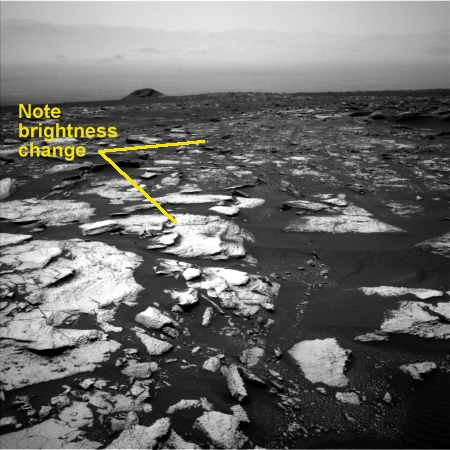
A new paper based on data gathered by the rover Curiosity in 2017 when it was lower on the slopes of Mount Sharp, as well as data obtained more recently at higher elevations, has confirmed that the past Martian environment of Gale Crater was wetter, and that deeper lakes formed lower down, as one would expect.

In 2017 Curiosity was traveling through a geological layer dubbed the Murray formation. It has since climbed upward through the hematite formation forming a ridge the scientists dubbed Vera Rubin Ridge to reach the clay formation, where the rover presently sits. Above it lies the sulfate-bearing unit, where the terrain begins to be get steeper with many very dramatic geological formations.

Looking across the entirety of Curiosity’s journey, which began in 2012, the science team sees a cycle of wet to dry across long timescales on Mars. “As we climb Mount Sharp, we see an overall trend from a wet landscape to a drier one,” said Curiosity Project Scientist Ashwin Vasavada of NASA’s Jet Propulsion Laboratory in Pasadena, California. JPL leads the Mars Science Laboratory mission that Curiosity is a part of. “But that trend didn’t necessarily occur in a linear fashion. More likely, it was messy, including drier periods, like what we’re seeing at Sutton Island, followed by wetter periods, like what we’re seeing in the ‘clay-bearing unit’ that Curiosity is exploring today.”

Up until now, the rover has encountered lots of flat sediment layers that had been gently deposited at the bottom of a lake [the Murray Formation]. Team member Chris Fedo, who specializes in the study of sedimentary layers at the University of Tennessee, noted that Curiosity is currently running across large rock structures [Vera Rubin Ridge and the clay formation] that could have formed only in a higher-energy environment such as a windswept area or flowing streams.

Wind or flowing water piles sediment into layers that gradually incline. When they harden into rock, they become large structures similar to “Teal Ridge,” which Curiosity investigated this past summer [in the clay formation]. “Finding inclined layers represents a major change, where the landscape isn’t completely underwater anymore,” said Fedo. “We may have left the era of deep lakes behind.”

Curiosity has already spied more inclined layers in the distant sulfate-bearing unit. The science team plans to drive there in the next couple years and investigate its many rock structures. If they formed in drier conditions that persisted for a long period, that might mean that the clay-bearing unit represents an in-between stage – a gateway to a different era in Gale Crater’s watery history.

None of these results are really surprising. You would expect lakes in the flatter lower elevations and high-energy streams and flows in the steeper higher elevations. Confirming this geology however is a big deal, especially because they are beginning to map out in detail the nature of these geological processes on Mars, an alien world with a different make-up and gravity from Earth.

Below the fold is the Curiosity science teams overall map, released in May 2019, showing the rover’s future route up to that sulfate unit, with additional annotations by me and reduced to post here.
» Read more

0 comments

Weird glacial features in Martian crater

weird glacial feature in crater on Mars
Click for full image.

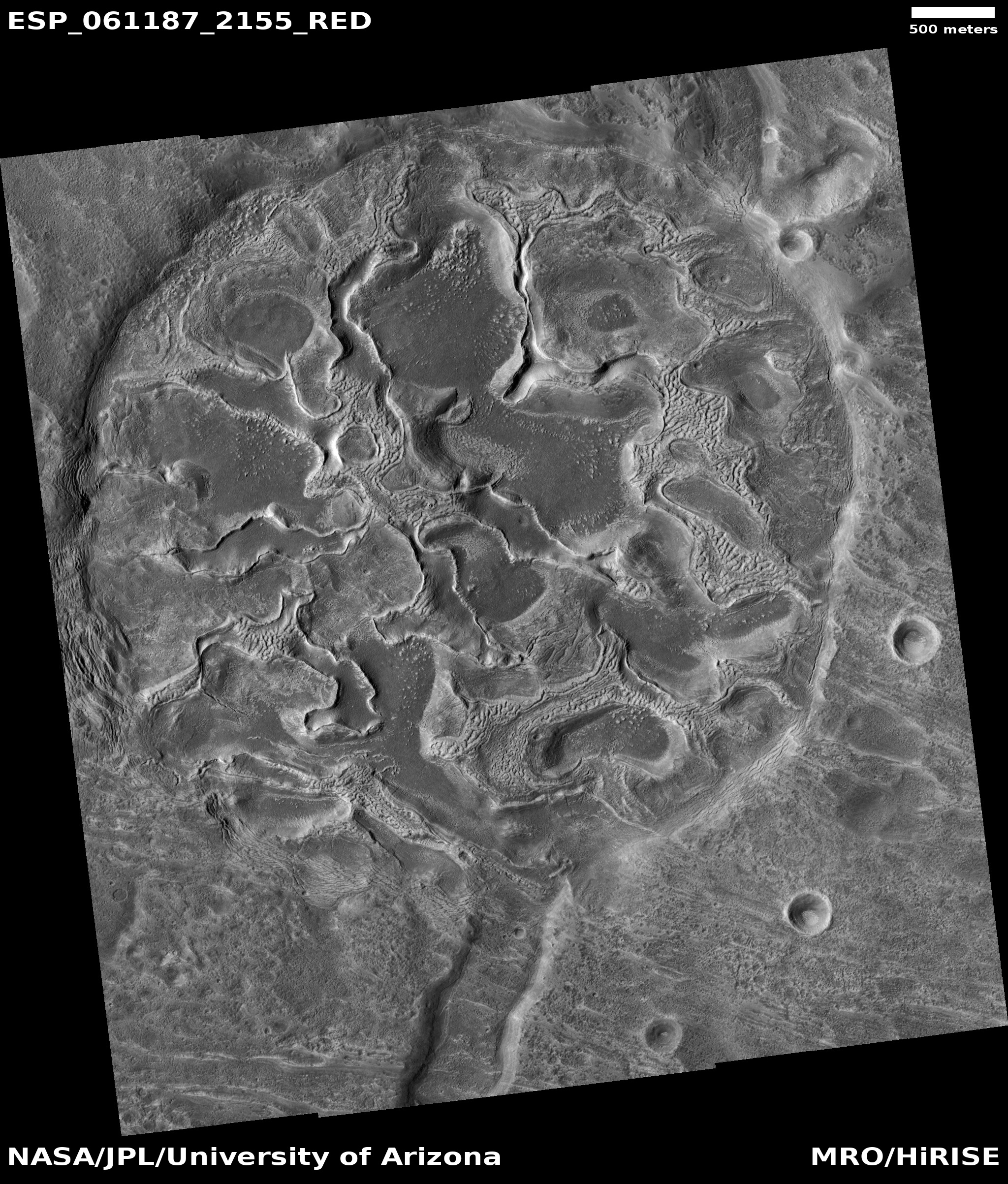
Cool image time! In reviewing today’s October release of new images from the high resolution camera of Mars Reconnaissance Orbiter (MRO), I came across the strange geology shown in the image to the right, rotated, cropped, and reduced to post here.

The uncaptioned image calls these “glacial features within crater.” The crater is located at 35 degrees north latitude in Arabia Terra, one of the more extensive regions of the transition zone between the northern lowlands and the southern highlands. It is also located within the northern band from 30 to 60 degrees latitude where most of the buried Martian glaciers are found.

The most abundant type of buried glaciers are called concentric crater fill (CCF) because they are found inside craters, and often show decay in a concentric manner. This weird feature likely falls into that category, though I would hardly call these glacier features concentric.

I’m not even sure if this is an impact crater. If it is, its rim has been heavily obscured, making it look instead like an irregular depression with one outlet to the south. In fact, I suspect it is possibly one of the lakes that scientists believe pepper this part of Arabia Terra and might have contained liquid water two to three billion years ago. That water would have later frozen, and possibly become covered by dust and debris to protect it.

According to present theories, Mars is presently in a period where its mid-latitude glaciers are shrinking, the water sublimating away and being transported back to its poles. The weird formations here suggest this process. Imagine what happens when you spray warm water on a big block of ice. It dissolves, but randomly to form weird shapes.

In this case the glacier is shrinking randomly where the ice has gotten exposed. In the thin Martian atmosphere, it transitions directly from a solid to a gas, sublimating into the atmosphere to leave these inexplicable shapes.

2 comments

InSight robot arm to help mole dig

Mole in hole, with robot arm and scoop above
Click for full image.

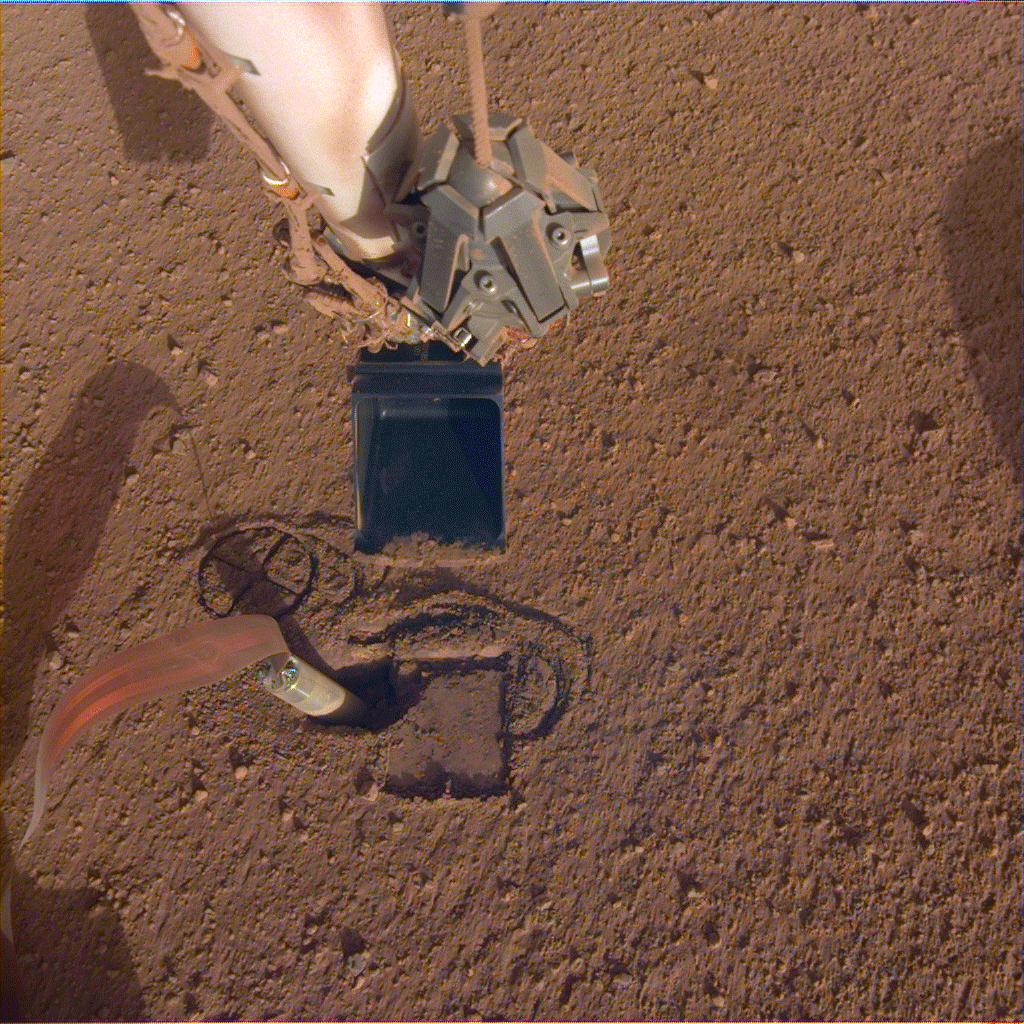
In their effort to solve the issues that have prevented InSight’s mole from penetrating more than fourteen inches into the ground on Mars, engineers now plan to use the scoop on the robot arm to “pin” the mole up against one wall of the hole so that it will have the friction necessary to drill downward.

The image to the right, cropped and reduced to post here, illustrates what they have been doing and what they will do. Previously the hole was much larger, which prevented the mole from moving downward because it needed the friction from the material around it to hold it in place after each hammer action. (Think of pounding a nail into a wooden board: The nail is gripped tightly by the wood around it as it goes down, so that after each hit it goes further in.)

Since June they have been using the arm and scoop to fill in the hole around the mole. Now I think they intend to bring the scoop around to the mole’s left side, as shown in the image, and pin it upright against the right wall of the hole. When it resumes hammer-drilling they hope both the wall and the scoop will provide enough friction for the mole to drill downward.

1 comment

The slowly changing dunes of Mars

Map of Mars

In order to better understand the climate and geology of Mars, scientists need to study how the thin Martian atmosphere causes changes to the planet’s numerous sand dunes. To do this, they have been using the high resolution camera on Mars Reconnaissance Orbiter (MRO) to periodically snap photos of the same places repeatedly over time, to track any changes that might occur.

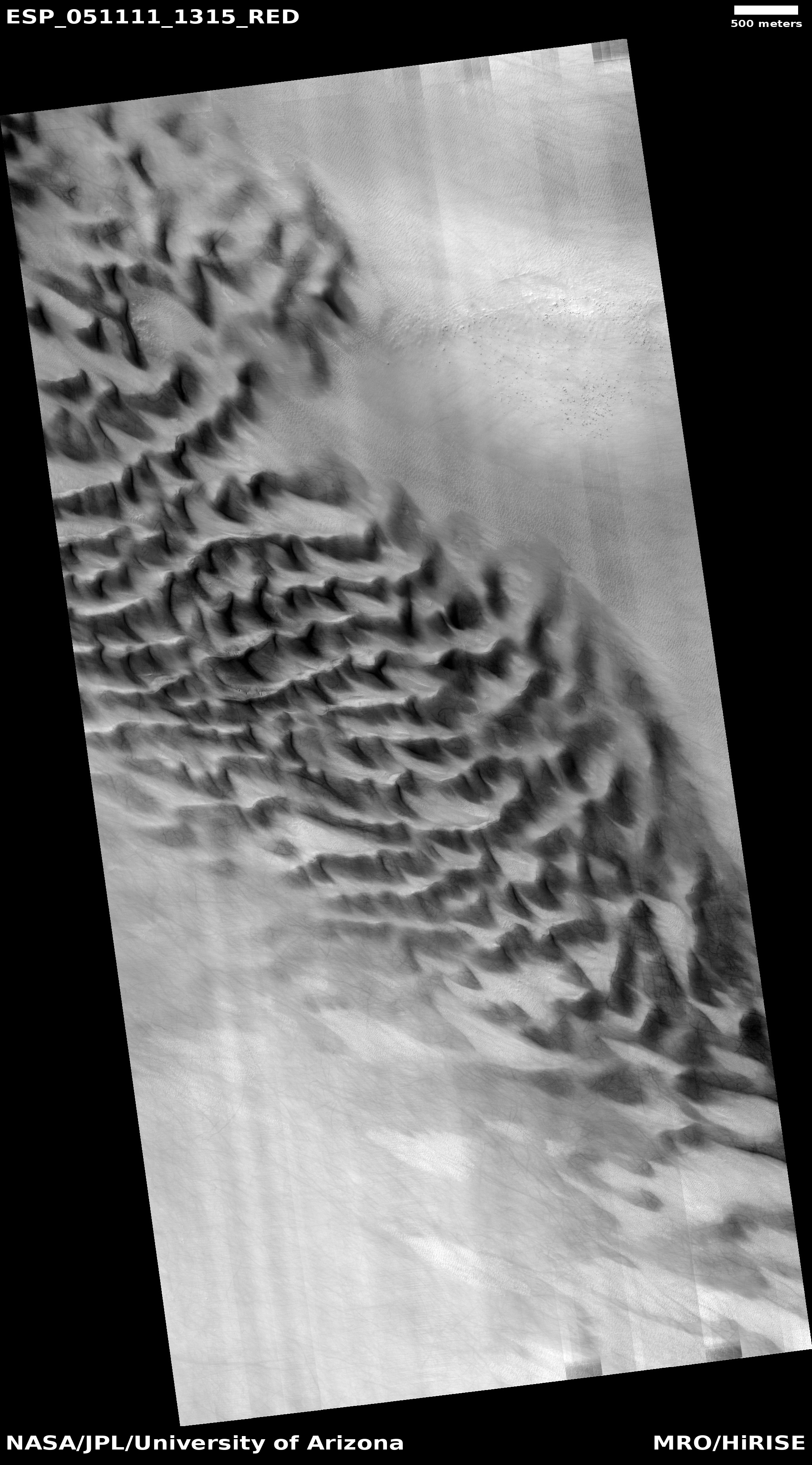
Recently the monthly download dump of images from MRO included one such location in the northwest quadrant of Hellas Basin, what I call the basement of Mars because it the planet’s lowest point. The uncaptioned image was taken on May 20, 2019 and was titled “Hellas Region Sand Dune Changes.” A review of past images shows that MRO has taken pictures of this location several times in the past, in 2011 and in 2017. All these images were taken during the Martian autumn season, and were taken to see if over time there were any significant changes to the dunes due to winds.

My superficial comparison of the 2011 and 2017 images does not show much obvious change. There could be small changes that my quick review did not spot, and there is also the strong possibility that the entire dune field could have shifted as a unit over those three Martian years, a change that would require a more detailed analysis beyond my technical capabilities. Click on both links, put the photographs in separate tabs, and switch quickly between them to see if you can spot any differences.

Comparing the 2011 and 2019 images however shows some significant changes, most of which I think are due to the 2018 global dust storm. Below is that comparison.
» Read more

0 comments

The sounds of Mars

The InSight seismometer team today issued an update of their results since the instrument began recording quakes on Mars in February.

But after the seismometer was set down by InSight’s robotic arm, Mars seemed shy. It didn’t produce its first rumbling until this past April, and this first quake turned out to be an odd duck. It had a surprisingly high-frequency seismic signal compared to what the science team has heard since then. Out of more than 100 events detected to date, about 21 are strongly considered to be quakes. The remainder could be quakes as well, but the science team hasn’t ruled out other causes.

The press release provides audio for many of these detections, including two 3.3+ earthquakes as well as a strange sequence of what they call “dinks and donks” that appear to occur each evening as the seismometer adjusts to night-time temperatures.

So far the data suggests that Mars’ interior is a relatively quiet place, compared to Earth.

3 comments

Martian impact into lava crust?

Impact crater north of Pavonis Mons
Click for full image.

Cool image time! The photo on the right, cropped to post here, was taken by the high resolution camera on April 23, 2019. It shows a quite intriguing impact crater on the northern lava slopes of Pavonis Mons, the middle volcano in the chain of three gigantic volcanoes to the west of Valles Marineris.

What makes this image cool is what the impact did when it hit. Note the circular depression just outside the crater’s rim. In the southeast quadrant that ring also includes a number of additional parallel and concentric depressions. Beyond the depression ground appears mottled, almost like splashed mud.

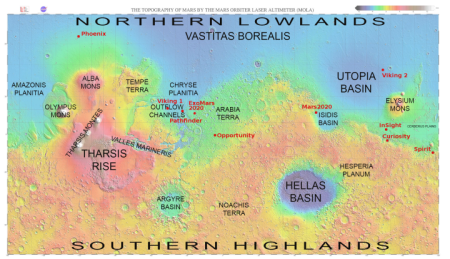
What could have caused this circular depression? Our first clue comes from the crater’s location, as shown in the overview map below and to the right.
» Read more

3 comments

Curiosity to use first of nine “wet chemistry cups”

two drill holes in clay layer
Click for full image.

The Curiosity science team has decided to use the first of its nine “wet chemistry cups” to test a recently obtained Martian drill sample for organic material.

Searching for organic molecules in rocks on Mars is no easy task. Curiosity’s Sample Analysis at Mars (SAM) instrument is designed to analyze the chemical composition of gases, which it creates by slowly heating rock samples in an oven. The volatile gases that are driven off the heated rock sample get sent to SAM’s gas chromatograph and mass spectrometer (GCMS), which can identify the different gaseous compounds. However, organic molecules are tough to detect with this technique, because instead of transforming straight into gases when heated, they can decompose into simpler molecules.

But if organic molecules are “derivatized” before they’re heated – meaning that they react with other chemicals first in order to become more volatile – then the compounds are more likely to enter the GCMS without breaking down, and SAM has a better chance of detecting them. This derivatization process uses solvents of chemicals, so we call it a “wet chemistry” experiment. Curiosity only has nine cups containing these solvents, so we are careful to save our wet chemistry experiments for only the most interesting rock samples.

The “Glen Etive” site, which we have been studying for the past month, is enticing enough for this special experiment!

They are performing this operation today. This is a big deal, because they only have nine of these cups. They have been saving them for the right time, and when the drill had problems two years ago and looked for awhile like it would never work again, they were horrified at the possibility they would never get to use them at all. While I would not be surprised if NASA issues a press release today touting this decision, do not expect any announcement of results for quite awhile, as I suspect the scientists in charge will want to publish their paper on the subject first.

This location, in the clay unit in the foothills of Mount Sharp, is a spot where they have drilled twice, as shown by the two drill holes visible near the center of the the picture above.

0 comments

Tongue-shaped glaciers on Mars

Tongue-shaped glacier on Mars
Click for full image.

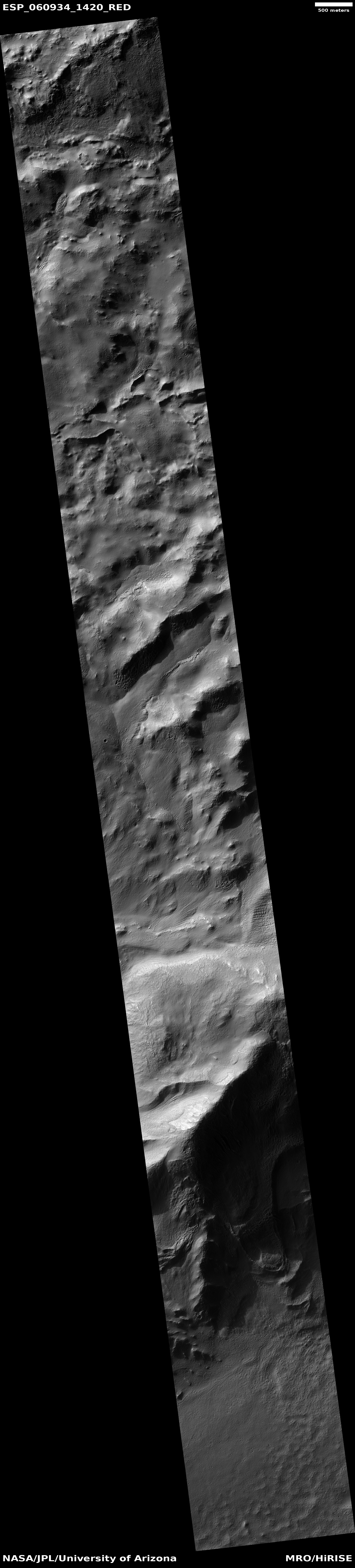
Cool image time! I could also call this another example of mass wasting, which it appears to be according to my understanding of Martian geological processes. However, the Mars Reconnaissance Orbiter science team dubbed this image “Tongue-Shaped Glaciers in Centauri Montes,” and I have no right to disagree with them.

The image to the right, rotated, cropped, reduced, and brightened to post here, shows the most prominent tongue-shaped glacier in the full image. The two curved ridges to the south of the glacier’s tip are almost certainly old moraines of debris pushed there during earlier events, when the glacier material extended farther out. In fact, if you look close you can see that this tongue lies on top of a larger older tongue that lines up with the closer of these two ridges.

This feature is located at 37 degrees south latitude, which puts it inside Mars’s southern glacial band that extends from 30 to 60 degrees latitude. According to the present defined types of Martian glaciers, this tongue is what scientists have dubbed a lobate debris apron, a glacier that in many ways resembles glaciers we see on Earth.

The location of this feature is especially interesting, especially because other images have found that it is not unique to this region.
» Read more

0 comments

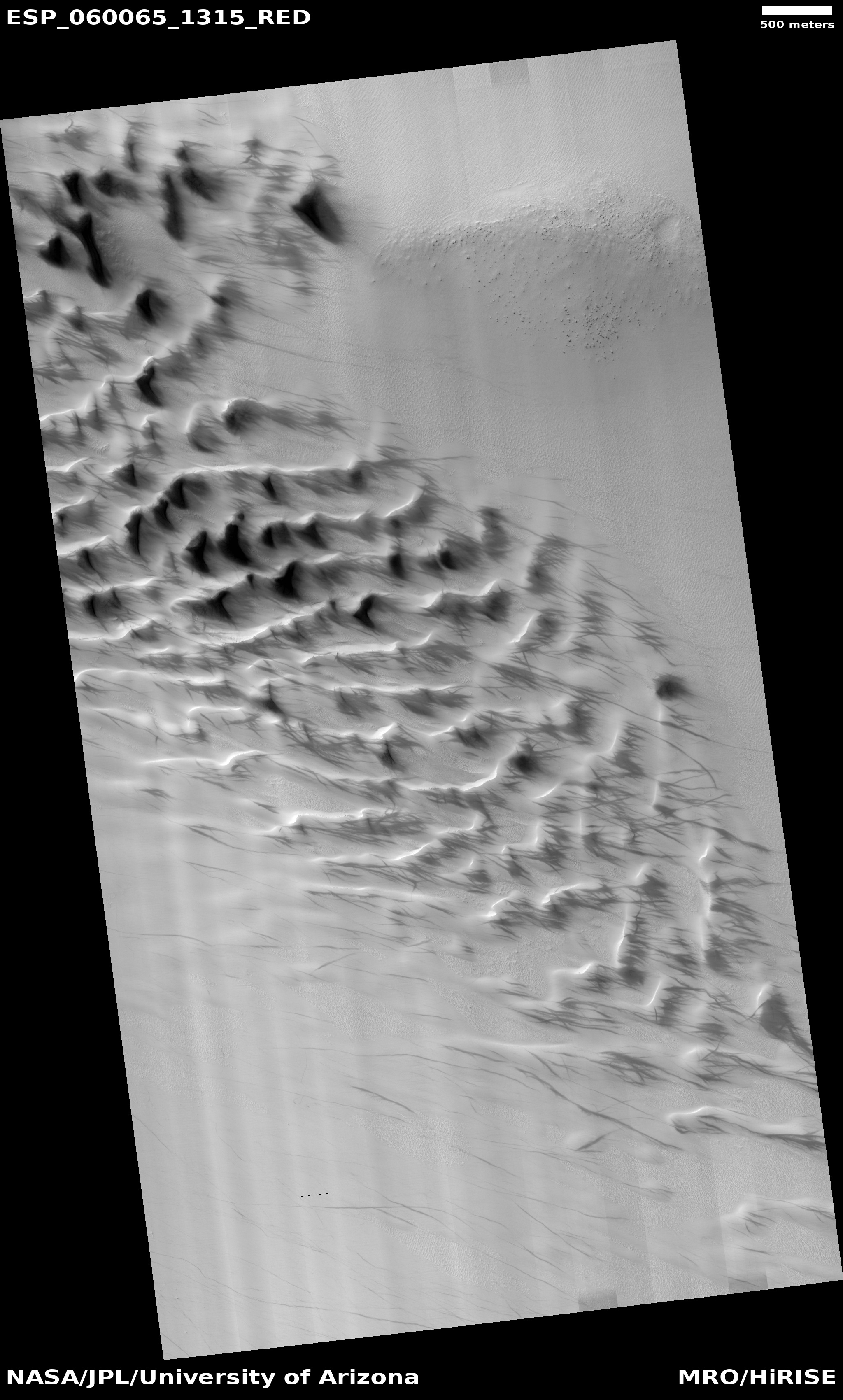
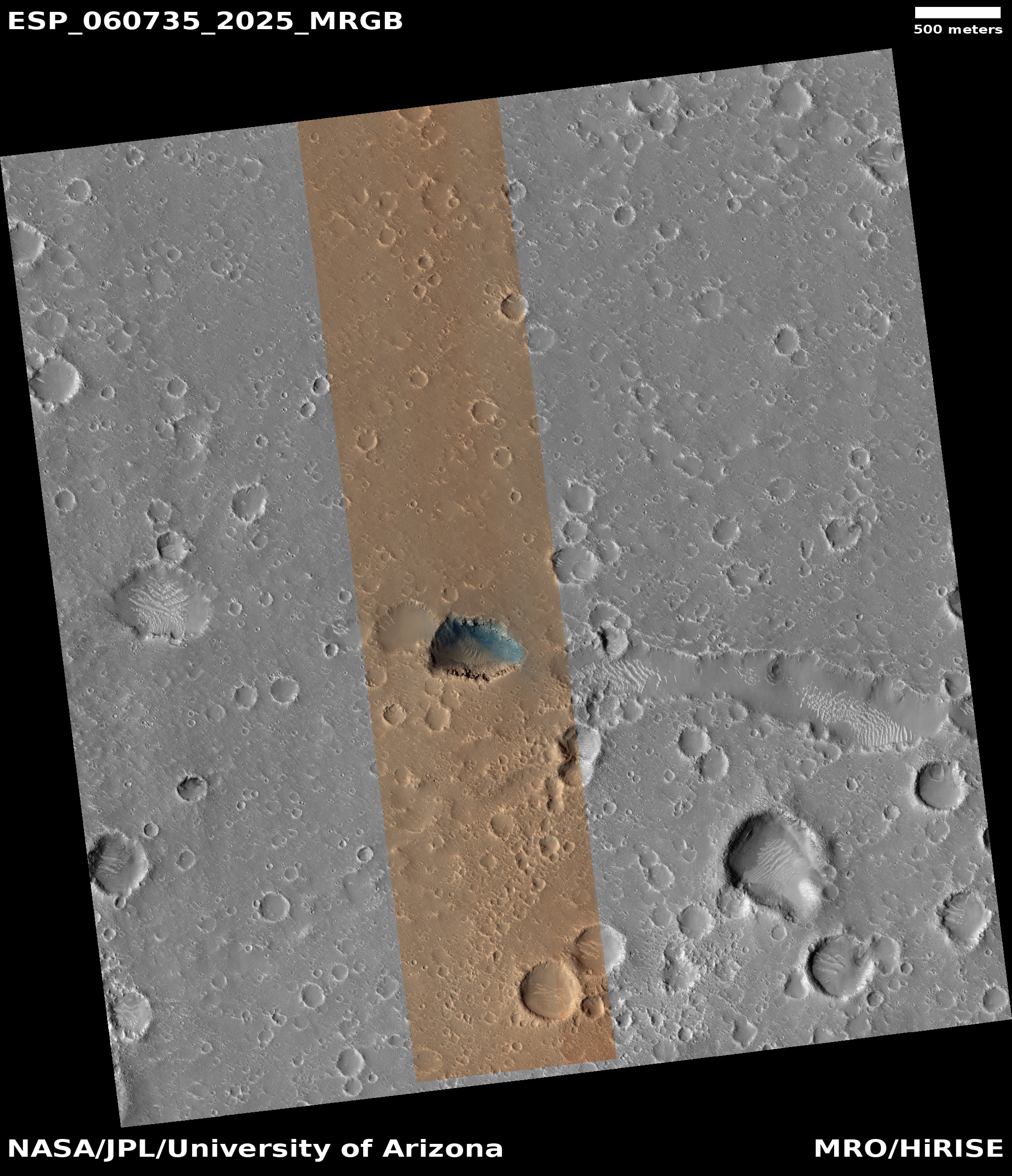
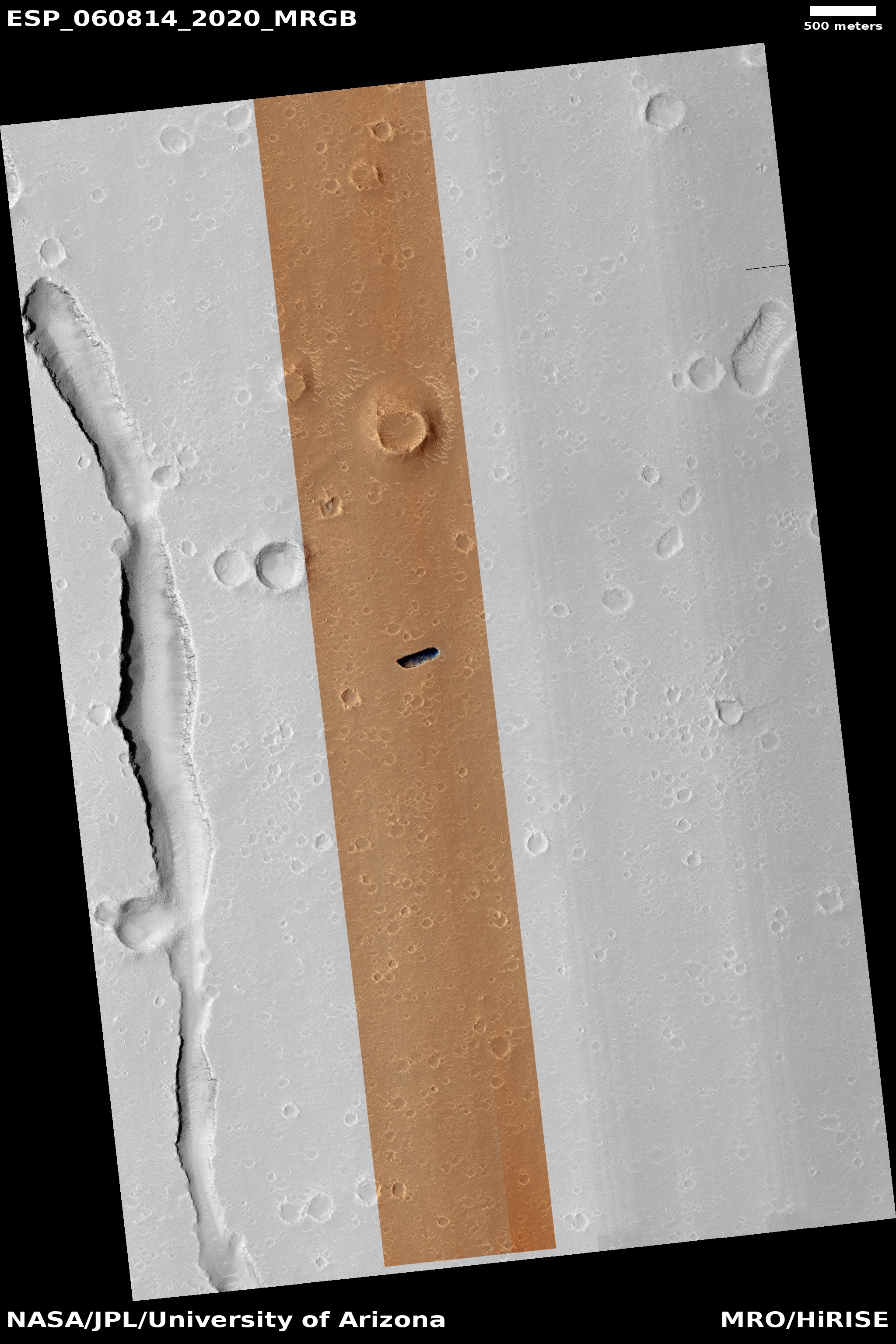
Cave pits in the Martian northern lowlands

New pits in Hephaestus Planitia

I could call this my monthly Martian Pit update. Since November 2018 I have each month found from two to five new and interesting cave pits in the monthly download of new images from the high resolution camera on Mars Reconnaissance Orbiter (MRO). My previous posts:

All except the last August 12 post were for pits on the flanks of Arsia Mons, the southernmost in the line of three giant volcanoes to the southeast of Olympus Mons, and were thus almost certainly resulting from lava flows.

The August 12 post instead showed pits found in Utopia Planitia, one of the large plains that comprise the Martian northern lowlands where scientists think an intermittent ocean might have once existed. All of these pits are found in a region of meandering canyons dubbed Hephaestus Fossae.

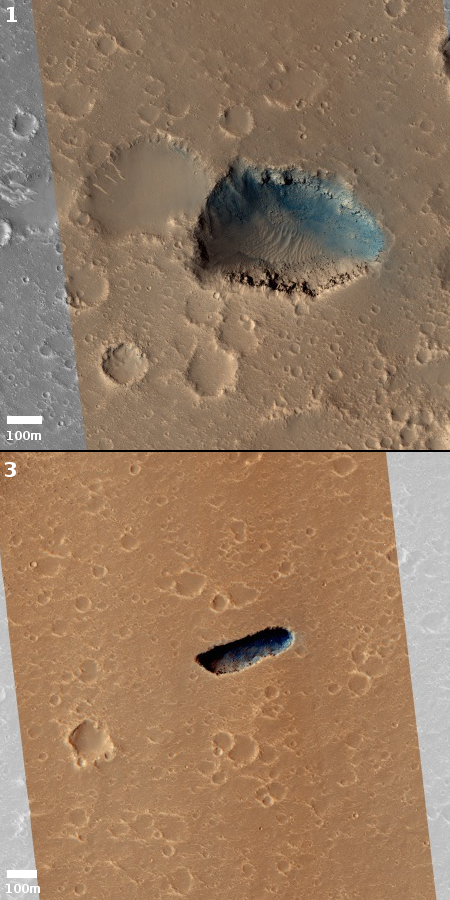
In the most recent MRO release scientists once again focused on the pits in or near Hephaetus, imaging four pits, two of which have been imaged previously, as shown in my August post and labeled #2 and #4 in this article, and two (here and here) that appear new. The image on the right, cropped to post here, shows the two new pits, dubbed #1 and #3. In the full image of #1, it is clear that this pit lines up nicely with some other less prominent depressions, suggesting an underground cave. Pit #3 however is more puzzling. In the full image, this pit actually runs perpendicular to a long depression to the west. There are also no other related features around it.

What makes all four of these pits intriguing is their relationship to Hephaestus Fossae and a neighboring rill-like canyon dubbed Hebrus Valles, as shown in the overview map below.
» Read more

6 comments

ESA asks NASA’s help on ExoMars rover parachute problems

The European Space Agency (ESA) has asked for help from NASA in trying to figure out the cause of the failures during testing of the parachutes they want to use to safely land their ExoMars 2020 rover, Rosalind Franklin.

So far the parachutes have been damaged on all previous tests. They plan two more tests in December and February.

Both tests, to be held at high altitude to simulate the Martian atmosphere, need to succeed in order for the parachutes to pass qualification. TheExoMars mission faces a final review scheduled April 2020, Francois Spoto, ExoMars program manager, told SpaceNews. “Now the situation is critical, of course, because we have limited time and no margin,” Spoto says.

If one of the tests fails, the ExoMars mission will miss the narrow July 25 to Aug. 13 launch window next year and slip to the next window, in late 2022. The lander and rover segments are meanwhile progressing well and ready for environmental testing.

They held a workshop on the previous failures, and obtained new analysis of the causes from JPL engineers.

2 comments
1 133 134 135 136 137 212