Recent impact on Mars

Recent impact on Mars
Click for full image.

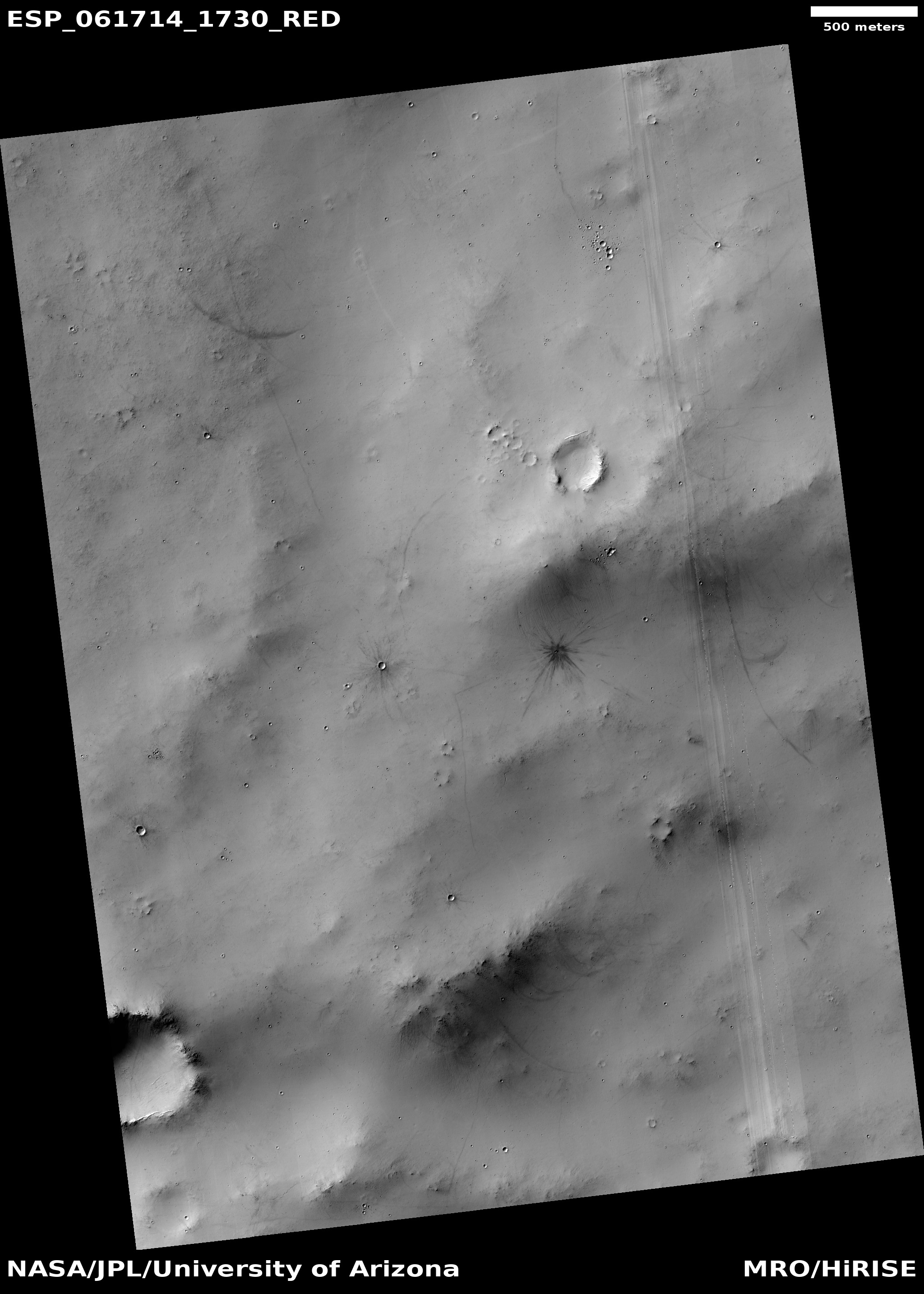
Cool image time! While finding recent impacts on Mars is not that unusual, the image to the right, found among the November image download from the high resolution camera on Mars Reconnaissance Orbiter (MRO), was dramatic enough that I decided that more people besides planetary scientists should see it. For scale the photograph is exactly 500 meters wide.

The photograph, taken September 26, 2019, also illustrates all the typical aspects of impact craters, and how they change the landscape.

This impact took place sometime between July 17, 2012 and January 4, 2018. We know this because it wasn’t there in a low-resolution image taken by the wide angle survey camera on MRO on the first date but was there when that same camera took another picture on the second date. Below is a side-by-side comparison of that July 17, 2012 image with the high resolution 2019 image above.
» Read more

1 comment

Islands of ice on Mars and Pluto

Ice-filled craters near Martian south pole

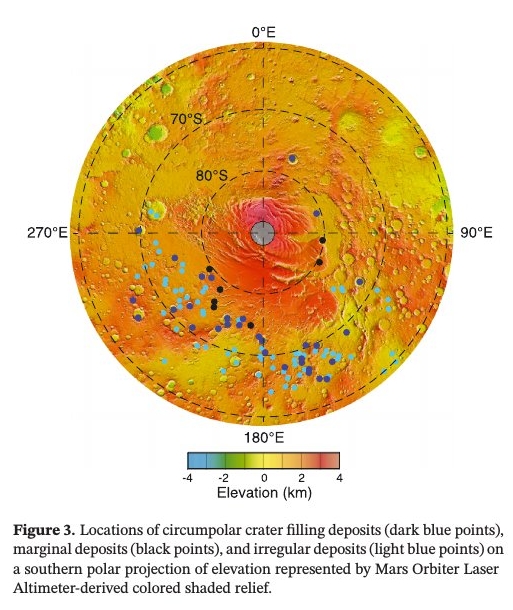
In a paper published today in the Journal of Geophysical Research: Planets, scientists describe the identification of 31 ice-filled craters in the high southern latitudes of Mars. The map to the right, from their paper, shows the locations of these craters. The scientists also took a look at Pluto, and found five craters there that had similar features, though these were likely filled with frozen nitrogen, not water ice.

From their abstract:

These new 31 ice deposits represent an inventory of more than 10 trillion cubic meters of solid water, similar to but greater in number and volume than previously studied features near the north pole. Similar features of nitrogen ice may exist in craters on Pluto, suggesting that craters are a favorable location for the accumulation or preservation of ices throughout the Solar System. [emphasis mine]

These results are reinforced by the existence of glacial features found in numerous Martian craters at much lower latitudes, as well as the ice suspected to exist in the permanently shadowed craters on the Moon and Mercury. The processes that put the ice there on these different planets might be fundamentally different, but the results are the same: Ice accumulating within craters.

One aspect of these high latitude craters that remains somewhat unexplained is their asymmetrical distribution around the south pole, favoring the side of the planet south of Mars’ giant volcanoes. Moreover, in looking at the ice deposits within these craters the scientists found that the ice seemed to lie off-center within the craters, favoring a similar direction.

Based on the available data, the scientists theorize that the most likely cause of this asymmetric off-center pattern is wind. From their paper:

Basic physical arguments, mesoscale atmospheric models, and geomorphological observations predict deflection of winds emanating from the south pole by the Coriolis Force. Such deflection results in a general westward trend of winds (i.e., easterlies) in the south polar regions outside the [south pole cap], matching the [ice-filled crater] offsets we observe.

This correlation implies that wind is important in … formation and/or evolution [of craters with ice]. For the case where winds control [their] formation, katabatic winds may travel down the east side of crater walls and preferentially deposit ice on the west side of the crater via orographic precipitation as they flow up the west crater wall. This mechanism thus favors local accumulation of ice within craters.

I find it fascinating that the location of ice within craters on Mars might indirectly provide scientists with information about the planet’s global weather patterns. This unexpected connection highlights the need to dismiss no data or feature in trying to understand planetary formation. Unlikely things might answer our questions.

7 comments

A journey into the depths of Valles Marineris

Valles Marineris

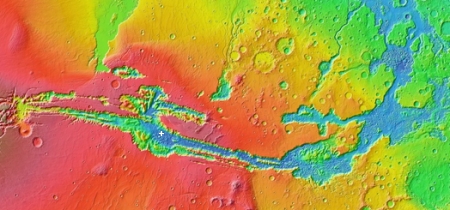
Cool image time! Rather than start with the cool image, let’s begin with the long view. To the right is a wide mosaic of Valles Marineris on Mars, the largest known canyon in the solar system. About 2,500 miles long and 400 miles wide, this canyon is so large that it would cover most of the United States if put on Earth. The Grand Canyon, 500 miles long by 19 miles wide, could easily fit within it and not be noticed. In depth Valles Marineris is equally impressive, with a depth of more than four miles, about four times deeper than the Grand Canyon.

A closer view of the central regions of Valles Marineris

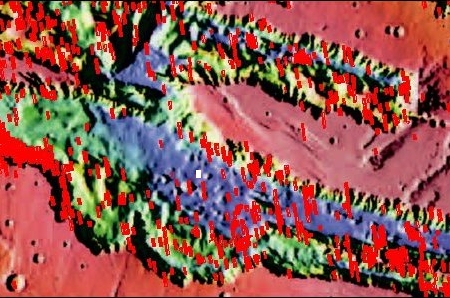
The white cross in the mosaic above is where we are heading. You can see it as the white box in the zoomed in overview to the right. This central part of Valles Marineris is named East Melas Chasma, and the red boxes indicate locations where the high resolution camera of Mars Reconnaissance Orbiter (MRO) has already taken images.

As you can see, we do not yet have many high resolution images of this part of the canyon floor. The white box is the most recent image, and is the subject of today’s post.
» Read more

3 comments

Both methane and oxygen fluctuate in unison seasonally in Gale Crater

The uncertainty of science: According to a new science paper, data from Curiosity on Mars has now found that both methane and oxygen fluctuate in unison seasonally in Gale Crater.

From the paper’s abstract:

[T]he annual average composition in Gale Crater was measured as 95.1% carbon dioxide, 2.59% nitrogen, 1.94% argon, 0.161% oxygen, and 0.058% carbon monoxide. However, the abundances of some of these gases were observed to vary up to 40% throughout the year due to the seasonal cycle. Nitrogen and argon follow the pressure changes, but with a delay, indicating that transport of the atmosphere from pole to pole occurs on faster timescales than mixing of the components. Oxygen has been observed to show significant seasonal and year‐to‐year variability, suggesting an unknown atmospheric or surface process at work. These data can be used to better understand how the surface and atmosphere interact as we search for signs of habitability.

The data shows that the unexpected and so far unexplained seasonal oxygen fluctuation appears to track the same seasonal methane fluctuations. While biology could cause this signature, so could geological processes, though neither can produce these fluctuations easily.

Meanwhile, adding to the uncertainty were results from the two European orbiters, Mars Express and Trace Gas Orbiter. Both have failed to detect a June 19, 2019 dramatic spike in methane that had been measured by Curiosity.

0 comments

China unveils Mars lander during landing simulation test

The new colonial movement: China today unveiled to the international press its first prototype Mars lander, showing it attempting a simulated controlled descent on a gigantic test stand.

The demonstration of hovering, obstacle avoidance and deceleration capabilities was conducted at a site outside Beijing simulating conditions on the Red Planet, where the pull of gravity is about one-third that of Earth.

China plans to launch a lander and rover to Mars next year to explore parts of the planet in detail.

This is the first time I have heard anything about China sending a lander/rover to Mars in 2020. Previously the reports had discussed only sending an orbiter.

I have embedded video of the test below the fold. It shows the prototype hanging by many wires from the test stand, then dropping quickly, with its engine firing, before stopping suddenly, followed by an engine burst. While impressive, it did not strike me that China is even close to sending this spacecraft to Mars. The test only proved the spacecraft’s ability to do some maneuvering during descent. It did not show that it could land.

That the project’s designer said that landing would take “about seven minutes” also suggests that they are copying the techniques used by JPL to land Curiosity. Considering that JPL’s computers have been repeatedly hacked, including some hacks identified as coming from China, it would not surprise me if China has simply stolen those techniques.

I still expect them to launch an orbiter to Mars in 2020. Whether they also send a lander and rover remains to be seen.
» Read more

7 comments

SpaceX completes 1st round of Starship’s Mars landing site images

All locations photographed of the candidate landing region for SpaceX's planned Mars missions

On August 28, 2019 I broke the story that SpaceX is beginning to obtain images of candidate Starship landing sites from Mars Reconnaissance Orbiter (MRO).

It now appears that SpaceX has completed its first round of Starship requests from MRO. In the image releases from Mars Reconnaissance Orbiter (MRO) since September, only three new Starship locations were taken, and all three were the unreleased candidate sites I noted in my September 16, 2019 update.

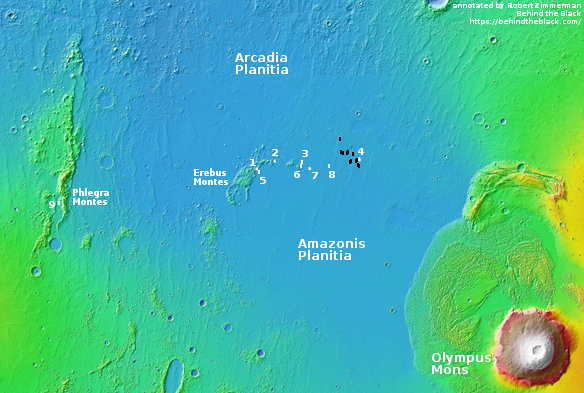
Below is the full list of all of the Starship images, their locations indicated on the map above by the numbered white boxes:

With the release of these last photographs, the initial list of proposed images of candidate Starship landing sites on Mars has apparently been completed. No additional images at any other locations appear to have been suggested. The MRO science team has taken stereo images of each one of the nine locations, eight of which were in Amazonis Planitia, and one in Phlegra Montes.

This however is not the first round of pictures requested by SpaceX of the Arcadia Planitia region in connection with the company’s desire to land spacecraft on Mars.
» Read more

9 comments

Polygons on Mars

Scallops and polygons on Mars
Click for full image.

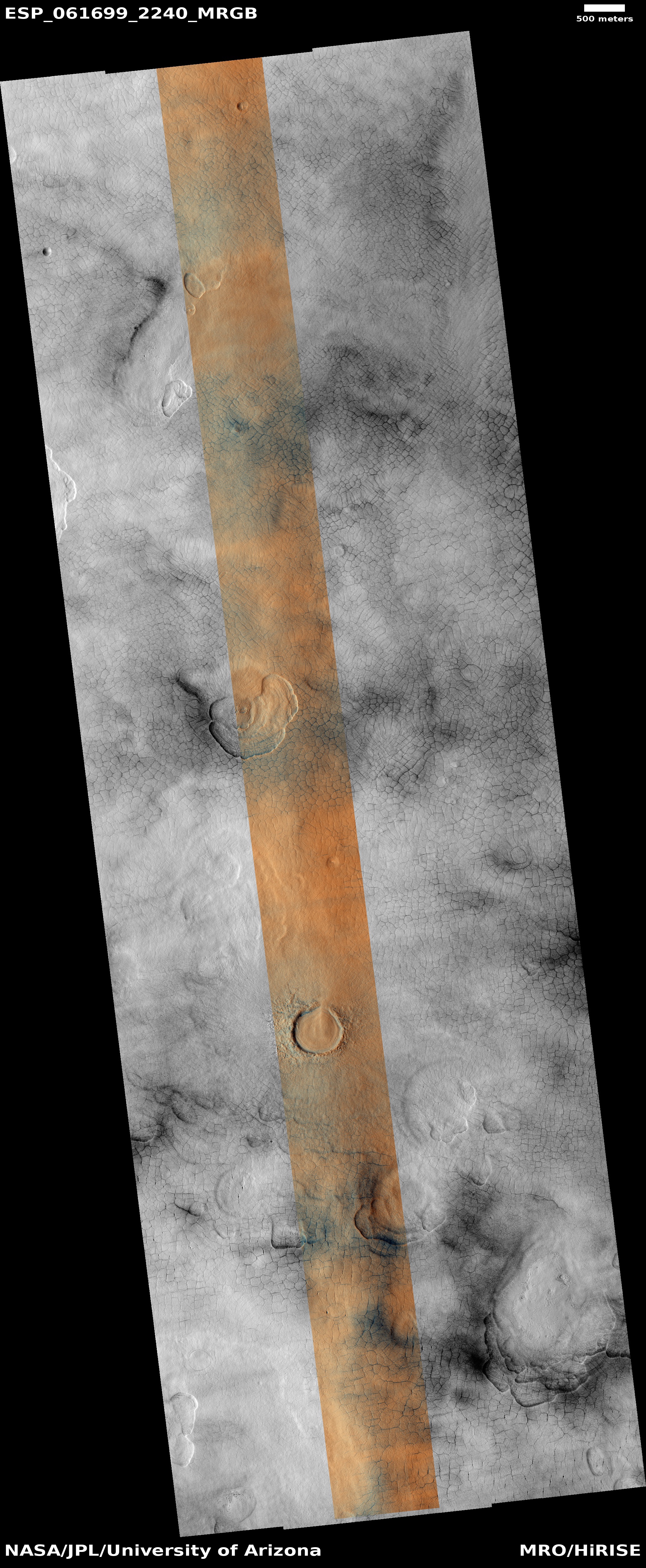
Cool image time! The photograph on the right, cropped to post here, was taken on September 25, 2019 by the high resolution camera on Mars Reconnaissance Orbiter (MRO) and made public in its November image release. It shows the weird but very typical scalloped terrain, with its adjacent polygon pattern of fractures, found routinely in the northern lowland plains of Utopia Planitia on Mars. From an earlier captioned image from 2006 of these same features:

The scalloped depressions are typical features; a smooth layered terrain located between 40 and 60 degrees in both hemispheres. Scalloped depressions probably form by removal of ice-rich subsurface material by sublimation (ice transforming directly from a solid to a gaseous state), a process that may still be active today. Isolated scalloped depressions generally have a steep pole-facing scarp and a gentler equator-facing slope. This asymmetry is interpreted as being the result of difference in solar heating. Scalloped depressions may coalesce, leading to the formation of large areas of pitted terrain.

The polygonal pattern of fractures resembles permafrost polygons that form in terrestrial polar and high alpine regions by seasonal-to-annual contraction of the permafrost (permanently frozen ground). On Earth, such polygons indicate the presence of ground ice.

On Earth these polygons are most often seen in mud, usually suggesting a drying process where the ground contracts with the lose of fluid. On Mars the cracks probably also form from contraction, but not by the lose of fluid but the lose of water ice as it sublimates into a gas.

These polygons and scallops illustrate an important feature of Mars’ vast northern plains. On large scales these plains appear flat and featureless. Up close however many many strange features, like the polygons and scallops in this image, come into view.
» Read more

3 comments

Mars’ seasonally vanishing carbon dioxide polar cap

Buzzell dunes, March 19, 2019
Click for full image.

Since the onset of the Martian spring in the northern hemisphere back in March of this year, scientists have been busy using the high resolution camera on Mars Reconnaissance Orbiter (MRO) to monitor the expected sublimation and disappearance of the cap of dry ice that falls as snow to become a winter layer mantling both the more permanent icecap of water 7,000 feet deep as well as the giant dune sand seas that surround that northern icecap.

The image on the right was first posted here on Behind the Black on June 6, 2019 as part of a long article describing that northern polar icecap and its annual evolution. It shows a set of dunes that Candice Hansen of the Planetary Science Institute in Arizona, who requested the image, has dubbed “Buzzell.” When that picture was taken in March, the frozen dry ice layer of translucent carbon dioxide still coated the dunes. The image’s darkness is because the Sun has just begun to rise above the horizon at this very high latitude location (84 degrees). The circular feature is likely a buried ancient crater, with the streaks indicating the prevailing wind direction blowing both sand and frost about.

On August 9, 2019 I provided an update on this monitoring, when new images of this same location were downloaded from MRO in April and June. MRO has now taken a new image of Buzzell, on October 2, 2019. Below the fold are all these images so that you can see the sublimation and disappearance of that dry ice layer over time.
» Read more

1 comment

New InSight image of mole shows collapse of hole

View of InSight drill hole
Click for full movie.

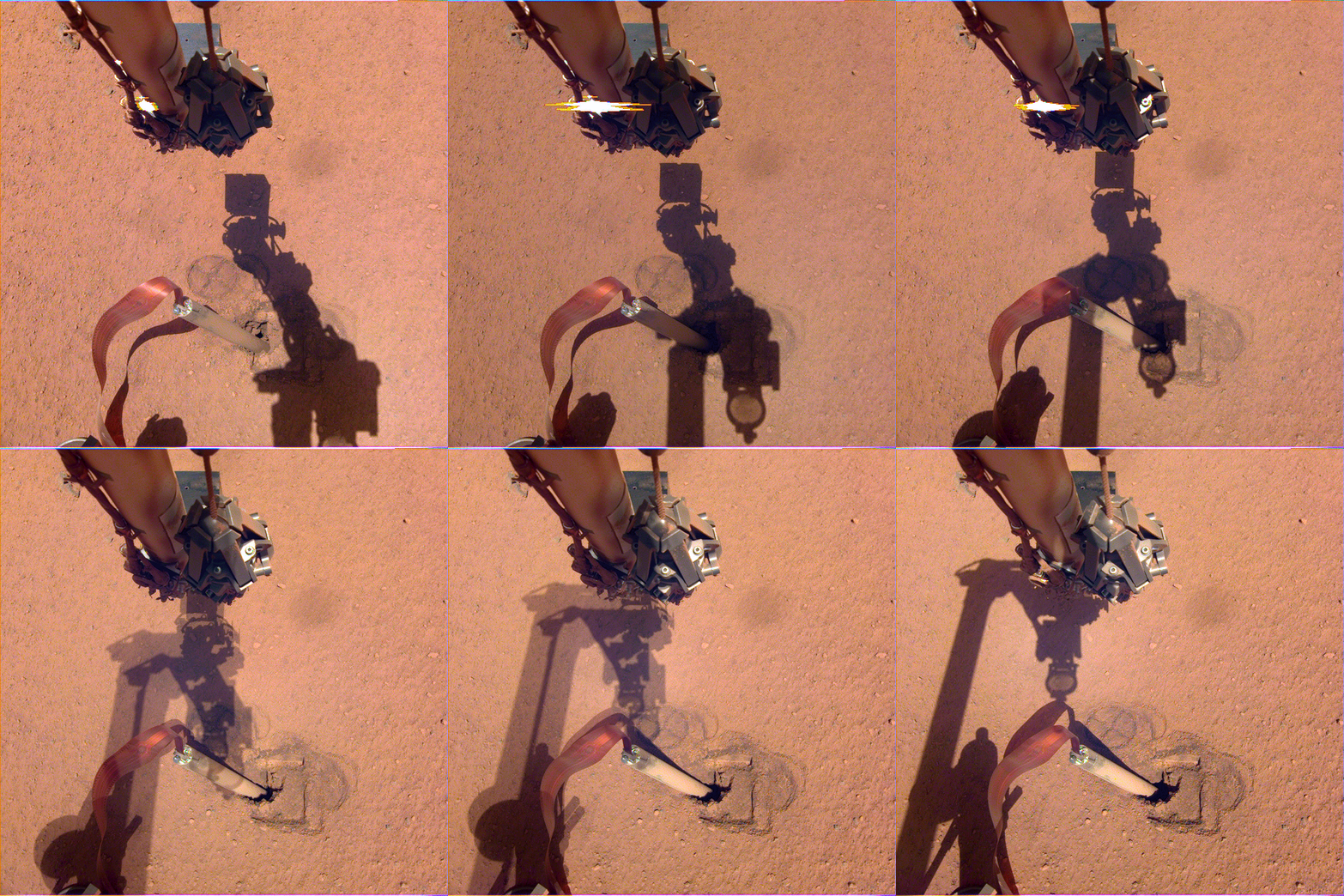
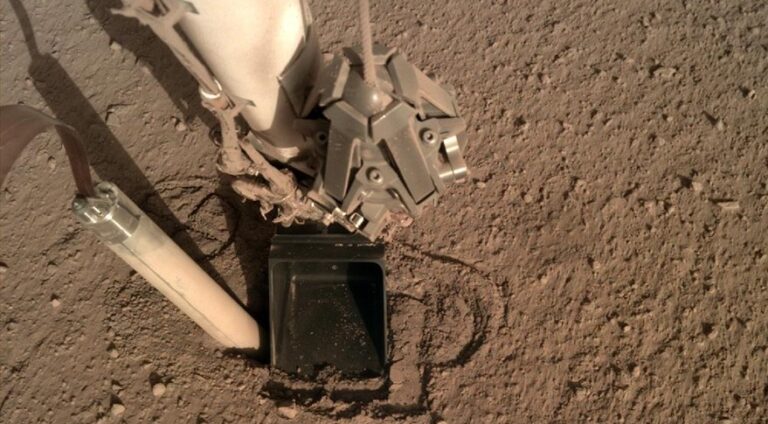
The InSight science image has lifted the lander’s rover arm off the drill hole and taken a new series of images in an effort to discover what caused the mole to pop out during its most recent drilling effort.

The image to the right, cropped to post here, was the first in a short movie made from all the images taken over the course of a day. The sequence shows the change in shadows, which helps define the situation in the hole.

This image however I think tells all. It shows that the walls of the hole have collapsed all around the mole, widening it further. It also shows that, once the mole popped out to lean sideways against the left wall, much of that material then fell into the hole, refilling it. These facts are very evident when today’s image is compared with this image from October, taken prior to the most recent drilling effort. The hole has become much wider, there is more material inside it, and the mole is now much farther out.

All these facts bode ill for the mole ever succeeding in drilling down the planned fifteen or so feet to insert a heat probe into the interior of Mars in order to take the first ever measure of the planet’s interior.

An overall assessment of this NASA mission is not very positive. The contribution from its international partners is especially bad. The mission was launched two years late because the French effort to build the seismometer failed. NASA had to subsequently give the job to JPL to get it done. Now the heat sensor is a failure, because the German-built mole has failed to get the heat sensor where it needs to be.

The seismometer and heat sensor were InSight’s only science instruments. This means that we will likely only get results from one.

7 comments

Sightseeing Central Butte on Mars

Central Butte in foothills of Mt Sharp

Overview showing perspective of panorama

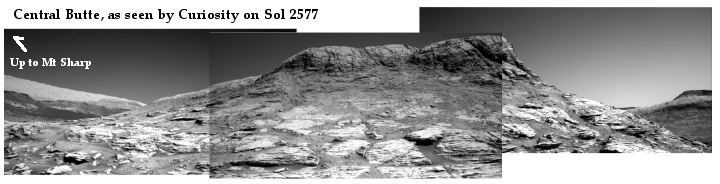
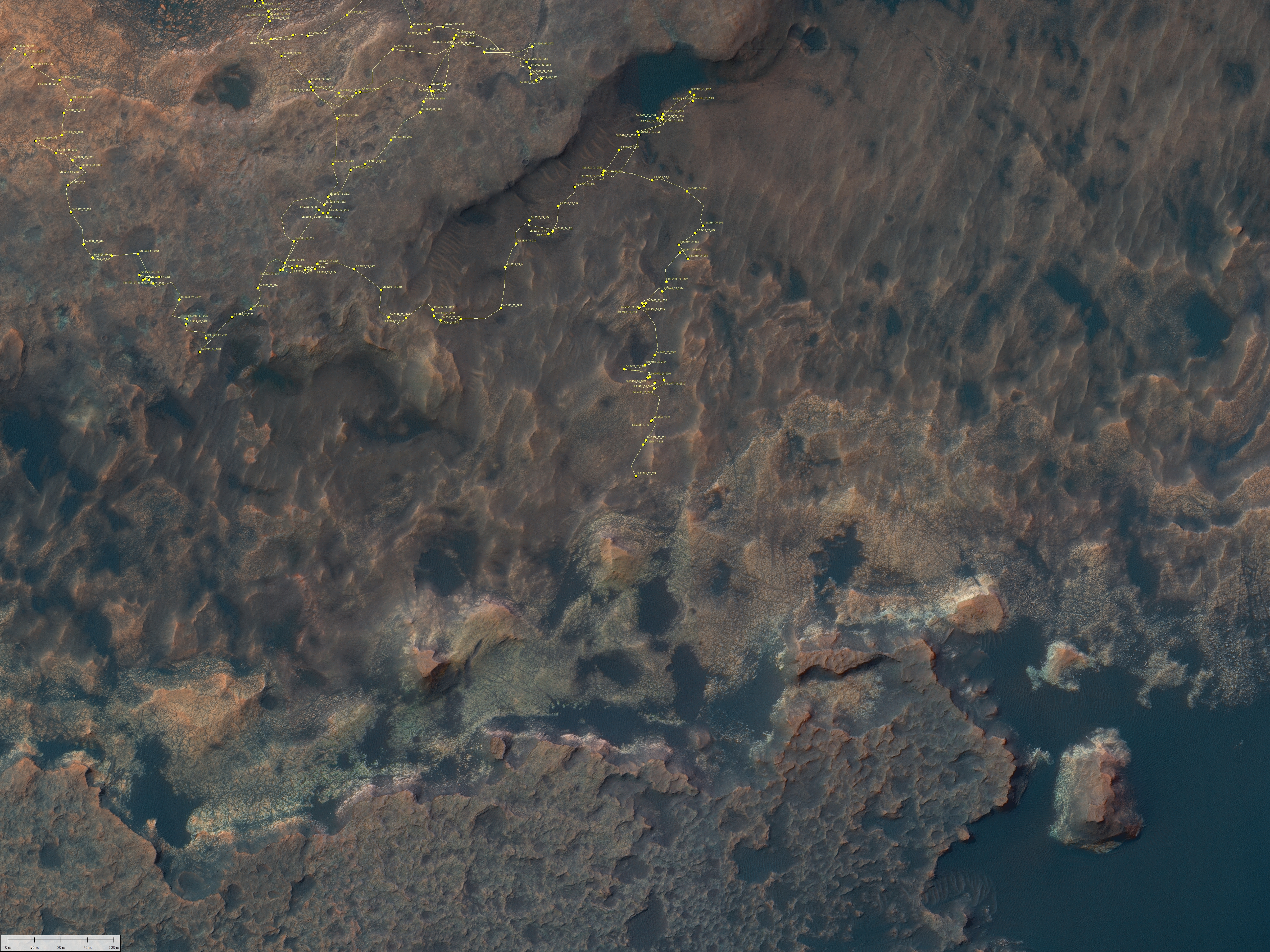
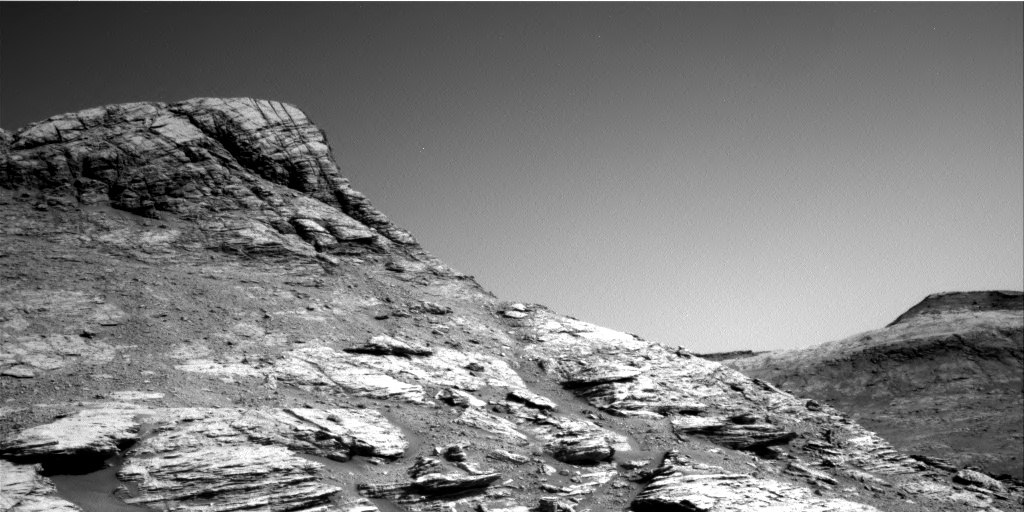
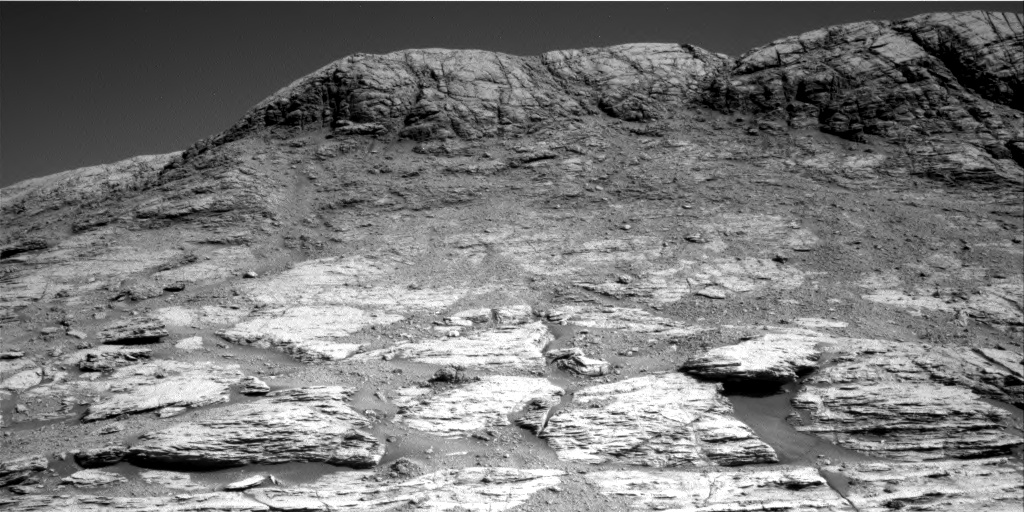
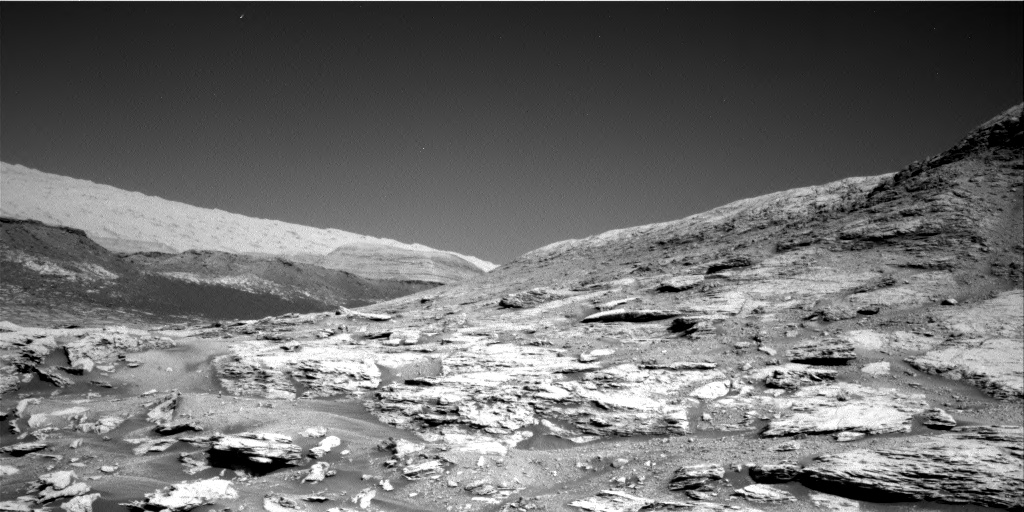
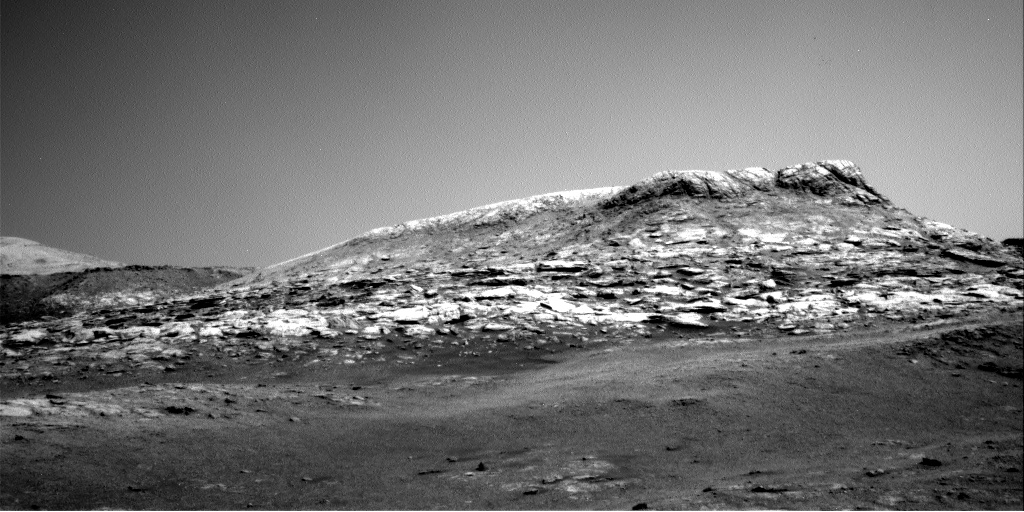
Curiosity has now roved to the very foot of Central Butte, where it has been taking close-up and panorama images of the butte and its geological layers. The panorama above was created from three Curiosity navigation images taken on Sol 2577 (November 6, 2019), here, here, and here.

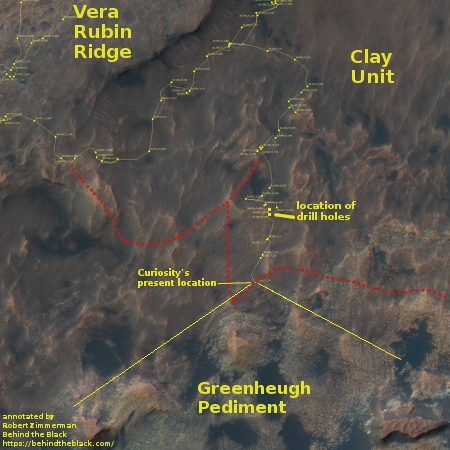
The overview on the right, based on Curiosity’s position about ten sols ago slightly farther from the butte, still indicates roughly with the yellow lines the area photographed in this panorama. The dotted red line indicates Curiosity’s initial planned route.

Following that route Curiosity will eventually climb up onto the plateau beyond this butte, approaching that higher terrain farther to the west. Once they do, however, they will no longer have access to the geological layers below the surface. Central Butte gives them a window into those layers, which is why they are going to spend some time at this location, first by taking a few sols looking at the butte at this point, then circling around to study its back side.

0 comments

Rover update: October 28, 2019

Summary: Curiosity finally on the move after several months drilling two adjacent holes in the clay unit. Yutu-2 continues roving west, has it now operates during its eleventh lunar day on the far side of the Moon.

For the updates in 2018 go here. For a full list of updates before February 8, 2018, go here.

Curiosity's present location in Gale Crater
Click for original full image.

Curiosity

For the overall context of Curiosity’s travels, see my March 2016 post, Pinpointing Curiosity’s location in Gale Crater.

I have not done any of my regular rover updates since May 30, 2019 because it was simpler to do individual updates for both Curiosity and Yutu-2, the only working rovers presently on other worlds. (If things had gone well, which they did not, we would have had two other lunar rovers in the past six months, one from Israel and one from India, but both crashed during landing.)

However, since Curiosity is finally on the move after spending several months at one location, where it drilled two holes in the clay unit (the material from one used in a wet cup experiment to look for organic life) it is time to update my readers on where Curiosity is and where it is heading.

The first image above and to the right is an annotated overview of Curiosity’s present position, moving south to a line of buttes which scientists have determined delineates the transition from the clay unit to a new geological layer they have dubbed the Greenheugh Pedimont. The yellow lines indicate the area seen in the panorama below, created from two photographs (here and here) taken by the rover’s navigation camera.
» Read more

0 comments

InSight’s mole has popped out of its hole

InSight's mole, out of the ground
Click for full image.

In a setback for its renewed digging effort, the mole drill on InSight has apparently bounced out of its drilled hole during the most recent drilling, soon after engineers had increased the rate of hammer strokes.

The image to the right shows the mole, the white cylinder on the left, with the scoop of the robot arm mostly covering the hole in its effort to pin the mole in position.

“While digging this weekend the mole backed about halfway out of the ground,” the mission announced via a pair of tweets Oct. 27. “Preliminary assessment points to unexpected soil properties as the main reason.”

…The mission added that one possibility is soil is falling in front of the mole, filling the hole. “Team continues to look over the data and will have a plan in the next few days.”

Without question the alien and fluffy properties of the soil appears to be the problem. Based on how the mole is leaning, I wonder if the left wall of the hole began to widen and collapse, as had the rest of the hole during initial drilling, thus defeating the purpose of the robot arm’s effort to pin the mole in place.

7 comments
1 131 132 133 134 135 212