Perseverance’s possible travel route on Mars

Perseverance's planned driving routes
Click for full image.

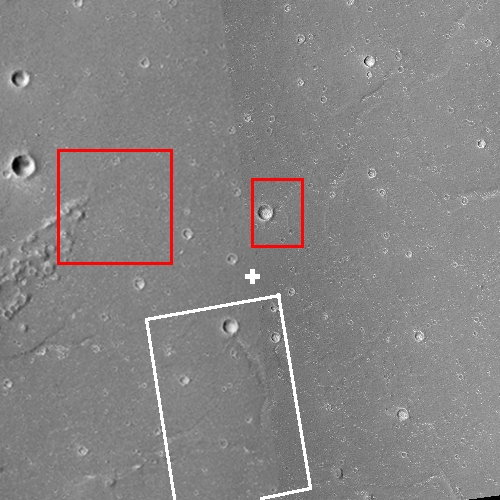
In touting the plans of NASA and the European Space Agency (ESA) to someday launch a rover to Jezero Crater designed to pick up the cached samples that Perseverance is going to leave behind, NASA today published the map to the right, showing Perseverance’s planned driving routes in the crater, on the large delta that poured into the crater in the past, and beyond that crater.

The yellow lines indicate Perseverance’s planned route, beginning somewhere in that red landing ellipse. The green lines indicated the many proposed landing sites and pathways the proposed follow-on sample retrieval mission can take to grab Perseverance samples.

The planned route looks like they will spend a lot of time exploring the top of delta, then will move out of the crater and to the southwest towards what had been another candidate landing site for Perseverance, now dubbed the Midway ellipse.

What route the science team will eventually take at the delta depends greatly on exactly where Perseverance lands today. We will know more in only a few hours.

7 comments

Hungarian company awarded NASA contract to develop Moon mini-rover

A Hungarian company has won a NASA contract worth $225K to develop what the company calls its Puli Moon mini-rover.

Named after a Hungarian breed of dog, the Puli rover is a low-cost platform designed to carry different payloads, including the ice water snooper, which won the 2020 “Honey, I Shrunk the NASA Payload” challenge, a competition organised by the U.S. space agency. Weighing less than 400 grammes (14 oz), its purpose is to probe for water ice by identifying and mapping the subsurface hydrogen content of the lunar soil.

The “news article” at the link appears to be a poorly researched article distributed by Reuters that has now been reprinted without changes by such stalwart American mainstream news outlets like the New York Post and MSN.com, to name two. Neither bothered to do any further research.

The article falsely claims that the airplane-based SOFIA telescope recently confirmed there is water on the Moon. It also claims that this rover will be on a lunar mission next year, something that does not seem likely at all.

A look at the company’s website clarifies things. The company competed in a NASA contest offering its design of a very tiny lightweight rover, won, and was then awarded a larger development contract of $225K. No launch is presently set, though if the company is successful in building it for this cost, they will likely get a berth on a later unmanned mission.

0 comments

An update on coronavirus from an Arizona doctor

My personal GP doctor in Arizona, Robert Lending, has for the last year sent out weekly detailed updates to his patients on the on-going COVID-19 epidemic. I thought I provide my readers his carefully researched doctor’s perspective, with his permission of course.

First he updates us on the state of the epidemic in Arizona:

The surge in AZ and in Pima County is over; with dramatic decreases in Cases, Case Fatality Rates (CFR), and Case Hospitalization Rates (CHR). The hospitalization utilizations including beds and ventilators, etc. are markedly decreased. {{{Tucson Medical Center is down to 10.5% Inpatient Covid-19, and they will resume elective surgeries.}}} The initial reductions began before vaccinations, but now may have been helped by the vaccinations. On the other hand, the virus acts as it will; independent of most of society’s attempts to control or modify it, no matter what the politicians and health department officials state. [emphasis mine]

The highlighted text matches what I have been saying for the past year, that the panicky effort to “stop the spread of COVID-19” was foolish, counterproductive, and entirely useless. And the evidence now a year later supports that conclusion. Nothing done by any government anywhere in the world has stopped the virus from spreading, whether it be lockdowns, masks, or quarantines. In the U.S. and Europe especially places that imposed fewer restrictions on their citizens seemed to fare about the same as places where the government stamped down hard. And those former places also had less negative consequences for their economies and for the freedoms of their citizens.

Meanwhile, the evidence is that the epidemic in Arizona is fading. And as far as I can see, during its height it affected almost no one in the general population. Like the flu it impacted the elderly sick the most, but everyone else either didn’t see it at all, or if they got sick they almost always recovered.

Unfortunately, it doesn’t matter that the epidemic is fading and that a vaccine is now available. The unreasonable rules imposed during the panic remain in force, and likely will never go away. And I speak from experience. For example, in trying to schedule an appointment with another doctor, I was told by his office that even if I had tested negative for COVID, received the vaccine, and quarantined myself between its receipt and my appearance at the office, I would still be required to wear a mask.

Think about that. I would be totally healthy and have no symptoms and could in no way transmit the virus, and yet the mask would still be required. We are now a society that irrationally sees all other humans as a threat to be avoided, at all times.

As for the flu, Lending noted some very intriguing data.
» Read more

24 comments

Strange corroding features on Mars

Strange corroding features on Mars
Click for full image.

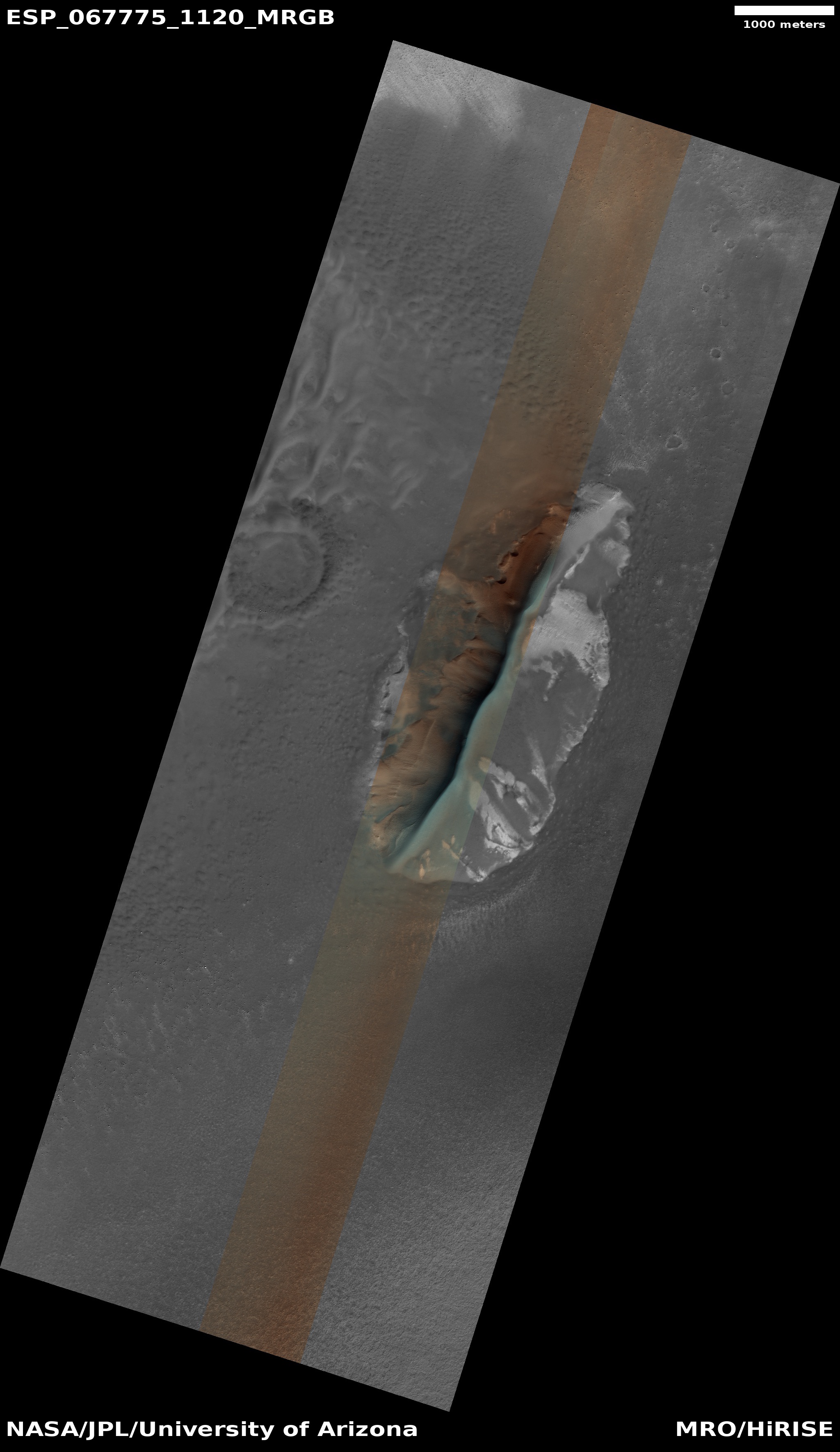
Cool image time! The photo to the right, rotated, cropped, and enhanced to post here, was taken by the high resolution camera on Mars Reconnaissance Orbiter (MRO) on October 4, 2020. It shows what appears to be features that are either corroding or eroding away, with the lower areas filled with rippling sand dunes.

The circular features might be ancient craters. The material that partly fills them might be a layer of dust or sand that the wind is slowly blowing away to dig out the depressions along the southern cliff wall.

According to the MRO science team’s interpretation of the colors produced by the high resolution camera [pdf], the dark blue colors here are likely “coarser-grained materials (sand and rocks)”, while the orange-red material on the higher terrain is likely dust.

Could this material be evidence of buried ice eroding away? At first I thought so, and then I took a look at the photo’s location, as shown in the overview image below.
» Read more

0 comments

Watching Perseverance’s landing on Mars

Because it will take eleven minutes for radio communications from Mars to reach Earth, no one on Earth will have any direct contact with the American rover Perseverance as comes in to land in Jezero Crater on Mars on February 18th. When NASA broadcasts the landing here on Earth it will already have happened.

Nonetheless, if you want see as soon as possible if the landing was successful, you can go to NASA public channel here at NASA or here at Youtube. I have also embedded the live stream telecast below the fold in this post.

The landing itself is set for about 3:55 pm (Eastern) on Thursday, February 18th. NASA’s coverage is scheduled to begin at 2:15 pm (Eastern). Expect almost everything you watch to be seeped in NASA propaganda, though of course their overview of the rover, its landing, and its landing site will be informative.

One important note: NASA has been selling the false notion that the primary goal of Perseverance is to search for life on Mars, and sadly much of the mainstream press has been repeating this notion blindly. It is simply not true. The rover’s primary goal, first, last, and always, is to gain more knowledge of the geology of Mars and its past history. If along the way the rover detects evidence of life, all for the better, but that is not what it will be focused on doing during its journey in Jezero Crater.
» Read more

19 comments

New paper: Underlying ice layer seen in Martian gullies at LOW mid-latitudes

Snow on Mars?
Click to see full image.

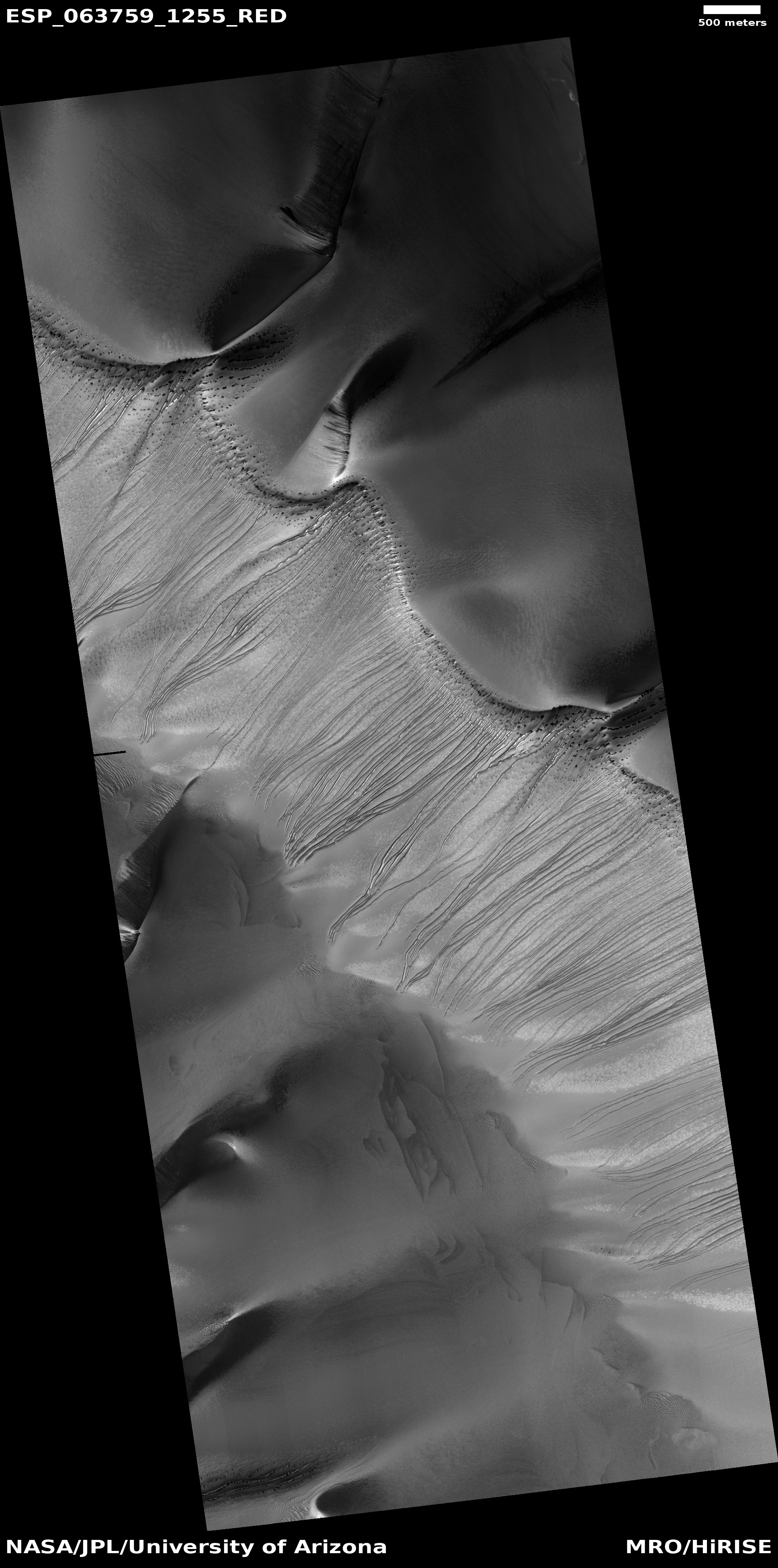
In a paper just published, scientists are proposing that bright areas seen in the low mid-latitude gullies on Mars are the underground ice table newly exposed as surface dust is removed.

This paper is a reiteration in more detail of a previous presentation [pdf] by these same scientists at the 2019 the 50th Lunar and Planetary Science Conference in Texas and reported here in March 2019.

The image to the right, from the paper, was taken by the high resolution camera of Mars Reconnaissance Orbiter (MRO) in 2009, and has been cropped to post here. The white streaks are what the scientists propose is that exposed underground ice table. At 32.9 south latitude, this particular gully would be the closest to the equator that such an ice layer has been identified. All the previous ice layer discoveries have been in the ice scarps found at latitudes above 50 degrees. As the paper’s lead author, Aditya Khuller at Arizona State University, explained in to me in an email, “We believe we are seeing exposures of dusty ice that likely originated as dusty snow.” From their paper:

We suggest … that the light-toned materials are exposed H2O ice. … [T]he appearance, and then subsequent disappearance of these light-toned materials, suggests that they are some form of volatile, such as dusty ice, rather than dust alone. … [The appearance] of these light-toned materials is similar to the >100m thick, light-toned ice deposits exposed on steep mid-latitude scarps, indicating that these materials are probably also ice, with some amount of dust on, and within the ice.

The layer would have likely been laid down as snow during a time period (a long time ago) when the rotational tilt of Mars, its obliquity, was much higher than today’s 25 degrees. At that time the mid-latitudes were colder than the poles, and water was sublimating from the polar ice caps to fall as snow in the mid-latitudes.

The overview map below reveals some additional intriguing possibilities.
» Read more

0 comments

UAE releases first Al-Amal image of Mars

Al-Amal's first Mars image
Click for full image.

The new colonial movement: The leader of the United Arab Emirates (UAE) yesterday released on his twitter feed the first photo of Mars that was beamed back from its Al-Amal (“hope” in English) orbiter, taken shortly after achieving orbit.

That photo is to the right, cropped and reduced to post here. From the article at the link:

[The photo] was captured by Hope’s EXI instrument from an altitude of 24,700 km (15,350 miles) above the Martian surface at 20:36 GMT on Wednesday – so, one day after arriving at the Red Planet.

The north pole of Mars is in the upper left of the image. At centre, just emerging into the early morning sunlight, is Olympus Mons, the largest volcano in the Solar System. Look right on the boundary between night and day, the so-called terminator.

The three shield volcanoes in a line are Ascraeus Mons, Pavonis Mons, and Arsia Mons. Look east, to the limb of the planet, and you can see the mighty canyon system, Valles Marineris. It’s part covered by cloud.

Right now the spacecraft’s orbit is very eccentric, ranging from 600 to 30,000 miles above the Martian surface. After several orbital trims, Al-Amal will end up in an orbit about 14,000 by about 27,000 miles, with an inclination of about 25 degrees. From that high orbit it will then focus on studying the Martian atmosphere.

Thus, future images will likely be similar to this, global and mostly aimed at tracking visible phenomenon in the atmosphere (dust storms and clouds).

2 comments

Rover update: The rovers are coming! The rovers are coming!

With the imminent landing on Mars of both the American rover Perseverance only days away on February 18th followed by China’s rover in April, I think it time for a new rover update, not only providing my readers a review of the new landing sites but a look at the most recent travels of Curiosity on Mars and Yutu-2 on the Moon.

Curiosity

Curiosity's view of the base of Mount Sharp, February 12, 2021
Click for full resolution image.

Overview map of Curiosity's most recent and future travels

The panorama above, made from four images taken by Curiosity’s right navigation camera on February 12, 2021 (found here, here, here, and here), looks south to the base of Mount Sharp, now only a short distance away. The yellow lines on the overview map to the right show the area this panorama covers. The white line indicates Curiosity’s previous travels. The dotted red line in both images shows Curiosity’s planned route.

The two white dots on the overview map are the locations of the two recurring slope lineae along Curiosity’s route, with the plan to get reasonable close to the first and spend some time there studying it. These lineae are one of Mars’ most intriguing phenomenon, seasonal dark streaks that appear on slopes in the spring and fade by the fall. There are several theories attempting to explain their formation, most proposing the seepage of a brine from below ground, but none has been accepted yet with any enthusiasm.
» Read more

2 comments

Possible exoplanet detected in habitable zone around Alpha Centauri A?

The uncertainty of science: Scientists have detected faint evidence that suggests the existence of a Neptune-sized exoplanet circling the sunlike star Alpha Centauri A.

After analyzing 100 hours of data gathered by NEAR in May and June of 2019, the scientists detected a thermal fingerprint in the habitable zone of Alpha Centauri A. The signal potentially corresponds to a roughly Neptune-size world orbiting between 1 and 2 astronomical units (AU) from the star, study team members said. (One AU, the average Earth-sun distance, is about 93 million miles, or 150 million kilometers.)

But that planet has not yet been confirmed, so it remains a candidate for now.

This result is very uncertain at this moment, so we should constrain our enthusiasm. If true, however, it would signal the possibility of more exoplanets circling the stars of the nearest stellar system. Alpha Centauri is actually three stars, a binary of two sunlike stars circled at great distance by the red dwarf Proxima Centauri. Scientists already think there are exoplanets circling Proxima, with one about the size of Earth.

What makes this particular interesting, if true, is that the exoplanet was detected not by the slight wobble its gravity caused in the star, or by a transit across the face of the star, but by its own light. If the detection is real, this would be I think the first time that an exoplanet has been seen directly, even if that detection comprises a few tiny pixels of light.

4 comments

Europa Clipper to fly on commercial rocket, not SLS

NASA managers have now decided unequivocally to not use SLS to launch Europa Clipper, and will instead choose a commercial rocket in about a year.

During a Feb. 10 presentation at a meeting of NASA’s Outer Planets Assessment Group (OPAG), leaders of the Europa Clipper project said the agency recently decided to consider only commercial launch vehicles for the mission, and no longer support a launch of the spacecraft on the SLS.

“We now have clarity on the launch vehicle path and launch date,” Robert Pappalardo, project scientist for Europa Clipper at the Jet Propulsion Laboratory, said. That clarity came in the form of a Jan. 25 memo from NASA’s Planetary Missions Program Office to “immediately cease efforts to maintain SLS compatibility” and move forward with a commercial launch vehicle, or CLV, he said.

Though this decision was expected following the approval of the most recent congressional budget for NASA, which contained language allowing NASA to abandon SLS if it thought it wise, this decision continues the string of recent stories that all point toward the eventually abandonment of SLS itself.

At the moment the rocket most likely to win the contract is the Falcon Heavy.

4 comments

Scientists confirm distance to farthest known solar system object

Scientists have now confirmed that the large asteroid dubbed Farfarout (about 250 miles across) is presently about 132 astronomical units from the Sun (about 12 billion miles), making it the farthest known solar system object.

Its orbit however is far from circular, and it isn’t presently even at its farthest point in that orbit.

[T]he orbit of Farfarout is quite elongated, taking it 175 au from the Sun at its farthest point and around 27 au at its closest, which is inside the orbit of Neptune. Because its orbit crosses Neptune’s, Farfarout could provide insights into the history of the outer Solar System. “Farfarout was likely thrown into the outer Solar System by getting too close to Neptune in the distant past,” said Trujillo. “Farfarout will likely interact with Neptune again in the future since their orbits still intersect.”

The astronomers expect to discover more such objects in the coming years that will even eclipse this one in distance.

9 comments

Inexplicable ridges in Hellas Basin on Mars

Sinuous ridge in Hellas Basin
Click for full image.

Time for some more cool but mysterious Martian images! The photo to the right, rotated, cropped, and reduced to post here, is the first of two images today, both of which show the ridges but of a completely different nature. Both are located in Hellas Basin in Mars southern hemisphere.

This first picture was taken on September 4, 2020 by the high resolution camera on Mars Reconnaissance Orbiter (MRO), and shows a sinuous complex that resembles to a remarkable extent a set of river tributaries, but is instead a set of raised ridges rather than a canyon system.

Scientists have found more than 10,000 miles of such ridges in the northern hemisphere in Arabia Terra, the most extensive transition zone between the southern highlands and the northern lowlands, and have dubbed them fossilized rivers. From a 2016 press release:

The inverted channels are similar to those found elsewhere on Mars and Earth. They are made of sand and gravel deposited by a river and when the river becomes dry, the channels are left upstanding as the surrounding material erodes. On Earth, inverted channels often occur in dry, desert environments like Oman, Egypt, or Utah, where erosion rates are low – in most other environments, the channels are worn away before they can become inverted. “The networks of inverted channels in Arabia Terra are about 30m high and up to 1–2km wide, so we think they are probably the remains of giant rivers that flowed billions of years ago. Arabia Terra was essentially one massive flood plain bordering the highlands and lowlands of Mars. We think the rivers were active 3.9–3.7 billion years ago, but gradually dried up before being rapidly buried and protected for billions of years, potentially preserving any ancient biological material that might have been present,” added Joel Davis.

Nor are such features on Mars limited to Hellas and Arabia Terra. For a particularly spectacular feature in the cratered highlands see this 2019 post.

The origin of these sinuous ridges in Hellas might have a similar origin as these other fossilized rivers. At present the bottom of Hellas, the deepest basin on Mars, is a place with little signs of ice. In the past there is evidence that lakes once existed here, so we cannot rule out water as a cause.

At the same time, Hellas was formed by a gigantic impact. One cannot dismiss the possibility of a volcanic origin, impact melt left over from the heat of that crash.

Today’s second ridge complex in Hellas looks far different.
» Read more

3 comments

Jupiter’s southern jet streams

Jupiter's southern jet streams
Click for full image.

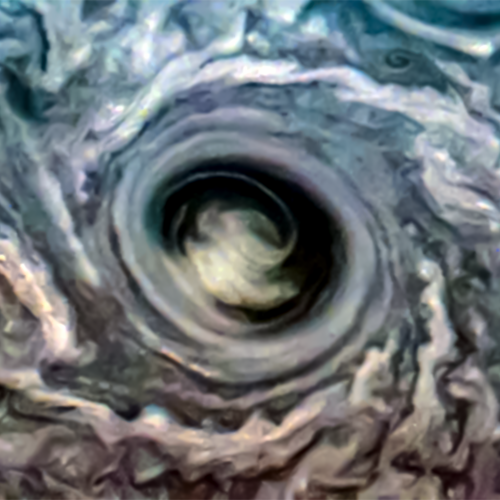
Cool image time! The photo to the right, rotated and reduced slightly to post here, shows the southern jet streams in Jupiter’s atmosphere. From the press release:

The storm known as the Great Red Spot is also visible on the horizon, nearly rotated out of view as Juno sped away from Jupiter at about 30 miles per second (48 kilometers per second), which is more than 100,000 mph (160,900 kilometers per hour).

Citizen scientist Tanya Oleksuik created this color-enhanced image using data from the JunoCam camera. The original image was taken on Dec. 30, 2020 as the Juno spacecraft performed its 31st close flyby of Jupiter. At the time, the spacecraft was about 31,000 miles (about 50,000 kilometers) from the planet’s cloud tops, at a latitude of about 50 degrees South.

According to data obtained by Juno, these bands of storms extend about 1,800 miles into Jupiter’s interior, much deeper than expected.

The Great Red Spot is at about 22 degrees south latitude, so this tells us that this picture covers Jupiter’s southern hemisphere from about the equator down to about 80 degrees.

2 comments

Turkey to do lunar mission, send astronaut into space

The new colonial movement: Turkey’s leader, Tayyip Erdogan, announced yesterday a new space exploration initiative that will include sending an unmanned probe to the Moon as well as flying an astronaut into space.

“The first rough landing will be made on the moon with our national and authentic hybrid rocket that shall be launched into orbit in the end of 2023 through international cooperation,” Erdogan said, detailing a two-phase mission. Erdogan did not elaborate further on the cooperation. Last month, Erdogan spoke to Tesla and SpaceX boss Elon Musk on possible cooperation in space technologies with Turkish companies.

Speaking in an event in Ankara, Erdogan announced a programme with 10 strategic goals including sending a Turkish citizen to a scientific mission in space.

The manned mission will not be flown by Turkey, but will be purchased from someone else, either Russia or SpaceX or Boeing maybe even China.

The timing of this announcement, the same day the UAE’s Al-Amal probe entered Mars’ orbit, suggests it was prompted by that success, and is an example of keeping up with the Joneses. Whether there is any reality to these proposals however remains to be seen.

2 comments

China’s Tienwen-1 enters Mars orbit

The new colonial movement: China’s Tienwen-1, carrying an as-yet-unnamed lander/rover, successfully inserted itself into orbit around Mars early today.

With a successful Mars Orbit Insertion, the craft has entered a highly eccentric, equatorial capture orbit of the planet, and controllers will now spend two months undertaking initial activations and checkouts in Martian orbit for the primary science mission while altering the craft’s orbit from equatorial to polar.

In April 2021, the lander, with the rover inside, will detach from the orbiter and prepare for Entry, Descent, and Landing. Prior to launch, 23 April 2021 was given as the target landing date.

The landing location is within Utopia Planitia and will — if the orbit insertion burn is completed successfully — utilize a combination of aerobraking, parachute descent, retrorocket firing, and airbag deployments to achieve a soft touchdown on the Martian surface. After landing, the rover will be deployed — ideally on the same day — to begin a planned 90 Sol (Martian day) mission to categorize the local environment.

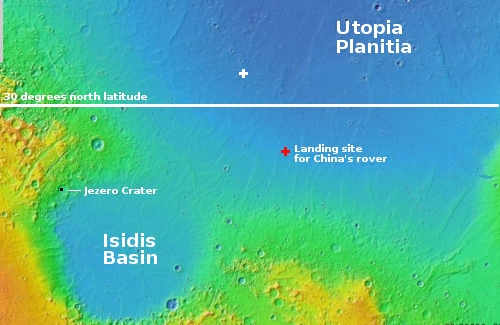
The suspected landing site in Utopia Planitia is at about 25 degrees north latitude. Though it is in the northern lowland plains, this latitude places it south of the latitudes (greater than 30) that scientists now believe ample ice likely exists underground but accessible. The lander/rover carries radar equipment capable of detecting evidence of underground ice, and will look nonetheless. If it finds any, this will be a significant discovery.

Two down, one to go. Next week, on February 18th, the American rover Perseverance will attempt its landing in Jezero crater.

2 comments

Another “What the heck?!” image on Mars

A
Click for full image.

Today’s cool image, taken on September 2, 2020 by the high resolution camera on Mars Reconnaissance Orbiter (MRO) and cropped and reduced to post here, is one that I will make very little attempt to explain. It falls into a category I call “What the heck?!” The uncaptioned website labels this “Ringed Ridges in Kasei Valles”, which merely describes what we see.

This isn’t an impact crater. The rings don’t fit any morphology I’ve ever seen for such features.

Could we be looking at some type of glacial feature? The latitude, 29 degrees north, makes this unlikely but possible. Even so, it sure doesn’t look like it. The ripples in the center and between the ridges are sand dunes, not glacial features.

Might this be a volcanic vent, with the concentric ridges marking multiple eruptions? Maybe, but if so I’ve never seen any volcanic vent or caldera that looked quite like this.

The overview map below gives some context, but hardly explains anything.
» Read more

9 comments

Sunspot update: January activity returns to expected levels

Though I am a bit late this month, it is once again time provide my monthly update of the Sun’s on-going sunspot cycle. Below is NOAA’s February 1, 2021 monthly graph, showing the Sun’s monthly sunspot activity. I have, as I do each month, annotated it to show the previous solar cycle predictions.

After two months of relatively high activity, activity that was very high so early in the ramp up to solar maximum, the number of sunspots in January dropped down to closely match the predicted value. It was still higher, but not by much.

» Read more

3 comments

Fiftieth anniversary of Apollo 14 lunar landing

Apollo 14 as seen by LRO
Click for full image.

In honor of the fiftieth anniversary today of the landing of Apollo 14 on the Moon, the Lunar Reconnaissance Orbiter (LRO) science team has used images from the spacecraft to map out what the astronauts did on the surface, as shown in the reduced image to the right. The orange and teal lines indicate the routes followed during the two EVAs, with the pink triangles indicating stopping points along the way.

Unlike Apollo 11 and 12, which focused on engineering goals such as landing precisely on the Moon, Apollo 14 focused on addressing science goals. Antares (lunar module) landed in the Fra Mauro highlands, the original destination of the failed Apollo 13 mission, essentially taking on that mission’s objectives. This was the first crewed landing in the lunar highlands and not in the mare.

The Apollo 14 astronauts who landed on the Moon, Alan Shepard (Commander) and Edgar Mitchell (Lunar Module Pilot), completed two extra-vehicular activities (EVAs) while on the surface. They spent a total of 9 hours and 22 minutes setting up equipment, taking photographs, collecting samples, and exploring.

This was the last mission where the astronauts had to walk. The next three Apollo missions brought a rover with them, so that they could drive to their research sites.

5 comments

Musk: Starlink to go public once operational

Capitalism in space: According to a tweet by SpaceX founder Elon Musk, once the Starlink internet satellite constellation is operational and has a “reasonable well” cash flow it will issue and IPO and become a publicly traded stock.

“SpaceX needs to pass through a deep chasm of negative cash flow over the next year or so to make Starlink financially viable,” Musk wrote in another tweet. “Every new satellite constellation in history has gone bankrupt. We hope to be the first that does not.”

Based on the company’s pace of launching satellites and rolling out service, this moment could occur as early as late this year. More likely it will occur in mid-22.

I would also expect that stock to quickly rise in value, and based on the history of all of Musk’s companies, will continue to rise thereafter. Expect also that a significant portion of the investment capital that Starlink will raise will be used to finance the development of Starship and Super Heavy, because Starlink will need that larger rocket to maintain its satellite constellation.

9 comments

UAE’s Hope or Al-Amal Mars Orbiter orbital insertion

UPDATE: The probe has apparently achieved orbit.

The new colonial movement: The United Arab Emirates’ (UAE) Mars orbiter, Hope, or Al-Amal in Arabic, is about to insert itself into orbit around the red planet, with that insertion to be confirmed by 11:08 (Eastern).

If you want to watch, I have embedded the live stream below the fold. A warning: The insertion is a relatively interesting event to watch, as the orbiter works autonomously and the signal confirming it happened arrives after the event. Most of the stream is propaganda for the UAE.
» Read more

2 comments
1 145 146 147 148 149 438