Rover update: The state of Curiosity’s wheels

[For the overall context of Curiosity’s travels, see my March 2016 post, Pinpointing Curiosity’s location in Gale Crater. For the updates in 2018 go here. For a full list of updates before February 8, 2018, go here.]

In my last rover update (April 16, 2020), I posted some new images taken of Curiosity’s wheels, showing the damage that they have experienced during the rover’s journey so far in Gale Crater.

At the time, I was unable to match any of the released images, taken on Sol 2732 (April 13, 2020), with the previous wheel image I have used to quickly gauge any new damage (see my July 9, 2019 report).

As it turns out, one of those images did match the earlier image. I simply failed to realize it. Today’s daily download of raw images from Curiosity included additional photos of the rover’s wheels, apparently also taken on Sol 2732 but not available until now. One of those images matches the earlier wheel image, and this time I spotted the match. A comparison is posted below, with my analysis.
» Read more
1 comment

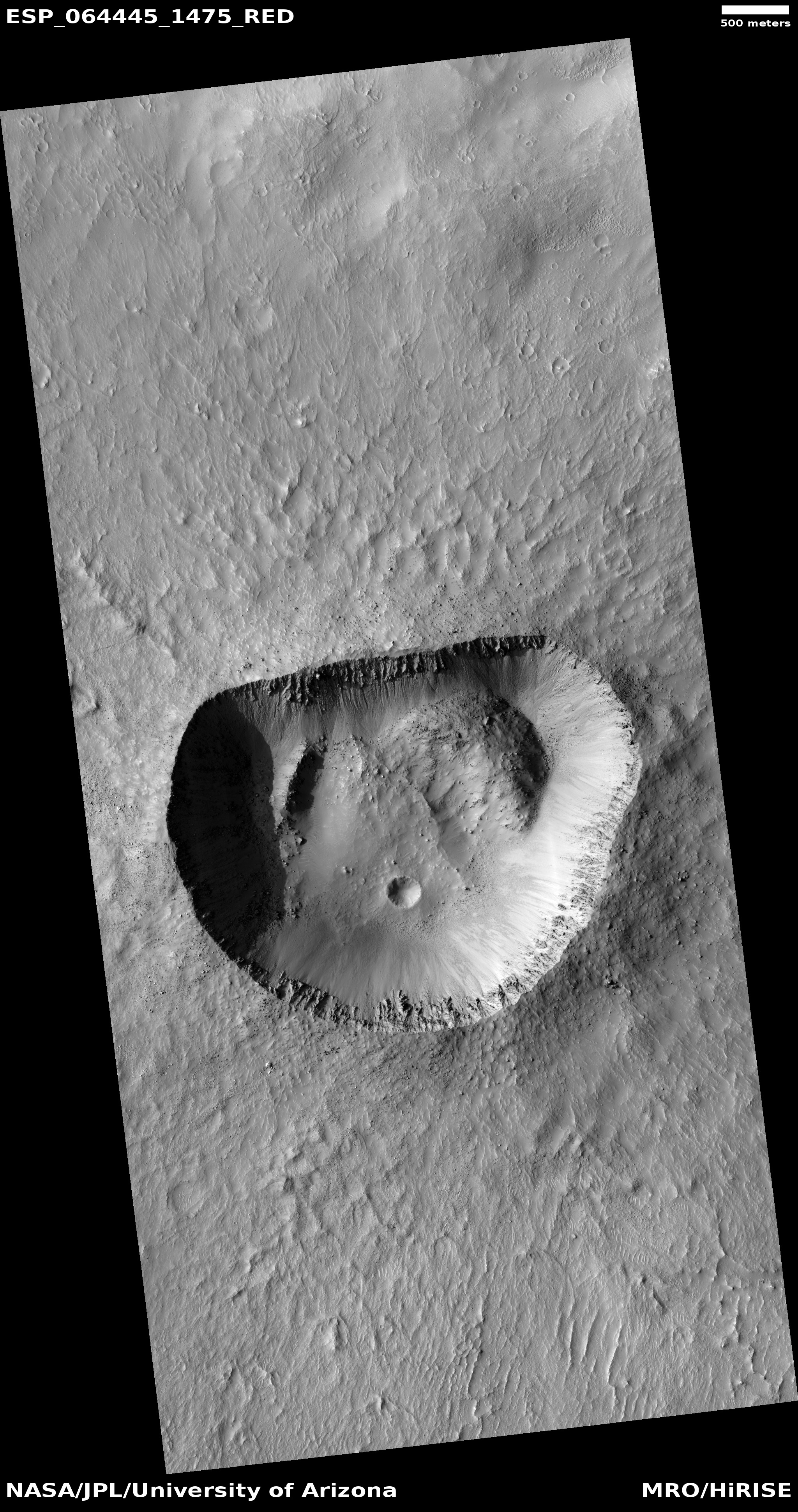
A Martian crater with a straight edge

A mis-shapened crater on Mars
Click for full image.

Cool image time! The image to the right, cropped and reduced to post here, was released today by the science team of the high resolution camera on Mars Reconnaissance Orbiter (MRO). It shows a small Martian crater whose northern rim for some reason is flattened into a straight line. Such a crater is rare, since almost all craters rims are round, even in the case of a low angle impact. The cause is unknown, though there are theories. From the caption, written by Ingrid Daubar of the Lunar and Planetary Laboratory in Arizona:

One possibility is that there was a zone of joints or faults in the crust that existed before the impact. When the impact happened, the crater formed along the straight line of these faults. Something similar happened to Meteor Crater in Arizona. Our image doesn’t show any faults, but they could be beneath the surface.

Perhaps some sort of uneven collapse changed the shape of the crater. There are piles of material on the crater’s floor, especially in the northwest and northeast corners. If those piles fell down from the rim, why did it happen there and not in other places? This crater is near the size where larger craters start to show wall slumping and terraces, so this type of collapse could be occurring unevenly.

The crater is located in the southern cratered highlands of Mars, at about 32 degrees latitude. At that latitude, it is also possible that some past glacial activity could have misshapen this crater, though I have no idea how. The crater itself does not appear to have any glacial material in it.

3 comments

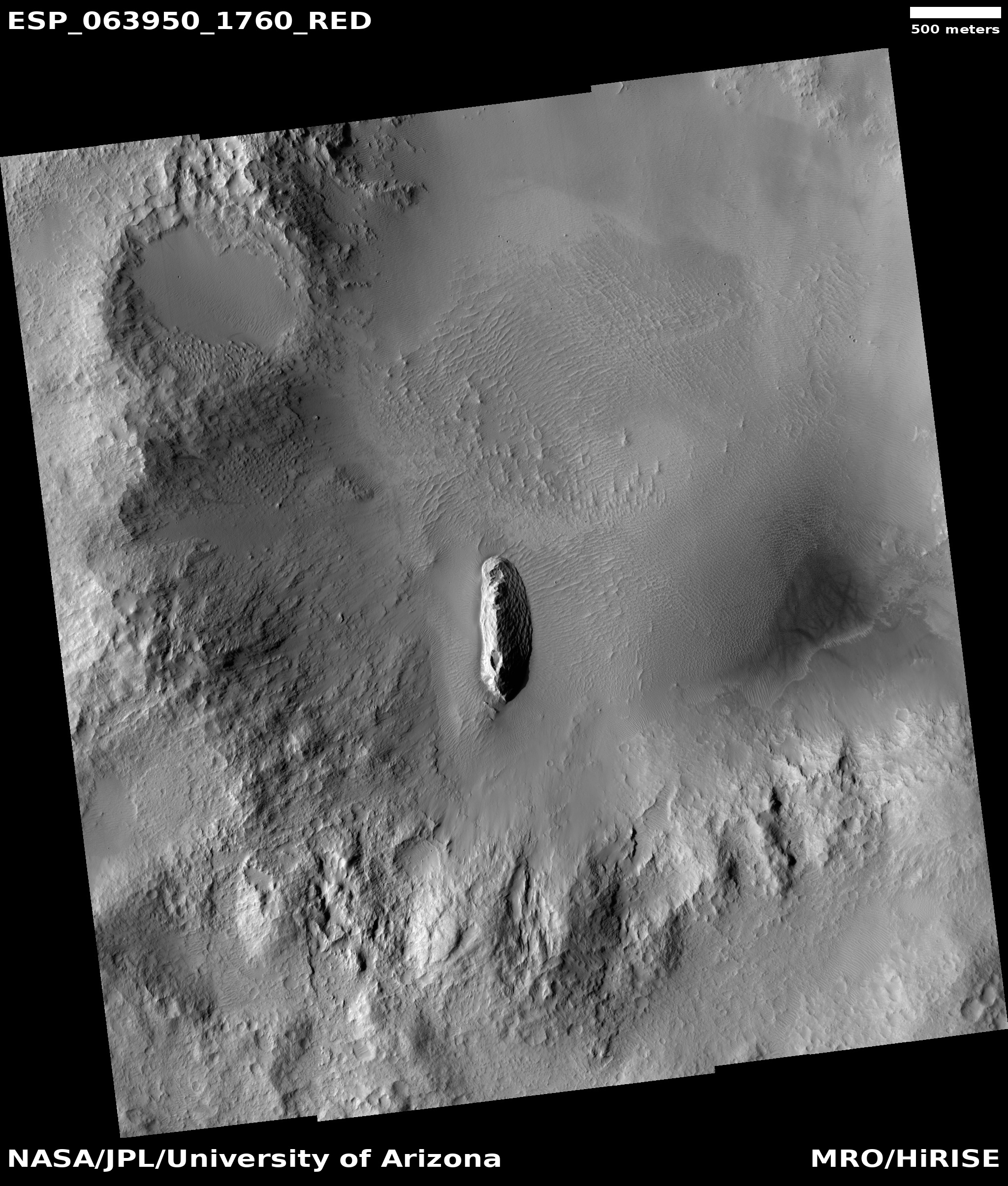
Weird central peak in Martian crater

Textured central peak in Martian crater
Click for full image.

Cool image time! The photo to the right, cropped to post here, was taken by the high resolution camera on Mars Reconnaissance Orbiter on March 18, 2020. It shows a very strange central peak in a crater on Mars. Not only does this peak stick out like a sore thumb in a relatively flat crater floor, its surface is strangely textured, patterned with what look like scallops.

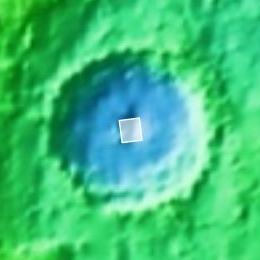
The overview map below shows the area covered in the crater by the full image.

My guess is that the peak is the final impact melt from the original impact. Think of a pebble thrown into a pond. You get ripples (the crater rim) as well as an upward drop of water (the central peak). Unlike pond water, the material in a crater freezes quickly, leaving both the ripple and the upward drop frozen in place.

Close overview of crater

This peak however also reminds me of volcanic cones found in the American southwest, the remnant cone of a much larger volcano that has long ago eroded away.

The textures might be evidence of that erosion process, as they resemble scallops that wind and water erosion can cause on rock faces.

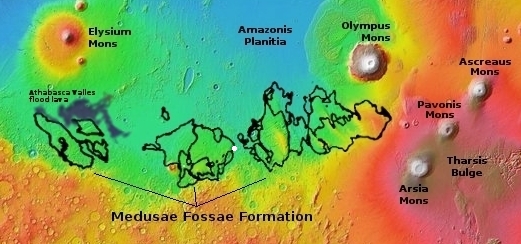
We also could be seeing dunes on the slopes themselves, though I think this is unlikely. This crater is on the edge of the vast Medusae Fossae Formation, the largest volcanic ash deposit field on Mars, as shown by the white cross on the overview map below. Thus, being on the edge of this ash field there is a lot of available dust and sand that can pile up on these slopes.

Wide Overview map

Still, the sunlight side of the ridge suggests the scallops are in bedrock, not sand dunes. And to assign their origin to either wind or water or ice erosion I think is a stretch.

So while the peak is probably the frozen melt remains of the original impact, the scallops are a geological mystery that needs unraveling.

2 comments

Amazing layers

Bedrock layering in Holden Crater
Click for full image.

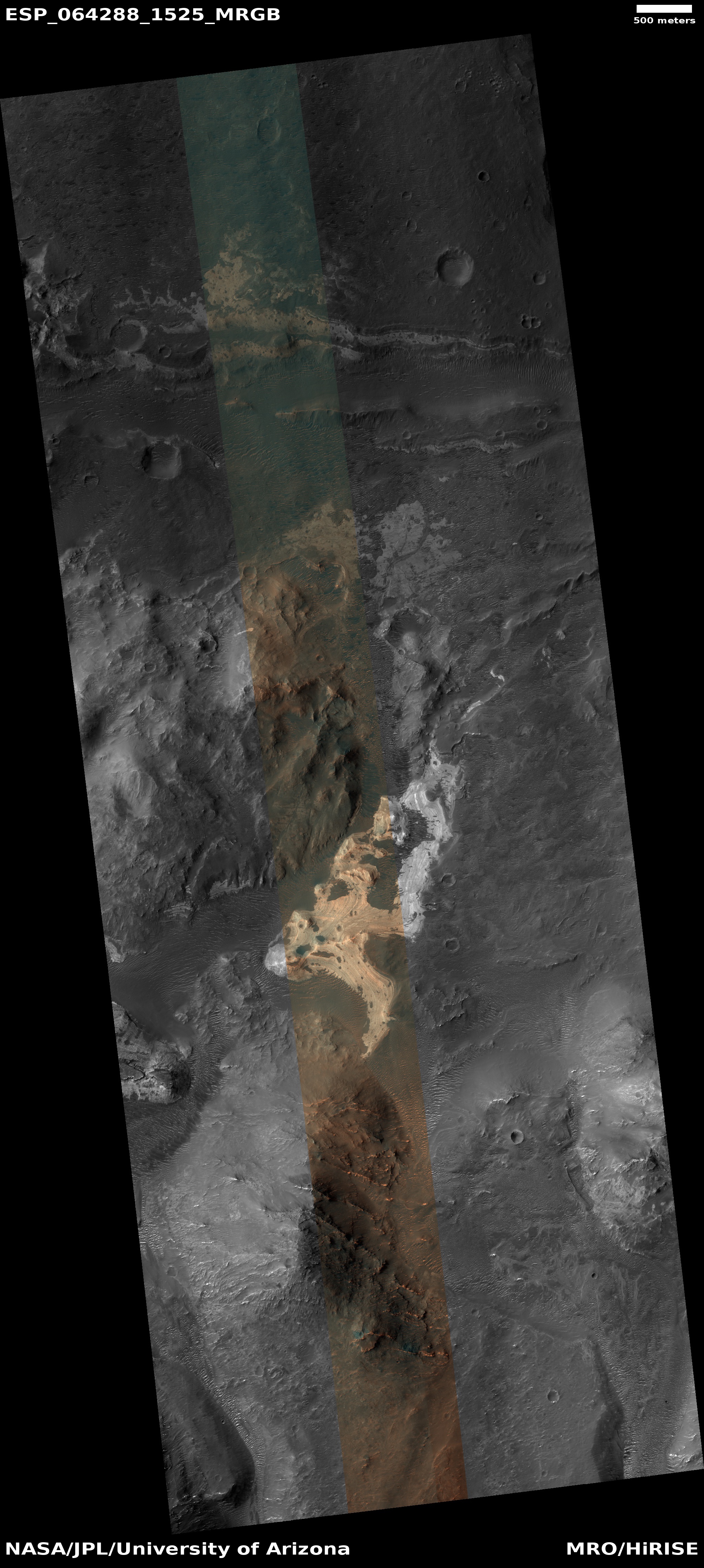
Cool image time! The science team for the high resolution camera on Mars Reconnaissance Orbiter (MRO) today released a cool captioned image entitled “Exquisite Layering”, showing a place on the floor of Holden Crater where the dust and sand that normally covers most of the Martian surface has been wiped away, cleared off because these layers are on higher sloping terrain.

The image to the right, cropped to post here, focuses in on that exposed layering, believed to be sedimentary and must have therefore happened in the eons following the impact that caused the crater.

Overview map

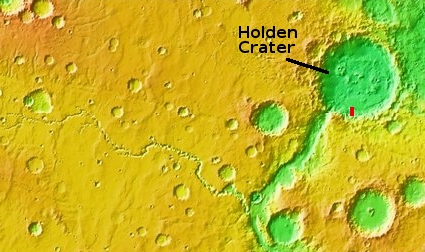
The overview map to the right shows with the red box the location of this layering inside Holden Crater. The map also illustrates why this crater was considered a candidate landing site for Curiosity. Like Gale Crater, it has evidence — the large meandering canyon system flowing into the crater — that suggests it had once been filled with a water lake. These sedimentary layers support that hypothesis, suggesting that this lake was intermittent. Each time it refilled and then dried up, it laid down a new deposit of those sedimentary layers.

0 comments

More pits found on Mars

Pit near Hephaestus Fossae
Click for full image.

Overview map

Since 2018 I have made it a point to document every new pit image taken on Mars by the high resolution camera on Mars Reconnaissance Orbiter (MRO). The list of can be found at the bottom of this post.

In the most recent release from MRO, a number of new pits were photographed. All continue to suggest that Mars has a lot of underground voids, some caused by lava flow, some by tectonic activity, some by water ice erosion, and some almost certainly caused by processes we don’t yet know. The images also suggest that we have only identified a small fraction of those underground voids.

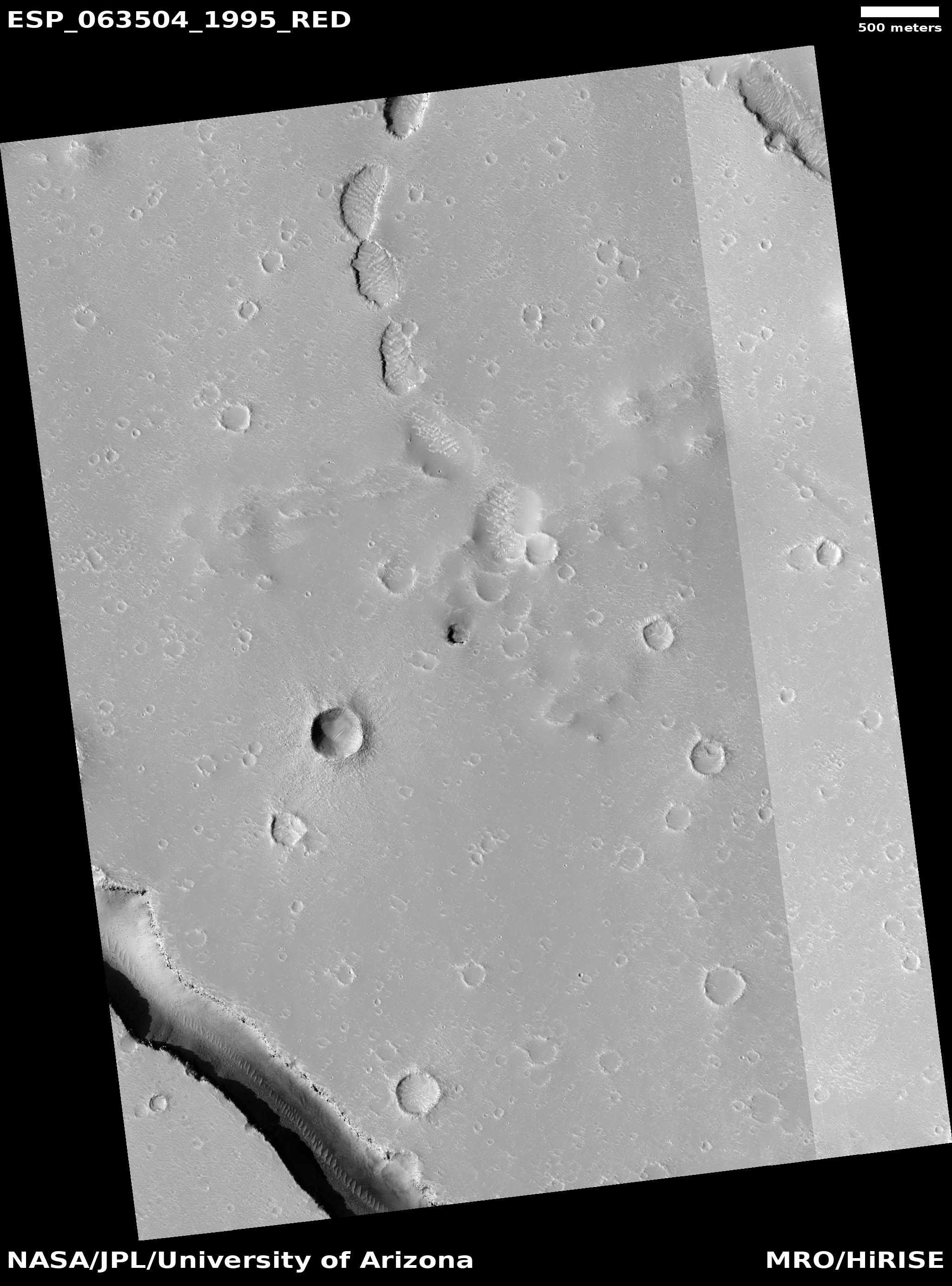
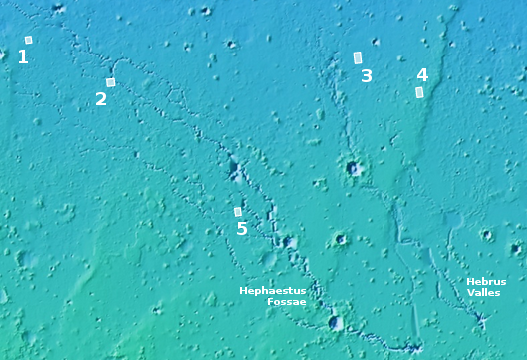
The first image to the right, cropped to post here, shows the one new pit in the northern lowlands of Utopia Planitia, near a series of meandering channels and canyons dubbed Hephaestus Fossae and Hebrus Valles.

This appears to be the fifth such pit found in this region. Previously I had documented the first four. The overview map to the right adds this fifth pit. Note how the pit is much closer to the head of Hephaestus. In the full image you can see fissures both to the north and south, as well as many nearby aligned depressions, suggesting the existence of more underground passages, some possibly linked to voids under this very pit.

The pit itself seems filled, with no apparent side passages, though to the southwest there might be something leading off in the shadows.

The overall terrain in this region, including these pits, the fissures, and the many aligned depressions, strongly suggests a lot of underground voids. As I noted in 2019:
» Read more

14 comments

A Jupiter Trojan asteroid spouts a tail

The ATLAS telescope has discovered the first Jupiter Trojan asteroid to spout a tail like a comet.

Early in June 2019, ATLAS reported what seemed to be a faint asteroid near the orbit of Jupiter. The Minor Planet Center designated the new discovery as 2019 LD2. Inspection of ATLAS images taken on June 10 by collaborators Alan Fitzsimmons and David Young at Queen’s University Belfast revealed its probable cometary nature. Follow-up observations by the University of Hawaiʻi’s J.D. Armstrong and his student Sidney Moss on June 11 and 13 using the Las Cumbres Observatory (LCO) global telescope network confirmed the cometary nature of this body.

Later, in July 2019, new ATLAS images caught 2019 LD2 again – now truly looking like a comet, with a faint tail made of dust or gas. The asteroid passed behind the Sun and was not observable from the Earth in late 2019 and early 2020, but upon its reappearance in the night sky in April of 2020, routine ATLAS observations confirmed that it still looks like a comet. These observations showed that 2019 LD2 has probably been continuously active for almost a year.

While ATLAS has discovered more than 40 comets, what makes this object extraordinary is its orbit. The early indication that it was an asteroid near Jupiter’s orbit have now been confirmed through precise measurements from many different observatories. In fact, 2019 LD2 is a special kind of asteroid called a Jupiter Trojan – and no object of this type has ever before been seen to spew out dust and gas like a comet.

There are a number of mysteries here. First, why should it have suddenly become active, since its orbit is relatively circular (similar to Jupiter’s)? Second, it had been assumed that the Jupiter Trojans had been in their orbits for a long time and had long ago vented any ice on their surfaces. This discovery proves that assumption false. It suggests that either this asteroid is a comet that was recently captured, or that things can happen on these asteroids to bring some buried volatiles up to the surface, where they can then vent.

Above all, this asteroid shows that it is dangerous to assume all Jupiter Trojan asteroids are the same. I guarantee when we finally get a close look at a bunch, when the Lucy mission arrives beginning in 2027, the variety will be quite spectacular.

1 comment

A shadowed ice patch on Mars

A shadowed ice patch on Mars
Click for full image.

Cool image time! The evidence coming back from Mars in the past two decades has increasingly suggested that there is a lot of water in that planet’s mid- and high latitudes. In the mid-latitudes the evidence suggests that ice is locked in a lot of buried and inactive glaciers that were laid down during periods when the planet’s rotational tilt, its obliquity, was greater so that the annual seasons were more extreme. During those times the mid-latitudes were colder than the poles, and water was being transferred from the poles to those mid-latitudes.

The image to the right appears to be more such evidence. Taken on March 21, 2020 by the high resolution camera on Mars Reconnaissance Orbiter (MRO) and cropped and brightened by me to bring out the important details, it shows what looks to be a distinct patch of ice on the south-facing slope of the rim of a large crater. Since this crater is in the southern mid-latitudes (34 degrees south), that south-facing slope generally gets much less sunlight, even in the summer, so any remaining buried glacial ice on that slope will linger for a longer period.

Think of the lingering ice and snow patches on shadowed locations on Earth. Because the Sun does not directly shine on them, they will be the last patches to melt away.

What I think is likely important about this patch are the exposed layers along its edge. These are the spots that are melting first, as they are where the ice is exposed, unprotected by a layer of dust and debris. It is also here that we have a window into that geological history. Even at this resolution you can see that the ice was laid down in layers, meaning that it contains evidence of those repeated climate cycles produced by Mars’ shifts in obliquity.

Those layers even seem to show the same sharp and sudden change from brighter and dirtier layers, as seen in the layers of the north pole ice cap, that occurred about 4.5 million years ago.

How tantalizing. The entire climate history of Mars is sitting there for us to decipher. We need only drill a few core samples and voila! the pieces of that history will start to fall into place.

4 comments

The edge of an eroded buried Martian glacier

The edge of an eroded buried Maritian glacier
Click for full resolution image.

Overview

Cool image time! The image to the right, rotated, cropped, and reduced to post here, was taken by the high resolution camera of Mars Reconnaissance Orbiter (MRO) on April 6, 2020.

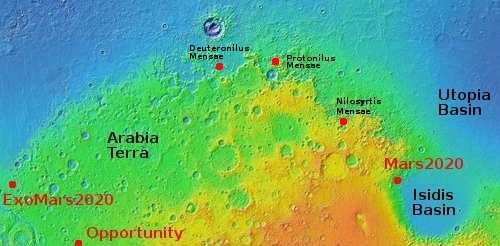
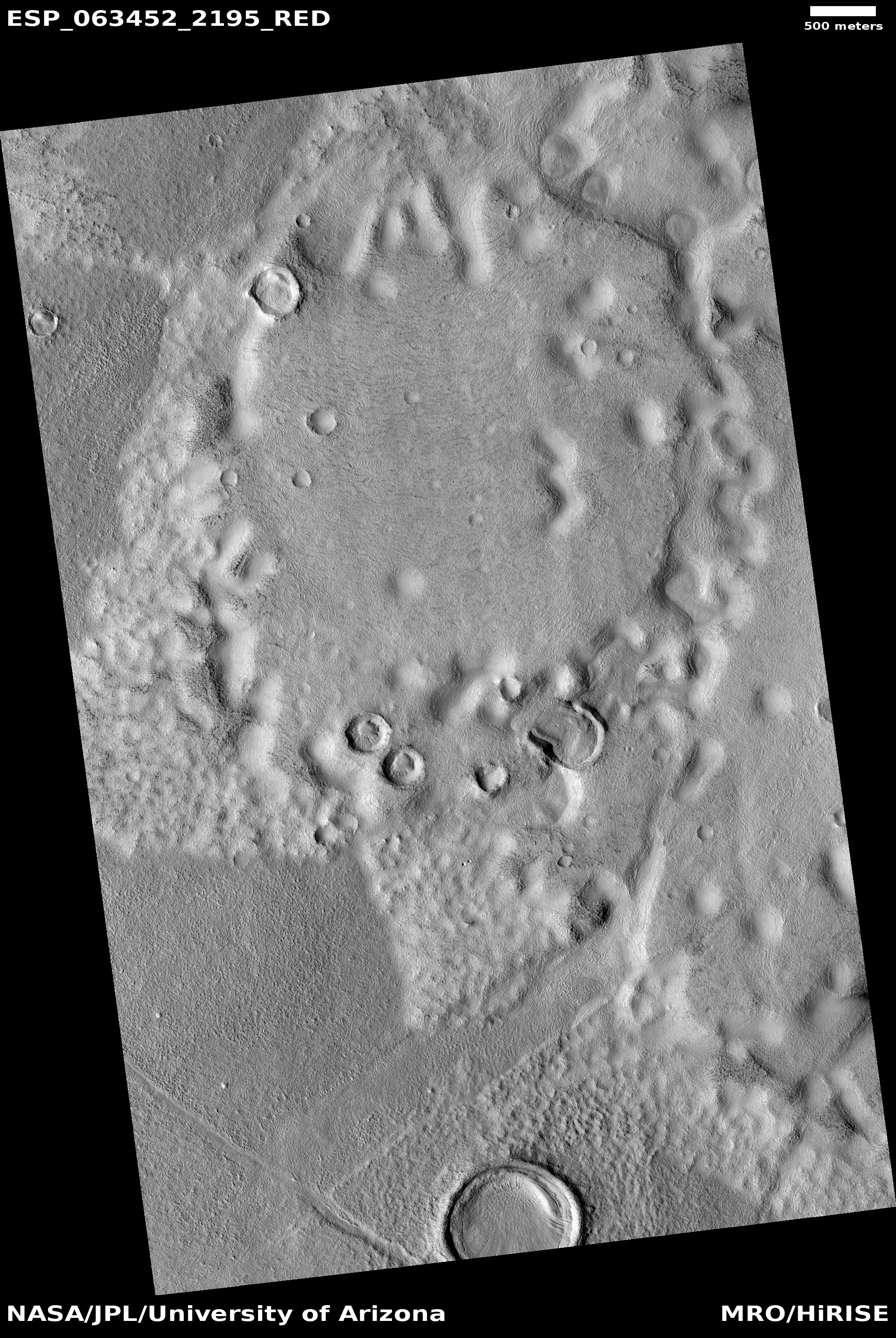
The image shows the dying edge of a debris flow coming down from a mesa, the edge of which can be seen as the dark slopes in the upper left. The white arrows point up slope. It is located in the chaos terrain of a mid-latitude region called Deuteronilus Mensae, in the transition zone between the southern highlands and northern lowlands, where many such glacial-like features are found. I featured a similar nearby glacial edge only two months ago, where the image showed the glacier’s break up and collapse at its edge.

Here, the debris flow isn’t breaking up so much as crumbling away, its edge a line of meandering depressions, with the uphill slope covered with many knobs and tiny depressions, reminiscent to me of the many features I see in caves, where the downward flow of water shapes and erodes everything to form cups and holes and knobs, all the same size. If you click on the full resolution image and zoom into that debris slope and then compare it with the linked cave formation photo, you will see the resemblance.

We are almost certainly looking at a buried inactive glacial flow coming off that mesa, though it appears to be eroding at its foot. The overview image to the right shows the context, with the red dots indicating this image as well as similar features in adjacent mensae regions (featured in the linked images above). While the chaotic and rough terrain found along this transition zone does not make them good first settlement sites, the ample evidence of vast reservoirs of buried ice, combined with a variety of topography, will likely someday make this good real estate for those living on Mars.

3 comments

The blobby wettish flows of Mars

flow-like feature in Utopia Planitia
Click for full image.

Cool image time! Rather than talk about shut downs, lying politicians, and our tragically fear-filled society, let’s go exploring on Mars. The image to the right, rotated, cropped, and reduced to post here, was taken by the high resolution camera on Mars Reconnaissance Orbiter (MRO) on February 8, 2020. Dubbed a “Flow-Like Feature within the Adamas Labyrinthus”, it shows what appears to be a very distorted and eroded pedestal crater surrounded by strange triangular-shaped flow features.

It also shows, as does much other research, that the northern mid-latitudes of Mars have a lot of frozen water, much of it buried very close to the surface.

Assuming this is a pedestal crater (which it might not be), this feature has to be very old. Pedestal craters require age, as to stand out above the surrounding terrain a lot of time is needed to erode that terrain away. This age is confirmed by the bunch of newer craters on top.

At the same time, the partially filled small crater near its bottom, as well as the soft eroded depressions on top, suggest that much of this surface has been reshaped by more recent flows, changing its shape over time.

The surrounding triangular flows probably occurred at the original impact, and suggest that there is ice near the surface, making the material here act almost like wet mud when heated. Since this location is right in the middle of the mid-latitude bands where scientists have found lots of evidence of buried glaciers and ice near the surface, this supposition seems reasonable.

The overall location provides some further context.
» Read more

0 comments

A relaxed crater on Mars

A relaxed crater on Mars
Click for full image.

Cool image time! The photo to the right, rotated, cropped, and reduced to post here, shows what the science team for the high resolution camera on Mars Reconnaissance Orbiter (MRO) call a “Relaxed Crater.” This particular image was taken in July 2014. A more recent photo was taken in March 2020 to create a stereo pair, but because this older image shows more of the crater I decided to highlight it.

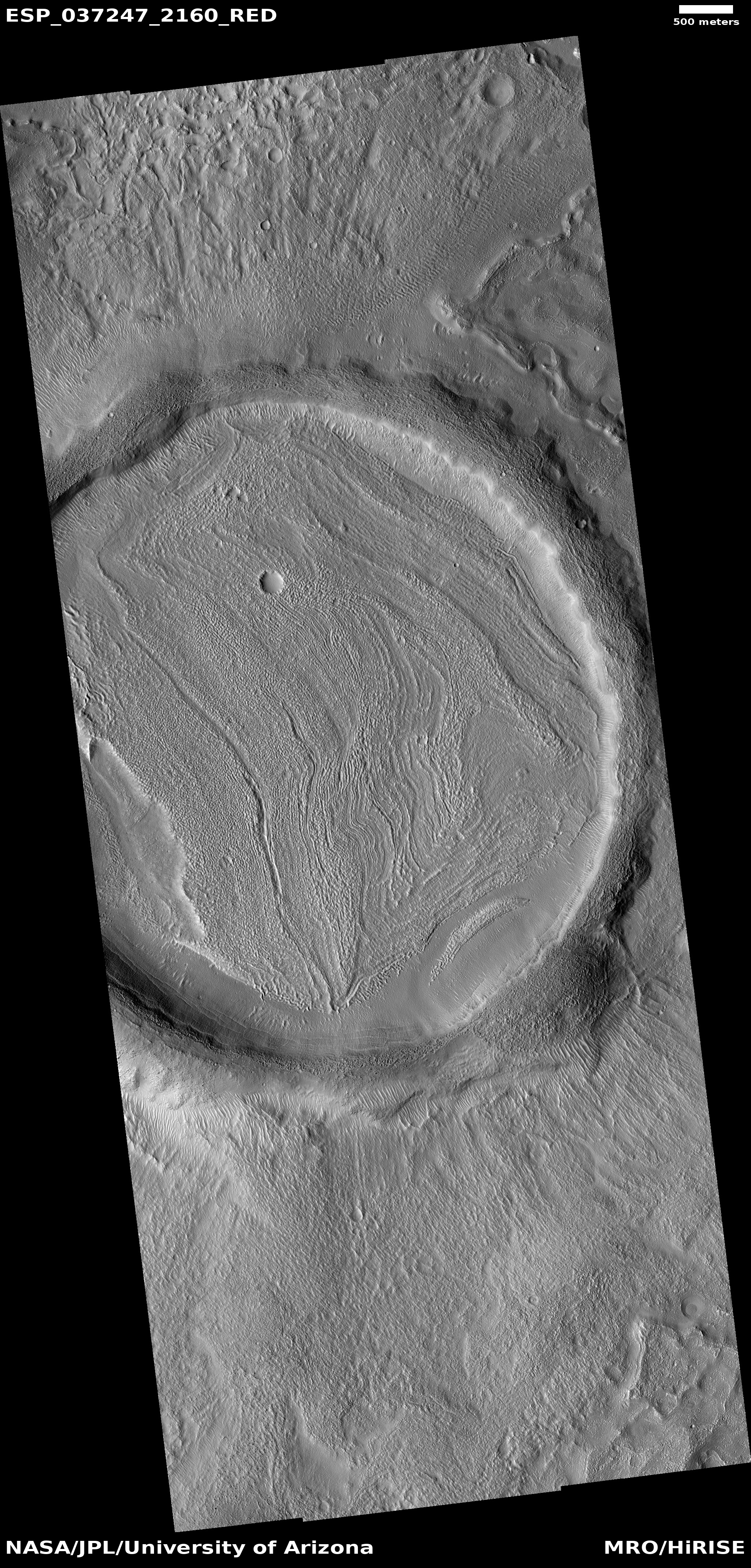
The crater is considered relaxed because it is very shallow and appears as if, after impact, some process caused the interior to in-fill with material even as the rim became less pronounced and degraded (as explained in this paper [pdf]). The process could have involved either molten magma or melted ice. As this crater is located in the northern highlands to the southwest of Erebus Mountains, in a region that research has consistently suggested has a great deal of ice just below the surface, the latter seems likely. This assumption is further reinforced in that the crater is also located in the mid-latitudes where scientists have found a lot of craters they think are filled with buried glaciers. This certainly seems the case here.
» Read more

0 comments

The eroding edge of Mars’ largest volcanic ash field

Eroding yardangs at the edge of Mars' largest volcanic ash field
Click for full image.

Cool image time! In the regions between the biggest volcanoes on Mars is the Medusae Fossae Formation, a immense deposit of volcanic ash that extends across as much surface area as the nation of India. As planetary scientist Kevin Lewis of Johns Hopkins University explained to me previously,

In general, much of the [formation] seems to be in net erosion now, retaining very few craters on the surface. …One hypothesis is that this long term erosion, since it’s so enormous, is the primary source of the dust we see covering the much of the planet’s surface.

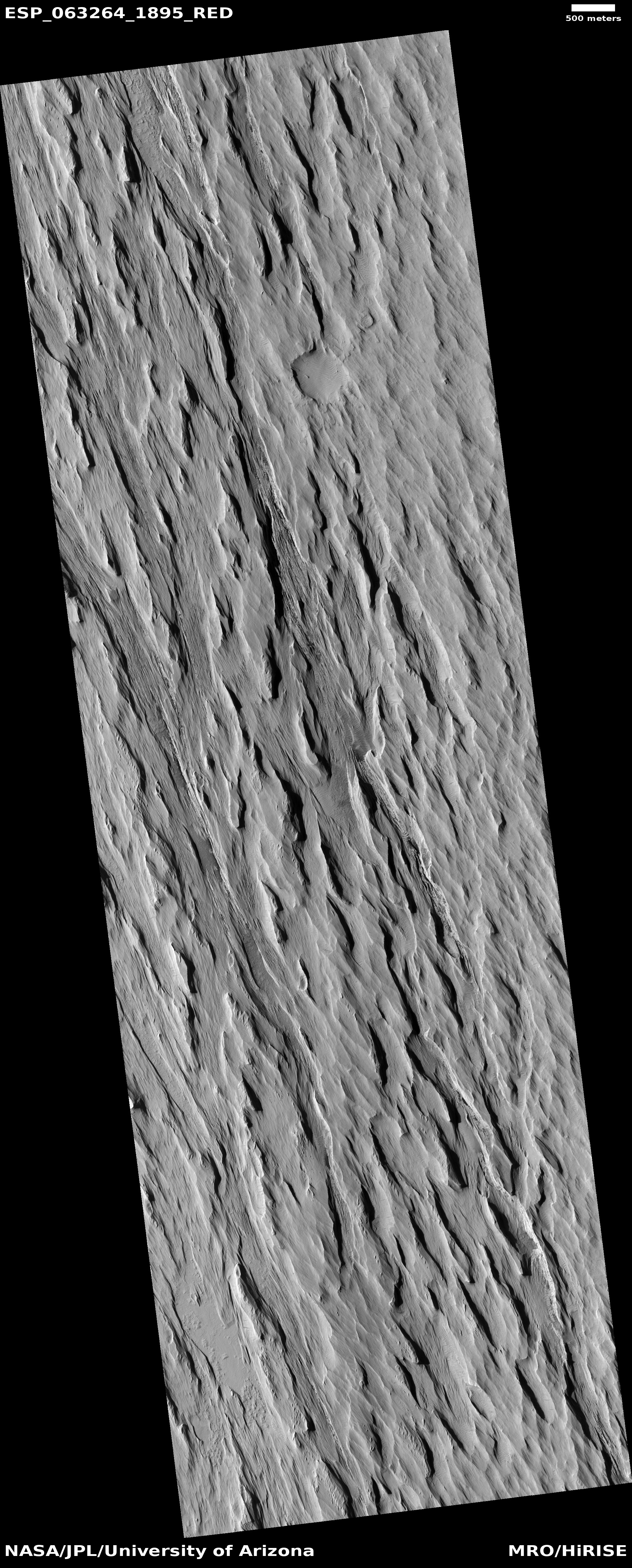
The image above, cropped and reduced to post here, was taken by the high resolution camera on Mars Reconnaissance Orbiter (MRO) on January 25, 2020. It shows one very small area at the very edge of the Medusae ash deposit, in a region where that deposit is clearly being eroding away by the prevailing southeast-to-northwest winds. The mesas of this ash that remain are called yardangs, their ash more tightly pressed together so that it resists erosion a bit longer than the surrounding material.

In the context map below the location of these yardangs is indicated by the white cross, right on the edge of the Medusae ash field.
» Read more

0 comments
1 112 113 114 115 116 157