Tuesday at the non-existent Lunar & Planetary Science Conference

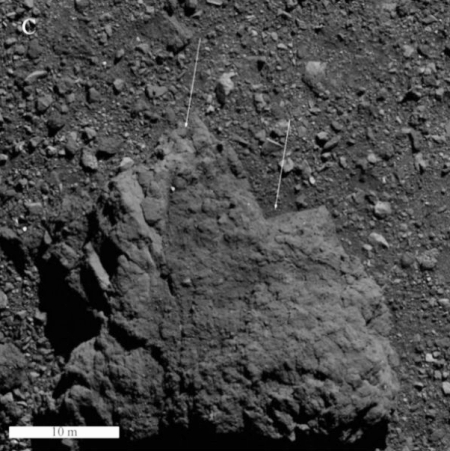
Boulder on Bennu with changes in layered texture changes

Today was supposed to have been the second day of the week-long 51st annual Lunar & Planetary Conference, sadly cancelled due to fear of the Wuhan virus. As I had planned to attend, I am now spending each day this week reviewing the abstracts of the planned presentations, and giving my readers a review of what scientists had hoped to present. Because I am not in the room with these scientists, however, I cannot quickly get answers to any questions I might have, so for these daily reports my reporting must be more superficial than I would like.

On this day the most significant reports came from scientists working on the probes to the asteroids Bennu and Ryugu as well as the probes to the Moon. The image to right for example is from one abstract [pdf] that studied the texture differences found fourteen boulders on Bennu. The arrows point to the contacts between the different textures, suggesting the existence of layers. Such layers could not have been created on Bennu. Instead, these rocks must have formed on a parent body large enough and existing long enough for such geological processes to take place. At some point that parent body was hit, flinging debris into space that eventually reassembled into the rubble pile of boulders that is Bennu.

Other abstracts from scientists from both the Hayabusa-2 mission to Ryugu and the OSIRIS-REx mission to Bennu covered a whole range of topics:
» Read more

0 comments

Monday at the non-existent Lunar & Planetary Science Conference

Today I had planned on attending the first day of the 51st annual Lunar & Planetary Science Conference in the suburbs of Houston, Texas. Sadly, for the generally foolish and panicky reasons that is gripping America these days, the people in charge, all scientists, decided to cancel out of fear of a virus that so far appears generally only slightly more dangerous than the flu, though affecting far far far fewer people.

Anyway, below are some of the interesting tidbits that I have gleaned from the abstracts posted for each of Monday’s planned presentations. Unfortunately, because I am not in the room with these scientists, I cannot get my questions answered quickly, or at all. My readers must therefore be satisfied with a somewhat superficial description.
» Read more

24 comments

China on track for Mars launch in July?

Two stories today, one from Nature and the second from space.com, pushed the idea that China’s Mars orbiter/lander/rover mission is still on schedule to meet the July launch window.

A close read of both stories however revealed very little information to support that idea.

The Nature article provided some details about how the project is working around travel restrictions put in place because of the COVID-19 virus epidemic. For example, it told a story about how employees drove six scientific instruments by car to the assembly point rather than fly or take a train, thereby avoiding crowds.

What struck me however was that this supposedly occurred “several days ago,” and involved six science payloads that had not yet been installed on the spacecraft. To be installing such instrumentation at this date, only four months from launch, does not inspire confidence. It leaves them almost no time for thermal and vibration testing of the spacecraft.

The article also provided little information about the status of the entire project.

The space.com article was similar. Lots of information about how China’s space program is dealing with the epidemic, but little concrete information about the mission itself, noting “the lack of official comment on the mission.” Even more puzzling was the statement in this article that the rover “underwent its space environment testing in late January.”

I wonder how that is possible if those six instruments above had not yet been installed. Maybe the instruments were for the lander or orbiter, but if so that means the entire package is not yet assembled and has not been thoroughly tested as a unit. Very worrisome.

Posting today has been light because I was up most of the night dealing with a family health issue, meaning that I ended up sleeping for several hours during the day. All is well, nothing serious (it is NOT coronavirus), but it has left my brain and schedule very confused. Will likely take a good night’s sleep to get back to normal.

6 comments

Black dunes and weird hills on Mars

Black dunes and weird hills on Mars
Click for full image.

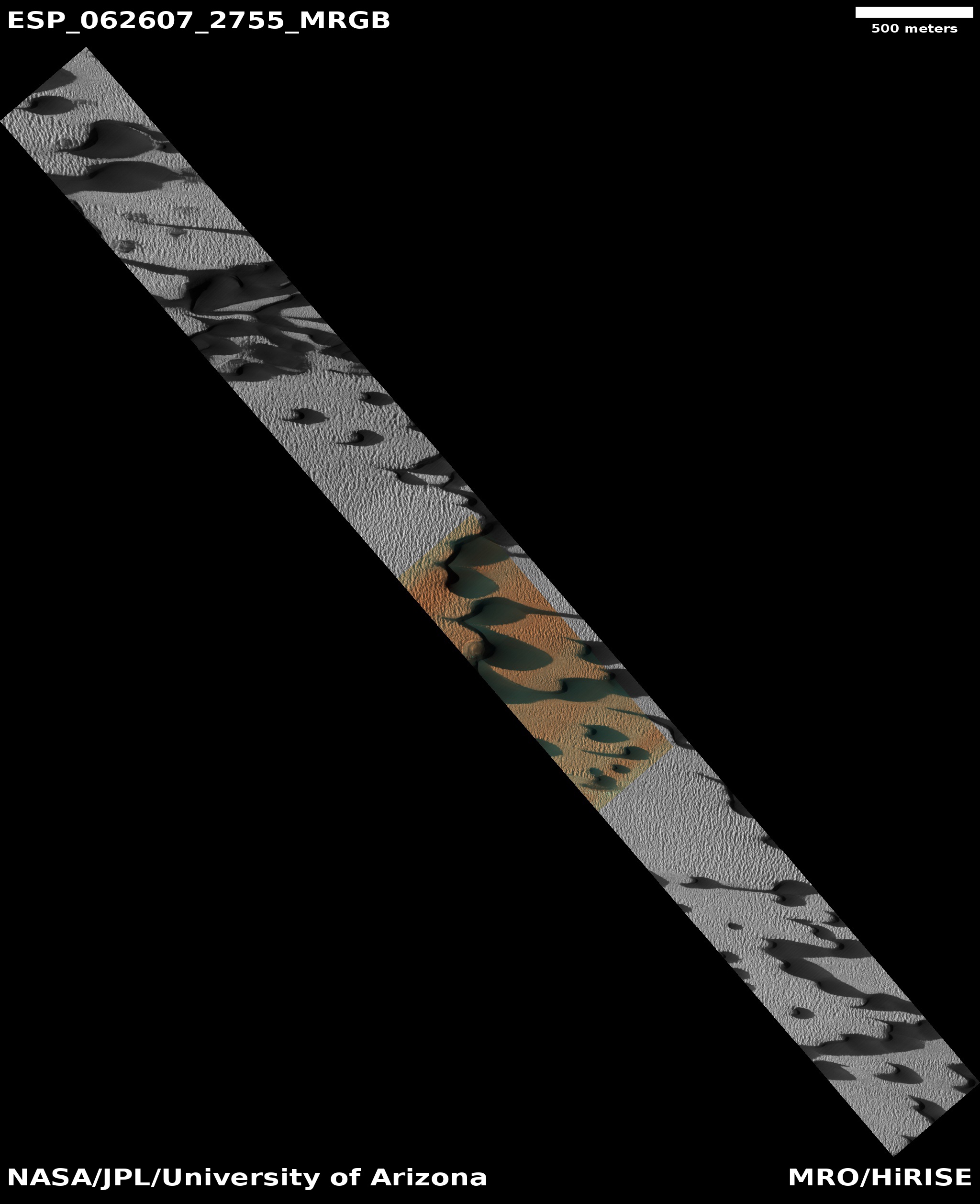
Cool image time! Or I should say a bunch of cool images! The photo on the right, rotated, cropped, reduced, and annotated by me, was taken by the high resolution camera on Mars Reconnaissance Orbiter (MRO) on February 3, 2020. An uncaptioned image, it was entitled “Arabia Terra with Stair-Stepped Hills and Dark Dunes.” Arabia Terra is one of the largest regions of the transition zone on Mars between the northern lowland plains and the southern cratered highlands. It is also where Opportunity landed, and where Europe’s Rosalind Franklin rover will land, in 2022.

This image has so many weird and strange features, I decided to show them all, Below are the three areas indicated by the white boxes, at full resolution. One shows the black dunes, almost certainly made up of sand ground from volcanic ash spewed from a long ago volcanic eruption on Mars.
» Read more

1 comment

ExoMars2020 rover delayed until 2022

The European Space Agency (ESA) today announced that they are delaying the launch of their ExoMars2020 rover mission until the next launch window in 2022

The press release says this will give them the time “necessary to make all components of the spacecraft fit for the Mars adventure.” Considering that the spacecraft’s parachutes have yet to have a successful high altitude test, that the entire spacecraft is not yet assembled, and that when they did the first thermal test of the rover the glue for the solar panel hinges failed, this seems that they need to do a lot of testing.

Overall the decision is smart. Better to give them the time to get this right then launch on time and have a failure.

At the same time, there appears to be something fundamentally wrong within the management of this project at ESA. This project was first proposed in 2001, and has gone through repeated restructurings and redesigns. Moreover, they began planning the rover for this 2020 launch in 2011, and after ten years were not ready for launch.

0 comments

Martian dust devil tracks come and go

The changing surface of dunes on Mars
Click for full image.

Earlier image of the same dunes
Click for full image.

Cool image time! To understand what created the vastly strange and alien Martian surface, it will be necessary for scientists to monitor that surface closely for decades, if not centuries. To the right is one small example. Taken by the high resolution camera of Mars Reconnaissance Orbiter (MRO) and rotated, cropped, and reduced to post here, it shows a dune field inside a crater in the southern cratered highlands of Mars. Craters have been found to be great traps for dust and sand on Mars. Once the material is blown inside, the winds are not strong enough to lift the material out above the surrounding rims. Thus you often get giant dunes inside craters, as we see here.

What makes this location of interest to planetary scientists is the changing surface of these dunes. They have been monitoring the location since 2009. In 2013, the MRO science team released a captioned photograph, the second image to the right, also rotated, cropped, and reduced by me to match the same area in the top image. In that caption planetary scientist Corwin Atwood-Stone of the Lunar and Planetary Laboratory in Arizona wrote,

This area was previously imaged in August 2009, about two Mars years ago, and in that image dust devil tracks were also visible. However the tracks visible now are completely different from the earlier ones. This tells us that there has been at least one dust storm since then to erase the old tracks, and lots of dust devil activity to create the new ones.

Since then the MRO science team has taken repeated images of this location to monitor how the dust devil tracks change, as well as monitor possible changes to the dunes themselves, including avalanches. The newest image above shows the result of the global dust storm last year. It wiped out the dust devil tracks entirely.

The newer image was entitled, “Monitor Dune Avalanche Slopes,” but I couldn’t find any examples. Based on published research, I am sure there is something there, even if I couldn’t find them. Maybe my readers have a better eye than I.

0 comments

China completes remote communications test of Mars rover

The new colonial movement: Though the report today in China’s state-run press is remarkably vague and lacking in details, it appears that they have successfully completed a remote communications test between their planned Mars rover and their ground control center.

The report also said that this will be the “only” such test before the summer launch of their orbiter/lander/rover to Mars.

China has been exceedingly closed-mouthed about this Mars project. Except for one landing test (which I found far from impressive), they have provided very little information about their progress.
While this does not mean they are having problems, it also does not engender confidence, especially because the launch window is only about four months away.

0 comments

Martian badlands

The Tyrrhena Terra badlands
Click for full image.

The photo to the right is a small section cropped from an image taken by the high resolution camera on Mars Reconnaissance Orbiter (MRO) on January 2, 2020. It shows the rough, cratered southern highlands dubbed Tyrrhena Terra that lie between the low Isidis Basin to the north and Mars’ deepest basin, Hellas, to the south.

The image was taken not because any specific scientific request, but because MRO was doing spectroscopy over this area and it made sense to also take a photograph. Comparing the photograph with the spectroscopic data allows scientists to better understand that spectroscopy.

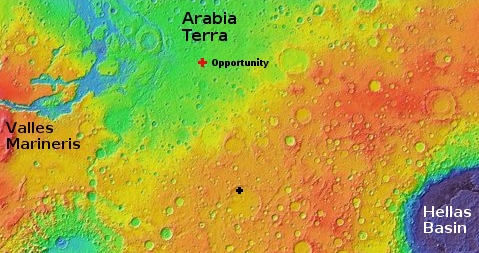
The white cross in the map below shows the location of this image. The map itself covers latitudes from 40 degrees north to 55 degrees south.
» Read more

5 comments

Curiosity reaches highest point yet on Mars

Curiosity looking north across Gale Crater
Click for full resolution version.

Time for some more cool images! The panorama above, cropped and reduced to post here, was assembled from images taken by Curiosity on March 6, 2020 by its left navigation camera, just after it topped the slope and settled on the very rocky plateau of what the scientists have dubbed the Greenheugh Piedmont, the highest point on Mars that Curiosity has so far traveled. It looks north, across Gale Crater to its far rim, about thirty miles away. That rim rises about a mile higher than where Curiosity sits today.

To quote Michelle Minitti, the planetary geologist who wrote the update describing this achievement:

Kudos to our rover drivers for making it up the steep, sandy slope below the β€œGreenheugh pediment” (visible in the [right] side of the above image) and delivering us to a stretch of geology we had our eyes on even before we landed in Gale crater!

The panorama below is also assembled from photos taken by the left navigation camera, but this time it looks south, across the piedmont toward Mt. Sharp. Its view of the the piedmont’s very very rough terrain I think proves that once the scientists have gathered their data from this point, the rover will descend back down and resume its original route, circling the piedmont to skirt its southern edge where orbital data suggests the going will be smoother.
» Read more

1 comment

Rolling boulders on Mars

Boulder tracks on Mars
Click for full image.

Cool image time! The photo to the left, cropped to post here, was taken by the high resolution camera on Mars Reconnaissance Orbiter (MRO) on January 21, 2020, and shows several boulders at the bottom of a slope, along with the tracks those boulders made as they rolled downhill sometime in the far past.

Uphill is to the south. We know the dark spots at the end of these tracks are large boulders partly because of the wind streaks emanating away from them to the north. As the wind goes around each rock it produces eddies that produce the tracks. Based on the scale and the image resolution (about 10 inches per pixel), these boulders range in size from about one to five feet in diameter.

This image has two points of interest. First, the tracks left by the boulders seem to have a repeating pattern. My guess is that the pattern most likely formed because the boulders are not spherical in shape, and as they rolled each roll repeated a certain pattern reflecting that shape. This theory is reinforced by a close look at each boulder. Though the resolution is insufficient to resolve the boulders themselves, the pixel distribution for each strongly suggests an asymmetric shape.

Second, this image, when compared with an earlier MRO image of the same spot, taken fourteen years ago in December 2006, shows no obvious change. These tracks, and their boulders, have therefore probably sat here, as we see them, for a long time. Since there appear to be two sets of tracks, with one overlying the other, this suggests that two separate events (an earthquake or nearby impact) each time caused a bunch of boulders to break free and roll downward together, with the second set of boulder tracks crossing over the earlier set.

Establishing when those two events occurred, however, will require some on-site data, something that will likely not occur until humans roam the surface of Mars in large numbers.

0 comments

NASA dubs next Mars rover “Perseverance”

NASA today announced that they have named their next Mars rover, due to launch in July, “Perseverance.”

The name was announced Thursday by Thomas Zurbuchen, associate administrator of the Science Mission Directorate, during a celebration at Lake Braddock Secondary School in Burke, Virginia. Zurbuchen was at the school to congratulate seventh grader Alexander Mather, who submitted the winning entry to the agency’s “Name the Rover” essay contest, which received 28,000 entries fromK-12 students from every U.S. state and territory.

“Alex’s entry captured the spirit of exploration,” said Zurbuchen. “Like every exploration mission before, our rover is going to face challenges, and it’s going to make amazing discoveries. It’s already surmounted many obstacles to get us to the point where we are today – processing for launch. Alex and his classmates are the Artemis Generation, and they’re going to be taking the next steps into space that lead to Mars. That inspiring work will always require perseverance. We can’t wait to see that nameplate on Mars.”

I truly hope that the rover is well-named, and lives a very long life on Mars, long enough that it is still in use the day an human arrives to touch it again.

6 comments

Upgrades to Deep Space Network to block commands to Voyager 2

A scheduled eleven month upgrade to one of the three Deep Space Network antennas used to communicate with planetary missions will prevent scientists from sending commands to Voyager 2 during that time period.

Data will still be downloaded, but if anything should go wrong, such as happened in January, it will be impossible to do anything about it. In January engineers were able to troubleshoot the problem and upload corrections. During these upgrades a fix will have to wait. To reduce the chance of serious issue, engineers will put Voyager 2 into a more dormant state during this time period.

The repairs are essential however, even if it means we lose Voyager 2. This network must work for all the other Moon and Mars missions planned for the next few decades, and an upgrade has been desperately needed for years.

1 comment

Mars rover Update: March 4, 2020

Panorama looking south and uphill
Click for full resolution.

Curiosity

[For the overall context of Curiosity’s travels, see my March 2016 post, Pinpointing Curiosity’s location in Gale Crater.

For the updates in 2018 go here. For a full list of updates before February 8, 2018, go here.]

Map of Curiosity's travels

Since my last rover update on January 13, 2020, Curiosity has finally moved on from the base of Western butte, where it spent more than a month drilling a hole and gathering a great deal of geological data. Rather than head downhill and around the plateau and back to its planned route (as indicated by the red line in the map to the right), the Curiosity science team decided to push upward and onto the Greenheugh Piedmont (as indicated by the yellow line).

They had always planned to reach the top of this plateau, but not for several years. First they were going to head east to study a recurring slope lineae (see my October 2019 update), an example of a dark streak that darkens and fades seasonally and could provide evidence of water seepage from below ground.

Instead, they decided the close proximity of the top of the piedmont and its geology was too tempting. The piedmont is apparently made up of a layer that is very structurally weak, and breaks up easily, as you can see by the panorama above. It also appears to sit on softer, more easily eroded material, which thus accentuates this break up. If you look at the left part of the panorama you can see what I mean. The piedmont layer there is the thin unbroken layer sitting on what looks like sand. As that sand erodes away the layer quickly breaks into small pieces, as shown in the rest of panorama.

Traveling on the piedmont will likely be difficult and threaten Curiosity’s wheels. I suspect this reality prompted them to choose to get to the top and obtain data now, rather than wait several more years of rough travel that might have made access to the piedmont difficult if not impossible.

They presently sit just below the top, and are studying their options before making that last push.
» Read more

3 comments

Summer at the Martian North Pole

Buzzell pedestal crater in context with polar icecap scarp
Cool image time! The image above, cropped, reduced, and brighten-enhanced to post here, was taken by the high resolution camera of Mars Reconnaissance Orbiter (MRO) on December 26, 2019 of the dunes just below the 1,500 to 3,000 foot high scarp that marks the edge of the Martian north polar icecap. I have brought up the brightness of the dune area to bring out the details.

This one image shows a range a very active features at the Martian north pole. At this scarp scientists have routinely photographed avalanches every Martian spring, as they have been occurring, caused by the warmth of sunlight hitting this cliff wall and causing large sections to break off. As Shane Byrne of the Lunar and Planetary Lab University of Arizona explained in my September 2019 article,

On Mars half of the images we take in the right season contain an avalanche. There’s one image that has four avalanches going off simultaneously at different parts of the scarp. There must be hundreds to thousands of these events each day.

Buzzell dunes, March 19, 2019
Click for full image.

On the left side of the image is an area of dunes that Candice Hansen of the Planetary Science Institute in Arizona has dubbed β€œBuzzell.” As spring arrives here, she has MRO regularly take images of this site (as well as about a dozen others) to monitor the changes that occur with the arrival of sunlight on the vast dune seas that surround that polar icecap.

The image to the right zooms in on one particular distinct feature, a pedestal crater, surrounded by dunes, that I have labeled on the image above. This image was taken just as spring began, with the Sun only five degrees above the horizon. At that time the dunes and pedestal crater were mantled by a frozen layer of translucent carbon dioxide that had fallen as dry ice snow during the sunless winter and then sublimates away each Martian summer.

Since March I have periodically posted updates to monitor the disappearance of that CO2 layer. (See for example the posts on August 2019 and November 2019.) Below are two more images, showing the ongoing changes to this area from early to late summer.
» Read more

2 comments

ExoMars2020 parachute tests delayed until late March

The European Space Agency (ESA) has decided to delay until late March the next high altitude tests of the revamped ExoMars2020 parachutes, despite the success of recent ground tests.

The tests of the 15-meter-diameter supersonic and 35-meter-wide subsonic parachutesβ€”an essential part of the entry, descent and landing phase of the missionβ€”had been scheduled for December and February. The delay comes despite six ground tests demonstrating successful parachute extraction – the point at which damage was caused in earlier, failed high altitude tests.

Both tests need to be successful for the go-ahead for launch of 300-kilogram Rosalind Franklin rover during the July 25 to Aug. 13 Mars launch window. Any failure would mean a wait of 26 months for the next launch window, opening late 2022.

There will be a meeting next week of the project’s top management, from both Russia and Europe, and I strongly suspect that they are going to decide to delay launch to the 2022 launch window. Not only have the parachutes not been tested successfully at high altitude, they recently discovered an issue with the glue holding the solar panel hinges on the ExoMars Rosalind Franklin rover.

1 comment

Glacial breakup on Mars

glacial breakup on Mars
Click for full image.

Cool image time! The photograph to the right, cropped and reduced to post here, was taken by the high resolution camera on Mars Reconnaissance Orbiter on December 22, 2019 and was titled “Contact Between Debris Apron and Upper Plains in Deuteronilus Mensae”.

The section of the full image that I have focused on shows what appears to be the downhill break-up of the surface debris covering an underlying water ice glacier. The grade is downhill to the south.

I am confident that this is buried glacial material based on recent research:

Both of these reports found lots of evidence of shallow ice in Deuteronilus Mensae, a region of chaos terrain in the transition zone between the Martian northern lowlands and the southern highlands.

With this image we see what appears to be the slippage of that ice downslope, causing breakage and cracks on the surface, with much of that surface made up of the dust and debris that covers the ice and protects it. Towards the bottom of the image it even appears that the disappearing ice is unveiling the existence of a bunch of buried bedrock mesas, typical of chaos terrain, previously hidden by the ice because it filled the surrounding canyons.

Below is a close-up of the photograph’s most interesting area of break-up.
» Read more

1 comment

Peering into a Martian pit

Peering into a pit
Click for full image.

Cool image time! The science team for the high resolution camera on Mars Reconnaissance Orbiter last week released the above image of a pit to the west of the giant volcanoes Arsia and Pavonis Mons. The left image is without any adjustments in exposure. The right image has brightened the pit’s interior to bring out details in order to see what’s there. As planetary scientist Ross Beyer of Ames Research Center noted in his caption:

The floor of the pit appears to be smooth sand and slopes down to the southeast. The hope was to determine if this was an isolated pit, or if it was a skylight into a tunnel, much like skylights in the lava tubes of Hawai’i. We can’t obviously see any tunnels in the visible walls, but they could be in the other walls that aren’t visible.

Wider view of pit
Click for full image.

Because the image has been rotated 180 degrees, north is down. The northern wall of the pit appears to be either very vertical, or overhung. A tunnel might head north from here, but because of the angle of the photograph, this cannot be confirmed.

To the right is a wider look from the full photograph, showing the surrounding terrain, with north now to the top. In line with this pit is a depression that crosses the east-west canyon to the north. This alignment strongly suggests that a fault or fissure exists here, and that an underground void along this fissure line could exist. It also suggests that a deeper and larger void could exist below that larger canyon.

This pit, and the accompanying fissures, were likely caused by crack-widening along these faults, produced as this volcanic region bulged upward.

Map of knowns pits surrounding Arsia Mons

This pit is also one of the many many pits found near these volcanoes. The map to the right shows by the black boxes all the pits documented by the high resolution camera on MRO in the past few years, with this new pit indicated by the white box.

Beginning in November 2018 until November 2019 I was almost doing a monthly post reporting the new pits photographed by MRO. Since November however the number of new pit images dropped. This is not because every pit has been imaged, but because it appears they have completed their initial survey.

Below is a list of all those previous pit posts:
» Read more

2 comments

Europe considering delaying ExoMars2020 two years

The Europe Space Agency (ESA) is considering delaying the launch of its ExoMars2020 Mars rover two years because of continuing problems with its parachutes.

According to a spokesperson for the European Space Agency (ESA), a “working-level review” for the project was held among ESA and Roscosmos officials in late January, and a preliminary assessment was forwarded to the respective heads of the space agencies, Jan WΓΆrner of ESA and Dmitry Rogozin of Roscosmos, on February 3. “They instructed the respective inspectors general and program chiefs to submit an updated plan and schedule covering all the remaining activities necessary for an authorization to launch,” the ESA spokesperson said. “This plan will be examined by the two agency heads who will meet on 12 March to jointly agree the next steps.”

It appears that the European and Russian officials will make a public announcement about ExoMars next month. Their options include pressing ahead with a launch this year or delaying two years until the next favorable window for a launch to Mars opens. Given multiple issues with the mission, a source said a delay is the most likely option.

The parachutes are not the only problem. They have just discovered during thermal testing that the glue used in the the hinges of the rover’s solar panels comes unstuck.

In August 2019, when the parachute issues were first revealed (after much hemming and hawing by ESA officials), I predicted a 50-50 chance they’d delay. When in September 2019 the problems were found to be more serious than first admitted, I lowered the chances of meeting the 2020 launch date to less than 25%.

Right now I predict that the launch of ExoMars2020 will not occur this summer, but will be delayed until the next Martian launch window in 2022. You heard it here first.

13 comments

Enclosed Martian canyon, filled with ice

Ice-filled canyon on Mars
Click for full image.

Cool image time! The photo on the right, rotated, cropped, and reduced to post here, was taken by the high resolution camera on Mars Reconnaissance Orbiter on November 21, 2019. The uncaptioned image was simply entitled “Ice-filled Graben.”

The location is on the lower flanks of the giant volcano Alba Mons, which in itself sits north of Olympus Mons and the volcanic Tharsis Bulge. The canyon is called a graben because it was formed when a section of the crust slips downward along parallel faults. It does not have the features of a rill, or lava flow, as it starts and stops suddenly. It probably formed due to the rise of the volcano, pulling apart its flanks along faults, causing some sections then to slip downward.

How do the scientists know this is ice-filled? I suspect they have other data that indicates the presence of water, but there are also clear features inside this canyon that resemble the glacial features found elsewhere on Mars. For example, note the parallel lines near the canyon walls. These indicate past surface levels as well as layers within the ice from cyclic climate processes. The line of pits along the southwest wall, where the surface gets more sunlight, also suggests that this sunlight is causing more ice to sublimate away.

Finally, the graben is located at 46 degrees north latitude, definitely far enough north for such ice to exist, based on ample other research.

8 comments

Quakes by InSight indicate Mars’ interior is active

Cerberus Fossae

The first seismic results from InSight’s seismometer now show that the interior of Mars is active, with regular moderately-sized quakes.

The Seismic Experiment for Interior Structure (SEIS) instrument – a seismometer developed by an international consortium under the leadership of the French space agency CNES – recorded a total of 174 seismic events between February and September 2019. Twenty of these marsquakes had a magnitude of between three and four. Quakes of this intensity correspond to weak seismic activity of the kind that occurs repeatedly on Earth in the middle of continental plates, for example in Germany on the southern edge of the Swabian Jura hills.

Although only one measurement station is available, models of wave propagation in the Martian soil have been used to determine the probable source of two of these quakes. It is located in the Cerberus Fossae region, a young volcanic area approximately 1700 kilometres east of the landing site.

Cerberus Fossae is a land of cracks and linear depressions located between the giant volcanoes, Elysium Mons to the north and Olympus Mons to the east. It is believed those fissures were caused by the rise of those volcanoes, stretching the crust and cracking it.

This new data from InSight strengthens this theory.

2 comments
1 75 76 77 78 79 128