Strange terrain southwest of Jezero Crater

Strange terrain near Jezero Crater

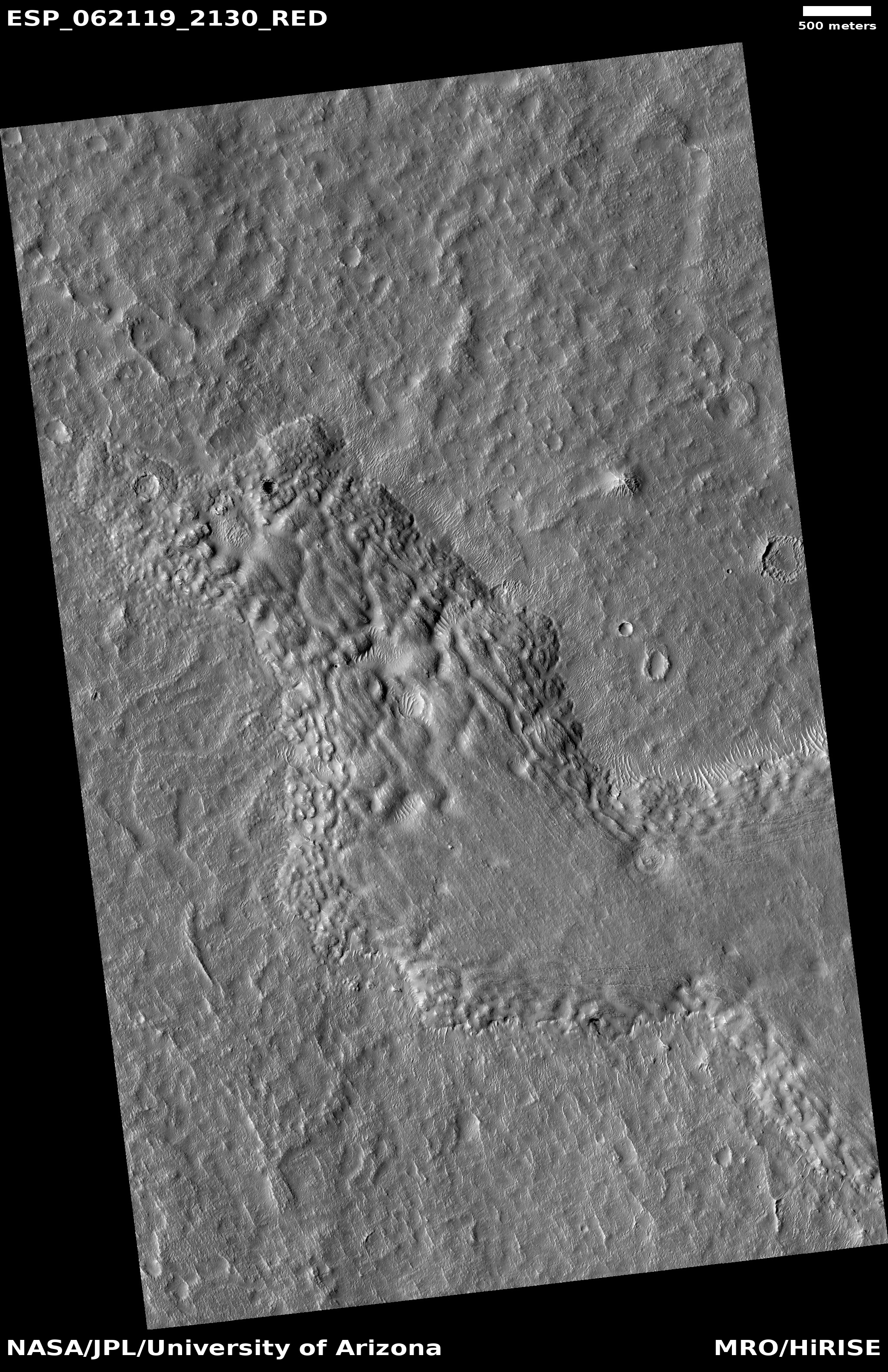
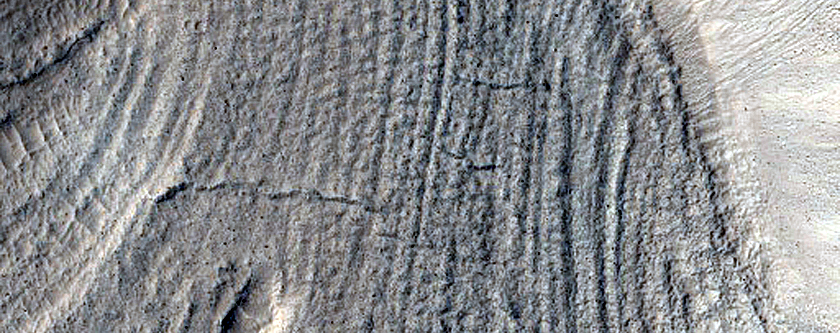
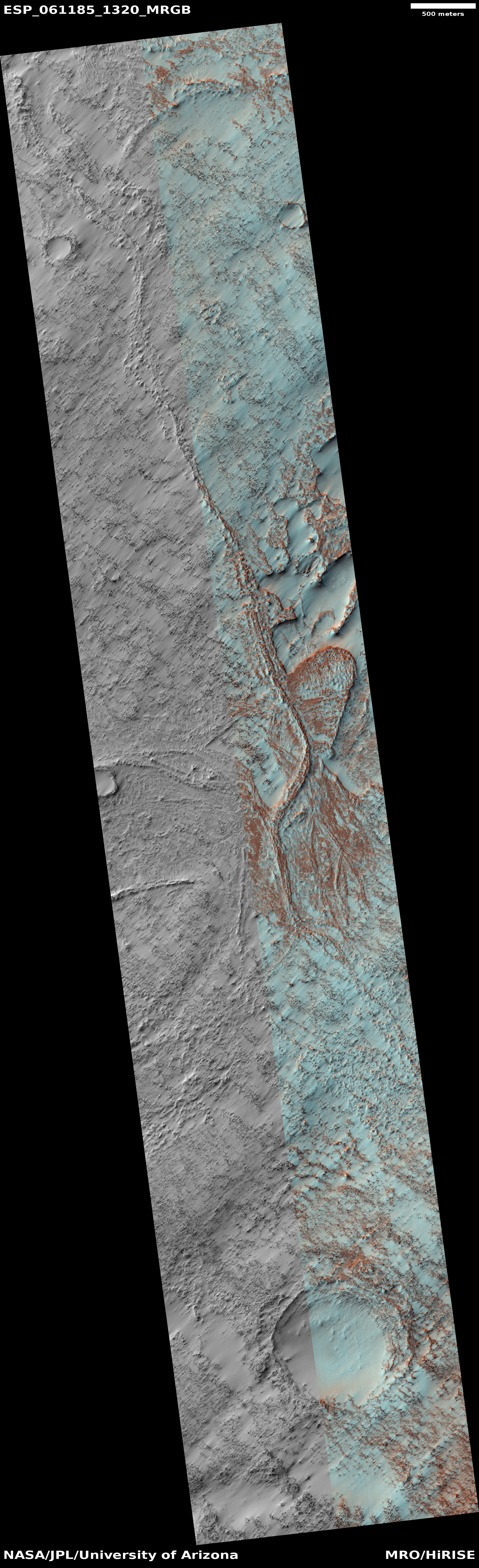
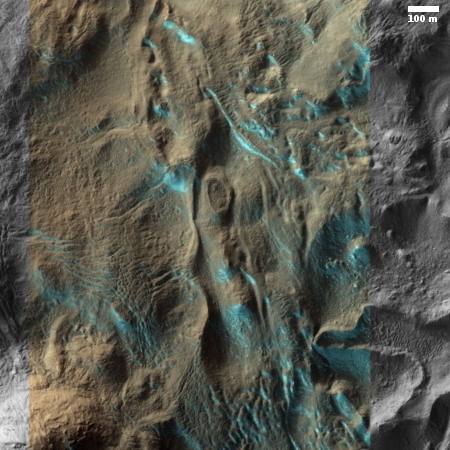
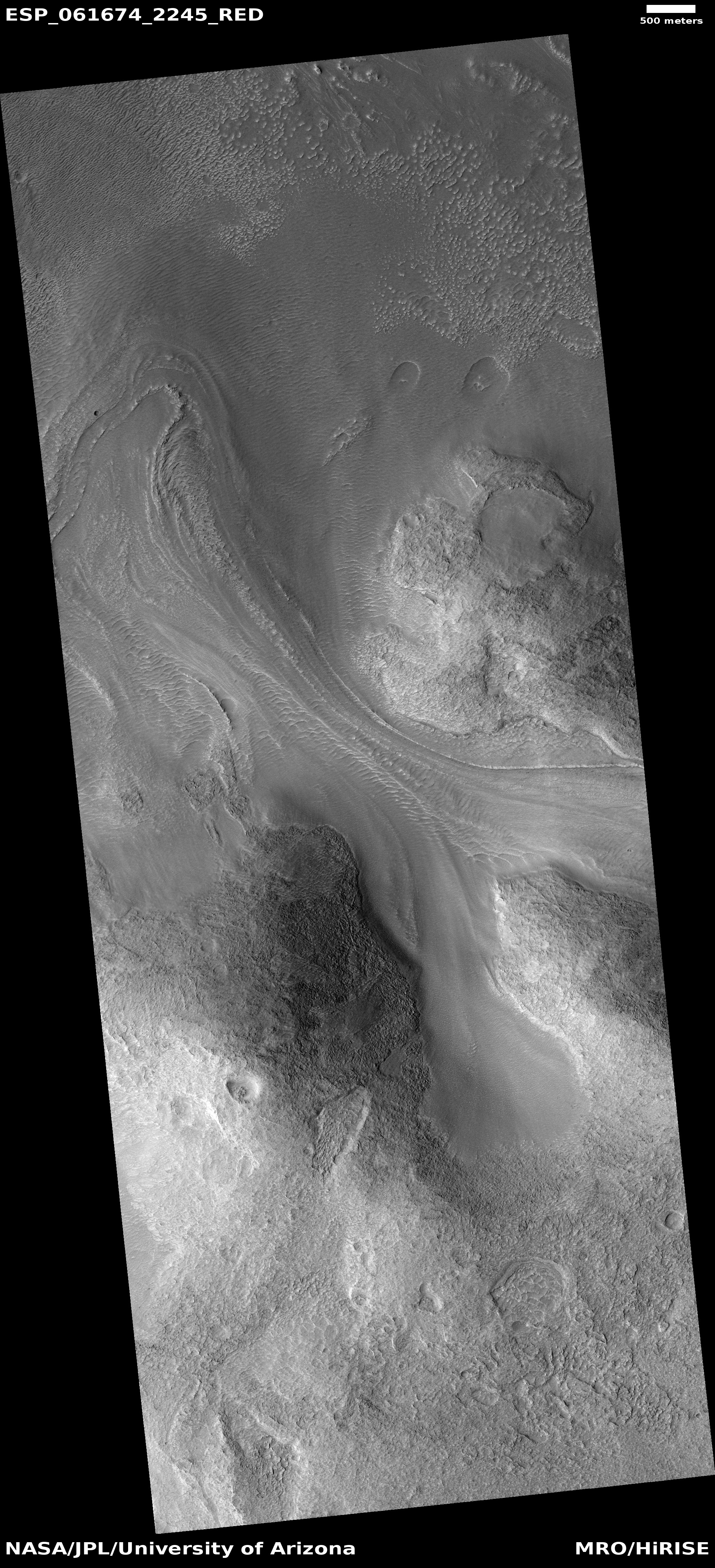
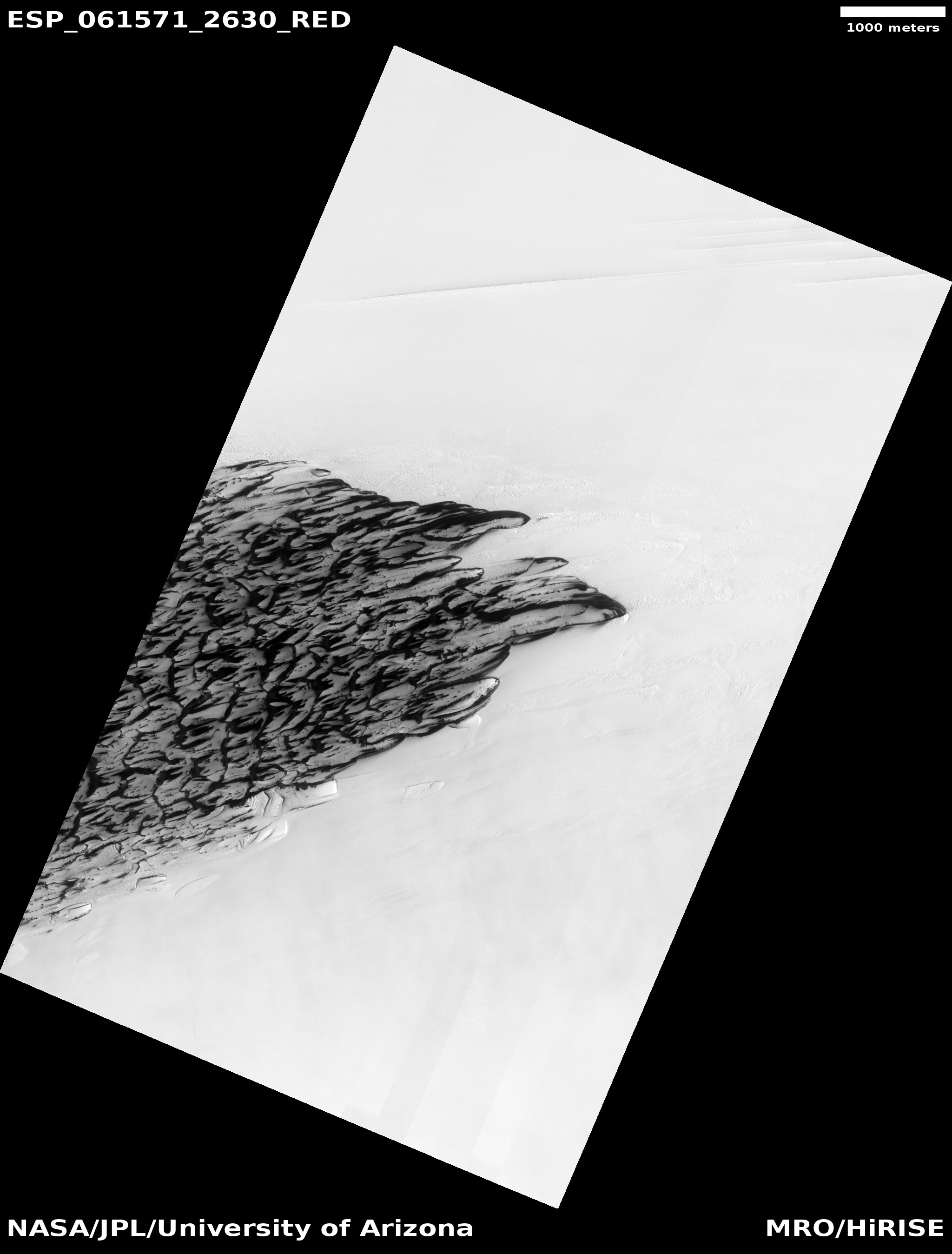
Cool image time! The photo to the right, cropped and reduced to post here, was taken on June 16, 2022 by the high resolution camera on Mars Reconnaissance Orbiter (MRO). It shows what the scientists have merely label “landforms.”

I instead call them strange. Clearly we are seeing exposed layering that surrounds the mesa in the middle of the image. This in turn suggests that the mesa top was once the surface of this whole region, and that region had been formed by the repeated placement of multiple sedimentary layers. Then, over time the surrounding terrain was eroded away, exposing those underlying layers.

Even so, some of the parallel lines do not appear to be layers, but striations etched into the ground. To get a better look, the white box marks the area covered by a full resolution close-up below.
» Read more

1 comment

Glacial flows pushing out through a Martian crater rim

Wider view of 6-mile-wide crater
Click for full image.

Today’s cool image once again illustrates how Mars is far from a waterless planet. Instead, there is strong evidence that water ice can be found across most of the Red Planet’s surface, excluding the equatorial regions lower than 30 degrees latitude.

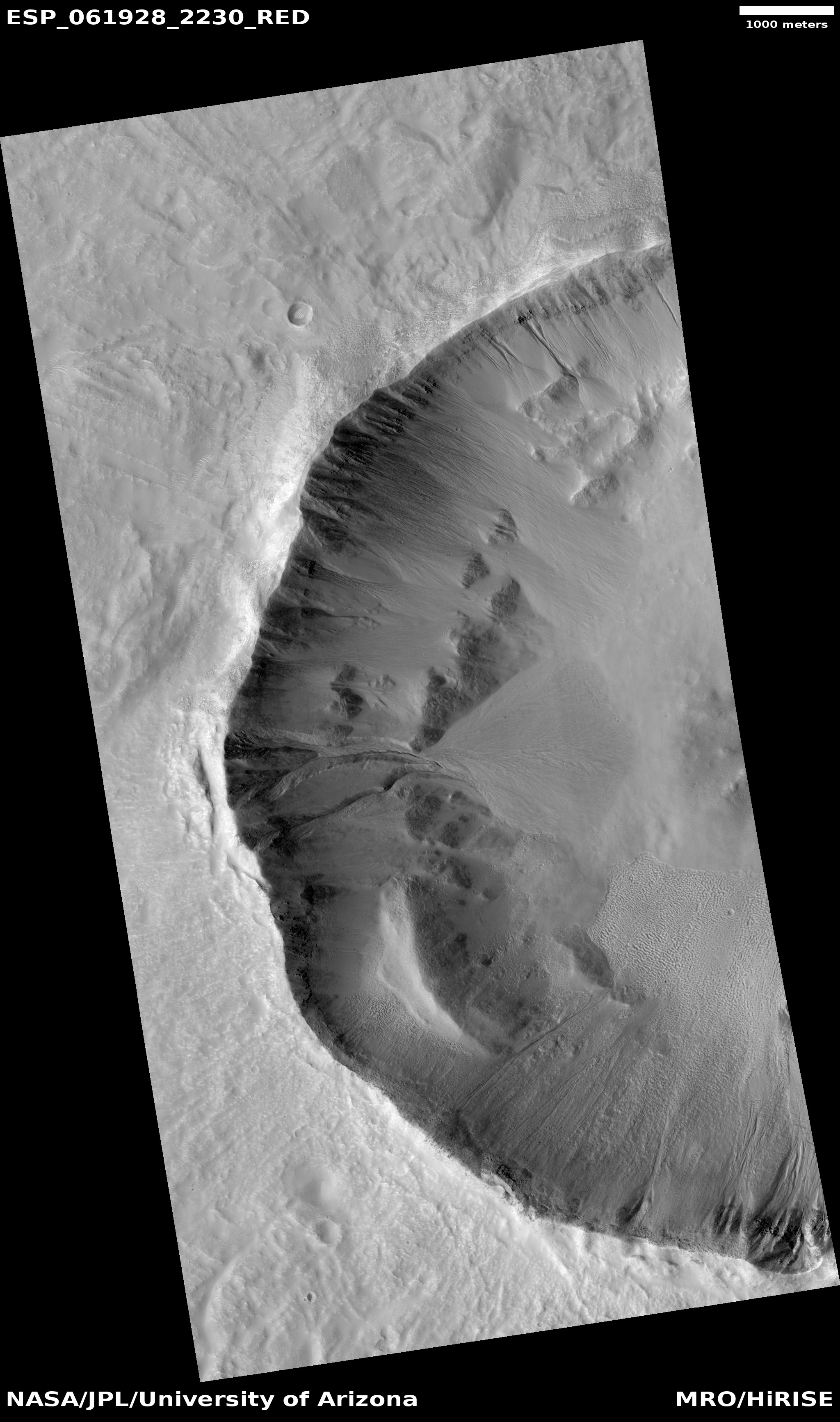
The photo to the right was taken on September 11, 2021 by the wide view context camera on Mars Reconnaissance Orbiter (MRO). It shows a 6-mile-wide unnamed crater on Mars, located at 35 degrees south latitude, with what appears to be a glacier in its interior, flowing to the southwest towards several breaches in the crater’s southwest rim. Several of those breaches now sit higher than the flow, suggesting that the glacier itself was once higher and flowed out of those gaps. Now the level has dropped, and the only place the glacier exits the crater is the central gap at the center of the white rectangle.

That white rectangle marks the area covered by a recent MRO high resolution image, taken on March 29, 2022 and cropped and reduced to post below.
» Read more

1 comment

Ice in the Martian equatorial region?

Global overview of ice on Mars

Glacial features in low latitude Martian crater

Today’s cool image to the right, rotated, cropped, and reduced to post here, is actually an older captioned image, published in 2017 by the science team for the high resolution camera on Mars Reconnaissance Orbiter (MRO). I missed its significance when it was first released. From the caption by Alfred McEwen of the Lunar & Planetary Laboratory in Arizona:

The material on the floor of this crater appears to have flowed like ice, and contains pits that might result from sublimation of subsurface ice. The surface is entirely dust-covered today. There probably was ice here sometime in the past, but could it persist at some depth?

This crater is at latitude 26 degrees north, and near-surface ice at this latitude (rather than further toward one of the poles) could be a valuable resource for future human exploration.

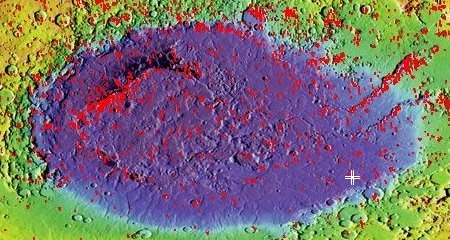
As shown in the global map of Mars above, this 26-mile-wide unnamed crater, marked by the black cross, is well inside the equatorial region 30 degrees north and south from the equator where almost no evidence of near surface ice has been found. Whenever I look at an image from MRO, if the picture appears to show ice or glacial features, its latitude is always 30 degrees or higher. If it does not, it is almost always in this equatorial region.

This crater however shows evidence of glacial features in its interior, but is far closer to the equator than normal. How could this be? It is possible that its high altitude, sitting in the southern cratered highlands, might have helped preserve its buried but near surface glacial features.

Regardless, as McEwen notes, its location closer to the equator is tantalizing, because it suggests that such ice could exist even in the equatorial regions, though buried and thus not detected by the instruments presently available in Mars orbit.

0 comments

Inverted Martian tadpole

Inverted Martian tadpole
Click for full image.

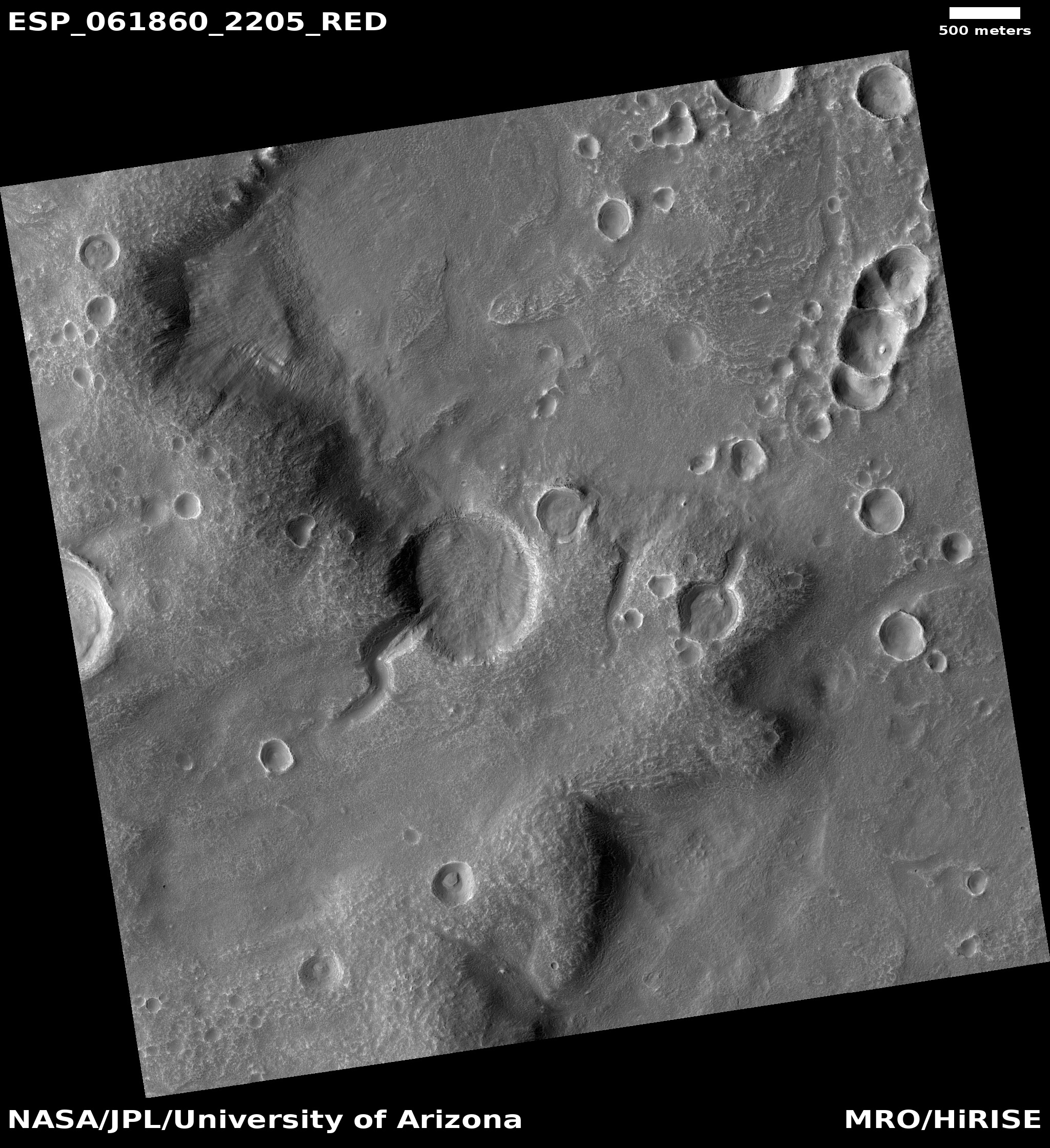
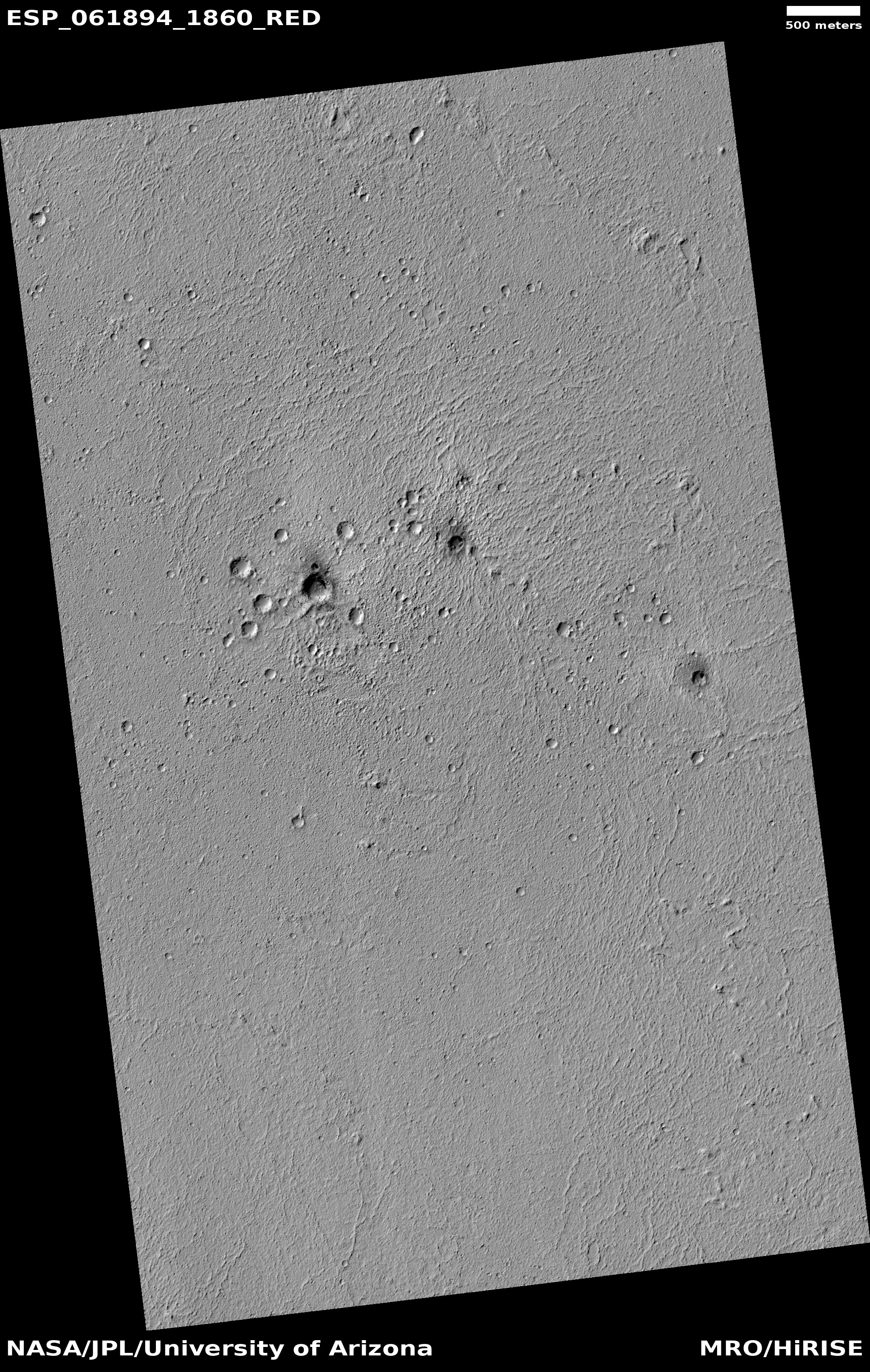
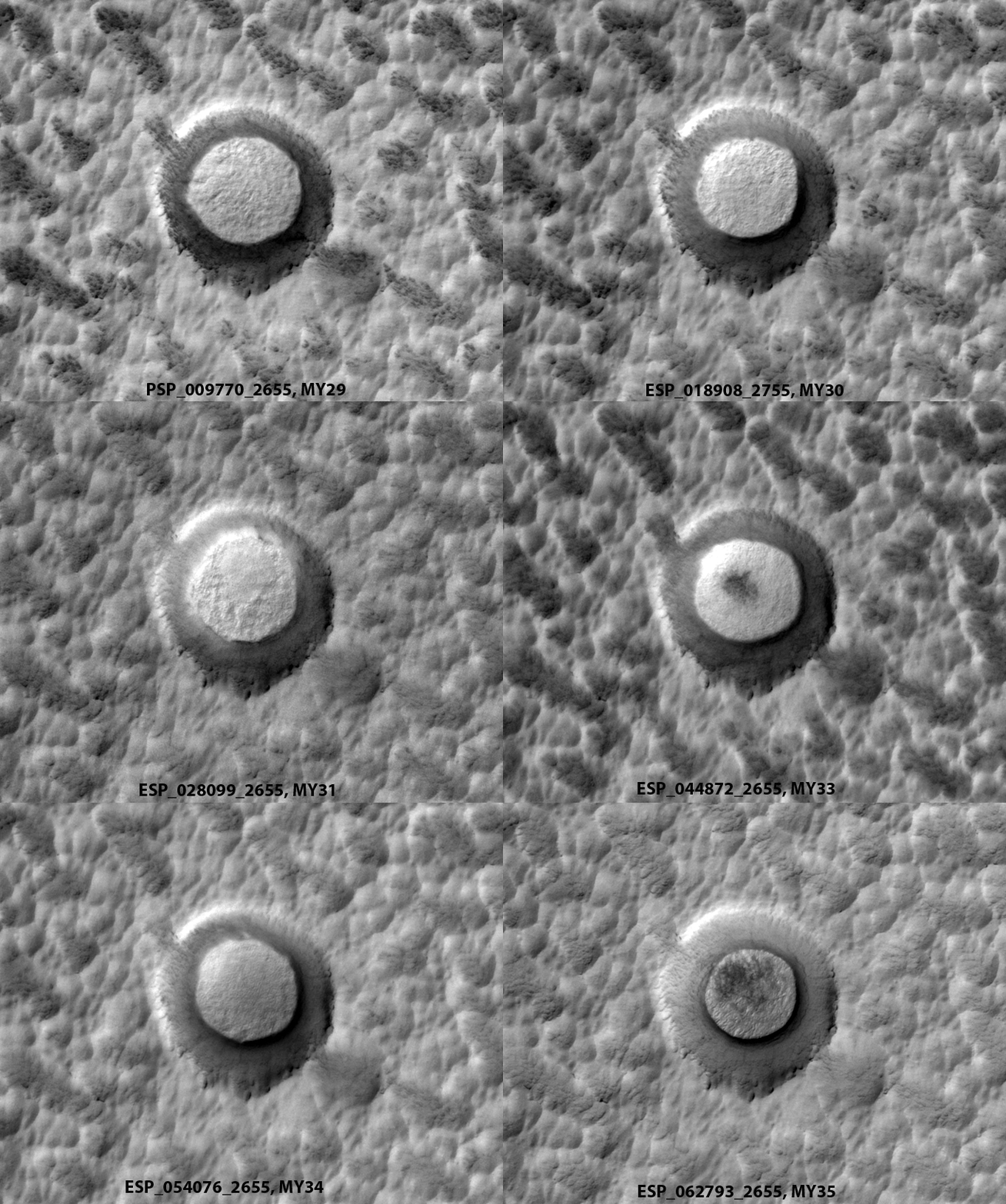
Cool image time! On Mars it is not unusual to see what scientists call tadpole features, craters with meandering canyons or channels either flowing into or out from the crater’s rim. The photo to the right, rotated, cropped, and reduced to post here, is another example, though with one major difference. The channel and crater are inverted, with the channel instead a ridge and the crater a circular plateau. The picture itself was taken on April 16, 2022 by the high resolution camera on Mars Reconnaissance Orbiter (MRO).

Orbital images have found on Mars a lot of what scientists call pedestal craters, where the impact packed and hardened the ground under the crater so that when the surrounding terrain eroded away the crater remained, as a plateau.

Scientists have also found on Mars a lot of what they call “inverted channels,” places where the channels of a drainage pattern followed the same geological process, becoming more resistant to erosion so that over time it turned from a channel to a ridge.

Here we have a combination of both. The overview map below provides us the larger picture.
» Read more

0 comments

The very end of an 800-mile-long Martian canyon

The very end of an 800-mile-long Martian canyon
Click for full image.

Cool image time! While most geeks interested in Mars are familiar with Valles Marineris, the largest canyon in the solar system, Mars has other large canyons that while not a big are impressive in their own right. The picture to the right, rotated, cropped, and reduced to post here, shows us the very very end of one such canyon. Taken on April 19, 2022 by the high resolution camera on Mars Reconnaissance Orbiter (MRO), it shows the easternmost spot where Cerberus Fossae begins. From here, this narrow fracture-caused canyon extends another 800 miles to the west, sometimes splitting into two or three parallel cracks, but always oriented in the same direction, slightly north of due west.

The overview map below provides the context and wider view.
» Read more

3 comments

Martian terraces

Overview map
Glacier country on Mars

Martian terraces
Click for full image.

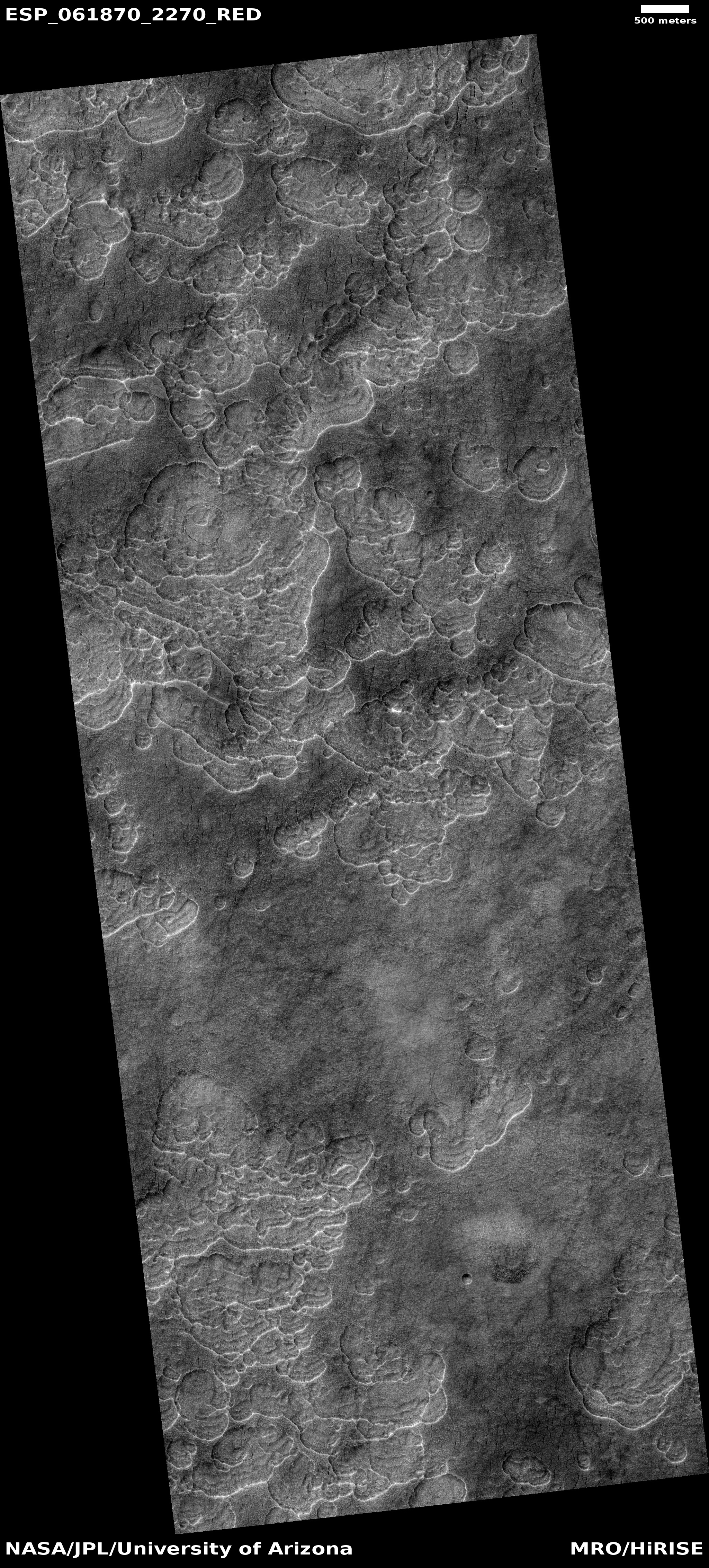
Cool image time! The photo to the right, cropped and reduced to post here, was taken on May 17, 2022 by the high resolution camera on Mars Reconnaissance Orbiter (MRO). It shows what the scientists have labeled “Dipping layers against mound in Deuteronilus Mensae.”

Deuteronilus is the westernmost mensae region in the 2,000-mile-long strip of heavy glaciers found in the northern mid-latitudes that I dub glacier country. This photo, the location of which is marked by the white cross on the overview map above, is another example, though somewhat strange and puzzling. Normally the layers will dip away from the high point. Here, the layers dip towards the mound. I can think of only one explanation, that of prevailing winds causing the erosion in this unusual manner, but I also find that explanation very unsatisfactory.

The layers themselves illustrate the cycles that have shaped Martian geology, caused by the wide swings in the planet’s rotational tilt, from 11 to 60 degrees. When that tilt is high, the poles are warmer than the mid-latitudes, and water ice migrates from the poles towards the equator. When the tilt is low, the mid-latitudes are warmer, and the water ice heads back towards the poles. Thus, the many many layers the orbiters and rovers are now finding everywhere on Mars.

Right now scientists think, because Mars’ tilt is in the middle of these swings at 25 degrees, the planet is in equilibrium, with the water at the poles and mid-latitudes essentially going no where. This conclusion however is not yet confirmed.

0 comments

Layered mesa on Mars

Layered mesa on Mars
Click for full image.

Cool image time! The photo to the right, cropped and reduced to post here, was taken on May 26, 2022 by the high resolution camera on Mars Reconnaissance Orbiter (MRO). It shows a mesa about three quarters of a mile in length that appears to be many-layered, from top to bottom.

The brightness of the mesa, compared to the surrounding plains, also emphasizes the different layers, though in this case it suggests two major epochs where the material being laid down in each was fundamentally different.

Or the difference could simply mean that the surrounding terrain is covered with dust, hiding its true color.

There is no question that winds in the thin Martian atmosphere have contributed to the erosion that formed this mesa, much like the buttes in the American southwest are shaped by winds. Whether water was a factor for this Martian butte is far less certain.

The overview map below provides context.
» Read more

1 comment

Icy scarps in the high southern latitudes of Mars

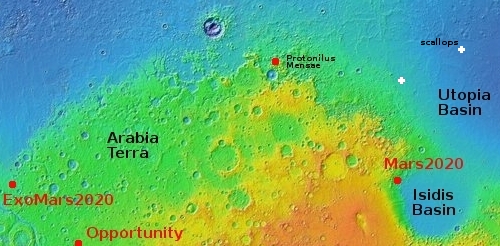
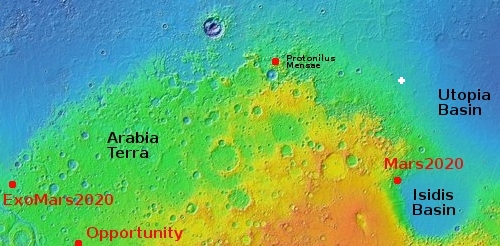
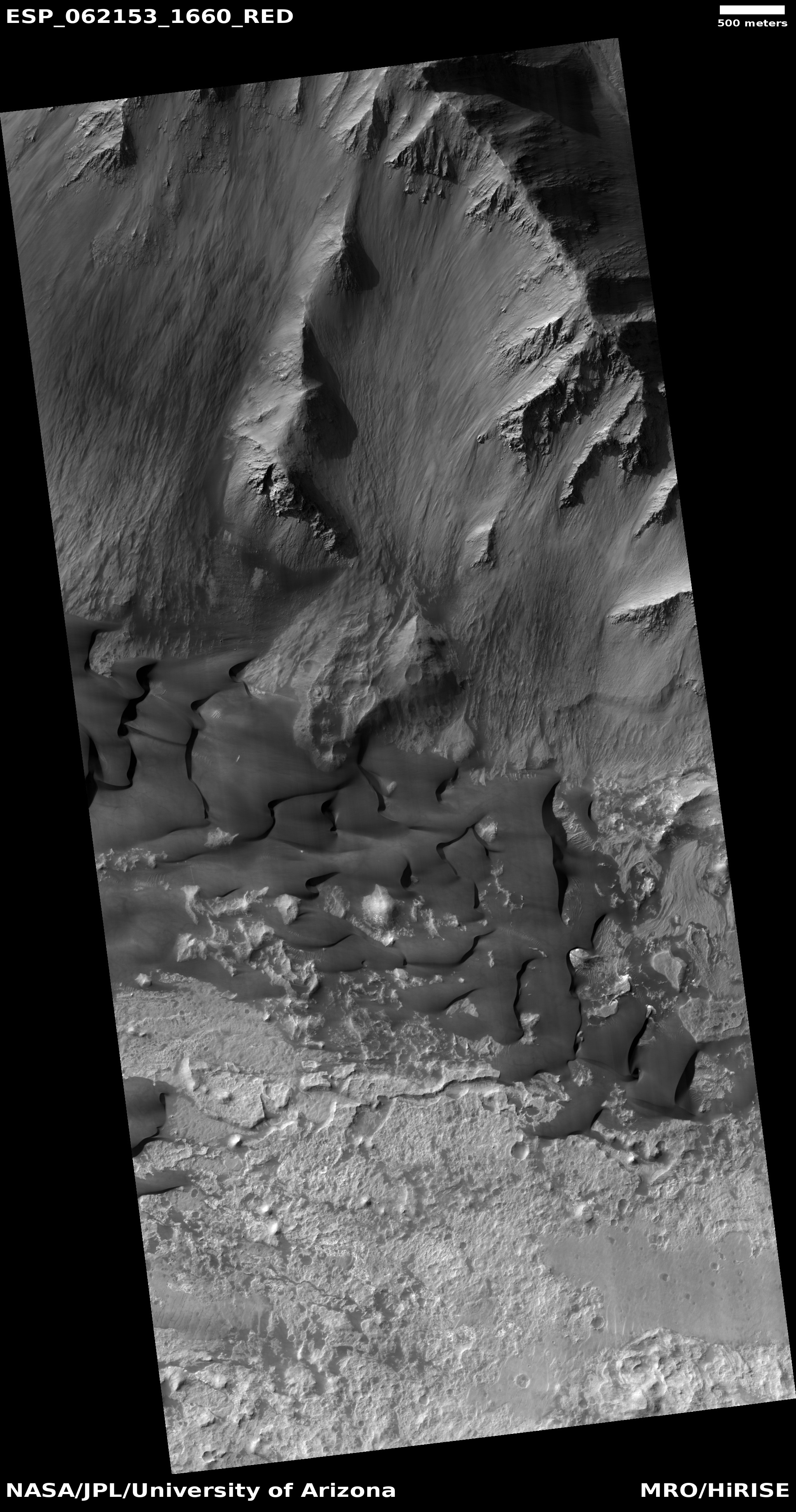
Icy scallops in the high southern latitudes of Mars
Click for full image.

Cool image time! The photo to the right, rotated, cropped, and reduced to post here, was taken on May 30, 2022 by the high resolution camera on Mars Reconnaissance Orbiter (MRO). It shows what the scientists label “Patching Mantling Unit,” located at about 57 degrees south latitude in a region where scientists have found good evidence of near surface ice. The top layer, or mantle, is likely patchy because it has a high content of water ice and is sublimating away. That almost all the cliffs are south-facing, which in the southern hemisphere gets the least direct sunlight, supports this supposition. For example, in the crater at the bottom of the image the ice would have disappeared first from the north-facing interior rim slopes, with the sublimation slowly working its way northward. Thus we have that butte extending out from the north rim.

The global map below not only indicates the location of these scallops with the green dot, it illustrates the overall icy nature of most of the Mars.
» Read more

0 comments

The highest point on Mars

The highest point on Mars
Click for full image.

Today’s cool image is cool not because of anything visible within it, but because of its location. The picture to the right, cropped to post here, was taken on May 27, 2022 by the high resolution camera on Mars Reconnaissance Orbiter (MRO). While the terrain shown is a relatively featureless plain of craters and gullies not unlike the surface of the Moon, what we are really looking at is the peak of Mars’ tallest mountain, Olympus Mons.

That’s right, this spot on Mars sits about 70,000 feet above Mars’ mean “sea level”, the elevation scientists have chosen as the average elevation on Mars from its center. At 70,000 feet, this peak is more than twice as high as Mount Everest on Earth.

Yet you wouldn’t really know you are at this height if you stood there. The scale of this mountain is so large that this peak, which actually forms the southern rim of the volcano’s 50 to 60 mile wide caldera, is actually relatively flat. If you stood here, you would not see the vast distant terrain far below. Instead, you’d see an ordinary horizon line in the near distance only slightly lower than where you stand.
» Read more

1 comment

Collapse pits on Mars

Elongated collapse pit on Mars
Click for full image.

Cool image time! The photo to the right, cropped to post here, was taken on May 21, 2022 and was today’s picture of the day from the high resolution camera on Mars Reconnaissance Orbiter (MRO). Dubbed “An Elongated Collapse Pit” by the science team, their caption explains:

This observation can help to tell whether or not there is a subterranean connection to this pit. As an added bonus, the much smaller depression to its south also appears to be another collapse pit.

This image had already been in my queue for a future cool image post, but since the scientists have posted it, it is time that I did as well.

In the inset I have brightened the image drastically to try to illuminate the darkest spots in both pits. The elongated pit appears to slope downward towards a hole in the southeast corner, while the interior of the second pit to the south remains completely dark. Both appear to suggest a void below that both reach.

The wider context image and overview map below shows that there is further evidence of more voids in this region of Mars, dubbed Ceraunius Fossae, because of its many north-south parallel fissures.
» Read more

3 comments

The colorful layers of the Martian north pole icecap

Colorful layers in the Martian north pole ice cap
Click for full image.

Wider view
Click for full image.

Today’s cool image above, rotated, reduced, and annotated to post here, comes from today’s picture of the day for the high resolution camera on Mars Reconnaissance Orbiter (MRO), which in turn is a retrospective of a captioned image first taken in 2010. The photo to the right, rotated, cropped, and reduced to post here, shows a larger area to provide some context. For this image north is towards the top. The rectangle indicates the area covered by the picture above.

The ice cap at the north pole is about 600 miles across and a little less than 7,000 feet deep, made up of many layers that are a mixture of water ice and cemented dust and sand. From the picture’s caption:

In many locations erosion has created scarps and troughs that expose this layering. The tan colored layers are the dusty water ice of the polar layered deposits; however a section of bluish layers is visible below them. These bluish layers contain sand-sized rock fragments that likely formed a large polar dunefield before the overlying dusty ice was deposited.

The lack of a polar ice cap in this past epoch attests to the variability of the Martian climate, which undergoes larger changes over time than that of the Earth.

The overview map below provides some further context.
» Read more

1 comment

From the rim to the floor of Valles Marineris

Overview map

From the rim to the floor of Valles Marineris
Click for full image.

For today’s cool Martian image, we begin from afar and zoom in. The overview map above shows the solar system’s largest canyon, Valles Marineris, 1,500 miles long, and 400 miles wide at its widest. The white dot on the north rim of the section of the canyon dubbed Melas marks the location of the photo to the right, rotated, cropped and reduced to post here and taken on January 28, 2011 by the wide angle context camera on Mars Reconnaissance Orbiter (MRO).

I have added elevation numbers to this picture to give it some understandable scale. From the rim to the interior canyon floor — a distance of about ten miles — the canyon wall drops about 19,000 feet. Compare this with Bright Angel Trail in the Grand Canyon, which from the rim to the Colorado River drops about 4,400 feet in about the same distance. The wall of Valles Marineris is about four times steeper.

Even that doesn’t give you the full scale. Having hiked down to that interior canyon floor, you are still about 10,000 feet above Valles Marineris’s main canyon floor, with fifteen more miles of hiking to go to reach it.

The white rectangle marks the area covered by the MRO high resolution image below.
» Read more

0 comments
1 44 45 46 47 48 90