How did sand dunes get to the top of a Martian mesa?

Sand dunes at the top of a Martian mountain
Click for full image.

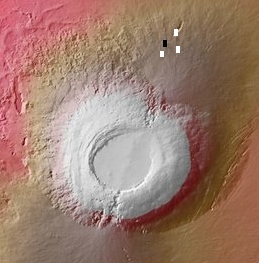
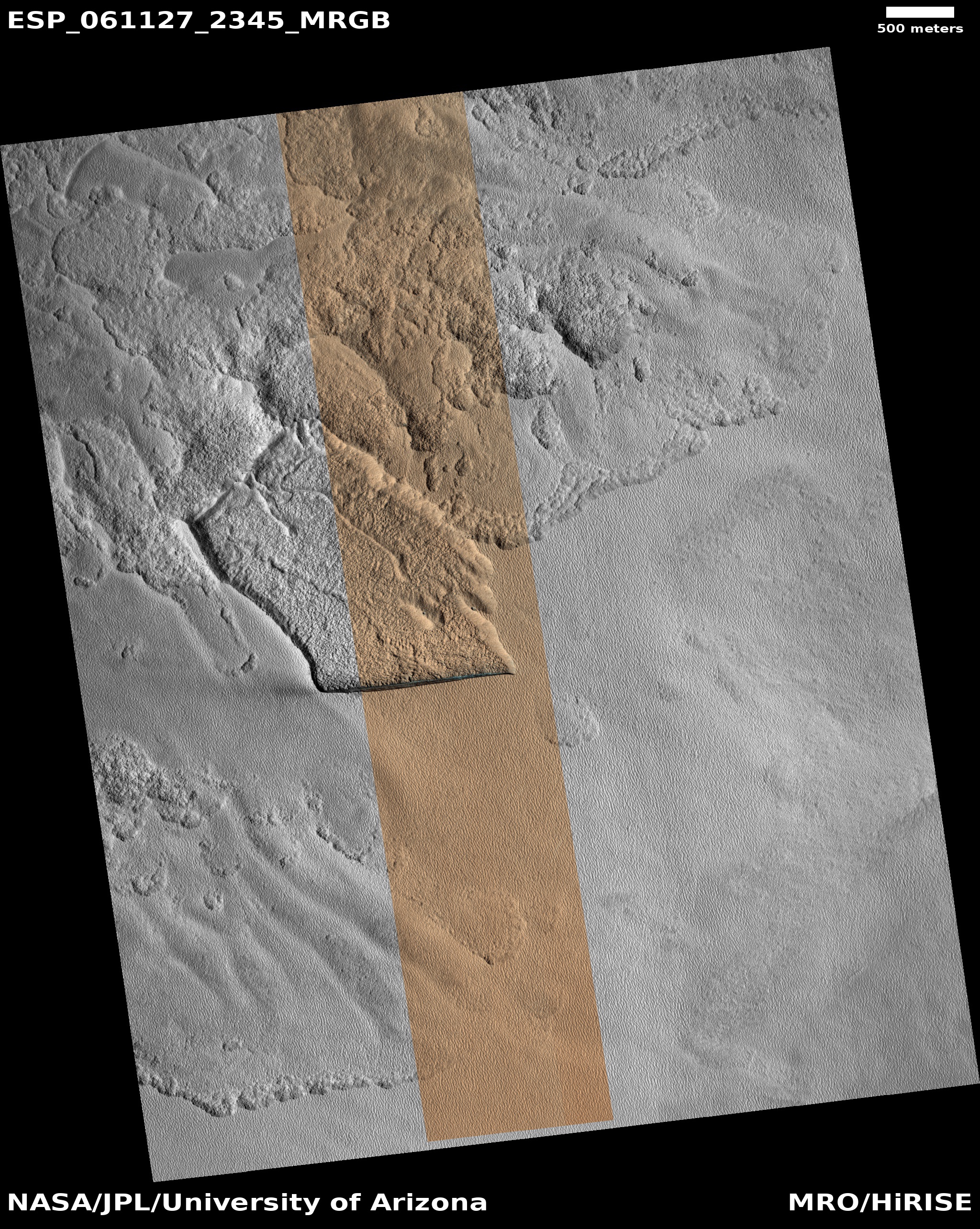
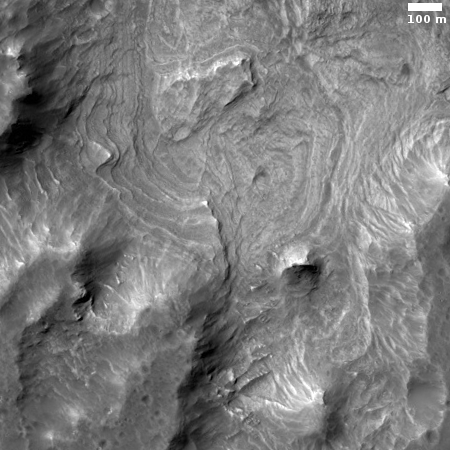
Cool image time! The photo to the right, cropped and reduced to post here, was taken on January 1, 2022 by the high resolution camera on Mars Reconnaissance Orbiter (MRO) and shows one of the peaks of a 5,000+ foot high mesa inside Juventai Chasma, one of Mars’ deep mostly-enclosed chasms north of Valles Marineris.

I grabbed this picture because its label, “Bedform Change Detection in Juventae Chasma”, suggested something had changed from past photos, probably related to the sand dunes that hug the upper slopes of this peak. Unfortunately, in comparing this image with the earliest high-res image taken by MRO back in February 2018, I could not spot any change, probably because the resolution of the pictures released is not as high as MRO’s raw images.

However, the caption written for that 2018 image tells us where that change has likely occurred:

This image reveals a unique situation where this small dune field occurs along the summit of the large 1-mile-tall [mesa] near the center of Juventae Chasma. The layered [mesa] slopes are far too steep for dunes to climb, and bedform sand is unlikely to come from purely airborne material. Instead, the mound’s summit displays several dark-toned, mantled deposits that are adjacent to the dunes and appear to be eroding into fans of sandy material.

In other words, somewhere in the full resolution image scientists have spotted a change in the bedform sands that make-up these high mountain dunes that hug the peak. Since the data so far has suggested that the source for the sand of these high elevation dunes likely comes from the mesa itself — not from any distant source — any change found will help confirm or disprove that hypothesis.

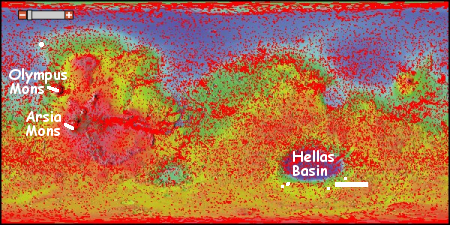
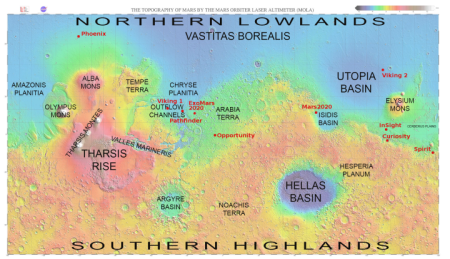
The white box indicates the area covered by the close-up higher resolution picture below. Also below is an overview map, showing both the location of this mountain in Juventai Chasma as well as Juventai’s location relative to Valles Marineris.
» Read more
1 comment

Strange pitted and isolated ridges on Mars

Context camera image of isolated ridges
Click for full image.

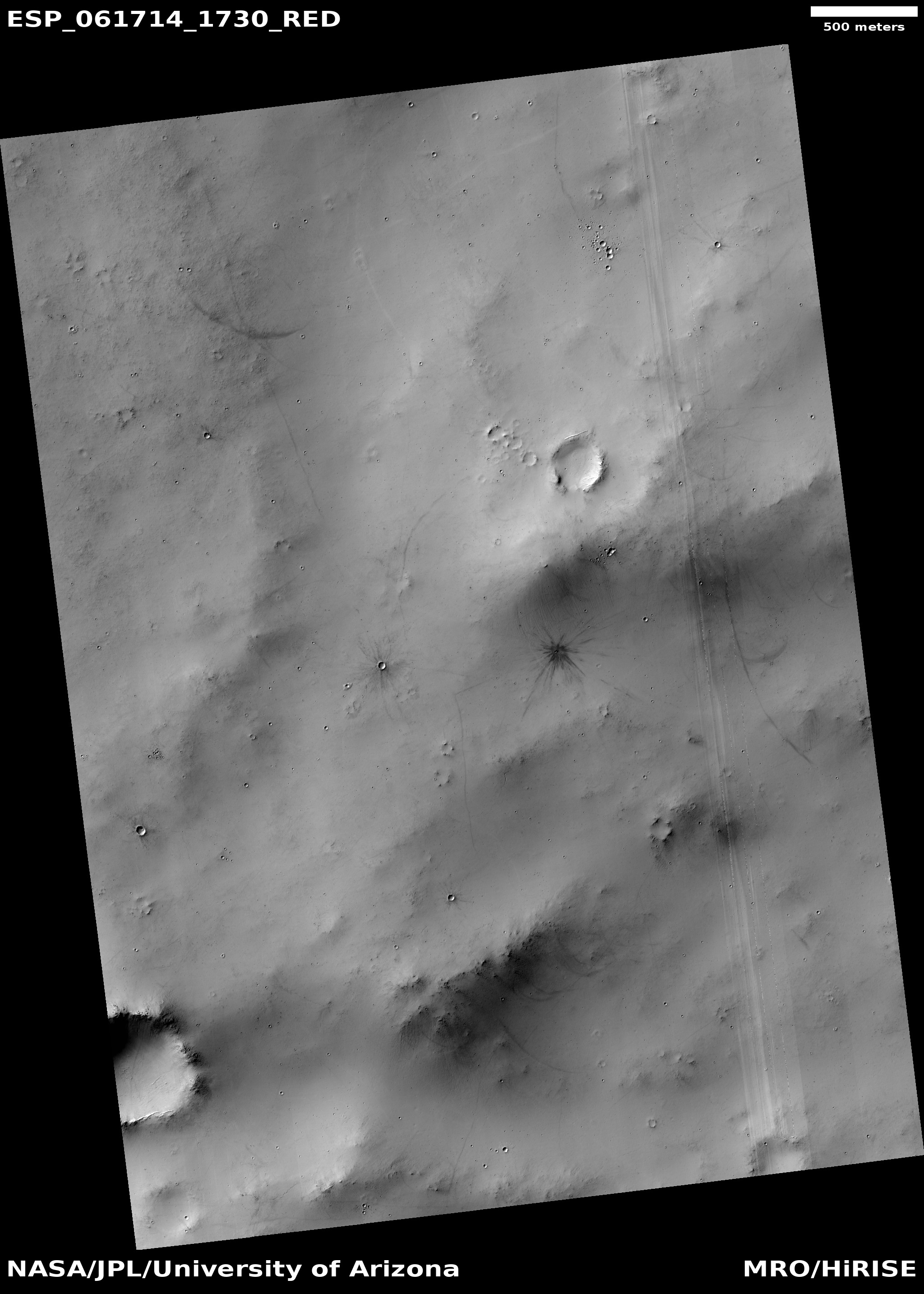
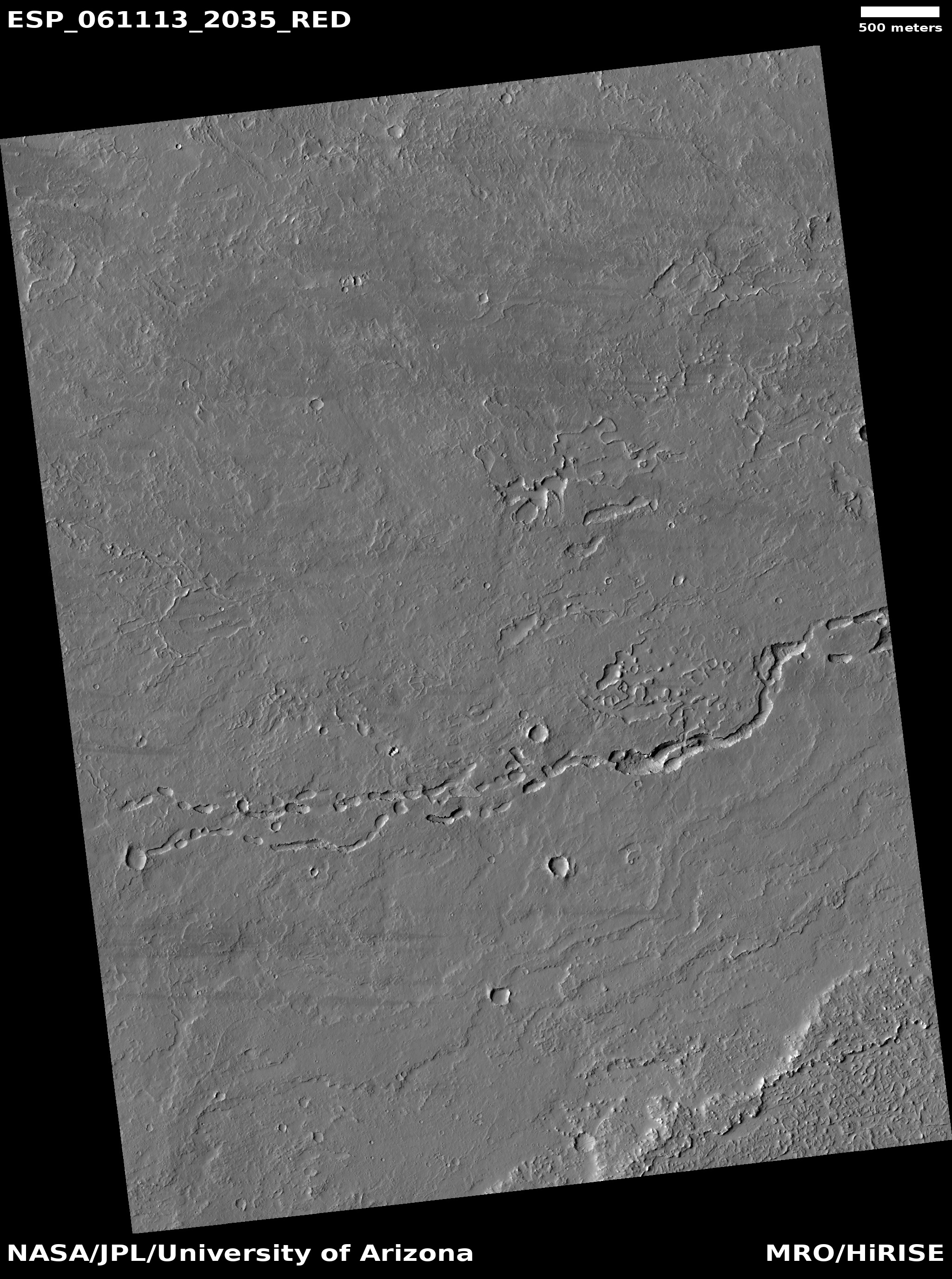
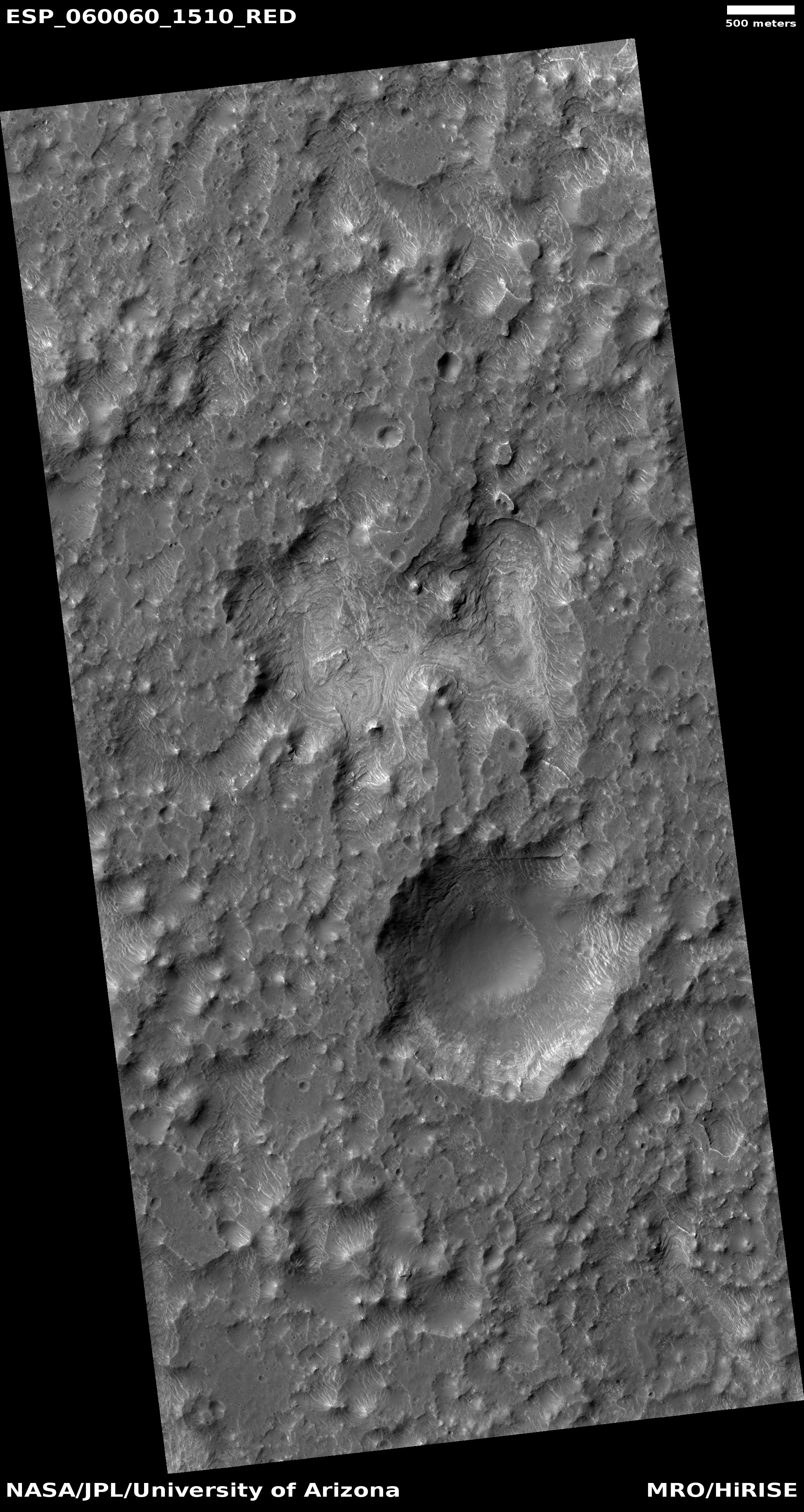
Cool image time! The photo to the right, rotated, cropped, and reduced to post here, was taken on February 17, 2012 by the wide-view context camera on Mars Reconnaissance Orbiter (MRO). It shows a section of the northern lowland plains of Mars, latitude 31 degrees north, where several very inexplicable and isolated ridges can be seen.

One ridge meanders mostly in a north-south direction, while a second instead meanders east-west. The shape of both says that neither has anything to do with any past impact crater. In fact, their random snakelike shape doesn’t really fit any obvious explanation. For example, they do not fit the look of the many fossil rivers found on Mars, where the hardened and dry riverbed channel resists erosion and becomes a ridge when the surrounding terrain erodes away.

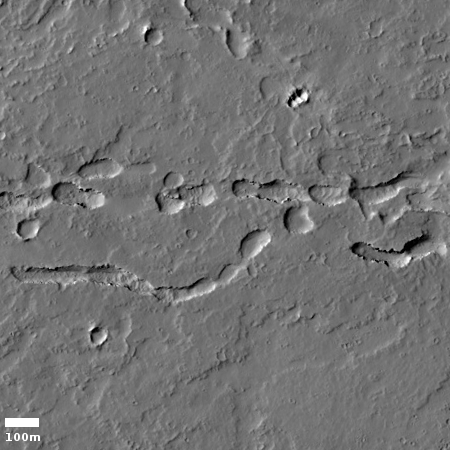
What geological process caused them? In the decade since this photo was taken the scientists who use MRO have only been able to snap a handful of high resolution images of these ridges. The image below is the most recent, covering the area in the white rectangle above.
» Read more
2 comments

Glacial features in a Mars crater at 29 degrees south latitude?

Glacial features in Mars crater
Click for full image.

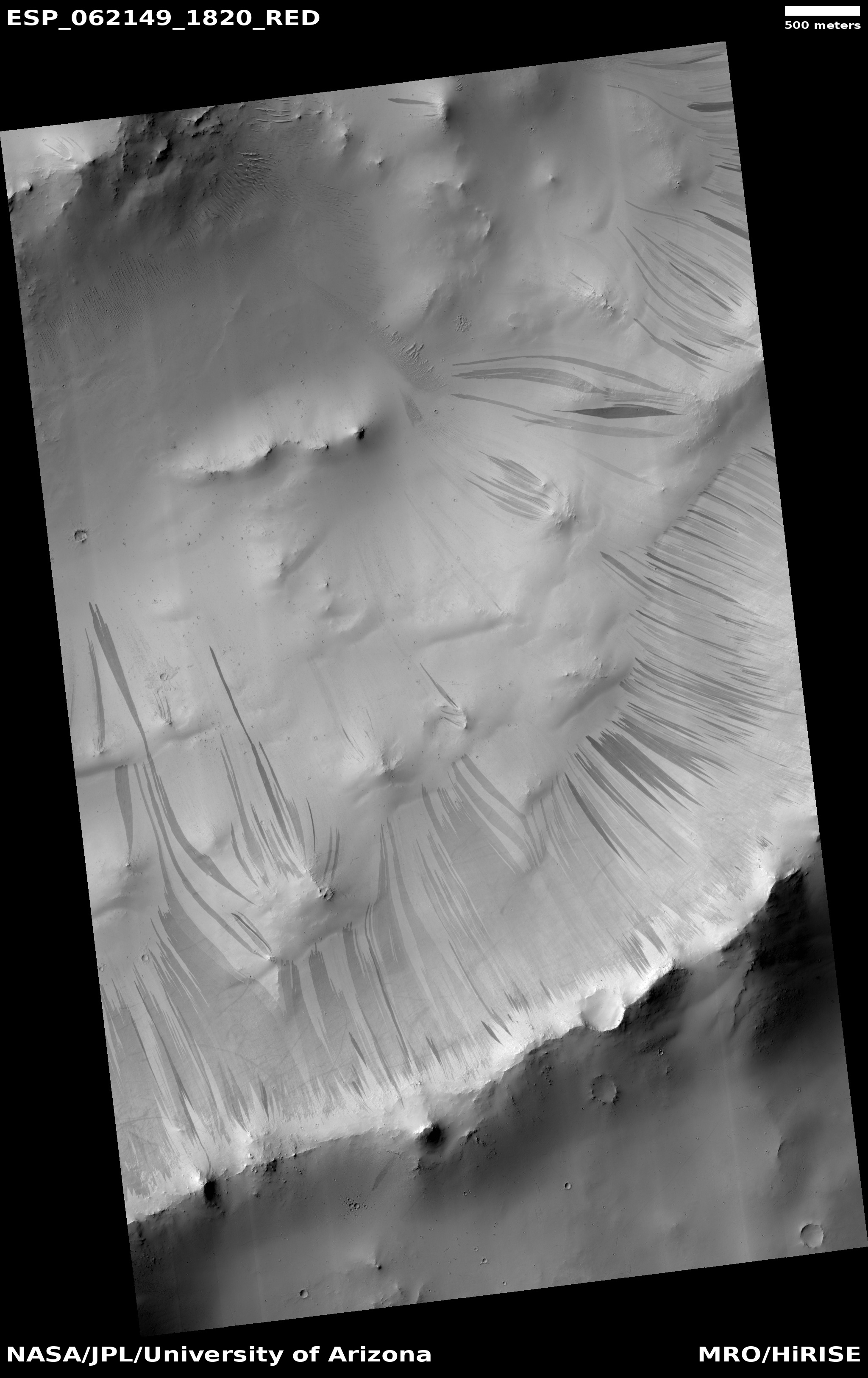
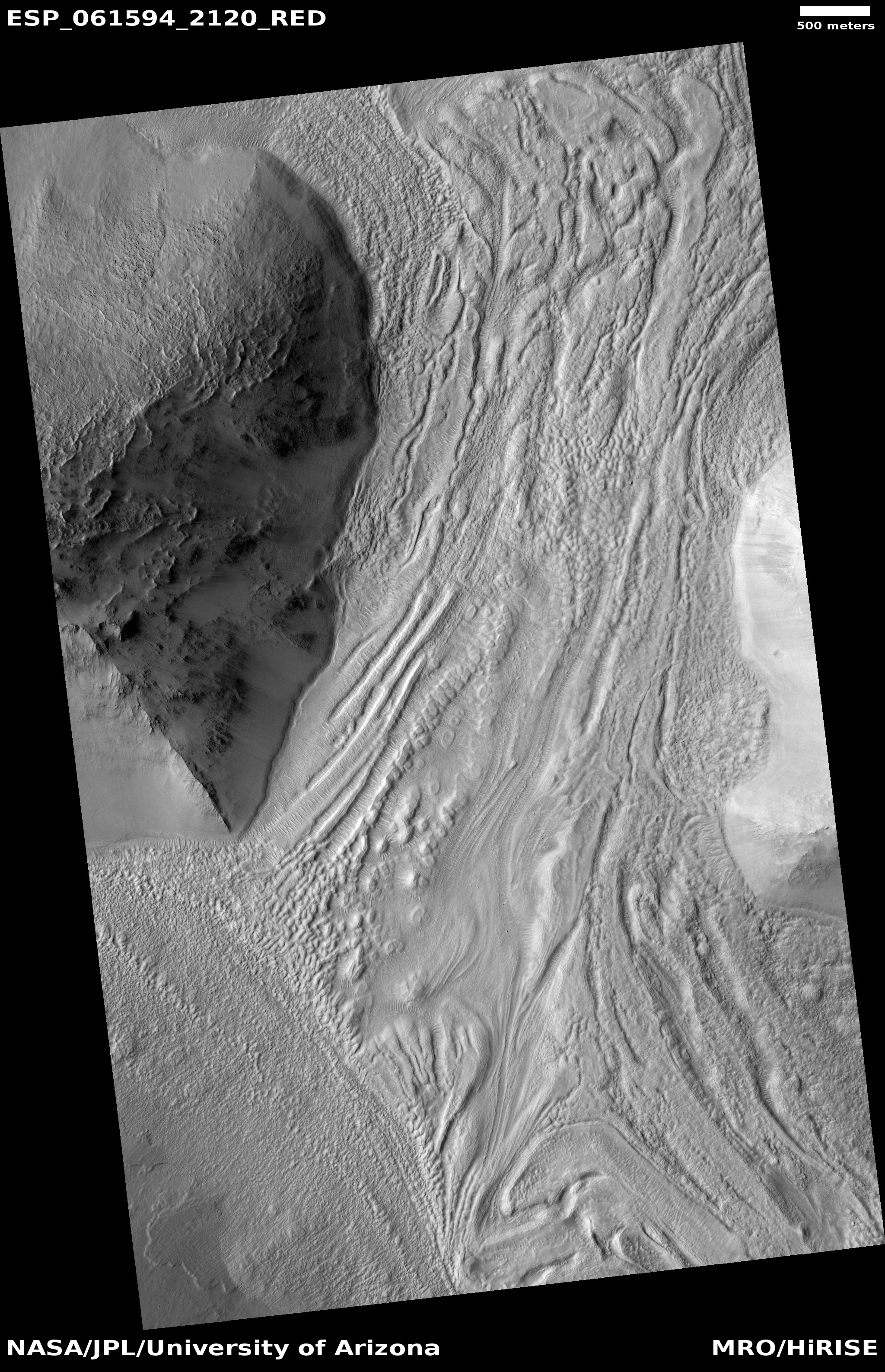
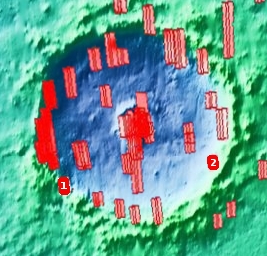
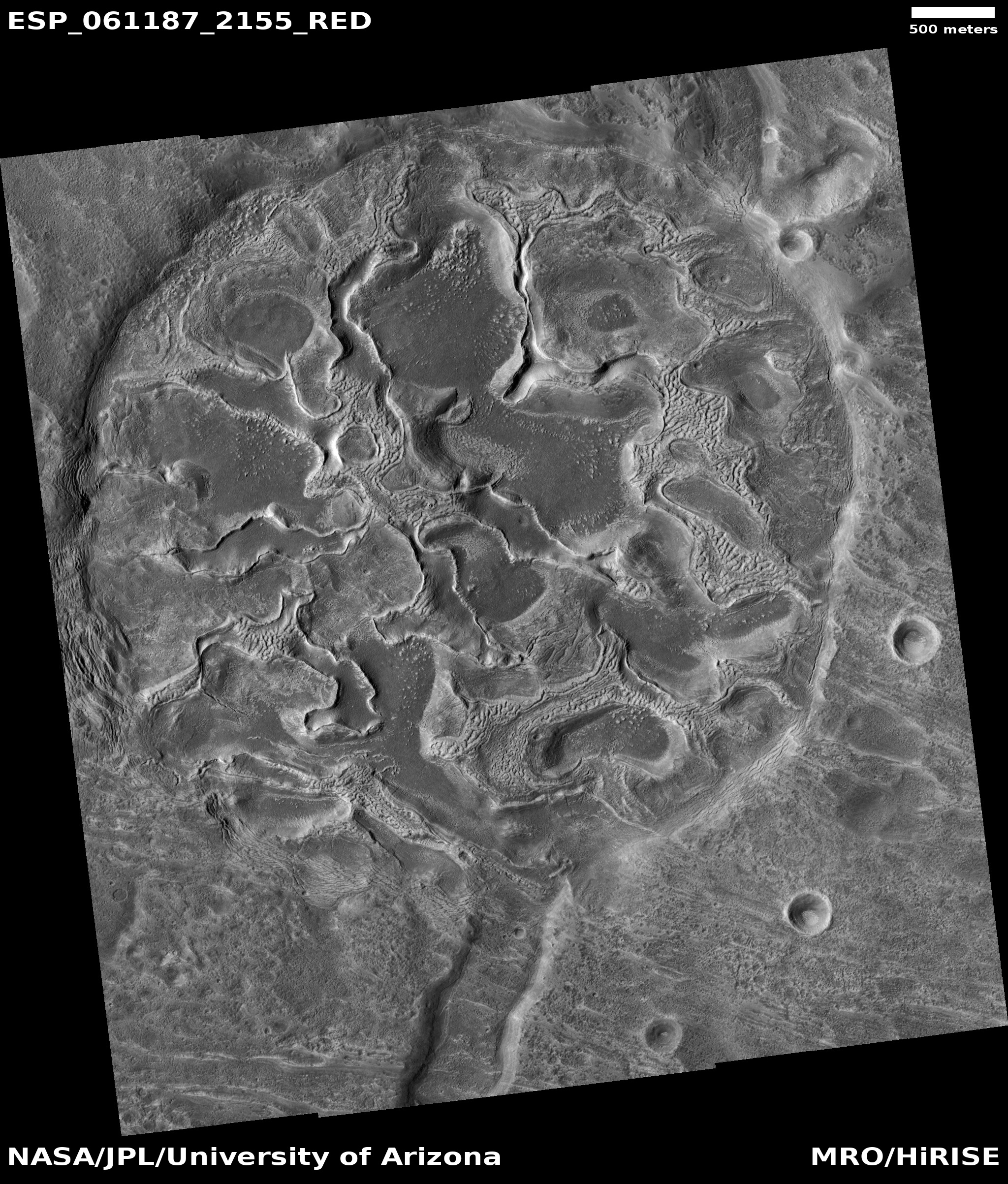
Cool image time! The photo to the right, cropped and reduced to post here, was taken on January 2, 2022 by the high resolution camera on Mars Reconnaissance Orbiter (MRO). Simply labeled “slope features,” it was likely taken to monitor the gullies and streaks on the interior walls of this 4-mile-wide crater. Scientists have been using MRO to track the coming and going of frost on this crater’s interior walls since 2016.

Equally intriguing however are what appear to be squashed layers within the crater’s interior. These appear to be some form of glacial feature created by repeated climate cycles, similar to the glacial features routinely seen throughout the 30 to 60 degree mid-latitude strips north and south.

What makes the glacial features in this particular crater particularly intriguing is its location, as shown in the overview map below.
» Read more

0 comments

Scientists want your help cataloging the clouds on Mars

In order to fully identify all the clouds seen in the sixteen years of data collected by the cloud instrument on Mars Reconnaissance Orbiter (MRO), scientists have now organized a citizen-scientist project to catalogue those clouds.

The project revolves around a 16-year record of data from the agency’s Mars Reconnaissance Orbiter (MRO), which has been studying the Red Planet since 2006. The spacecraft’s Mars Climate Sounder instrument studies the atmosphere in infrared light, which is invisible to the human eye. In measurements taken by the instrument as MRO orbits Mars, clouds appear as arches. The team needs help sifting through that data on Zooniverse, marking the arches so that the scientists can more efficiently study where in the atmosphere they occur.

You can join up by going here.

0 comments

A thick and syrupy flow on Mars

A thick and syrupy flow on Mars
Click for full image.

Overview map

Cool image time! The photo above, rotated, cropped, and reduced to post here, was taken on March 5, 2022 by the high resolution camera on Mars Reconnaissance Orbiter (MRO). It shows what the scientists label as a “viscous flow feature,” which is another way of saying the flow was thick and syrupy.

Nor is such a flow unusual in this area of Mars. It is located in a region of chaos terrain dubbed Protonilus Mensae, which is also the central mensae region in the 2,000-mile-long strip in the northern mid-latitudes of Mars I label glacier country. The overview map above of Protonilus Mensae — covering about 500 miles in width — shows how common such flows are in this place. The black rectangles mark the locations of other cool images I have featured, as follows:

The red rectangle indicates the location of today’s cool image.

The glacial aspect of everything in this region is even more emphasized by the wider view provided by MRO’s context camera below.
» Read more
1 comment

A snakelike Martian ridge

A snakelike Martian ridge
Click for full image.

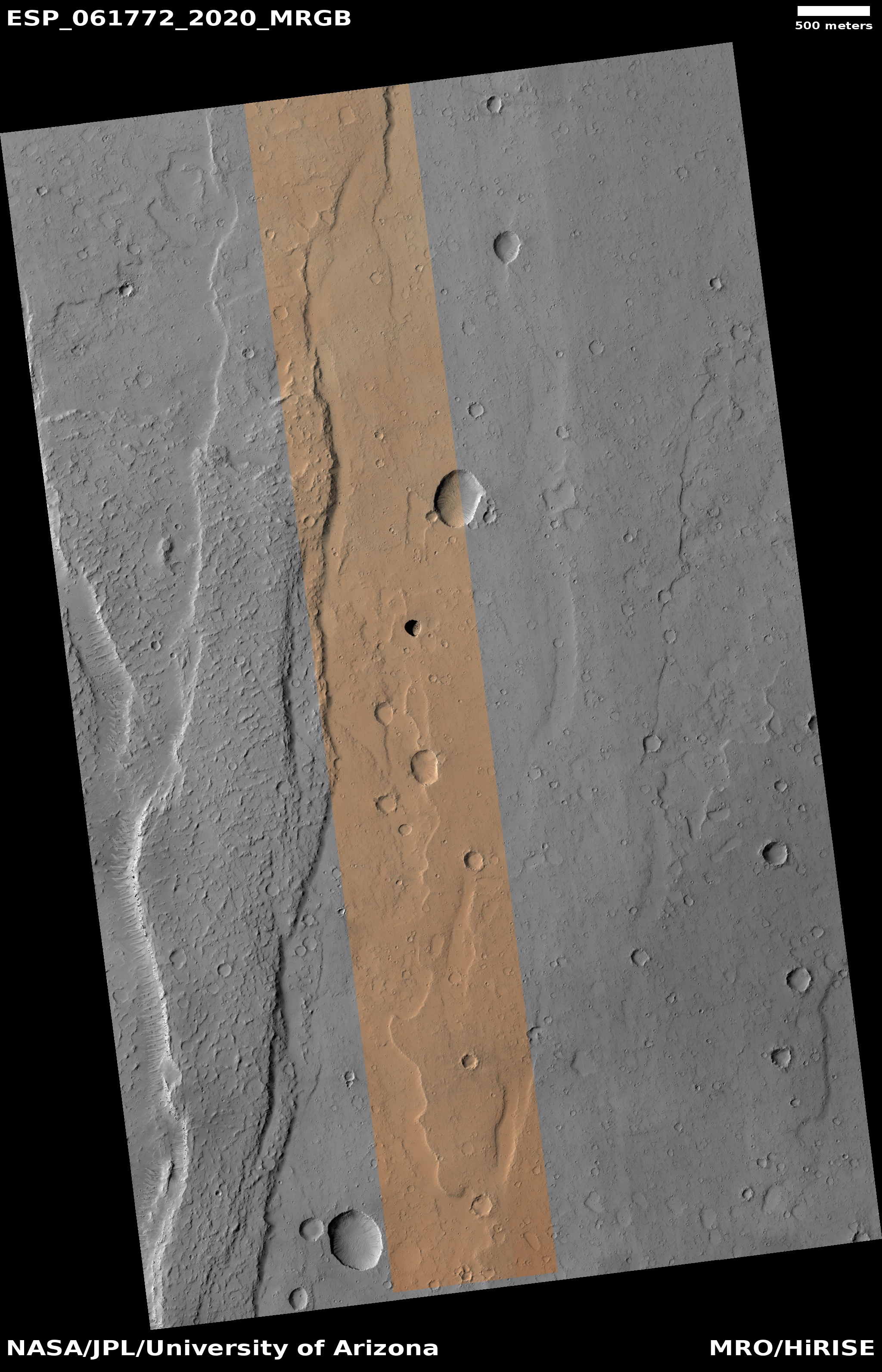
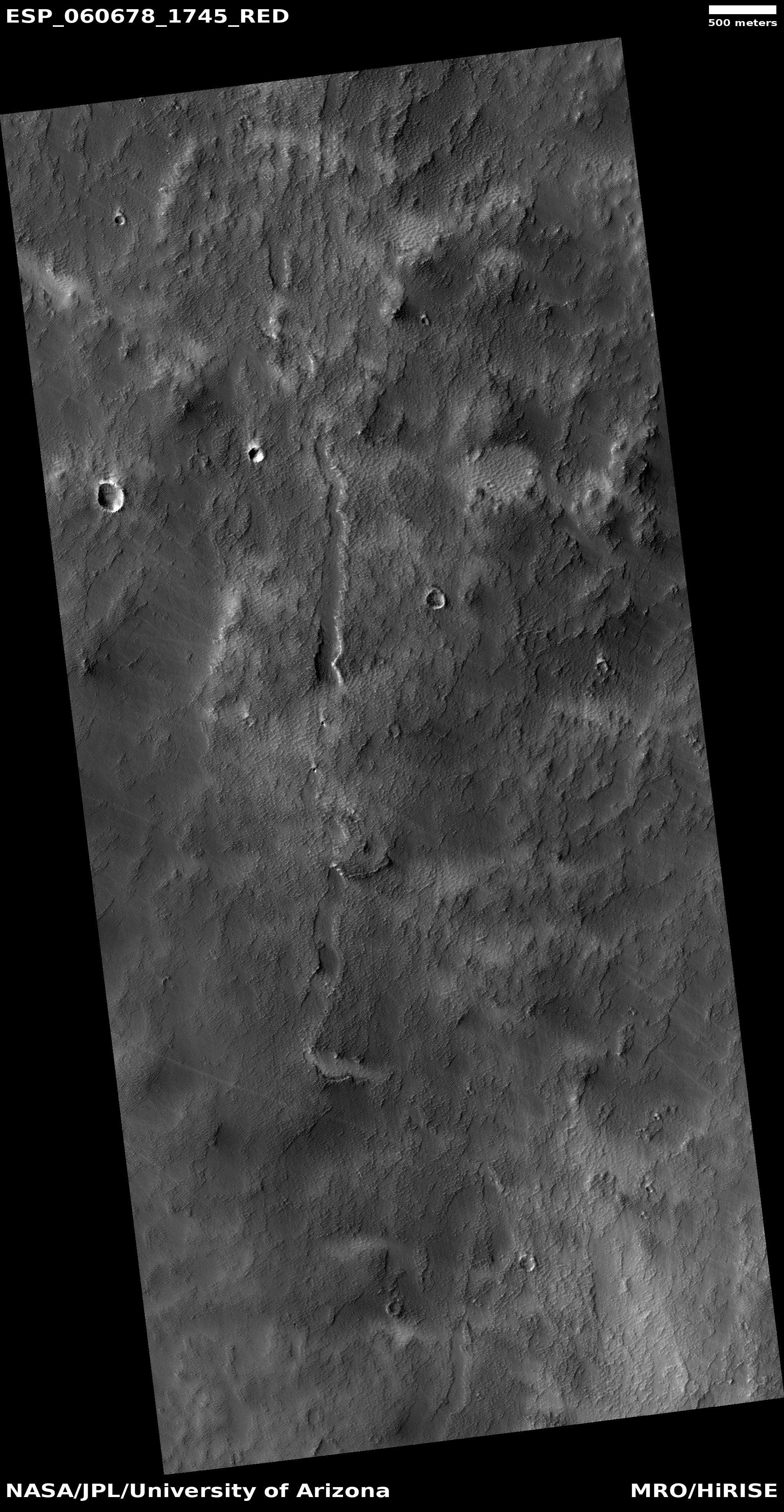
Cool image time! The photo to the right, rotated, cropped, and reduced to post here, was taken on November 22, 2021 by the high resolution camera on Mars Reconnaissance Orbiter (MRO). It shows what the science team labeled a sinuous ridge. Make sure you also look at the full image. The ridge goes on to the south, but then fades way as an almost perfect ramp, only to have another even more wiggly but thinner north-south ridge begin only a few feet to the west.

Sinuous ridges like this are found in many places on Mars. Almost always their origin is thought the result of a former river channel that became a ridge when the surrounding softer material eroded away.

That explanation however does not seem to work for this ridge. It has too many other inexplicable features. For example, note how the peak of the ridge smoothly transitions from sharp to flat-topped. It has a soft appearance that is strengthened by the gap near the top.

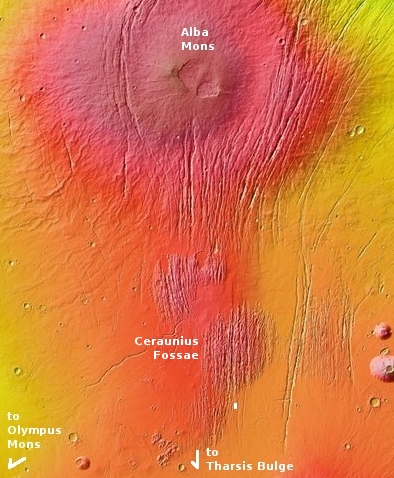
It is almost as if this ridge is a kind of elongated sand dune! And guess what: The overview map below gives that explanation some believability.
» Read more
1 comment

Water and dry ice at the Martian north polar ice cap

water and dry ice at the Martian north pole
Click for original image. Click here for full image.

In our third Martian cool image of the day, we go to the north pole of Mars, as seen from orbit by the high resolution camera of Mars Reconnaissance Orbiter (MRO). Taken on March 30, 2022 and cropped and reduced to post here, this picture shows some of the distinct and unique geological features found only on the polar caps of Mars. From the caption by Candy Hansen of the Planetary Science Institute in Tucson, Arizona:

Both water and dry ice have a major role in sculpting Mars’ surface at high latitudes. Water ice frozen in the soil splits the ground into polygons. Erosion of the channels forming the boundaries of the polygons by dry ice sublimating in the spring adds plenty of twists and turns to them.

Spring activity is visible as the layer of translucent dry ice coating the surface develops vents that allow gas to escape. The gas carries along fine particles of material from the surface further eroding the channels. The particles drop to the surface in dark fan-shaped deposits. Sometimes the dark particles sink into the dry ice, leaving bright marks where the fans were originally deposited. Often the vent closes, then opens again, so we see two or more fans originating from the same spot but oriented in different directions as the wind changes.

The top layer of translucent dry ice falls as dry ice snow during the winter, than sublimates away with the arrival of spring. Since this photo was taken in autumn, we are looking at features left over from the activity from the spring and summer.

1 comment

Wavy crescent ridges on Mars

Wavy crescents on Mars
Click for full image.

Cool image time! The photo to the right, cropped and reduced to post here, was taken on November 19, 2021 by the high resolution camera on Mars Reconnaissance Orbiter (MRO). It shows what the science team has labeled “Crescentic forms,” which in some ways resemble crescents that I featured in a cool image back in November 2020.

Unlike those earlier crescents, today’s are linked together to form a longer wavy line. Furthermore, today’s crescents include some positive relief, with some parts standing above the surrounding terrain. The earlier crescents were entirely carved out of the ground, forming depressions.

And yet, the method of formation for both must be somewhat similar. I say this based on their location, as shown in the overview map below.
» Read more

0 comments

Spiders galore on Mars!

Spiders galore on Mars
Click for full image.

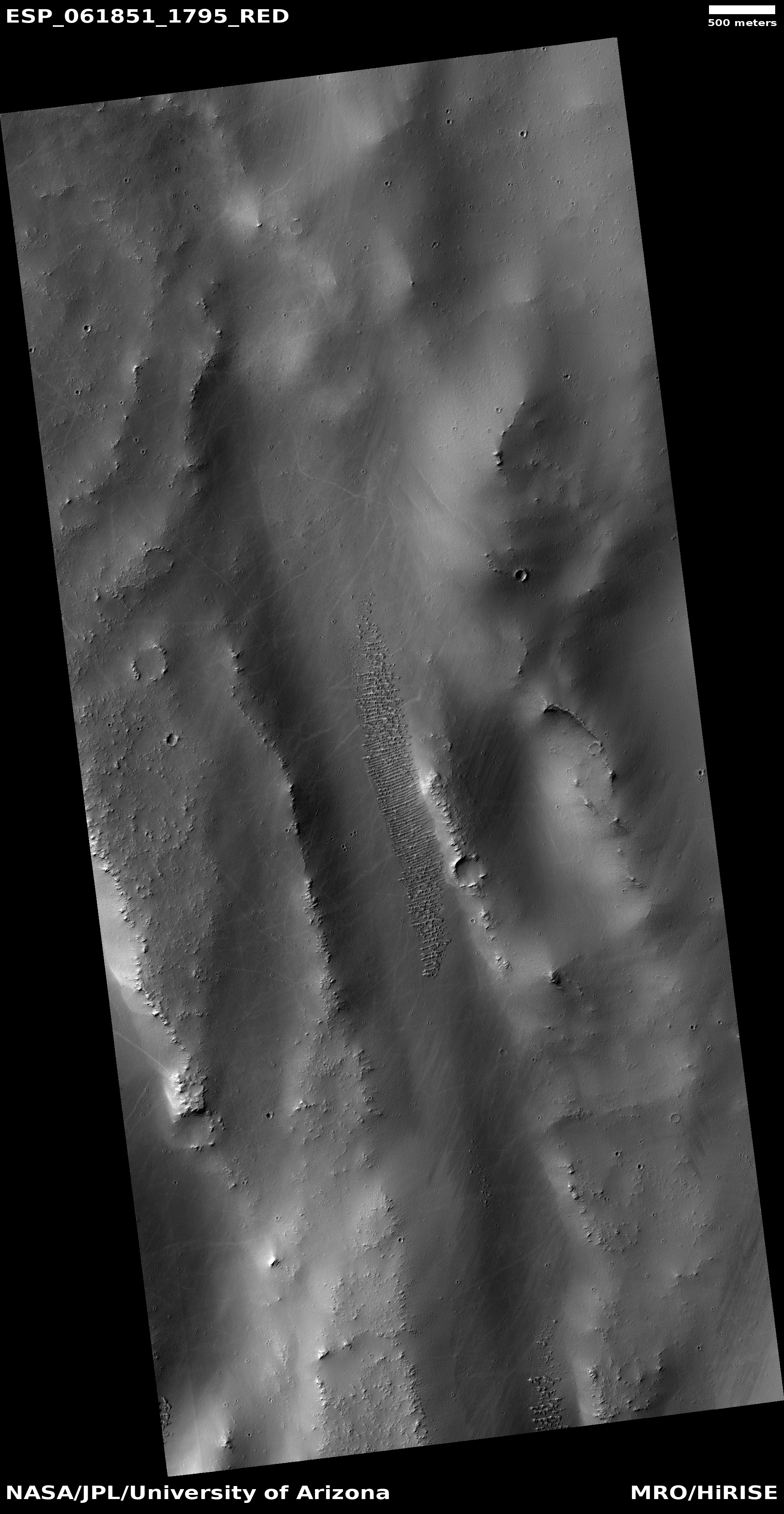
Cool image time! The photo to the right, cropped to post here, was taken on February 27, 2022 by the high resolution camera on Mars Reconnaissance Orbiter (MRO) and shows a nice collection of what scientists have informally (but permanently) labeled as spiders, strange formations that exists only in the regions of the Martian south pole.

The spiders are believed to have formed because of the coming and going of the dry ice mantle in the polar regions that falls as snow in the winter and then sublimates away come the spring. Because dry ice is mostly clear, the spring sunlight penetrates it and warms the underlying surface, which acts to warm the base of the dry ice mantle. CO2 gas builds up, trapped below the dry ice, until the pressure causes it to break the dry ice at a weak point and spew outward, carrying with it dust that blackens the surface above. You can see three examples in today’s image.

Spiders however only happen at the south pole. In the north much of the terrain is formed by unstable dunes, which change from year to year, thus causing the gas breakage to occur at random and different spots.

In the south however the terrain is more stable, a surface of ice and dirt. The spiders form because the trapped gas always follows the same path from year to year to the same weak points, carving riverlike tributaries until these feeders combine and build up enough gas pressure to crack the overlying dry ice so that the gas can escape.

Though the gas functions much like a river of water, it has one fundamental difference that makes this phenomenon wholly Martian and quite alien. On Earth rivers flow downhill. On Mars, the gas in these spider tributaries is flowing upward, seeking a path into the atmosphere above.

2 comments

A high mountain inside Valles Marineris

A high mountain inside Valles Marineris
Click for full image.

Cool image time! The photo to the right, cropped, reduced, and annotated to post here, was taken on January 4, 2022 by the high resolution camera on Mars Reconnaissance Orbiter (MRO). It shows the flat top of a mountain inside Candor Chasma, one of the side canyons of the solar system’s largest canyon, Valles Marineris.

The image was taken when the sun was about 32 degrees above the horizon, to the west, and thus apparently low enough to put the flat top mostly in shadow.

What is most spectacular about this photo is the sense of scale it portrays once you know the overall context. Note the many layered slope to the west. That slope will continue downward far beyond the left edge of this image, dropping for dozens of miles and about 13,000 feet. The overview map below makes this clearer.
» Read more

0 comments

Martian ridge sticking up out of a lava flood plain

Martian ridge sticking up out of a lava flood plain
Click for full image.

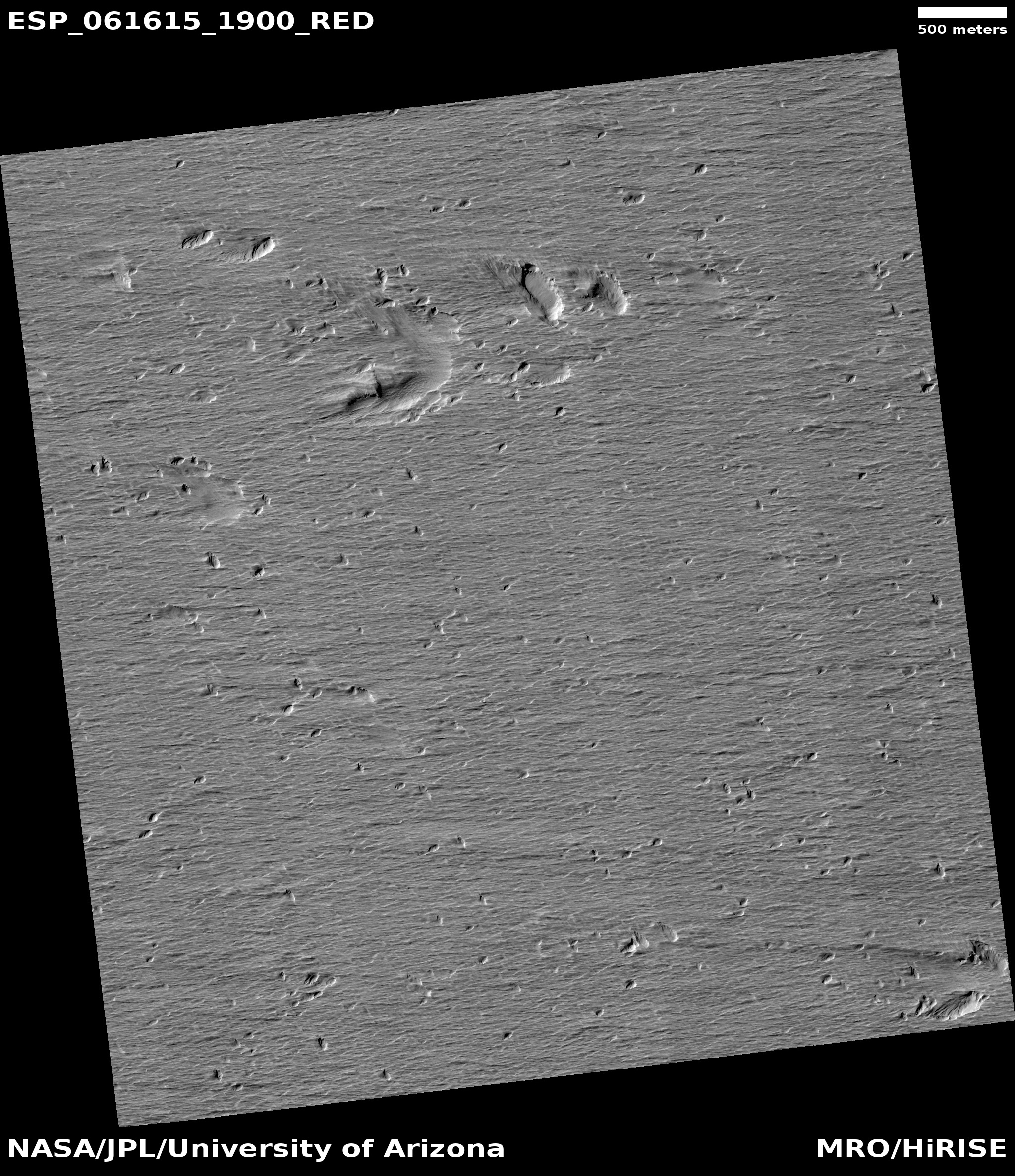
Cool image time! The photo to the right, rotated, cropped, and reduced to post here, was taken on August 9, 2020 by the high resolution camera on Mars Reconnaissance Orbiter (MRO) and was featured today as this camera’s picture of the day. As today’s caption notes:

This observation focuses a ridge that is standing above the old lava surface of the floor of Echus Chasma. What is this ridge doing here? Is it preexisting material surrounded by lava? Is it material pushed up at a restraining bend? If the ridge is not lava, it may have colorful flanks.

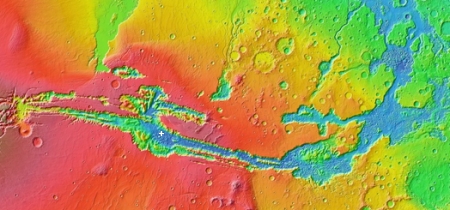
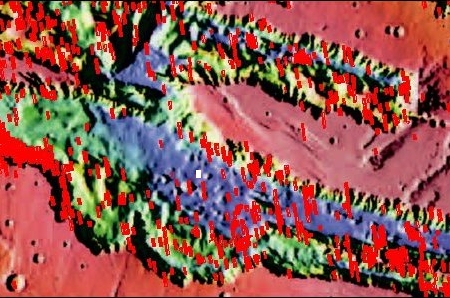
The overview map below shows that this location in Echus Chasma is even more interesting, as some scientists believe it once also held a large lake.
» Read more

2 comments

Mars: Are these eroding glaciers or impacts in lava?

Eroding lava or glaciers?
Click for original image.

Cool image time and a mystery! The photo to the right, cropped to post here, was taken on March 29, 2022 by the high resolution camera on Mars Reconnaissance Orbiter (MRO) of an 18-mile-wide crater in the southern cratered highlands of Mars. The full picture, dubbed “Steep Cliff,” was taken apparently to get a good view of the crater’s northern rim. The rim’s steepness suggests that the floor of the crater is significantly filled.

More intriguing however are the scattering of strange depressions about six miles south of the rim. What caused them? The crater’s location is in a part of Mars where it is not unusual to find both glacial features as well as flood plain lava. In fact, the crater’s northeast and southwest rims appear to have been buried by what appears to be flood lava. The northern rim’s shallowness also suggests the crater is well filled with flood lava.

However, the crater is also at 38 degrees south latitude, a latitude where planetary scientists have found lots of glacial features. Much of this crater fill could be glacial.

The overview map below illustrates this mystery.
» Read more

1 comment
1 45 46 47 48 49 90