Curiosity images the Martian version of a cave formation

An helictite on Mars?
Click for full image.

Cool image time! The photo to the right, cropped and reduced to post here, was taken today by Curiosity’s Mars Hand Lens Imager (MAHLI), a camera designed to get close high resolution images of very small features on the surface.

The Curiosity image site does not provide a scale, but MAHLI, located at the end of the rover’s robot arm, is capable of resolutions as small as 14 microns per pixel. Since a micron is one thousandth of a millimeter, and the original image was 1584 by 1184 pixels in size, that means the entire image is likely only slightly larger than 18 to 25 millimeters across, or slightly less than an inch.

This feature, which closely resembles a cave helictite, is thus about a quarter inch in size. Helictites, which in caves often resemble wildly growing roots, are nonetheless made of calcite, not organic material. They grow wildly because the water is being pushed out from their center is under pressure, so that as it drips away from the formation it leaves its calcite deposits randomly, causing the formation to grow randomly.

MAHLI also took what looks to be an infrared or heat image of the formation, which appears to show that the tips of the branches are at a different temperature, I think cooler, than the rest of the formation.

While seeping water causes helictites on Earth, what formed this thing on Mars is beyond my guess. It sure looks cool however.

4 comments

Ingenuity update: Dust storm caused issues; 20th flight upcoming

Overview map
Click for interactive map.

According to the Ingenuity engineering team in an update today, the Mars helicopter is getting ready for its 20th flight, scheduled for no earlier than today, even as the team successfully dealt with dust that settled on the helicopter’s various parts prior to flight 19.

The dust storm did, however, leave the Ingenuity team with two additional challenges to deal with: a dirty navigation camera window and dust in the swashplate assemblies.

Comparing navigation camera images taken before and after the dust storm revealed that the storm deposited debris on the ground-facing navigation camera window, specifically around the periphery of the camera’s field of view. Debris on the navigation camera window is problematic because Ingenuity’s visual navigation software may confuse the debris with the actual ground features that it tries to track during flight, which can cause navigation errors. Fortunately, Ingenuity’s software provides a tool for dealing with this issue: The team can provide an updated image mask file that tells the visual navigation software to ignore certain regions of the image. The operations team made use of this feature and performed an image mask update late last month.

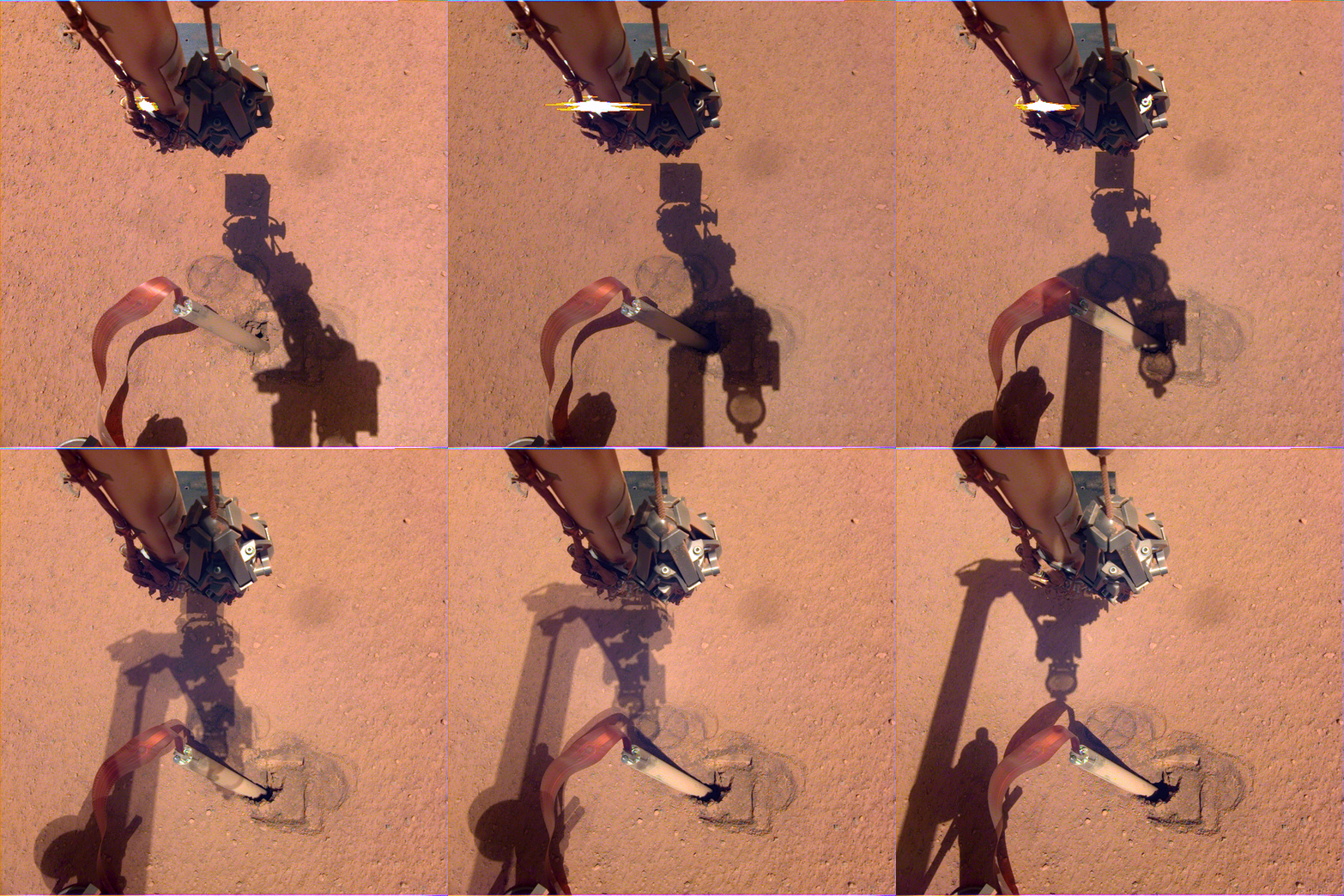
The dust storm also deposited dust and sand in Ingenuity’s swashplate assemblies. On Mars as well as on Earth, a helicopter’s swashplates are very important because they control the pitch (angle from horizontal) of the rotor blades, which is essential for stable and controlled flight. Ingenuity’s swashplate issue was first detected when the rotorcraft reported a failure during its first automated swashplate actuator self-test since the dust storm on Jan. 28, 2022 (Sol 335 of the Perseverance mission). Data revealed that all six swashplate servo actuators were experiencing unusual levels of unusual levels of resistance while moving the swashplates over their range of motion.

The engineers subsequently tested a procedure, planned before launch, for cleaning the swashplates, and found that it worked.

The data from that activity showed a significant improvement – a reduction in servo loading, so the team followed it up with seven back-to-back servo wiggles on Sol 341. Remarkably, by the end of that activity, Ingenuity’s servo loads appeared nearly identical to nominal loads seen prior to the dust storm.

After dealing with both dust issues, flight 19 proceeded successfully, as planned.

The overview map above shows the present location of Perseverance as the red dot, the present location of Ingenuity by the green dot, and the approximate landing site for the helicopter’s 20th flight by the black dot. The tan dotted line shows Perseverance’s planned route.

Perseverance itself has been traveling fast since Ingenuity’s last flight on February 9th, almost completely retracing its steps to return almost to its landing site.

4 comments

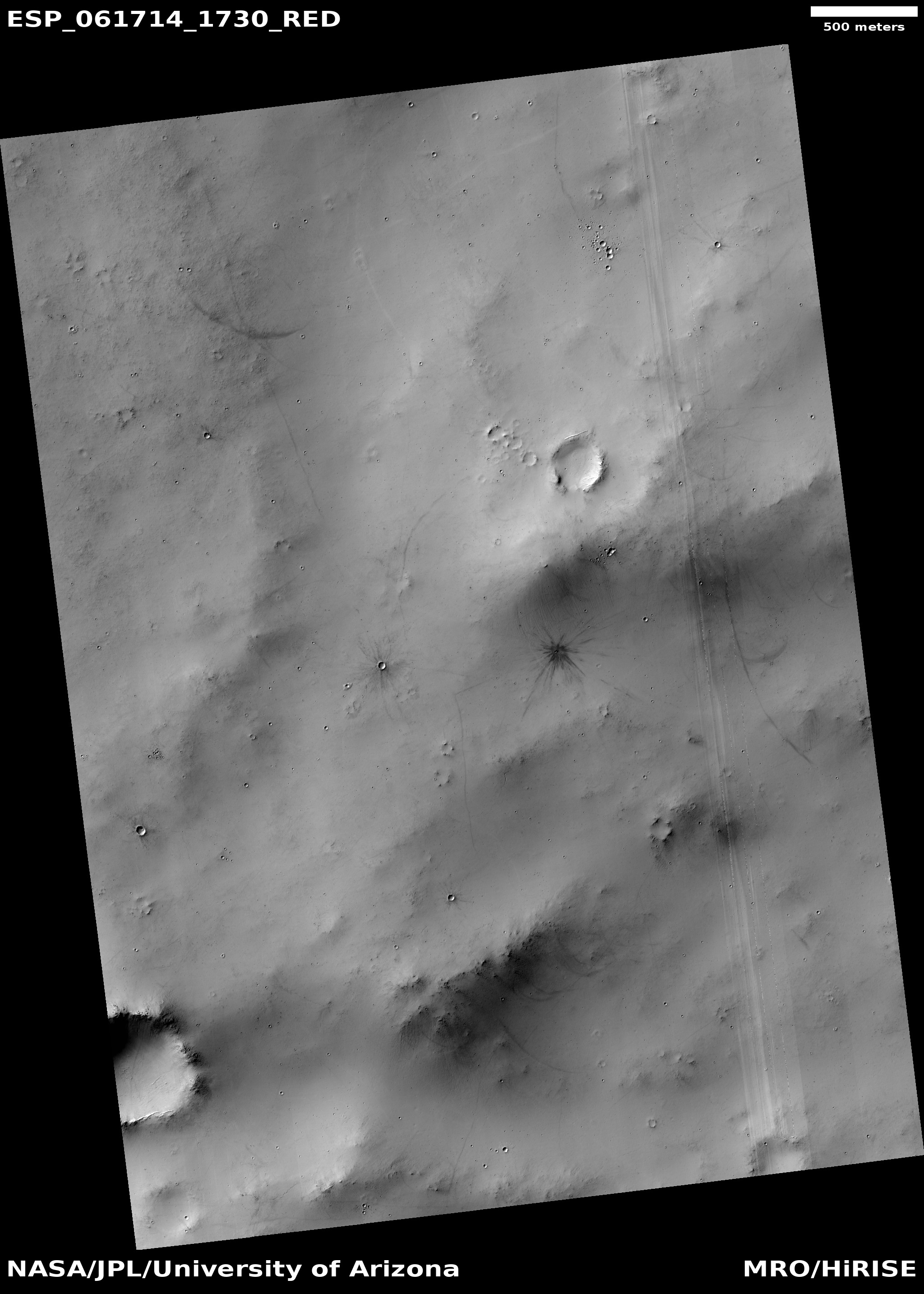
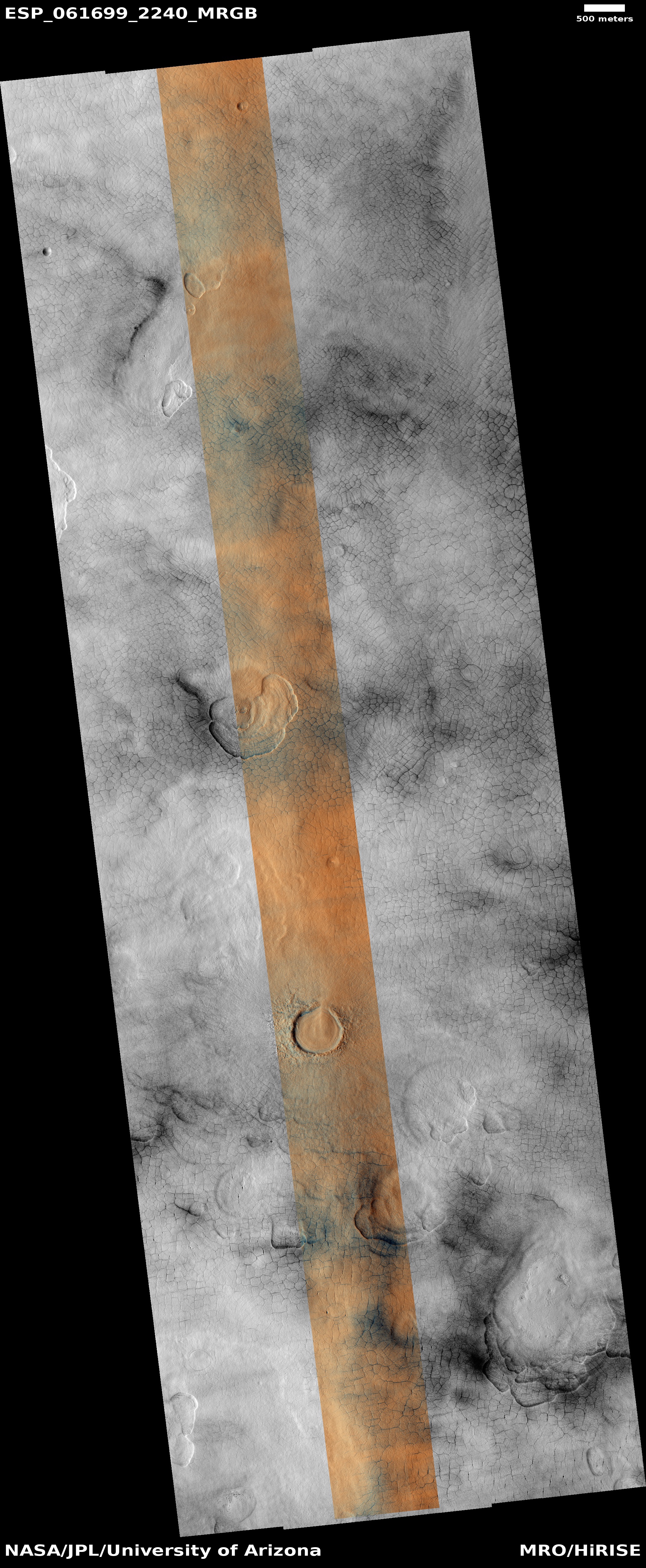
Dry barren ground in Martian northern lowlands?

Dry barren ground in the Martian northern lowlands?
Click for full image.

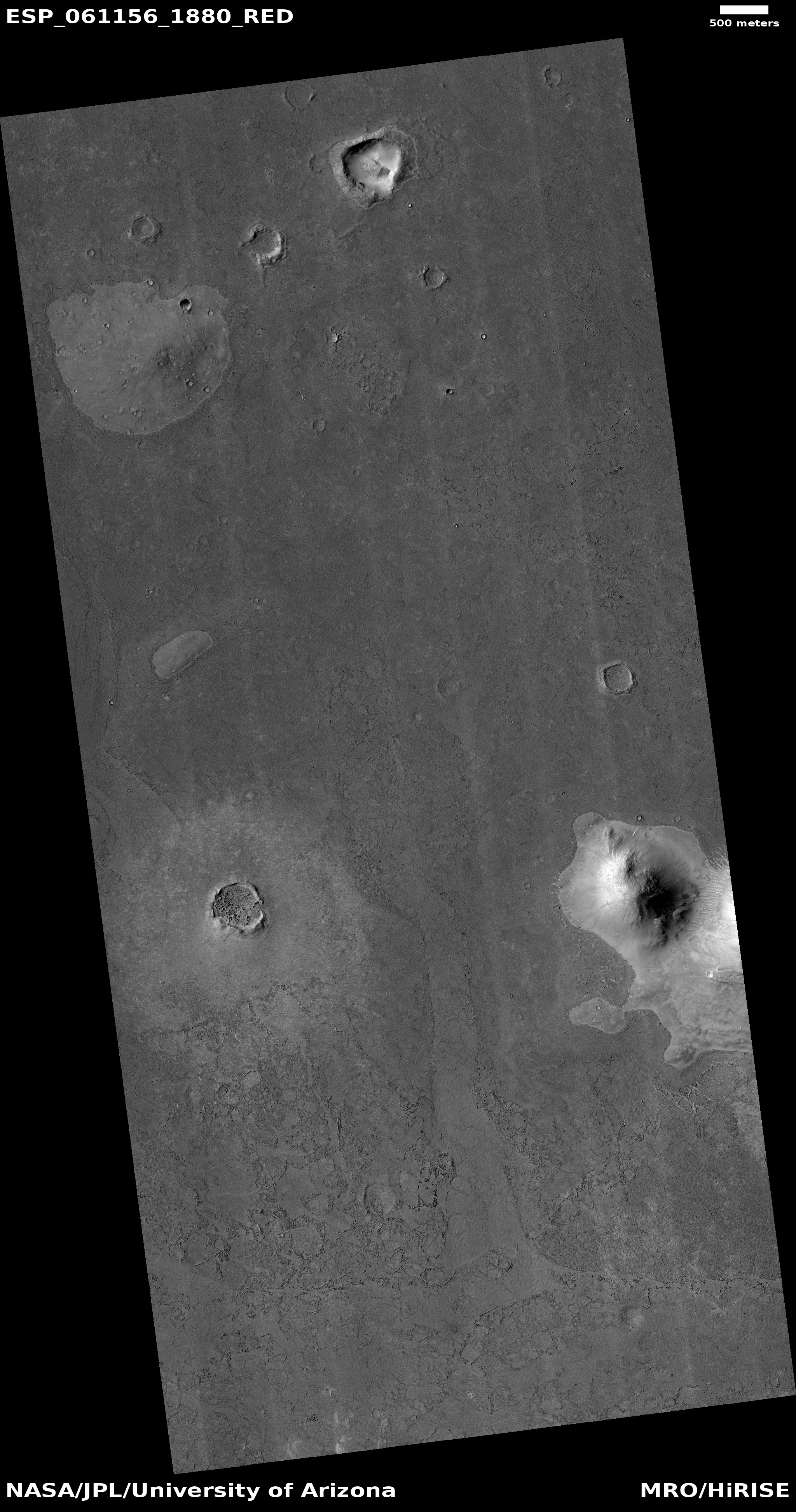
Today’s cool image is intriguing because of what appears to not be there, rather than what is there. The photo to the right, cropped and reduced to post here, was taken on November 3, 2021 by the high resolution camera on Mars Reconnaissance Orbiter (MRO).

At first glance it appears to show a very dry, barren surface. At its base are many parallel grooves running from the southwest to the northeast. On top of these grooves are several more recent crater impacts, as well as several patches of higher bedrock that appears to have been hard enough to resist whatever erosion process caused the groves.

Yet, based on the overview map below, the location of this photo should not be dry and barren, but instead home to a near-surface ice sheet covering everything.
» Read more

0 comments

Curiosity’s coming travels across the rocky Greenheugh Pediment

Curiosity's view west on February 21, 2022 (Sol 3393)
Click for full resolution panorama. Original images can be found here, here, and here.

Overview map
Click for interactive map.

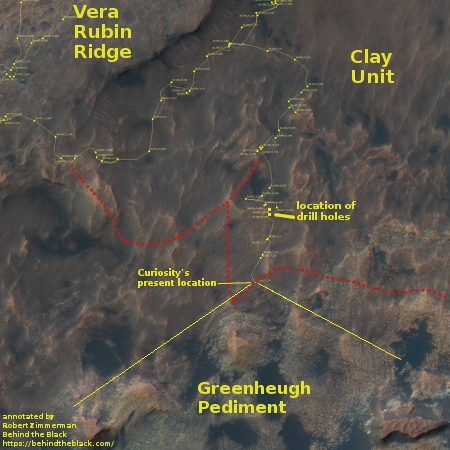
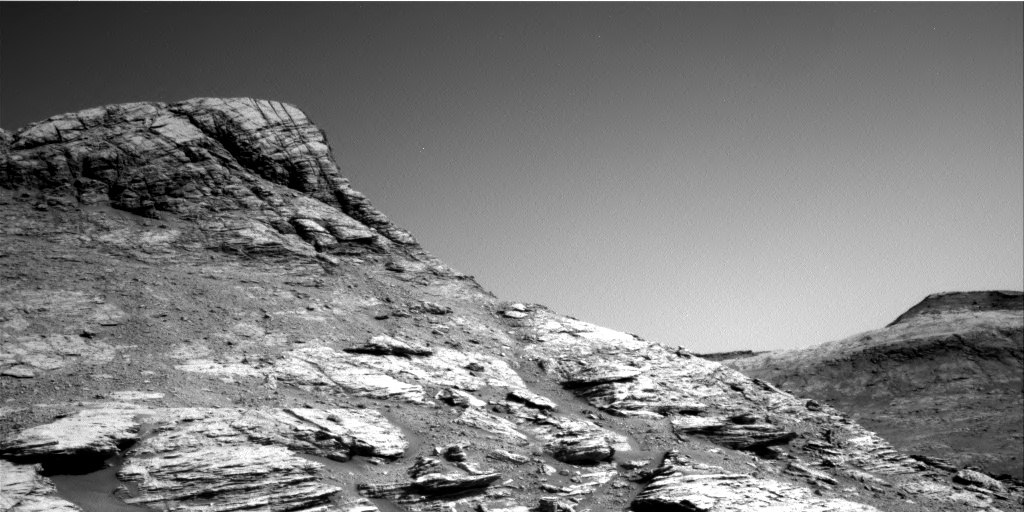
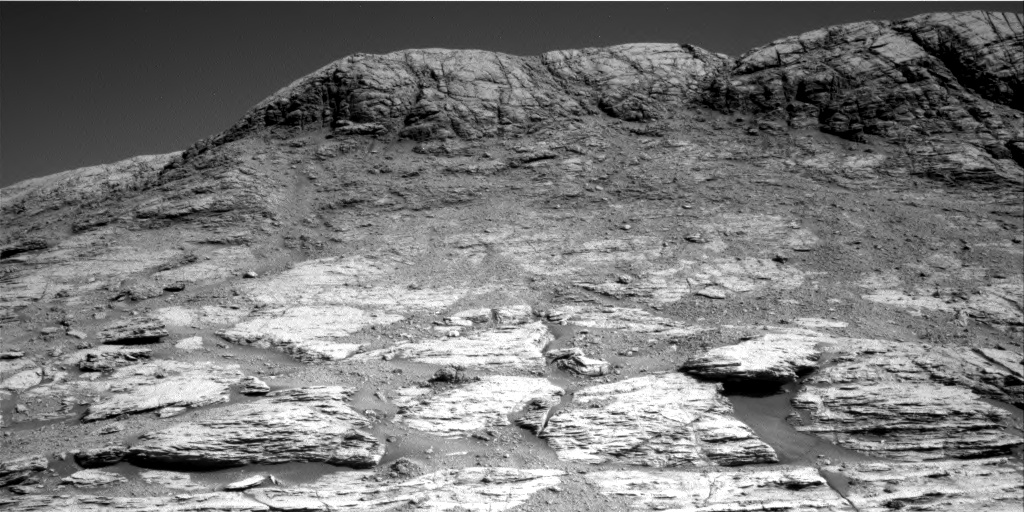
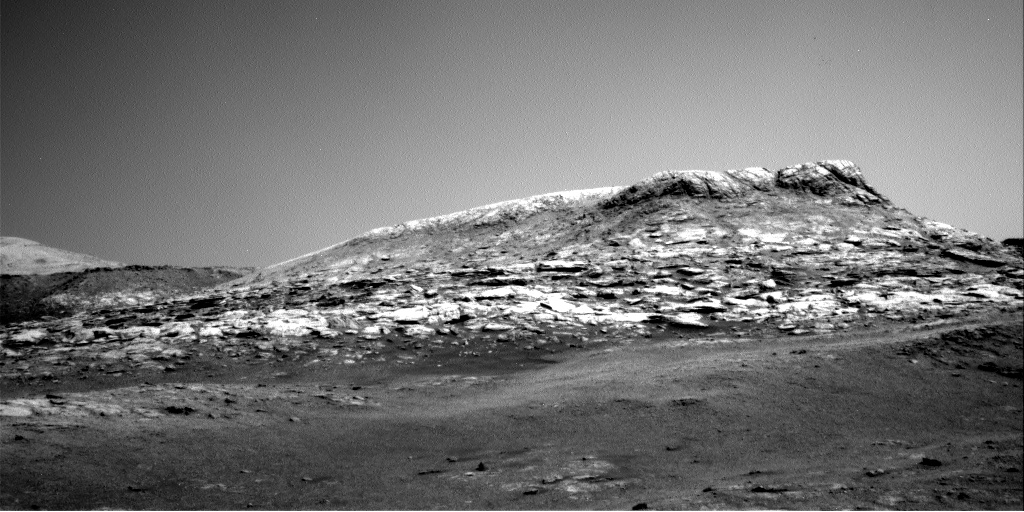
Curiosity, having successfully climbed up and out of Gordon Notch, was able to aim its navigation cameras forward yesterday and get its first views from this position across the very rocky Greenheugh Pediment to its next major goal, Gediz Vallis Ridge. The panorama above, taken by the rover’s right navigation camera, shows this view. The ridge is about 1,500 feet away, at its closest point. The rim of Gale Crater, barely visible in the haze, is about 20-30 miles away.

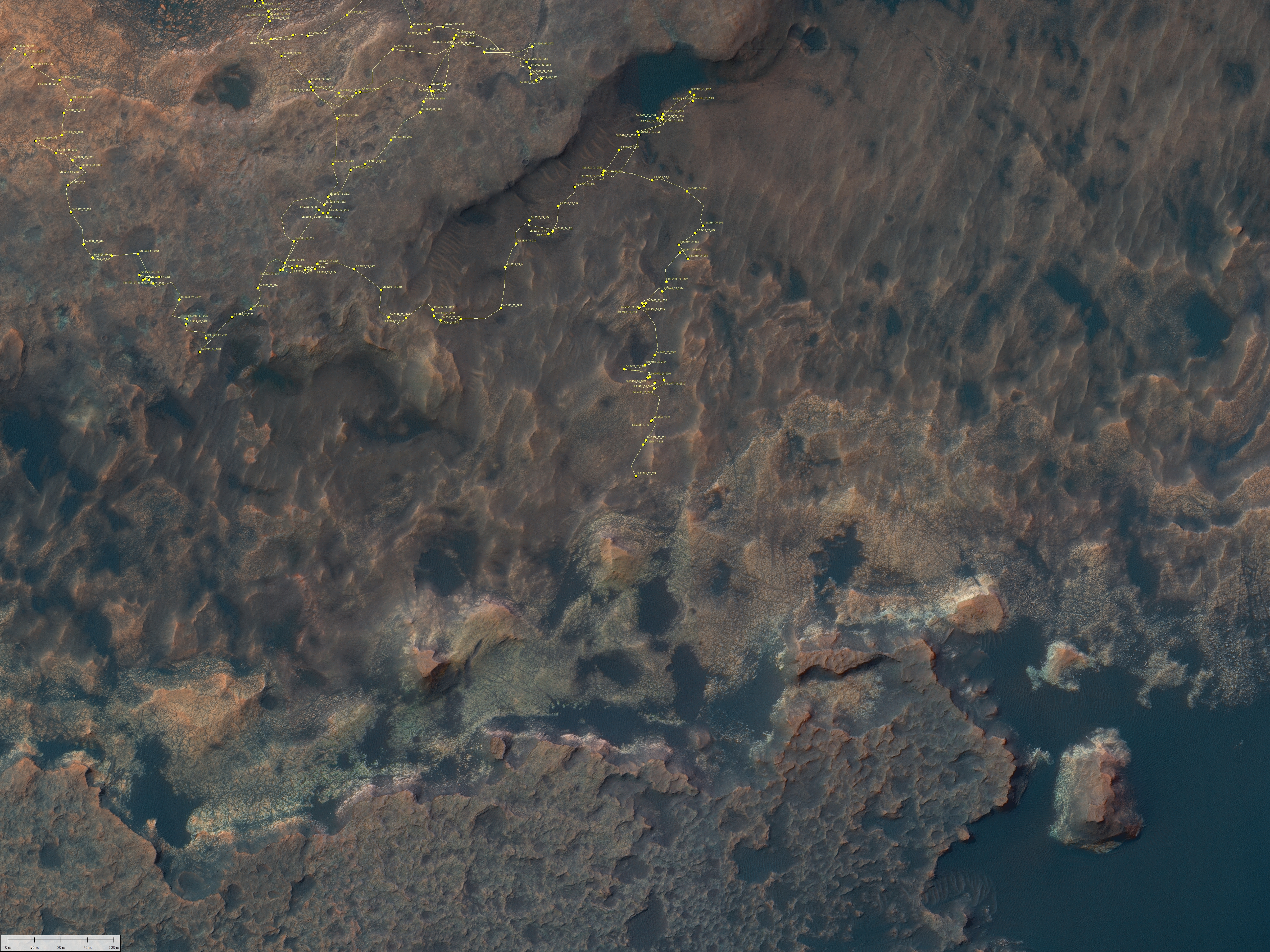
The overview map to the right indicates the area covered in this panorama by the yellow lines. The red dotted line indicates Curiosity’s planned future route.

Curiosity’s first view of the pediment was made in March 2020, from a point on its northern border, just beyond the top edge of the map. The panorama taken then showed what appeared to be a very treacherous and rough surface, possibly too rough for Curiosity to traverse.

According to the science team’s most recent update from before the holiday weekend, the plan had been to spend February 19-20 studying the ground, then drive a short distance yesterday to get a better view ahead.

This will give us a good vantage point to look into the valley ahead and try to scope out our future route. … We chose to drive about 10m total, in order to get the rover oriented at a good heading and parked in a good spot. We expect a similarly beautiful view from our post-drive imaging.

That view is the panorama above. Though still very rough, the ground ahead appears far more traversable than the surface seen in 2020.

1 comment

Deformed Martian craters

Deformed Martian craters
Click for full image.

Cool image time! The picture to the right, rotated, cropped, and reduced to post here, was taken on September 3, 2021 by the high resolution camera on Mars Reconnaissance Orbiter (MRO). The focus of the image for the MRO science team were the wedding cake layers inside the largest crater. These layers suggest glacial ice, with the layers suggesting multiple cycles of glacial ebb and flow. Since the crater is at 43 degrees north latitude, and sits in the chaos region dubbed Protonilus Mensae, smack dab in the center of what I call Mars’ glacier country, this conclusion makes perfect sense.

To my eye, however, the most interesting feature of this photo are the many distorted craters. The overview map below shows the picture’s location, as well as several nearby very large impact craters which might have caused many secondary impacts, including the many craters at this location.
» Read more

1 comment

Cracking ice on Mars?

Cracking ice on Mars?
Click for full image.

Cool image time! The photo to the right, cropped and reduced to post here, was taken on December 7, 2021 by the high resolution camera on Mars Reconnaissance Orbiter (MRO). It shows what the MRO science team dubs “erosion of scalloped terrain” in the northern lowland plains of Mars.

The cracks invoke the polygon cracks one sees in mud as it dries. The circular feature suggests a buried crater whose shape is merely suggested because the cracks are conforming to the underground topography.

Are we looking at dried mud? Maybe, but more likely we are seeing a sheet of ice now sublimating away and cracking as it does so. If you look at the full photo you will see the cracked material also appears to drape itself over several nearby low ridges, something that seems more likely from ice than mud.

The overview map below also suggests this is a buried layer of ice.
» Read more

4 comments

Curiosity looks out across the mountains

Curiosity panorama, Sol 3387, February 15, 2022
Click for high resolution. Original images found here and here.

Overview map
Click for interactive map.

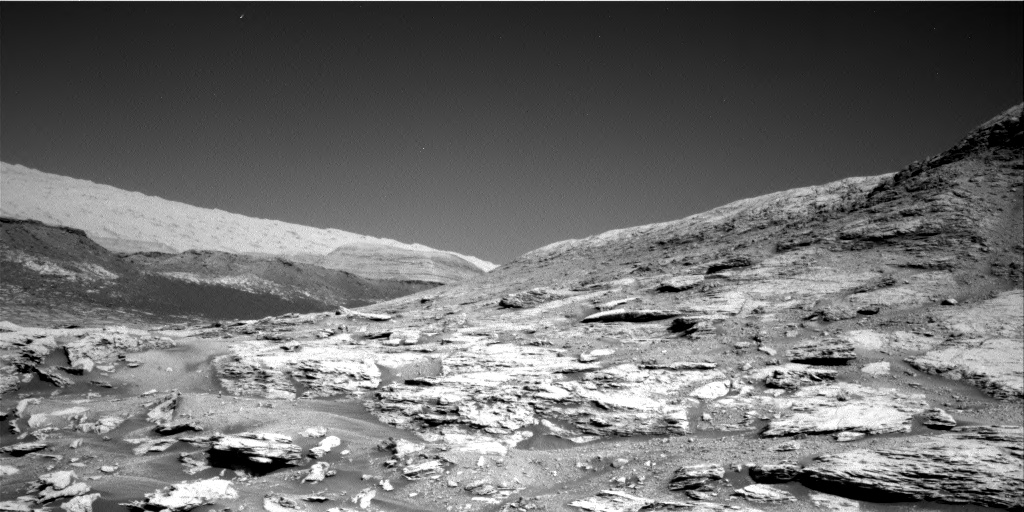
Cool image time! The mosaic above, created from two photos taken by Curiosity’s left navigation camera and downloaded from the rover today, looks to the southeast across the small rocky valley the rover has been traversing for the past two months towards Mount Sharp.

The rover had entered this valley through the nearest gap on the left, then traveled uphill from the left to the right until it had passed behind the nearest dark ridge on the right. It then retreated and turned left, starting uphill through Gordon Notch, as shown in the overview map to the right.

On the overview, the white line marks Curiosity’s past travels, with red dotted line indicating its planned future route. The yellow lines indicate the approximate view in the panorama above.

For scale, Navarro Mountain is about 450 feet tall. The actual peak of Mount Sharp is blocked by the white front range to the left. The rover is presently still 12,600 feet below that peak, which sits to the southeast about 35 miles away.

0 comments

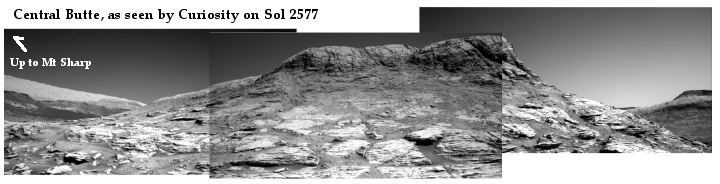
A floating Martian rock

Mosiac of top of butte
For original images, click here and here.

A floating Martian rock
Click for original photo.

Cool image time! As Curiosity begins the slow and careful journey up through the rocky Gordon Notch onto the even rockier Greenheugh Pedimont layer above, the science team is using its cameras to take pictures of the buttes that form the northern and southern walls of that notch.

The mosiac above and the photo to the right, both cropped and reduced to post here, is one beautiful example. Taken by Curiosity’s high resolution camera on February 11th, both images show the consequences on geology of Mars’ low gravity, one third that of Earth’s. The top image shows the entire top of the butte, with the picture to the right focusing on one boulder that almost seems to be floating in the air. Look close and you can see daylight under the rock’s entire left half.

I think this butte is the north wall of Gordon Notch, but am not sure. Either way, the photos once again demonstrate that it is very dangerous to assign our Earth-based assumptions to Martian geology. There may be similarities, but the differences must not be ignored, or else our conclusions about what we see will be wrong.

2 comments

Global image of Mars from UAE’s Al-Amal orbiter

Mars as seen by Al-Amal in January 2022
Click for original image.

Cool image time! The United Arab Emirates (UAE) today released several new images taken by its Al-Amal Mars orbiter, showing the changing atmospheric conditions on Mars between September ’21 and January ’22.

The photo to the right, cropped and annotated by me, is the January image, showing the dust storm conditions that presently exist in the equatorial regions of Mars. The lighter puffy cloud-like features in the center of the image are a 1,500 mile wide dust storm centered on the equator. The white dot indicates the approximate spot where Perseverance sits in Jezero Crater, within that storm.

The previous Al-Amal image from September (available at the link) shows the whole Martian hemisphere with generally clear skies.

Below is a recent photo taken by Perseverance illustrating these dusty conditions.
» Read more

7 comments

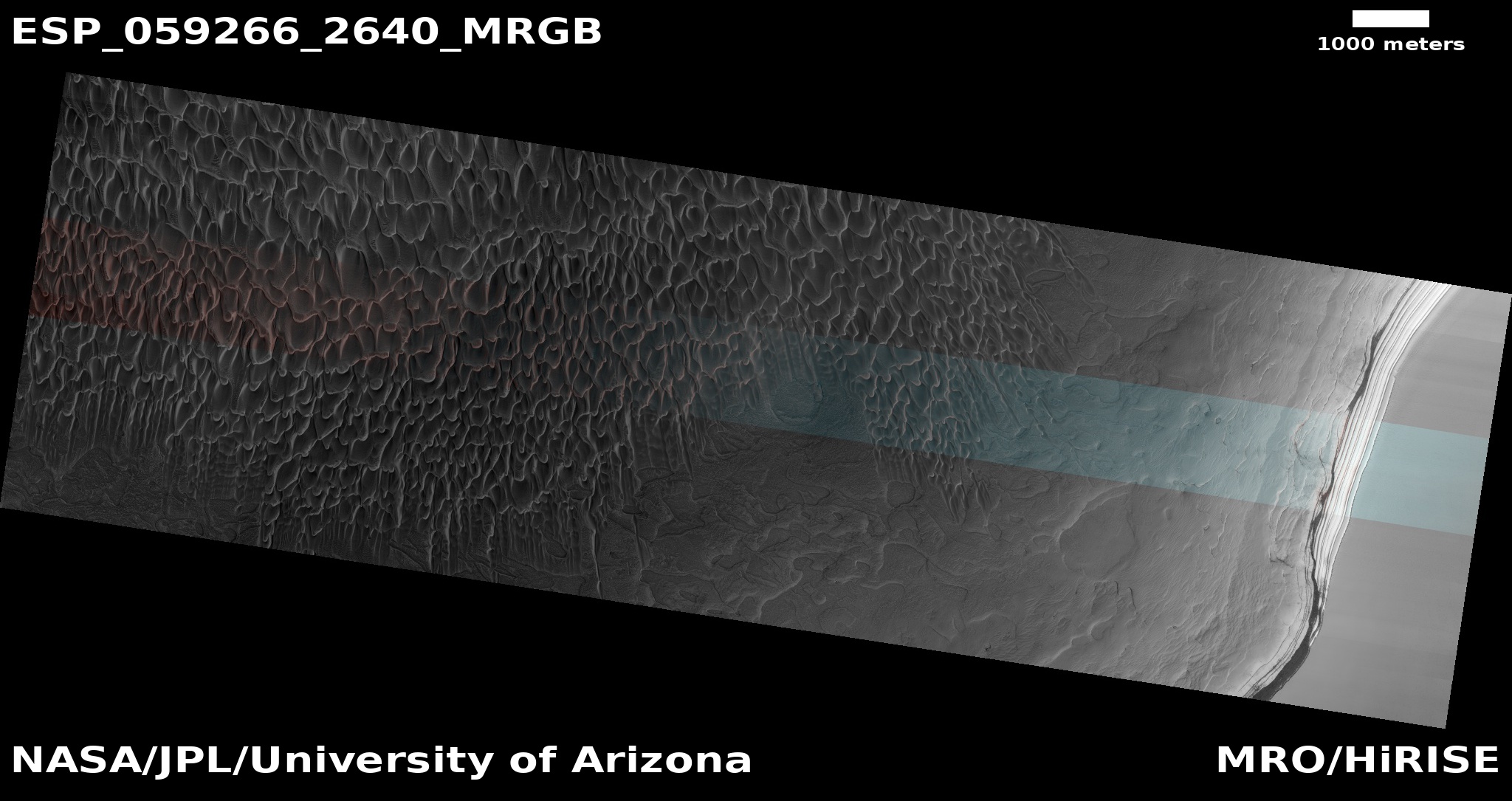
Mars: Glaciers on top of glaciers on top of glaciers

Overview map
Mars’ glacier country.

glaciers on top of glaciers on top of glaciers
Click for full image.

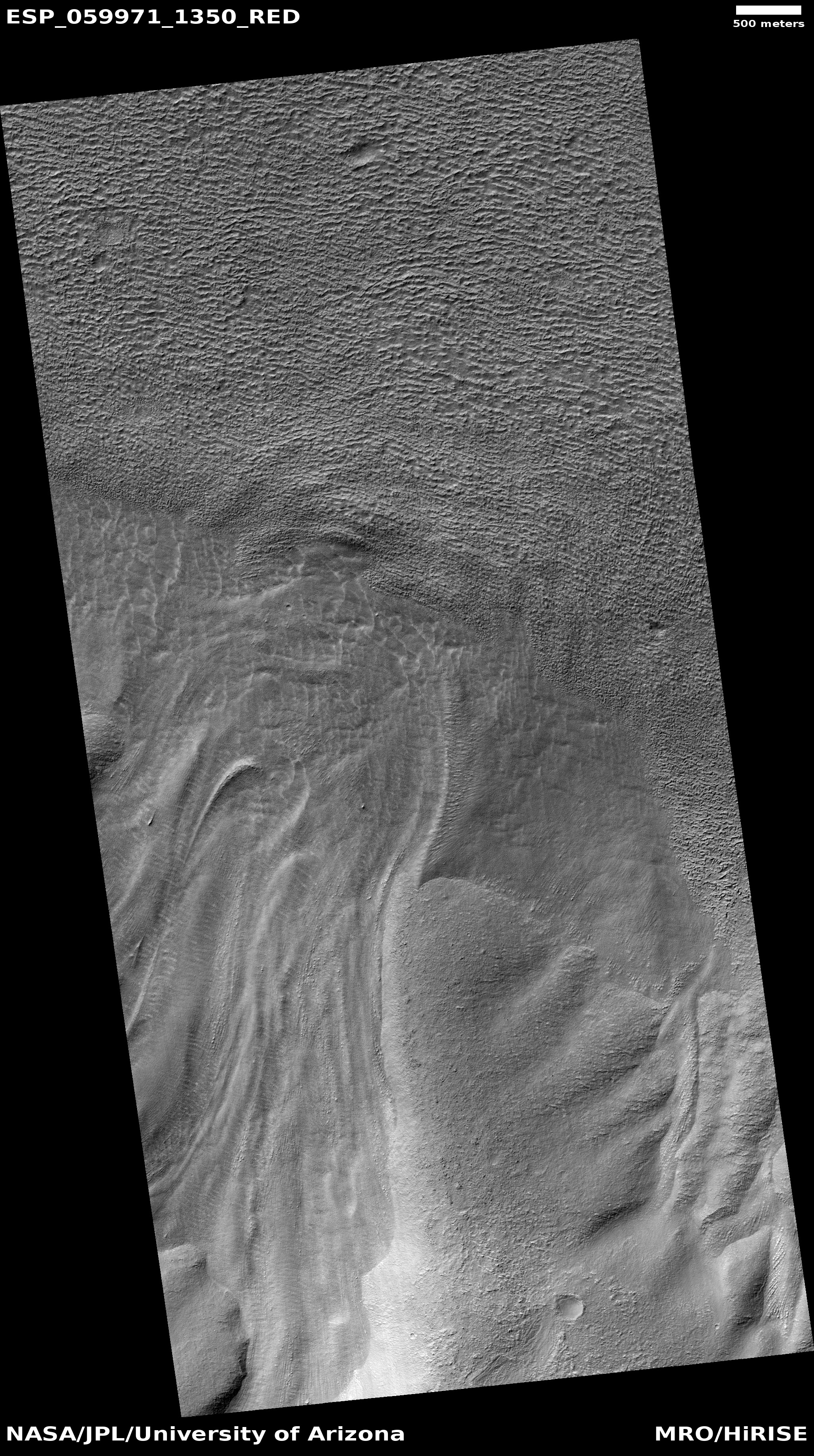
Cool image time! The photo to the right, rotated, cropped, and reduced to post here, was taken on December 12, 2021 by the high resolution camera on Mars Reconnaissance Orbiter (MRO). It shows a small patch of layered glacial features flowing in all directions. The overview map above marks its location by the red dot, at 40 degrees north latitude in the region dubbed Deuteronilus Mensae, on the western end of the 2,000 long strip from 30 to 60 degrees north latitude that I dub Mars’s glacier country because practically every image in this region shows glacial features.

What makes the glacial features in this picture so remarkable is their number, their somewhat chaotic nature, and the evidence of many layers, suggesting a cyclical process of ebb and flow over the eons.

Below I zoom into one section of this photo, showing that section at full resolution.
» Read more

1 comment

Ingenuity completes 19th flight

Perserverance and Ingenuity as of February 8, 2022
Click for interactive map.

The Mars helicopter Ingenuity yesterday successfully completed its 19th flight on the Martian surface, traveling for 99 seconds about 200 feet to the northeast, landing close to the landing site of its 8th flight back in June 2021.

The map to the right shows the helicopter’s overall travels in tan, with the 19th flight path in green. The white line marks Perseverance’s travels, with the red dot indicating its present location. The dashed yellow line indicates the rover’s planned route. To achieve that the rover team is retracing its steps along the path it had previously traveled, with Ingenuity flying in front, along that path.

The flight had been delayed more than a month while waiting for a dust storm to settle as well as making sure Perseverance was in a good position to maintain communications throughout the flight. With Perseverance finally on the move to the east and the dust storm subsiding, the Ingenuity flight was finally possible.

0 comments

Random Martian ridges on a lava plain

Random ridges on Martian lava plain
Click for full image.

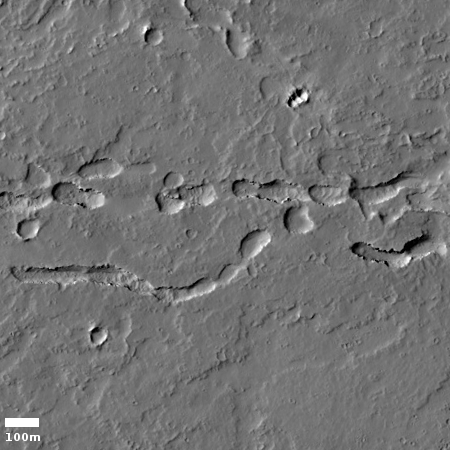
Cool image time! The photo to the right, cropped and reduced to post here, was taken on December 30, 2021 by the high resolution camera on Mars Reconnaissance Orbiter (MRO). This was a terrain sample image, taken not as part of any specific research project but to fill a gap in the camera’s schedule and thus keep its temperature maintained properly. When the MRO team needs to take such pictures, they try to pick locations that might be interesting and previously unphotographed, but often the location is neither.

In this case this terrain sample captured a flat lava plain interspersed with sinuous ridges going in all directions. On top of this is a scattering of smaller impact craters, which obviously occurred after the lava had flowed and solidified.

What caused the ridges?
» Read more

0 comments
1 79 80 81 82 83 212