
InSight robot arm to help mole dig

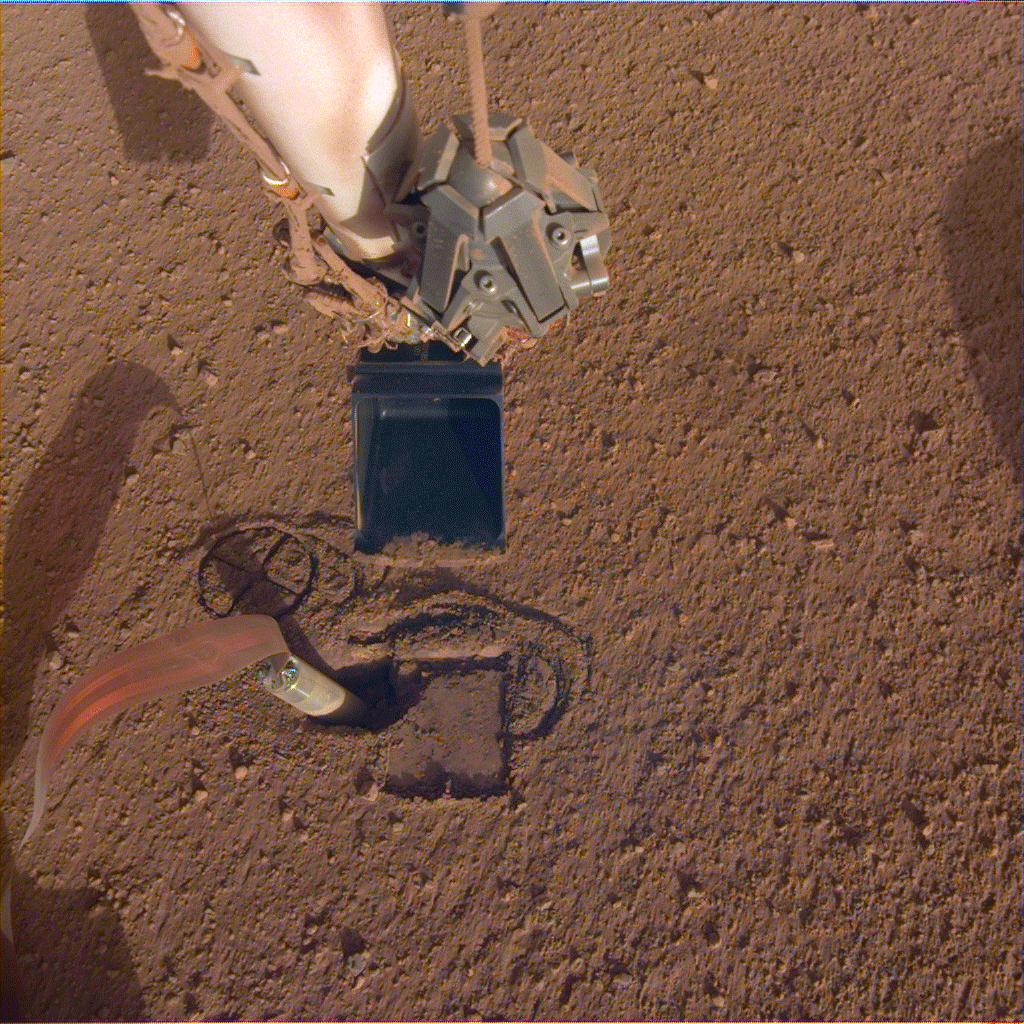
Mole in hole, with robot arm and scoop above
Click for full image.

In their effort to solve the issues that have prevented InSight’s mole from penetrating more than fourteen inches into the ground on Mars, engineers now plan to use the scoop on the robot arm to “pin” the mole up against one wall of the hole so that it will have the friction necessary to drill downward.

The image to the right, cropped and reduced to post here, illustrates what they have been doing and what they will do. Previously the hole was much larger, which prevented the mole from moving downward because it needed the friction from the material around it to hold it in place after each hammer action. (Think of pounding a nail into a wooden board: The nail is gripped tightly by the wood around it as it goes down, so that after each hit it goes further in.)

Since June they have been using the arm and scoop to fill in the hole around the mole. Now I think they intend to bring the scoop around to the mole’s left side, as shown in the image, and pin it upright against the right wall of the hole. When it resumes hammer-drilling they hope both the wall and the scoop will provide enough friction for the mole to drill downward.

1 comment

The slowly changing dunes of Mars

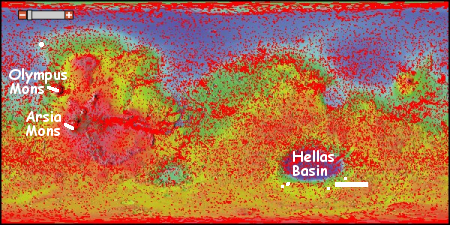
Map of Mars

In order to better understand the climate and geology of Mars, scientists need to study how the thin Martian atmosphere causes changes to the planet’s numerous sand dunes. To do this, they have been using the high resolution camera on Mars Reconnaissance Orbiter (MRO) to periodically snap photos of the same places repeatedly over time, to track any changes that might occur.

Recently the monthly download dump of images from MRO included one such location in the northwest quadrant of Hellas Basin, what I call the basement of Mars because it the planet’s lowest point. The uncaptioned image was taken on May 20, 2019 and was titled “Hellas Region Sand Dune Changes.” A review of past images shows that MRO has taken pictures of this location several times in the past, in 2011 and in 2017. All these images were taken during the Martian autumn season, and were taken to see if over time there were any significant changes to the dunes due to winds.

My superficial comparison of the 2011 and 2017 images does not show much obvious change. There could be small changes that my quick review did not spot, and there is also the strong possibility that the entire dune field could have shifted as a unit over those three Martian years, a change that would require a more detailed analysis beyond my technical capabilities. Click on both links, put the photographs in separate tabs, and switch quickly between them to see if you can spot any differences.

Comparing the 2011 and 2019 images however shows some significant changes, most of which I think are due to the 2018 global dust storm. Below is that comparison.
» Read more

0 comments

The sounds of Mars

The InSight seismometer team today issued an update of their results since the instrument began recording quakes on Mars in February.

But after the seismometer was set down by InSight’s robotic arm, Mars seemed shy. It didn’t produce its first rumbling until this past April, and this first quake turned out to be an odd duck. It had a surprisingly high-frequency seismic signal compared to what the science team has heard since then. Out of more than 100 events detected to date, about 21 are strongly considered to be quakes. The remainder could be quakes as well, but the science team hasn’t ruled out other causes.

The press release provides audio for many of these detections, including two 3.3+ earthquakes as well as a strange sequence of what they call “dinks and donks” that appear to occur each evening as the seismometer adjusts to night-time temperatures.

So far the data suggests that Mars’ interior is a relatively quiet place, compared to Earth.

3 comments

Martian impact into lava crust?

Impact crater north of Pavonis Mons
Click for full image.

Cool image time! The photo on the right, cropped to post here, was taken by the high resolution camera on April 23, 2019. It shows a quite intriguing impact crater on the northern lava slopes of Pavonis Mons, the middle volcano in the chain of three gigantic volcanoes to the west of Valles Marineris.

What makes this image cool is what the impact did when it hit. Note the circular depression just outside the crater’s rim. In the southeast quadrant that ring also includes a number of additional parallel and concentric depressions. Beyond the depression ground appears mottled, almost like splashed mud.

What could have caused this circular depression? Our first clue comes from the crater’s location, as shown in the overview map below and to the right.
» Read more

3 comments

Curiosity to use first of nine “wet chemistry cups”

two drill holes in clay layer
Click for full image.

The Curiosity science team has decided to use the first of its nine “wet chemistry cups” to test a recently obtained Martian drill sample for organic material.

Searching for organic molecules in rocks on Mars is no easy task. Curiosityโ€™s Sample Analysis at Mars (SAM) instrument is designed to analyze the chemical composition of gases, which it creates by slowly heating rock samples in an oven. The volatile gases that are driven off the heated rock sample get sent to SAMโ€™s gas chromatograph and mass spectrometer (GCMS), which can identify the different gaseous compounds. However, organic molecules are tough to detect with this technique, because instead of transforming straight into gases when heated, they can decompose into simpler molecules.

But if organic molecules are “derivatized” before theyโ€™re heated โ€“ meaning that they react with other chemicals first in order to become more volatile โ€“ then the compounds are more likely to enter the GCMS without breaking down, and SAM has a better chance of detecting them. This derivatization process uses solvents of chemicals, so we call it a “wet chemistry” experiment. Curiosity only has nine cups containing these solvents, so we are careful to save our wet chemistry experiments for only the most interesting rock samples.

The “Glen Etive” site, which we have been studying for the past month, is enticing enough for this special experiment!

They are performing this operation today. This is a big deal, because they only have nine of these cups. They have been saving them for the right time, and when the drill had problems two years ago and looked for awhile like it would never work again, they were horrified at the possibility they would never get to use them at all. While I would not be surprised if NASA issues a press release today touting this decision, do not expect any announcement of results for quite awhile, as I suspect the scientists in charge will want to publish their paper on the subject first.

This location, in the clay unit in the foothills of Mount Sharp, is a spot where they have drilled twice, as shown by the two drill holes visible near the center of the the picture above.

0 comments

Tongue-shaped glaciers on Mars

Tongue-shaped glacier on Mars
Click for full image.

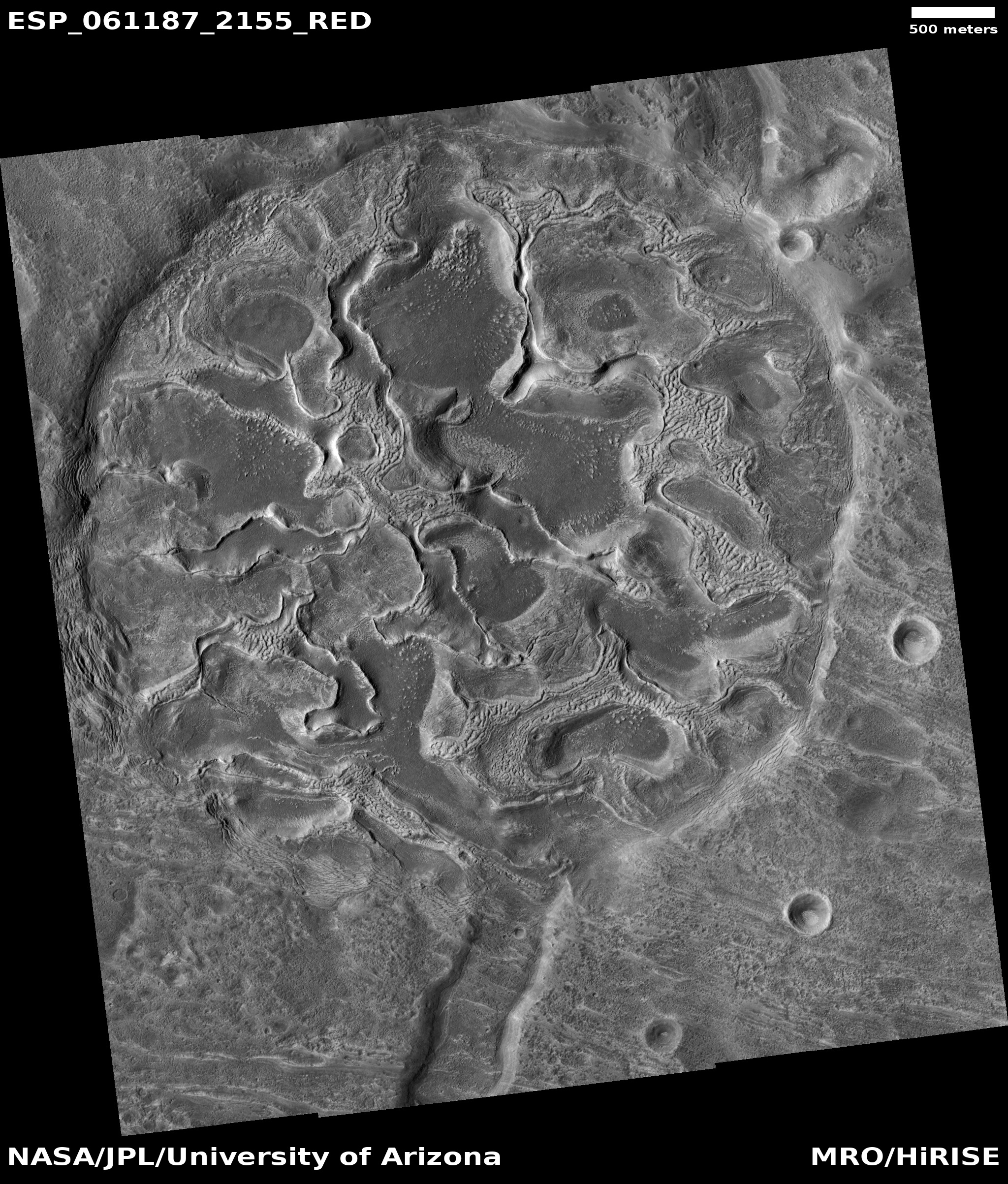
Cool image time! I could also call this another example of mass wasting, which it appears to be according to my understanding of Martian geological processes. However, the Mars Reconnaissance Orbiter science team dubbed this image “Tongue-Shaped Glaciers in Centauri Montes,” and I have no right to disagree with them.

The image to the right, rotated, cropped, reduced, and brightened to post here, shows the most prominent tongue-shaped glacier in the full image. The two curved ridges to the south of the glacier’s tip are almost certainly old moraines of debris pushed there during earlier events, when the glacier material extended farther out. In fact, if you look close you can see that this tongue lies on top of a larger older tongue that lines up with the closer of these two ridges.

This feature is located at 37 degrees south latitude, which puts it inside Mars’s southern glacial band that extends from 30 to 60 degrees latitude. According to the present defined types of Martian glaciers, this tongue is what scientists have dubbed a lobate debris apron, a glacier that in many ways resembles glaciers we see on Earth.

The location of this feature is especially interesting, especially because other images have found that it is not unique to this region.
» Read more

0 comments

Cave pits in the Martian northern lowlands

New pits in Hephaestus Planitia

I could call this my monthly Martian Pit update. Since November 2018 I have each month found from two to five new and interesting cave pits in the monthly download of new images from the high resolution camera on Mars Reconnaissance Orbiter (MRO). My previous posts:

All except the last August 12 post were for pits on the flanks of Arsia Mons, the southernmost in the line of three giant volcanoes to the southeast of Olympus Mons, and were thus almost certainly resulting from lava flows.

The August 12 post instead showed pits found in Utopia Planitia, one of the large plains that comprise the Martian northern lowlands where scientists think an intermittent ocean might have once existed. All of these pits are found in a region of meandering canyons dubbed Hephaestus Fossae.

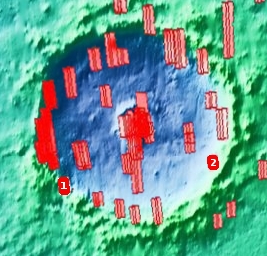
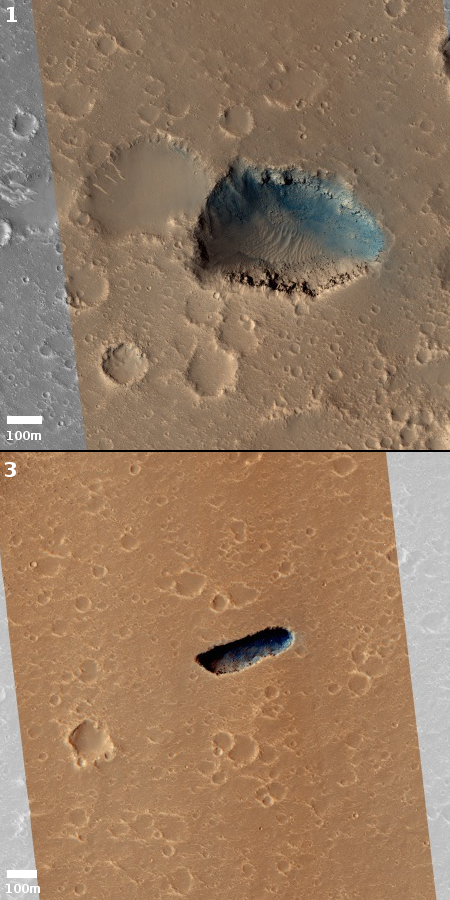
In the most recent MRO release scientists once again focused on the pits in or near Hephaetus, imaging four pits, two of which have been imaged previously, as shown in my August post and labeled #2 and #4 in this article, and two (here and here) that appear new. The image on the right, cropped to post here, shows the two new pits, dubbed #1 and #3. In the full image of #1, it is clear that this pit lines up nicely with some other less prominent depressions, suggesting an underground cave. Pit #3 however is more puzzling. In the full image, this pit actually runs perpendicular to a long depression to the west. There are also no other related features around it.

What makes all four of these pits intriguing is their relationship to Hephaestus Fossae and a neighboring rill-like canyon dubbed Hebrus Valles, as shown in the overview map below.
» Read more

6 comments

ESA asks NASA’s help on ExoMars rover parachute problems

The European Space Agency (ESA) has asked for help from NASA in trying to figure out the cause of the failures during testing of the parachutes they want to use to safely land their ExoMars 2020 rover, Rosalind Franklin.

So far the parachutes have been damaged on all previous tests. They plan two more tests in December and February.

Both tests, to be held at high altitude to simulate the Martian atmosphere, need to succeed in order for the parachutes to pass qualification. TheExoMars mission faces a final review scheduled April 2020, Francois Spoto, ExoMars program manager, told SpaceNews. โ€œNow the situation is critical, of course, because we have limited time and no margin,โ€ Spoto says.

If one of the tests fails, the ExoMars mission will miss the narrow July 25 to Aug. 13 launch window next year and slip to the next window, in late 2022. The lander and rover segments are meanwhile progressing well and ready for environmental testing.

They held a workshop on the previous failures, and obtained new analysis of the causes from JPL engineers.

2 comments

More potential Starship landing sites on Mars

Starship landing sites

On August 28, 2019 I broke the story that SpaceX is beginning to obtain images of candidate Starship landing sites from Mars Reconnaissance Orbiter (MRO).

Many news sources, skilled in their ability to rewrite press releases, saw my article and immediately posted stories essentially repeating what I had found, including my geological reasoning. Some did some more digging and, because they came out a few days later they were able to take advantage of the next MRO team image release, issued on August 30th, to find a few more candidate site images.

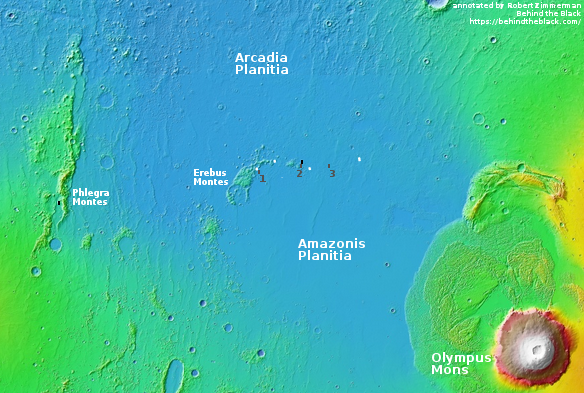
Those additional images included the remaining stereo images for all the images in my August post, indicated by the white boxes in the overview map above. They also included two new locations, indicated by the black boxes. One was of one more location in the easternmost hills of Erebus Montes. The other was a stereo pair for one entirely different landing location, farther to the west in the mountains dubbed Phlegra Montes, a location that SpaceX had previously been considering, but until this image had not been included in its MRO image requests.

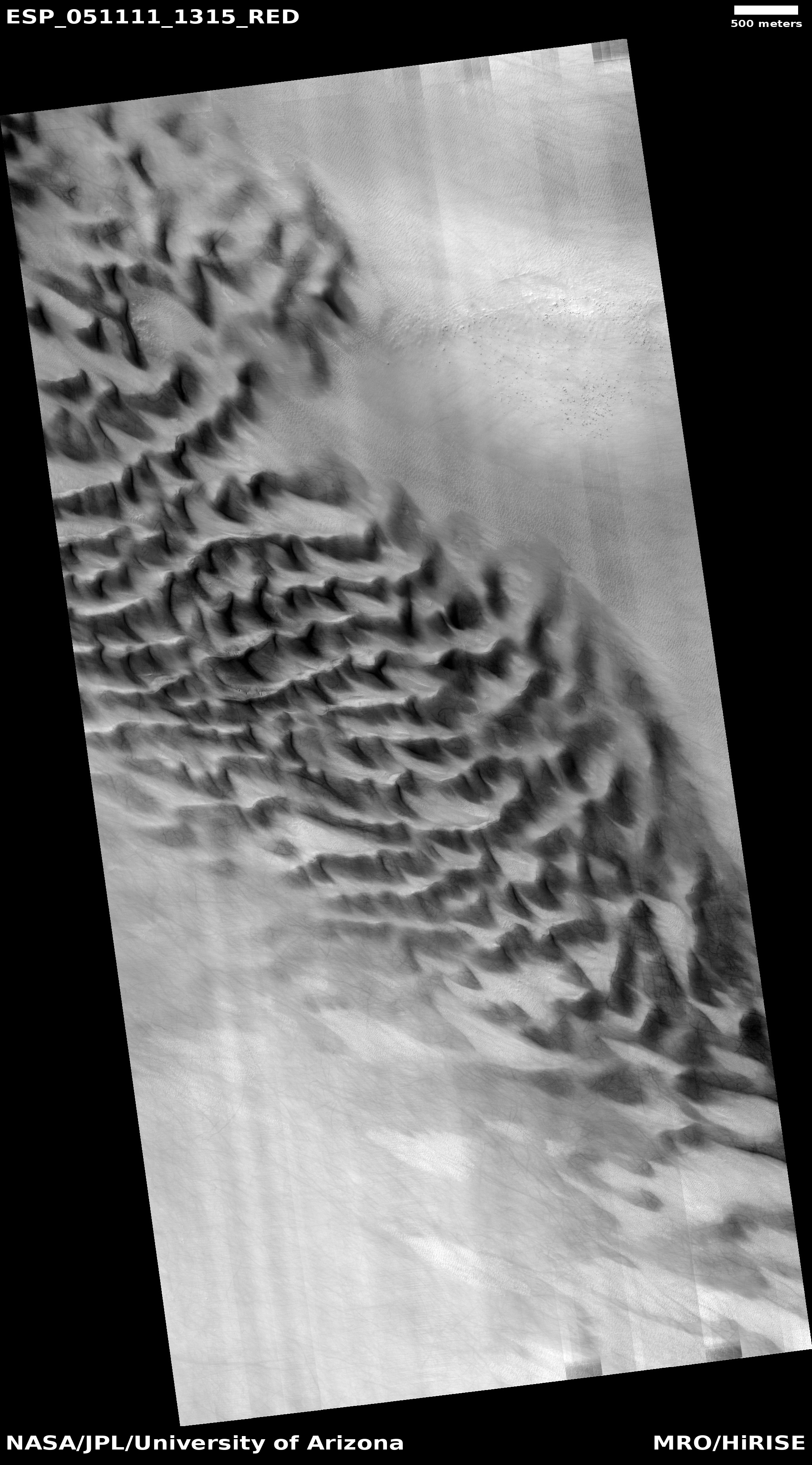
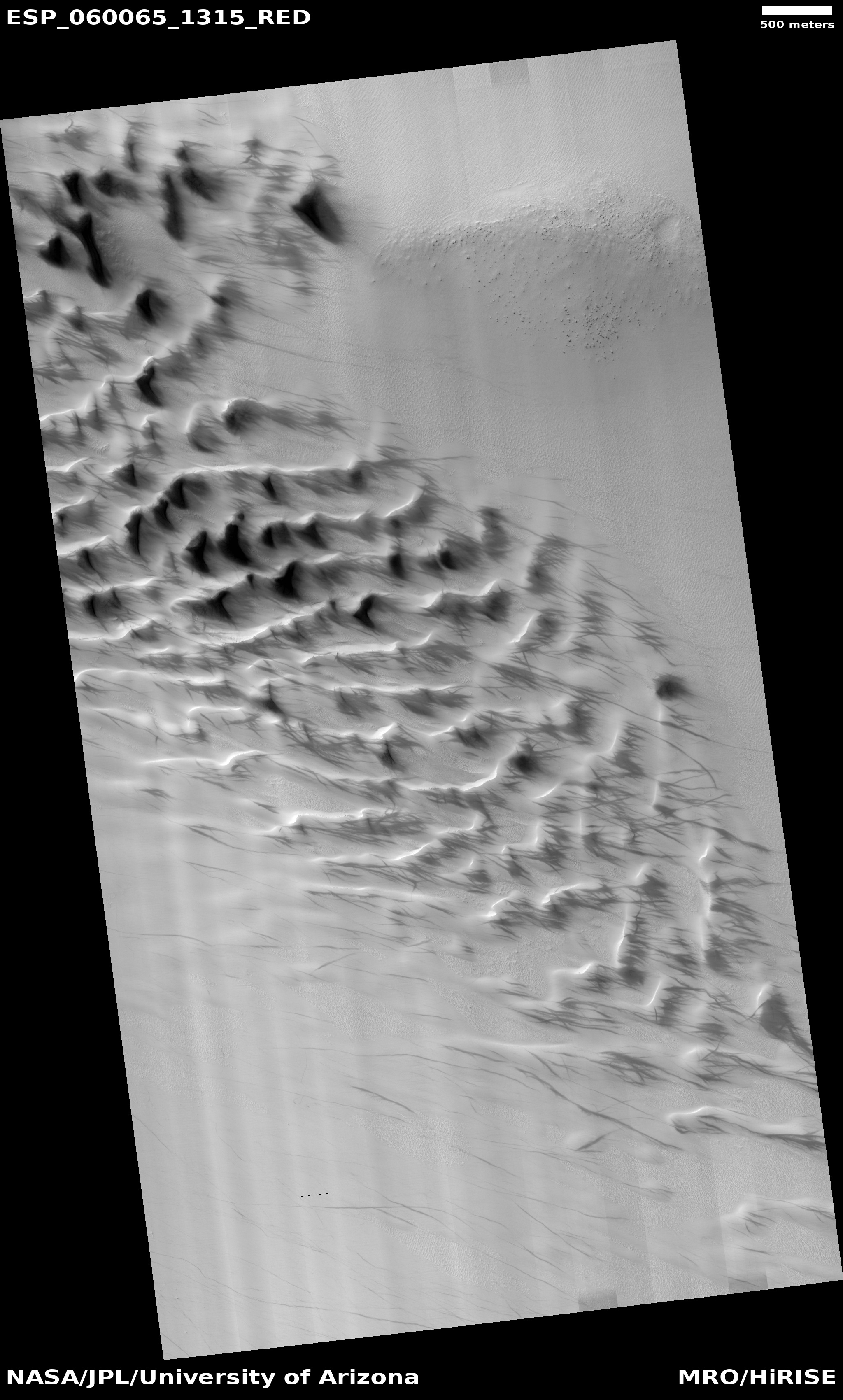
The grey boxes in the map above show the approximate locations of images not yet officially released by MRO. Though unreleased, their existence is still public knowledge, as they are listed as already acquired images in the HiWish database. Below are links to the three upcoming new images (the second stereo images for locations #1 and #2 are not included)

Both the Phlegra Montes location and #3 above appear to be looking at soft slushy material that might have a lot of water just below the surface.
» Read more

0 comments

Update on effort to save heat probe on InSight

Link here. The article, written in late August by one of the German scientists in charge of the heat probe on the Mars lander InSight, gives a detailed look at the effort to figure out what is blocking the Mole, the digging tool designed to pound the heat probe as much as 15 feet into the ground.

They had discovered previously is that the ground had collapsed around the drill shaft, creating a very wide hole. The Mole however needed the friction caused by the surrounding dirt to push downward, and thus didn’t have it.

They have since used InSight’s scoop at the end of the robot arm to push at the ground around the hole in an effort to fill the hole. As of mid-August this has managed to fill the hole about half way.

This report was written on August 27, just before contact with Mars was lost for two weeks because the Sun had moved between the Earth and Mars. Communications have now resumed, so I expect they will also resume their efforts to fill the hole enough that they might then try to resume the digging effort.

Hat tip to Doug Messier of Parabolic Arc, who by the way is right now running his annual fund-raising drive for the website. Please consider donating.

0 comments

More delays for China’s Long March 5

Chinese officials have now admitted that the next launch of China’s biggest but troubled rocket, the Long March 5, will not occur until December 2019 at the earliest.

Moreover, the first launch of Long March 5B, the new version of the rocket developed following the Long March 5 failure on its second launch in 2017, won’t happen until 2020. This is the version they plan to use to launch their space station modules, and these delays probably thus delay start of the in-orbit assembly of their space station by two years, to 2022.

These rocket delays also threaten the launch of China’s Chang’e-5 lunar sample return mission and their first Mars orbiting mission, which has a firm summer 2020 launch window which if missed will delay the mission’s launch for two years.

These reports also for the first time officially explain the engine trouble that caused the Long March failure on its second launch in July 2017.

Addressing the causes of the failure has required a lengthy process of redesign and testing of the YF-77 liquid hydrogen-liquid oxygen propellant engines. Two YF-77 engines power the rocketโ€™s first stage, with an oxidizer turbopump isolated as the fault behind the 2017 launch failure.

The Space News article very strangely headlines the completion of the core module for China’s space station, when the real story here is the continuing delays in getting Long March 5 off the ground. Without that rocket none of China’s big space plans can proceed. Yet the article buries this scoop many paragraphs down. I wonder why.

0 comments

Avalanche season at the Martian north pole

Avalanche on-going at the edge of Mars' north pole icecap
Click for full resolution image.

As the Martian spring started to unfold in April 2019, the focus of many Martian planetary scientists immediately shifted to the northern polar icecap, where they fully expected, based on previous experience, some spectacular events to occur.

I have already reported on this year’s initial observations of the sublimation of the carbon dioxide frost layer. That frost layer, generally less than six feet thick, falls as dry ice snow with the coming of winter, then sublimates away each spring. Since the arrival of Mars Reconnaissance Orbiter (MRO) in 2006 and its discovery of this process by its high resolution camera, these scientists have been monitoring the disappearance of that frost layer from Martian year to Martian year.

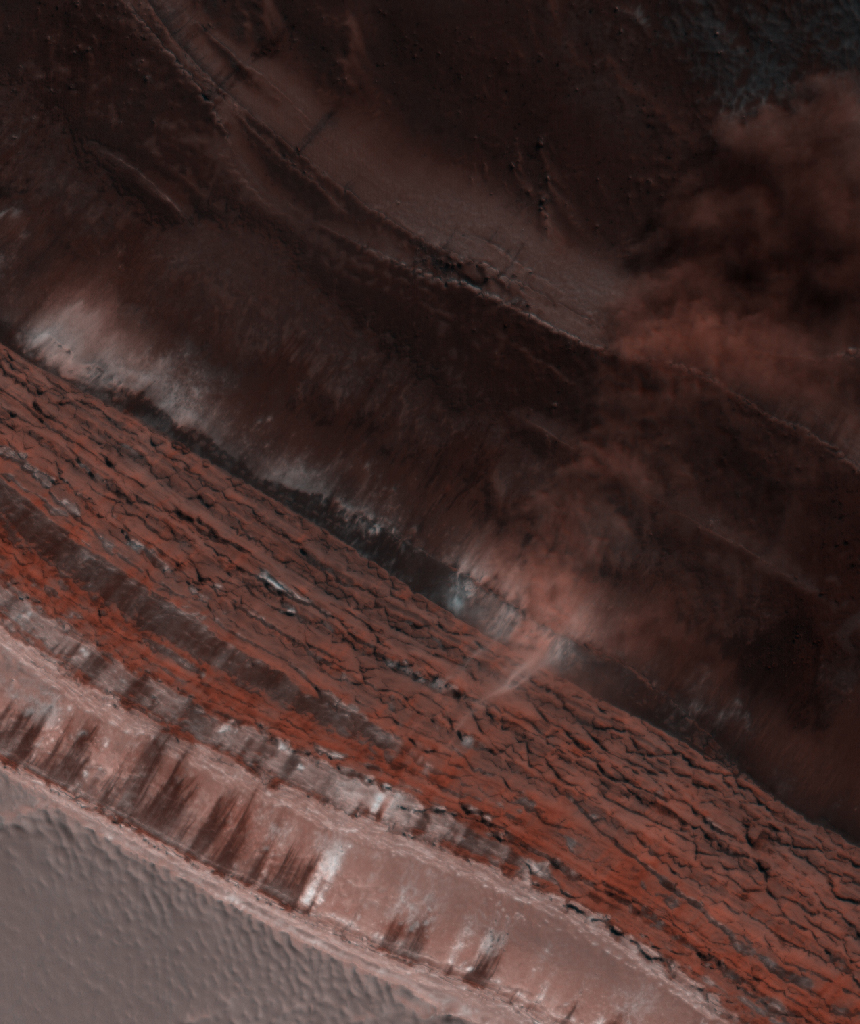
That sublimation process also brings with it other spectacular changes, including the coming of frequent avalanches along the high cliff scarps, ranging in heights from 1,500 to 3,000 feet, that comprise the edge of that north pole icecap. The image above, reduced to post here, shows one of the many avalanches found this spring and photographed as they were actually happening. It looks down at the cliff that runs from the left to the lower right of the image, with its top being the flat plateau in the lower left. From the caption, written by Dr. Candice Hansen of the Planetary Science Institute in Tucson, Arizona,

Every spring the sun shines on the side of the stack of layers at the North Pole of Mars known as the north polar layered deposits. The warmth destabilizes the ice and blocks break loose.

When they reach the bottom of the more than 500 meter tall cliff face [about 1,600 feet], the blocks kick up a cloud of dust. (In the cutout, the top layer of the north polar cap is to the lower left.) The layers beneath are different colors and textures depending on the amount of dust mixed with ice.

The linear many-layered look of that cliff face is due to the many layers believed to exist within the permanent water icecap of Mars. To give some perspective, this cliff is several hundred feet taller than the World Trade Center after completion. Those falling blocks are dropping farther than the bodies that horribly fell from the Trade Center the day it was hit by airplanes flown by Islamic terrorists on September 11, 2001.

The map below shows most of the eastern half of that icecap, with the white boxes showing the various places MRO has spotted such avalanches.
» Read more

1 comment

Communications restored with Curiosity

The most recent Curiosity drill hole
Click for full resolution image.

With Mars moving out from behind the Sun yesterday, the Curiosity science team has successfully reestablished communications with the rover.

The focus of Curiosity’s activities since returning to operations after conjunction, now that Mars has safely moved out from behind the sun, is to finish up the analyses associated with the drilling campaign at “Glen Etive 1.”

The image to the right, cropped and reduced to post here, was among the first images downloaded from the rover once communications were reestablished. It was taken by a camera at the end of the robot arm that the scientists had positioned above the hole in order to get a close-up.

Before continuing up the mountain they now plan a second drill hole close-by, to better constrain the data at this location obtained from this first hole.

0 comments

More parachute problems for ExoMars 2020?

Space is hard: Eric Berger at Ars Technica reported yesterday that the parachute issues for Europe’s ExoMars 2020 mission are far more serious that publicly announced.

The project has had two parachute failures during test flights in May and then August. However,

The problems with the parachutes may be worse than has publicly been reported, however. Ars has learned of at least one other parachute failure during testing of the ExoMars lander. Moreover, the agency has yet to conduct even a single successful test of the parachute canopy that is supposed to deploy at supersonic speeds, higher in the Martian atmosphere.

Repeated efforts to get comments from the project about this issue have gone unanswered.

Their launch window opens in July 2020, only about ten months from now. This is very little time to redesign and test a parachute design. Furthermore, they will only begin the assembly of the spacecraft at the end of this year, which is very very late in the game.

When the August test failure was confirmed, I predicted that there is a 50-50 chance they will launch in 2020. The lack of response from the project above makes me now think that their chances have further dropped, to less than 25%.

3 comments

Taking a look back at a Martian pit

Pavonis Mons pit
Click for full image.

The pit to the right could almost be considered the first “cool image” on Behind the Black. It was first posted on June 20, 2011. Though I had already posted a number of very interesting images, this appears to be the first that I specifically labeled as “cool.”

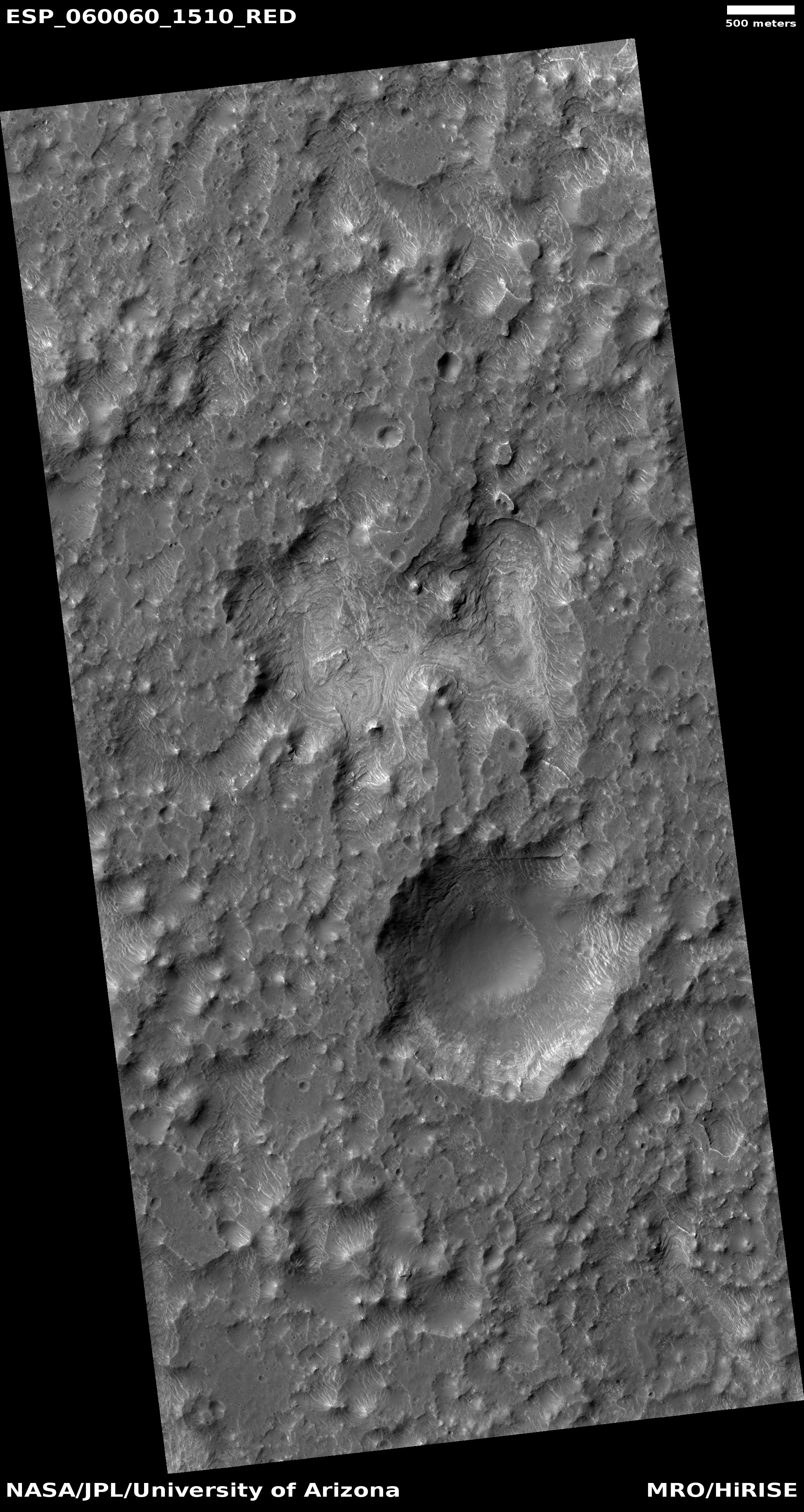
The image, taken by the high resolution camera on Mars Reconnaissance Orbiter (MRO), had been requested by a seventh grade Mars student team at Evergreen Middle School in Cottonwood, California, and shows a pit on the southeastern flank of the volcano Pavonis Mons, the middle volcano in Mars’ well-known chain of three giant volcanoes. A close look at the shadowed area with the exposure cranked up suggests that this pit does not open up into a more extensive lava tube.

What inspired me to repost this image today was the release of a new image from Mars Odyssey of this pit and the surrounding terrain, taken on July 31, 2019 and shown below to the right.
» Read more

3 comments

Terraced and banded hills on Mars

Banded or terraced hills in eastern Hellas
Click for full image.

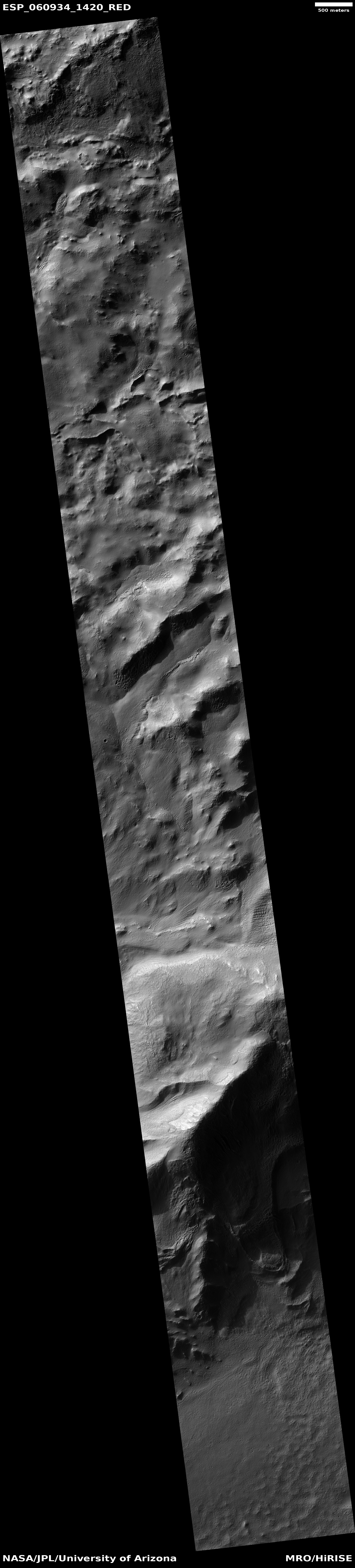
Cool image time! In my review of the most recent download of images from Mars Reconnaissance Orbiter’s (MRO) the high resolution camera, I found a very startling (and cool) image of some dramatic terraced Martian hills, taken on July 30, 2019. I wanted to post it here, but decided to first do some more digging, and found that an earlier image, taken in 2017, showed more of this particular hill. It is this earlier image posted to the right, cropped and reduced.

Don’t ask me to explain the geology that caused this hill to look as it does. I can provide some basic knowledge, but the details and better theories will have to come from the scientists who are studying this feature (who unfortunately did not respond to my request for further information).

What I can do is lay out what is known about this location, as indicated by the red box in the overview map below and to the right, and let my readers come up with their own theories. The odds of anyone being right might not be great, but it will be fun for everyone to speculate.
» Read more

0 comments

Mars’ mysterious slope streaks become even more mysterious

Bright slope streaks in Arabia Terra
Click for full image.

Mars is an alien planet. This fact needs to be restated over and over, because we humans have an uncontrolled and unconscious tendency to view the things we find on Mars and assume they are caused by and resemble phenomenon we see all the time here on Earth.

Not. Mars has a very different climate, a significantly weaker gravitational field (about one third of Earth’s), and a geological and environmental make-up very alien from Earth’s. While many phenomenon there might have parallels on Earth, it is very dangerous to assume they are the same, because more often than not, they are exceedingly dissimilar and mysterious.

The image on the right is another example of this, reduced and cropped to post here. It is of some slope streaks in the Arabia Terra region on Mars, the largest most extensive region in the transition zone between the northern lowland plains and the southern highlands. I found it in my review of the August 30th release of new images from the high resolution camera on Mars Reconnaissance Orbiter.

As I already noted in my previous article about the mysterious slope streaks of Mars:

The bottom line, as noted in one paper, โ€œThe processes that form slope streaks remain obscure. No proposed mechanism readily accounts for all of their observed characteristics and peculiarities.โ€

Mars is strange. Mars is alien. Mars epitomizes the universe in all its glory.

The image above only reinforces this conclusion.
» Read more

0 comments

Cliff collapse on Mars

Cliff collapse on Mars
Click for full image.

Cool image time! The photograph to the left, rotated, cropped, and reduced to post here, was found in the August image release of the high resolution camera on Mars Reconnaissance Orbiter (MRO).

This was an uncaptioned image, with a title “Cataract and Grooves in Kasei Valles.” Kasei Valles is the giant canyon north of Marineris Valles. Though it is not as well known or maybe as dramatic, it is about as long and vast as its more famous southern canyon. It also has some very intriguing features, including what I consider to so far be the pit on Mars with the highest priority for exploration.

The image on the right shows the result when a giant section of this cliff face broke off and collapsed into the canyon. It also shows that the collapse occurred a long time ago. Not only are there newer craters on the collapse debris, the breakdown at the cliff base looks well eroded, as if many eons have passed since it piled up there.

When this section broke off however it was a very big event. The width of the collapse is about a mile across, with its depth about 600 feet. The height of the cliff is approximately 3000 feet, give or take a few hundred feet. Thus the chunk that broke off was about 600 feet wide, 5,000 feet long, and about 3,000 feet high. That’s one very big rock.

0 comments

SpaceX begins hunt for Starship landing sites on Mars

Candidate landing sites for SpaceX's Starship

In the August image release from the high resolution camera of Mars Reconnaissance Orbiter (MRO) were five images whose title immediately caught my interest:

The overview map on the right shows the location on Mars for these five photographs. The second and third images are of the same location, taken to produce a stereo pair.

To put it mildly, it is most intriguing to discover that SpaceX is beginning to research a place where it can land Starship on Mars. I immediately emailed Nathan Williams, the JPL scientist who requested these images from SpaceX, but he was bound by a non-disclosure agreement with SpaceX and could not comment. I have since tried to get some information directly from SpaceX but so far the company has not responded. A 2017 news story had indicated the company’s interest in this Mars’ location, but gave no details either.

Based on what we now know of Mars, however, it is possible to figure out why they favor this location, on the border between the two large northern lowland plains Arcadia and Amazonis Planitia.
» Read more

43 comments

Engineers attach test helicopter to Mars 2020

Engineers have now attached to the Mars 2020 rover the test helicopter that will attempt to make the first air-born flight on another world.

The Mars Helicopter is considered a high-risk, high-reward technology demonstration. If the small craft encounters difficulties, the science-gathering of the Mars 2020 mission won’t be impacted. If the helicopter does take flight as designed, future Mars missions could enlist second-generation helicopters to add an aerial dimension to their explorations.

“Our job is to prove that autonomous, controlled flight can be executed in the extremely thin Martian atmosphere,” said JPL’s MiMi Aung, the Mars Helicopter project manager. “Since our helicopter is designed as a flight test of experimental technology, it carries no science instruments. But if we prove powered flight on Mars can work, we look forward to the day when Mars helicopters can play an important role in future explorations of the Red Planet.”

If this works on Mars, MiMi Aung will be in a position to win contracts for similar helicopters for the rest of her life. It seems to me that this project has been her baby from the beginning.

0 comments
1 80 81 82 83 84 128