A Martian tadpole

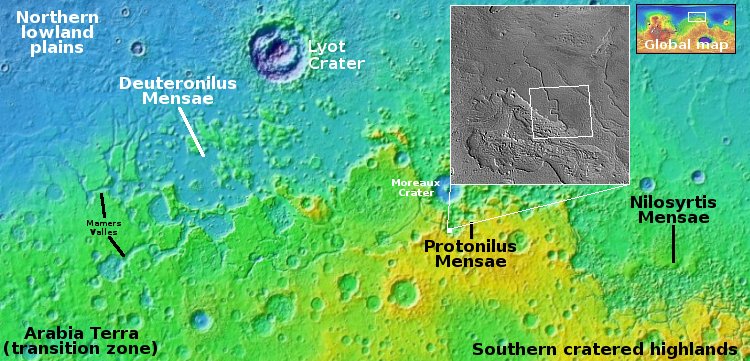
Overview map

A Martian tadpole
Click for original image.

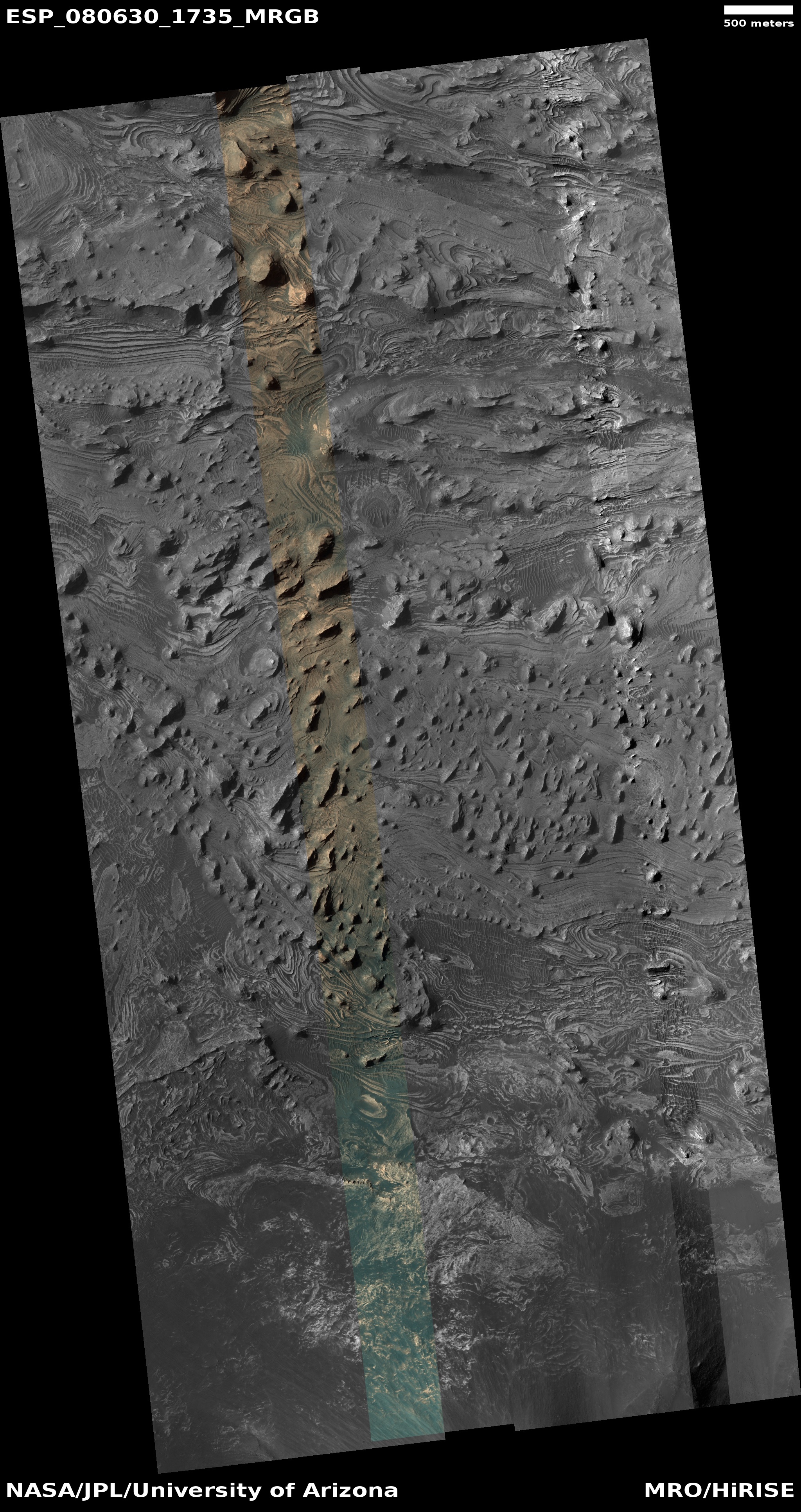
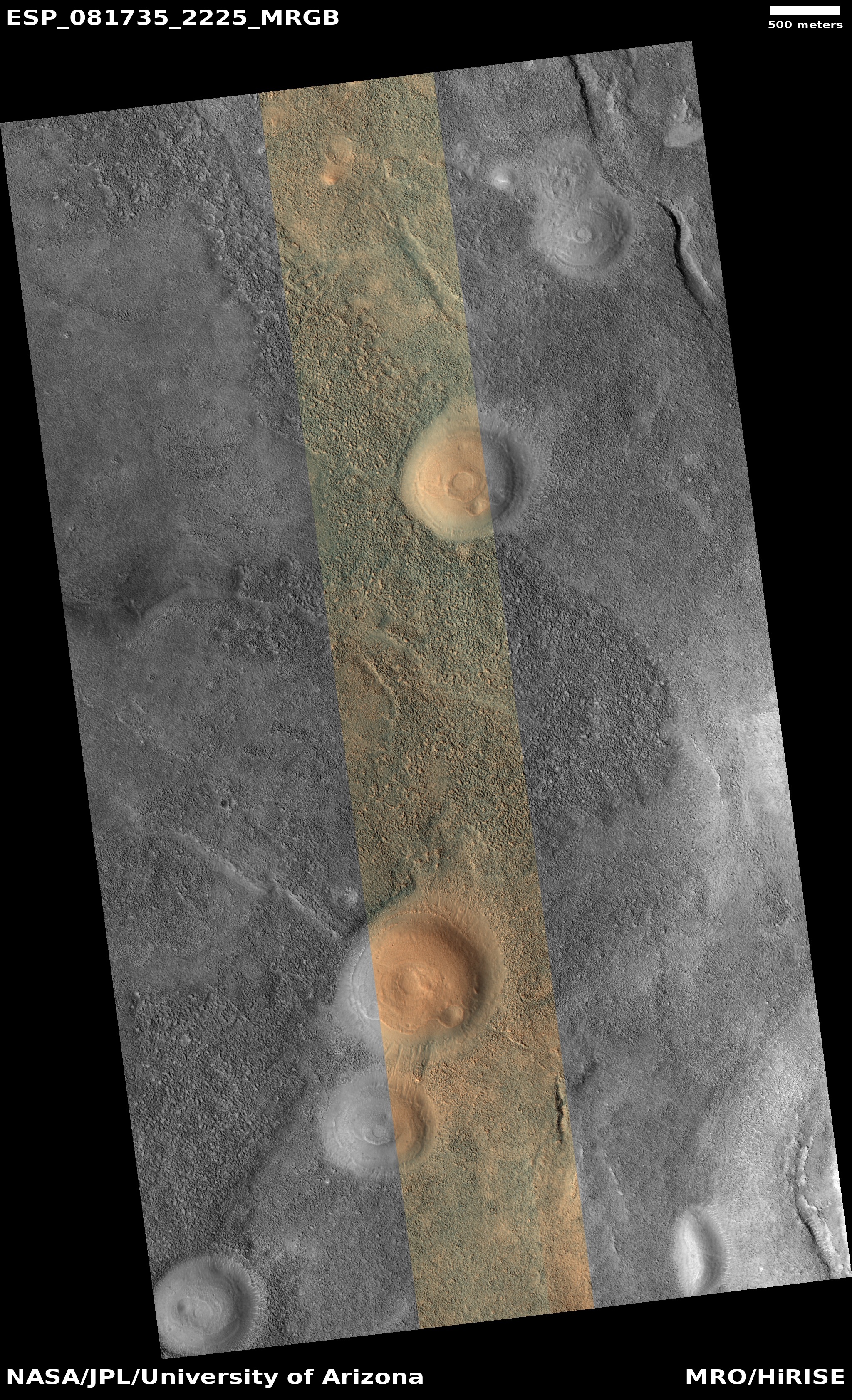
Cool image time! The picture to the right, rotated, cropped, reduced, and sharpened to post here, was taken on December 28, 2023 by the high resolution camera on Mars Reconnaissance Orbiter (MRO).

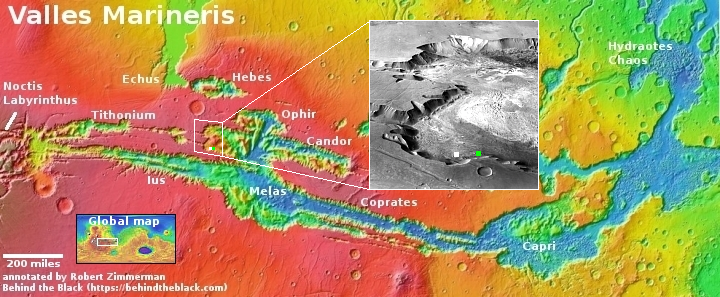
The white dot on the overview map above marks the location, with the rectangle in the inset marking the area covered by the picture. The science team labels this “inverted features,” a more vague way to describe the feature geologists dub “inverted channels.” The flow of a river or glacier acts to harden and increase the density of the channel bed. Later, the water or ice disappears, leaving just the canyon.

Even later, erosion begins to wear away the surrounding terrain. Because the canyon floor is now harder than that surrounding terrain, that floor is more resistent to erosion, and eventually becomes ridge following the exact same path as the long gone river or glacier.

This is what we have here, with this inverted channel, which is about five miles long, once draining into the deeper eroded valley to the south.

The location is at 38 degrees north latitude and inside the 2,000-mile-long mid-latitude region I dub glacier country, because almost every image shows evidence of glaciers or ice flows on the surface. This picture however is a rare exception. The features in this picture instead appear to be bedrock, something that is rarely seen in the canyons and craters in glacier country. It is beyond my pay grade however to explain why this spot lacks such features. Or it could be the near surface ice here looks so much like bedrock I am misinterpreting the picture.

0 comments

The strange surface of the perennial dry ice cap at Mars’ south pole

The strange surface of Mars' dry ice cap
Click for original image.

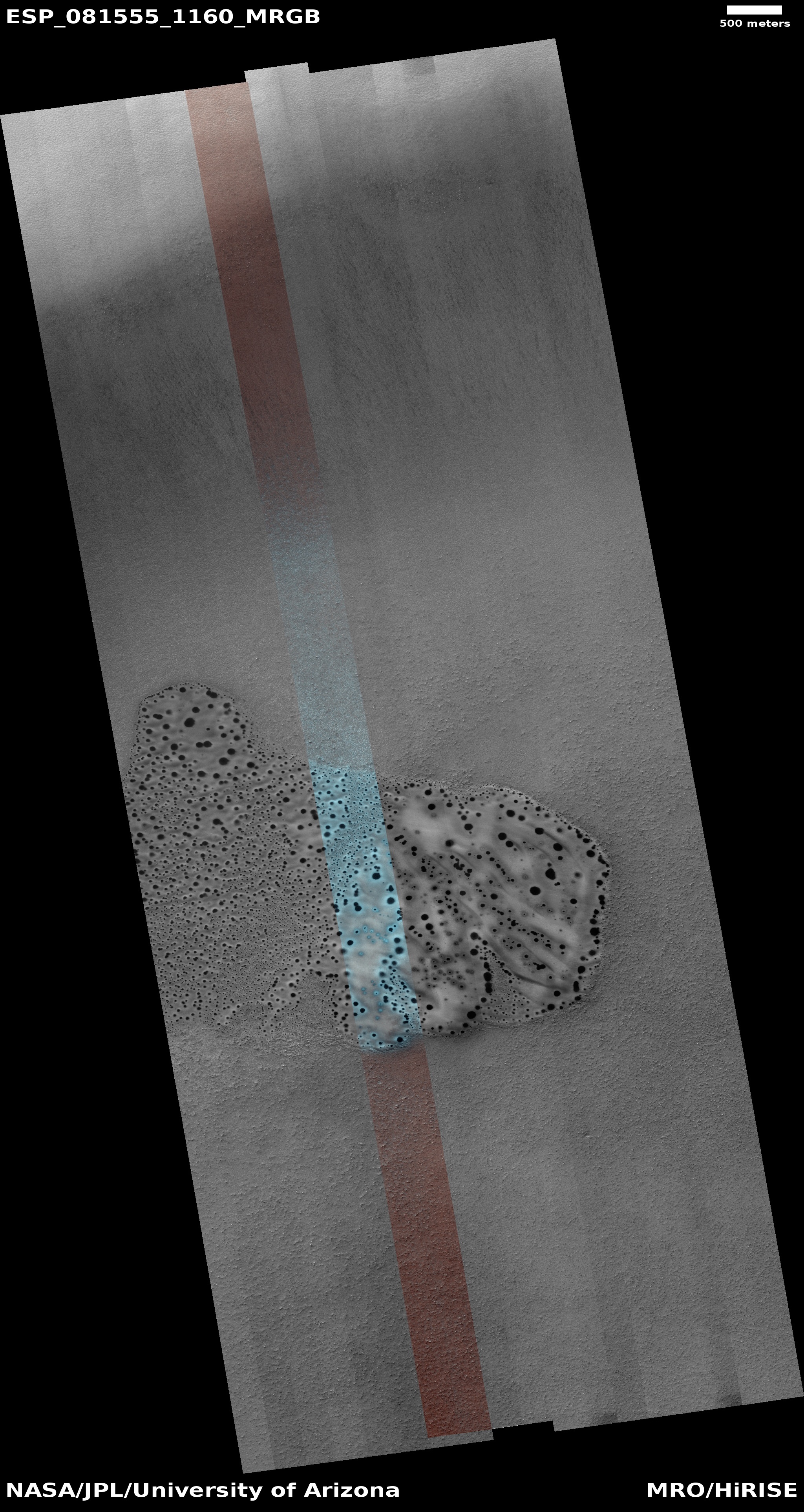
Cool image time! The picture to the right, cropped to post here, was taken on January 24, 2024 by the high resolution camera on Mars Reconnaissance Orbiter (MRO). It shows a region about 180 miles from the south pole of Mars.

This terrain is intriguing because is the pattern of ridges that cover it entirely. I have simply cropped the original image to show these ridges in highest resolution. The full image shows them covering a region much larger than this.

What are we looking at? Because it is near the pole, it is likely that the black splotches are caused by carbon dioxide gas breaking through the winter mantle of dry ice that covers the poles during the winter months and then sublimates away, from the bottom, each spring. As the dry ice turns to CO2 gas that gas is trapped, until it can find a weak spot in the overlying mantle. When the pressure builds enough, the mantle breaks, the gas escapes, and as it does so it deposits the dark dust around the breakage. That dust fades as the mantle disappears.

Sounds good, eh? Not so fast.
» Read more

1 comment

The really really strange landscape of Cydonia on Mars

Some really strange terrain on Mars
Click for original image.

Cool image time! The picture to the right, cropped, reduced, and sharpened to post here, was taken on January 3, 2024 by the high resolution camera on Mars Reconnaissance Orbiter (MRO), and shows what the camera team describes merely as “landforms.”

In truth, these features, as well as almost everything in the surrounding terrain beyond the edge of this picture, are possibly the weirdest geological features on Mars. The two mounds, no more than fifteen feet high at the most, resemble pimples. The rough ground to the north actually appears to be some flow that worked its way around the mounds, as indicated by the arrows. The crack to the southeast of the two mounds appears to be an extension of a fault line that cuts through the center of the larger mound, suggesting the mound is some form of eruption belching out of that fissure.

That the latitude is 42 degrees north, these weird features all suggest some form of ice-based volcanic activity, because the ground here is probably impregnated with ice.

As for the bridge connecting the two mounds, who knows what caused it?
» Read more

9 comments

A Martian cliff of ash, flushed by wind

A Martian cliff of ash flushed by wind
Click for original image.

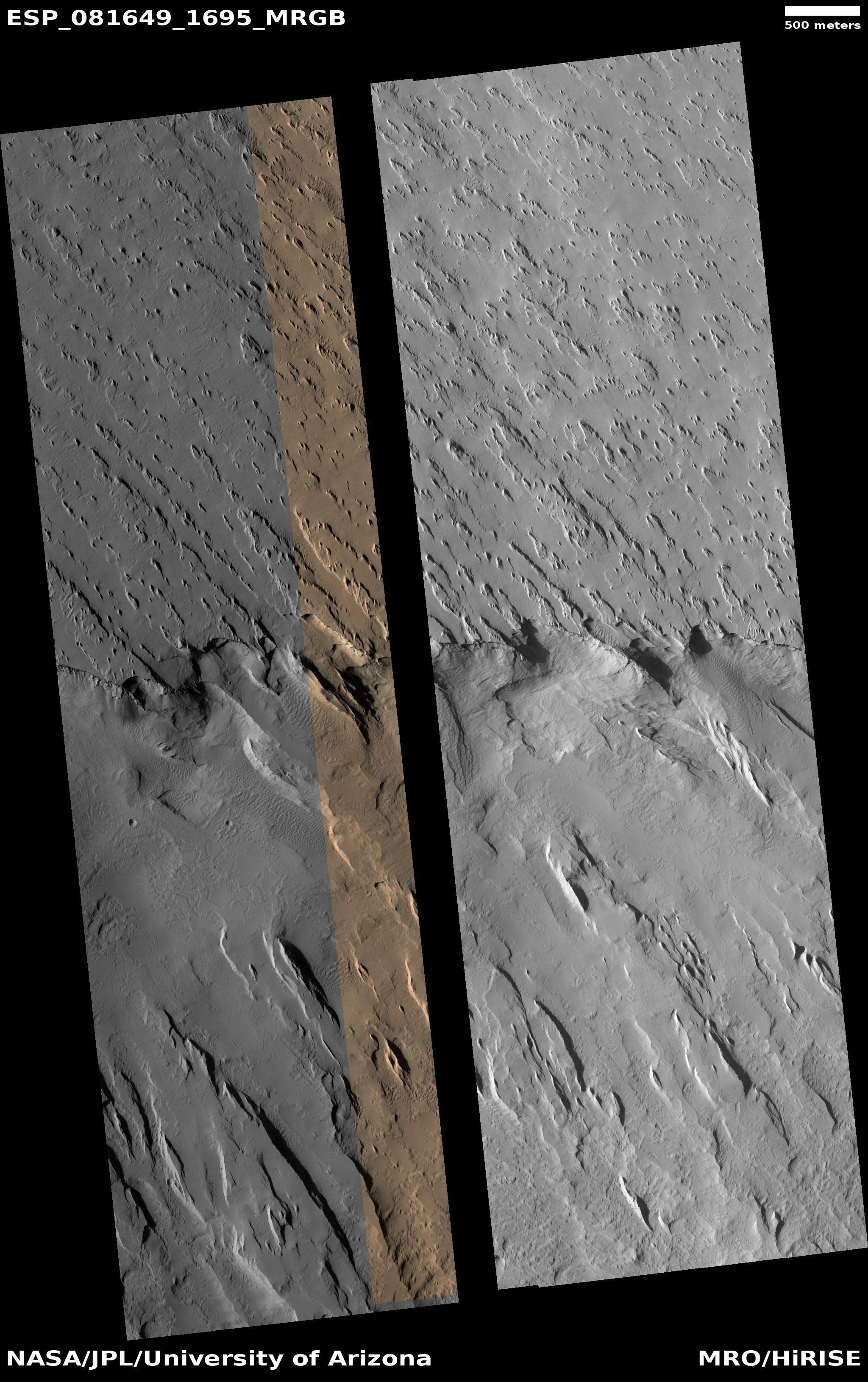
Cool image time! The picture to the right, rotated, cropped, reduced, and sharpened to post here, was taken on December 27, 2023 by the high resolution camera on Mars Reconnaissance Orbiter (MRO). Described merely as an “exposed scarp” by the science team, this cliff edge is actually much more.

First some basic details. The elevation drop from the plateau down to the base of this cliff is about a thousand feet. The material that forms this plateau, scarp, and its base is all volcanic ash. The thicker sections of ash has caused its lower levels to compress, harden into a kind of sandstone. Near the surface however it is more friable, and like sandstone can break apart somewhat more easily.

The prevailing winds at this site are generally blowing to the south, but beginning to turn to the east, which explains the northwest to southeast orientation of the features.

The best analogy I can come up with to explain the erosion of this scarp is as follows: Imagine a deposit of dry mud a few inches thick on pavement. Take a leaf blower and blow at it hard, always in one direction. Eventually the outer edge will break up and blow away, leaving a sharp edge, that will also retreat with time as the wind continues to blow.

Here the winds are eroding that cliff, causing periodic avalanches which dissolve into sand that then blows away, leaving no debris pile at the base of the cliff. The ridges indicate harder material, that breaks away last, which is why there are some ridgelines extending outward from the scarp in line with these ridges. At the same time, these ridges of harder ash still break up with time, as some are cut off suddenly at the cliff edge.
» Read more

0 comments

A recent volcanic eruption on Mars?

A recent volcanic eruption on Mars?
Click for original image.

Cool image time! The picture to the right, cropped, reduced, and sharpened to post here, was taken on December 16, 2023 by the high resolution camera on Mars Reconnaissance Orbiter (MRO). The science team labels the two darkened patches in the picture “plume-like features,” suggesting that the dark material was eruptive material thrown out from the depressions in a volcanic venting, that then settled on the nearby surrounding terrain.

Is that a correct interpretation? It is certainly strengthened by a different feature located about 550 miles to the northwest that looks almost the same. There, researchers theorize that the dark material surrounding a surface fissure was caused by a small volcanic event that occurred somewhere between 50,000 to 210,000 years ago. For that other location, scientists concluded as follows:

After careful comparison of this symmetrical dark feature with other dark wind-caused streaks in this region, the scientists concluded that it was not caused by wind, but is the remains of a relatively recent volcanic eruption that laid down a thin layer of material only about one foot thick.

» Read more

0 comments

Frozen lava rapids on Mars

Frozen lava rapids on Mars
Click for original image.

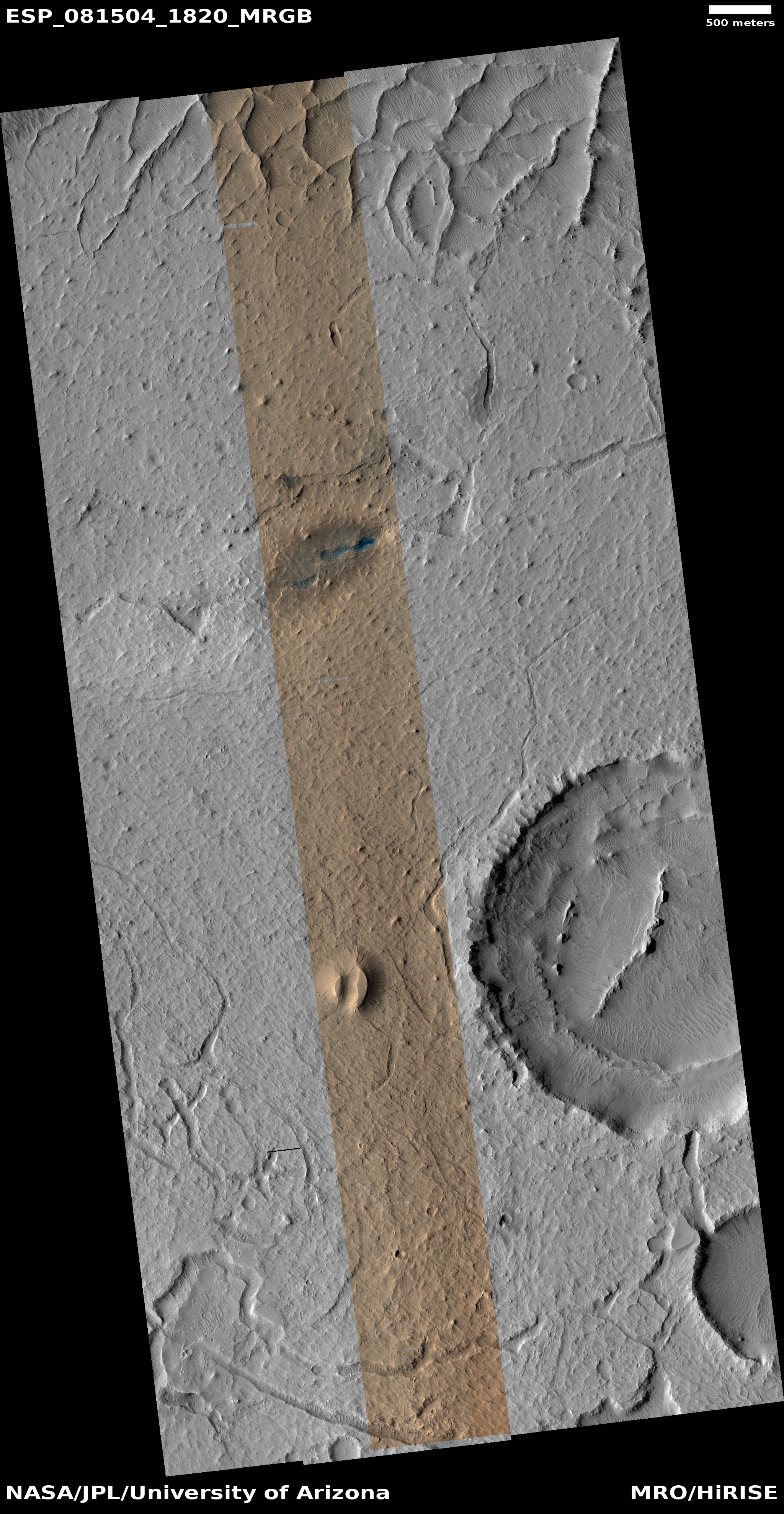
Cool image time! The picture to the right, rotated, cropped, reduced, and sharpened to post here, was taken on October 6, 2023 by the high resolution camera on Mars Reconnaissance Orbiter (MRO), and shows a spot on Mars where lava was squeezed between and around some small peaks as it flowed quickly south, flooding all the low areas in this landscape.

The science team describes the features in the full image as “streamlined”, a description that is literally accurate. As this “stream” of lava rushed past, it “lined” the higher terrain, carving it into tear-dropped shapes.

In the color strip, note the blueish spots at the northern base of the 400-foot-high hill. According to the science team’s explanation [pdf] of the colors in MRO images, “Frost and ice are also relatively blue, but bright, and often concentrated at the poles or on pole-facing slopes.” The picture was taken in summer, so if these bright spots are frost or ice, it suggests they are well shaded from sunlight in those north-facing alcoves. This location is only 9 degrees north of the equator, so finding any near surface ice here is highly unlikely. That frost might exist however is intriguing, to say the least.
» Read more

0 comments

Martian gullies caused by glacial and water erosion

A gully on the north rim of Niquero Crater
Click for original image.

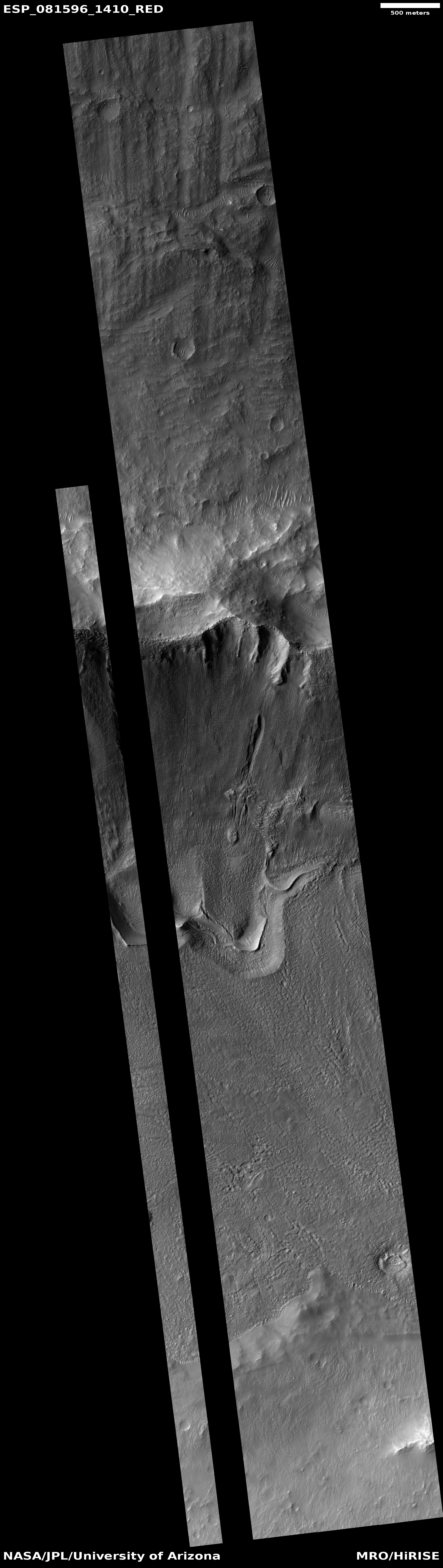
Cool image time! The picture to the right, rotated, cropped, reduced, and sharpened to post here, was taken on December 23, 2023 by the high resolution camera on Mars Reconnaissance Orbiter (MRO).

The image shows us the north interior rim of 7-mile-wide Niquero Crater on Mars. From the high to the low points the elevation difference is about 2,500 feet, with a steep downhill slope averaging about 18 degrees. The terrain appears to show several avalanche collapses that pushed lower material out of the way, though at the bottom where that material has been pushed aside there is no obvious large debris pile.

The science team labels this image simply “volatiles and gullies”, a label that carries a host of significant information. These gullies, which were among the earliest found by Mars Global Surveyor in the late 1990s, were the first evidence that the surface of Mars had a lot of near surface ice. It is for this reason that this relatively small crater on Mars has a name. Most craters this small remain unnamed, but the gullies on Niquero’s north slopes required more study, and thus the crater was given a name.

Subsequent orbital imagery has now shown that craters like Niquero, located in latitudes higher than 30 degrees, quite often are filled with glacial debris. In fact, the material that these avalanches pushed aside at the base of the slope is that glacial material, protected by a thin layer of dust and debris. The avalanche essentially disturbed that protected layer, and thus the debris pile (made up mostly of ice) sublimated away when warmed by sunlight. Thus. no big debris pile.

The gullies tend to be on the pole-facing slopes. Scientists believe they are the remnant evidence of ancient glaciers that grew on these slopes because they were protected from sunlight. In subsequent eons, when the climate on Mars changed, those glaciers collapsed, leaving behind the gullies we see now.
» Read more

0 comments

Alternating dark and light terraces inside Valles Marineris

Overview map

Alternating dark and light layered terraces in Valles Marineris
Click for original image.

Cool image time! The picture to the right, cropped and enhanced to post here, was taken on October 9, 2023 by the high resolution camera on Mars Reconnaissance Orbiter (MRO), and shows what appear to be the somewhat typical terrain at this location, in a part of the giant Martian canyon Valles Marineris dubbed West Candor Chasma. For example, I featured similar swirls in August 2022 at a place only about six miles to the east, that spot indicated by the green dot on the overview map above. The white dot marks the location of today’s image.

So, what are we looking at? The elevation drop from the high and low points is only about 180 feet, but in that short distance it appears there are more than two dozen visible layers, and those layers form terraces that alternate between bright and dark material.

The shape of the swirls also suggest that a flow of some kind, either water, ice, or wind, moved from the northwest to the southeast, carving these terraces as it descended the stair steps downward. It is also just as likely that we are seeing repeated lava flows going downhill to the southeast, each even laying another layer on top of the preceeding one. And it is also possible that we are looking at a combination of both.

The alternating dark and light layers suggest that each dark layer was an event that put down dark material, such as volcanic dust, that was subsequently covered with light material, with this process repeating itself many times over the eons.

That the floor of this part of Valles Marineris is uniquely covered in this manner is in itself intriguing. Why here, and not elsewhere within the canyon?

1 comment

The alien surface of Mars

The alien surface of Gediz Vallis
Click for original image.

Overview map
Click for interactive map.

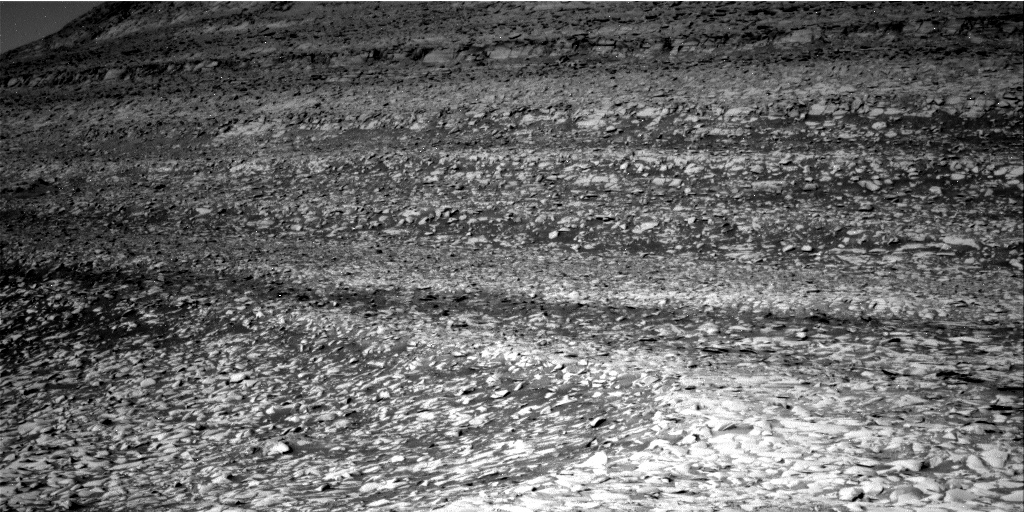
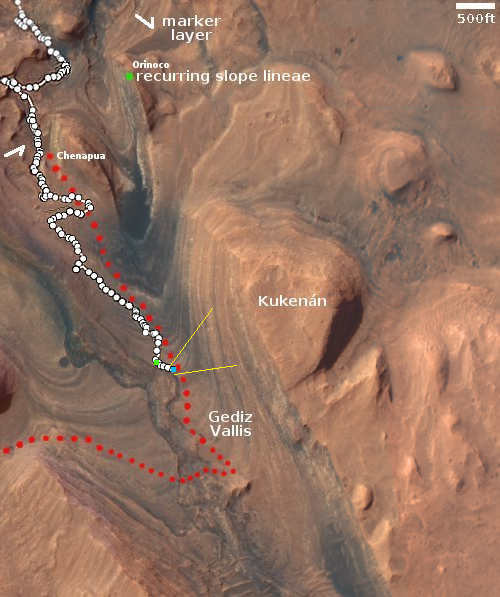
Cool image time! The picture above, brightened slightly to post here, was taken on February 15, 2024 by the right navigation camera on the Mars rover Curiosity. It looks east at the looming cliff face of the mountain Kukenan that the rover has been traveling beside for the last six months. On the overview map to the right the yellow lines indicate roughly the area covered by this picture. The blue dot marks Curiosity’s present position, while the green dot marks its position on February 5, 2024. As you can see, the rover is making slow but steady progress uphill into Gediz Vallis.

This image illustrates the alien landscape of Mars quite beautifully. First, there is absolutely no life in this picture. On Earth you would be hard pressed to find any spot on the surface that doesn’t have at least some plant life.

Second, there is the rocky layered nature of this mountain. When the Curiosity science team first announced its future route plans (the red dotted line) to drive into this canyon back in 2019, the orbital images of these layers from Mars Reconnaissance Orbiter (MRO) had suggested the terrain here would be reminiscent of The Wave in northern Arizona, a smooth series of curved layers smoothed nicely over time by the wind.

As you can see, there is no smoothness here. Instead, every single layer here is infused with broken rock, suggesting that each layer is structurally weak. As erosion exposes each, the layer breaks up, crumbling into the chaos in this picture. The curved nature of the terrain at the bottom of the picture however does suggest that some sort of flow once percolated down this canyon, either liquid water or glacial ice, carving the layers into this curved floor.

3 comments

The shoreline of a Martian lava sea

The shoreline of a Martian lava sea
Click for original image.

Cool image time! The picture to the right, cropped, reduced, and enhanced to post here, was taken on October 2, 2023 by the high resolution camera on Mars Reconnaissance Orbiter (MRO).

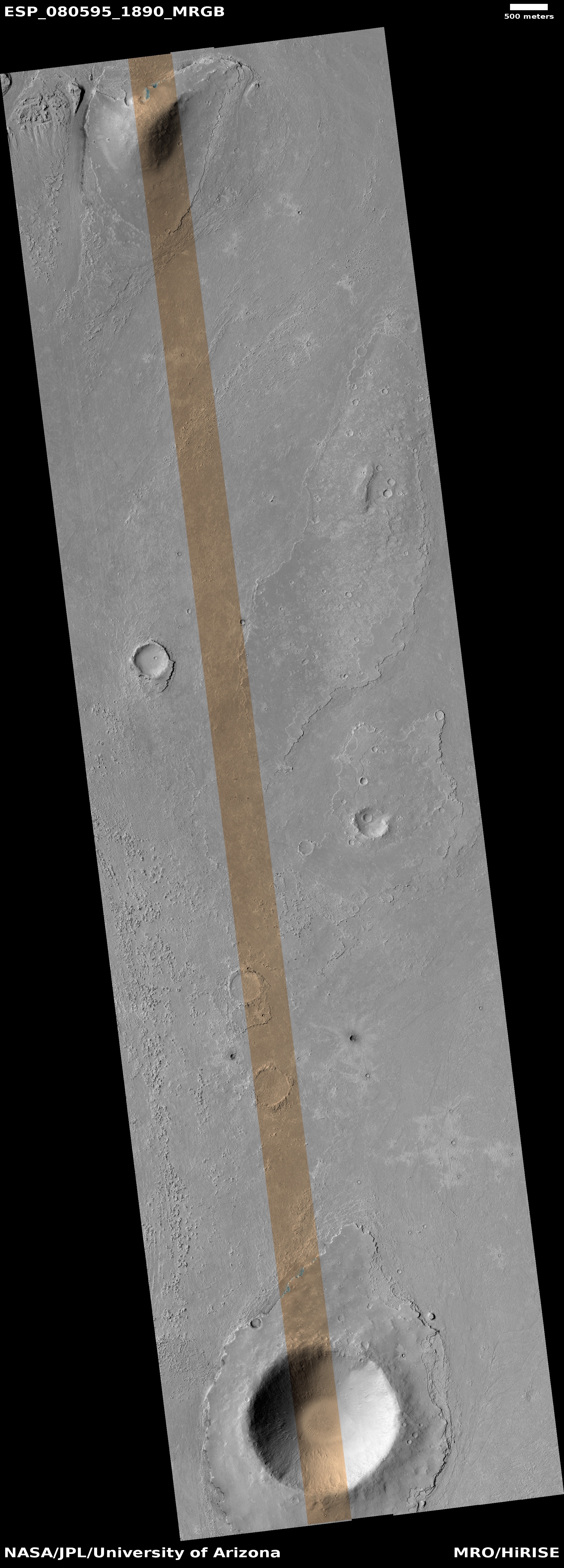
The science team labeled this a “lava margin.” The darker material on the right is apparently a newer deposit of lava, flowing on top of the lighter lava on the left. The newer deposit is only about three feet thick, so it had to have flowed fast almost like water to cover this large area with such a thin layer before freezing. Even so, this new lava layer has a roughness greater than the older layer below it. Either the older layer is smoother because of erosion from wind over eons, or the lava in these two layers was comprised of slightly different materials that froze with different textures.

The small ridges appear to be wrinkle ridges, created when material shrinks as it freezes.

This margin marks the edge of a very large flood lava event, as illustrated by the overview map below.
» Read more

0 comments

Spiders on the rim of a Martian crater

Spiders on the rim of a Martian crater
Click for original image.

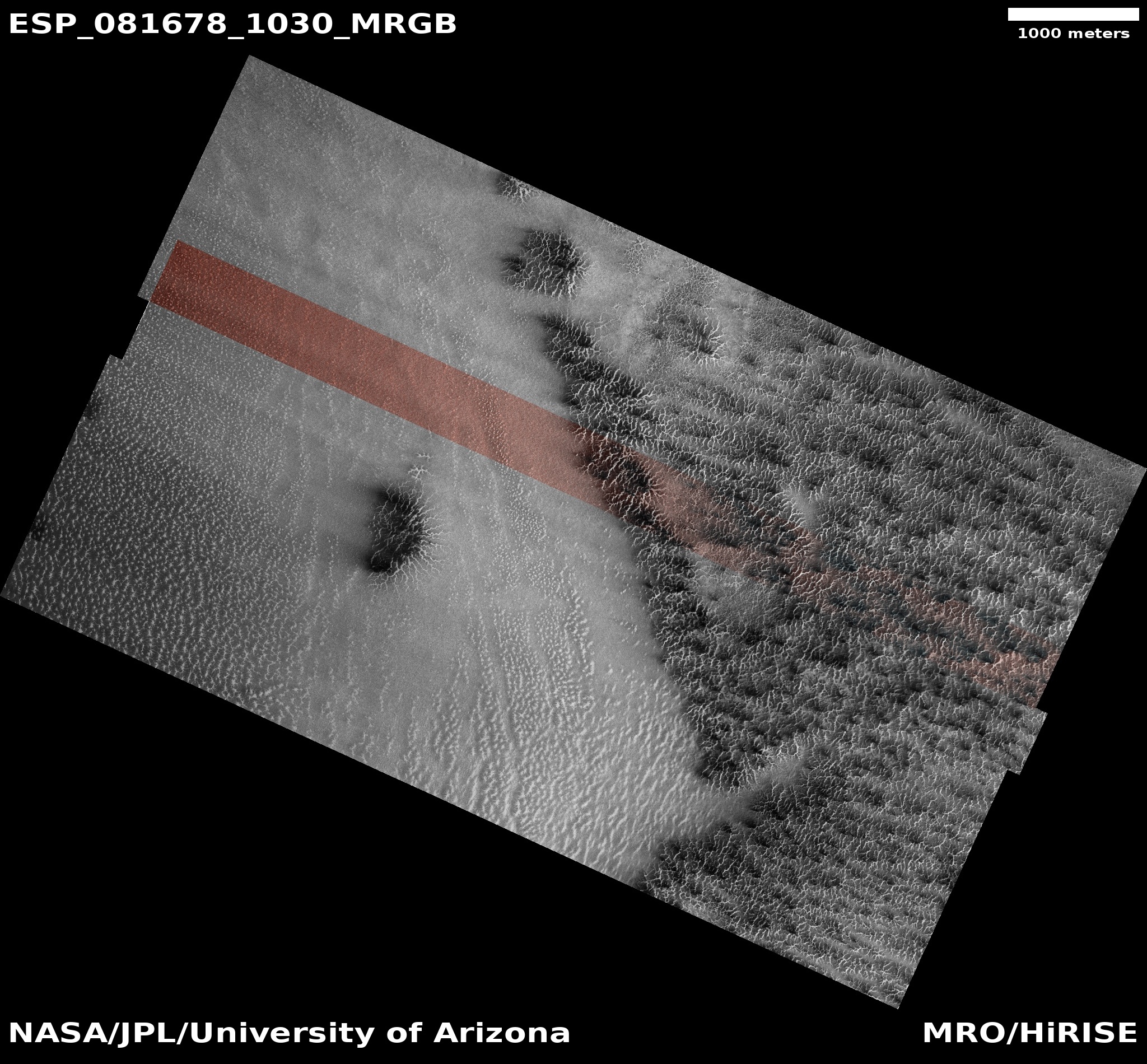
Cool image time! The picture to the right, cropped to post here, was taken on December 29, 2023 by the high resolution camera on Mars Reconnaissance Orbiter (MRO). It shows strange spidery formations on the rim of a 17-mile-wide crater about 500 miles from the south pole of Mars.

Scientists think these spider features are formed due to the seasonal cycle on Mars. In the winter at the poles the carbon dioxide in the atmosphere falls as snow in the polar regions, creating a thin dry ice mantle that covers everything. When spring arrives, sunlight goes through the clear mantle to heat its base, causing that dry ice to sublimate into gas that is trapped below the mantle. Eventually that mantle cracks at a weak point and the gas escapes, spewing dark dust on its top. By summer the mantle is entirely gone, and the black splotches disappear as they blend back into the same colored ground.

At the south pole the ground appears to be firmer and more structurally sound than at the north pole. The trapped gas appears to travel upward along the same tributary paths to the same escape points each year, thus carving these spidery features that are permanent features.
» Read more

1 comment

Martian dunes with strange splotches

Martian dunes with splotches

Cool image time! The picture to the right, cropped to post here, was taken on December 20, 2023 by the high resolution camera on Mars Reconnaissance Orbiter (MRO). It shows what the science team labels as “Dunes with Blotches.”

The blotches, or as I call them splotches, are the round dark patches on dunes themselves. Though their darkness is reminiscent of the dark patches that appear as spider features in the south polar regions of Mars, there are problems linking the two. The spiders form when the winter mantle of dry ice that falls as snow begins to weaken when the Sun reappears in the spring. Sunlight travels through the clear dry ice to warm the base of the mantle, causing it to sublimate into carbon dioxide gas. That gas however is trapped at the base, and only escapes when the thin mantle cracks at weak points. As the gas puffs out it carries with it dust, which leaves dark patches on the surface that disappear when the mantle disappears entirely by summer.

In the southern hemisphere at the poles the ground is somewhat stable, so the trapped gas appears to travel along the same paths each year to the same weak spots. This in turn causes it to carve spidery patterns in the ground, like river tributaries, except here the tributaries of gas flow uphill to their escape point. At the north pole the ground is not as stable. Instead we have many dunes, so that the dry ice mantle sublimates away at different places each year. There is no chance to form such spider patterns over time.

Making these splotches more puzzling is the season. This picture was taken in the winter, at a time one would think no dry ice is sublimating away.
» Read more

0 comments
1 19 20 21 22 23 90