The Martian cycles of climate change, as shown in just one crater

The Martian cycles of climate change, as shown in one crater

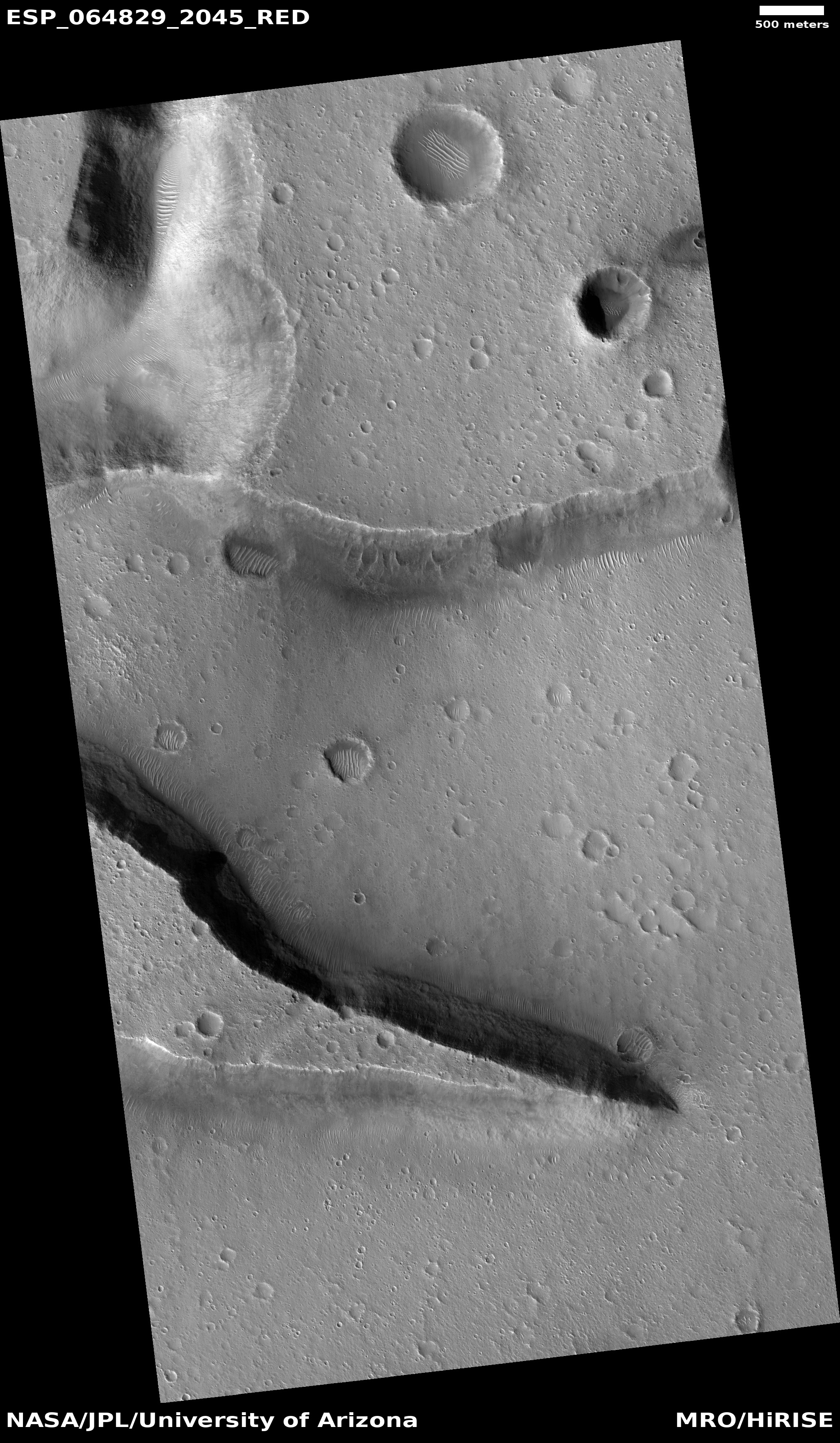
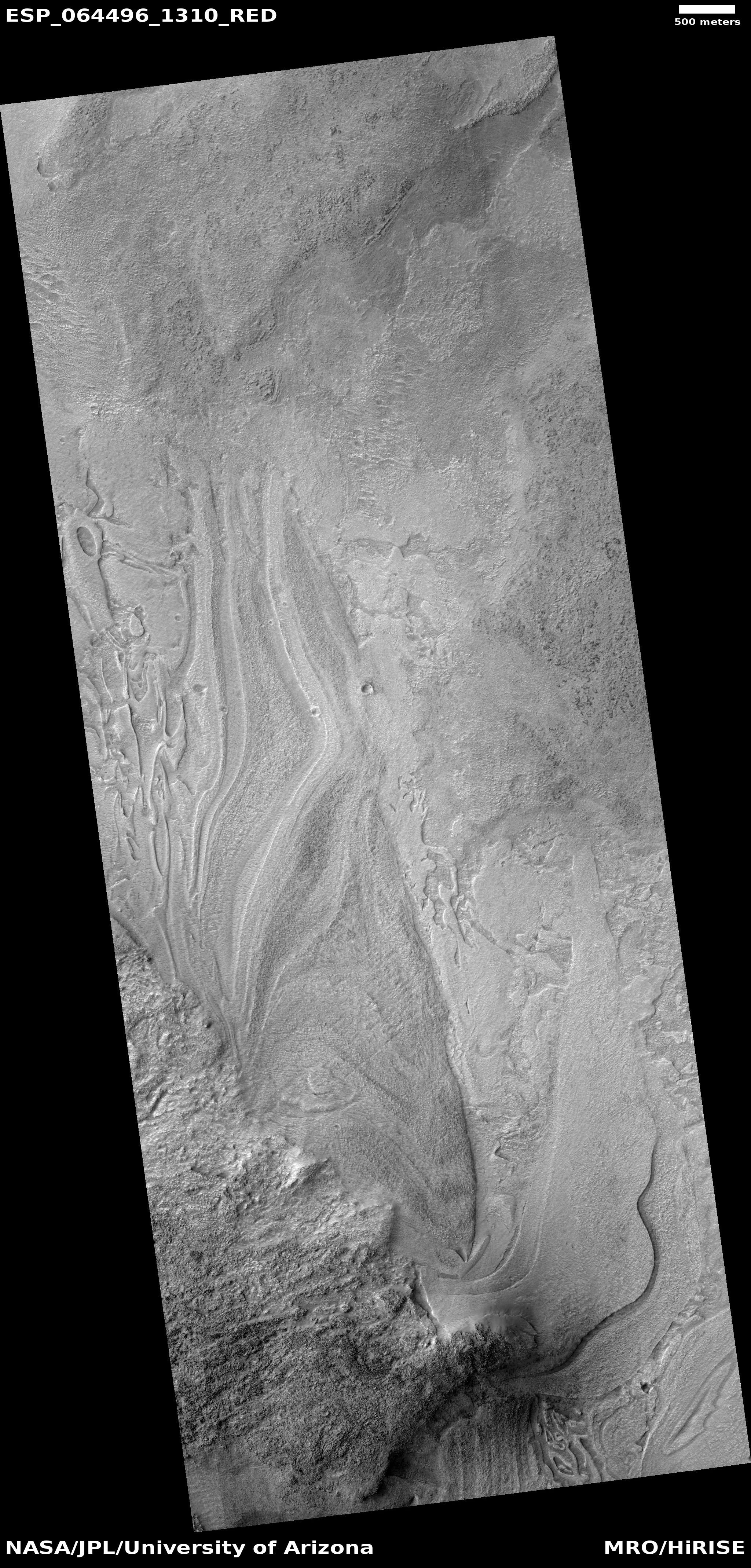
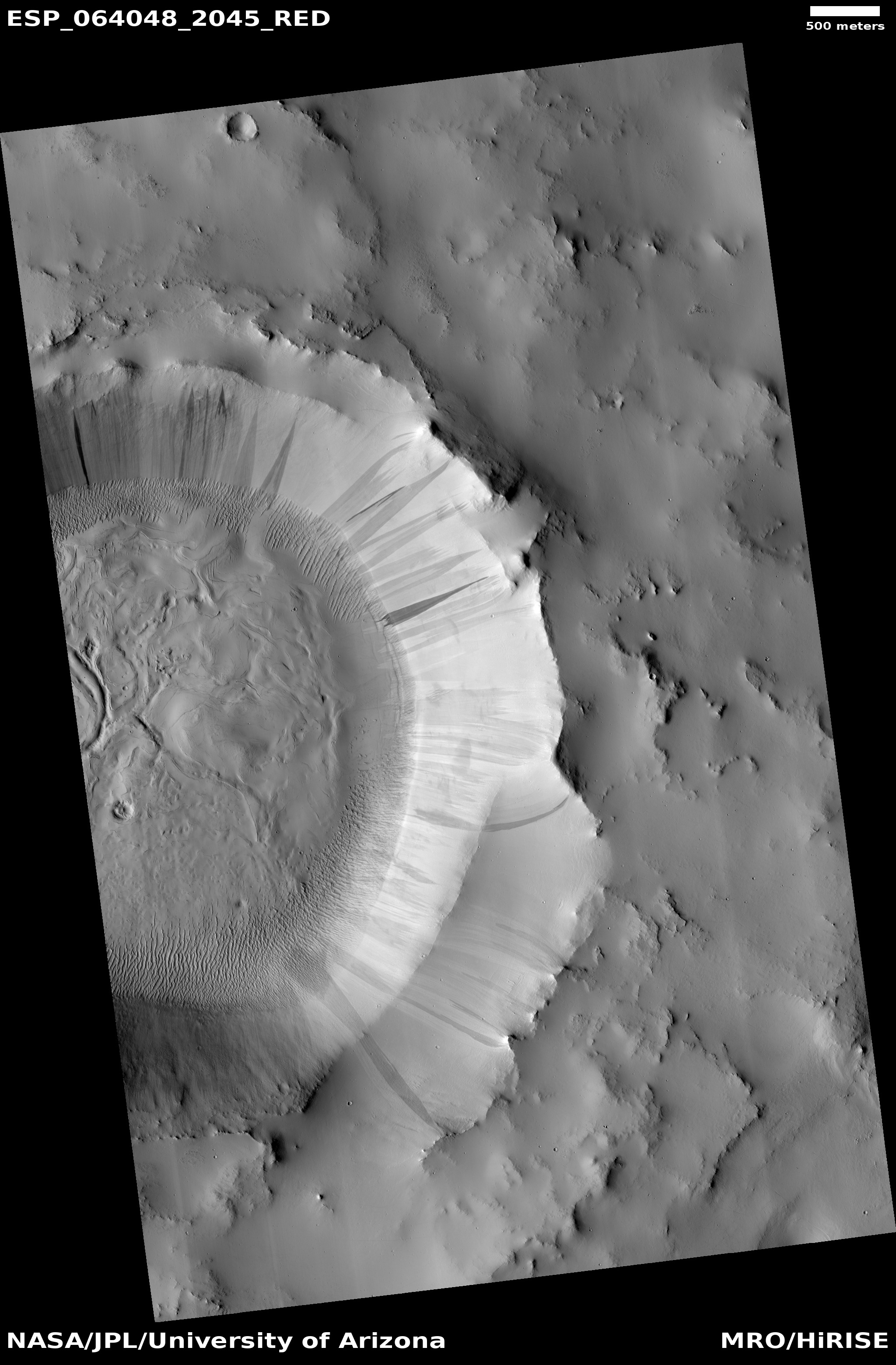
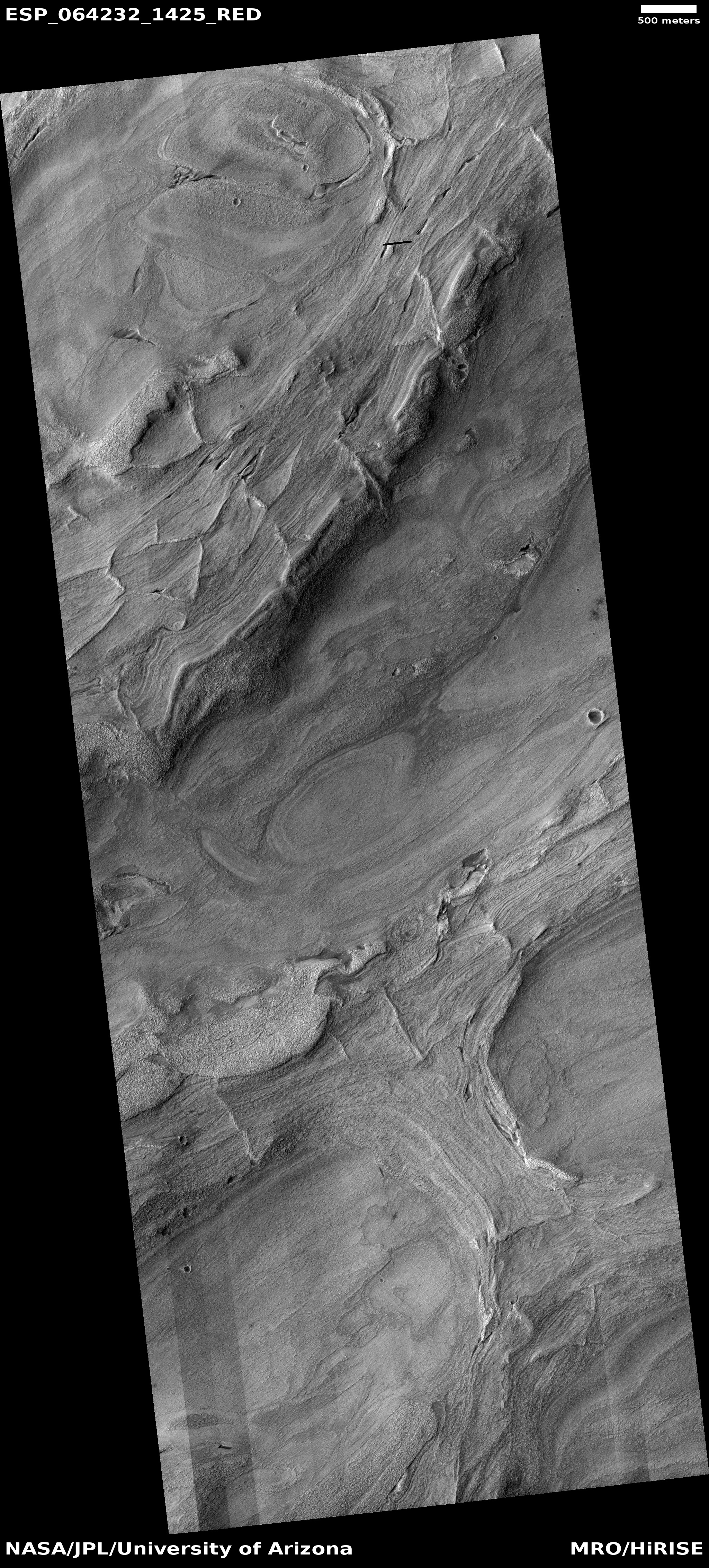
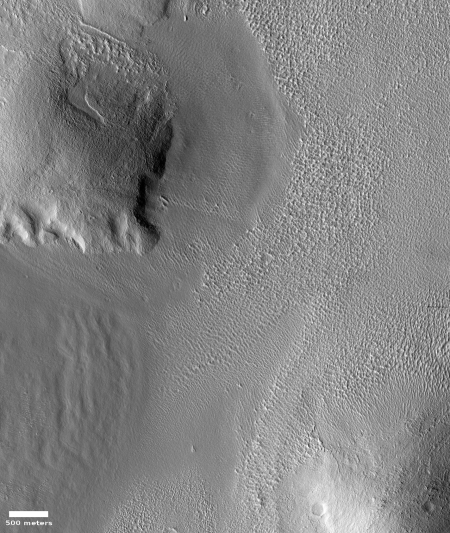
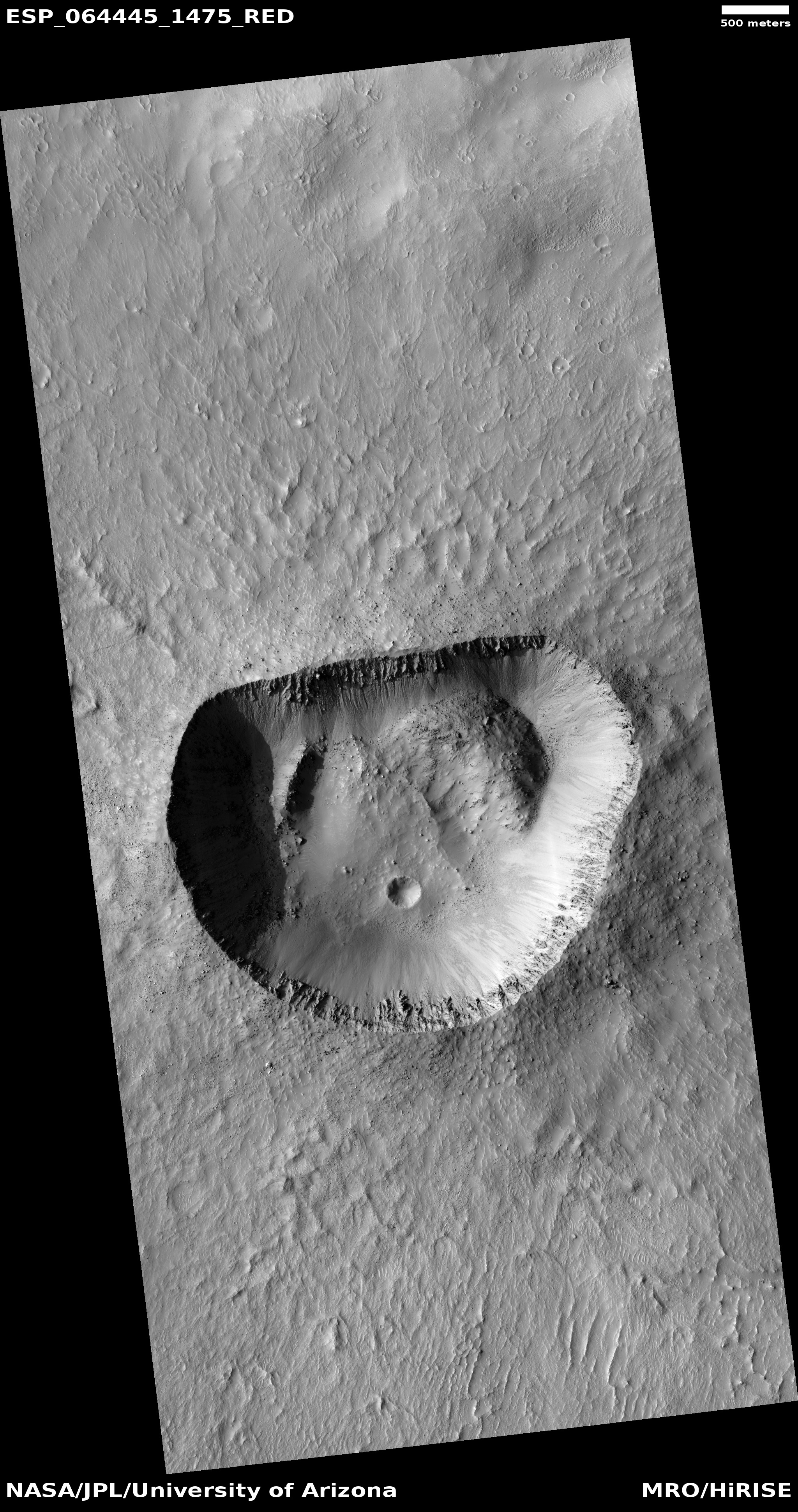
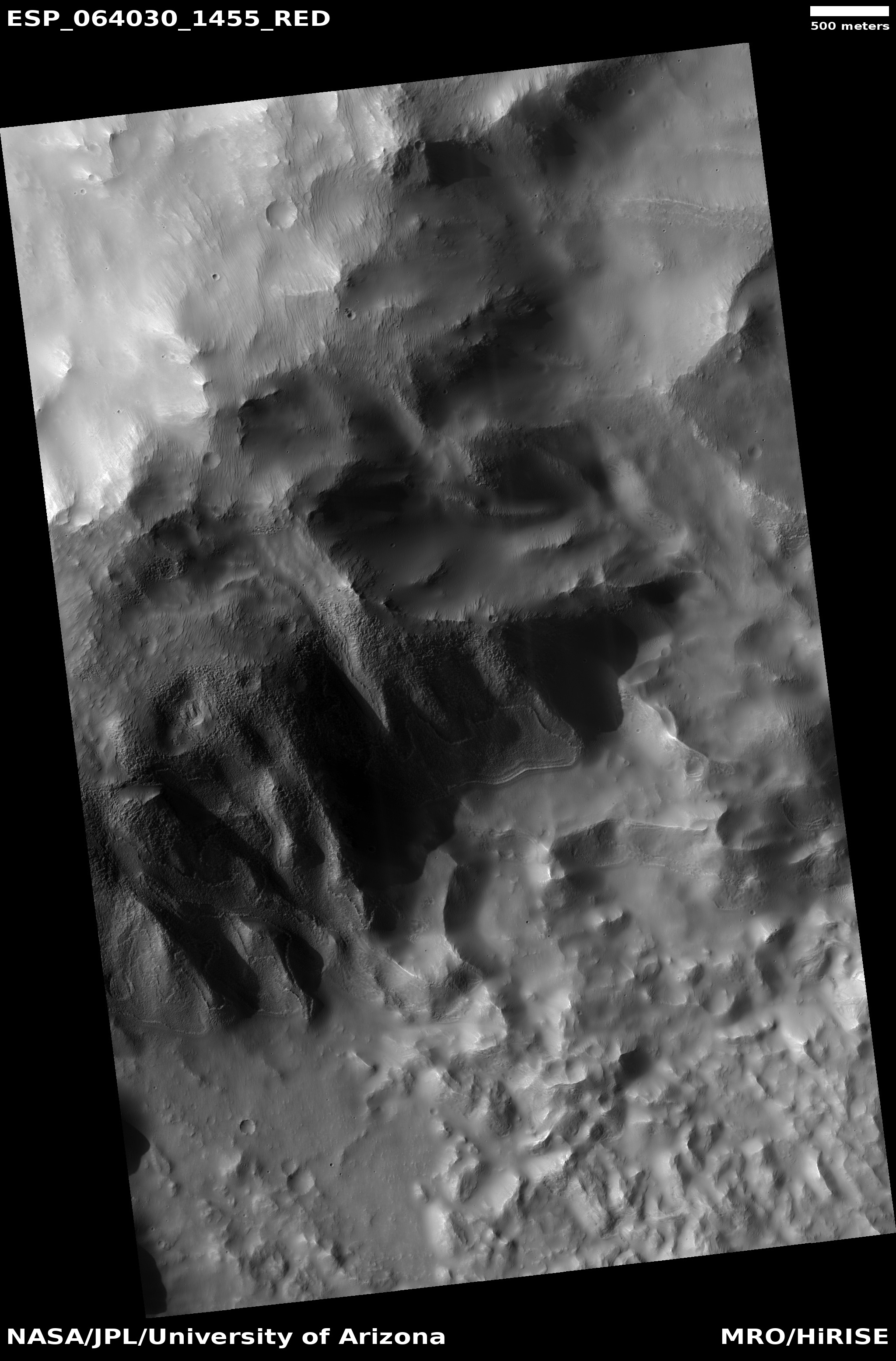
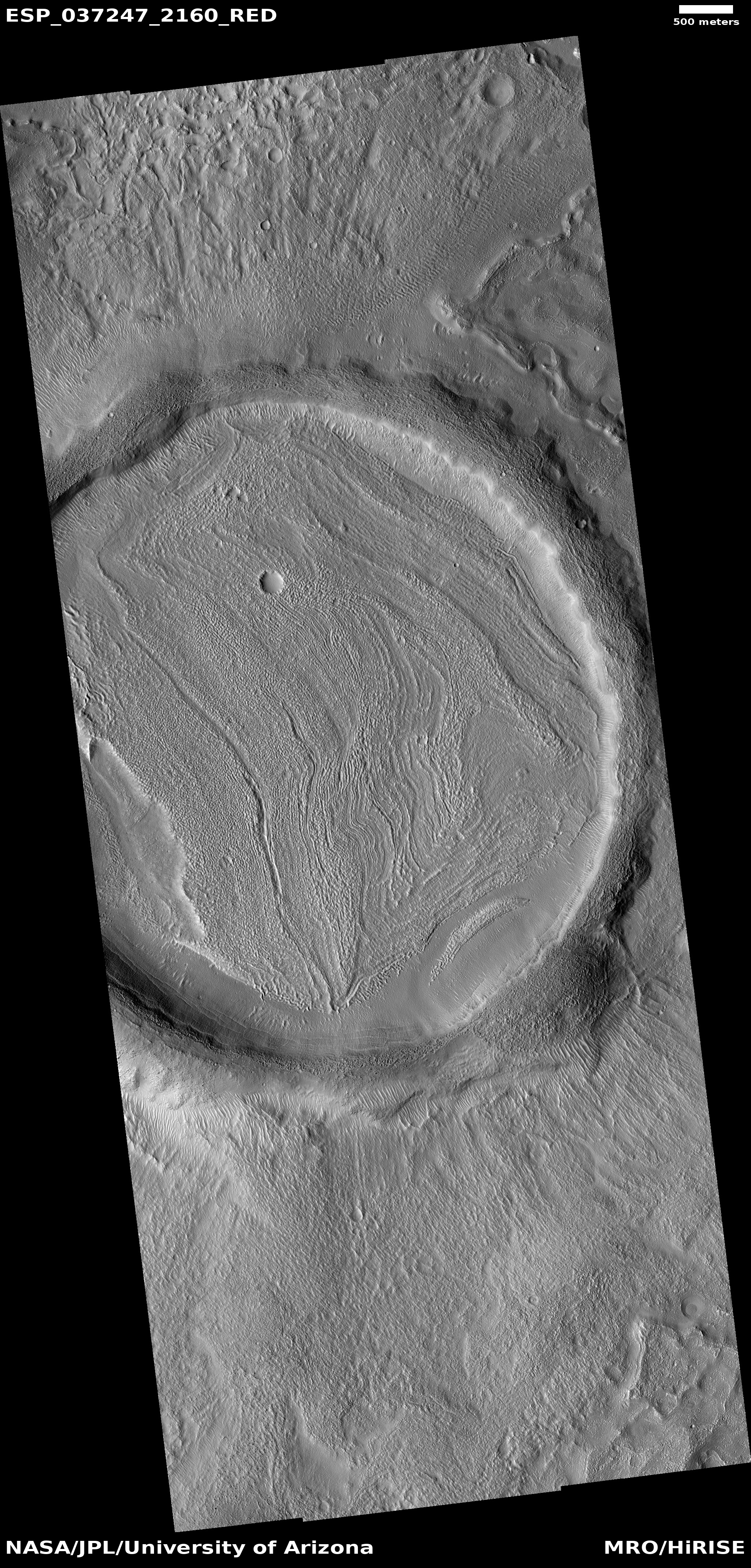
Cool image time! The photo to the right, rotated, cropped, reduced, and enhanced to post here, was taken on September 2, 2022 by the high resolution camera on Mars Reconnaissance Orbiter (MRO). The science team titled this picture “Gullies with Terminal Ridges on Glacial Crater Fill,” a title that in one phrase encapsulates everything we see here of this unnamed 8-mile-wide crater’s western rim and interior.

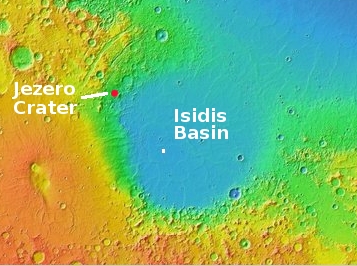
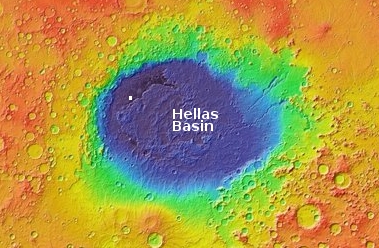
The crater is located at 46 degrees south latitude inside the much larger 145-mile-wide Kepler Crater, and about 1,500 miles east of Hellas Basin in a region where a lot of glacial ice is found. A context camera image taken in July 2020 shows the entire crater floor apparently covered with glacial fill that on the edges appears to be eroding away.

Today’s high resolution photo focused on the western part of the crater, where that eroding edge was instead replaced by a meandering ridge reminiscent of a moraine. The gullies on the interior slope to the west, as well as the parallel north-south cracks, suggest that debris falling and sliding down from that rim had pushed up against this glacial ice and created that ridge.

There is a lot more to this geology however.
» Read more

0 comments

A cliff face of volcanic erosion on Mars

A cliff face of volcanic erosion on Mars
Click for full image.

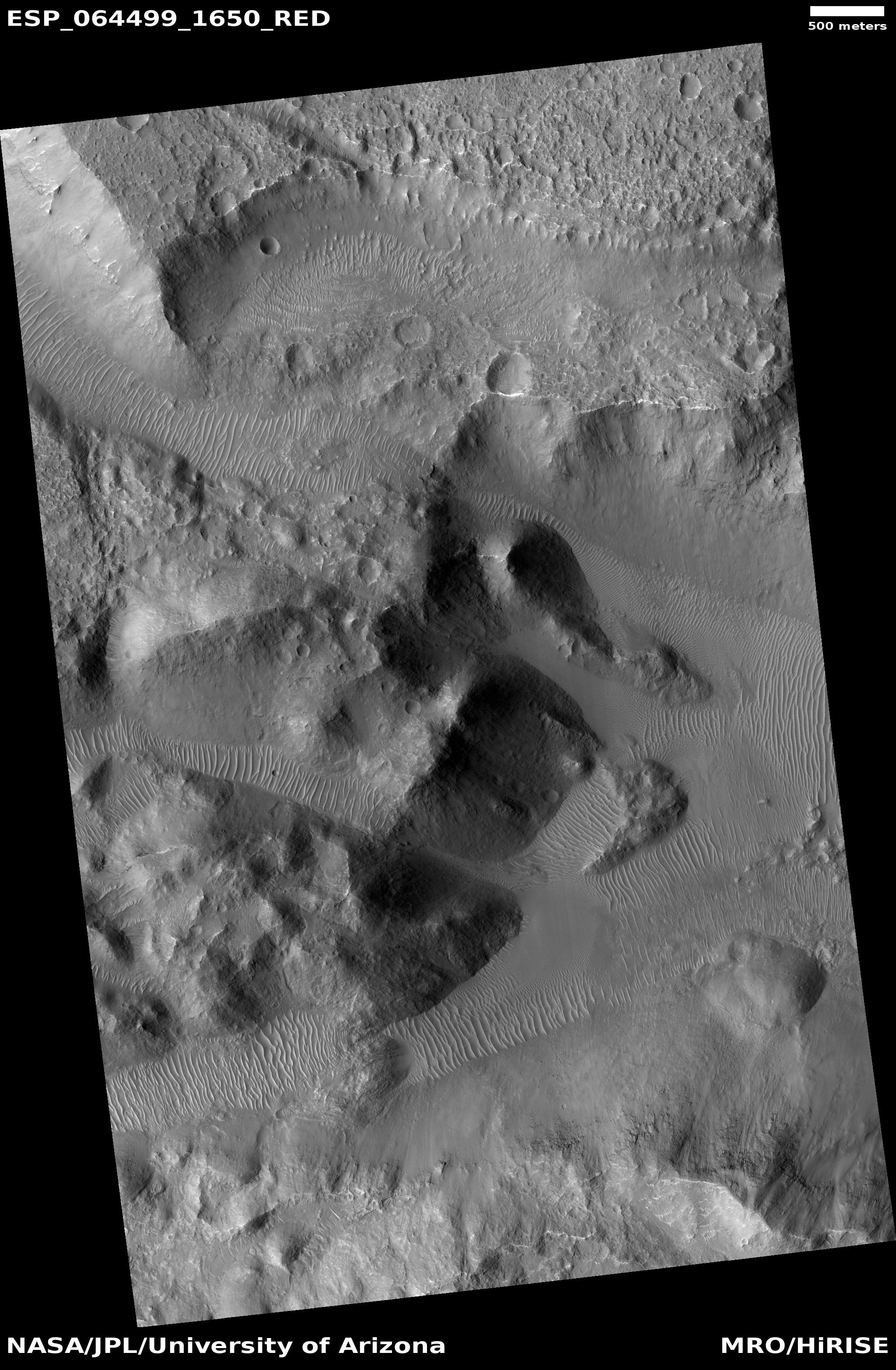
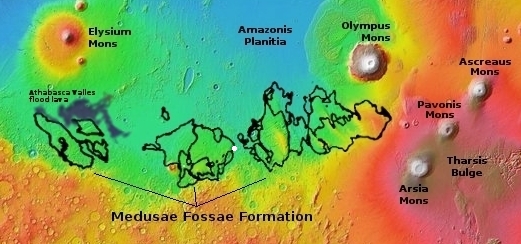
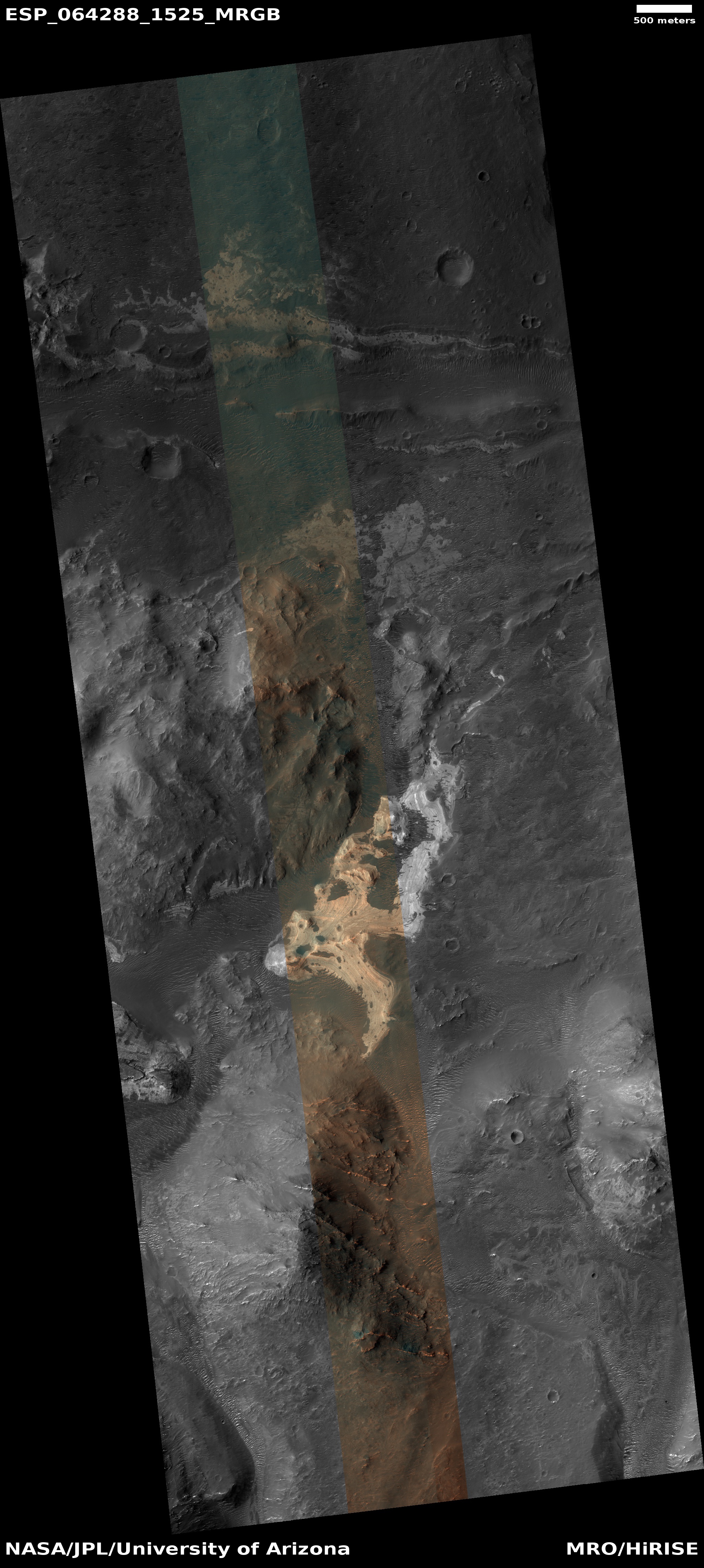
Today’s cool image is a variation of yesterday’s, showing another area on the edge of Mars’ largest volcanic ash field, dubbed the Medusae Fossae Formation and about the size of India. This time however the edge is an abrupt cliff, not the slow petering out of wind-shaped mesas.

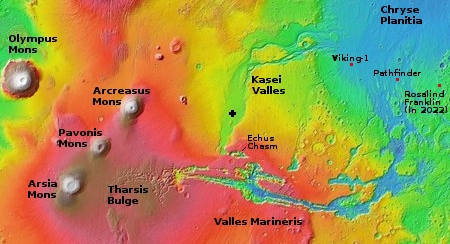
The picture to the right, cropped, reduced, and sharpened to post here, was taken on August 27, 2022 by the high resolution camera on Mars Reconnaissance Orbiter (MRO). It shows what I very roughly estimate to be a 1,500 to 2,500 foot high cliff that appears to delineate the edge. To the north we have a plateau of intersperse layers of flood lava and ash. To the south those layers have eroded away, leaving a rough lava plain with a handful of scattered wind-sculpted mesas.

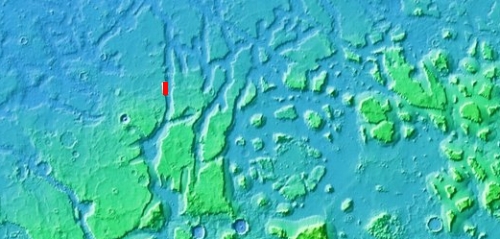
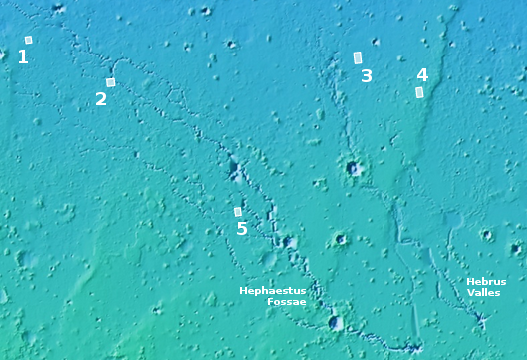
The overview map below, by providing a wider view of his region, makes its nature clearer.
» Read more

0 comments

Erosion at the edge of Mars’ biggest volcanic ash field

Erosion at the edge of Mars' biggest ash field
Click for full image.

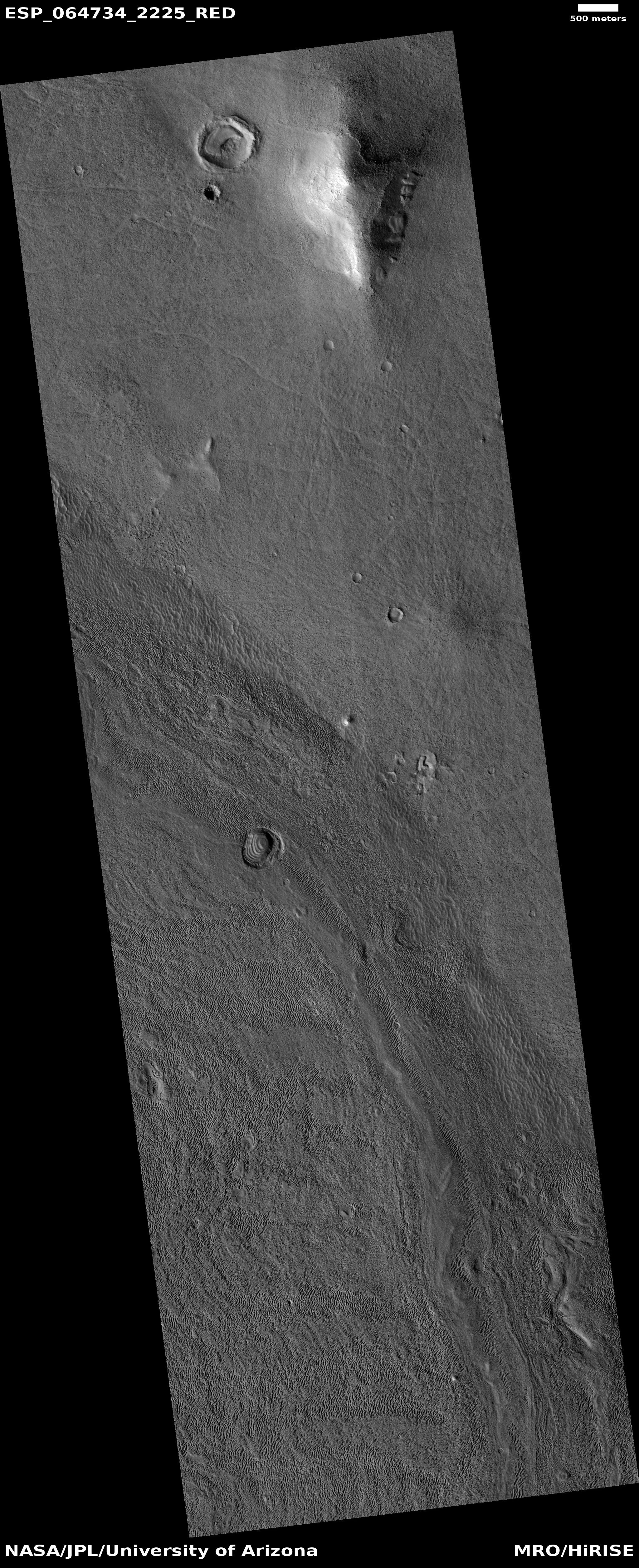
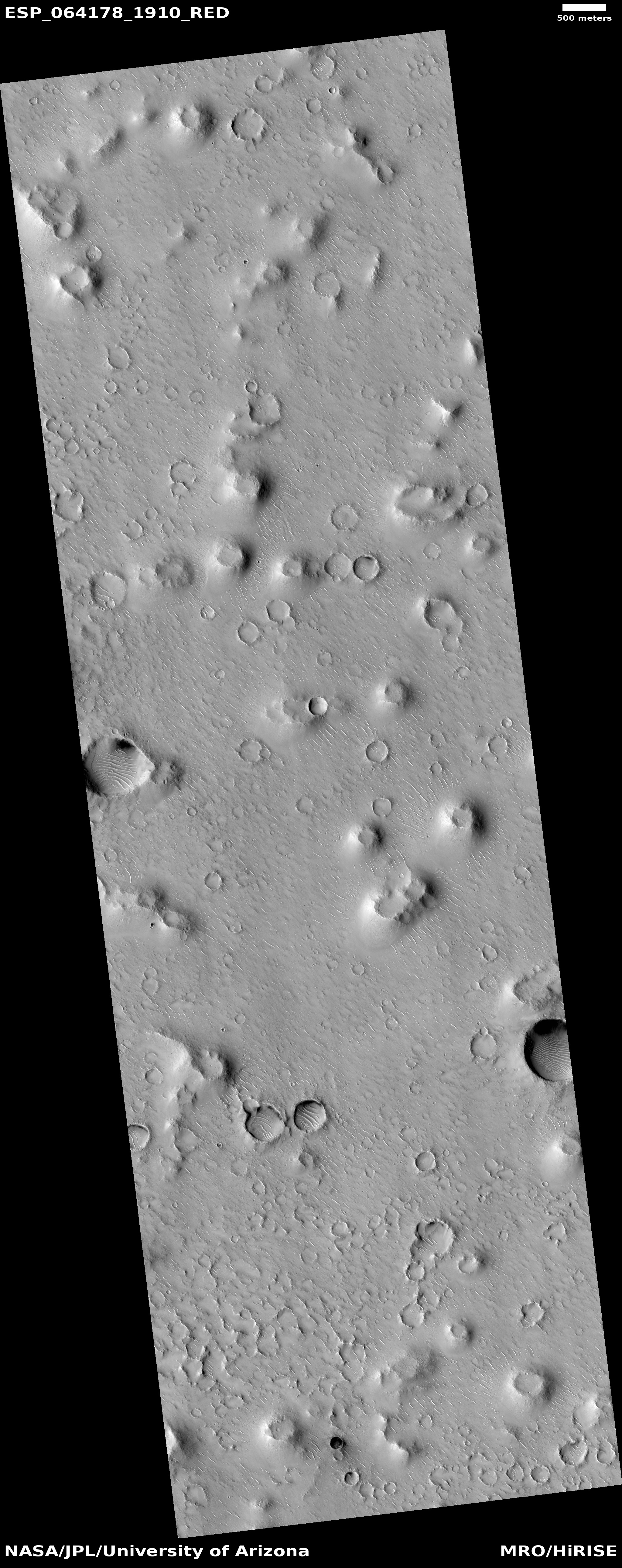
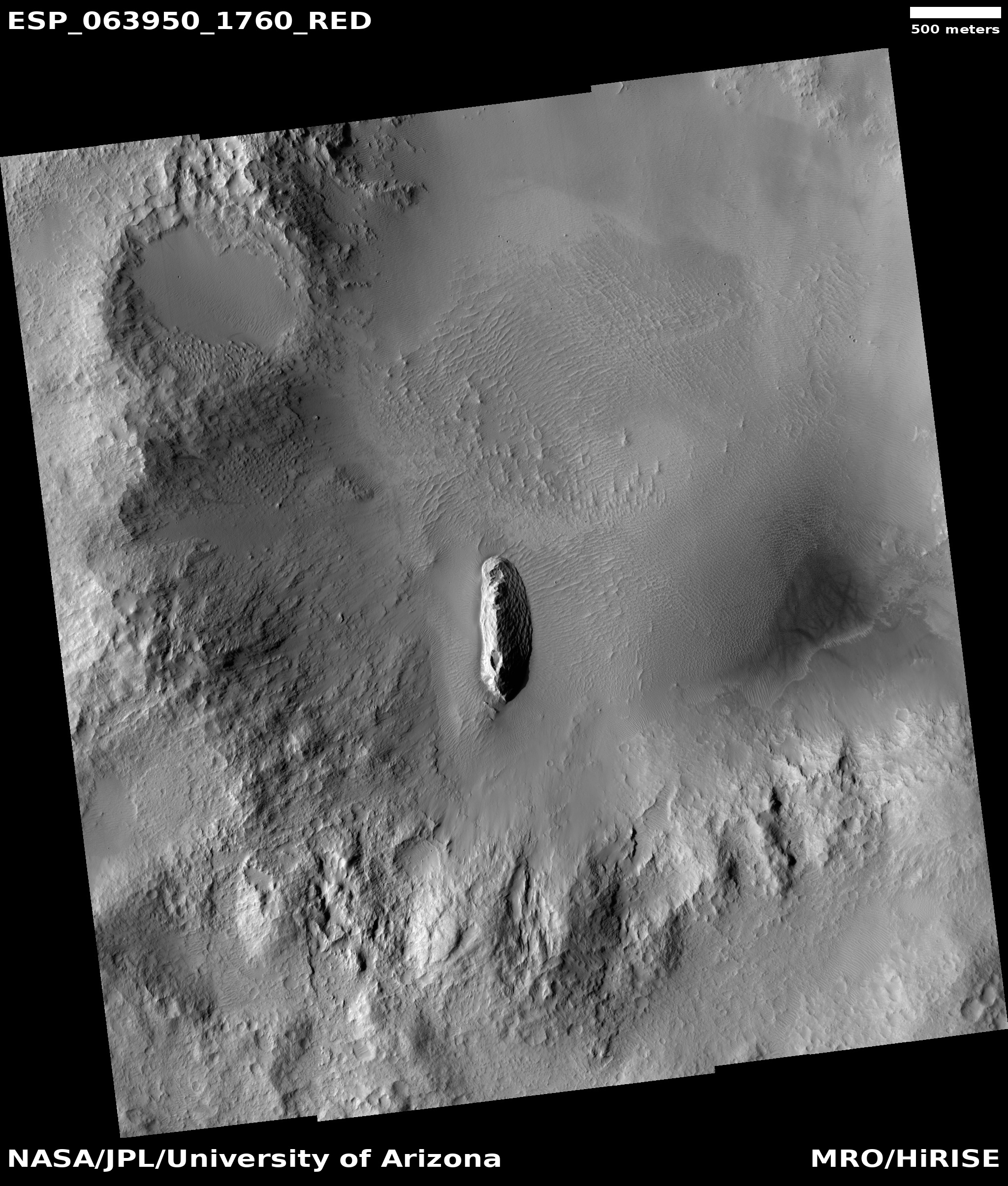
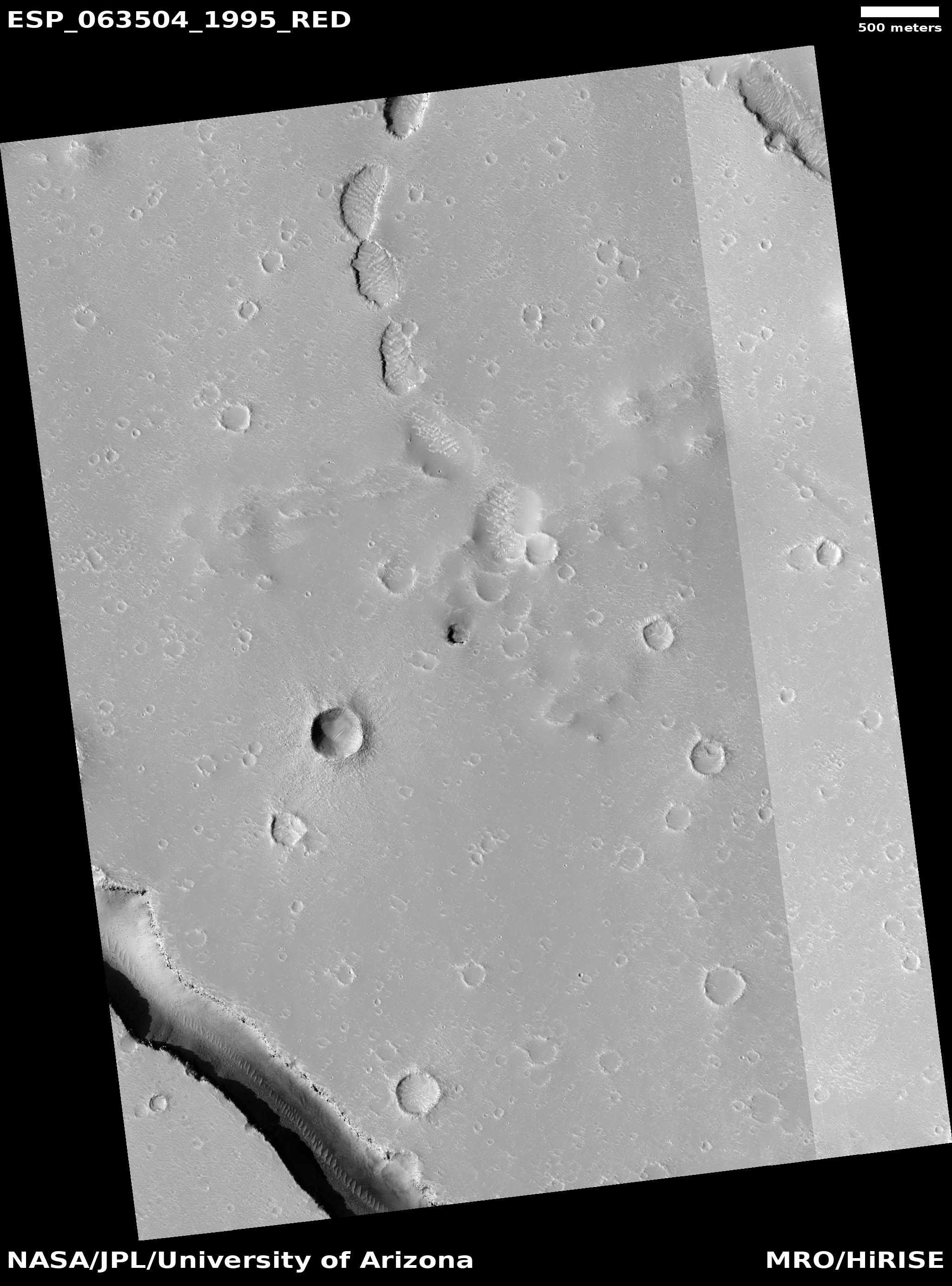
Cool image time! The photo to the right, rotated, cropped, reduced, and sharpened to post here, was taken on August 13, 2022 by the high resolution camera on Mars Reconnaissance Orbiter (MRO). It is another fine example of the wind-blown sculpted terrain that one finds routinely in Mars’ largest volcanic ash field, dubbed the Medusae Fossae Formation. About the size of India, this gigantic field is thought to be the source of most of the dust on Mars.

This particular location sits on the northernmost edge of that huge field. The elongated mesas mark the field’s edge, disappearing to the north but becoming thick and extensive to the south. The prevailing southeast-to-northwest winds have acted to clean most of the ash away.

We can get an idea about how deep and pervasive that field once was at this location by the pedestal crater in the middle right. Once, the floor of that crater was below the top of the ash field. At that time, the top of the dunes marked the general ground level across this entire image. Over time, the winds blew most of this material away, but the denser packed floor of the crater resisted that erosion, and thus now stands above the surrounding terrain.

The more normal-looking craters nearby could have occurred before the ash was deposited, or after it was blown away. The impact that created the pedestal crater however occurred when the ash covered everything here.
» Read more

0 comments

The knobby floor of a Martian crater

The knobby floor of a Martian crater

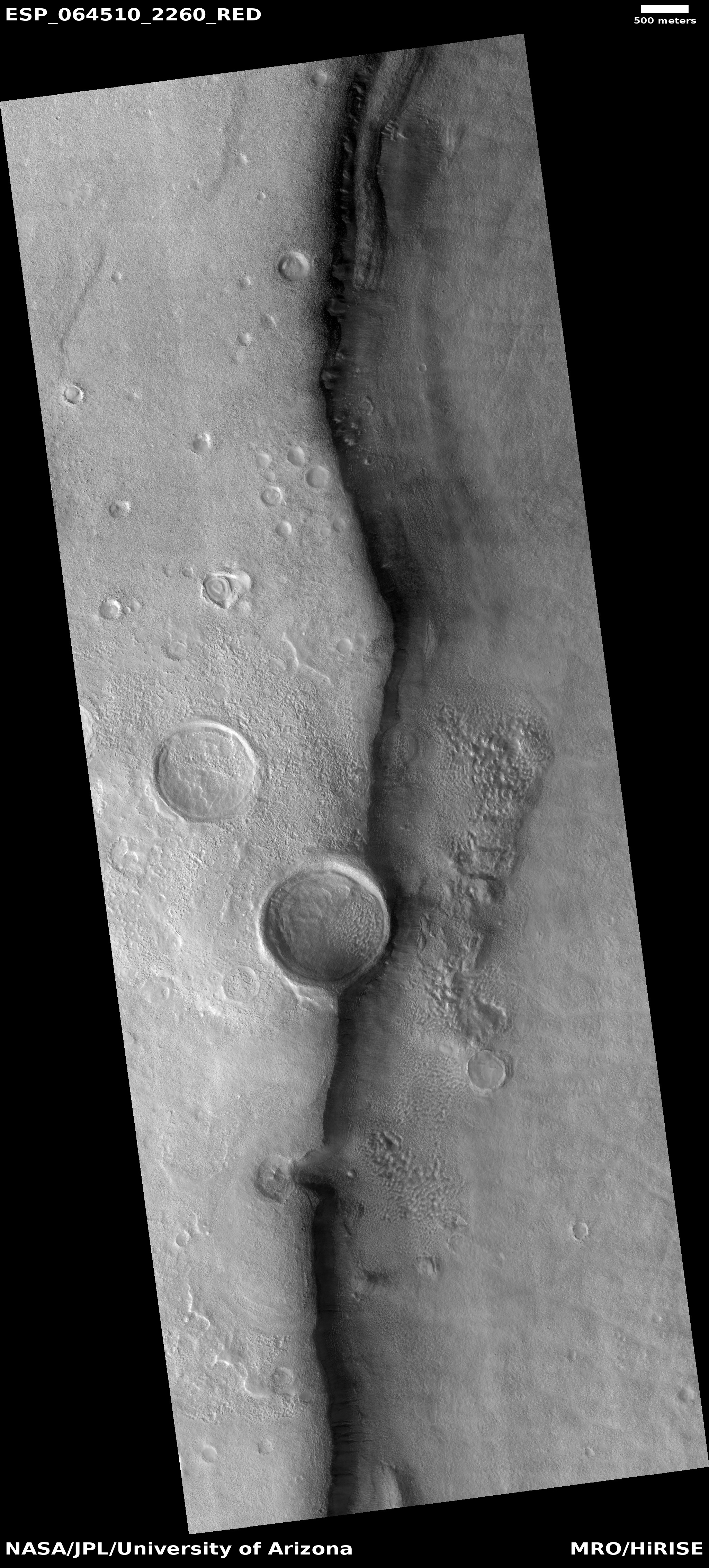
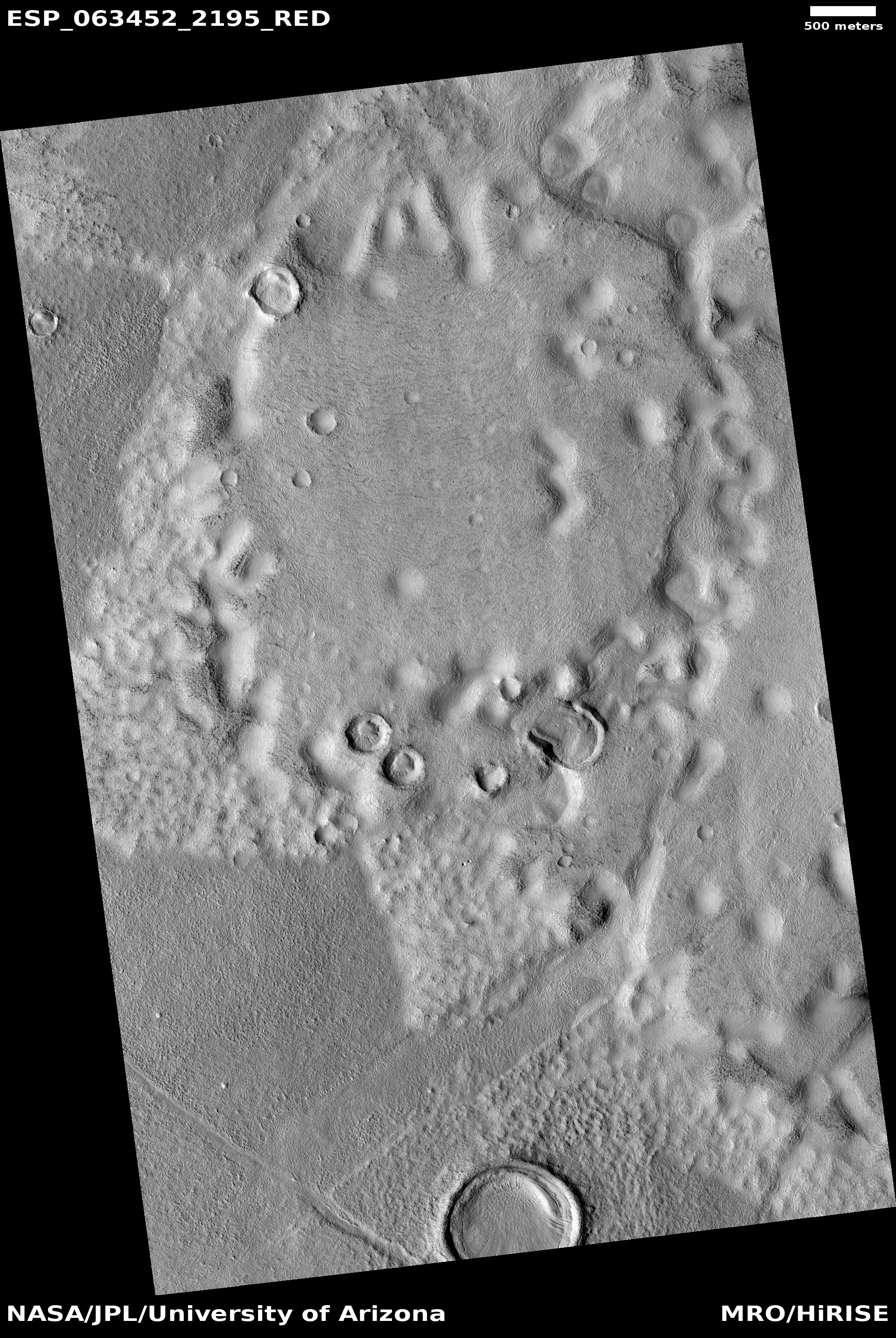
Cool image time! The picture to the right, rotated, cropped, reduced, and enhanced to post here, was taken on July 20, 2022 by the high resolution camera on Mars Reconnaissance Orbiter (MRO). It shows a small portion of the knobby floor of a 70-mile-wide ancient and eroded unnamed crater in the southern cratered highlands of Mars.

Why knobby? Usually such terrain on Mars signifies an very ancient and well eroded region of chaos terrain, its knobs the leftover worn remains of ancient mesas cut by eons of glacier flow.

If this is so, the location as shown in the overview map below suggests if there were ever any glaciers — or any near surface ice — at this location, it had to be a very long time ago.
» Read more

0 comments

InSight detects and dates large impact on Mars

InSight's Christmas Eve impact
Click for full image.

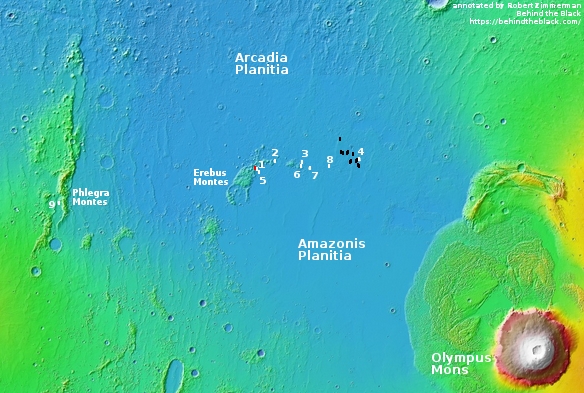
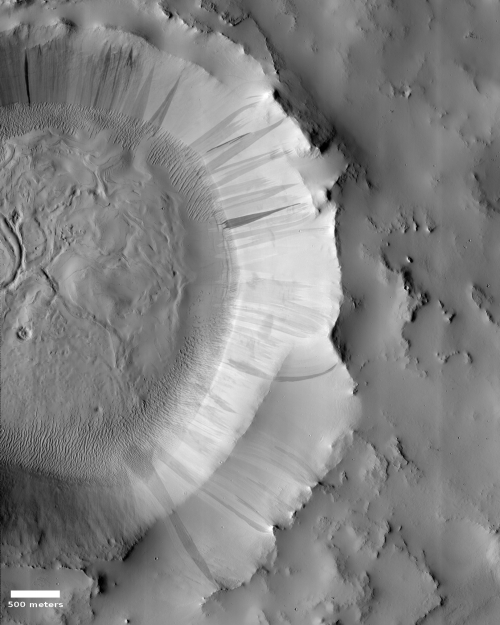
Using the data from InSight’s seismometer of a 4 magnitude earthquake on Mars on December 24, 2021, scientists were able to use the high resolution camera on Mars Reconnaissance Orbiter (MRO) to find the meteorite impact that produced that quake, the largest detected since spacecraft have been visiting Mars. The picture to the right, cropped and reduced to post here and unveiled at yesterday’s press conference, shows the new crater.

The meteoroid is estimated to have spanned 16 to 39 feet (5 to 12 meters) – small enough that it would have burned up in Earth’s atmosphere, but not in Mars’ thin atmosphere, which is just 1% as dense as our planet’s. The impact, in a region called Amazonis Planitia, blasted a crater roughly 492 feet (150 meters) across and 70 feet (21 meters) deep. Some of the ejecta thrown by the impact flew as far as 23 miles (37 kilometers) away.

With images and seismic data documenting the event, this is believed to be one of the largest craters ever witnessed forming any place in the solar system.

This is not the first such impact identified from InSight seismic data, but it is the largest. The white streaks surrounding the crater are thought to be near-surface ice ejected at impact.

The overview map below provides further context, as well as showing us the proximity of this impact to the proposed Starship landing sites on Mars.
» Read more

2 comments

A glacier sea on Mars

A glacier sea on Mars
Click for full image.

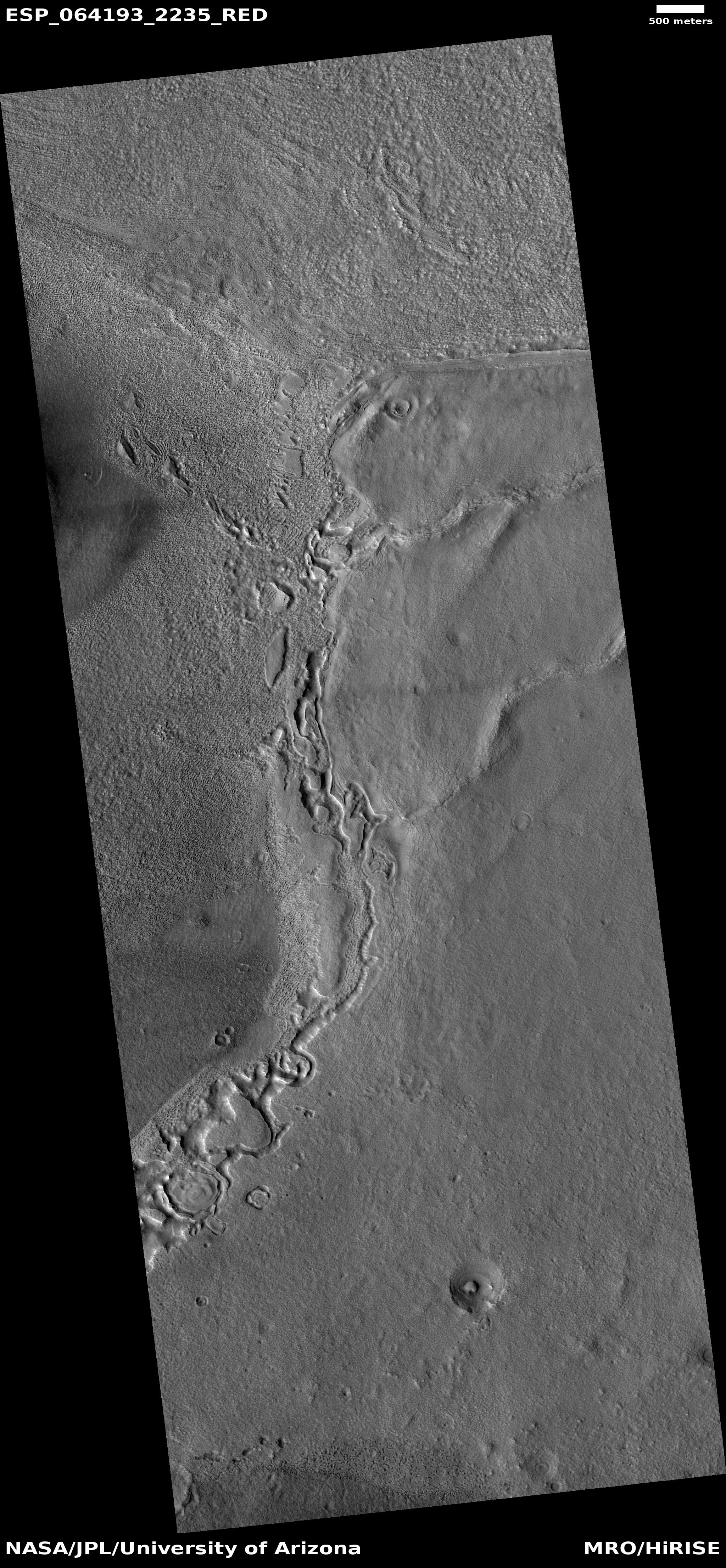
Cool image time! The photo to the right, rotated, cropped, and reduced to post here, should at first glance be one of my “What the heck!?” images. However, a little detective work quickly provides us some understanding of the inexplicable geology seen at this particular location on Mars.

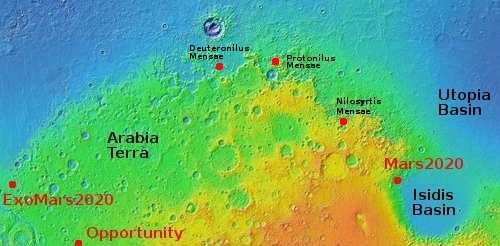
The picture was taken on August 29, 2022 by the high resolution camera on Mars Reconnaissance Orbiter (MRO) and was labeled by the science team a “Lobate Debris Apron in Deuteronilus Mensae.” This mensae region is the western part of the 2,000-mile-long strip in the northern mid-latitudes of Mars that I label glacier country, since almost every high resolution picture taken in this strip shows extensive glacial features.

This picture is no different, showing what appears to be glaciers, but by itself it is still difficult to make sense of it. Glaciers flow downhill, like rivers. In this high resolution image the direction of flow is somewhat unclear.

As always, a wider view clarifies the picture.
» Read more

0 comments

Martian rectilinear ridges

Martian rectilinear ridges
Click for original image.

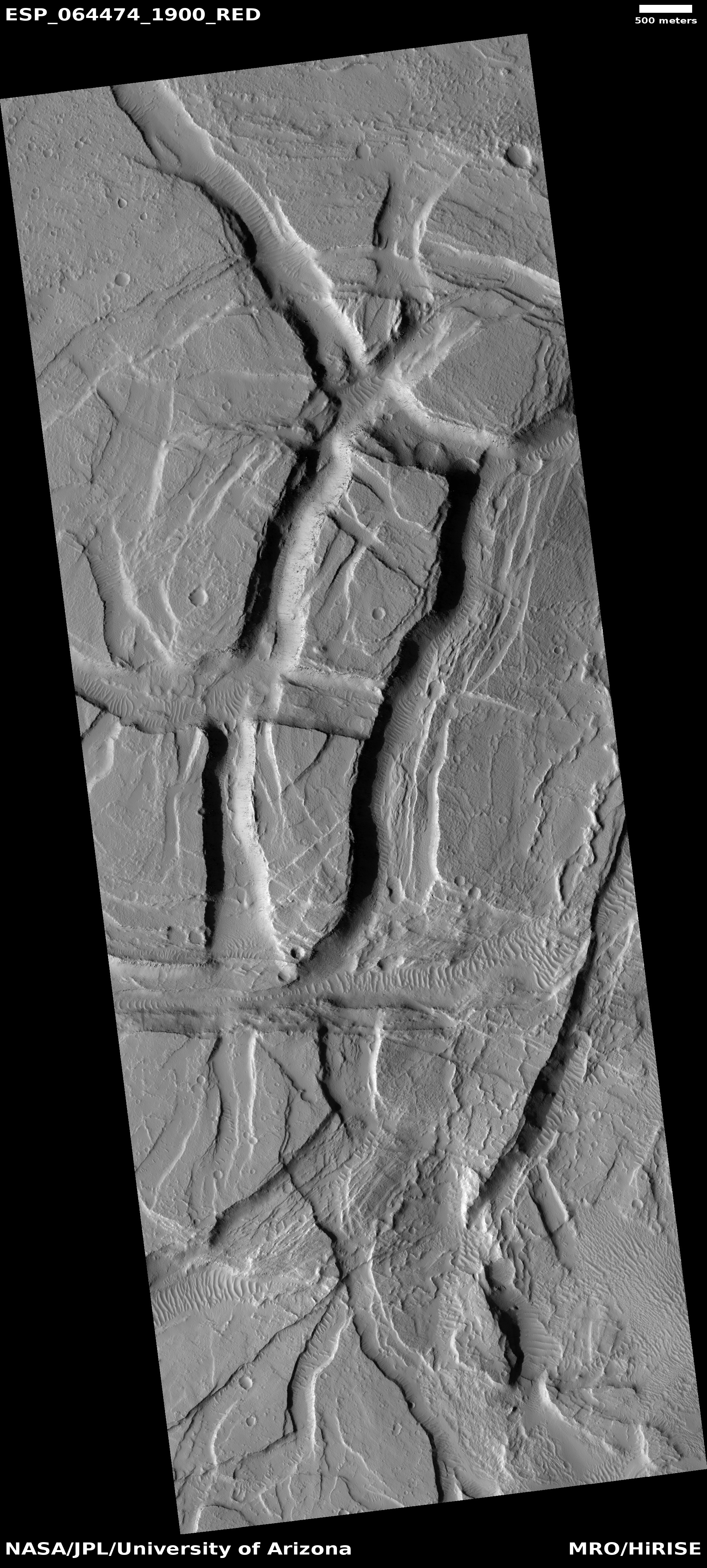
Today’s cool image is also a bafflement. The photo to the right, cropped, reduced, and enhanced to post here, was taken on July 25, 2022 by the high resolution camera on Mars Reconnaissance Orbiter (MRO). The ridges in this picture are labeled by the scientists “Rectilinear Ridges,” but they really do not resemble any of the Martian rectilinear ridge types outlined in this paper [pdf], all of which appear to have a much more pronounced criss-cross pattern.

These ridges however are more meandering, and instead to my eye seem more like inverted channels, ancient channels whose beds became compacted and then became ridges when the less dense surrounding material eroded away. The problem with this conclusion however is the lack of any obvious tributary pattern. If these were once channels where either liquid water or glaciers once flowed, none of them seem to exhibit any drainage pattern. The ridges go in all directions.

The context map below only increases the mystery.
» Read more

0 comments

InSight still hangs in, barely

InSight's power status as of October 22, 2022

A new update on the status of the Mars lander InSight was released today, showing its power output daily through October 22, 2022. The graph to the right shows this update. From the report:

As of October 22, 2022, InSight’s seismometer is collecting data again after being switched off to conserve energy after a recent dust storm. The lander was generating an average of 280 watt-hours of energy per Martian day, or sol. The tau, or level of dust cover in the atmosphere, was estimated at 1.45 (typical tau levels outside of dust season range from 0.6-0.7).

These power levels are very low, so low I am surprised the science team thought it was able to start the seismometer again. It could be they expect the lander to fail any moment, and decided to maximize the data it can get in the little time it has left.

A press conference is planned for Thursday, October 27, 2022 to provide an update on InSight’s future, as well it appears to describe a recent discovery (likely the exact moment some recent impacts took place) based on data from InSight and images from Mars Reconnaissance Orbiter (MRO). This was already reported in mid-September, but more impacts might have been identified.

It is also possible the MRO images detected some other change on the surface (not an impact) that InSight’s seismometer picked up. If so, the briefing will be far more interesting.

0 comments

ESA asks member nations to build lander for Franklin Mars rover

In its most recent request for funding from the member nations of the European Space Agency (ESA), the agency has asked the member nations to finance the design and construction of a new lander for its long delayed Rosalind Franklin Mars rover, replacing the Russian lander that had became unavailable due to sanctions resulting from Russia’s invasion of the Ukraine.

According to the BBC (opens in new tab), ESA will request 360 million euros to kickstart work on the new landing system, with additional funds likely needed in subsequent years. ESA has already spent some 1.3 billion euro on the ExoMars program, which also includes an orbiter that has been studying Mars’ atmosphere and surface since 2017. ESA will put the plan in front of delegates of its 22 member states at a ministerial conference in November.

“We will have to wait if the [member states] decide to go forward with the project,” Parker said. “This concept is now proposed as part of the director general’s package within [ESA’s] exploration program for decision at the ministerial [conference].”

If ESA’s member nations agree to this plan, expect the launch of Franklyn to be delayed further. Based on the normal pace in which ESA functions, that lander will take a minimum of five years to design and build (likely much longer). Though ESA is now targeting ’28 for the launch of Franklin, which was supposed to launch this past summer after a two year delay, this plan likely means it will not get off the ground this decade.

Meanwhile, there are now at least a half dozen private companies building lunar landers that could more quickly (and for less money) get a Franklin Mars lander built for ESA. None are in Europe however, which means ESA would rather have this mission delayed years so that it can funnel money to its own contractors..

0 comments

Bedrock layers in Terby Crater on Mars

Bedrock layers in Terby Crater on Mars
Click for full image.

Cool image to end the week! The picture to the right, rotated, cropped, reduced, and enhanced to post here, was taken by on July 18, 2022 by the high resolution camera on Mars Reconnaissance Orbiter (MRO). It shows the bedrock layers on one of two very large mesas that jut out into the floor of 108-mile-wide Terby Crater.

I want to focus your eye on the spoon-shaped mesa near the top right of the photo. Note how the layers can be seen on both sides, even though the top of the mesa seems to be concave. This is strange and complex geology, made even more fascinating in that the two mesas almost reach the center of the crater floor. Why are they here? Why were they not flattened during impact, like the rest of the crater floor? Or maybe the original crater floor is the mesa top, but if so, why did the rest of the crater interior get eroded away.

The overview map below provides some context, and helps fill in some details, even if it fails to answer any of these questions.
» Read more

1 comment

InSight status: Barely hanging on

InSight's power status as of October 19, 2022

The science team for the InSight lander on Mars today posted an update on the power the spacecraft’s dust covered solar panels are producing. I have added that data to my on-going graph of these power levels, to the right. From the update:

On October 19, 2022, InSight was generating an average between 275 and 285 watt-hours of energy per Martian day, or sol. The tau, or level of dust cover in the atmosphere, was estimated at 1.5 (typical tau levels outside of dust season range from 0.6-0.7).

The jump in tau level is due to a large dust storm that developed in September more than two thousand miles away in the southern hemisphere. Though it is so far away, that storm put a lot more dust in the atmosphere above InSight, and forced engineers to shut down all but its most essential functions.

That storm is apparently continuing, and might even be growing. If so, the future of InSight is dim indeed. Any further drop in the amount of power it generates daily will likely make it unable to operate at all, and the mission will end.

0 comments

Frozen lava flows around Martian hills

Martian lava flowing around hills
Click for full image.

Cool image time! The photo to the right, rotated, cropped, reduced, and enhanced to post here, was taken on August 24, 2022 by the high resolution camera on Mars Reconnaissance Orbiter (MRO). It shows the westernmost edge of the Athabasca flood lava plain, thought to be the youngest lava flow on Mars, having covered the area of Great Britain in a matter of weeks 600 million years ago.

This image was a captioned feature yesterday by the MRO science team. As they note:

Although you can’t sail a boat on a sea of lava, hills and craters that stick up higher than the lava flow act like barriers. When a boat is driven through the water, there is a bow wave at the front of the boat, and a wake that trails off behind that indicates which way the boat is moving. In a lava flow, when a hill sticks up, the lava piles up on the upstream side (just like a bow wave) and can leave a wake on the downstream side, so we can tell which way the lava was moving against the stationary hill.

As you can see, every hill has a pile of lava on its northeast slopes, and a wake to its southeast. As the main vent of the Athabasca eruption is to the northeast, about 500 miles away (as shown on the overview map below), the flow direction suggested by the wakes fit the general geography.
» Read more

2 comments
1 41 42 43 44 45 90