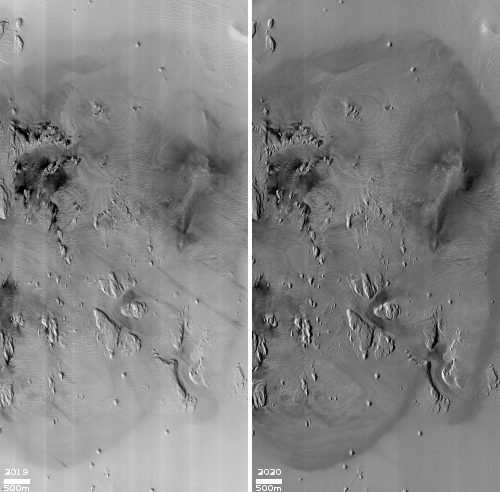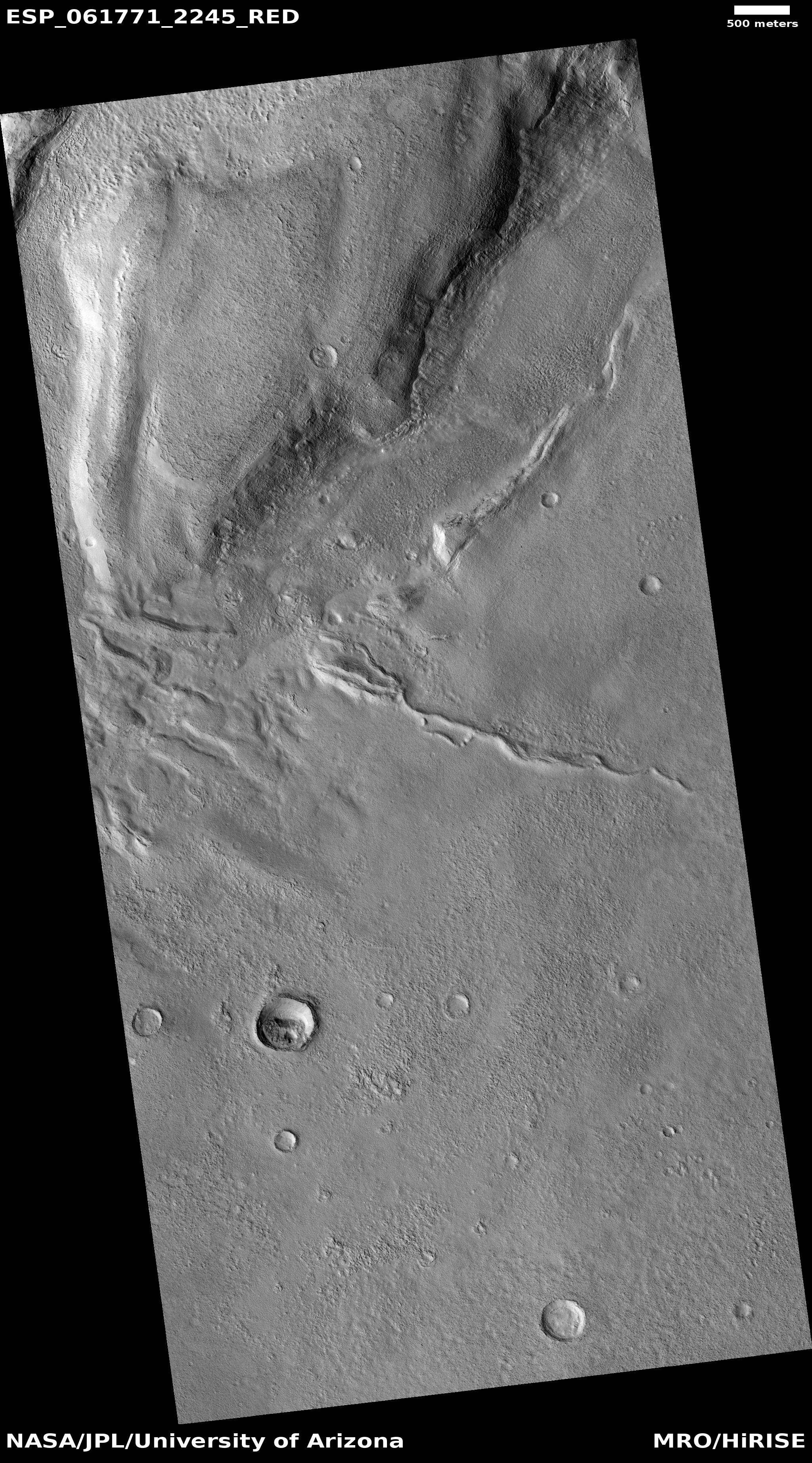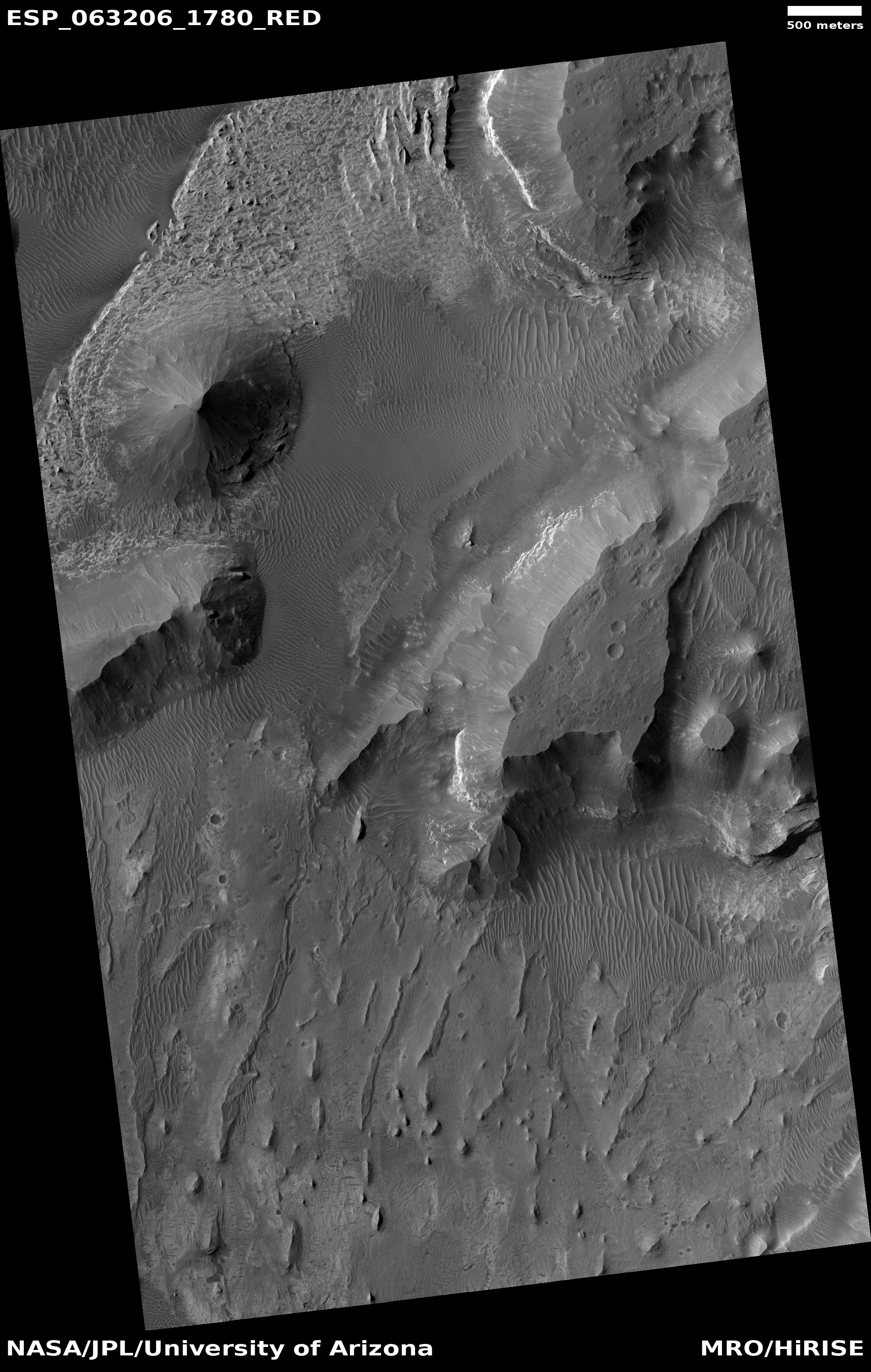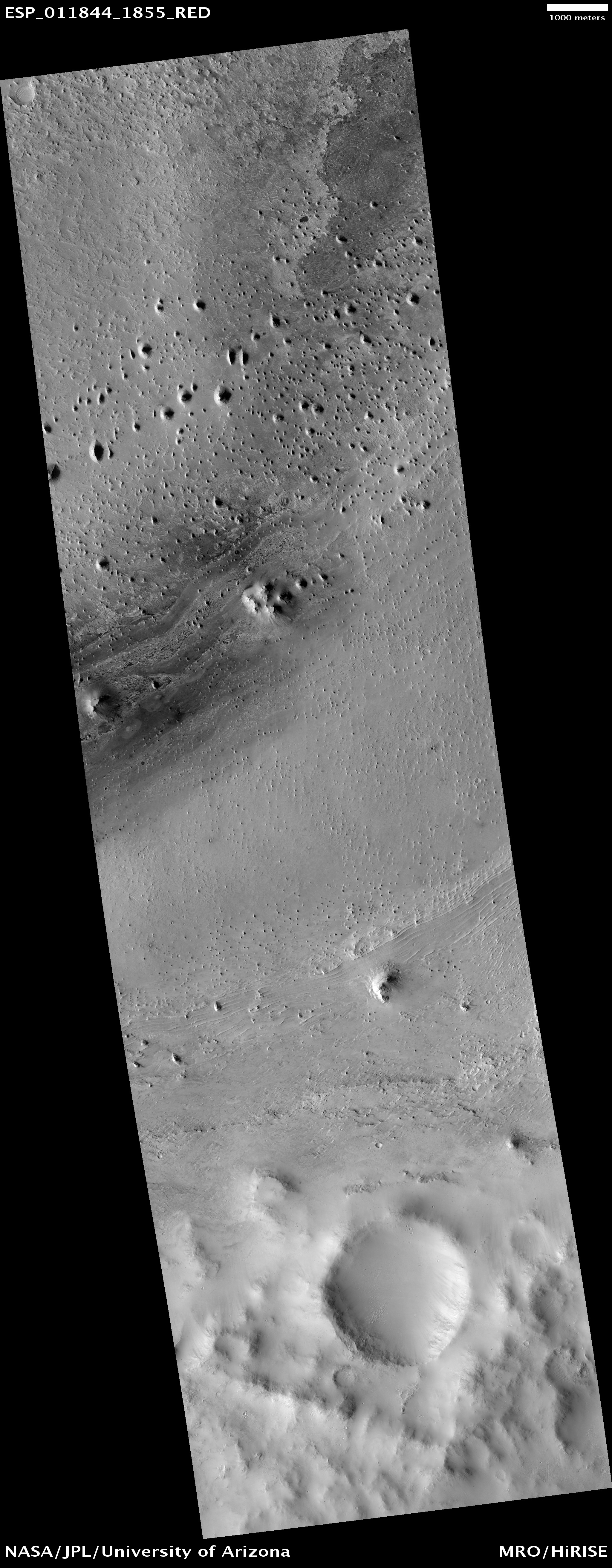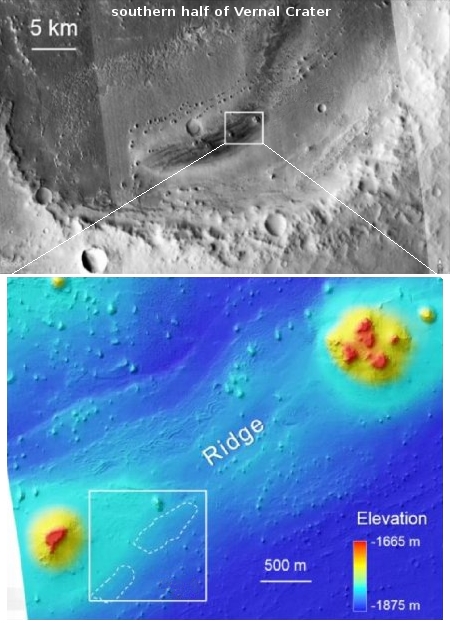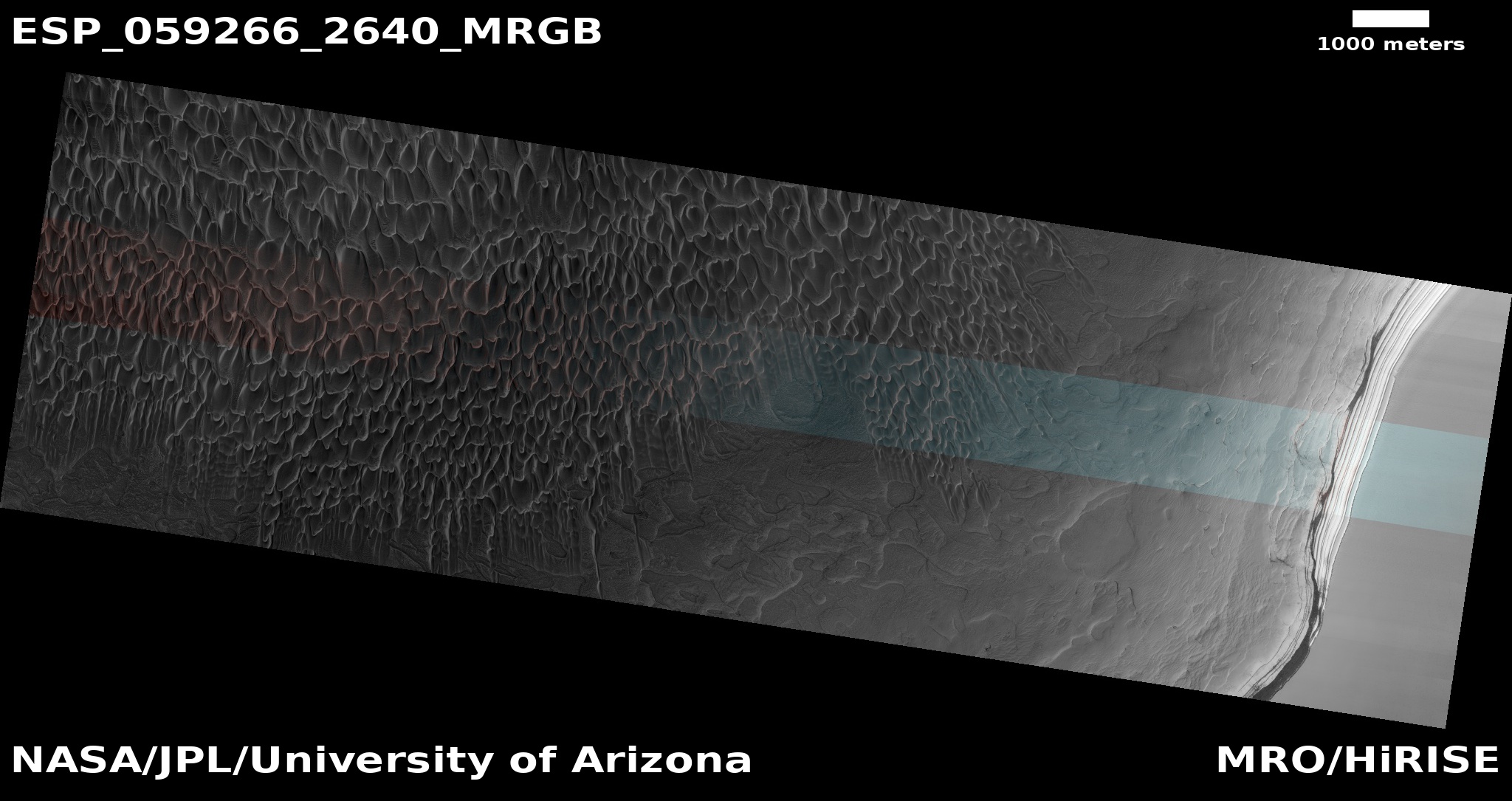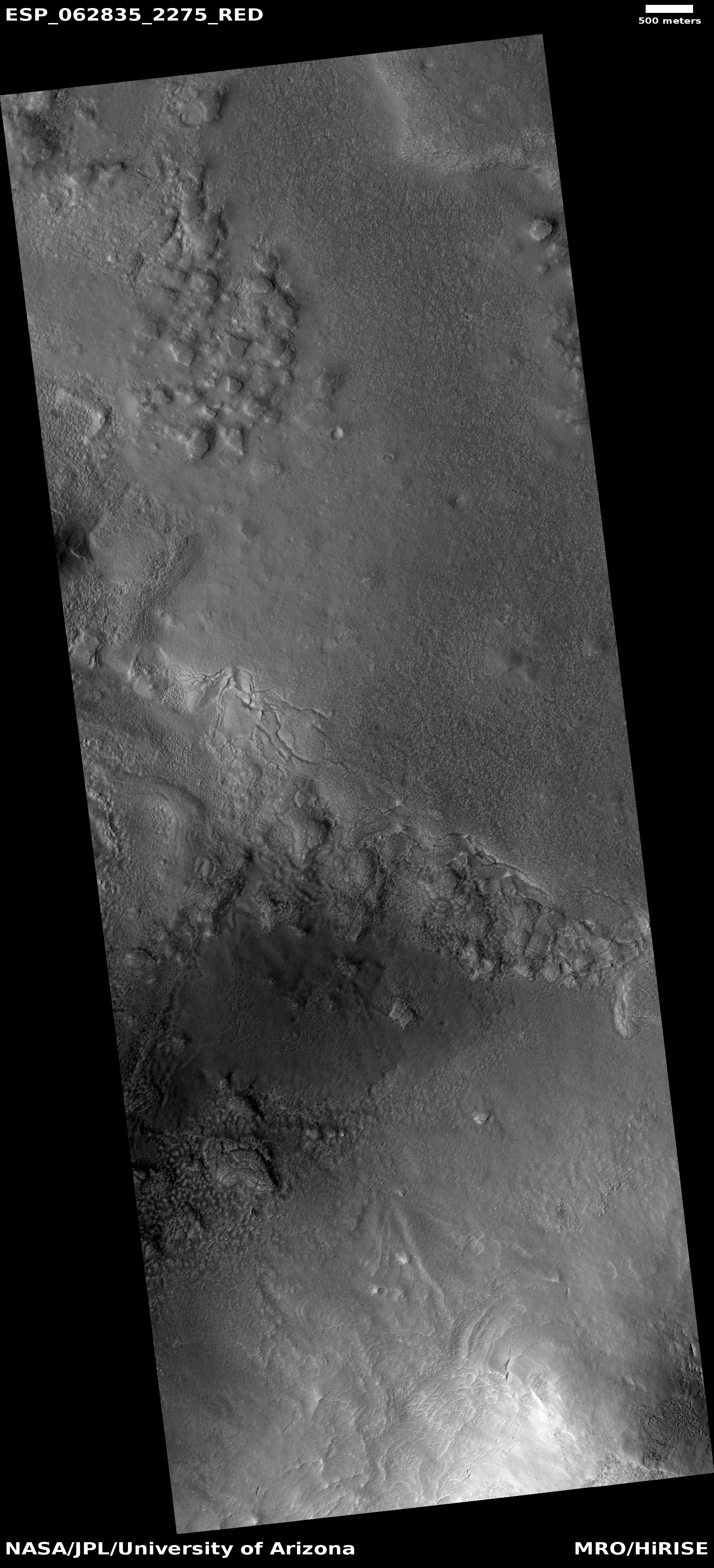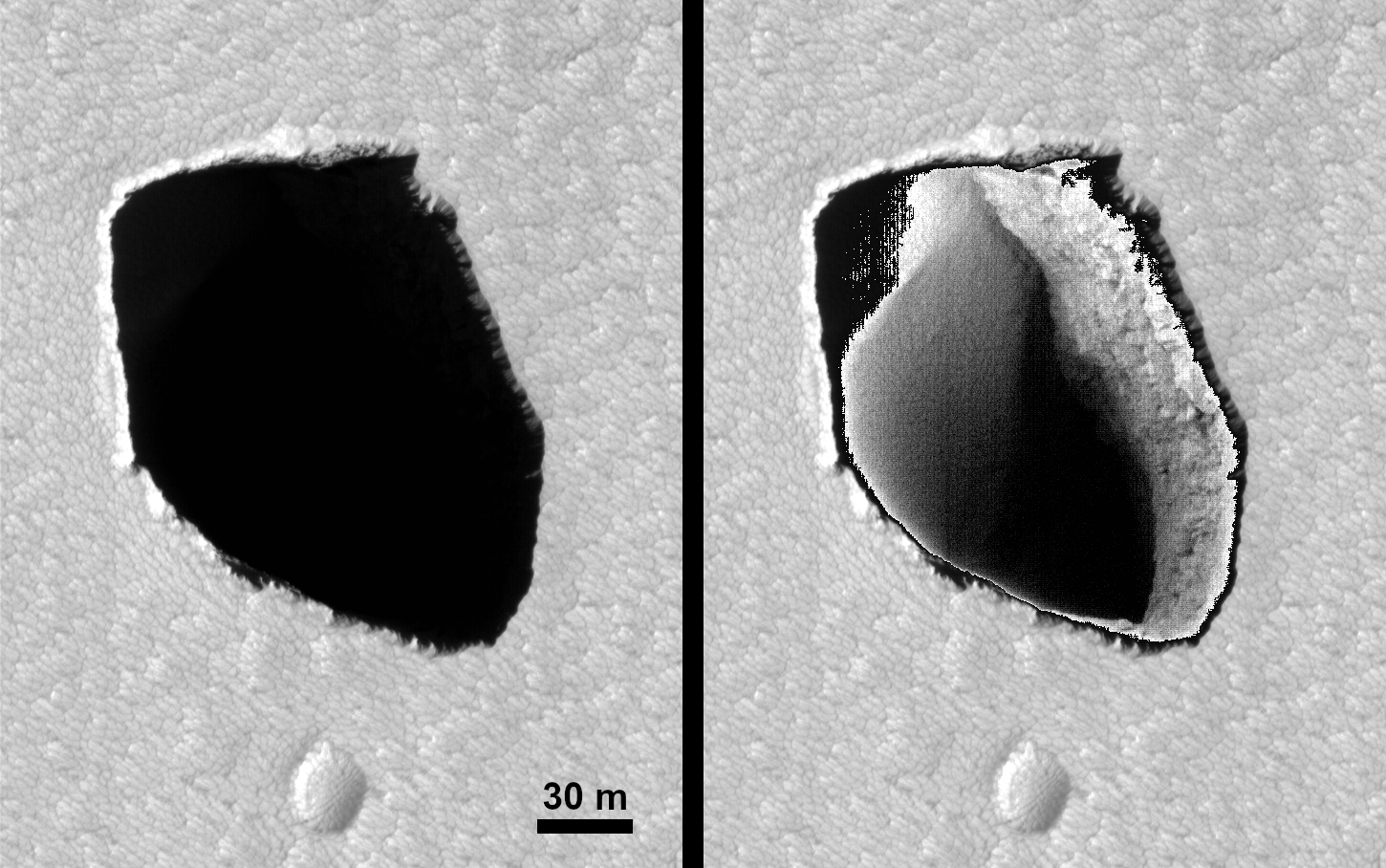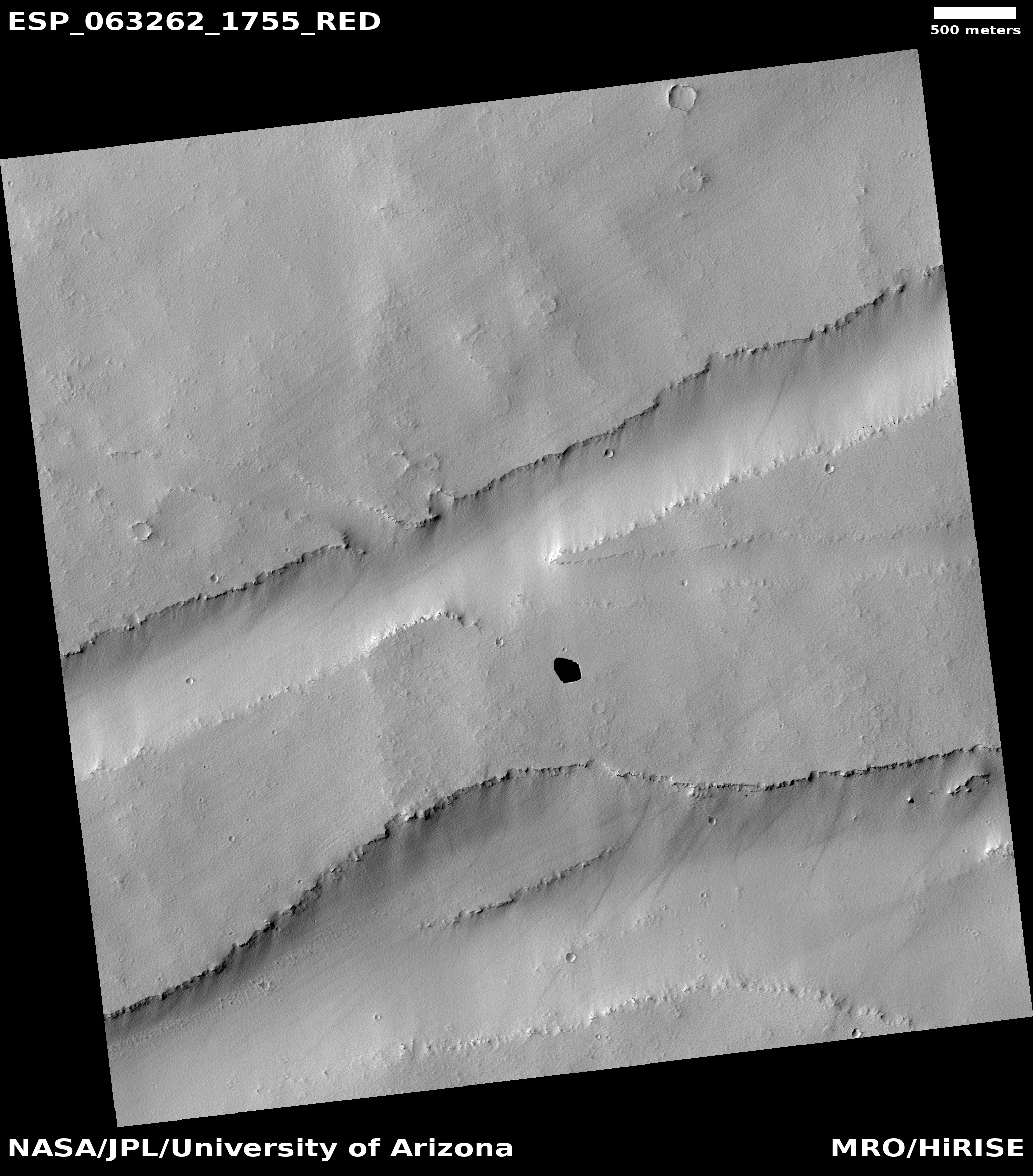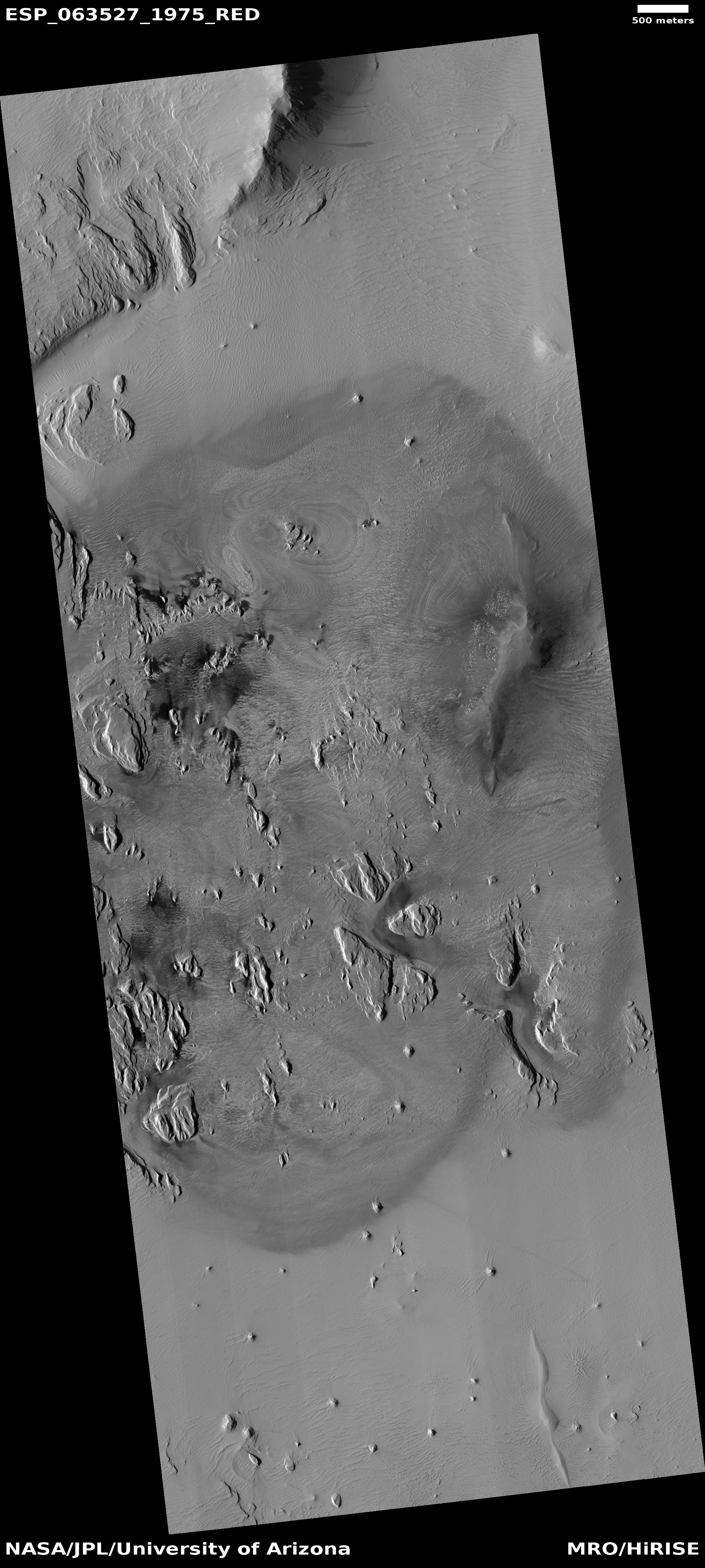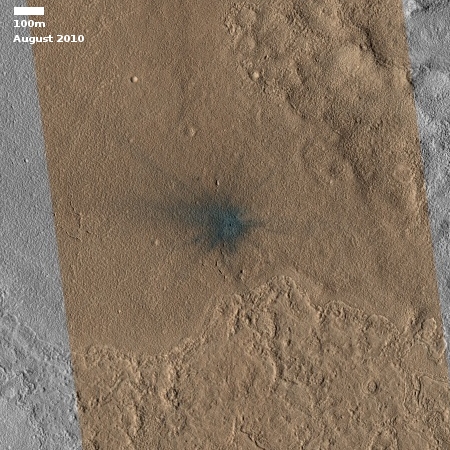
Cones south of Starship’s prime landing sites on Mars

Cones near Phlegra Mountains
Click for full image.
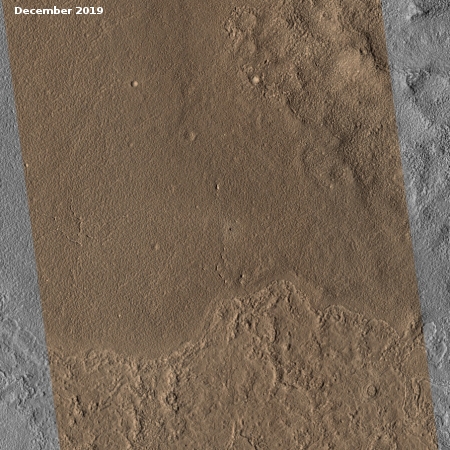
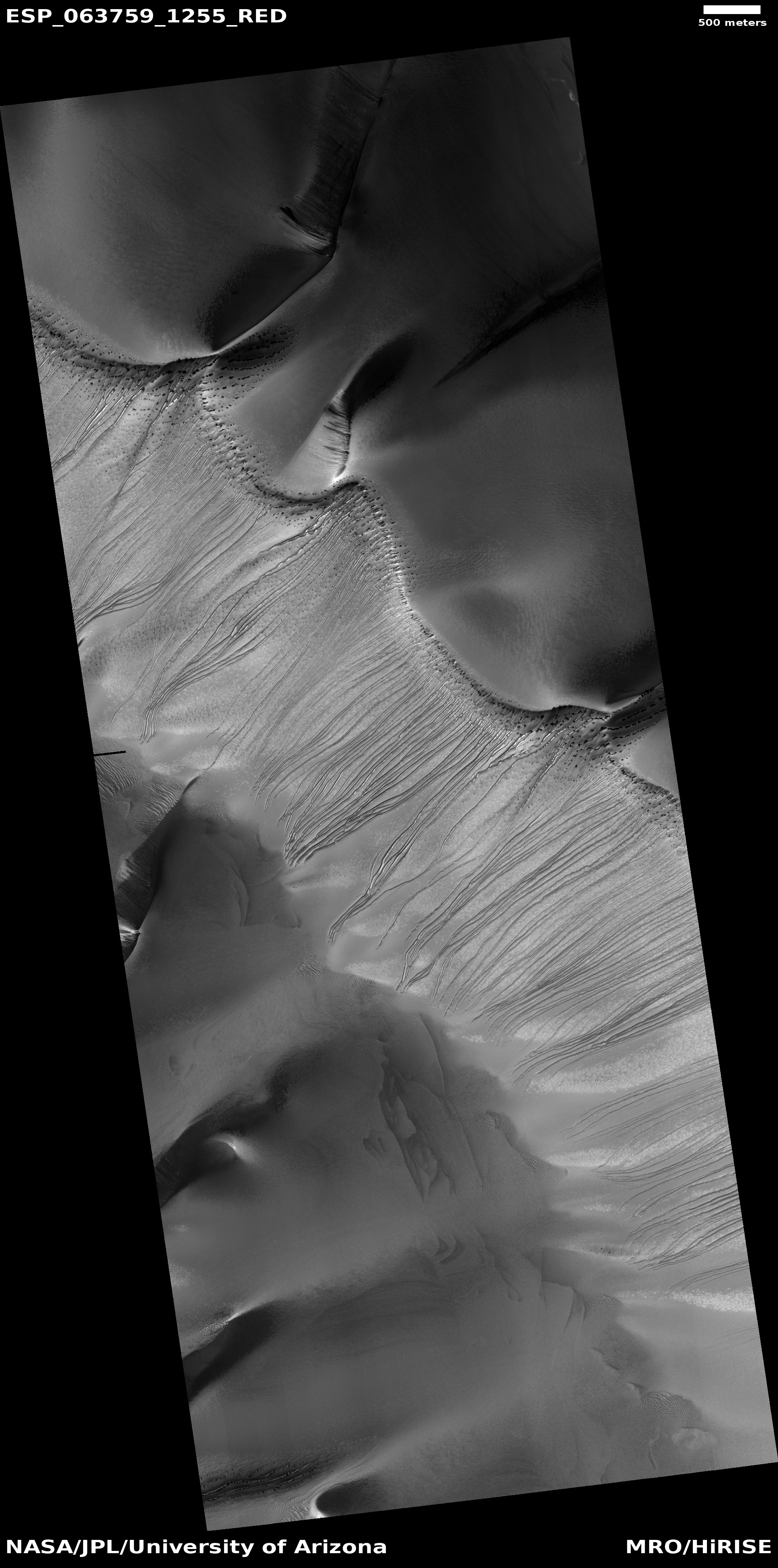
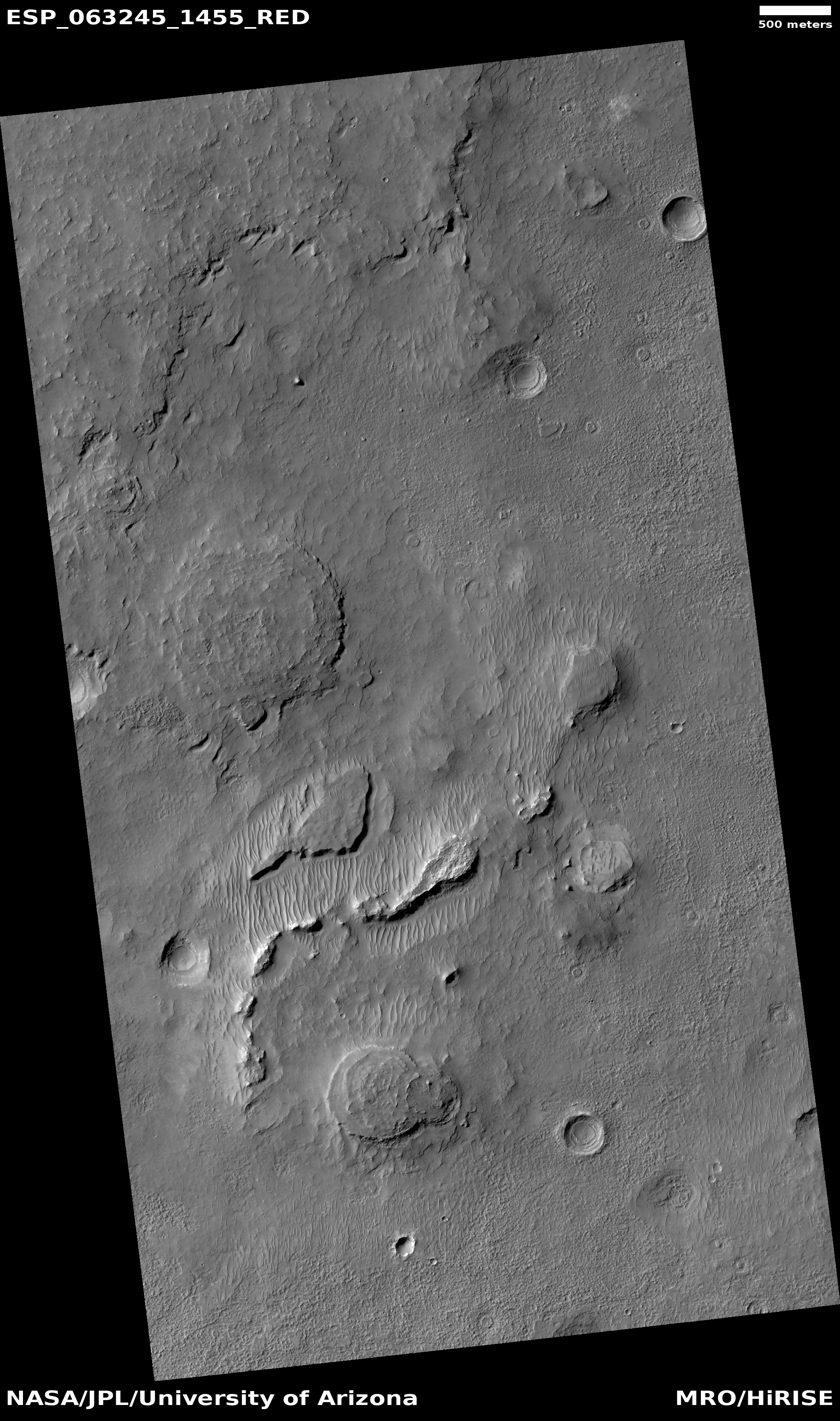
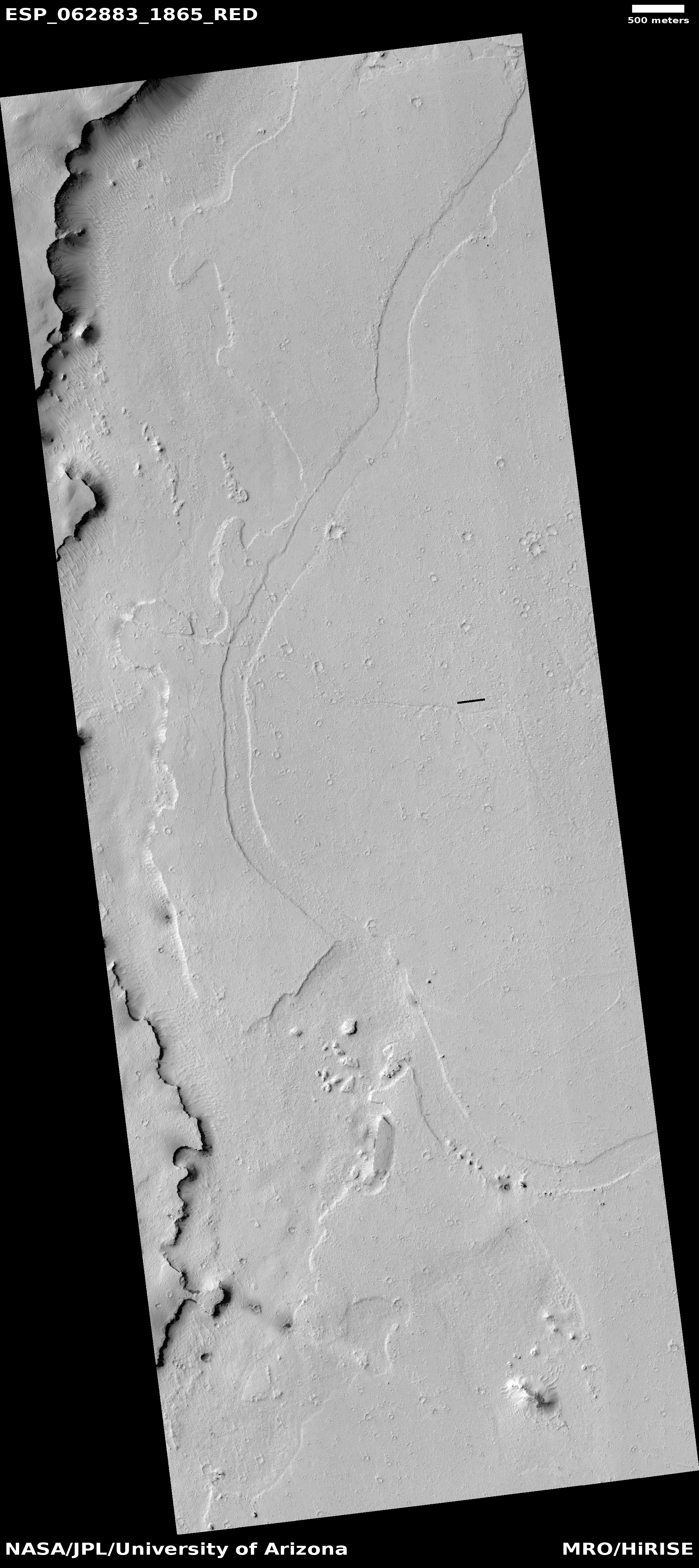
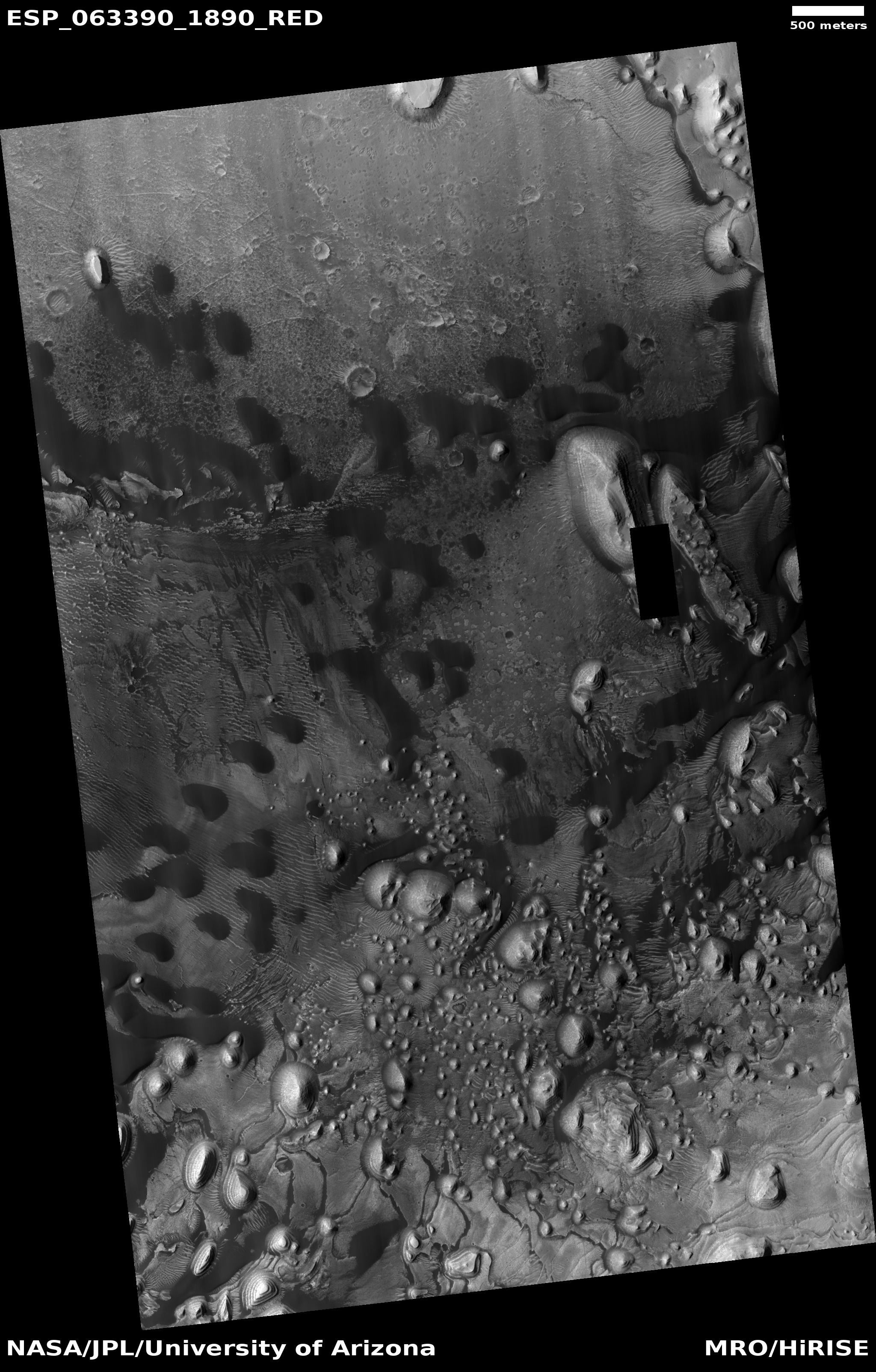
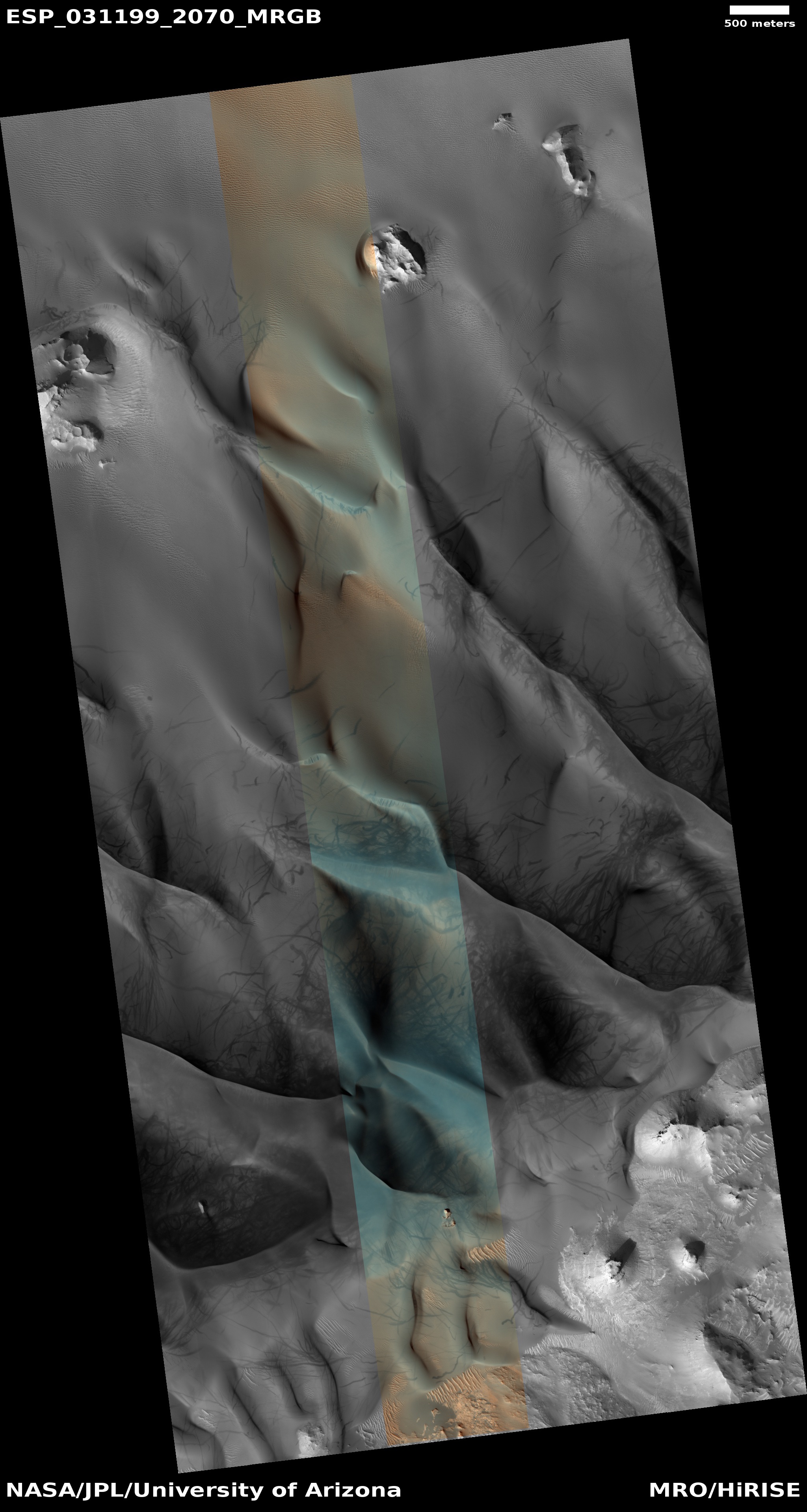
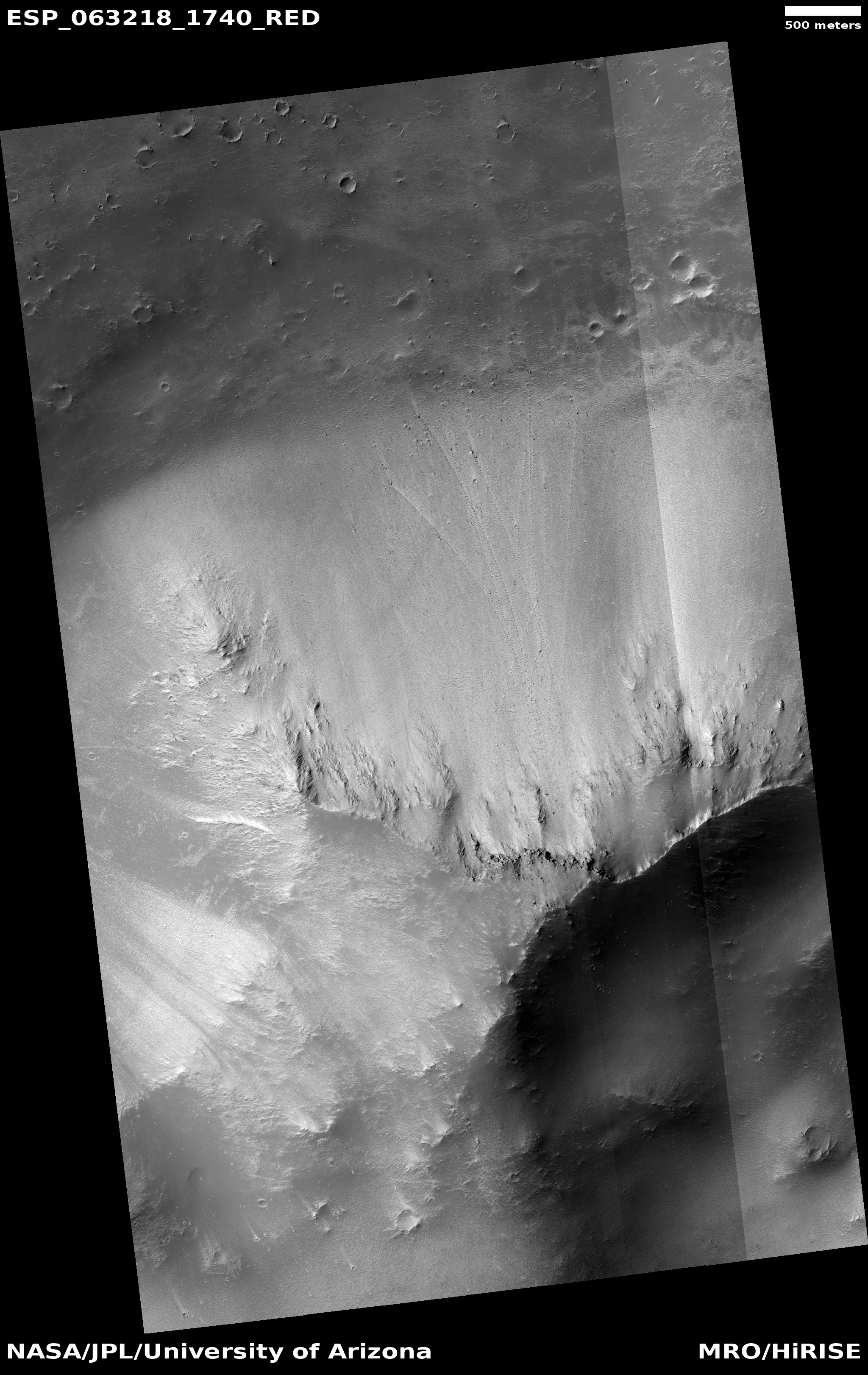
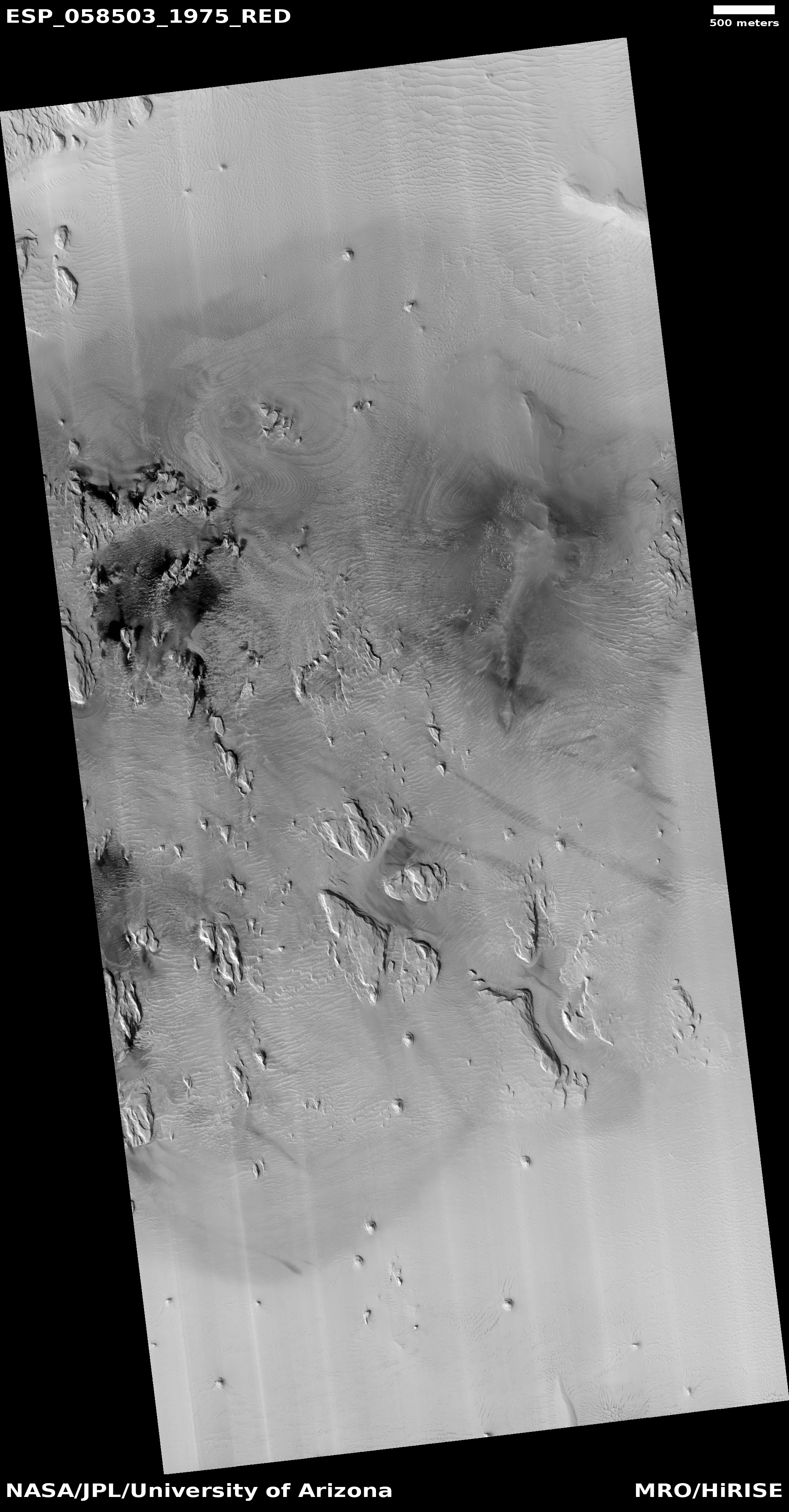
Cool image time! The photo to the right, cropped and reduced to post here, was taken on May 7, 2022 by the high resolution camera on Mars Reconnaissnace Orbiter (MRO). It shows what the scientists have labeled as “Cones in Phlegra.”

Cones such as these are one of the prime geological mysteries of Mars’ northern lowland plains. Scientists do not know yet whether they are either mud or lava volcanoes, or even if they are sedimentary mesas that resisted subsequent erosion. In fact, it was hoped by some American scientists that the Chinese would send its Zhurong rover north towards a nearby cone to find out, but alas, the Chinese decided to head south instead.

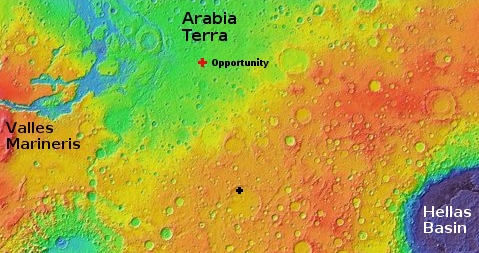
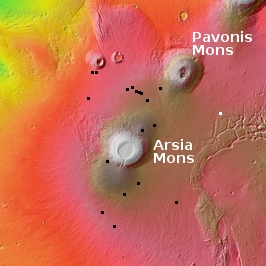
Zhurong however was on the other side of Mars. The overview map below shows us where these cones are located.
» Read more

2 comments

A distant cliff and a rocky path forward

Mosaic of Gediz Vallis
Click for full image.

Close-up of distant cliff face
Click for full image.

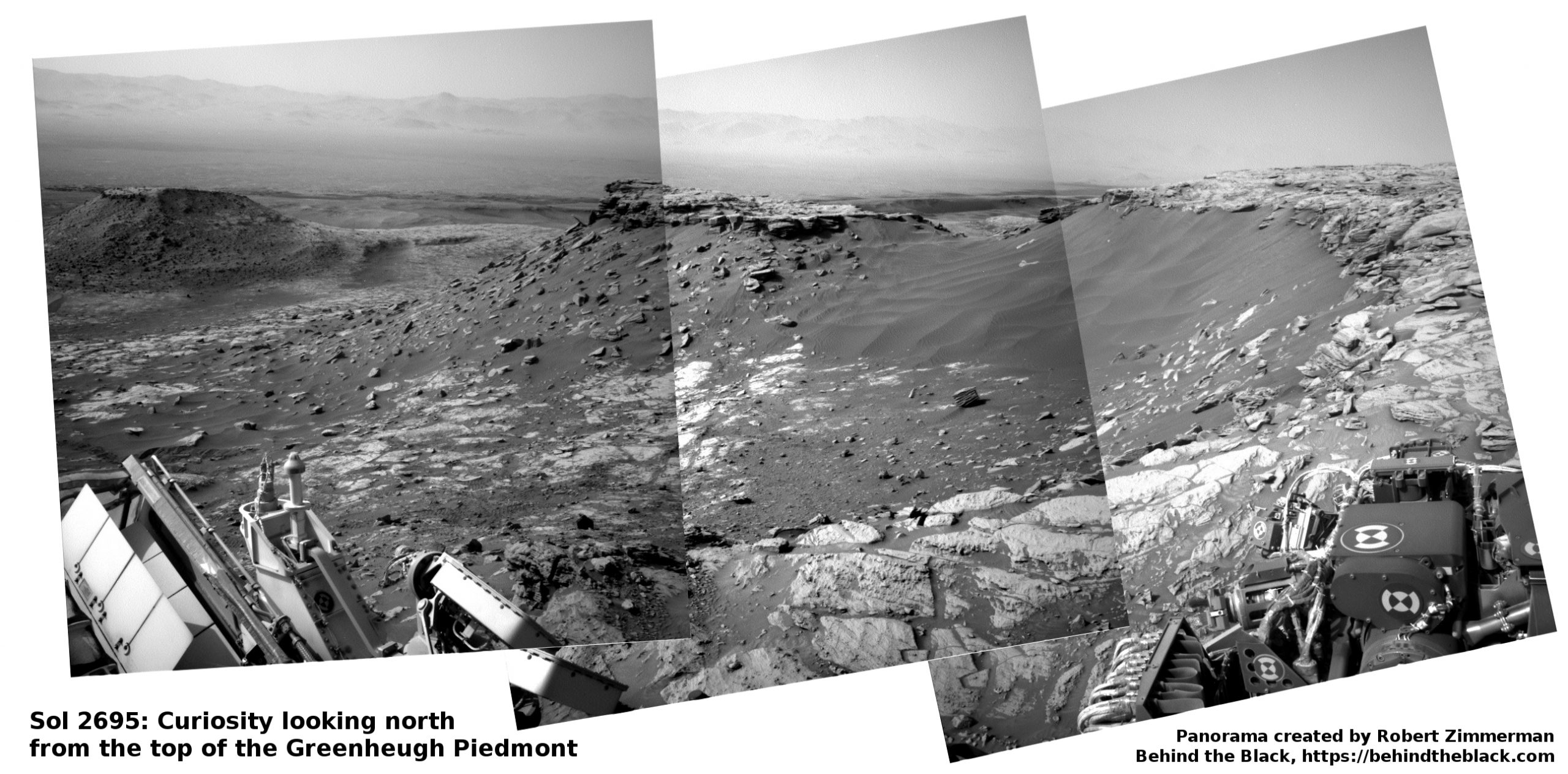
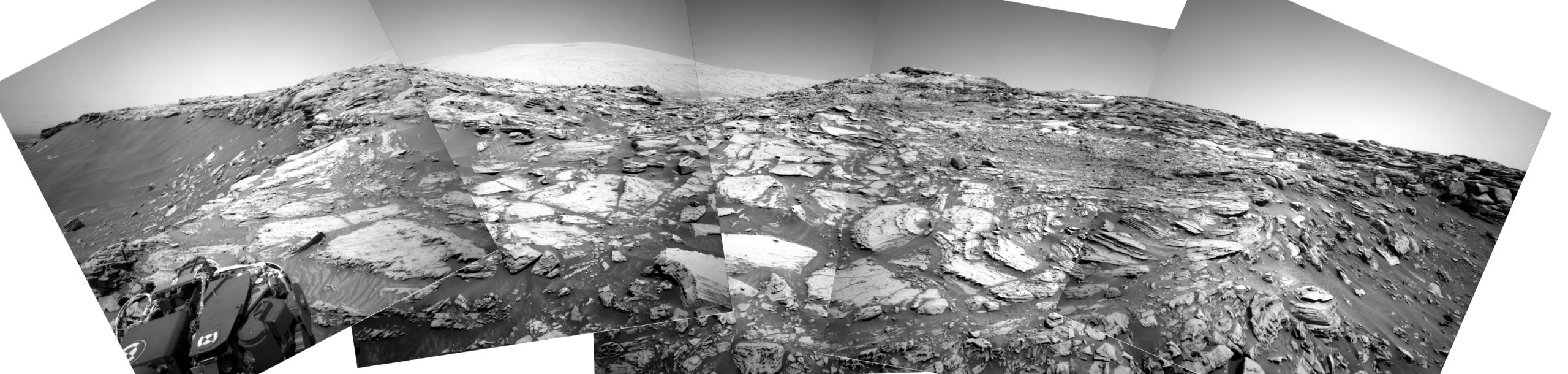
Two cool images arrived today from Curiosity, as it is about to enter the Martian canyon of Gediz Vallis. The mosaic above, cropped, reduced, and annotated to post here, was assembled from photos taken by the rover’s right navigation camera on August 15, 2022. The photo to the right, cropped and reduced to post here, was taken the same day by the rover’s Chemistry camera, normally designed to take very close-up pictures of nearby features. In this case the science team aimed it at a distant cliff face, marked by the arrow in the panorama above, to get a preview of some of the many layers in that mesa.

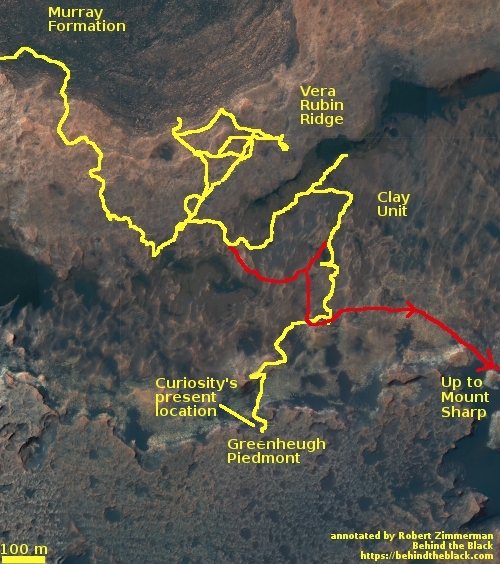
And has become quite expected from Mars, the number and types and variety of layers is astonishing. The layer that forms the flat bright area at the center of this image is what scientists have dubbed “the marker layer”, since they have found it at similar elevations in many places on the flanks of Mount Sharp. (See the annotated overview map from a post last week.)

Curiosity’s planned route is to head to the right of this mesa, circling around it to get into the upper reaches of Gediz Vallis. First however engineers are going to have to figure out how to get the rover past the somewhat large scattered rocks on the ground directly ahead, without further damaging Curiosity’s already tattered wheels. At first glance there does not appear to be any clear path.

1 comment

Curiosity finally looks out into Gediz Vallis

First look into Gediz Vallis
Click to view full mosaic.

Overview map
Click for interactive map.

Cool image time! Curiosity’s right navigation camera today produced the mosaic above, cropped and reduced to post here, taking its first good look into Gediz Vallis, the canyon that the rover has been aiming for since it landed on Mars ten years ago.

The green dot on the overview map to the right marks the approximate location of a recurring slope lineae, a streak that comes and goes depending on the seasons whose cause remains uncertain. The yellow lines show the approximate area covered by the mosaic. The red dotted lines show Curiosity’s upcoming route. According to previously announced plans, the rover will not head straight into Gediz Vallis, but circle to the west or right of the mesa to the right of Kukenan.

The valley of course looks spectacular. For scale, the cliff face of Kukenan is estimated to be about 1,500 feet high.

The most important revelation from this image however is the ground terrain. It looks like Curiosity will have no problem moving forward into the canyon from this point, something the science team could not know for sure until the rover reached the saddle and could look down and actually see ahead.

0 comments

InSight seismometer data suggests no underground ice at landing site

Using a computer model combined with seismometer data gathered by the Mars lander InSight, scientists have concluded that there is little or no underground ice in the equatorial region where InSight sits.

From the paper’s abstract:

We use rock physics models to infer cement properties from seismic velocities. Model results confirm that the upper 300 m of Mars beneath InSight is most likely composed of sediments and fractured basalts. Grains within sediment layers are unlikely to be cemented by ice or other mineral cements. Hence, any existing cements are nodular or formed away from grain contacts. Fractures within the basalt layers could be filled with gas, 2% mineral cement and 98% gas, and no more than 20% ice. Thus, no ice- or liquid water-saturated layers likely exist within the upper 300 m beneath InSight. Any past cement at grain contacts has likely been broken by impacts or marsquakes.

As the lander sits just north of the equator in the red planet’s equatorial zone, which ample orbital data has suggested is a dry region (as shown in the global map below), this result is not a surprise. It does provide further confirmation however of this conclusion, that if there is any water on Mars within 30 degrees latitude of the equator, it will be deep underground, and likely only in certain regions.
» Read more

1 comment

A typical Martian rock on Mount Sharp

Panorama of pass
Click for full 360 degree panorama.

Typical Martian rock
Click for full image.

Cool image time! The photo to right, taken by the Mars rover Curiosity on August 9, 2022, provides a nice close-up of what might be a somewhat typical rock on the flanks of Mount Sharp in Gale Crater, many layered with some of those layers extending outward to the side for somewhat ridiculous distances as thin flakes.

The scientists call it a float rock, because they think it actually fell from the cliff dubbed Bolivar in the panorama above. Thus, it gives geologists data on the layers higher up that are not easily accessible from Curiosity’s present position.

The panorama is a mosaic created from images taken by the rover’s right navigation camera on August 8, 2022. The white arrow marks the rock. The green dot marks the approximate location on the cliff face of a previously observed recurring slope lineae, streaks that appear to come and go seasonally whose origin is still not understood.

The red dots mark my guess as to the route engineers will pick for Curiosity as it weaves its way around the other float rocks ahead.
» Read more

10 comments

Fractures in the Martian northern lowland plains

Fractures in the northern lowland plains
Click for full image.

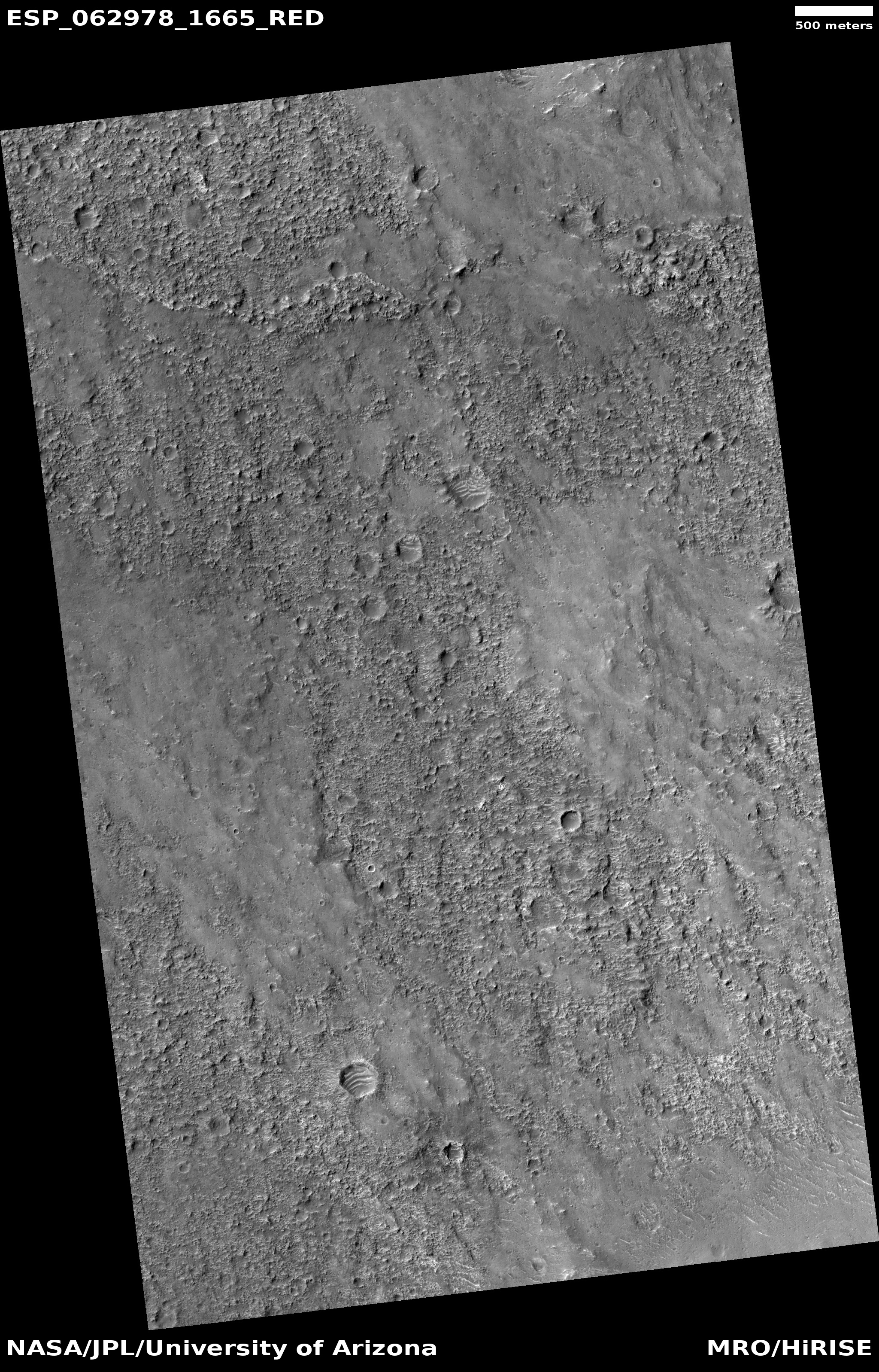
Cool image time! The photo to the right, rotated, cropped, and reduced to post here, was taken on April 21, 2022 by the high resolution camera on Mars Reconnaissance Orbiter (MRO) of a spot in the Martian northern lowland plains.

Generally the surface of these lowland plains — especially at high latitudes above 30 degrees — tends to appear very water saturated, producing blobby features and what look like mud volcanoes. This picture however features something different, what the scientists have labeled fractures, geological features that appeared caused by dry conditions and sudden quake-like events. The break in the fracture near the top of the photo illustrates why water flow had little if anything to do with its formation. Other fractures in the full image show the same thing. Also the stippled surface along the picture’s right edge also suggest there is little near surface water or ice at this location.

The location, as shown by the overview map below, suggests that water might still have played a part, but only a long time ago.
» Read more

1 comment

Further damage to Curiosity’s wheels

Curiosity wheel comparison of damage
For the original images, click here for the top photo and here and here
for the bottom photo.

The photo comparison to the right, created from high resolution images taken by Curiosity on Mars two months apart, provides us a new update on the state of the rover’s damaged wheels. It shows damage on the same wheel that I have been tracking for several years.

The numbers indicate the same treads, or grousers as termed by the science team. The “+” sign indicates spots where new damage has occurred since the previous photo.

The top photo was taken on June 3, 2022, and was the first to show new damage in more than five years. The bottom photo was taken on August 6, 2022, and shows that another small piece on the same grouser has broken off during the past two months.

Other than this change, however, the rest of the grousers appear unchanged. Moreover, a comparison with an earlier image of this same wheel taken in the summer of 2021 shows that grouser #6 as well as the unnumbered one just below appear also unchanged.

The damage in grouser #5 however is still concerning, and reflects the increasing roughness of the terrain as Curiosity climbs higher and higher on Mount Sharp. Though the science team has been very careful since the rover’s first few years on Mars to travel around obstacles that could damage the wheels, it apparently is becoming harder to do so.

However, even if this wheel eventually loses all the metal between the zig-zag grouser treads, the science team has said it has “proven through ground testing that we can safely drive on the wheel rims if necessary.” The team as also said they do not think that is likely, at least not for a long time, and based on the rate of damage documented by these pictures, this appears very true.

12 comments

Strange terrain southwest of Jezero Crater

Strange terrain near Jezero Crater

Cool image time! The photo to the right, cropped and reduced to post here, was taken on June 16, 2022 by the high resolution camera on Mars Reconnaissance Orbiter (MRO). It shows what the scientists have merely label “landforms.”

I instead call them strange. Clearly we are seeing exposed layering that surrounds the mesa in the middle of the image. This in turn suggests that the mesa top was once the surface of this whole region, and that region had been formed by the repeated placement of multiple sedimentary layers. Then, over time the surrounding terrain was eroded away, exposing those underlying layers.

Even so, some of the parallel lines do not appear to be layers, but striations etched into the ground. To get a better look, the white box marks the area covered by a full resolution close-up below.
» Read more

1 comment

Curiosity celebrates ten years on Mars

Curiosity's location in Gale Crater

Sometime today the rover Curiosity will celebrate its tenth anniversary on Mars. The oblique graphic of Gale Crater above, first released by the science team shortly before landing in 2012, has been further annotated with a red line to show the rover’s journey since then. As noted by Scott VanBommel, Planetary Scientist at Washington University, today on the science team’s blog:

As we the science and engineering teams have aged this last decade, so has Curiosity. The toll of ten years and nearly 28.5 km [17.7 miles] of Mars driving shows with every MAHLI wheel imaging activity, with less energy available for a plan, and with aging mechanisms. This is the life of a Mars rover. Spirit and Opportunity were no different, yet they persisted and paved the way scientifically and technologically for the rovers of today. Curiosity has made numerous scientific discoveries during these ten years, emphasized by the over 500 science team publications, with many more ahead as we continue our ascent and exploration of Gale crater and Mount Sharp.

I look forward to the next ten years.

Despite that aging, Curiosity’s general condition appears quite excellent, with its wheels the greatest concern but generally holding up. Based on the last ten years, the rover is likely to remain operational for at least ten more years, if not longer.

In the more immediate future, the rover is only days away from getting its first good look down into Gediz Valles, that canyon on the graphic above that it has been traveling towards since day one.

A good review of five of Curiosity’s biggest discoveries using its sample analysis instrument can be found here.

3 comments

Glacial flows pushing out through a Martian crater rim

Wider view of 6-mile-wide crater
Click for full image.

Today’s cool image once again illustrates how Mars is far from a waterless planet. Instead, there is strong evidence that water ice can be found across most of the Red Planet’s surface, excluding the equatorial regions lower than 30 degrees latitude.

The photo to the right was taken on September 11, 2021 by the wide view context camera on Mars Reconnaissance Orbiter (MRO). It shows a 6-mile-wide unnamed crater on Mars, located at 35 degrees south latitude, with what appears to be a glacier in its interior, flowing to the southwest towards several breaches in the crater’s southwest rim. Several of those breaches now sit higher than the flow, suggesting that the glacier itself was once higher and flowed out of those gaps. Now the level has dropped, and the only place the glacier exits the crater is the central gap at the center of the white rectangle.

That white rectangle marks the area covered by a recent MRO high resolution image, taken on March 29, 2022 and cropped and reduced to post below.
» Read more

1 comment

The scattered debris from Perseverance’s landing, now being tracked by the rover

Perseverance's parachute, as photographed by Ingenuity
Click for full image.

A piece of string on Mars
Click for full image.

The Perseverance science team today posted a detailed update on the various pieces of debris that both the rover and the Ingenuity helicopter have been tracking since both landed on Mars in February 2021.

Some of the EDL [entry, descent, landing] hardware broke into smaller pieces when it impacted the surface. These pieces of EDL debris have been spotted in images of the Hogwallow Flats region, a location roughly 2 km to the northwest of the EDL hardware crash zones. As of Sol 508 (July 24, 2022), the operations team has catalogued roughly half a dozen pieces of suspected EDL debris in this area. Some of these EDL debris are actively blowing around in the wind. So far, weโ€™ve seen shiny pieces of thermal blanket material, Dacron netting material that is also used in thermal blankets, and a stringlike material that we conclude to be a likely piece of shredded Dacron netting.

To the right are two of the most interesting examples. The top image shows the parachute and associated equipment from the landing, taken by Ingenuity during a flight in April 2022. That image, when compared with an earlier picture taken from orbit, showed that the wind of Mars, though incredibly weak, had been able to shift the parachutes edges.

The second image shows the string that the rover photographed on July 12, 2022, and had blown away four days later when Perseverance re-photographed this site.

Today’s update notes that the area in the crater they have dubbed Hogwallow Flats “appears to be a natural collecting point for windblown EDL debris.” The flats are an area at the foot of the delta that flowed into Jezero Crater in the past, and is an area where Perseverance has been traveling most recently.

That the wind has been able to move small pieces so effectively is I think somewhat of a surprise. That it is gathering the material against the crater’s western cliffs suggests the prevailing winds here blow to the west.

3 comments

Curiosity heads into the pass

Mosaic by Curiosity
Click for full mosaic.

Overview map
Click for interactive map.

Cool image time! The mosaic above, cropped, reduced, and annotated to post here, was created from 31 navigation images taken by the Mars rover Curiosity, and shows the rover’s upcoming drive. From the science team’s July 29, 2022 update:

We are attempting to reach a high point, just at the top right edge of the image, so we can look down into the valley to see if there is a way out on the other side and to help plan our path forward. High tilts, sand, and large and small rocks clutter the terrain, requiring the Rover Planners to pick their way around while making sure they stay clear of the hazards.

After the drive, we took a lot of imaging from our new location, including a 360 degree Mastcam mosaic and an upper tier of imaging to catch the tall relief of the valley walls.

The green dot in the image above as well as the overview map to the right indicates the approximate location on the cliff face of a previously observed recurring slope lineae, streaks that appear to come and go seasonally whose origin is still not understood.

The blue dot on the map marks the rover’s position on August 1, 2022. The yellow lines indicate the approximate area covered by the mosaic above. The large red dots on the overview indicate the rover’s original planned route, with the smaller red dots indicating the hoped-for route to get back to that path.

In the far distance the upper slopes of Mount Sharp can faintly be seen through the winter dust haze. That mountain is about 18,000 feet high, though its actual peak is not yet visible. Curiosity is still about 16,000 feet below that peak. Kukenan is about 1,500 feet high. The cliff with the slope lineae is probably about 400-500 feet high The two side hills that delineate the pass ahead are probably no more than 200 feet high.

1 comment
1 69 70 71 72 73 157